
What Is Forex? Forex Basics for Beginners
Forex, short for foreign exchange and also called FX, is the market in which currencies are exchanged and priced against one another. In forex trading, those relative values are quoted as currency pairs such as EUR/USD or GBP/USD.
Every currency pair compares two currencies. If EUR/USD changes, the move reflects a change in the euro's value relative to the U.S. dollar—not the value of either currency in isolation.
Forex, FX, and Foreign Exchange: What the Terms Mean
Forex, FX, and foreign exchange refer to the same broad subject, but the activity can serve different purposes. Currency conversion may be used for travel, international payments, business operations, investment, hedging, or speculation.
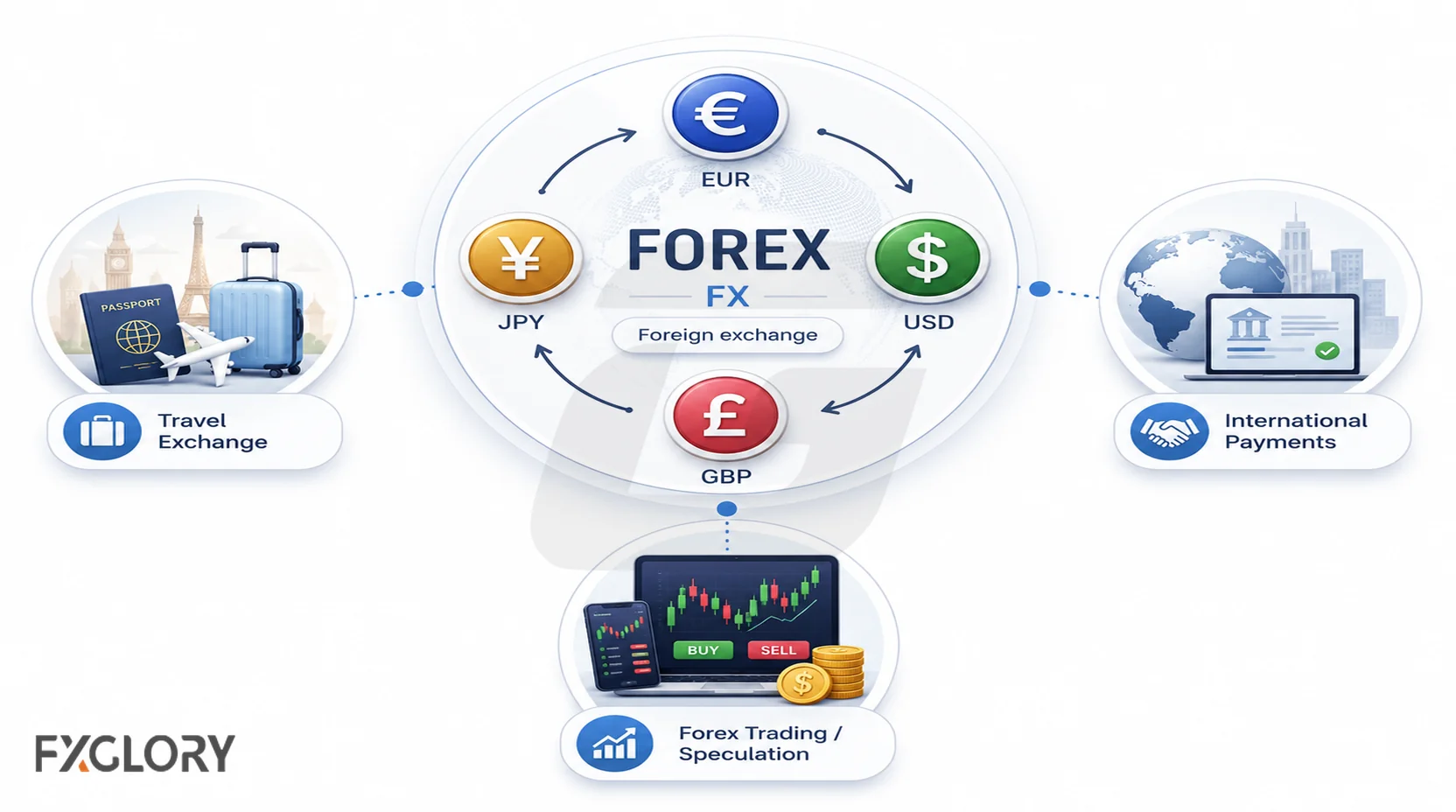
- Forex / FX: Common abbreviations for foreign exchange.
- Foreign exchange: The broader process of converting or exchanging one currency for another.
- Forex market: The global market in which currencies are priced and exchanged.
- Forex trading: Taking a position on a currency pair because the trader expects its exchange rate to move.
Exchanging cash before a trip, converting overseas business revenue, and trading EUR/USD all involve foreign exchange, but their purposes differ. Travel exchange is practical, business exchange may be operational or used to manage currency exposure, and retail forex trading is generally speculative.
Forex In One Simple Example
Imagine EUR/USD is trading at 1.1000. This means 1 euro is worth 1.1000 U.S. dollars. If EUR/USD rises to 1.1100, the euro has strengthened against the dollar. If EUR/USD falls to 1.0900, the euro has weakened against the dollar.
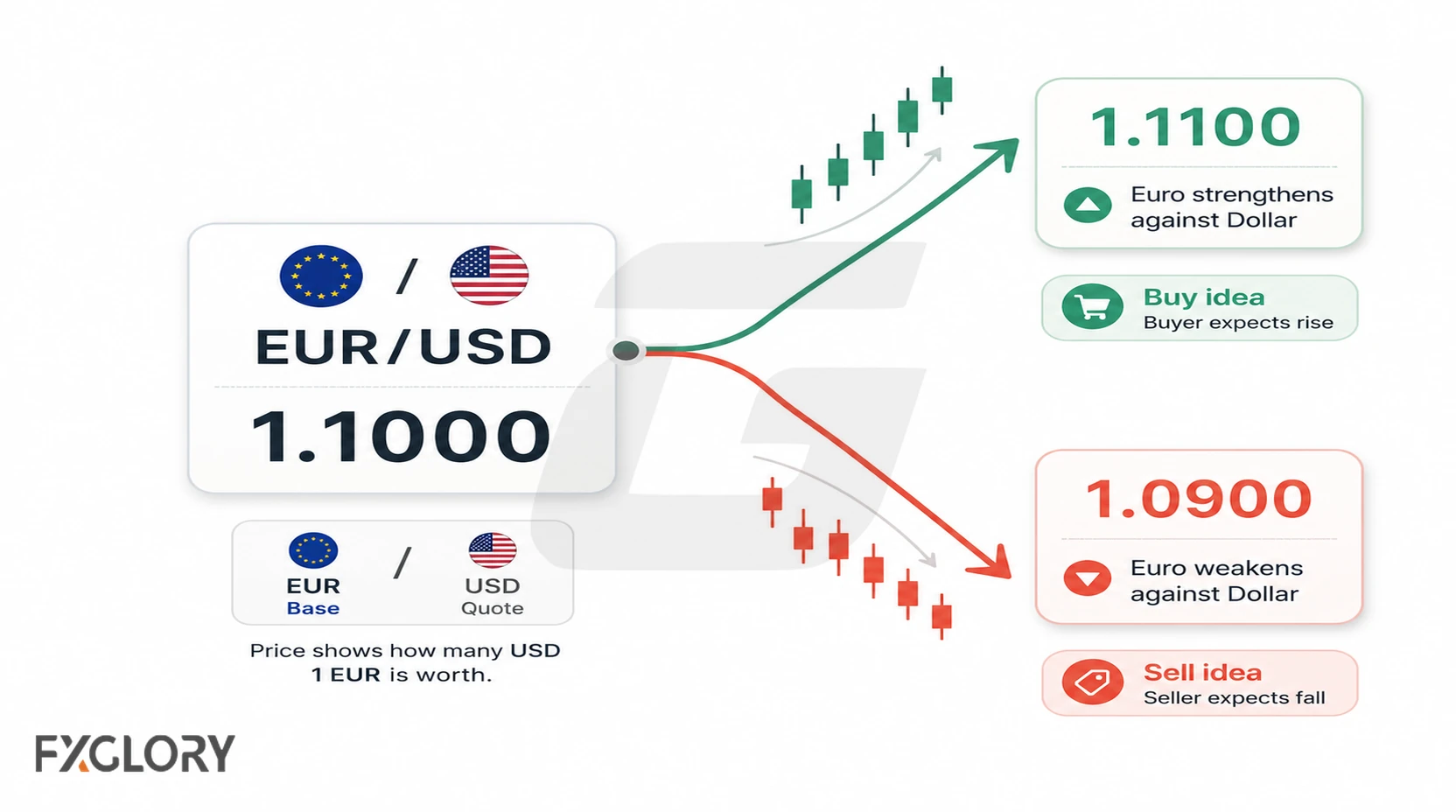
A trader who buys EUR/USD expects the euro to rise against the dollar. A trader who sells EUR/USD expects the euro to fall against the dollar. The result depends on how the exchange rate moves after the trade is opened.
- Buy EUR/USD: Expect EUR to strengthen against USD.
- Sell EUR/USD: Expect EUR to weaken against USD.
- Price rises: The base currency is strengthening against the quote currency.
- Price falls: The base currency is weakening against the quote currency.
Forex Basics At A Glance
This quick table summarizes the main forex basics beginners should understand before moving deeper into charts, platforms, or trading strategies.
| Concept | Beginner Meaning | Why It Matters |
|---|---|---|
| Forex | The exchange of one currency for another. | It is the foundation of every currency transaction and forex trade. |
| FX | A common abbreviation for foreign exchange. | You will see forex and FX used in the same market context. |
| Currency pair | Two currencies compared against each other, such as EUR/USD. | Every forex trade is based on one currency rising or falling against another. |
| Base currency | The first currency in a pair. | It is the currency being bought or sold when you trade the pair. |
| Quote currency | The second currency in a pair. | It shows what the base currency is being measured against. |
| Exchange rate | The price relationship between two currencies. | It tells you how much of the quote currency equals one unit of the base currency. |
| Pip | A small unit of forex price movement. | Pips help measure price changes, spread, profit, loss, and trade risk. |
| Spread | The difference between the buy price and sell price. | It is a trading cost that affects entries and exits. |
| Lot size | The size of the forex position. | It controls how much each price movement can affect the account. |
| Leverage | Using margin to control a larger position. | It can increase both potential gains and potential losses. |
| Margin | Funds required to open or maintain a leveraged position. | It affects position capacity, risk, and account pressure. |
| Risk management | Rules for limiting possible loss before and during a trade. | It helps beginners avoid letting one trade damage the account severely. |
What Is The Forex Market?
The forex market is the global marketplace where currencies are exchanged. It is used by banks, businesses, governments, funds, investors, travelers, and retail traders. Unlike a single stock exchange, forex does not depend on one central physical location where every trade happens.
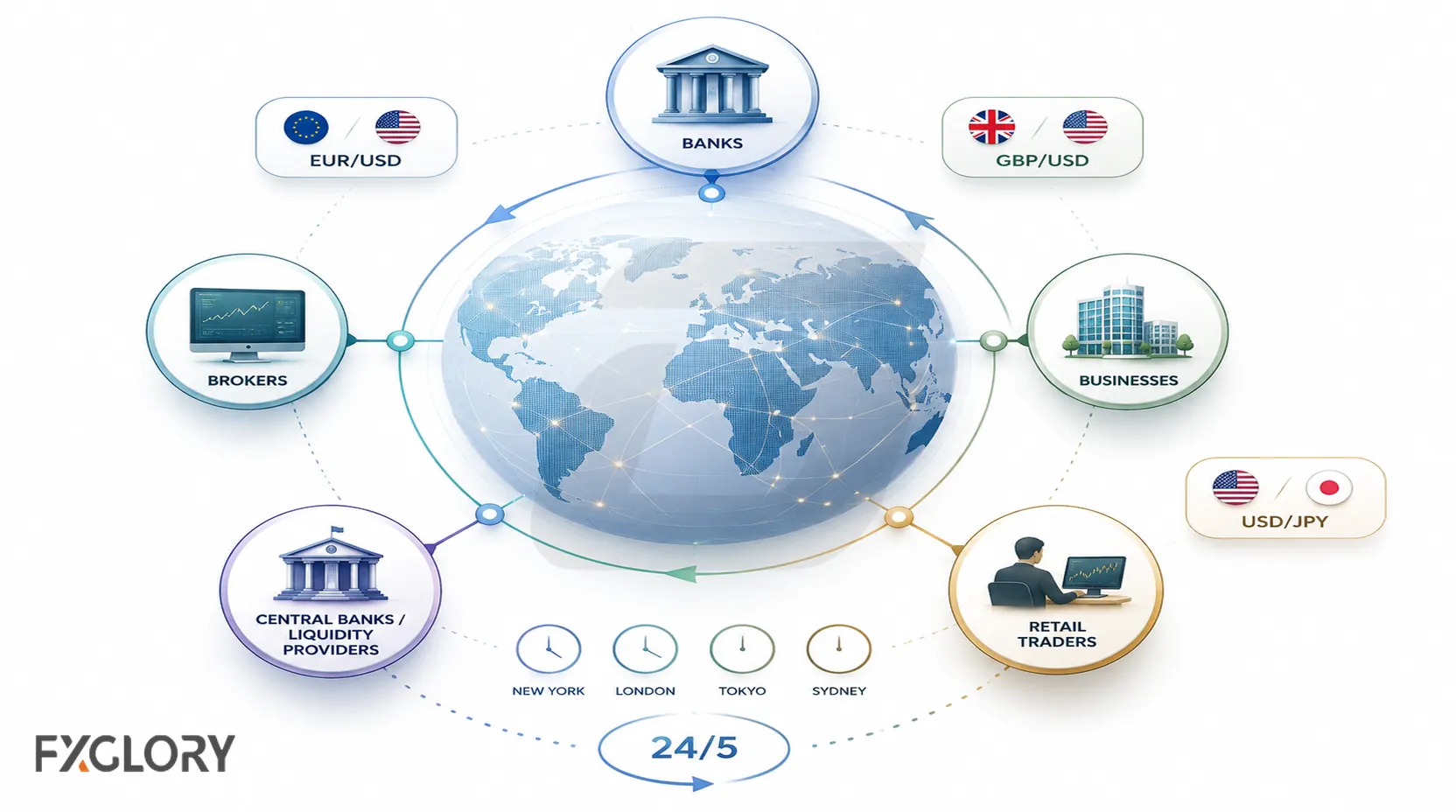
Instead, forex operates through a global network of institutions, brokers, dealers, liquidity providers, and trading platforms. This is why the market is often described as decentralized or over-the-counter. Prices are formed by supply, demand, liquidity, and market expectations across many participants.
Currency prices can move for many reasons. Interest-rate expectations, inflation data, employment reports, central-bank decisions, political risk, commodity prices, liquidity conditions, international trade flows, and global risk sentiment can all influence exchange rates.
How Does Forex Trading Work?
Forex trading works through currency pairs. A trader chooses a pair, reads the quoted price, decides whether they expect the exchange rate to rise or fall, selects a position size, and places an order through a trading platform.
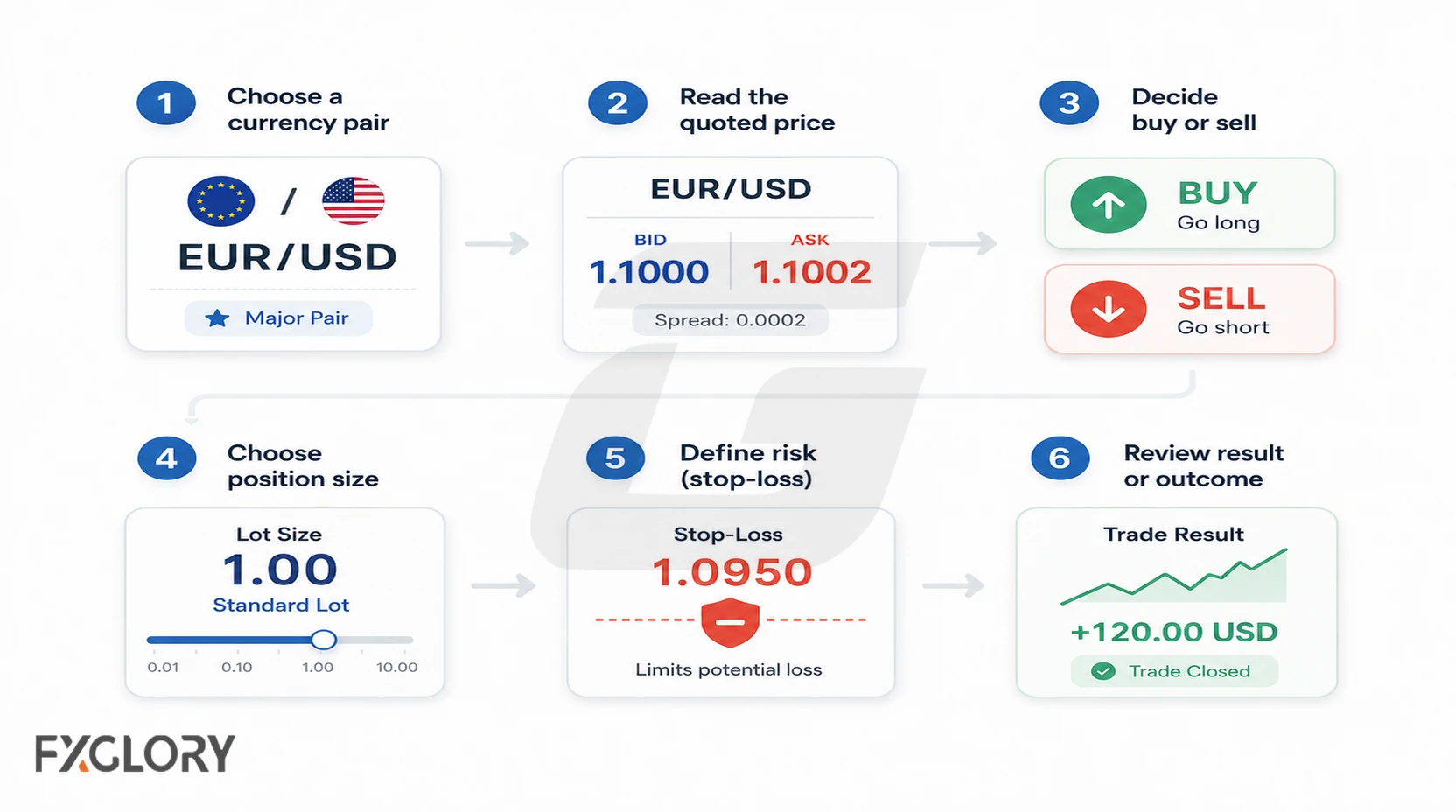
If the trader buys a pair, they are buying the first currency and selling the second. If the trader sells a pair, they are selling the first currency and buying the second. Profit or loss depends on price movement, trade size, spread, and execution conditions.
- Select a currency pair: For example, EUR/USD, GBP/USD, USD/JPY, or AUD/USD.
- Read the quoted price: The price shows how much of the quote currency is needed for one unit of the base currency. The forex quotes guide explains base currency, quote currency, bid, ask, and spread in more detail.
- Choose a direction: Buy if expecting the pair to rise, or sell if expecting the pair to fall.
- Choose a lot size: Trade size controls how much each pip movement affects the account. Learn more in what is a lot size in forex.
- Define risk: Know where the trade idea is wrong before entering.
- Review the result: Review whether the trade followed a plan, not only whether it won or lost.
How Currency Pairs Work
A forex pair has two parts: the base currency and the quote currency. The base currency appears first. The quote currency appears second. The exchange rate tells you how much of the quote currency is needed to buy one unit of the base currency.
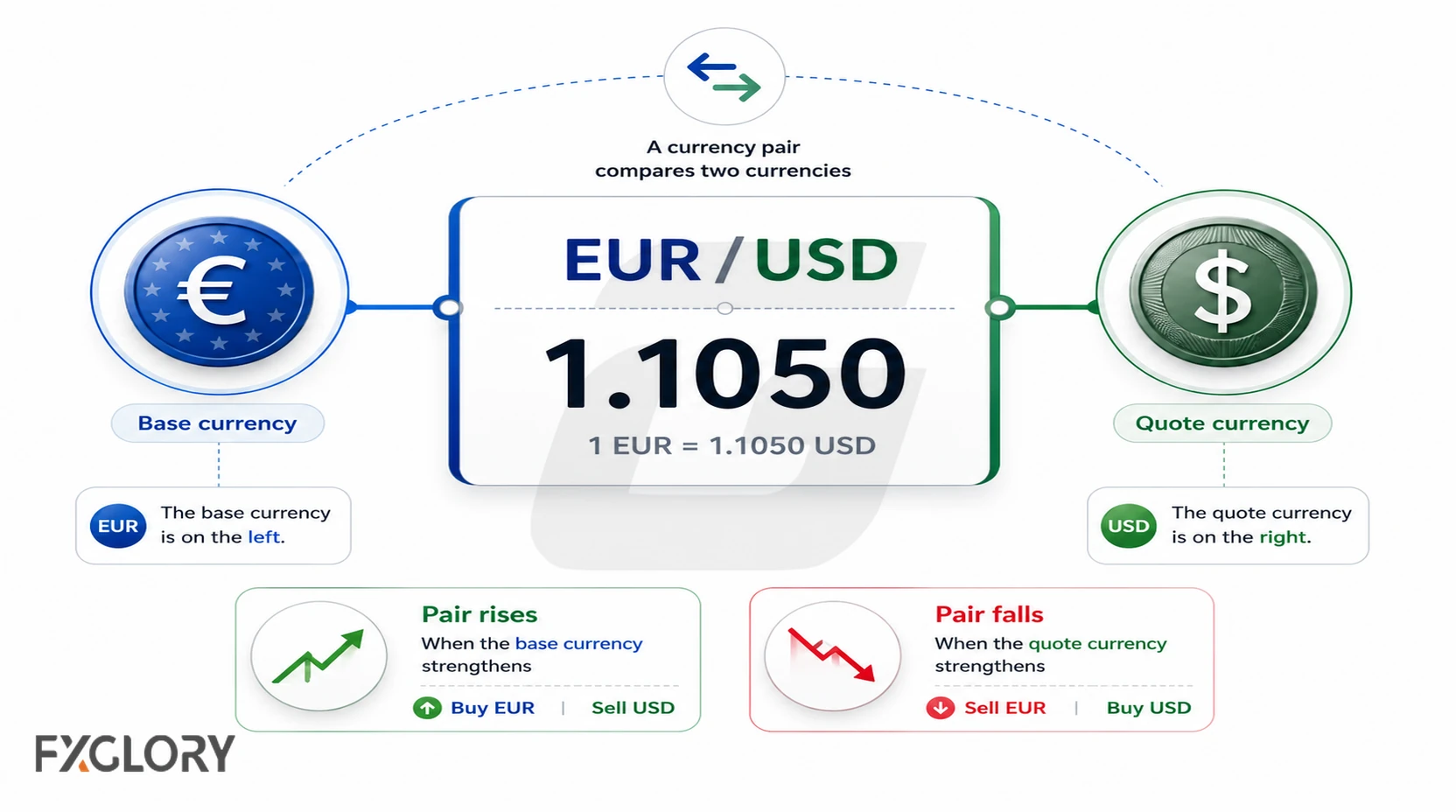
In EUR/USD, EUR is the base currency and USD is the quote currency. If EUR/USD is 1.1000, it means 1 euro equals 1.1000 U.S. dollars. If the pair rises, the euro is strengthening relative to the dollar. If the pair falls, the euro is weakening relative to the dollar.
- Base currency: The first currency in the pair.
- Quote currency: The second currency in the pair.
- Exchange rate: The price relationship between the two currencies.
- Buy position: A view that the base currency may strengthen against the quote currency.
- Sell position: A view that the base currency may weaken against the quote currency.
A currency pair always expresses a comparison. EUR/USD is not only about the euro and not only about the dollar. It is about the relationship between both currencies.
What Do You Trade In Forex?
In forex, traders trade exchange-rate movements between currency pairs. They do not usually take physical delivery of banknotes. Instead, they use a trading account to take a position on whether one currency may rise or fall against another.
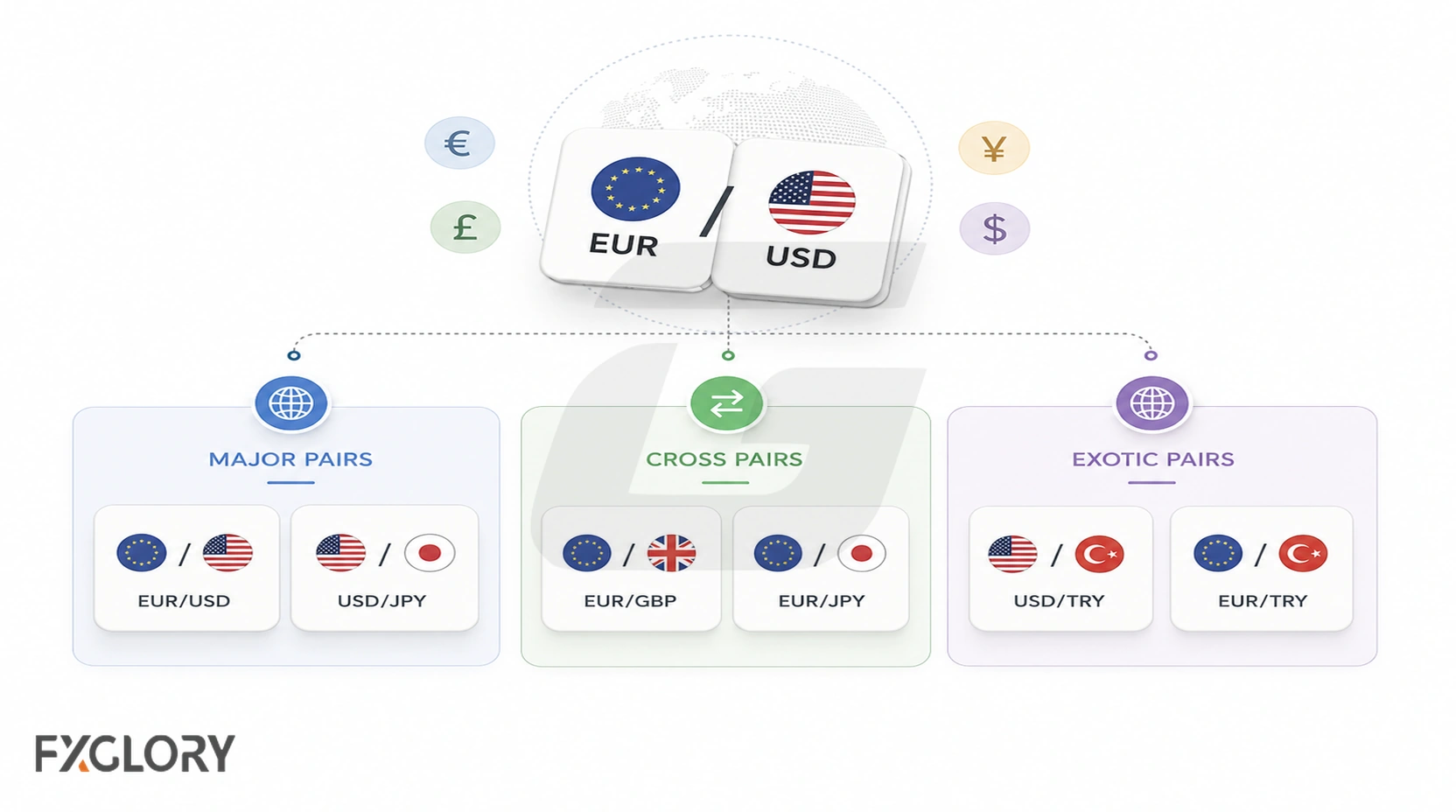
Currency pairs are often grouped into broad categories. The exact labels may vary by broker or platform, but beginners will often see major pairs, minor pairs, and exotic pairs.
- Major pairs: Heavily traded pairs that include the U.S. dollar, such as EUR/USD, GBP/USD, USD/JPY, and USD/CHF.
- Minor pairs: Pairs that do not include the U.S. dollar but involve widely traded currencies, such as EUR/GBP or EUR/JPY.
- Exotic pairs: Pairs that combine a major currency with a less commonly traded currency. These may have wider spreads and different liquidity conditions.
A beginner does not need to memorize every currency pair. It is more useful to understand how pairs work, how quotes are read, what the spread costs, and how position size affects risk.
Who Trades In The Forex Market?
The forex market includes many types of participants. Not everyone is trading for the same reason. Some participants exchange currencies for business needs, some manage exposure, and some speculate on price movement.
- Banks and financial institutions: Provide liquidity, quote prices, and handle large currency flows.
- Businesses: Exchange currencies for imports, exports, payroll, overseas expenses, and international operations.
- Governments and central banks: Manage reserves, policy operations, and financial stability objectives.
- Funds and investors: Use currencies for hedging, diversification, or macroeconomic views.
- Retail traders: Trade through brokers or platforms, usually with smaller account sizes than institutions.
- Travelers and individuals: Exchange money for practical needs such as travel, transfers, or overseas payments.
Because these participants have different goals, the market can move for many reasons at once. A beginner should not assume every price movement is caused by retail traders. To explore the structure more deeply, read who moves currency prices in the forex market.
Why Do People Trade Forex?
People trade or exchange forex for different reasons. A company may need to convert revenue from one currency into another. An investor may want to reduce currency exposure. A trader may try to profit from exchange-rate movement.
- Speculation: Taking a position because the trader expects a currency pair to rise or fall.
- Hedging: Reducing the impact of unwanted currency movement.
- International business: Converting money for imports, exports, invoices, or overseas costs.
- Portfolio exposure: Managing how currency changes affect investments.
- Travel and transfers: Exchanging money for practical cross-border needs.
Some beginners are attracted to forex because the market is active and accessible. Those features can create frequent price movement, but they do not reduce trading risk. Position size, leverage, volatility, spreads, and news events can all turn a small market move into a meaningful gain or loss.
Basic Forex Terms Beginners Should Know
Before learning strategies, beginners should understand the common terms used on forex platforms and education pages. These words affect how a trade is priced, opened, managed, and reviewed.
- Currency pair: Two currencies quoted together, such as EUR/USD.
- Exchange rate: The price relationship between two currencies.
- Base currency: The first currency in a forex pair.
- Quote currency: The second currency in a forex pair.
- Pip: A small unit of price movement in a currency pair. Start with what a pip means in forex.
- Spread: The difference between the buy price and sell price offered by the broker or platform.
- Bid price: The price at which a trader can sell. See bid and ask price in forex for a focused explanation.
- Ask price: The price at which a trader can buy.
- Lot size: The trade size or contract size used for the position.
- Leverage: The ability to control a larger position with a smaller amount of margin. Review how leverage works in forex before using it.
- Margin: The amount of funds required to open or maintain a leveraged position.
- Stop-loss order: An order type used to exit if price moves against the trade to a defined level.
- Take-profit order: An order type used to exit if price reaches a planned target.
- Volatility: The size and speed of price movement.
- Liquidity: How easily buying and selling can happen without large price disruption.
These terms are not just vocabulary. They affect risk. A small price move can have a very different impact depending on the pair, lot size, leverage, account currency, and trade direction. The forex trading glossary provides a broader reference for these terms.
A Beginner Learning Path For Forex Basics
A beginner does not need to learn everything at once. A better approach is to learn forex basics in layers. Each layer makes the next one easier to understand.
- Start with meaning: Understand forex, FX, foreign exchange, currency pairs, and exchange rates.
- Learn how quotes work: Understand base currency, quote currency, bid price, ask price, and spread.
- Learn price movement: Understand pips, pipettes, and how price changes are measured.
- Learn trade size: Understand lot size, micro lots, mini lots, and how size affects profit and loss.
- Learn leverage and margin: Understand how leverage magnifies both gains and losses.
- Learn order types: Understand market orders, pending orders, stop-loss orders, and take-profit orders.
- Practice without live risk: Use demo practice to connect definitions to platform behavior before using real capital.
- Build a trading plan: Define setup rules, risk rules, invalidation, and review habits. Use a forex trading plan template when you are ready to organize your rules.
What Should Beginners Know Before Trading Forex?
Beginners should understand forex basics before focusing on entries, indicators, or strategies. A new trader needs to know what is being traded, how prices are quoted, what can cause losses, and how much risk is involved in each decision.
- Forex is pair-based: Every trade compares one currency against another.
- Leverage increases risk: It can magnify both gains and losses.
- Spreads and execution matter: The entry price, exit price, spread, and trading conditions affect results.
- News can change conditions: Economic releases and central-bank events can move currencies quickly.
- A chart signal is not a full plan: A plan needs context, trigger, invalidation, risk, and review.
- Demo results are not guaranteed live results: Demo trading can help learning, but live trading involves emotions, execution differences, and real capital risk.
- Risk should be defined before entry: A beginner should know the possible loss before opening a position.
After the basics are clear, beginners can connect these concepts to the practical process of choosing a pair, placing an order, and managing a position in how to trade forex step by step.
Common Misunderstandings About Forex
Many beginner mistakes come from misunderstanding what forex is and what it is not. Clearing up these ideas early can prevent unrealistic expectations.
- Misunderstanding 1: Forex is not simply about deciding whether one currency is strong or weak. Every pair reflects the relative value of two currencies, so both sides of the pair matter.
- Misunderstanding 2: A low account balance does not make high leverage safe. Risk depends on position size, volatility, margin, and execution.
- Misunderstanding 3: A popular pair is not automatically easy to trade. Liquid pairs can still move quickly during news or abnormal conditions.
- Misunderstanding 4: Learning definitions is not the same as being ready to trade. A beginner still needs rules, risk limits, and review habits.
- Misunderstanding 5: No single indicator explains the whole forex market. Price can be affected by technical, economic, and liquidity conditions together.
- Misunderstanding 6: A winning trade is not always a good decision. A trade can make money by luck while still breaking risk rules.
- Misunderstanding 7: Forex trading is not guaranteed income. Losses are possible, and many beginners underestimate the effect of leverage.
The goal of forex basics is not to make trading look easy. The goal is to make the market understandable enough that a beginner can continue learning with fewer assumptions and better risk awareness.
Quick Recap: Forex Basics In Order
Start with currency pairs and exchange rates, then learn how quotes, pips, spreads, and lot size affect a position. After that, understand leverage, margin, order types, volatility, liquidity, and the rules you will use to limit risk.
These concepts connect directly to position sizing and potential loss. Knowing the vocabulary is useful, but applying it consistently is what turns basic market knowledge into a workable trading process.