

Quick Answer: 1:1 Forex Trading
A 1:1 setting changes the relationship between equity and exposure; it does not change the fact that the position can gain or lose value as the currency pair moves.
FXGlory currently lists leverage from 1:1 to 1:3000 in its Trading Account Conditions. The leverage available to an account is also subject to balance, equity, product, and other rules described in the FXGlory Leverage Conditions.
For the basic mechanics behind leverage and margin, see what is leverage in forex trading.
What 1:1 Forex Exposure Means
At 1:1 effective leverage, total open notional exposure is approximately equal to the account equity supporting it. A $10,000 account carrying about $10,000 of total open exposure is therefore close to 1:1.
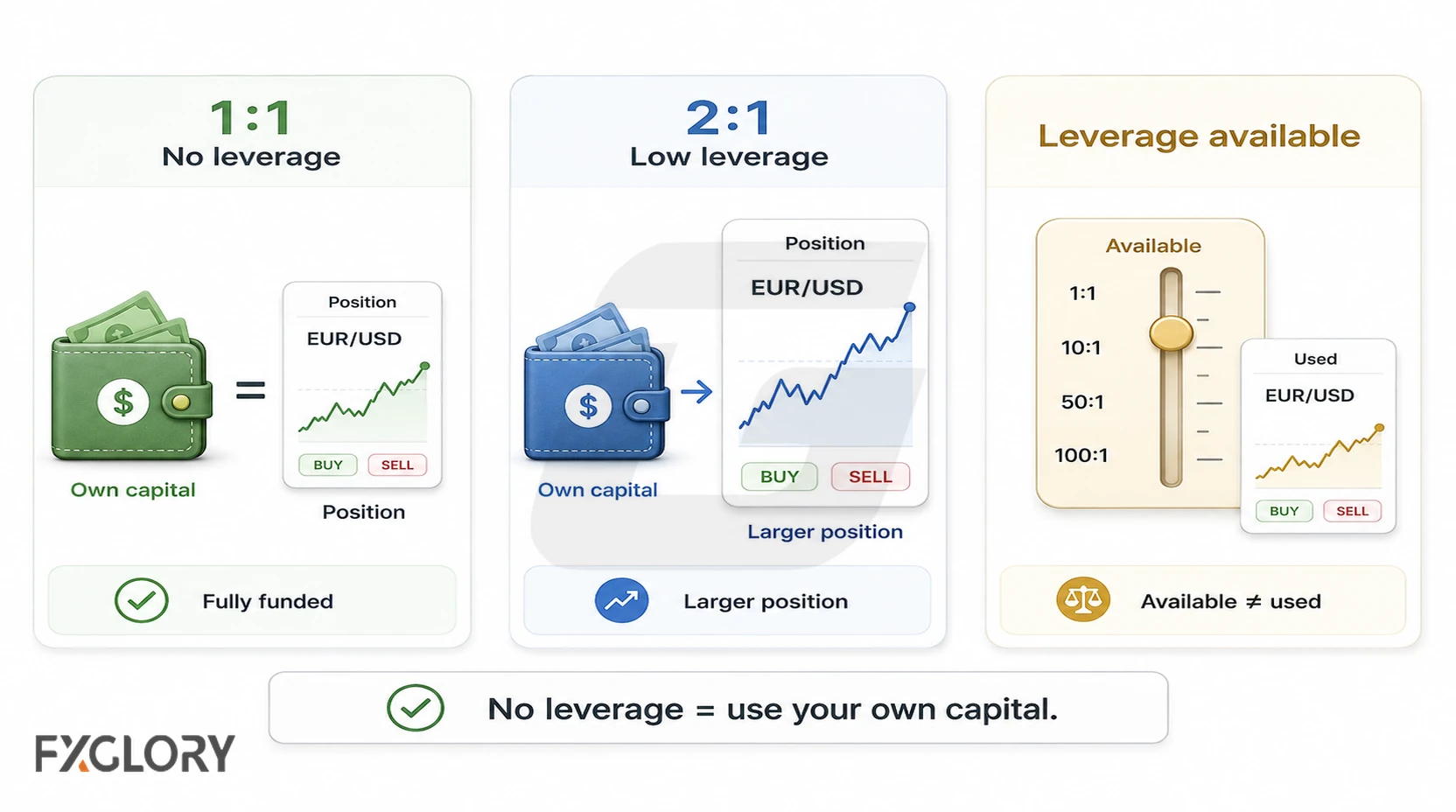
A 1:1 position can still be held inside a margin-based trading account. For that reason, “no leverage” and “no margin” should not automatically be treated as identical platform settings.
Four terms are useful to separate:
- 1:1 leverage: Open notional exposure is approximately equal to the equity supporting it.
- Margin-disabled account: A platform setting that prevents borrowing or margin-based position expansion, where such a setting exists.
- Low leverage: Exposure is above equity but kept at a relatively low multiple, such as 2:1 or 5:1.
- Maximum leverage: The highest leverage the account permits; it does not show how much leverage is actually being used.
Effective Leverage: Exposure Actually in Use
Effective leverage measures current exposure rather than the account's maximum leverage setting.
Effective leverage = total open notional exposure ÷ account equity
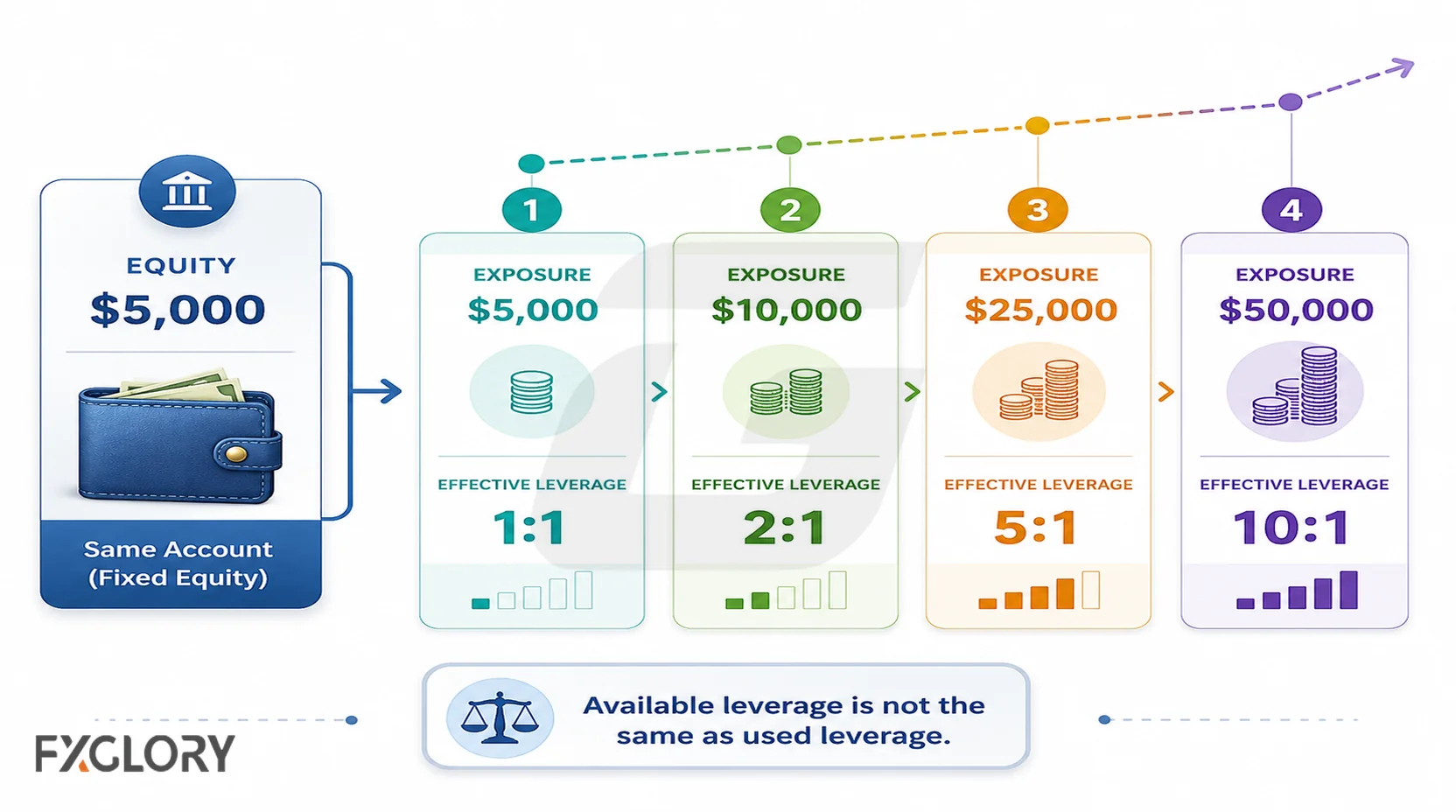
If account equity is $5,000 and total open exposure is $5,000, effective leverage is about 1:1. If the same account carries $25,000 of open exposure, effective leverage is about 5:1.
| Account Equity | Total Open Exposure | Effective Leverage | What Changes |
|---|---|---|---|
| $5,000 | $5,000 | 1:1 | Exposure is approximately equal to equity. |
| $5,000 | $10,000 | 2:1 | Exposure is twice account equity. |
| $5,000 | $25,000 | 5:1 | Each percentage move in the position has a larger effect on equity. |
| $5,000 | $50,000 | 10:1 | Exposure is ten times account equity. |
Having higher leverage available does not require using it. Position size determines how much of the available leverage is actually employed.
FXGlory and Broker Options for 1:1 Leverage
Broker implementations differ. Some platforms offer a selectable 1:1 leverage setting, some provide lower-leverage choices, and some allow effective leverage to be kept low primarily through position size.
FXGlory's current Trading Account Conditions list selectable leverage from 1:1 to 1:3000. Its leverage rules state that clients can change leverage in the Client Cabinet, while maximum leverage can also be affected by account balance or equity and other conditions.
Before relying on a 1:1 or no-leverage setup, check:
- whether 1:1 leverage is available for the account and instrument,
- whether the platform uses margin accounting at 1:1,
- the minimum and maximum trade sizes,
- the account base currency and currency-conversion rules,
- whether swaps, financing, commissions, or other charges apply,
- how margin call and stop-out rules work,
- whether account protections and restrictions vary by jurisdiction.
1:1 Leverage vs No-Margin Trading
A 1:1 leverage setting controls the relationship between exposure and supporting equity. It does not necessarily turn a margin account into a cash account or disable the platform's margin calculations.
A margin-disabled account is a separate platform feature when offered. For example, some multi-asset platforms explicitly allow margin trading to be disabled and then open eligible positions at 1:1. Other forex platforms may simply offer 1:1 leverage within their normal margin-account structure.
The practical question is therefore not only “what leverage number is selected?” but also “how does this account fund, margin, settle, and close the position?”
For leverage settings above 1:1, see the best leverage for forex guide.
Capital Needed at 1:1
At 1:1 exposure, account equity generally needs to be large enough to support approximately the full notional value of the position. Notional value is the value represented by the position, not the amount the trader expects to gain or lose.
For a simplified EUR/USD example, notional value in USD can be estimated as:
EUR position units × EUR/USD price = approximate USD notional value
If EUR/USD is 1.1000, the arithmetic looks like this:
| Position Type | Position Size | Example EUR/USD Price | Approx. Notional Value |
|---|---|---|---|
| Standard lot | 100,000 EUR | 1.1000 | $110,000 |
| Mini lot | 10,000 EUR | 1.1000 | $11,000 |
| Micro lot | 1,000 EUR | 1.1000 | $1,100 |
These figures are hypothetical arithmetic examples, not current EUR/USD quotes or universal broker funding requirements. Actual requirements depend on the pair, account currency, product structure, broker rules, and current exchange rate.
You can compare current EUR/USD pricing on the EUR/USD live price page, then apply the same notional-value calculation to the position size being considered.
For position units and lot conventions, see what is lot size in forex.
Profit and Loss at 1:1 Exposure
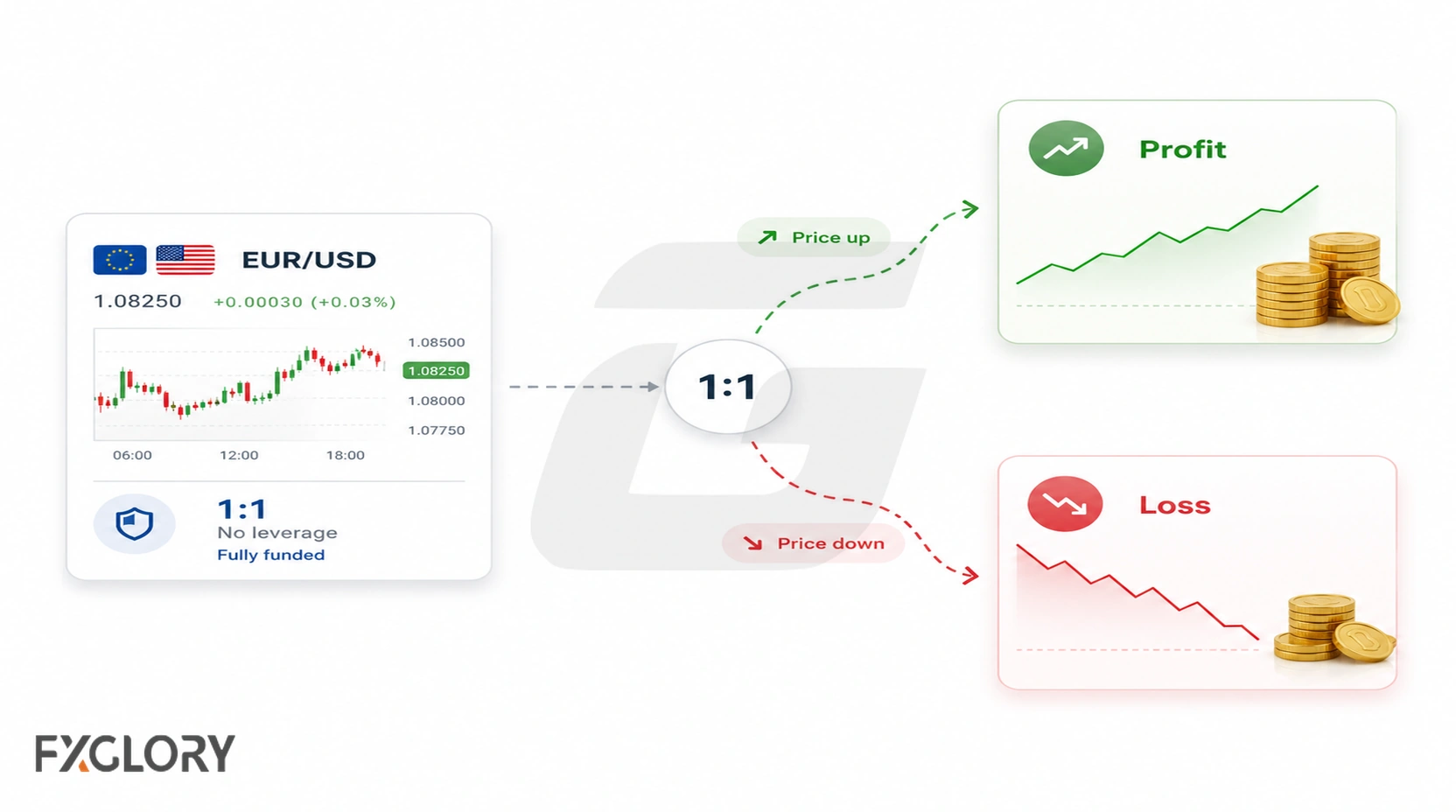
A 1:1 position can produce either a profit or a loss. What changes is the amount of exposure relative to account equity, not the direction of market risk.
For the same account equity and the same percentage price movement, a 1:1 position has a smaller equity impact than a position using higher effective leverage because less notional exposure is being carried.
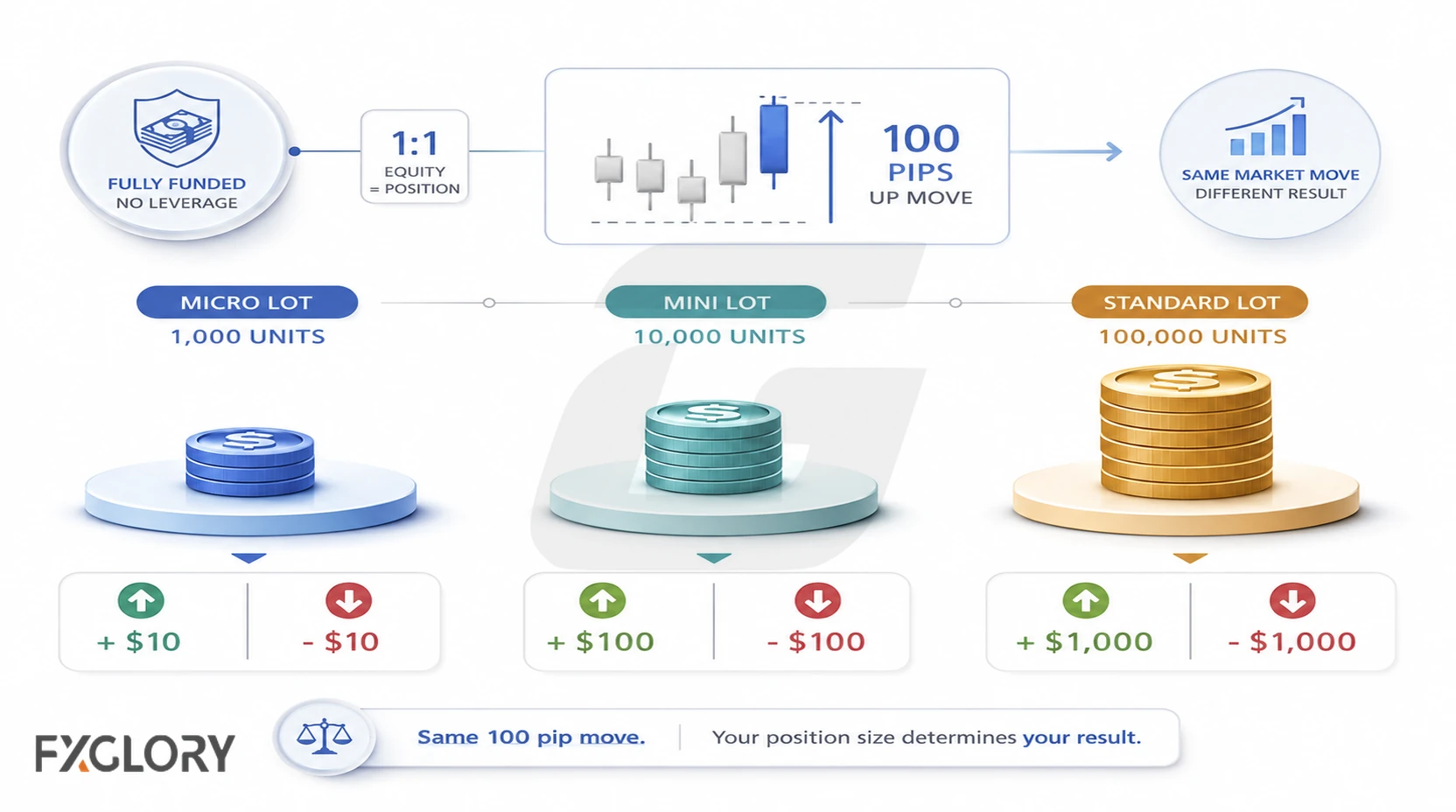
The table below uses a hypothetical 100-pip EUR/USD move only to show position-size arithmetic. It is not an expected or typical result.
| EUR Position Size | Example Notional Value at 1.1000 | 100-Pip Move | Gross P/L Before Costs |
|---|---|---|---|
| 1,000 EUR | $1,100 | Favorable or unfavorable | About +$10 or -$10 |
| 10,000 EUR | $11,000 | Favorable or unfavorable | About +$100 or -$100 |
| 100,000 EUR | $110,000 | Favorable or unfavorable | About +$1,000 or -$1,000 |
Actual account results can differ because of spread, slippage, swaps or financing, commissions where applicable, account-currency conversion, and the actual entry and exit prices.
For a broader discussion of profits and losses, see can you really make money trading forex.
Tradeoffs of 1:1 Forex Exposure
Keeping exposure close to equity changes both the risk profile and the amount of capital tied to the position.
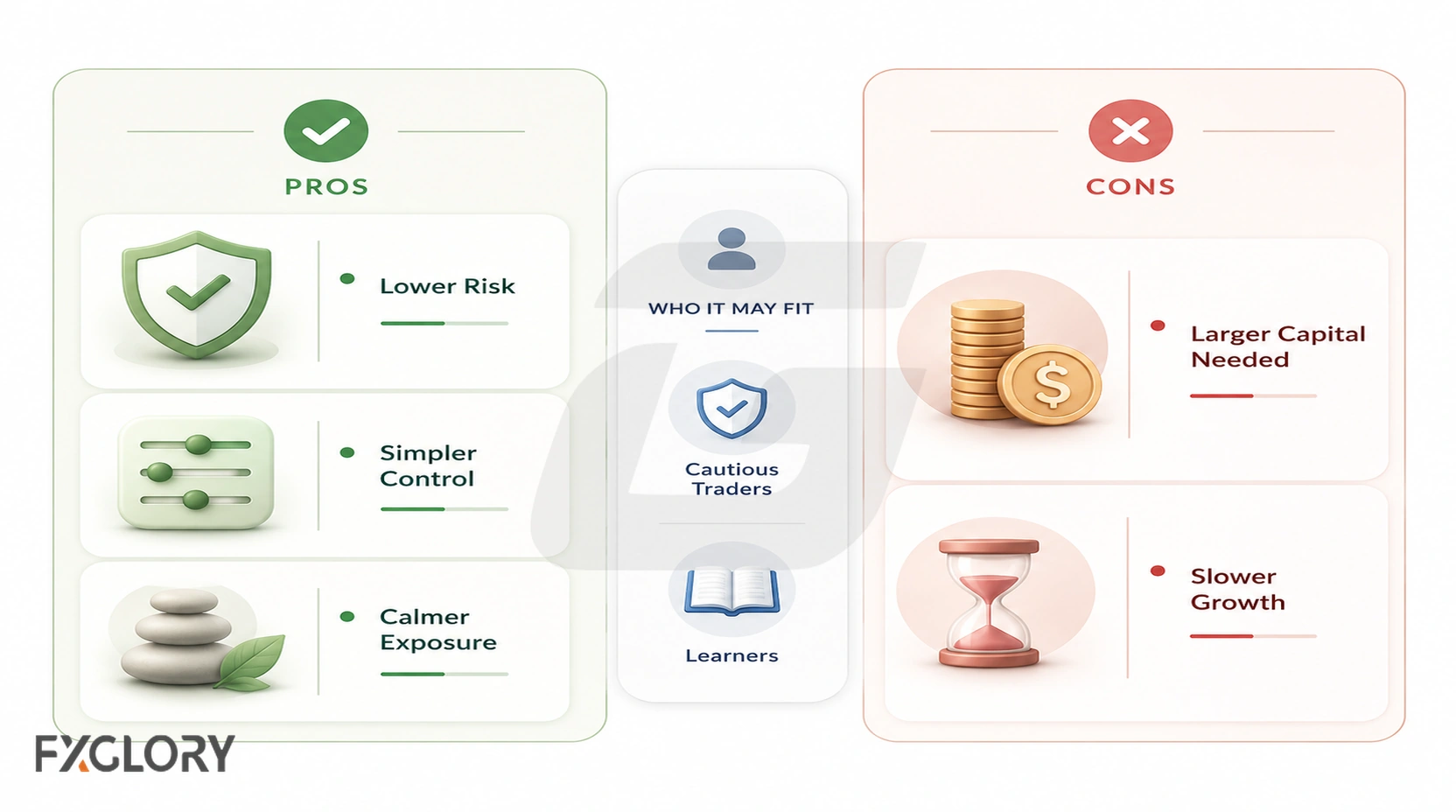
- Exposure: The position is not multiplied above supporting equity as it is with higher effective leverage.
- Capital: More equity is required to support the same notional position.
- P/L sensitivity: For the same account equity, a given percentage price move has less impact than it would with a more highly leveraged position.
- Costs: Spread, slippage, swaps or financing, and other applicable costs still matter.
- Position sizing: A 1:1 setting does not prevent a trader from concentrating too much of the account in one position.
What beginners should understand
Using 1:1 leverage can limit exposure, but it does not make a trade automatically well sized. A beginner still needs to understand pip value, stop distance, position size, trading costs, and the amount of account equity that could be lost if the trade moves against the plan.
How the tradeoff changes by account size and strategy
A larger account can support more notional exposure at 1:1, while a smaller account will be limited to smaller positions. Strategies that depend on many simultaneous positions can also tie up more equity at 1:1 than they would at higher leverage.
Risk Controls at 1:1 Exposure
Leverage is only one part of trade risk. Position size should still be derived from the trade's invalidation or stop distance and the amount of account equity the trader is prepared to risk.
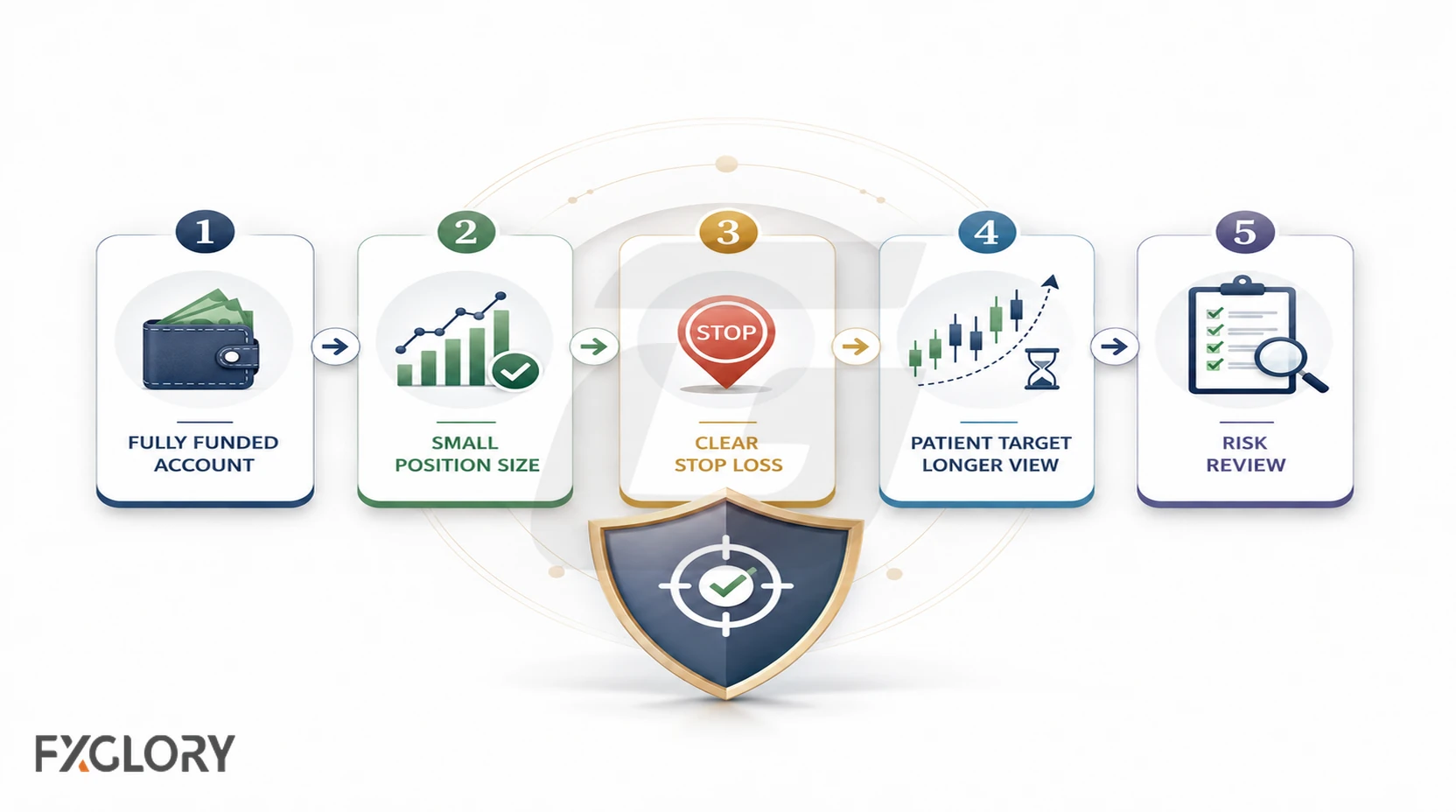
- Confirm the account rules: Check whether 1:1 is available for the account and instrument and how margin is calculated.
- Define invalidation: Identify the price or condition that makes the trade idea no longer valid.
- Measure stop distance: Convert the distance from entry to invalidation into pips or the appropriate price unit.
- Set the account-risk limit: Decide the maximum amount of equity that can be lost if the stop is reached.
- Calculate position size: Use stop distance and pip value to derive the size that fits that risk limit.
- Check effective leverage: Compare total open notional exposure with account equity after the proposed position is included.
- Check costs and account requirements: Review spread, slippage risk, swaps or financing, currency conversion, and margin rules.
Estimated stop risk = stop distance in pips × pip value for the chosen position size
For pip calculations, see how to calculate pips in forex. For spread and execution mechanics, see bid and ask price in forex.
Common Mistakes With 1:1 Forex Trading
Keeping leverage low does not correct errors elsewhere in the trading process. Common mistakes include:
- Treating 1:1 as risk-free: Market movement can still create losses.
- Confusing leverage with margin mechanics: A 1:1 setting can still exist inside a margin-based account.
- Ignoring the broker's implementation: Account rules, minimum trade size, margin calculations, and instrument availability can differ.
- Ignoring spread and slippage: Execution costs still affect the trade.
- Concentrating too much equity in one position: Full notional funding does not make concentration risk disappear.
- Skipping pip-value calculations: The monetary effect of the stop still depends on position size.
- Increasing size because unleveraged P/L feels small: A larger position changes both exposure and loss potential.
- Assuming available leverage equals used leverage: Effective leverage comes from actual open exposure.
- Using money needed for near-term obligations: Trading capital should be considered in the context of the trader's financial circumstances and ability to absorb losses.
No-Leverage Forex: Key Points
At 1:1 effective leverage, open notional exposure is approximately equal to the equity supporting it. That can reduce exposure relative to higher-leverage trading, but it also means more equity is needed for a given position size.
FXGlory currently lists 1:1 among its selectable leverage levels. The account's actual leverage conditions can still depend on balance, equity, instrument, and other platform rules.
A 1:1 setting does not eliminate price risk, execution costs, financing, or position-sizing risk, and it does not necessarily mean that margin accounting is disabled.