

Quick Answer: What Is Leverage in Forex Trading?
For beginners, the most useful distinction is between available leverage and position size. The account may allow a high leverage ratio, but the amount actually used depends on the positions opened.
Forex Leverage Explained: What Does Leverage Mean?
Forex leverage describes the relationship between a position's market exposure and the margin required to support it. If a trader controls a $50,000 position with $1,000 of required margin, the leverage relationship is 50:1.
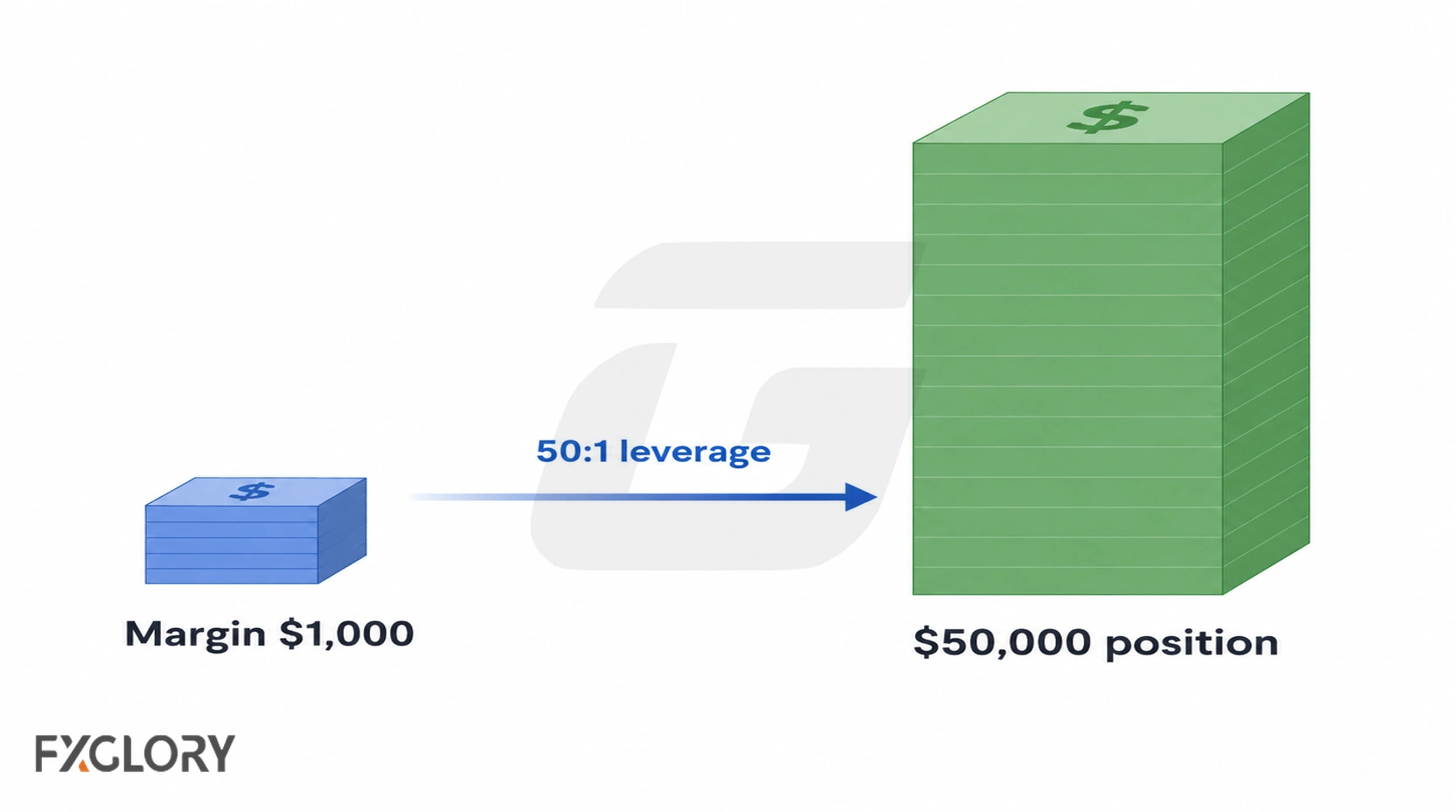
The trader does not need to provide the full notional value as margin, but the position still responds to market movement according to its full size. That is why leverage should be understood together with lot size, pip value, stop-loss distance, and account equity.
Forex Leverage at a Glance
| Concept | Meaning | What to Check |
|---|---|---|
| Leverage | Relationship between exposure and required margin. | Position exposure and margin requirement. |
| Margin | Funds required to open or maintain a position. | Used margin, free margin, and platform rules. |
| Lot size | The position size selected for the trade. | Pip value and total exposure. |
| Pip value | The money value of a one-pip move for that position. | Pair, position size, account currency, and exchange rate. |
| Real leverage | Total open exposure compared with account equity. | Total exposure divided by equity. |
| Trade risk | The potential account loss if price moves against the trade. | Position size, stop distance, execution, and costs. |
How Does Forex Leverage Work?
Leverage changes how much margin is needed to open a given position. It does not change the market's price movement, and it does not alter pip value when the position size stays the same.
- Choose a currency pair: For example, EUR/USD or GBP/USD.
- Choose position size: Lot size determines how much exposure the trade creates.
- Check the margin requirement: The platform applies its leverage or margin rules to that exposure.
- Estimate pip value: This shows the money impact of a one-pip move.
- Set the exit distance: A stop-loss or other exit rule defines how far price can move before the planned exit.
- Compare the estimated loss with the risk limit: Reduce position size if the trade is too large for the plan.
For more on position size, see what is lot size in forex. For spread mechanics, see bid and ask price in forex.
Forex Leverage and Margin: Formula and Examples
Leverage and margin describe the same position from different angles. Leverage is the exposure-to-margin ratio; margin is the amount that must be set aside to support the position.
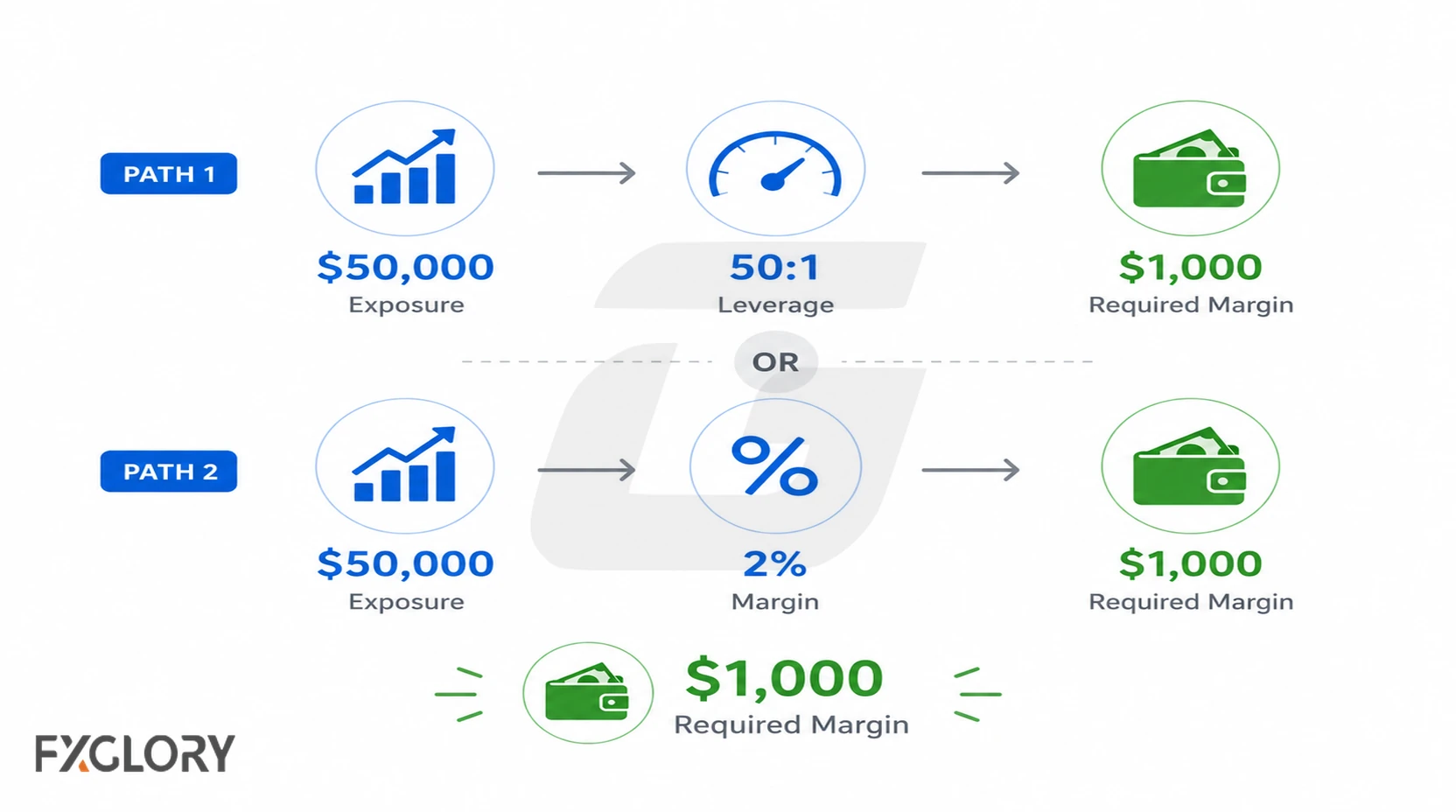
For example, a $50,000 position at 50:1 leverage requires about $1,000 of margin in a simplified calculation: $50,000 ÷ 50 = $1,000. The same relationship can be shown as $50,000 × 2% = $1,000.
| Position Exposure | Example Context | Leverage | Margin Requirement | Approx Required Margin |
|---|---|---|---|---|
| $10,000 | Example position exposure | 50:1 | 2% | About $200 |
| $50,000 | Example position exposure | 50:1 | 2% | About $1,000 |
| $100,000 | Example notional exposure | 50:1 | 2% | About $2,000 |
| $100,000 | Same notional exposure at higher leverage | 100:1 | 1% | About $1,000 |
A standard lot conventionally means 100,000 units of the base currency, not automatically $100,000. The position's value in US dollars or another account currency depends on the pair and exchange rate.
What Is a Leverage Ratio in Forex?
A leverage ratio compares position exposure with the amount of margin required to support it. In simplified terms, 50:1 leverage means each $1 of required margin supports about $50 of exposure.
The corresponding margin percentage can be estimated as the inverse of the leverage ratio.
| Margin Requirement | Approx Leverage | Meaning |
|---|---|---|
| 10% | 10:1 | About $10 of exposure per $1 of required margin. |
| 5% | 20:1 | About $20 of exposure per $1 of required margin. |
| 3.33% | 30:1 | About $30 of exposure per $1 of required margin. |
| 2% | 50:1 | About $50 of exposure per $1 of required margin. |
| 1% | 100:1 | About $100 of exposure per $1 of required margin. |
| 0.5% | 200:1 | About $200 of exposure per $1 of required margin. |
Maximum Leverage vs Real Leverage
Maximum leverage is the highest ratio the account or instrument permits. Real leverage measures how much exposure the trader is actually using relative to account equity.
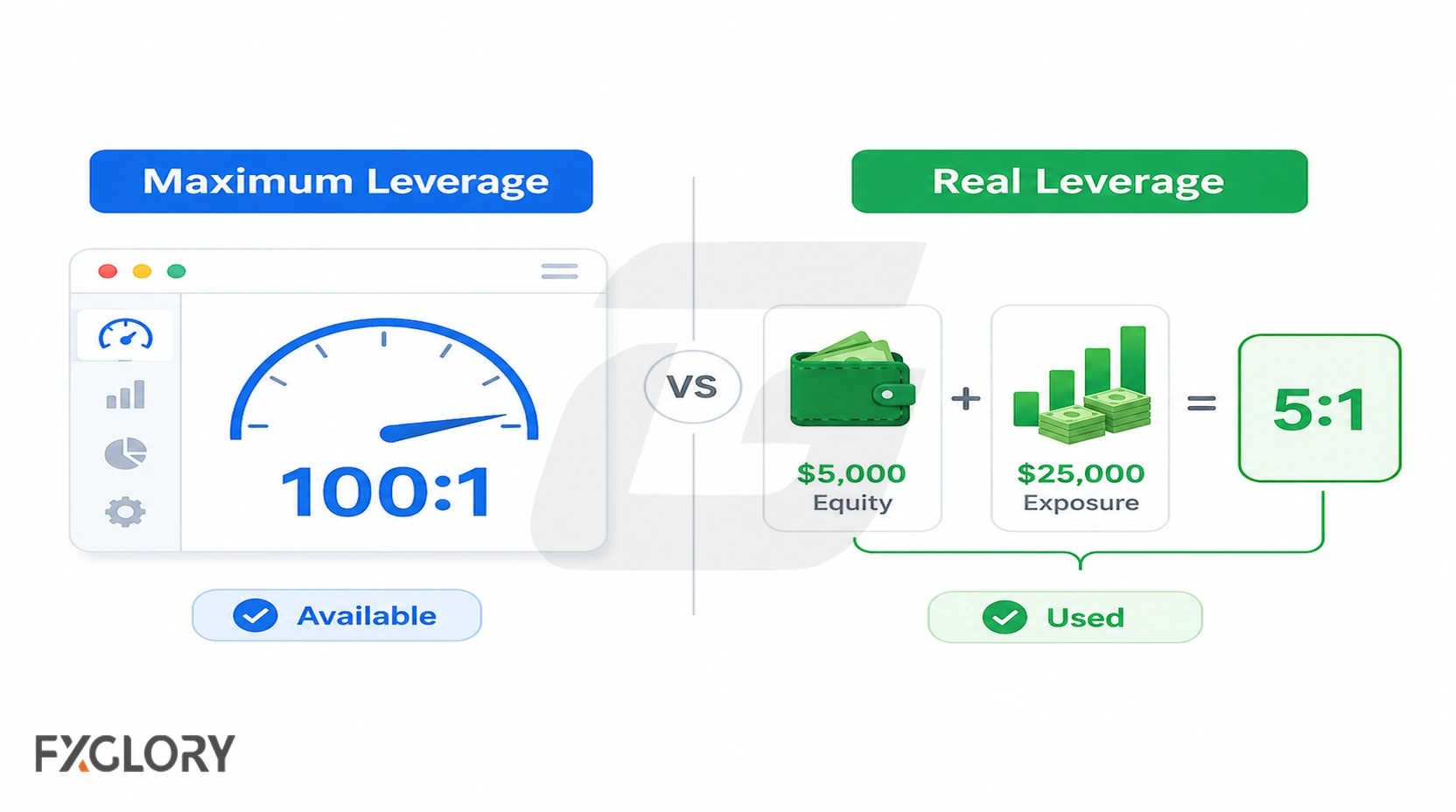
For example, if an account has $5,000 of equity and $25,000 of total open exposure, real leverage is about 5:1 even if the account allows a much higher maximum ratio.
| Account Equity | Total Open Exposure | Approx Real Leverage | What It Shows |
|---|---|---|---|
| $5,000 | $25,000 | 5:1 | Lower exposure relative to equity. |
| $5,000 | $50,000 | 10:1 | More exposure relative to the same equity. |
| $5,000 | $100,000 | 20:1 | Higher account sensitivity to market movement. |
Real leverage is a planning measure. It does not replace the platform's own calculations for used margin, free margin, margin level, or stop-out thresholds.
Leverage, Lot Size and Pip Value
Leverage and pip value are connected indirectly through position sizing. The leverage setting can affect how large a position the account is able to open, while position size determines the pip value of that trade.
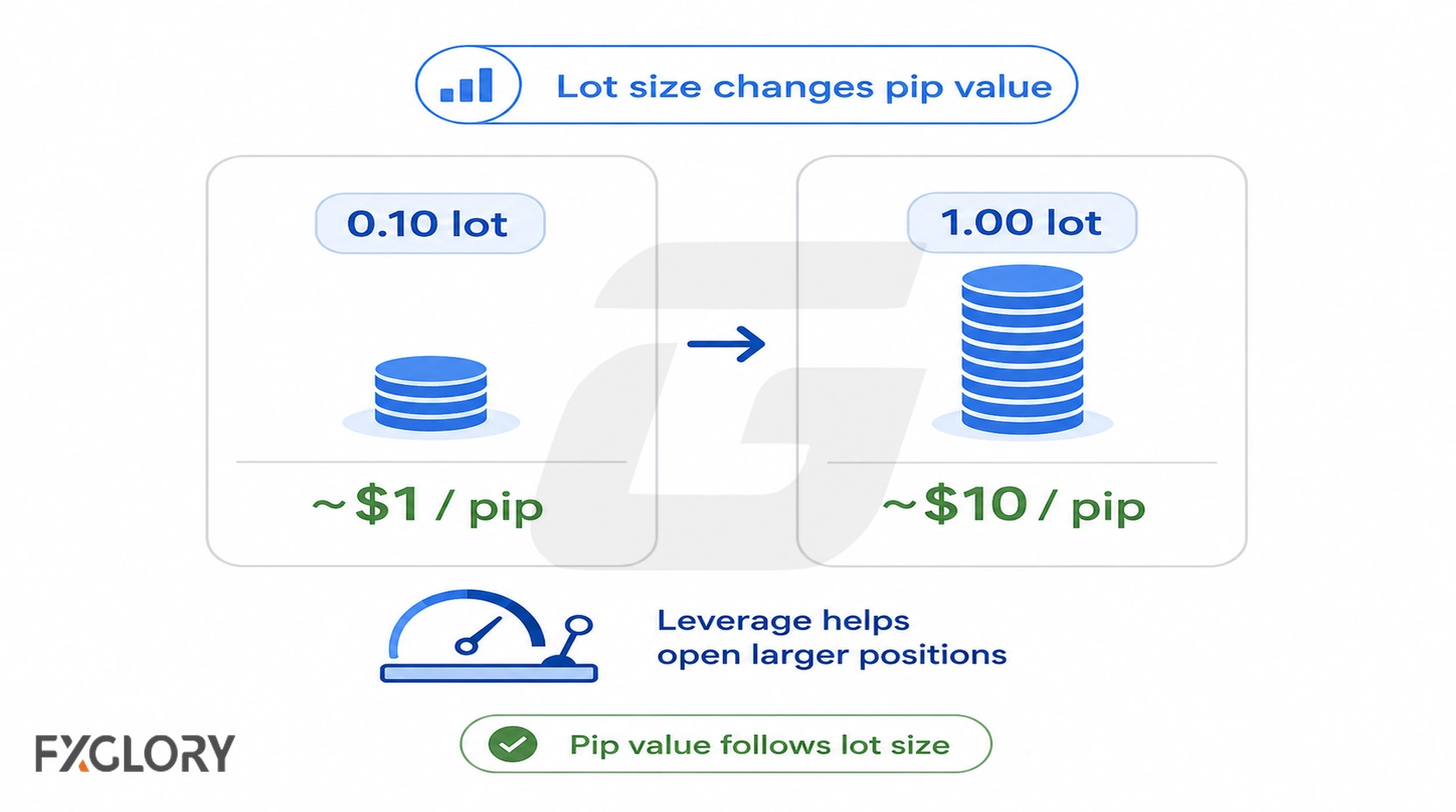
| Lot Size | Approx Pip Value on Many USD-Quoted Pairs | 50-Pip Move Approx Impact | Main Lesson |
|---|---|---|---|
| 0.10 lot | About $1 per pip | About $50 | Smaller position, smaller pip impact. |
| 1.00 lot | About $10 per pip | About $500 | Larger position, larger pip impact. |
For example, if a position is worth about $5 per pip and the planned stop is 50 pips away, the estimated price-movement risk is about $250 before costs.
For the position-size side, see what is lot size in forex. To review pip mechanics, read what is a pip in forex trading.
Worked Example: 50:1 Forex Leverage
Consider a simplified $50,000 position using 50:1 leverage:
- Position exposure: $50,000
- Leverage ratio: 50:1
- Margin requirement: About 2%
- Required margin: $50,000 × 2% = about $1,000
- Illustrative pip value: About $5 per pip
- 50-pip move: $5 × 50 = about $250 before costs
The $1,000 margin figure tells you how much collateral is required in this simplified example. The $250 figure illustrates the effect of a 50-pip move at the assumed pip value. They measure different things.
If the trader's planned maximum loss is only $50, this example position is too large for that plan. The appropriate adjustment would be to reduce position size rather than rely on the leverage setting itself to control risk.
How to Use Leverage in Forex Trading as a Beginner
There is no single leverage ratio that is automatically safe for every beginner. A more useful process is to start with the amount of money the trader is prepared to risk, then work backward to the position size.
Before opening a leveraged trade, answer these questions:
- Account equity: What account value is available to absorb losses?
- Position exposure: What approximate market value will the trade control?
- Required margin: How much margin will be tied up?
- Pip value: What is one pip worth for this position?
- Stop-loss distance: How far away is the planned exit?
- Estimated money risk: What loss would that stop imply before costs?
- Real leverage: How large is total open exposure compared with account equity?
A forex trading plan template can help organize position-sizing rules, risk limits, leverage limits, and review habits before trading live.
What Is a Margin Call in Forex?
A margin call can occur when account equity falls too low relative to the margin required for open positions. Depending on platform rules, the trader may need to add funds, reduce exposure, or face automatic position closures.
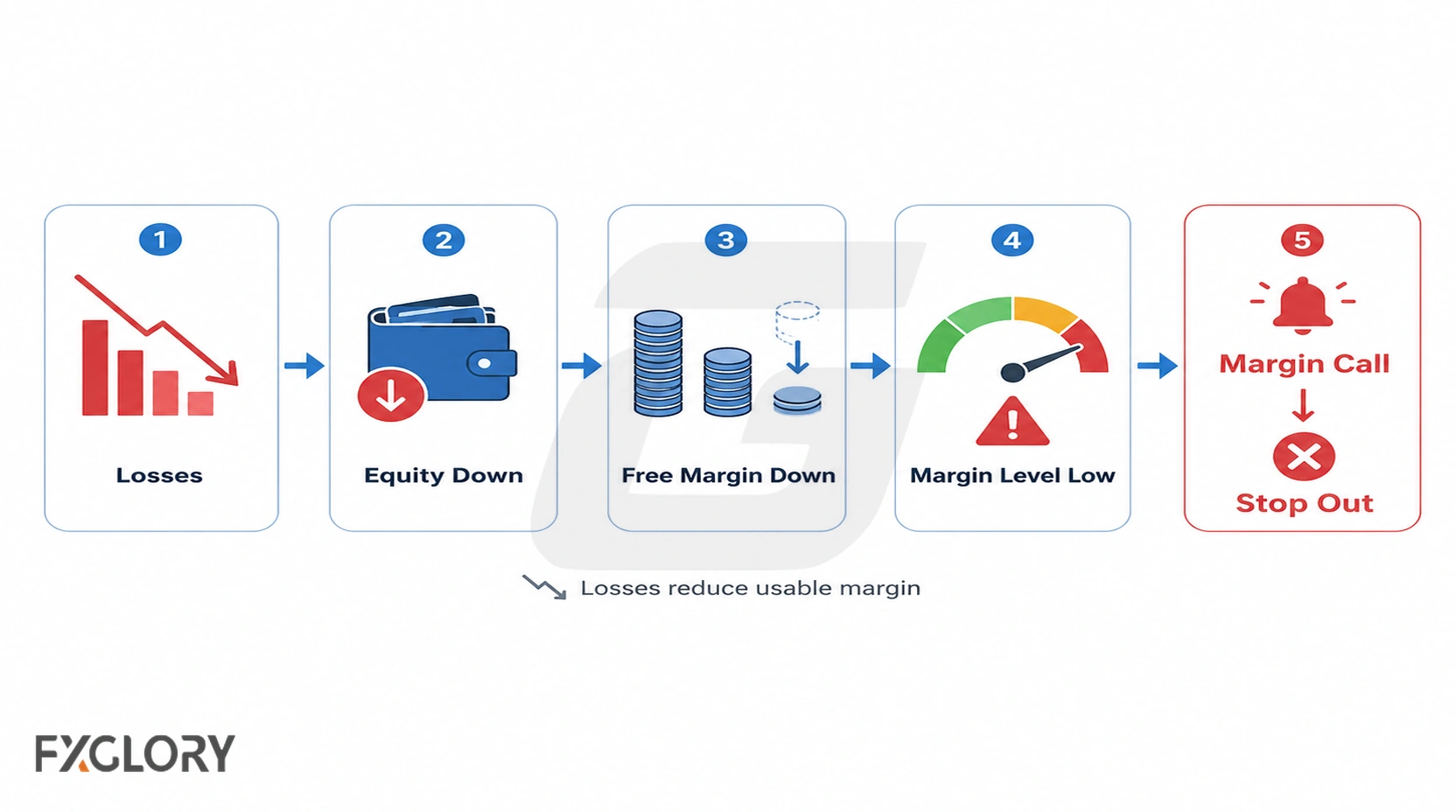
| Margin Term | Meaning | Why It Matters |
|---|---|---|
| Equity | Account value including open profit or loss. | Falls as open losses increase. |
| Used margin | Margin currently tied up in open positions. | Shows how much account capacity is reserved. |
| Free margin | Equity minus used margin. | Shrinks as losses reduce equity. |
| Margin level | Equity compared with used margin, often shown as a percentage. | Used to monitor margin pressure. |
| Margin call | A warning or account condition triggered by insufficient margin. | May require adding funds or reducing exposure. |
| Stop-out | Automatic closure of positions under platform rules. | Can occur if margin conditions deteriorate too far. |
Common Beginner Mistakes With Forex Leverage
- Choosing position size from the maximum leverage available: The account limit does not determine an appropriate trade size.
- Ignoring total exposure across several trades: Multiple positions can combine into high real leverage.
- Using lot size without checking pip value: A larger position can make ordinary price movement produce a much larger money impact.
- Assuming margin is the amount at risk: Margin is collateral for the position, while loss depends on market movement and trade management.
- Ignoring correlated currency exposure: Several trades can effectively concentrate risk in the same currency theme.
- Trading without understanding margin-call rules: Platform thresholds can affect how and when positions are closed.
- Increasing exposure after losses: Using additional leverage to chase losses can make account damage worse.
Quick Recap: Forex Leverage Explained
Forex leverage is the relationship between market exposure and the margin required to support it. The leverage ratio determines the margin requirement for a given position size, while position size determines pip value and the scale of profit or loss from market movement.
Maximum leverage is only an account or product limit. Real leverage depends on the exposure actually opened relative to account equity. For beginners, the practical sequence is to define the risk limit first, calculate the position size that fits it, and then check the resulting margin use and real leverage.
For the broader learning path, return to forex basics for beginners.