
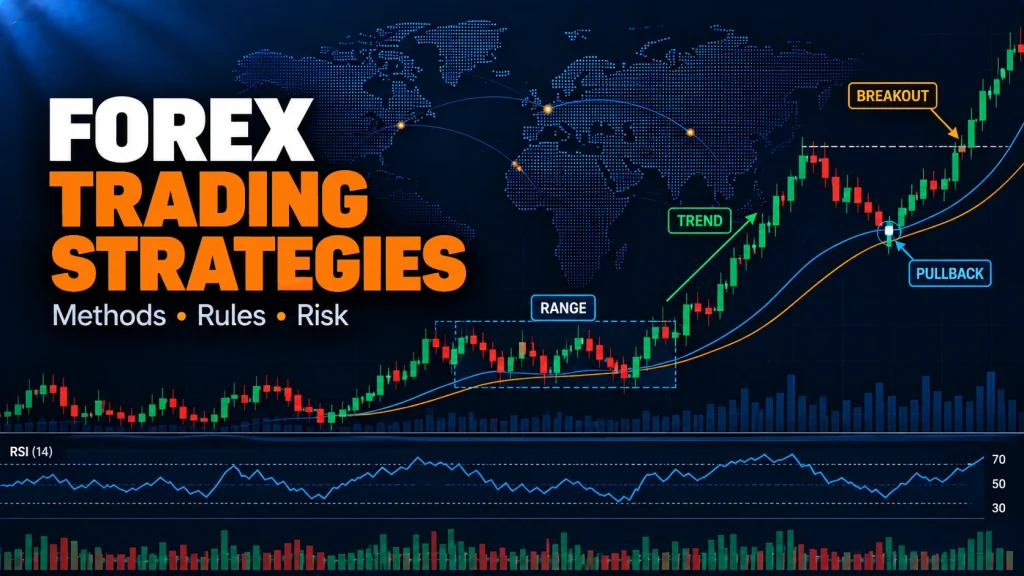
What Makes A Forex Strategy Useful?
A forex strategy is a repeatable way to make trading decisions. It should explain the market condition, the entry trigger, the invalidation point, the position risk, the exit logic, and the reason to stay out when the chart does not match the rules.
A strategy is not just a signal. For example, a breakout, moving-average crossover, candle rejection, or RSI divergence is only part of the process. The strategy becomes usable only when the trader knows where the idea is wrong, how much is at risk, what conditions are being avoided, and how the result will be reviewed.
Forex Strategy vs Setup vs Trading Plan
Clear terms prevent mixed rules. A trading setup is one eligible trade condition. A forex strategy is the method that decides whether that setup can be used. A trading plan is wider because it includes schedule, markets, risk limits, account rules, and review habits.
- Setup: A specific condition, such as a breakout, pullback, retest, candle reaction, or indicator signal.
- Strategy: The rules that decide when the setup is valid, where it fails, and how the trade is managed.
- Trading plan: The wider routine that covers market selection, risk limits, session timing, journaling, and review.
- Tactic: A smaller execution choice inside the strategy, such as waiting for a retest instead of entering on the first break.
For planning beyond strategy selection, use a forex trading plan template to document schedule, risk limits, and review habits.
Forex Strategy Map By Market Condition
The same currency pair can trend, range, compress, break out, or react to news at different times. Use the condition first, then choose the strategy group that fits it.
| Market Condition | Strategies To Compare | Usually Avoid | Main Check |
|---|---|---|---|
| Clear trend | Trend-following, pullback, moving-average, trailing-exit methods | Counter-trend entries without strict invalidation | Is the entry early enough, or is price already extended? |
| Sideways range | Range trading, mean reversion, support-and-resistance reactions | Trend-following entries in the middle of the range | Where does the range become invalid? |
| Compression | Breakout, box strategy, volatility-expansion methods | Entering before price leaves the structure | How will false breaks be handled? |
| Pullback inside trend | Retracement, trendline, moving-average pullback, price-action confirmation | Chasing after the move has already resumed | Is this a pullback or a reversal? |
| High-impact news | News-aware or straddle-style methods with strict risk controls | Normal technical entries that ignore spread and slippage | Can risk still be defined if price moves fast? |
| Interest-rate focus | Carry trade and broader fundamental methods | Short-term signals that ignore rollover and macro context | Can price movement outweigh the rate advantage? |
Main Types Of Forex Trading Strategies
Forex market strategies can be grouped by how they try to capture movement. The goal is not to use all of them. The goal is to choose one method that matches the trader, the market, and the trading conditions.
Trend Trading Strategies
Trend strategies look for sustained directional movement. They may use market structure, moving averages, trendlines, or momentum tools to confirm that price is moving with enough direction to plan continuation. A trend method should include a late-entry filter because price can be risky to chase after a long move.
When trend context is unclear, review forex trend behaviour before turning a directional idea into a trade.
Range Trading And Mean-Reversion Strategies
Range strategies focus on price rotating between support and resistance. Mean-reversion methods use a similar idea: price has moved away from a reference area and may return toward balance. These strategies need a clear invalidation rule because ranges can break and become trends.
Use support and resistance as background for level selection, while keeping the strategy focused on entry, exit, and risk.
Breakout Strategies
Breakout strategies look for price leaving a range, box, pattern, or important level. Some traders enter on a confirmed break; others wait for a break-and-retest. The strategy should define what counts as confirmation and what proves the breakout failed.
- Do not treat every spike beyond a level as a valid breakout.
- Define whether a candle close, retest, or volatility expansion is required.
- Skip the trade if spread, slippage, or news risk makes invalidation unclear.
Retracement And Pullback Strategies
Retracement strategies look for a controlled move against the broader direction. The trader is not trying to catch a full reversal; the aim is to find a pause that may continue with the original trend. Pullback plans often use prior structure, trendlines, moving averages, or Fibonacci areas as watch zones.
A watch zone is not a trade by itself. The strategy still needs a trigger and an invalidation point. For concept background, use the forex retracement guide.
Price Action Strategies
Price action strategies use chart behaviour such as highs, lows, candles, structure, support, resistance, failed breaks, and retests. They can be clean and flexible, but only if the rules are written clearly. Without a trigger and invalidation rule, price action can become subjective.
For definitions, use price action in forex. For strategy planning, focus on context, trigger, invalidation, risk, and review.
Indicator-Supported Strategies
Indicator-supported strategies use tools such as moving averages, RSI, MACD, ADX, ATR, Bollinger Bands, stochastic, CCI, Alligator, ZigZag, or Parabolic SAR. The stronger approach is to give each indicator one job: trend filter, momentum check, volatility measure, timing aid, or exit reference.
Do not stack indicators until every signal conflicts with another. For indicator mechanics, use the technical indicators guide before building rules around any single tool.
Scalping Strategies
Scalping strategies look for small short-term moves, often on very low timeframes. Because the targets are usually small, spread, execution speed, discipline, and order handling matter heavily. A scalping strategy should define active sessions, maximum trades, stop rules, spread limits, and when to stop after poor execution.
One-minute, five-minute, and fifteen-minute forex strategies belong under this short-term group. They should not be judged only by speed; they should be judged by cost, risk, execution quality, and whether the trader can follow the rules under pressure.
Day Trading Strategies
Day trading strategies open and close positions within the same trading day. They may use trend continuation, intraday breakouts, pullbacks, news reactions, or range rotations. A day trading strategy needs a session plan and a maximum daily risk rule so that one poor period does not turn into repeated impulsive trades.
Swing And Position Trading Strategies
Swing trading usually looks for multi-day movement. Position trading uses broader market context and may hold exposure for longer. These methods usually produce fewer signals than scalping or day trading, but the stop distance, holding risk, swap impact, and event exposure may be larger.
News Trading Strategies
News strategies respond to scheduled releases, central-bank decisions, employment data, inflation numbers, or unexpected events. These strategies need different rules from normal chart setups because spreads can widen, price can slip, and reversals can be fast.
- Define whether the strategy is directional or non-directional before the release.
- Plan for spread widening, slippage, rejected levels, and fast reversals.
- Do not use normal technical invalidation when the release can overpower the chart.
- Skip the trade if risk cannot be defined before the event.
Carry Trade Strategies
Carry trade strategies consider interest-rate differences between currencies. The approach is usually longer term and should include trend context, risk sentiment, rollover implications, and exit rules. A positive rate difference does not protect the position if the currency pair moves sharply against the trade.
Grid, Martingale, Hedging, And Recovery-Based Strategies
Grid and recovery-based methods can create exposure that grows while the market moves against the position. Hedging may reduce or reshape exposure, but it can also make the account harder to understand if the trader does not know the net risk. These strategies should be treated as advanced risk structures, not simple fixes.
Forex Strategy Comparison Table
Use this table to compare strategies by fit. The same method can behave differently when the pair, session, spread, timeframe, and volatility change.
| Strategy Type | Best Condition | Common Timeframes | Main Tools | Risk Question |
|---|---|---|---|---|
| Trend trading | Directional market | H1, H4, Daily | Structure, moving averages, trendlines | Is the entry late or overextended? |
| Range trading | Stable sideways market | M15, H1, H4 | Support, resistance, oscillators | Where does the range fail? |
| Breakout trading | Compression or level break | M15, H1, H4, Daily | Levels, patterns, volatility | How are false breakouts filtered? |
| Pullback trading | Trend with controlled retracement | H1, H4, Daily | Structure, Fibonacci, moving averages | Is it still a pullback, or has the trend failed? |
| Price action | Clear chart structure | All, depending on rules | Candles, highs/lows, levels, retests | Is the trigger objective enough to repeat? |
| Indicator strategy | Depends on indicator role | All, depending on settings | RSI, MACD, ADX, ATR, Bollinger Bands | Is the indicator supporting context or replacing it? |
| Scalping | Liquid, active conditions | M1, M5, M15 | Fast price action, short-term levels, quick exits | Can the target absorb spread and execution cost? |
| Day trading | Intraday movement | M15, M30, H1 | Session levels, trend, momentum | What stops overtrading? |
| Swing trading | Multi-day structure | H4, Daily | Trend, support, resistance, event context | Can the trader tolerate overnight movement? |
| News trading | Scheduled or unexpected volatility | M1 to H1 | Calendar, levels, execution rules | What happens if spread widens or price slips? |
| Carry trade | Rate differential plus supportive context | Daily, Weekly | Macro context, trend, rollover awareness | Can price movement outweigh the carry idea? |
| Grid strategy | Strictly controlled range or volatility plan | Varies | Order spacing, exposure limits, volatility rules | What is the maximum exposure if price trends one way? |
How To Choose A Forex Trading Strategy
A strategy should fit the trader's time, risk limit, market choice, and execution needs. A method that requires constant screen time may not fit someone who checks charts once per day. A slow method may not fit someone who reacts badly to overnight movement.
- Start with availability: Choose scalping, day trading, swing trading, or position trading based on how often the chart can be monitored.
- Match the market condition: Use trend methods in trends, range methods in ranges, and breakout methods after compression or structure breaks.
- Check spread sensitivity: Smaller targets need more attention to trading costs.
- Define invalidation first: If the trader cannot say where the idea is wrong, the setup is not ready.
- Choose instruments deliberately: Review the FXGlory forex market and currency pairs pages when deciding which markets fit the method.
- Limit variables: One clear rule set is easier to review than several mixed techniques.
- Set skip conditions: Flat market, unclear structure, high-impact news, abnormal spread, emotional state, or no valid risk boundary.
Worked Example: Choosing Between Trend, Range, And Breakout Planning
Assume a major currency pair is moving near a well-watched level. The strategy choice should change based on what price is doing around that area.
| Observed Condition | Better Strategy To Review | Reason | Skip If |
|---|---|---|---|
| Higher highs and higher lows continue above the level | Trend or pullback strategy | The market is still showing directional structure. | Price is already far from the last valid risk area. |
| Price keeps rejecting both sides of a range | Range or mean-reversion strategy | The level is acting as part of a rotation area. | A strong close breaks the range boundary. |
| Price compresses below the level, then closes through it | Breakout or break-and-retest strategy | The market may be leaving a defined structure. | The break happens during abnormal spread or unclear event risk. |
Compact Rule Framework For Any Forex Strategy
A strategy becomes easier to test when the rules are written before the trade. Use the checklist below to keep strategy selection tied to rules, risk, and review.
| Rule Area | Question To Answer |
|---|---|
| Condition | Is the market trending, ranging, compressing, pulling back, reacting to news, or unclear? |
| Setup | What makes the market worth watching? |
| Trigger | What exact event allows entry? |
| Invalidation | Where or when is the idea wrong? |
| Risk | How are stop distance, lot size, and planned loss connected? |
| Exit | What closes, reduces, trails, or reviews the trade? |
| Review | Was the strategy followed, or was the result caused by rule-breaking? |
Use the FXGlory margin calculator when margin requirements need to be checked before testing position size assumptions.
Testing Workflow Before Live Trading
Testing helps show whether the strategy can be repeated, whether the trader can follow it, and whether trading conditions change the result.
- Write the rules: Market condition, setup, trigger, invalidation, position risk, exit, and review.
- Collect examples: Mark both valid and invalid examples on historical charts.
- Backtest cautiously: Track enough examples to see losing streaks, weak conditions, and common failure points.
- Forward test: Watch the rules in current market conditions without rewriting them after every result.
- Practise execution: Use a demo account to practise order placement, stops, targets, and review habits before real-money trading.
- Check trading conditions: Review whether spread, stop distance, margin use, session timing, and order workflow still fit the strategy.
- Tag mistakes: Separate strategy failure, bad market condition, spread impact, late entry, execution issue, and rule-breaking.
Trading Conditions That Can Change Strategy Results
A strategy should be tested under realistic trading conditions. Spread, margin, leverage, platform workflow, and instrument behaviour can change whether a rule set is practical.
Spread
Spread affects every strategy, but it matters most when targets are small. Before testing scalping, one-minute, five-minute, news, or very short-term strategies, review FXGlory spreads and consider whether the target size leaves enough room after cost.
Leverage And Margin
Leverage changes exposure. It should not be used to force a larger position into a weak setup. Review leverage conditions and calculate margin before comparing trade size, stop distance, and account exposure.
Platform Workflow
Charting, indicators, order placement, and trade management should fit the method. Review FXGlory trading platforms when deciding whether a strategy needs specific chart tools, indicator access, or order workflow.
Instrument Behaviour
A strategy tested on a major currency pair should be reviewed again before applying it to metals or cryptocurrencies, because volatility, spread behaviour, and session activity can differ. Choose markets deliberately instead of applying one rule set everywhere.
- Do not test a tiny-target strategy without checking spread sensitivity.
- Do not test news trading without planning for fast movement and slippage.
- Do not test grid or recovery methods without a maximum exposure rule.
- Do not increase leverage to compensate for unclear rules.
High-Win-Rate, Secret, And Professional Strategy Claims
Some traders look for secret forex strategies, professional forex trading strategies, high-win-rate systems, no-stop-loss strategies, or forex tricks because they want a method that feels reliable. These claims should be checked through rules, risk, and testing instead of accepted at face value.
A professional-style strategy is not defined by hidden indicators or complicated language. It is defined by written rules, controlled exposure, consistent execution, realistic trade frequency, clear invalidation, and reviewable results.
A method with a high win rate can still be risky if losses are much larger than wins. A method without a stop loss can still have risk; it may simply move the risk into drawdown, margin pressure, or forced exit.
A Simple Beginner Path
Beginners do not need every forex trading tactic at once. The first step is to choose one trading style, one market condition, and one setup type that can be written and reviewed.
- Choose one style: scalping, day trading, swing trading, or position trading.
- Choose one condition: trend, range, breakout, or pullback.
- Write the entry, invalidation, risk, and exit rules before testing.
- Review a group of trades before changing the rules.
For basic mechanics such as placing a trade, platform steps, and beginner workflow, use the separate how to trade forex guide so this page stays focused on strategy selection.
Common Forex Strategy Mistakes
Most strategy problems come from unclear rules, uncontrolled exposure, or changing the method before it has been tested properly.
- No invalidation: The trader knows why to enter but not where the idea is wrong.
- Mixed conditions: A trend method is used in a range, or a range method is used during a breakout.
- Too many signals: Several indicators or patterns are combined without defining each tool's role.
- Late entries: The trader enters after most of the move has already happened.
- Ignoring spread: The strategy looks acceptable on the chart but weak after trading cost.
- Overusing leverage: Position size is based on available margin instead of planned risk.
- Moving the risk boundary: The stop or invalidation area changes after the trade moves against the position.
- Reviewing only outcome: A trade can win while breaking rules, or lose while following rules. Both need review.
Forex Strategy Checklist
Before testing any strategy for forex trading, answer these questions.
- What market condition does the strategy need?
- Which pairs or instruments will be tested?
- Which timeframe fits the trader's schedule?
- What exact event triggers entry?
- Where is the trade idea invalid?
- How is position size calculated?
- What is the exit or management rule?
- When should the setup be skipped?
- How could spread, slippage, margin, or leverage affect the result?
- How many trades will be reviewed before rules are changed?
A forex strategy is useful only when it can be written, tested, followed, and reviewed under realistic conditions.
Frequently Asked Questions
What are forex strategies?
Forex strategies are repeatable rule sets for trading currency pairs. A complete strategy defines market condition, entry trigger, invalidation, position risk, exit logic, and review rules.
Which forex strategy is best?
There is no single best forex strategy for every trader, pair, session, or market condition. A useful strategy is one the trader can test, understand, execute consistently, and control with defined risk rules.
What is the best forex strategy for beginners?
Beginners usually need simple strategies with clear invalidation, limited variables, and easy review. Trend-following, range trading, basic breakout planning, or support-and-resistance reactions can be easier to study than complex multi-indicator or high-frequency methods.
What is a professional forex trading strategy?
A professional-style forex trading strategy is not defined by complexity. It is defined by written rules, controlled exposure, consistent execution, realistic trade frequency, clear invalidation, and reviewable results.
What forex strategy should I avoid?
Avoid strategies that have no invalidation point, no maximum exposure rule, no clear loss scenario, unrealistic win-rate claims, or rules that depend on increasing position size after every adverse move.
Do forex strategies work?
A forex strategy can organize decisions, but it cannot guarantee profit. The strategy still has to be tested under realistic conditions, including spread, slippage, volatility, margin, leverage, and losing streaks.
Is a forex strategy the same as a trading setup?
No. A setup is one eligible trade condition. A strategy is broader because it defines when that setup is valid, how risk is calculated, how the trade is managed, and how results are reviewed.
Are secret forex strategies real?
Some traders keep their exact rules private, but there is no secret method that removes trading risk. Most durable approaches use familiar principles such as trend, support and resistance, volatility, risk-reward, position sizing, and review discipline.
How should I test a forex strategy?
Write the rules first, review historical examples, forward test in current conditions, practise execution in a demo environment, record trades, and review whether the rules were followed before changing the method.
Related Contents
Practise Forex Strategy Rules Before Trading Live
Use FXGlory to prepare your workflow, test strategy rules, and review risk controls before placing a real-money trade.
Create an FXGlory Account