

What Makes A Forex Strategy Beginner-Friendly?
A beginner-friendly forex strategy is not the fastest or most exciting method. It is the method that can be written, followed, tested, and reviewed without adding too many decisions at once.
A beginner should be able to explain the strategy in plain language: what market condition is needed, what triggers the trade, where the idea is wrong, how much is at risk, how the trade is closed, and when the setup should be ignored.
This page focuses on choosing a first strategy to test. For the broader strategy landscape, use the parent guide to forex trading strategies. For basic trade mechanics, order flow, and first platform steps, use the separate how to trade forex guide.
Simple Does Not Mean Risk-Free
A simple forex trading strategy can reduce the number of decisions a beginner needs to make. Fewer moving parts may make the method easier to observe, but it still needs clear entry, invalidation, exit, and risk rules.
A clean support level can break. A breakout can fail. A trend can reverse. A moving-average crossover can appear late. The strategy becomes usable only when the trader knows what would prove the idea wrong.
- Simple signal: Price breaks a level.
- Beginner strategy: Price breaks a level, confirms, defines invalidation, uses planned risk, and is skipped when spread or event risk makes the setup unclear.
- Unsafe shortcut: Entering because a setup looks easy, without knowing where the idea is wrong.
Beginner Strategy Map
The easiest way to choose a first strategy is to start with the condition on the chart. Do not begin with the name of a strategy. Begin with what price is doing.
| Market Condition | Strategy Or Supporting Method To Study | Why It Can Be Beginner-Friendly | Skip When |
|---|---|---|---|
| Clear trend with controlled pullbacks | Trend pullback strategy | The direction is visible and the pullback gives time to plan. | Price is choppy, extended, or no longer respecting structure. |
| Price rotating between visible levels | Support-and-resistance range strategy | The invalidation area can be easier to define. | The range breaks or news risk dominates the level. |
| Price compressing near a key level | Breakout-and-retest strategy | The trader can wait for confirmation instead of chasing the first spike. | The break occurs during abnormal spread, thin liquidity, or unclear event risk. |
| One clear indicator condition supports price context | Simple indicator confirmation | The indicator has one job, such as trend filter or momentum check. | The indicator replaces context or conflicts with price structure. |
Three Simple Forex Trading Strategies For Beginners To Test
The following frameworks are starting points for practice because each one can be described with clear conditions, triggers, invalidation, and skip rules. Choose one first, not all three at the same time.
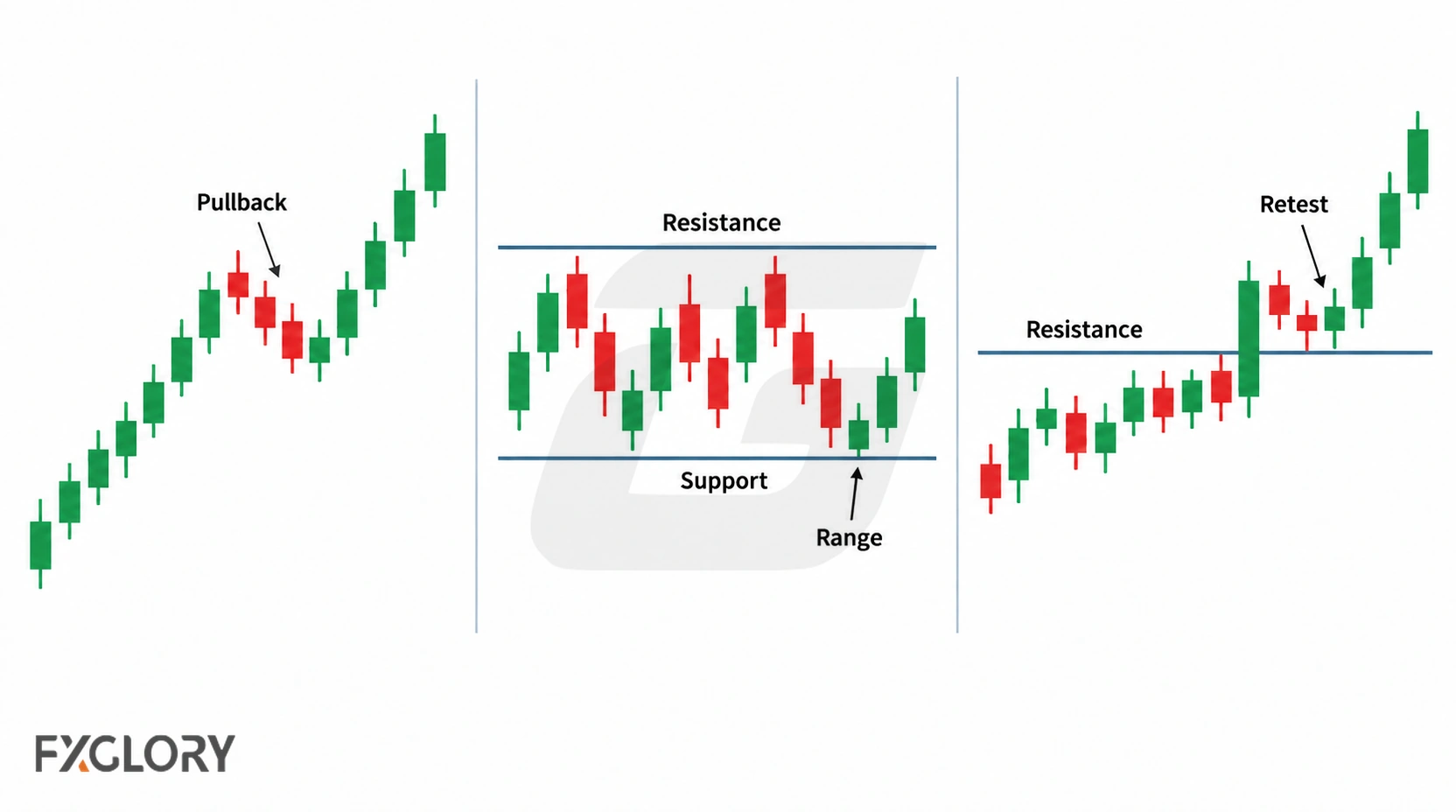
1. Trend Pullback Strategy
A trend pullback strategy starts with direction. The trader first checks whether the market is making higher highs and higher lows in an uptrend, or lower highs and lower lows in a downtrend. Then the trader waits for price to pull back instead of chasing after a move has already run.
- Condition: Price shows a visible trend rather than random movement.
- Watch area: A pullback toward prior structure, a trendline, or a moving average area.
- Trigger: Price stops moving against the trend and starts moving back with it.
- Invalidation: The pullback breaks the structure that made the trend idea valid.
- Skip rule: Skip when price is already far from the last clear risk area.
Before testing this method, review forex trend behaviour so the strategy is based on market direction, not only on hope that price continues.
2. Support-And-Resistance Range Strategy
A range strategy watches price rotate between visible support and resistance. Beginners often find simple price-action reactions easier to review when they happen at clear levels, but the reaction still needs invalidation and a skip rule.
- Condition: Price has reacted more than once from a support area and resistance area.
- Watch area: The edge of the range, not the middle.
- Trigger: Price reacts at the level and shows evidence that the boundary is still respected.
- Invalidation: Price breaks and holds beyond the range boundary.
- Skip rule: Skip if the range is messy, narrow, or sitting directly before major news.
Use support and resistance in forex as background for reading levels, while keeping the strategy focused on risk, not on drawing more lines.
3. Breakout-And-Retest Strategy
A breakout-and-retest strategy waits for price to move beyond a defined level and then checks whether the market respects that level from the other side. This can be easier for beginners than entering the first breakout candle because the retest gives more time to plan.
- Condition: Price compresses near a clear support or resistance area.
- Watch area: The broken level after price moves outside the structure.
- Trigger: Price retests the level and moves back in the breakout direction.
- Invalidation: Price returns inside the old range or fails to hold the retest area.
- Skip rule: Skip when the breakout is only a fast spike with no clear structure to manage risk.
Optional: Simple Indicator Confirmation
A simple indicator can help beginners describe what they already see on the chart. It should not replace the chart. For example, a moving average may act as a trend filter, and a moving-average crossover can be used as a simple confirmation tool only when market condition, invalidation, and spread impact are already defined. A crossover should confirm context, not act as a standalone reason to enter.
For indicator mechanics, use the forex technical indicators guide before adding any tool to a beginner strategy.
- Do not add indicators just because they are popular.
- Do not use several indicators that answer the same question.
- Do not enter only because an indicator changes color, crosses, or flashes a signal.
Beginner Strategy Comparison Table
This table compares three beginner strategy frameworks and an optional indicator-confirmation method by suitable market condition, risk, and first review question. The goal is to choose one framework to test, not to trade all of them at once.
| Strategy Or Supporting Method | Best Condition | Why Beginners Study It | Main Risk | First Review Question |
|---|---|---|---|---|
| Trend pullback | Clear directional movement | Direction and pullback area can be planned before entry. | Entering too late after the move is extended. | Was the trend still valid before entry? |
| Support-and-resistance range | Price rotating between levels | Invalidation can be easier to define near a boundary. | The range breaks and turns into trend movement. | Was the trade taken at the edge or in the middle? |
| Breakout-and-retest | Compression near a level | The retest can reduce impulsive chase entries. | False breakout or poor retest structure. | Did the level hold after the break? |
| Simple indicator confirmation | Clear price context plus one tool | The indicator can help describe trend, momentum, or volatility. | The indicator replaces market context. | Did the indicator have one clear job? |
Beginner-Suitability Table
This table compares beginner strategy candidates by rule burden, decision speed, cost sensitivity, risk clarity, and common failure mode. It does not rank strategies by performance.
| Strategy Or Method | Sample Complexity | Speed | Cost Sensitivity | Risk Clarity | Common Failure Mode |
|---|---|---|---|---|---|
| Trend pullback | Medium: trend, pullback area, trigger, and invalidation need to be marked repeatedly. | Moderate to slow, depending on timeframe. | Medium; wider stops may reduce spread impact, but late entries can weaken the plan. | High when trend structure and invalidation are written before entry. | Entering after the move is extended or treating any small dip as a pullback. |
| Support-and-resistance range | Low to medium: levels, boundary reaction, and range break rules need review. | Slow to moderate if trades are taken near range edges. | Medium to high when the range is narrow or the target is small. | High near clean boundaries; lower when price is in the middle of the range. | Trading the middle of the range or staying in after the boundary breaks. |
| Breakout-and-retest | Medium: level, breakout close, retest behavior, and failed-break rules need separation. | Moderate; the retest can slow the decision compared with chasing the first break. | High around fast moves, spread changes, and slippage-prone entries. | Medium to high when the broken level and failed-retest rule are clear. | Chasing the first spike or treating a false break as confirmation. |
| Simple indicator confirmation | Low for the signal, medium for context because the indicator still needs a defined role. | Depends on the chart timeframe and indicator setting. | Medium; small targets and late signals can increase cost pressure. | Medium when the indicator confirms a chart condition; low when it replaces context. | Adding indicators after losses or entering because a tool changes color without invalidation. |
| Fast scalping | High: entries, exits, cost checks, and emotional control must be very precise. | Very fast. | Very high because small targets can be heavily affected by spread and slippage. | Often low for beginners because decisions and exits happen quickly. | Overtrading, reacting late, or ignoring how costs affect a small target. |
| High-impact news trading | High: event timing, spread behavior, slippage, first reaction, and post-news confirmation need separate rules. | Very fast around the release. | Very high during volatile or illiquid conditions. | Low for beginners when the loss scenario changes during the release window. | Entering during unstable spreads or treating a headline reaction as a normal technical setup. |
Forex Strategies Beginners Should Usually Avoid First
Some strategies look simple because the rule sounds short. That does not make them beginner-friendly. A method can be easy to describe and still difficult to control.
- Fast scalping: Small targets can be heavily affected by spread, execution speed, and emotional pressure.
- High-frequency news trading: Price can move quickly, spreads can widen, and slippage can affect entries and exits.
- Grid and martingale-style recovery: Exposure can grow when price moves against the position.
- No-stop-loss methods: Risk may move into drawdown, margin pressure, or forced exit instead of disappearing.
- Universal strategy claims: Be careful with any method described as working on every pair, every session, or every market condition.
- Overloaded indicator systems: Too many signals can make the beginner less certain, not more disciplined.
How To Choose Your First Forex Trading Strategy
A beginner should choose the first strategy by fit, not by popularity. The strategy should match the time available, the market being watched, the size of the target, and the trader's ability to follow rules.
- Choose one market condition: Trend, range, or breakout. Do not mix all three at the start.
- Choose one or two pairs: Review available currency pairs and avoid jumping across too many markets while learning.
- Use a slower decision speed: Higher intraday or daily-chart review may be easier than one-minute or five-minute decisions because there is more time to check the setup.
- Match the method to screen time: If you cannot watch charts actively, avoid strategies that require constant reaction.
- Check spread sensitivity: The smaller the target, the more important the spread becomes.
- Define invalidation before entry: If there is no clear point where the idea is wrong, the trade is not ready.
- Keep tools limited: One clean chart condition plus one optional confirmation tool is easier to review than a crowded system.
- Write the rule in one sentence: If the method cannot be explained simply, it is probably not the first strategy to test.
Beginner Testing Workflow
Testing is where a simple forex trading strategy becomes useful or gets rejected. The goal is to find out whether the rules can be followed under realistic conditions.
- Write the rules: Condition, setup, entry trigger, invalidation, risk, exit, and skip rules.
- Use a written plan: A forex trading plan template helps keep the method separate from emotional decisions.
- Mark examples: Review charts and mark where the strategy was valid, invalid, or unclear.
- Practise before live trading: Review historical chart examples or practise in a demo environment, where available. Record the setup, entry, invalidation, exit, trading costs, skipped trades, and rule-following before risking real funds. An FXGlory account can be used to prepare the account workflow, but registration alone is not strategy testing.
- Check margin assumptions: Use the FXGlory margin calculator when position size and margin requirements need to be reviewed.
- Record outcomes: Track whether the rules were followed, not only whether the trade won or lost.
- Track difficult periods: Record losing streaks and unclear setups so the review includes weak conditions, not only clean examples.
- Review a group of trades: Do not change the strategy after one good or bad result.
Worked Example: Choosing A Beginner Strategy
Assume a beginner is watching a major currency pair near a clear resistance area. The trade idea should change based on the condition around that level.
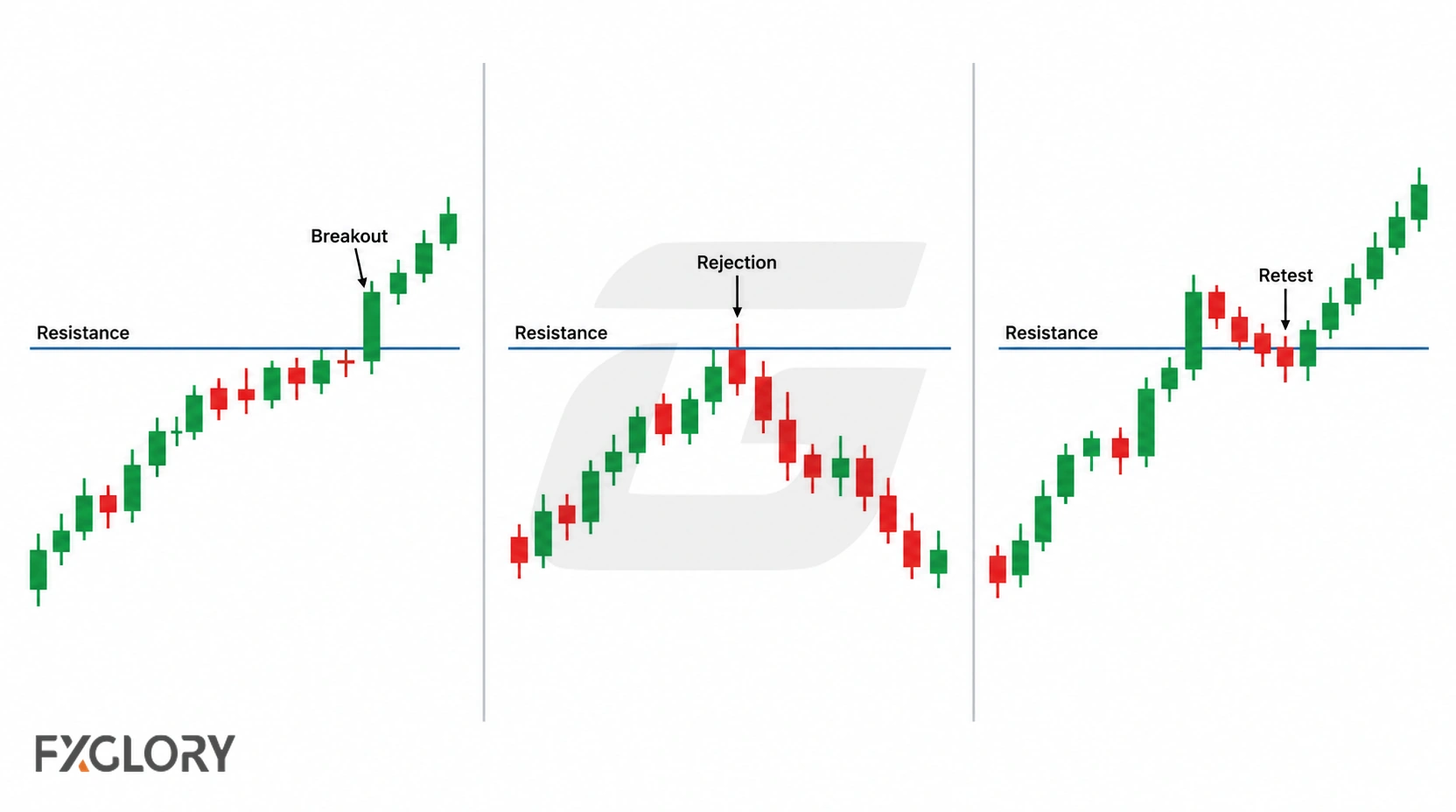
| What Price Does | Beginner Strategy To Consider | Why | Stand Aside If |
|---|---|---|---|
| Price keeps making higher lows below resistance | Breakout-and-retest | Compression may be building near the level. | The breakout is only a fast spike with no retest. |
| Price rejects resistance and returns toward support | Range strategy | The market may still be rotating between levels. | The range is too narrow after spread is considered. |
| Price breaks resistance, retests, then continues upward | Trend pullback or breakout-retest | The old resistance may become a planning area. | Price is already far from the retest and risk is unclear. |
Common Beginner Strategy Mistakes
Most beginner strategy problems come from unclear rules, too many tools, or trading before the setup is ready.
- Changing strategy too soon: One loss does not prove the method is broken, and one win does not prove it works.
- Trading in the middle of a range: Beginners often enter where risk is hardest to define.
- Chasing breakouts: A late entry can leave no clear invalidation point.
- Ignoring spread: A small target can look reasonable on the chart but become weak after trading cost.
- Using too much leverage: Position size should come from planned risk, not from available margin alone.
- Adding more indicators after losses: More tools can hide the real issue, which may be market condition or rule-breaking.
- Skipping review: Without a record, the trader cannot separate strategy weakness from execution mistakes.
Beginner Forex Strategy Checklist
Before testing any beginner forex trading strategy, answer these questions.
- Can the strategy be explained in one or two sentences?
- What market condition does it need?
- Which pair or small group of pairs will be watched?
- What exact event allows entry?
- Where is the trade idea invalid?
- How does spread affect the target?
- How is position size calculated?
- What closes the trade?
- When should the setup be skipped?
- How many trades will be reviewed before changing the rules?
A beginner strategy does not need to be complex. It needs to be clear, testable, controlled, and reviewed under realistic trading conditions.