

What Is The Best Forex Trading Strategy?
A strategy should be chosen after the market condition is clear. Trend, range, breakout, day-trading, swing, and carry-aware methods each need different conditions and risk checks.
A trend strategy can work poorly in a range. A range strategy can fail during a breakout. A day-trading method can become weak if spread and slippage are too large for the target. A swing strategy can be unsuitable for a trader who cannot tolerate overnight movement.
This page focuses on choosing the best method for a situation. For a broader map of strategy families, use the parent guide to forex trading strategies. If the question is about choosing a first method, use the beginner guide to forex trading strategies for beginners.
What Best Should Mean In Forex Strategy Selection
Searches for the best forex strategy, safest forex strategy, winning strategy, or proven strategy often point to the same need: traders want a method they can trust. A method should earn that trust through rules and review, not through a label.
- Best for the chart: The strategy fits the current condition instead of forcing a trade.
- Best for the trader: The method fits available screen time, experience, and emotional tolerance.
- Best for the cost structure: The target and stop still make sense after spread and possible slippage.
- Best for risk control: The position size is planned before entry and the loss scenario is known.
- Best for review: The rules are clear enough to judge after a group of trades.
Best Forex Strategy By Situation
The table below matches strategy types to conditions where they are easier to evaluate. It does not rank strategies from strongest to weakest.
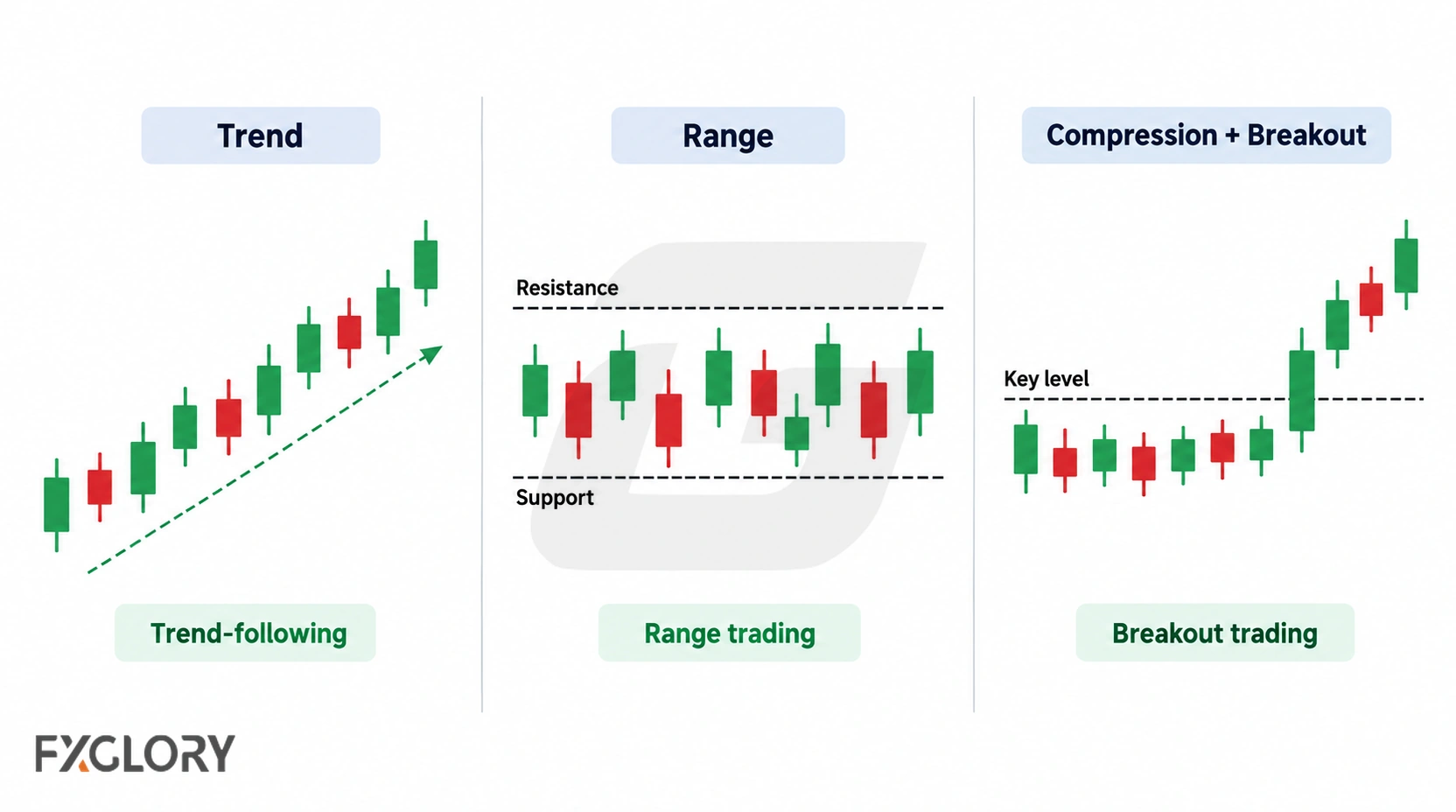
| Situation | Strategy To Compare First | Why It May Fit | Main Risk Filter |
|---|---|---|---|
| New trader choosing a first method | Trend pullback, range, or breakout-retest | The rules can be written and reviewed more easily. | Avoid fast decisions, unclear invalidation, and too many indicators. |
| Clear directional market | Trend-following or pullback strategy | The method works with visible market direction. | Do not chase after price is already extended. |
| Sideways market between visible levels | Range or mean-reversion strategy | Support and resistance can help define invalidation. | Skip if the range breaks or becomes too narrow after spread. |
| Compression near a key level | Breakout-and-retest strategy | The trader can wait for confirmation instead of entering the first spike. | False breakouts and news-driven moves can invalidate the setup quickly. |
| Intraday trader with screen time | Day-trading trend, range, breakout, or momentum method | The method can be planned around active sessions. | Spread, speed, overtrading, and daily loss limits matter heavily. |
| Trader with limited screen time | Swing or position-style strategy | The decision speed is slower and the chart can be reviewed less often. | Overnight movement, wider stops, and event exposure must be accepted. |
| Patient trader tracking macro context | Position or carry-aware method | The method can account for broader trend, rate context, and holding period. | Price movement, rollover, and event risk can outweigh the original idea. |
| Small target or short-term method | Only if spread and execution still leave room | Short-term methods need cost discipline. | The target may be too small after spread and slippage. |
| Risk-controlled approach | Any simple method with invalidation and position-size rules | Risk is defined before entry. | No strategy is controlled if exposure grows without a limit. |
Worked Example: Choosing The Best Method For One Situation
Assume a currency pair is trading near a visible resistance area. The best method changes with the condition around that level.
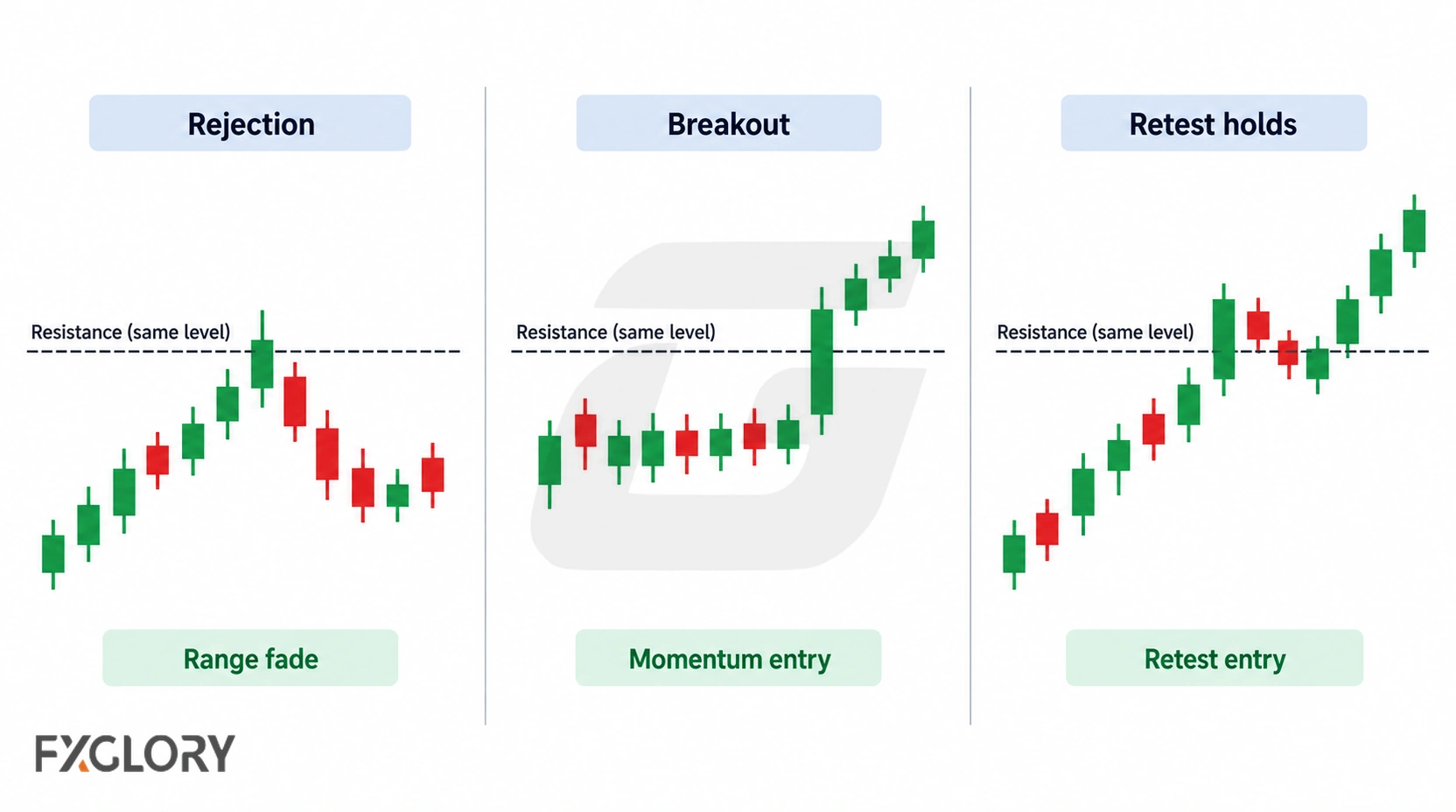
| Observed Condition | Better Method To Review | Reason | Stand Aside If |
|---|---|---|---|
| Price keeps making higher lows below resistance | Breakout-and-retest | Compression may be building before a possible level break. | The break is only a fast spike with no structure to manage risk. |
| Price rejects resistance and returns toward support | Range or mean-reversion | The level may still be part of a rotation area. | The range is too narrow after spread or the boundary breaks strongly. |
| Price breaks resistance, retests, and continues upward | Trend pullback or breakout-retest | The old resistance may become a planning area after the break. | Price is already far from the retest and the risk boundary is unclear. |
| Price moves sharply during a scheduled event | No trade or news-aware plan only | Fast movement can overpower normal technical rules. | Spread, slippage, or volatility makes the loss scenario unclear. |
Strong Strategy Candidates By Market Condition
The sections below compare candidate methods by fit. They are short by design so this page stays focused on selection rather than repeating the full strategy hub.
Trend-Following And Pullback Strategy
Best when: price is making visible directional progress and pullbacks remain controlled. Not best when: price is sideways, extended, or breaking the structure that made the trend valid.
Review forex trend behaviour before using trend as the reason for a trade.
Range And Mean-Reversion Strategy
Best when: price is rotating between visible support and resistance. Not best when: the range breaks, becomes too narrow after spread, or sits directly in front of major event risk.
Use support and resistance in forex as background for reading levels, but keep the trading rule focused on invalidation.
Breakout-And-Retest Strategy
Best when: price compresses near a clear level and then confirms beyond it. Not best when: the breakout is only a fast spike, the retest is unclear, or spread and slippage weaken the plan.
- Define whether a candle close, retest, or structure break is required.
- Skip the setup when the breakout is news-driven and risk cannot be defined.
- Check that spread and possible slippage do not weaken the reward-to-risk plan.
Price-Action Strategy
Best when: the chart has clean levels, visible structure, and a repeatable trigger. Not best when: the trader is relying on visual opinion without a written invalidation rule.
For the basic concept, review price action in forex. This page keeps the focus on when price action may be the best method, not on teaching every candle pattern.
Indicator-Supported Strategy
Best when: the indicator has one clear role, such as trend filter, momentum check, volatility measure, timing aid, or exit reference. Not best when: the signal replaces market context or conflicts with price structure.
Use the forex technical indicators guide when the tool itself needs more explanation.
Individual Review Summary
The table below summarizes selected educational reviews from individual strategy pages. It is not a new backtest for this page. Each row uses its own rule model, sample, timeframe, and cost assumptions, so the rows are context for strategy selection, not a ranking and not proof of future performance.
| Strategy Area | Individual Page Review | Baseline Summary | Selection Use |
|---|---|---|---|
| Trend and pullback | Forex Trend Trading Strategy and Forex Pullback Strategy | Trend trading: 195 trades, -0.0322R expectancy, -6.2703R total net. Pullback: 26 trades, -0.3802R expectancy, -9.8847R total net. | Use trend and pullback methods only when direction, pullback depth, stop distance, and cost assumptions are defined. |
| Range and mean reversion | Forex Range Trading Strategy and Forex Mean Reversion Strategy | Range trading: 198 trades, -0.3108R expectancy, -61.5361R total net. Mean reversion: 389 trades, -0.0426R expectancy, -16.5556R total net. | Use range logic only when boundaries, invalidation, and spread-adjusted target room are clear. |
| Breakout and retest | Forex Breakout Strategy and Break and Retest Strategy Forex | Breakout: 32 trades, -0.0898R expectancy, -2.8741R total net. Break and retest: 98 trades, -0.3951R expectancy, -38.7201R total net. | Use breakout rules only after defining confirmation, false-break handling, and same-candle stop-first logic. |
| Reversal and counter-trend | Forex Reversal Strategy and Forex Counter Trend Strategy | Reversal: 247 trades, -0.2127R expectancy, -52.5444R total net. Counter-trend: 26 trades, -0.4540R expectancy, -11.8049R total net. | Use reversal logic only when the failure condition is written before entry. |
| Indicator and confirmation | Forex Indicator Strategies and Forex Multiple Time Frame Analysis | Indicator model: 26 trades, 0.0633R expectancy, 1.6452R total net. Multiple-timeframe model: 16 trades, 0.0111R expectancy, 0.1783R total net. | Use indicator rules as filters or confirmation tools, not as a replacement for risk, invalidation, and cost checks. |
| Timeframe selection | Best Time Frame to Trade Forex | Same-rule timeframe comparison: 2,345 trades, -0.4310R expectancy, -1010.8095R total net across the compared timeframe set. | Use timeframe choice to study signal frequency, stop distance, holding time, and cost sensitivity, not to label one chart as universal. |
| Day trading | Forex Day Trading Strategy and Best Time Frame for Day Trading Forex | Same-day day trading model: 457 trades, -0.4516R expectancy, -206.3861R total net. 1H-15M-5M workflow: 640 trades, -0.3969R expectancy, -254.0399R total net. | Use intraday methods only with session rules, daily risk limits, spread checks, and no-overnight rules when required. |
| Scalping | Forex Scalping and Best Time Frame for Forex Scalping | Scalping backtest: 331 trades, -0.5399R expectancy, -178.6961R total net. Scalping timeframe cost-feasibility study: 2.15% baseline cost-adjusted target survival. | Use small-target methods only after checking whether spread and slippage leave enough target room. |
| News and calendar events | Forex News Trading Strategy and Economic Calendar Forex Strategy | Post-news waiting-period model: 16 trades, 0.3886R expectancy, 6.2175R total net. Economic-calendar model: 53 trades, -0.1011R expectancy, -5.3569R total net. | Use event-based methods only with event timing, spread, slippage, whipsaw, and no-trade rules defined. |
| Fundamental and central-bank context | Forex Fundamental Strategy and Central Bank Forex Strategy | Macro-event bias filter: 3,789 unique pair-bias observations with 54.53% one-day directional alignment. Central-bank timing study: 296 unique event-pair observations with continuation below 50% across tested windows. | Use macro context as a filter or study input, not as a stand-alone proof of trade direction. |
| Setup and full-system gates | Forex Trading Setups and Forex Trading System | Setup workflow: 153 trades, -0.1575R expectancy, -24.0915R total net. Full-system gate stack: 42 trades, -0.0521R expectancy, -2.1883R total net after 409 setup candidates and 42 accepted trades. | Use setup and system pages to define market gates, trigger rules, risk gates, cost gates, exposure gates, exits, and review logic. |
What Is The Best Strategy For Forex Day Trading?
Day trading is a trading style, not a single strategy. A day trader may use trend continuation, breakout-retest, range rotation, momentum, or news-aware methods. The chosen method must fit intraday volatility, session timing, spread, and the trader's ability to monitor the position.
If a trader cannot monitor charts during the active session, day trading is usually a poor fit even when the strategy looks simple.
| Day-Trading Method | Best Fit | Main Risk |
|---|---|---|
| Intraday trend continuation | Clear session direction | Late entries after the move is extended |
| Breakout-retest | Compression near a session level | False breakouts and fast reversals |
| Range rotation | Stable intraday support and resistance | Breakout against the range trade |
| Short-term momentum | Active session movement | Overtrading and spread sensitivity |
Before testing short-term methods, review FXGlory spreads because small targets can be affected heavily by trading cost.
What Is The Safest Forex Trading Strategy?
No forex strategy is completely safe. A safer approach is a risk-defined approach. The trader knows the invalidation point, calculates position size, checks margin, and avoids methods where exposure grows without a clear limit.
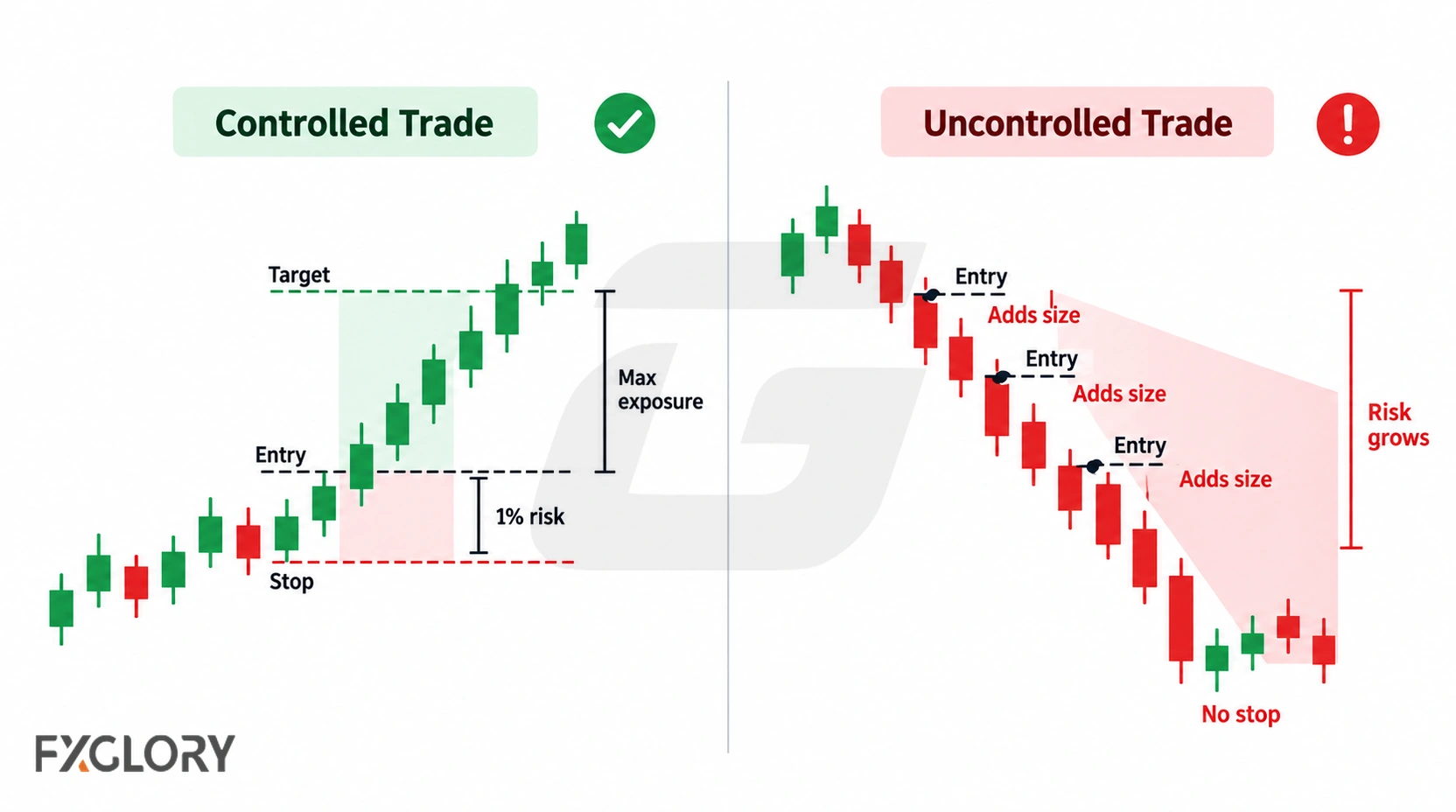
- Not controlled: A method that promises certainty or hides the loss scenario.
- More controlled: A method with written entry, invalidation, stop logic, position size, and skip rules.
- Not controlled: Increasing position size after losses without a maximum exposure rule.
- More controlled: Testing a fixed risk model and reviewing losing streaks before live trading.
- Not controlled: Using high leverage because margin is available.
- More controlled: Reviewing leverage conditions and calculating exposure before choosing trade size.
What Makes A Forex Strategy Work?
A forex strategy that works is not one that wins every trade. It is a method that can be repeated, tested, reviewed, and controlled through both strong and weak conditions, including losing streaks and unclear setups.
A strategy should be reviewed under the same trading conditions the trader expects to use, including spread, margin, leverage, and order workflow.
- Market condition: The strategy says when the chart is suitable.
- Entry trigger: The trade starts only after a defined event.
- Invalidation: The trader knows where the idea is wrong.
- Position size: The planned loss is connected to stop distance and account exposure.
- Trading cost: Spread and possible slippage are considered before judging the target.
- Platform workflow: The trader can place, manage, and review orders without confusing the rules.
- Review sample: The method is judged over a group of trades, not one result.
Use a forex trading plan template to keep the method written. Use the FXGlory margin calculator when margin requirements need to be checked before testing position size.
Forex Methods That Sound Best But Need Caution
Some methods sound powerful because they use strong language: proven, safest, guaranteed, high-win-rate, no-loss, or works on every pair. The wording does not make the method reliable.
A powerful strategy is not one with dramatic claims. It is one with repeatable rules, controlled exposure, and reviewable results.
A strategy is not proven by a screenshot, a forum post, or one winning sequence. It needs repeated review across normal, weak, and losing conditions.
- No-stop-loss methods: Risk may move into drawdown, margin pressure, or forced exit instead of disappearing.
- Martingale or recovery systems: Exposure can grow while the market keeps moving against the position.
- Grid without exposure limits: A trending market can create a position set that is difficult to control.
- High-win-rate claims: A high win rate can still lose money if losses are much larger than wins.
- Universal strategy claims: A method should be reviewed on each pair, timeframe, and trading condition before use.
- Overloaded systems: Too many indicators can create conflict instead of better decisions.
How To Choose Your Best Forex Trading Method
Choose the method by fit. A good forex trading strategy should match the market being traded, the time available, and the risk that can be controlled.
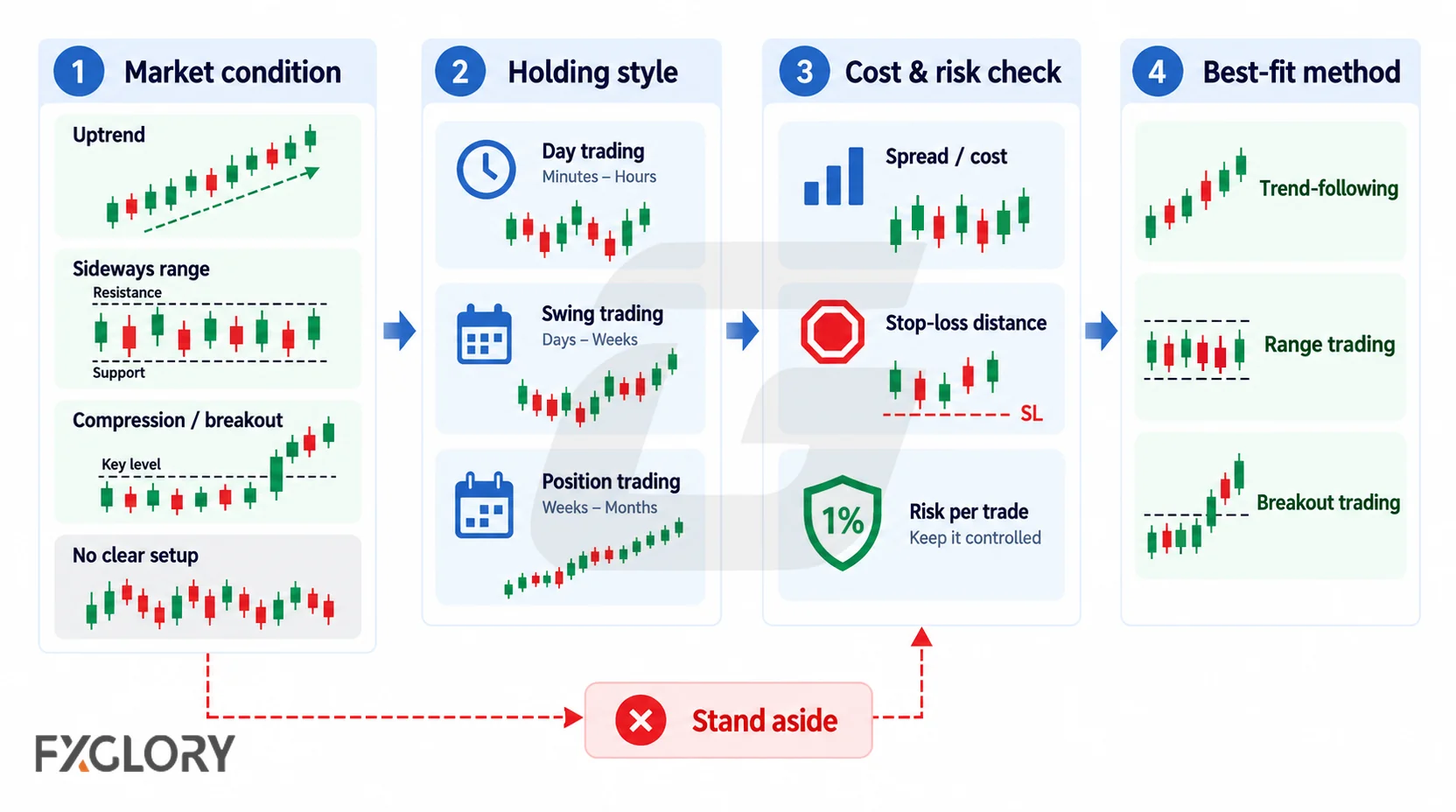
- Pick the condition first: Trend, range, breakout, news, or unclear market.
- Pick the holding style: Intraday, swing, position, or carry-aware exposure.
- Choose a small watchlist: Review available currency pairs instead of applying one method everywhere at once.
- Check trading cost: Small targets need stronger spread awareness.
- Check margin and leverage: Position size should come from planned risk, not from available exposure alone.
- Choose the tools: Price action, indicators, support and resistance, or fundamental context should each have a defined role.
- Write the skip rules: Stand aside when the chart is unclear, spread is abnormal, news risk dominates, or invalidation cannot be defined.
Testing Checklist Before Calling A Strategy Best
A strategy should be tested before it is treated as the best method for a trader. Testing should include clean examples, unclear examples, losing periods, and execution conditions.
- Can the full rule set be written in plain language?
- Does the strategy define the market condition before the entry?
- Is the invalidation point clear before the trade opens?
- Does the target still make sense after spread and possible slippage?
- Is margin use checked before position size is chosen?
- Can the trader follow the method without constant screen pressure?
- Were losing streaks reviewed, not only winning examples?
- Are rule-breaking trades separated from valid strategy trades?
- Does the method still make sense on the chosen pair or timeframe?
Review FXGlory trading platforms when the strategy needs specific charting, indicator, order-placement, or trade-management workflow. Create an FXGlory account to prepare the workflow before placing a real-money trade.
Final Answer: The Best Strategy Is The One You Can Control
The best strategy is the one that fits the market condition, defines the loss scenario, uses realistic position size, accounts for spread and margin, and can be reviewed after a group of trades.