
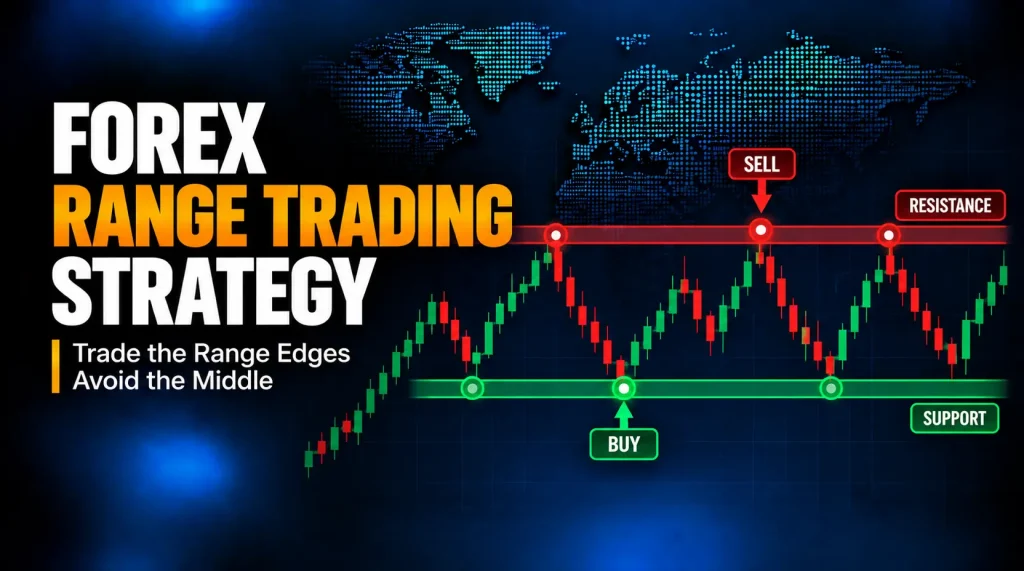
What Is A Forex Range Trading Strategy?
A forex range trading strategy is a trading method used when price moves sideways between a lower support zone and an upper resistance zone. Instead of following a strong trend, the trader reviews whether price is repeatedly reacting inside a defined area.
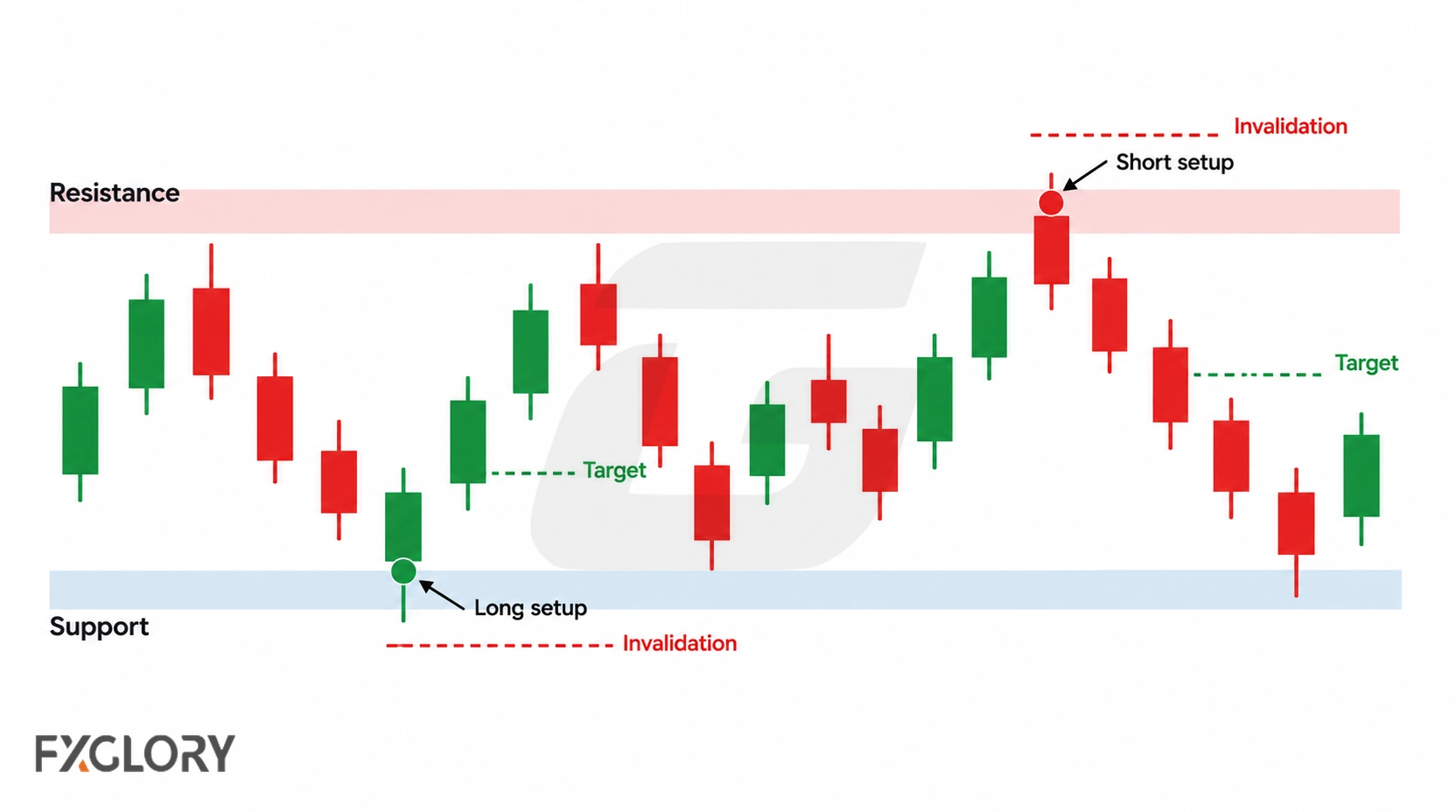
The range itself is only the market condition. A trader still needs a valid range, an edge location, entry confirmation, invalidation, stop placement, target logic, spread check, position sizing, and a rule for when the range has failed.
This page focuses on range-specific decisions: how to identify range quality, why the middle of the range is usually weak, how support and resistance zones are used, which indicators can help, and when breakout behavior should cancel the range idea.
Range vs Trend vs Breakout
A range, a trend, and a breakout are different market conditions. A range trader should not use the same rules when price starts building directional structure or when price breaks and holds beyond the range boundary.
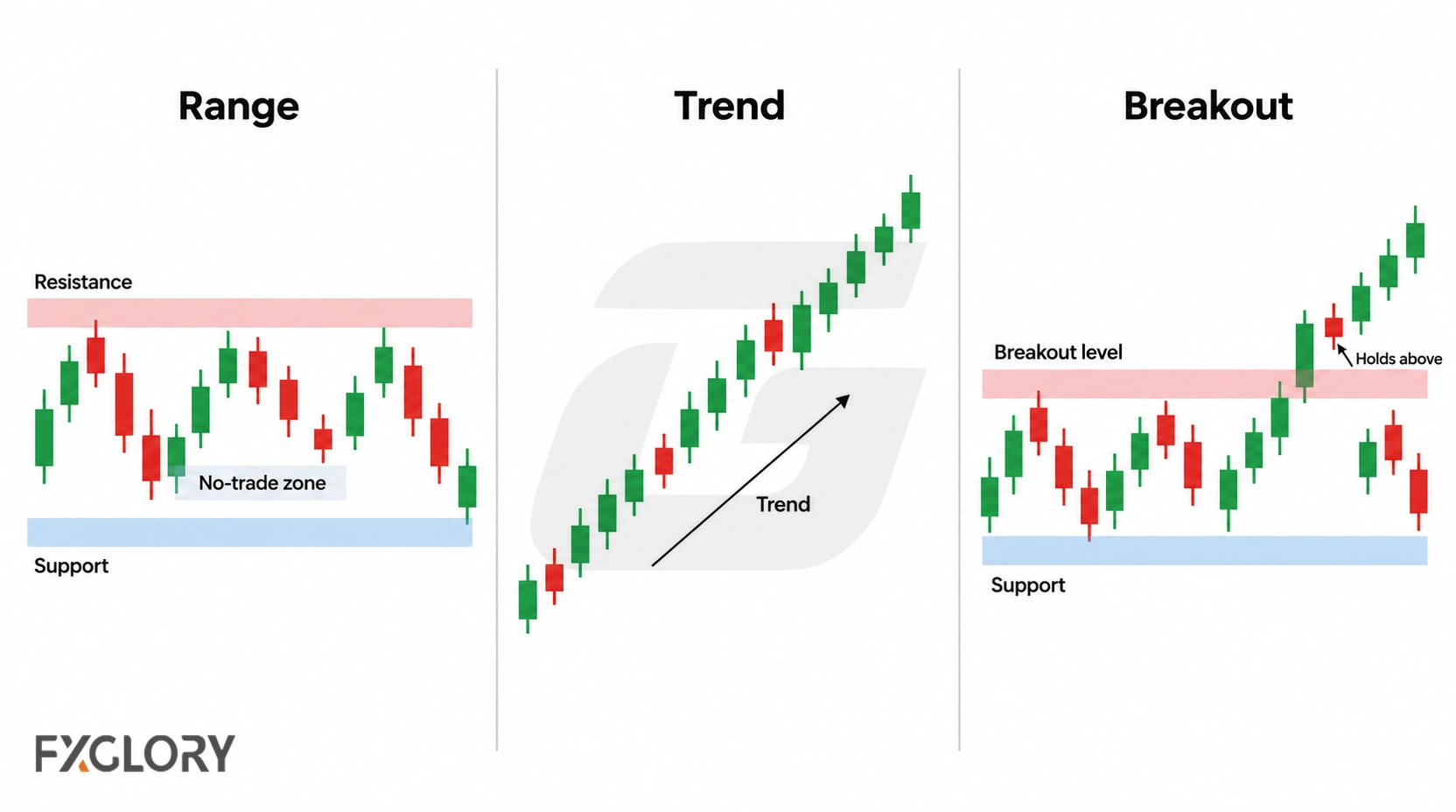
Range trading works best as a sideways-market framework. If price begins making higher highs and higher lows, lower highs and lower lows, or holds outside the range after a breakout, trend or breakout logic may become more relevant.
| Condition | What It Looks Like | Better Strategy Focus | Weak Use |
|---|---|---|---|
| Range | Price reacts between support and resistance without clear direction | Range-edge entries, midpoint caution, breakout cancel rules | Buying or selling in the middle of the range |
| Trend | Price forms directional structure such as higher highs and higher lows or lower highs and lower lows | Trend entries, pullbacks, continuation, trailing exits | Using range reversals against a strong trend |
| Breakout | Price breaks and holds outside the range boundary | Breakout confirmation, retest, fakeout rules, new structure | Continuing to fade the range edge after it fails |
When price starts behaving directionally, use the trend trading framework. When price breaks and holds outside the range, use the breakout strategy guide to review fakeout, retest, and invalidation rules.
Range vs Range Trade
A range is a price condition. A range trade is a planned decision. This distinction keeps the trader from entering simply because price has touched a line.
| Item | What It Means | Why It Is Not Enough Alone |
|---|---|---|
| Range | Price moves between a support zone and resistance zone | The range may be unclear, too tight, or close to breaking |
| Range edge | Price reaches support or resistance inside the range | A touch does not confirm that price will reverse |
| Range trade | The trader has an edge location, confirmation, stop, target, risk limit, and breakout cancel rule | The plan can still be invalid if spread, volatility, or structure changes |
For the full entry-and-exit chain behind a range trade, use the entry and exit strategy guide. A range entry should already have a stop, target, midpoint or time rule, and invalidation point.
How To Identify A Valid Forex Range
A valid forex range should be visible before the trade is planned. The trader should be able to mark the support and resistance zones without forcing lines through random reactions.
The range also needs enough width. A range can look clean on a chart but still be unsuitable if spread and stop distance leave little room for the target.
| Range Check | Better Version | Weak Version |
|---|---|---|
| Repeated reactions | Price has reacted around both support and resistance zones more than once | One bounce is treated as a full range |
| Clear boundaries | Support and resistance zones can be marked before entry | Boundaries are redrawn after every candle |
| Sideways structure | Price is not clearly building a trend | Range rules are used during a directional move |
| Enough width | The distance between support and resistance leaves room after spread | The range is too tight for cost and stop logic |
| Stable conditions | Volatility is not suddenly expanding beyond the range plan | Trader fades the edge during a breakout or news-driven move |
| Defined invalidation | The trader knows where the range idea is wrong | Stop is chosen after price breaks the range edge |
Common Forex Range Types
Not every forex range is a clean rectangle. Some ranges have clear horizontal boundaries, while others are irregular, expanding, contracting, tied to a session window, or formed after a prior trend. The range type affects entry quality, stop placement, target planning, and breakout risk.
| Range Type | What It Looks Like | Useful Focus | Main Risk |
|---|---|---|---|
| Rectangular range | Price reacts between relatively clear horizontal support and resistance zones | Edge entries, midpoint caution, opposite-boundary targets | Trader assumes the range will last forever |
| Irregular range | Boundaries are uneven, messy, or harder to define | Stricter confirmation or skip rule | Support and resistance are forced after price moves |
| Expanding range | Swings become wider and boundaries stretch outward | Volatility and stop-distance review | Stops and targets become harder to plan |
| Contracting range | Price compresses into narrower swings | Breakout-risk monitoring | Trader enters before expansion direction is clear |
| Session range | Range forms during a defined intraday window or lower-activity period | Session timing, spread, and range width | New session activity breaks the range |
| Post-trend range | A prior trend pauses and price starts moving sideways | Watch for continuation, reversal, or failed edge behavior | Trader keeps using old trend logic or fades a new breakout |
Range Quality Checklist
Range quality matters because a weak range can create repeated small losses. The best range trades usually start near a clean edge, have space back toward the middle or opposite side, and include a clear rule for when the range has failed.
| Range-Quality Check | Why It Matters | No-Trade Warning |
|---|---|---|
| Support and resistance are zones | Forex price can pierce a level before returning inside | Trader treats one exact price as guaranteed support or resistance |
| Midpoint is avoided | The middle has weaker stop and target structure | Trader enters because price feels halfway cheap or expensive |
| Range is wide enough | Spread and stop distance must leave useful room | Target is too small after cost |
| Volatility is contained | Range logic depends on price respecting boundaries | Expanding candles suggest breakout risk |
| Trend strength is not rising sharply | Directional pressure can end the range | ADX, structure, or momentum warns that price may trend |
| Reaction quality is visible | Edges show repeated rejection or hesitation | Price slices through both sides without respect |
| News risk is controlled | Fast event moves can break range assumptions | Range entry is taken into a high-volatility event without rules |
Forex Range Trading Decision Sequence
A forex range strategy should follow the same order each time. If the trader starts with an oscillator signal and draws the range afterward, the trade cannot be reviewed clearly.
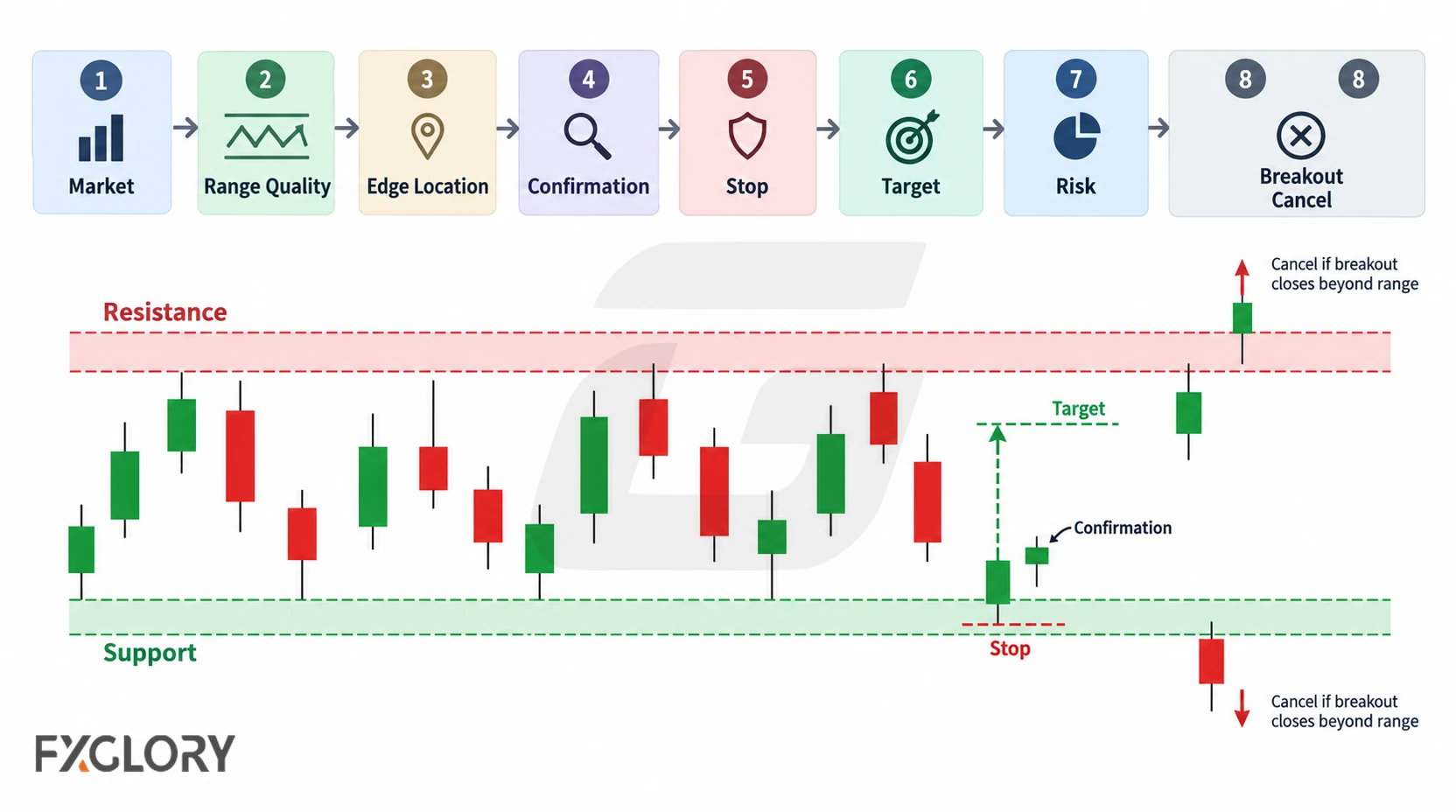
| Step | Decision | Continue Only If |
|---|---|---|
| 1. Market condition | The market is ranging, trending, breaking out, or unclear | The condition supports range trading |
| 2. Range quality | Support and resistance zones are visible before entry | The range is not forced after price reacts |
| 3. Edge location | Price is near support or resistance, not in the middle | The entry area gives measurable invalidation and target room |
| 4. Confirmation | Price rejects, closes, stalls, or reacts under a written rule | The entry is not early, late, or forced |
| 5. Stop | The invalidation point is known before entry | The stop is outside the zone or based on volatility |
| 6. Target | The target is midpoint, prior reaction, opposite edge, or time rule | The target still makes sense after spread |
| 7. Risk | Position size, margin, and daily risk fit the account rules | The trade does not break risk limits |
| 8. Breakout cancel rule | The trade is skipped or exited if price breaks and holds outside the range | The trader does not keep fading a failed range |
Buying Support And Selling Resistance
The core range method is simple to describe but difficult to execute well: traders may look for long setups near support and short setups near resistance while the range remains valid.
The word near matters. Support and resistance are zones. A price spike outside the line does not automatically destroy the range, but a clear break and hold outside the zone may invalidate the range trade.
| Range Edge | Possible Trade Logic | Weak Version |
|---|---|---|
| Support zone | Look for a long setup only if price reacts near support and the range remains valid | Buy every touch even when support keeps weakening |
| Resistance zone | Look for a short setup only if price reacts near resistance and the range remains valid | Sell every touch even when resistance keeps weakening |
| Zone pierce | Review whether price rejects the area and returns inside the range | Assume every pierce is a fakeout |
| Repeated test | Check whether each test is weakening the edge or still respecting it | Ignore edge fatigue after several attempts |
| Opposite edge target | Use the other side of the range only if there is enough room after spread | Assume price must reach the full opposite boundary |
Mid-Range No-Trade Zone
The middle of a range is often the weakest location for a range trade. Price is away from both support and resistance, which can make the stop less clear and the target less attractive.
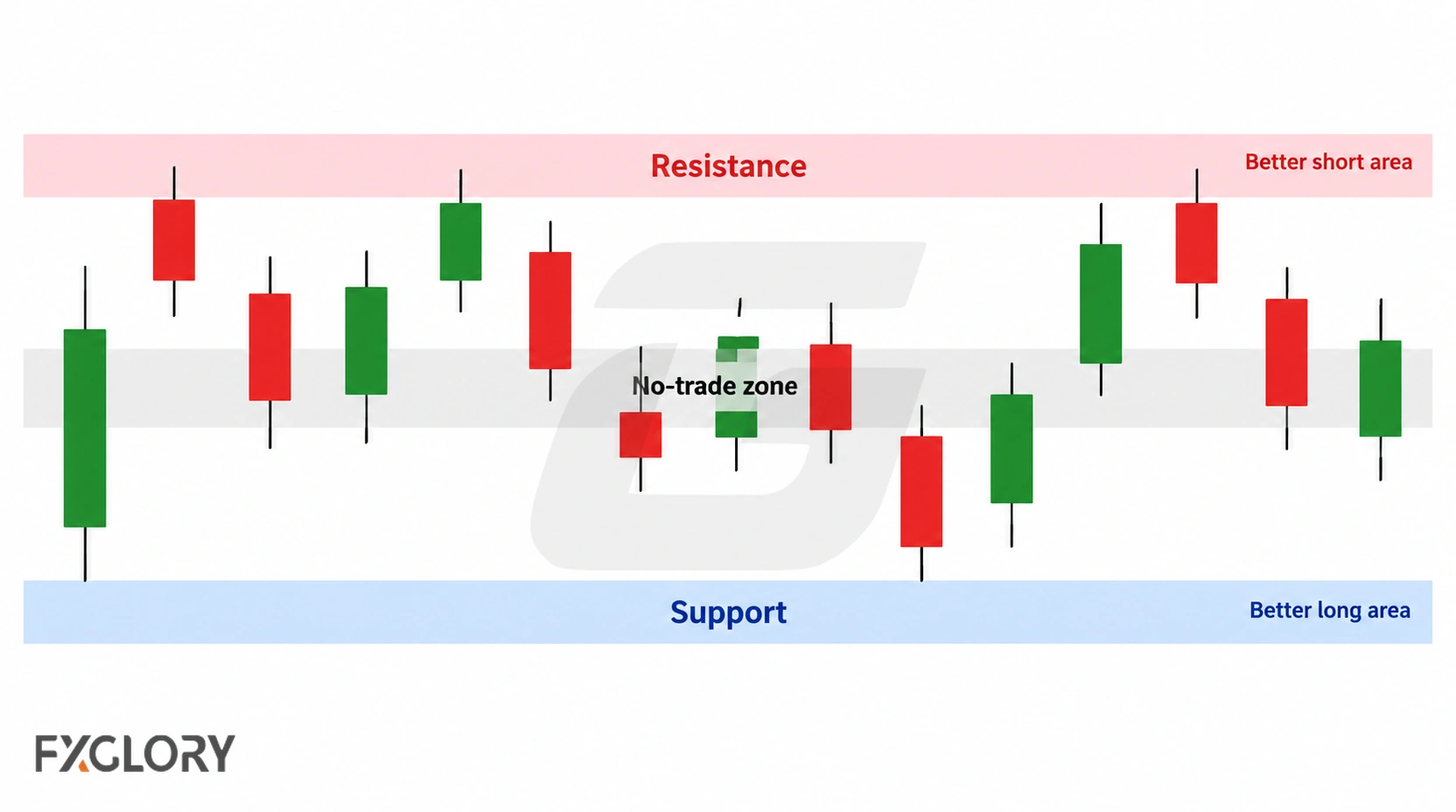
A mid-range entry can also trap the trader between two competing ideas. It is no longer close enough to support for a clean long setup, and not close enough to resistance for a clean short setup.
| Location | Decision Quality | Common Mistake |
|---|---|---|
| Near support | Long idea can be reviewed if support holds and confirmation appears | Buying without a stop beyond invalidation |
| Near resistance | Short idea can be reviewed if resistance holds and confirmation appears | Selling without checking breakout pressure |
| Middle of the range | Usually weaker because stop and target are less defined | Entering because the trader is impatient |
| Outside the range | Range idea may be invalid or in breakout/fakeout review | Fading the breakout without a written failure rule |
Indicators For Forex Range Trading
Indicators can help review range conditions, but they should not replace support and resistance structure. A range indicator should answer one question: is price stretched, is volatility contained, is directional strength weak, or is price reacting near a planned edge?
| Indicator | Range Role | Weak Use |
|---|---|---|
| RSI | Reviews overbought or oversold conditions near range edges | RSI is traded in the middle of the range or during a trend |
| Stochastic | Reviews short-term timing around support or resistance | Every cross becomes a trade without range structure |
| Bollinger Bands | Reviews volatility, band reactions, and possible squeeze conditions | Every band touch is treated as a reversal |
| ADX | Reviews whether directional strength is weak or rising | ADX is used as a buy or sell signal |
| ATR | Reviews whether volatility is low, expanding, or too small for target logic | ATR is treated as direction or used to justify a poor range trade |
| CCI | Reviews stretched conditions or momentum shifts inside the range | Used without support, resistance, or invalidation |
| Pivot points | Reviews possible intraday support, resistance, or reaction areas | Every pivot touch becomes a trade |
For RSI-specific structure, use the RSI forex trading strategy page. For band reactions and volatility compression, use the Bollinger Bands forex strategy guide. When directional strength becomes the key filter, review the ADX forex trading strategy page. For volatility and stop-distance review, use the ATR forex strategy framework.
False Breakouts And Range Breaks
Every range eventually needs a rule for what happens at the edge. Sometimes price briefly pierces support or resistance and returns inside. Other times price breaks, holds outside, and the range condition may be over.
A range trader should not decide this emotionally after price moves. The breakout or false-breakout rule should be written before entry.
| Edge Behavior | Possible Meaning | Range-Trading Response |
|---|---|---|
| Brief spike outside and return inside | Possible false breakout or liquidity sweep | Review only if the written fakeout rule allows it |
| Close outside the range | Range may be weakening or breaking | Stop fading the edge unless the strategy has a retest rule |
| Hold outside the range | Breakout structure may be forming | Switch to breakout review or stand aside |
| Retest from outside | Old support or resistance may change role | Use breakout or pullback rules, not normal range rules |
| Repeated edge attacks | Support or resistance may be weakening | Reduce trust in the edge and wait for clearer behavior |
For complete breakout logic, including retests, fakeouts, and failed breaks, use the forex breakout strategy guide. If price breaks out and then retests the old range edge, the pullback strategy guide can help review the new structure without forcing old range rules.
Stop, Target, And Exit Rules
A range trade should define stop, target, and exit logic before entry. If the stop appears only after the edge fails, the trader is reacting instead of following a plan.
| Rule Area | Possible Range Rule | Weak Version |
|---|---|---|
| Stop near support | Stop is placed beyond the support zone or volatility invalidation area | Stop is placed too close inside normal range noise |
| Stop near resistance | Stop is placed beyond the resistance zone or volatility invalidation area | Stop is widened after price breaks resistance |
| Midpoint target | Part of the trade may be reviewed or closed near the range midpoint | Midpoint is ignored even when price stalls |
| Opposite boundary target | Target is planned near the other side of the range if room remains | Trader assumes price must travel the full range |
| Partial exit | Part of the trade is closed at a planned area and the rest is managed by rule | Partial exit is used randomly because the trader is nervous |
| Time rule | Trade is reviewed or closed if price does not move away from the edge within the planned window | A stalled range trade becomes an unplanned hold |
| Breakout exit | Exit or cancel when price breaks and holds beyond the range edge | Trader keeps fading a failed edge |
Short-term range targets can be sensitive to cost. Check the spread conditions that affect trade planning before accepting a small target. When stop distance, position size, leverage exposure, and margin need to be reviewed together, use the margin calculator before the order is placed.
Forex-Specific Cost, Spread, And Volatility Rules
Forex range trading is cost-sensitive because many range targets are limited by the distance between support and resistance. A range that looks tradable before costs may become weak after spread, stop distance, and nearby obstacles are included.
Volatility also matters. A quiet range may offer too little movement. A sudden expansion may turn the range into a breakout environment. The trader should check whether current conditions still match the range plan before entering.
| Forex-Specific Check | Why It Matters | Action |
|---|---|---|
| Spread vs range width | Spread can consume too much of a small target | Skip if the range is too narrow after cost |
| Stop distance vs target | A stop beyond the edge may be too wide for the likely target | Resize, wait, or skip |
| Volatility expansion | Fast candles can signal breakout conditions | Stop using normal range rules |
| Thin or inactive conditions | Movement may be too limited for the plan | Wait for clearer range behavior |
| News-event window | Spread and volatility can change quickly | Follow the event-risk rule |
| Correlated exposure | Several range trades can create the same currency exposure | Review overlapping risk before entry |
Why Forex Range Strategies Fail
Range strategies often fail when the trader keeps using range logic after the range has already weakened. Another common failure is entering in the middle of the range because the trader does not want to wait for a clean edge.
| Failure Reason | What Happens | Better Rule |
|---|---|---|
| Weak range | Support and resistance were never clearly defined | Trade only ranges that can be marked before entry |
| Mid-range entry | Stop and target become unclear | Wait for support or resistance |
| Ignoring breakout | Price breaks and holds outside but trader keeps fading the edge | Use the breakout cancel rule |
| Oscillators used in trends | RSI or Stochastic stays stretched while price keeps trending | Confirm the market is range-bound first |
| Stop too tight | Normal range noise knocks the trade out | Place stop where the range idea is invalid, then size accordingly |
| Range too narrow | Spread and stop distance leave little usable room | Skip if target is weak after cost |
| Overtrading edges | Every touch becomes a new trade | Limit trades to planned setups and risk rules |
| Daily stop ignored | More attempts become recovery trades | Stop trading when the risk limit is reached |
Risk Rules And No-Trade Conditions
Range trades can look controlled because support and resistance are visible, but visible boundaries do not remove breakout, spread, volatility, or account-risk problems. A range setup should be rejected when the edge, stop, target, or market condition no longer supports the trade.
| No-Trade Condition | Why It Matters | Action |
|---|---|---|
| Range is unclear | The trader may be forcing support and resistance after price moves | Skip until boundaries are clear |
| Price is in the middle | Stop and target structure are usually weaker | Wait for a range edge |
| Range is too tight after spread | Cost can damage the expected target | Skip the setup |
| Edge keeps weakening | Repeated tests can reduce confidence in support or resistance | Wait for clearer reaction or stand aside |
| Price breaks and holds outside | The range condition may be over | Stop using range rules |
| Stop is unclear | The trader cannot define where the range idea is wrong | Do not enter |
| Volatility expands | The market may be shifting from range to breakout behavior | Use breakout rules or skip |
| News or event risk changes conditions | Spread, speed, and slippage can change quickly | Follow the event-risk rule |
| Correlated exposure builds | Several positions may create the same currency risk | Reduce or avoid overlapping exposure |
| Daily stop reached | More range trades can become recovery attempts | Stop trading for the session |
| Recovery motive appears | The trade exists because the trader wants to recover a prior loss | Step away and review the plan |
For account-level risk rules, use the forex risk-management strategy page. For charting, indicator layout, stop workflow, and trade management tools, review FXGlory trading platforms.
Backtesting Notes For Forex Range Trading Strategy
This hypothetical educational model uses one daily range-edge rule: a 30-candle horizontal range, an ADX range filter, an EMA slope filter, edge-zone rejection confirmation, ATR-based stop placement, a midpoint target comparison, a breakout-failure exit, and spread/slippage sensitivity. It does not test RSI ranges, Bollinger Band touches, pivot ranges, session ranges, false-breakout systems, or discretionary support and resistance fades.
The model reviews EURUSD, GBPUSD, USDJPY, AUDUSD, USDCAD, and USDCHF on daily candles using public yfinance OHLC data where available. The range high, range low, midpoint, edge zones, stop, target, and breakout-failure level are defined before the simulated entry.
| Rule Area | Educational Model Rule |
|---|---|
| Strategy type | Daily horizontal range-edge fade |
| Range high | Highest high of the previous 30 completed daily candles |
| Range low | Lowest low of the previous 30 completed daily candles |
| Valid range width | At least 1.50 ATR(14) and no more than 5.00 ATR(14) |
| Range condition filter | ADX(14) no more than 22, with absolute EMA(50) slope over 10 completed daily candles no more than 0.50 ATR(14) |
| Lower edge zone | Lower 20% of the 30-candle range |
| Upper edge zone | Upper 20% of the 30-candle range |
| Long confirmation | Signal candle trades into the lower edge zone, does not pierce more than 0.20 ATR(14) below the range low, closes back above the lower edge line, and closes above its open |
| Short confirmation | Signal candle trades into the upper edge zone, does not pierce more than 0.20 ATR(14) above the range high, closes back below the upper edge line, and closes below its open |
| Entry | Next daily open after the completed signal candle |
| Stop | Beyond the range boundary with a 0.25 ATR(14) buffer |
| Target comparison | Range midpoint |
| Trade-quality filter | Entry-to-midpoint target distance must be at least 0.80R |
| Breakout-failure exit | Exit at daily close if price closes outside the range boundary against the trade after entry |
| Maximum holding review | 15 daily candles after entry |
The review records trade count, win rate, average win in R, average loss in R, expectancy in R, profit factor, maximum drawdown in R, worst losing streak, average holding period, pair-level behavior, direction-level behavior, exit reasons, and spread/slippage sensitivity.
| Cost Input | Assumptions Used |
|---|---|
| Spread | 0.5, 1.5, and 3.0 pips |
| Slippage | 0.1, 0.5, and 1.0 pips per side |
| Baseline comparison | 1.5-pip spread and 0.5-pip slippage per side |
| Swap and rollover | Not included |
Educational Sensitivity-Test Results
The hypothetical backtest used public yfinance daily OHLC data from 2016-06-29 through 2026-06-29 where available. The baseline cost assumption used a 1.5-pip spread and 0.5-pip slippage per side. The baseline result was negative, with expectancy of -0.3108R and total net result of -61.5361R.
| Metric | Baseline Result |
|---|---|
| Number of trades | 198 |
| Win rate | 29.8% |
| Average win | 1.3814R |
| Average loss | -1.029R |
| Expectancy | -0.3108R |
| Profit factor | 0.5698 |
| Maximum drawdown | -62.5016R |
| Worst losing streak | 15 |
| Average holding period | 4.32 daily candles |
| Median holding period | 3.0 daily candles |
| Total net result | -61.5361R |
| Pair | Trades | Win Rate | Expectancy | Profit Factor | Max Drawdown | Total Net R |
|---|---|---|---|---|---|---|
| EURUSD | 30 | 30.0% | -0.2551R | 0.6437 | -9.2274R | -7.6525R |
| GBPUSD | 40 | 20.0% | -0.4361R | 0.461 | -23.1599R | -17.4424R |
| USDJPY | 27 | 33.33% | -0.2996R | 0.5596 | -7.5813R | -8.0888R |
| AUDUSD | 40 | 37.5% | -0.1324R | 0.7999 | -9.4076R | -5.2973R |
| USDCAD | 28 | 28.57% | -0.3495R | 0.5288 | -12.2321R | -9.7849R |
| USDCHF | 33 | 30.3% | -0.4021R | 0.4378 | -13.1195R | -13.2701R |
| Direction | Trades | Win Rate | Expectancy | Profit Factor | Max Drawdown | Total Net R |
|---|---|---|---|---|---|---|
| Long | 92 | 30.43% | -0.2845R | 0.6007 | -34.4105R | -26.1742R |
| Short | 106 | 29.25% | -0.3336R | 0.5436 | -35.755R | -35.3619R |
| Spread (pips) | Slippage Per Side (pips) | Expectancy | Profit Factor | Max Drawdown | Total Net R |
|---|---|---|---|---|---|
| 0.5 | 0.1 | -0.2737R | 0.6056 | -56.5261R | -54.1917R |
| 0.5 | 0.5 | -0.2902R | 0.5892 | -59.1819R | -57.4559R |
| 0.5 | 1.0 | -0.3108R | 0.5698 | -62.5016R | -61.5361R |
| 1.5 | 0.1 | -0.2943R | 0.5853 | -59.8458R | -58.2719R |
| 1.5 | 0.5 | -0.3108R | 0.5698 | -62.5016R | -61.5361R |
| 1.5 | 1.0 | -0.3314R | 0.5512 | -65.8213R | -65.6162R |
| 3.0 | 0.1 | -0.3252R | 0.5567 | -64.8254R | -64.3922R |
| 3.0 | 0.5 | -0.3417R | 0.5422 | -67.7602R | -67.6563R |
| 3.0 | 1.0 | -0.3623R | 0.5248 | -71.8218R | -71.7365R |
| Exit Reason | Baseline Count |
|---|---|
| Breakout failure close | 5 |
| Range midpoint target | 55 |
| Stop first same bar | 1 |
| Stop loss | 132 |
| Time exit | 5 |
Testing And Review Before Live Trading
A forex range trading strategy should be reviewed on historical examples or demo conditions before it is used with real funds. The purpose is not to find perfect ranges. The purpose is to check whether the same range definition, edge rules, confirmation, stop rule, target method, and breakout cancel rules can be followed repeatedly.
Record both taken and skipped trades. Skipped trades matter because many range-trading mistakes come from mid-range entries, weak range boundaries, ignored breakouts, and ranges that are too tight after spread.
- Record whether the market was ranging, trending, breaking out, or unclear before entry.
- Record the support and resistance zones before price reaches them.
- Record whether the entry was near support, near resistance, in the middle, or outside the range.
- Record the confirmation method used before entry.
- Record whether the stop and target were known before entry.
- Record whether spread, margin, and position size were checked before entry.
- Record whether price broke and held outside the range, and how the rule handled it.
- Compare trades that followed the plan with trades that broke it.
Forex Range Trading Checklist
Before a range setup becomes a trade, each item below should already be clear.
- Define whether the market is ranging, trending, breaking out, or unclear.
- Mark support and resistance zones before price reaches them.
- Check whether the range is wide enough after spread and stop distance.
- Avoid the middle of the range unless the strategy has a clear rule for it.
- Wait for entry confirmation near support or resistance.
- Define the invalidation point before entry.
- Choose position size only after stop distance is known.
- Set the target by midpoint, opposite boundary, prior reaction, time rule, or invalidation.
- Write the breakout cancel rule before entry.
- Skip the trade if price breaks and holds outside the range.
- Check spread, margin, leverage exposure, volatility, and correlated risk before entry.
- Stop trading when the daily loss, drawdown, or trade-count rule is reached.
- Review whether the trade followed the plan, not only whether it made or lost money.