
What Is A Forex Trader?
A forex trader is a person or institution that buys and sells currency pairs in the foreign exchange market. Every forex position compares one currency with another, such as EUR/USD, GBP/USD, USD/JPY, or EUR/GBP.
Traders may speculate on exchange-rate movements or manage an existing currency exposure. Retail traders usually use personal capital through an online broker, while professional traders may work for banks, funds, companies, brokerages, trading firms, or other institutions.
The role involves more than opening an order. Before and after a trade, the trader may assess market conditions, define position size and risk, plan an exit, monitor exposure, and review the result.
Forex Trader Meaning And Related Terms
Forex is short for foreign exchange, and FX is another standard abbreviation. For that reason, “forex trader,” “FX trader,” and “foreign exchange trader” are different labels for the same broad role.
The term does not tell you whether the person is a beginner or professional, works independently or for an institution, or trades short-term or long-term. Those differences are better described by categories such as retail trader, professional trader, scalper, day trader, swing trader, or position trader.
The foreign exchange market is global and decentralized. The Bank for International Settlements reported average daily OTC foreign exchange turnover of $9.6 trillion in April 2025. That market size reflects extensive currency activity by banks, companies, funds, governments, institutions, and individual traders; it does not imply that retail trading is easy or low risk.
If the mechanics of placing and managing a trade are still unclear, use FXGlory's guide to how forex trades are opened and managed.
What Does A Forex Trader Do?
A forex trader turns a market view into a controlled position. The workflow normally covers market selection, price and cost checks, position sizing, entry and exit planning, trade monitoring, and post-trade review.
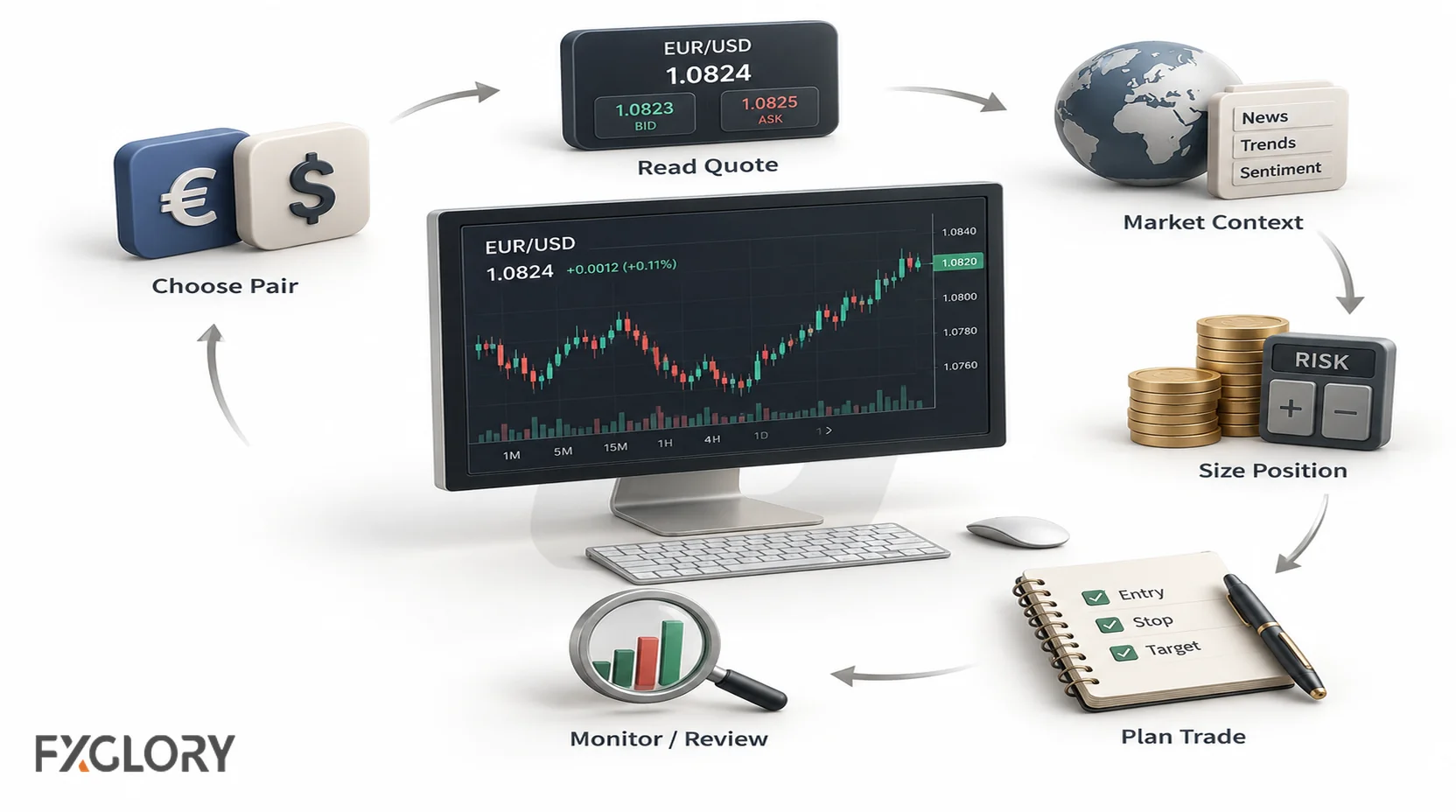
| Trader Task | What It Means | Why It Matters |
|---|---|---|
| Choose a currency pair | Select a pair such as EUR/USD, GBP/USD, EUR/CHF, or NZD/USD. | Each pair has different liquidity, spread behavior, volatility, and news sensitivity. |
| Read the quote | Understand base currency, quote currency, bid price, ask price, and spread. | The trader needs to know the price being offered before entering or exiting. |
| Check the market context | Review trend, range, volatility, economic events, support, resistance, or other defined inputs. | Context helps organize decisions, but it does not remove uncertainty. |
| Size the position | Choose lot size and estimate exposure before entering. | Position size controls how much a price move can affect the account. |
| Manage margin and leverage | Understand how borrowed exposure changes profit, loss, and margin pressure. | Too much exposure can damage an account quickly when price moves against the trade. |
| Plan exits | Define invalidation, stop-loss thinking, profit-taking logic, or manual exit rules. | A trade without an exit plan can become an emotional decision. |
| Keep records | Write down setup, reason, entry, exit, result, mistake, and lesson. | Records help separate repeatable behavior from random outcomes. |
For the language that appears around order tickets and market pages, review the terms a trader sees before pressing buy or sell.
What Do You Trade In Forex?
In forex, you trade currency pairs. A pair shows the value of one currency compared with another. The first currency is the base currency. The second currency is the quote currency. If EUR/USD is quoted at 1.1000, the quote shows how many US dollars are needed for one euro at that price.
Forex traders usually group pairs into major, minor, and exotic categories. Major pairs include the US dollar and are widely followed. Minor pairs, also called cross pairs, do not include the US dollar. Exotic pairs include one major currency and one currency from a smaller or less liquid market, and they can involve wider spreads or sharper movement.
| Pair Group | Example | What A Trader Checks |
|---|---|---|
| Major currency pairs | EUR/USD, GBP/USD, USD/JPY | Liquidity, session activity, economic releases, spread, and trend context. |
| Minor currency pairs | EUR/GBP, EUR/CHF | Cross-currency relationships, regional news, spread behavior, and volatility. |
| Exotic currency pairs | Pairs involving a major currency and a less liquid currency. | Higher spread risk, lower liquidity, sharper moves, and country-specific events. |
To connect this definition with live market structure, review FXGlory's currency-pair pages after you understand what a pair represents. If the two-price structure is still unclear, study how bid and ask prices create the spread a trader must overcome.
A Simple Forex Trader Example
Assume EUR/USD moves from 1.1000 to 1.1050. The pair has risen by 50 pips before trading costs. A trader who bought EUR/USD before that move would see favorable price movement before spread, swap, slippage, and position size are considered. A trader who sold EUR/USD would see unfavorable price movement over the same move.
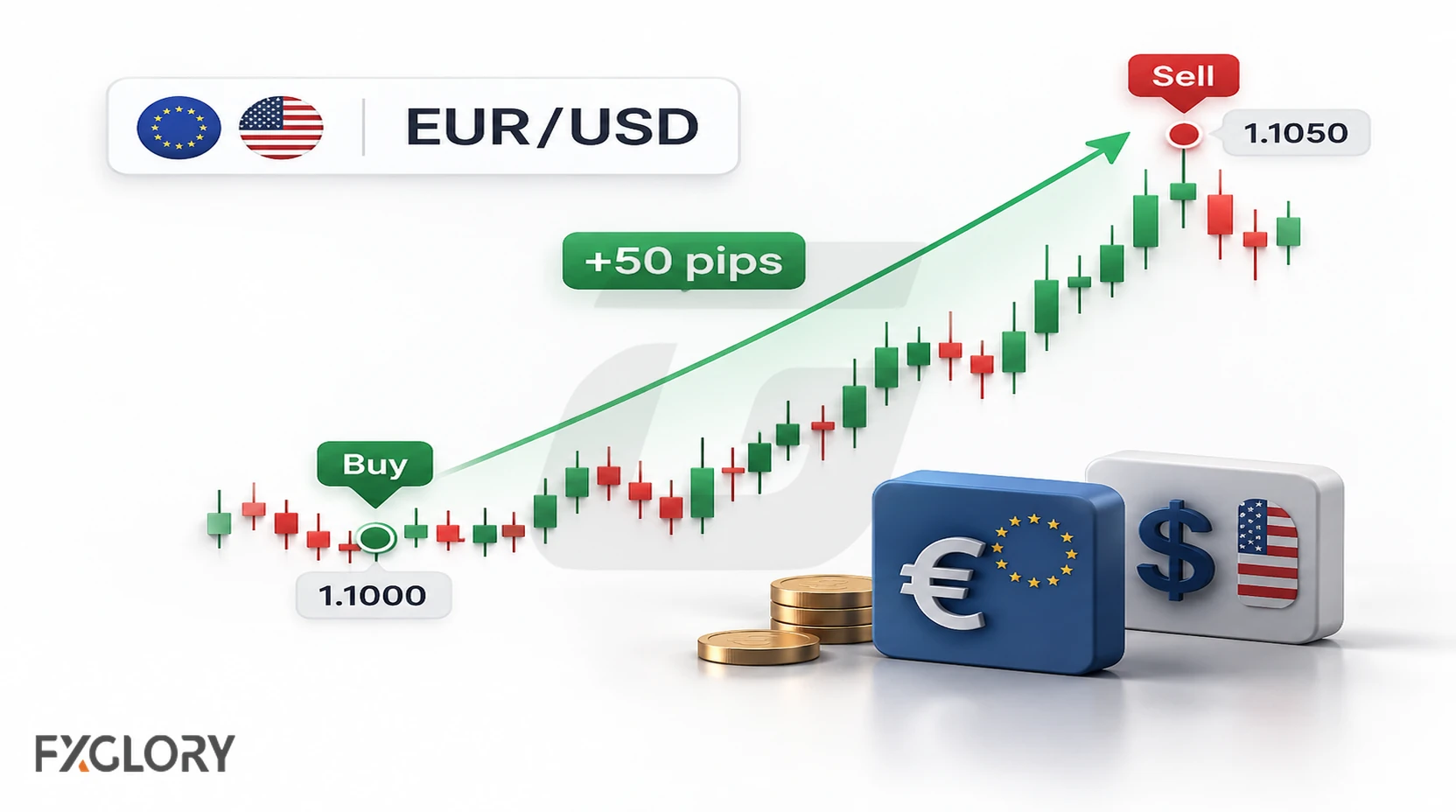
This example is not a trading signal. It only shows how direction works. A 50-pip move does not create the same result for every trader because the actual account result depends on lot size, pip value, entry price, exit price, spread, swap, leverage, margin, and execution.
| Trade View | What The Trader Expects | If EUR/USD Rises | If EUR/USD Falls |
|---|---|---|---|
| Buy EUR/USD | The euro strengthens against the US dollar, or the pair rises. | Favorable before costs. | Unfavorable before costs. |
| Sell EUR/USD | The euro weakens against the US dollar, or the pair falls. | Unfavorable before costs. | Favorable before costs. |
For the movement unit, use the pip calculation guide before estimating a trade result. For exposure, use the lot-size guide before choosing trade size.
Retail Forex Trader vs Professional Forex Trader
A retail forex trader and a professional forex trader can both trade currency pairs, but their environment is different. A retail trader usually trades personal capital through an online broker. A professional trader may work inside a bank, hedge fund, investment firm, brokerage, corporate treasury, or another institution.
Professional roles can involve formal hiring standards, internal risk limits, compliance rules, team oversight, client responsibilities, and reporting. Retail trading is more accessible, but that accessibility can become dangerous when a beginner treats trading like a shortcut to income.
| Area | Retail Forex Trader | Professional Forex Trader |
|---|---|---|
| Capital source | Usually personal funds. | May trade firm, client, treasury, or institutional capital. |
| Main environment | Online trading account and personal decision-making. | Bank, fund, company, brokerage, trading desk, or professional trading firm. |
| Controls | Self-imposed rules, account settings, and broker conditions. | Internal limits, compliance rules, reporting, and oversight. |
| Income structure | No salary from the market; results depend on trading gains and losses. | May receive salary, bonus, or other compensation depending on role and employer. |
| Education path | No degree is required to learn or open an account, but education and risk awareness are essential. | Employers may prefer finance, economics, mathematics, statistics, business, programming, or market-analysis backgrounds. |
| Risk problem | Overleverage, emotional trading, weak records, unrealistic expectations. | Model risk, liquidity risk, compliance risk, client exposure, market-event risk. |
For a detailed side-by-side view, read the retail vs professional forex trader comparison. To see where individual traders fit in the wider FX ecosystem, compare them with banks, funds, companies, central banks, and other market participants.
Forex Trader vs Broker vs Investor
Beginners often mix the words trader, broker, and investor. They are not the same role.
| Term | Meaning | Common Confusion |
|---|---|---|
| Forex trader | The person or institution taking positions in currency pairs. | A trader is responsible for their own decisions and risk. |
| Forex broker | The company that gives clients access to a trading environment, account conditions, platforms, and market pricing. | A broker is not the same as the trader using the account. |
| Forex investor | A person allocating capital with an investment objective, often with a longer-term framing. | Retail forex trading is usually speculative and can be much shorter term than investing. |
| Signal seller or mentor | A person or service offering trade ideas, education, or signals. | Signals do not remove risk, and guaranteed-return promises are a warning sign. |
This distinction protects the reader from a common mistake: opening an account does not make someone a skilled trader, and using a broker does not transfer trading responsibility away from the account holder.
Types Of Forex Traders
Forex traders can be grouped by holding time, analysis method, decision style, or purpose. These labels describe behavior; they do not prove skill or profitability.
| Trader Type | Typical Focus | Main Risk To Watch |
|---|---|---|
| Scalper | Very short-term trades and small price movements. | Spread, execution speed, overtrading, and emotional fatigue. |
| Day trader | Intraday moves without holding positions for long periods. | News volatility, session changes, and frequent decision pressure. |
| Swing trader | Multi-day market swings or broader technical structures. | Overnight gaps, swap costs, and changing market conditions. |
| Position trader | Longer-term themes, trend structure, or macro views. | Large drawdowns, patience errors, and policy-event surprises. |
| News trader | Market reaction around economic releases or central-bank events. | Slippage, spread widening, fast reversals, and poor execution conditions. |
| Algorithmic trader | Rules coded into automated or semi-automated systems. | Bad assumptions, weak testing, technical failure, and changing market behavior. |
| Hedging-focused trader | Managing currency exposure rather than only seeking speculative gains. | Mismatch between exposure, hedge size, timing, and business need. |
For a detailed breakdown of each type, review the types of forex traders and their differences. For strategy categories, use the forex strategy library as a map of methods, not as a promise of results.
How Forex Traders Read The Market
Forex traders use different inputs to form a market view. Some focus on price charts. Some watch economic releases, central-bank expectations, interest-rate differences, inflation data, employment reports, or geopolitical events. Some combine several inputs and only trade when the information agrees with their plan.
| Input | How Traders Use It | Limit |
|---|---|---|
| Technical analysis | Reviews price action, support, resistance, trends, indicators, patterns, and volatility. | Chart tools organize observations; they do not predict outcomes with certainty. |
| Fundamental analysis | Reviews economic data, central-bank policy, interest rates, inflation, and growth expectations. | Markets can react differently from what the data appears to suggest. |
| Sentiment and positioning | Reviews whether traders appear crowded, cautious, risk-seeking, or defensive. | Sentiment can remain extreme longer than a trader expects. |
| Trading conditions | Checks spread, rollover, volatility, session timing, and execution environment. | Good analysis can still fail if costs and conditions are ignored. |
For chart-reading foundations, start with how forex charts display price movement. For level-based context, review support and resistance before treating a price area as important.
Tools Forex Traders Commonly Use
A trader's tools should support decisions, not replace them. Platforms, charts, market pages, calculators, account-condition pages, and journals help a trader understand the environment before and after a trade.
| Tool | What It Helps With | FXGlory Page To Check |
|---|---|---|
| Trading platform | Chart review, order entry, trade monitoring, and account management. | Compare FXGlory platform options before choosing a workflow. |
| Live market page | Watching currency pairs, metals, or crypto categories separately. | Review the market hub before choosing an instrument category. |
| Spread information | Understanding the cost gap between bid and ask prices. | Check spread information before judging a trade setup. |
| Leverage and margin information | Estimating exposure, required margin, and account pressure. | Read leverage conditions before increasing position size. |
| Margin calculator | Estimating required margin for a planned position. | Use the margin calculator before placing a leveraged trade. |
| Demo account | Practicing platform navigation and order handling without using real funds. | Practice first in a demo environment. |
FXGlory provides access to trading platform options such as MetaTrader 4, MetaTrader 5, WebTrader, and GloryTrader Classic or Pro. A trader should choose a workflow based on chart needs, order entry, device preference, and account conditions rather than on the platform name alone.
How Forex Trading Profits And Losses Work
A trading position gains or loses value as the currency pair moves relative to the entry price. The final account result also depends on position size, spread, swap, slippage, leverage, and the exit price.
- Price movement: The pair must move in a favorable direction for the position.
- Spread: The trade starts with a cost because the buy and sell prices are different.
- Lot size: Larger position size increases the financial effect of each price movement.
- Leverage: Leverage can increase exposure beyond the cash placed as margin.
- Swap or rollover: Holding trades overnight may create extra costs or credits depending on the instrument and account conditions.
- Slippage and volatility: Fast markets can produce fills away from expected prices.
A trade that looks small in pips can still create large account exposure when position size or leverage is high. The guides to pip calculations, lot size, and leverage explain how those pieces interact.
Beginner Forex Trader: What To Learn First
A beginner forex trader should learn the market language before risking live funds. The order matters because a trader who does not understand quotes, pips, lot size, leverage, and margin cannot accurately understand the risk of a position.
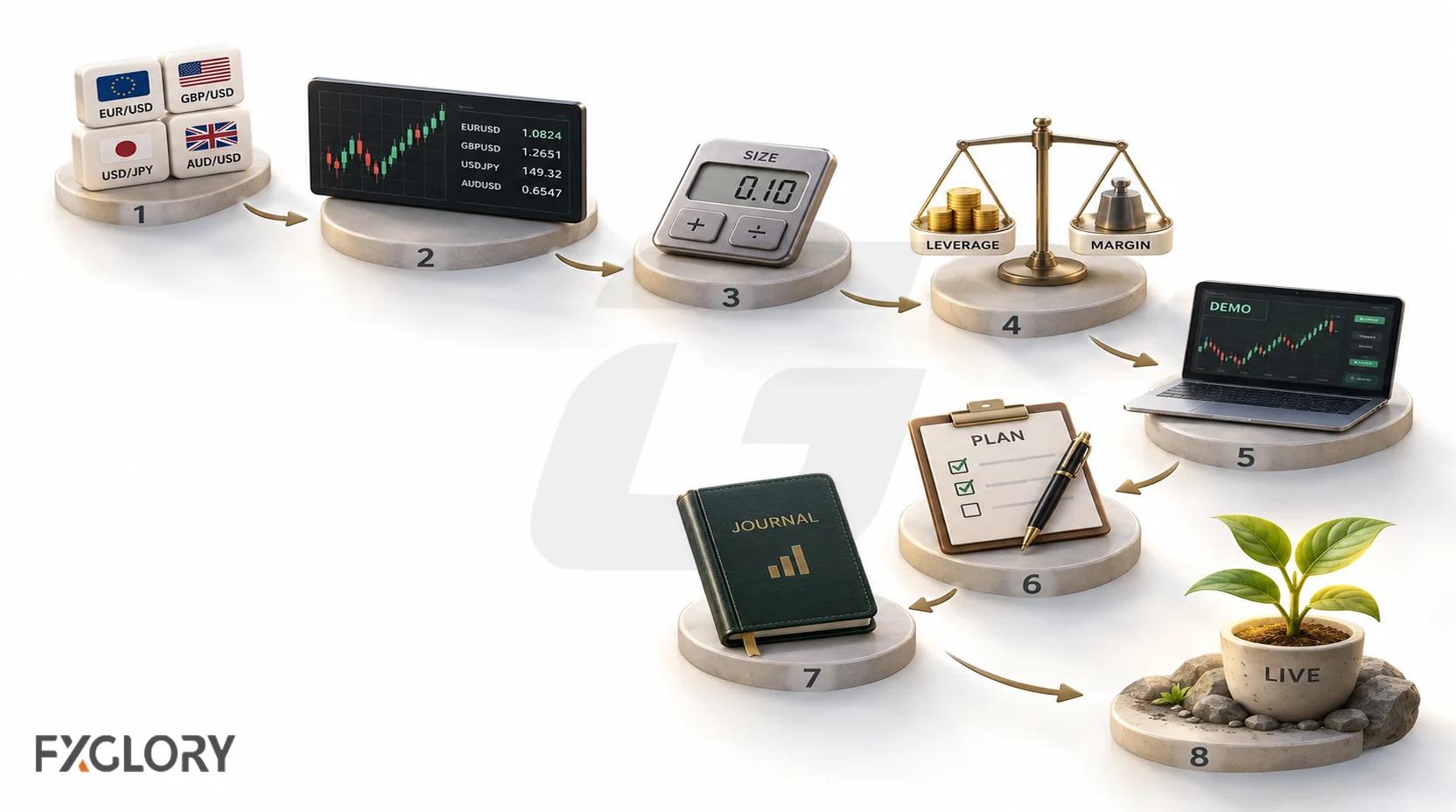
- Learn what a currency pair is: Understand base currency, quote currency, majors, minors, and exotics.
- Learn how prices are quoted: Read bid, ask, spread, and pip movement before placing trades.
- Learn position size: Know how lot size changes exposure.
- Learn leverage and margin: Treat leverage as risk amplification, not buying power to use automatically.
- Practice on demo: Learn platform navigation, order types, trade history, and position monitoring without real funds.
- Write a basic plan: Define market, setup, risk limit, invalidation, exit logic, and review habit.
- Keep a journal: Record trades so results can be reviewed instead of remembered emotionally.
- Start slowly if moving live: Use risk limits and avoid increasing exposure after a loss.
A useful next step is to build a written process with the forex trading plan template. If leverage feels unclear, read whether forex can be traded without leverage before deciding how much exposure is appropriate. For a structured progression from basics to first live trade, follow the how to become a forex trader guide.
Skills And Habits Forex Traders Need
Skill in forex trading is not only market knowledge. The habits around risk, review, and emotional control often matter more than the setup label.
| Skill Or Habit | What It Looks Like | What It Prevents |
|---|---|---|
| Risk control | Defining how much can be lost before entering. | Oversized trades and account-damaging losses. |
| Patience | Waiting for a planned condition instead of trading out of boredom. | Random entries and overtrading. |
| Record-keeping | Saving trade reason, entry, exit, result, and mistake. | Repeating errors without evidence. |
| Emotional control | Pausing after wins or losses instead of chasing the next trade. | Revenge trading and overconfidence. |
| Market awareness | Checking news, sessions, spread, and volatility before entry. | Entering during unstable conditions without preparation. |
| Method consistency | Using one defined process long enough to evaluate it. | Changing systems after every losing trade. |
For account-protection rules, use risk management as the trader's operating limit, not as a final detail added after a setup is found.
When Do Forex Traders Trade?
The forex market is organized around global trading sessions and is commonly active across much of the business week. A retail trader should still check platform availability, instrument schedules, holidays, rollover periods, spreads, and liquidity conditions before trading.
More available hours do not mean more good trades. Late-session movement, rollover, thin liquidity, and major news can create difficult conditions. A beginner should reduce the number of decisions, not increase them just because the market is open.
Risks, Fraud Warnings, And Misconceptions
Forex trading attracts unrealistic claims because the market is large, accessible, and leveraged. The risk is not only market movement. A trader also faces poor education, emotional pressure, unsuitable leverage, weak record-keeping, and scams that promise simple income.
The CFTC warns that forex is volatile, carries substantial risks, and is not a place for money a person cannot afford to lose. It also warns investors to be cautious with offers that promise easy or unusually high returns. Those warnings fit retail forex education because beginners are often targeted with shortcuts, signals, robots, or copy-trading promises.
- Guaranteed profit claims: No forex trader, mentor, signal, robot, or platform can guarantee profitable trades.
- High leverage without a plan: Leverage can magnify losses as well as gains.
- Trading to recover losses: Revenge trading often increases damage after a bad decision.
- Ignoring costs: Spread, swap, slippage, and execution conditions can change the result of a trade.
- Confusing demo with live: Demo practice helps with process, but live trading adds real emotional and execution pressure.
- Following strangers blindly: A signal does not explain whether the trade fits your account size, risk limit, or market conditions.
- Using rent, loan, or emergency money: Money needed for essential expenses should not be placed at trading risk.
Is Being A Forex Trader Right For Everyone?
No. Forex trading is not suitable for everyone. It may be unsuitable for someone who cannot tolerate losses, needs guaranteed income, is using essential funds, reacts emotionally to fast price movement, or has not learned how leverage and margin work.
A person can study forex without trading live. A person can use a demo account to learn platform behavior without using real funds. A person can also decide that the risk is not appropriate. That decision is part of responsible financial judgment.
If you continue learning, do it in this order: understand the market, practice the platform, write a plan, define risk limits, review records, and only then decide whether live trading fits your situation.
Forex Trader Summary Table
| Topic | Key Point |
|---|---|
| Core role | Takes and manages positions in currency pairs. |
| Main instruments | Currency pairs such as EUR/USD, GBP/USD, and USD/JPY. |
| Retail vs professional | Retail traders usually use personal funds; professionals may trade for institutions under formal controls. |
| Broker relationship | The trader makes trading decisions; the broker provides account access, platform tools, pricing, and trading conditions. |
| Key responsibilities | Market analysis, position sizing, risk control, exit planning, monitoring, and review. |
| Main beginner risks | Excessive leverage, weak position sizing, unrealistic expectations, emotional trading, and ignoring costs. |
Sources Used For Market-Size And Risk Context
This guide uses official market and risk references for factual context, while the trader workflow, beginner pathway, and internal learning links are written for FXGlory readers.
- Bank for International Settlements: The global foreign exchange market-size reference uses the BIS 2025 Triennial Central Bank Survey.
- Commodity Futures Trading Commission: The risk and fraud-warning context reflects CFTC guidance on retail forex trading, leverage risk, and guaranteed-return claims.