
What Is a Forex Chart?
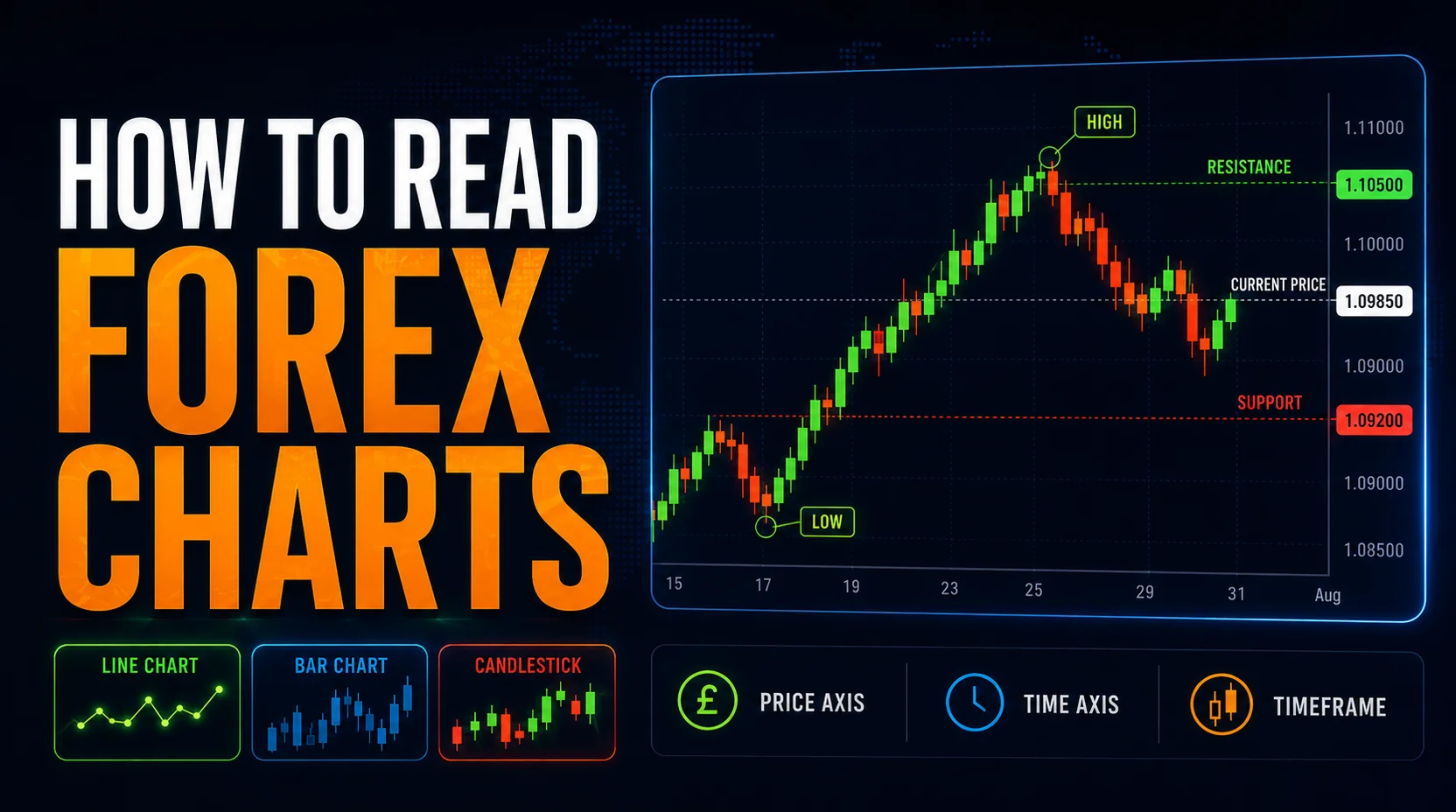
A forex chart shows how the exchange rate of a currency pair changes over time. It turns exchange-rate changes into a visual timeline, so the trader can read price, time, and context in one place.
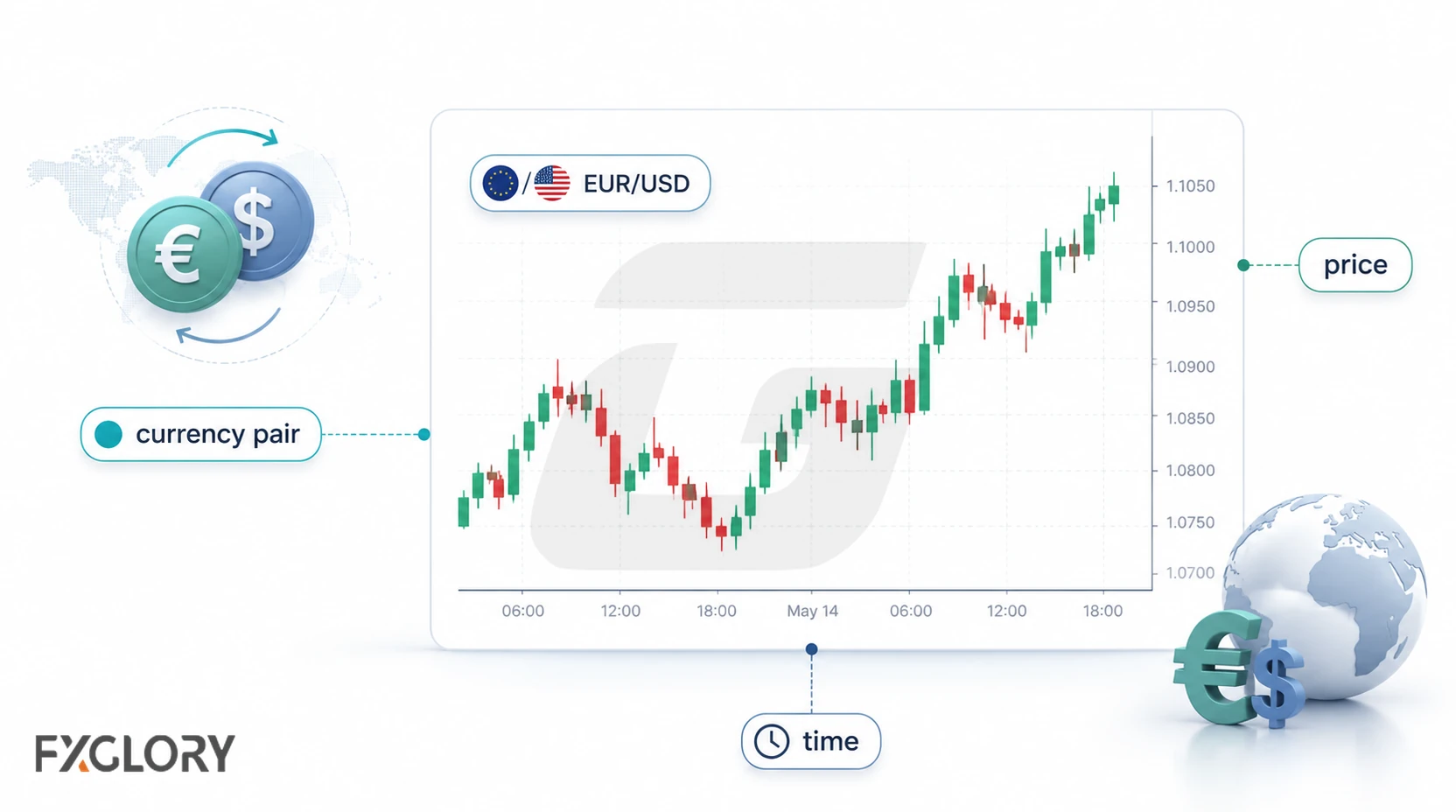
A currency pair compares one currency against another. The first currency is the base currency, and the second currency is the quote currency. For example, in EUR/USD, EUR is the base currency and USD is the quote currency.
If EUR/USD rises, one euro buys more US dollars than before. If EUR/USD falls, one euro buys fewer US dollars than before. This is why the pair name matters before any chart reading begins.
Most forex charts use a vertical price axis and a horizontal time axis. The price axis shows the exchange rate. The time axis shows when each price movement happened.
This guide explains the basic chart-reading process within forex technical analysis, including the chart information a beginner should identify before adding deeper analysis.
How Forex Charts Work
Reading a forex chart starts with three basic parts: the pair, the price, and the time. If one of these is unclear, the rest of the analysis can be built on the wrong assumption.
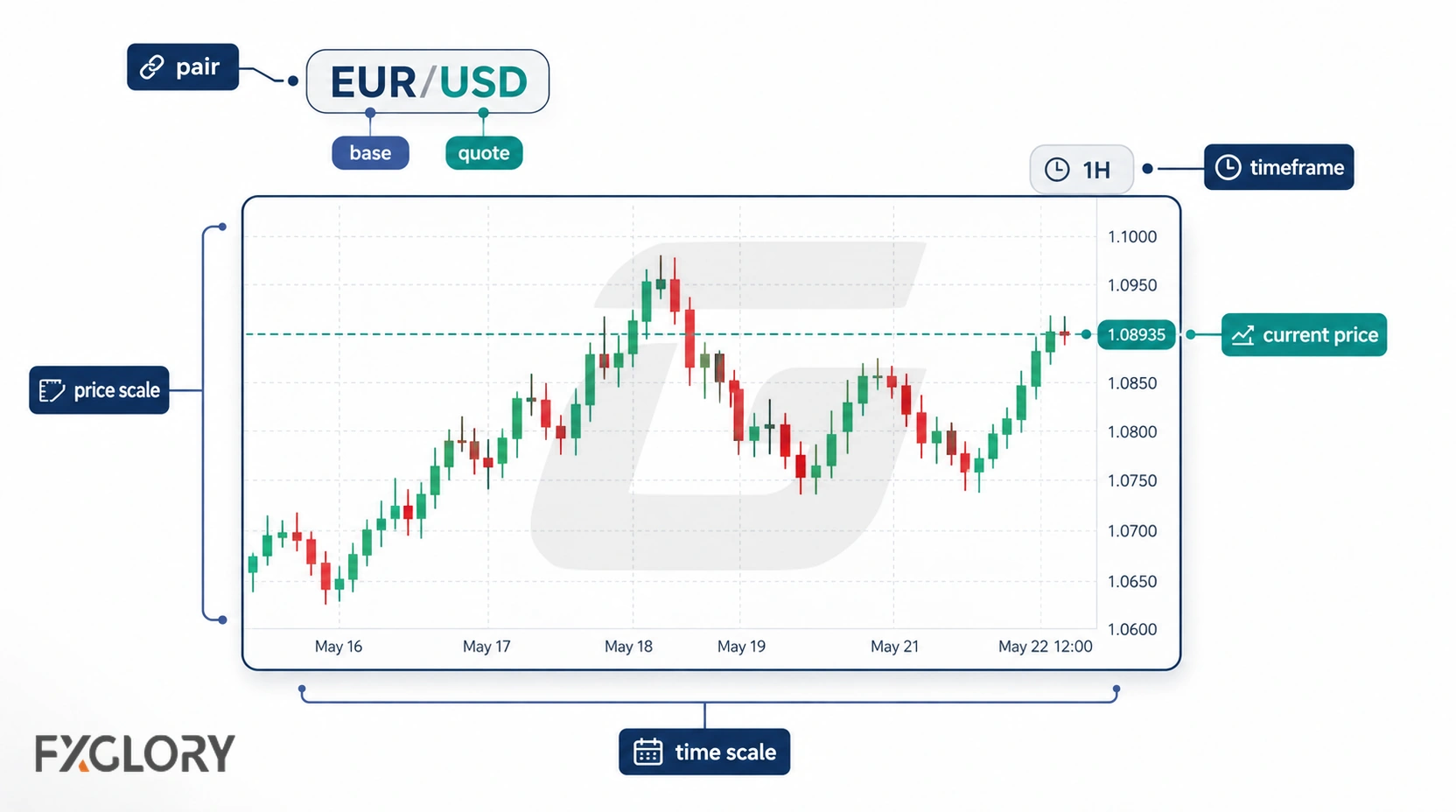
- Pair: The two currencies being compared, such as EUR/USD or GBP/USD.
- Base currency: The first currency in the pair.
- Quote currency: The second currency in the pair.
- Price: The exchange rate shown on the chart.
- Time: The period shown along the bottom of the chart.
- Timeframe: The amount of time represented by each candle, bar, or data point.
- Current price area: The most recent area where price is trading on the chart.
Timeframe matters. A 5-minute chart, 1-hour chart, and daily chart can show the same currency pair at different levels of detail. Shorter timeframes show more short-term price fluctuations, while longer timeframes show broader context with less intraperiod detail.
The current candle or bar can change before it closes. Beginners should not read an unfinished candle as if it is final.
Main Types of Forex Charts
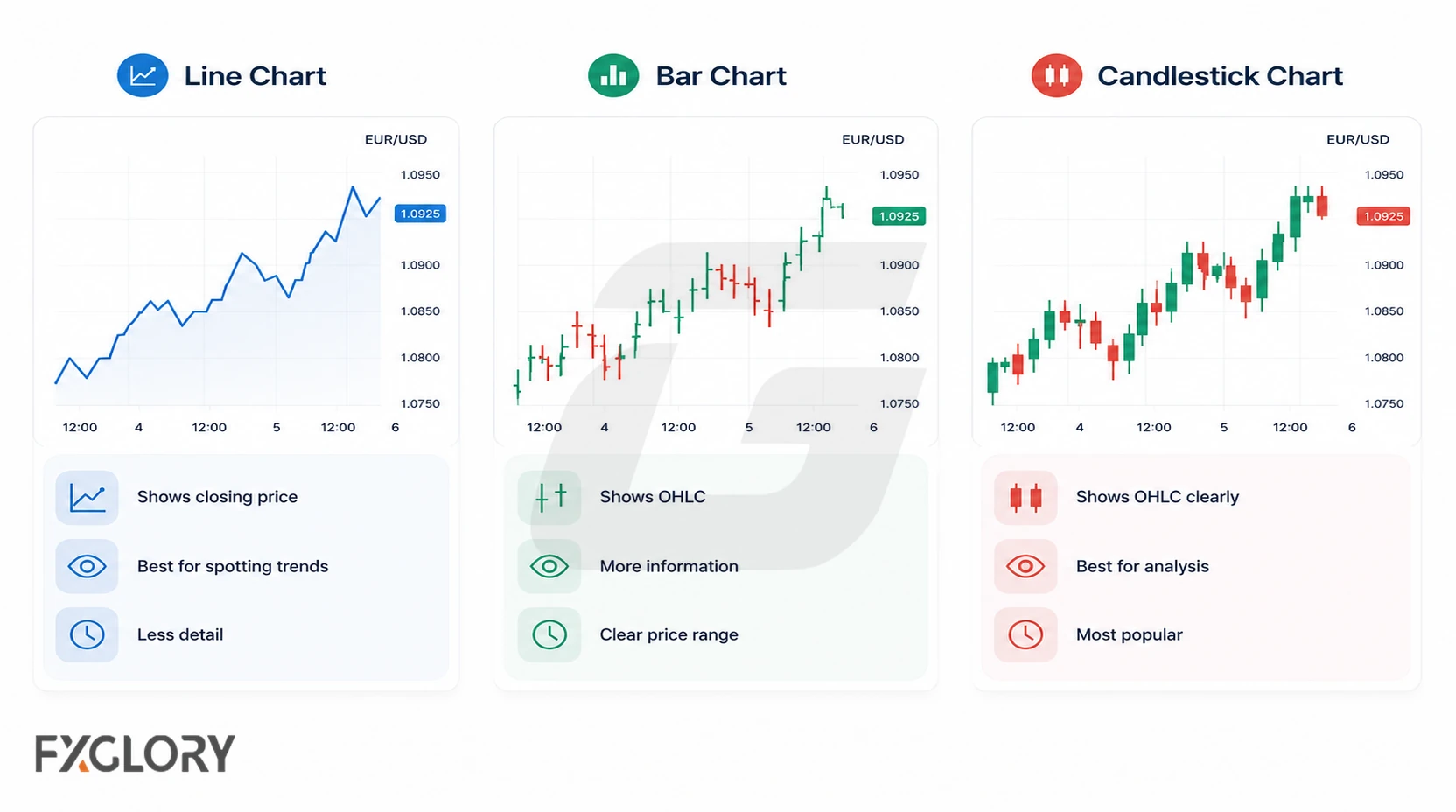
Forex charts can display the same price movement in different formats. The most common beginner chart types are line charts, bar charts, and candlestick charts.
| Chart Type | What It Shows | Beginner Use | Main Limitation |
|---|---|---|---|
| Line chart | A simple line connecting selected prices, often closing prices | Useful for seeing broad direction quickly | Shows less detail inside each period |
| Bar chart | Open, high, low, and close for each period | Useful for reading price range and direction | Can look less visual than candles for beginners |
| Candlestick chart | Open, high, low, close, body, and wick structure | Useful for reading price behavior inside each period | Can be overinterpreted if read without context |
A line chart gives the cleanest overview, a bar chart adds OHLC detail, and a candlestick chart makes that OHLC information easier to scan visually.
How to Read a Candlestick or Bar
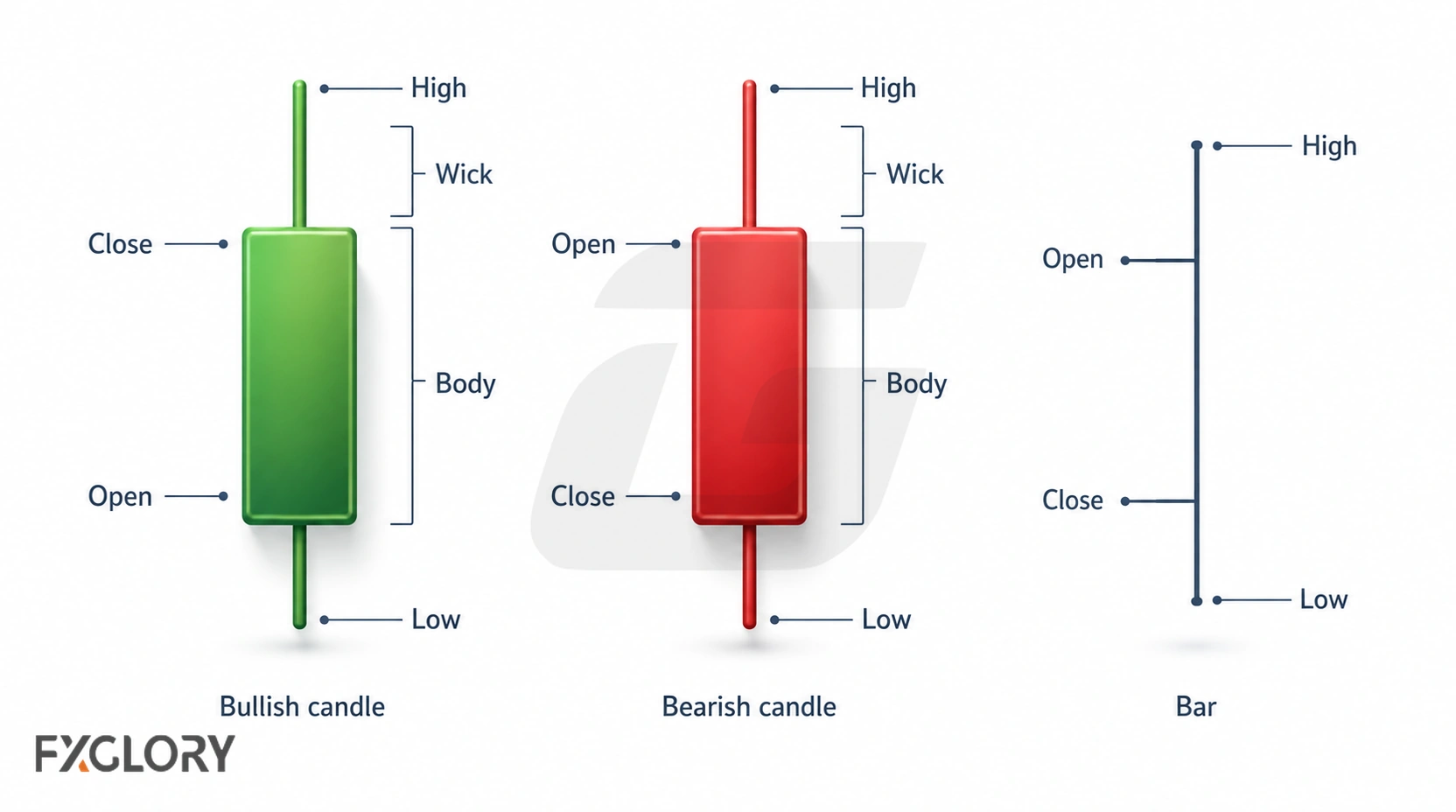
A candlestick or bar usually shows four important prices for a selected period: open, high, low, and close. These are often called OHLC data.
| Part | Meaning | Beginner Note |
|---|---|---|
| Open | The first shown price of the period | Shows where the period started |
| High | The highest shown price of the period | Shows how far price moved upward |
| Low | The lowest shown price of the period | Shows how far price moved downward |
| Close | The final shown price of the period | Often used to judge how the period ended |
| Body | The distance between open and close on a candle | Shows whether price closed above or below the open |
| Wick | The extension above or below the candle body | Shows the high and low beyond the open-close area |
One candle should not be treated as a complete chart reading. A candle makes more sense when the trader knows the timeframe, the surrounding price movement, and the broader context.
Forex candlestick patterns explains how individual candle formations can be interpreted within broader chart context.
Chart Price vs Trading Price
The price shown on a chart is not always the same as the exact price a trade receives. Forex trading uses bid and ask prices, and the difference between them is the spread.
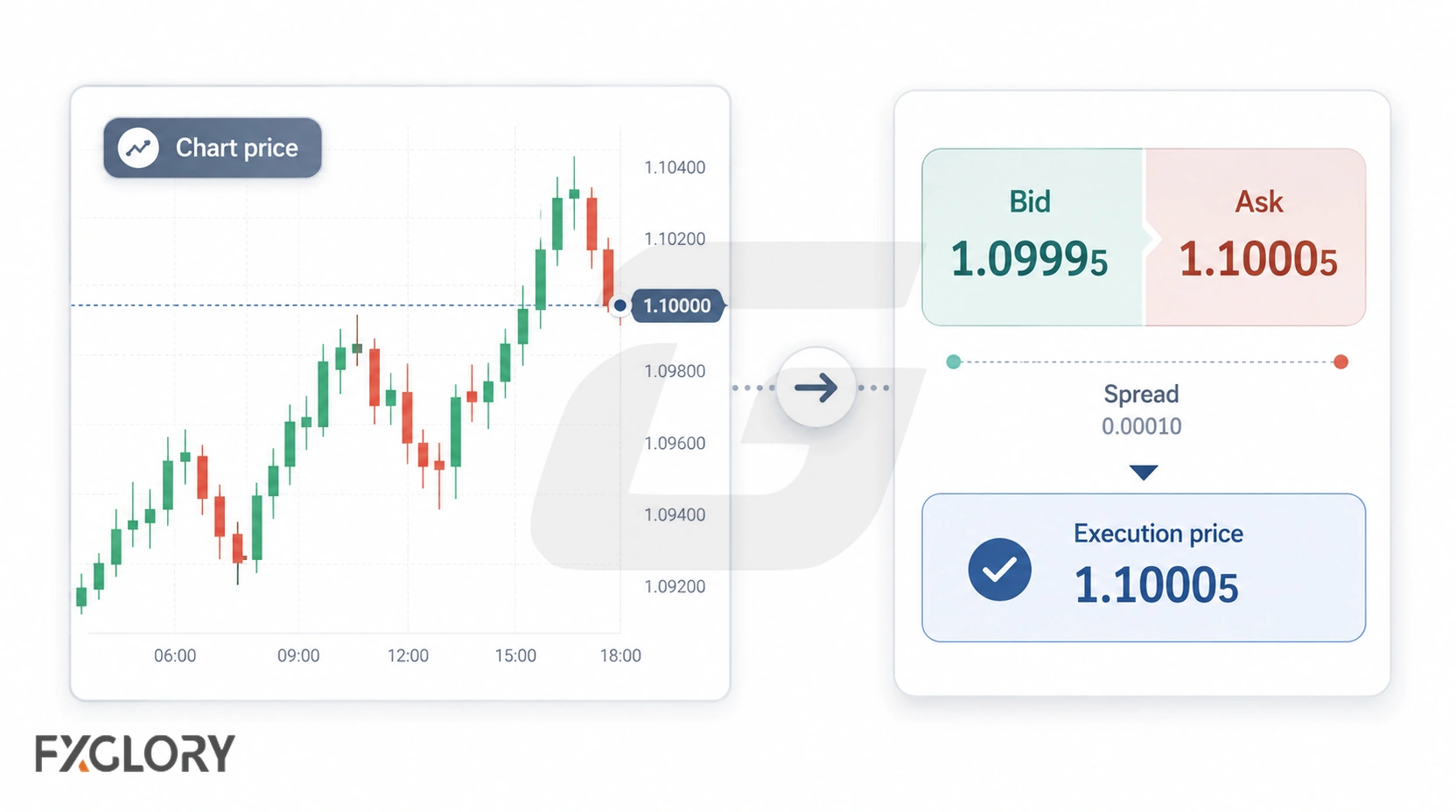
- Bid: The quoted price available for selling.
- Ask: The quoted price available for buying.
- Spread: The difference between bid and ask.
- Chart price: The price series displayed by the platform, which depends on its data source and chart settings.
- Execution price: The price at which an order is actually filled.
Execution can differ from the displayed chart because orders use available market quotes and may be affected by spread, liquidity, slippage, volatility, and order type.
Basic Forex Chart Reading Workflow
A beginner should read a forex chart in layers instead of jumping straight to patterns, indicators, or trade ideas.
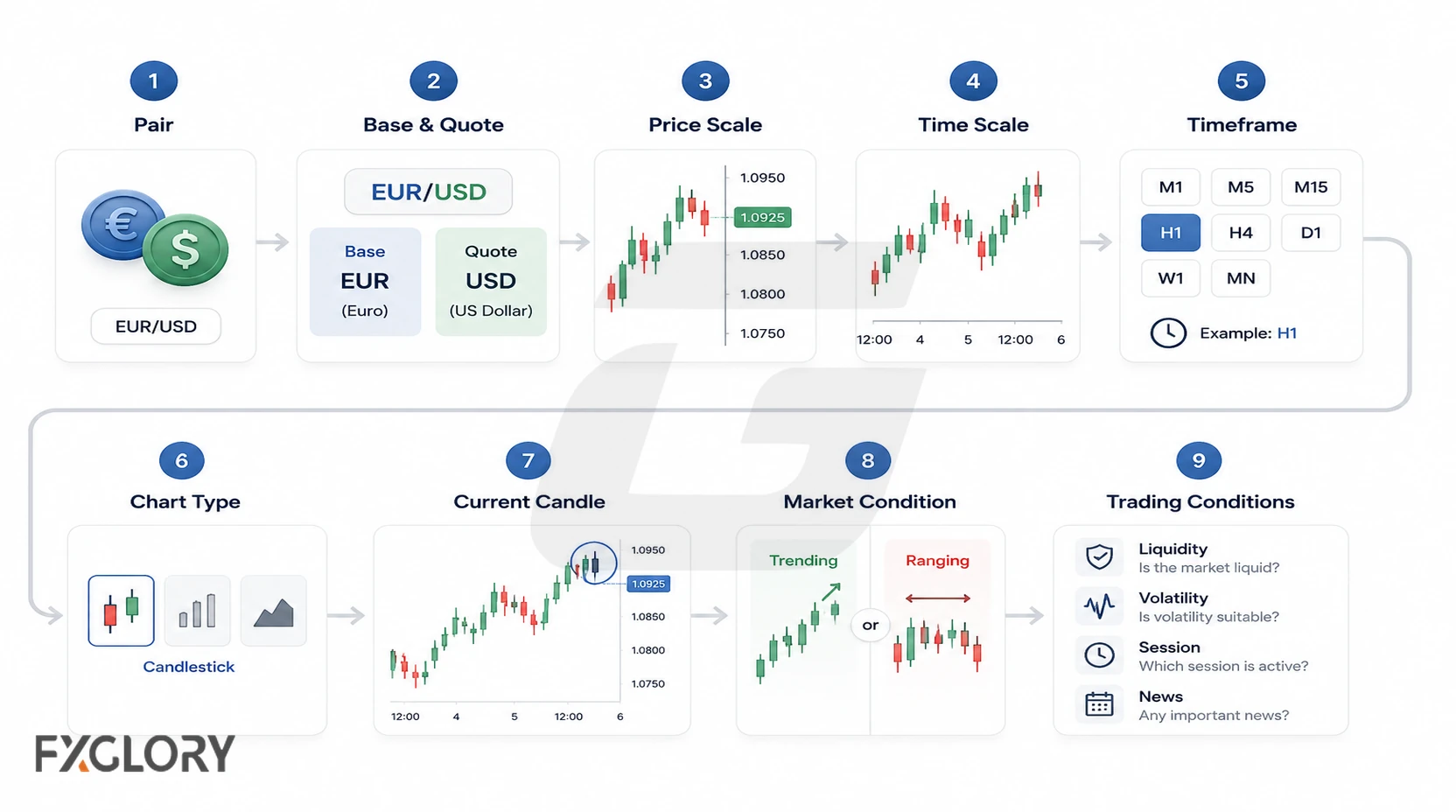
- Identify the currency pair: Know which two currencies are being compared.
- Identify the base and quote currency: Know which currency is being priced against the other.
- Read the price scale: Check the exchange rate on the vertical axis.
- Read the time scale: Check the time period shown along the horizontal axis.
- Choose the timeframe: Know whether each candle or bar represents minutes, hours, days, or another period.
- Choose the chart type: Decide whether line, bar, or candlestick view is being used.
- Read the current candle or bar carefully: Check open, high, low, close, and whether the period is finished.
- Check the basic condition: Decide whether the chart looks directional, sideways, volatile, quiet, or unclear.
- Check trading conditions: Review bid and ask prices, spread, volatility, relevant news risk, and the point that would invalidate the chart idea.
This workflow keeps chart reading focused on the chart interface first. Deeper analysis layers can be added only after the pair, price, time, timeframe, and chart type are clear.
What to Look For After Basic Chart Reading
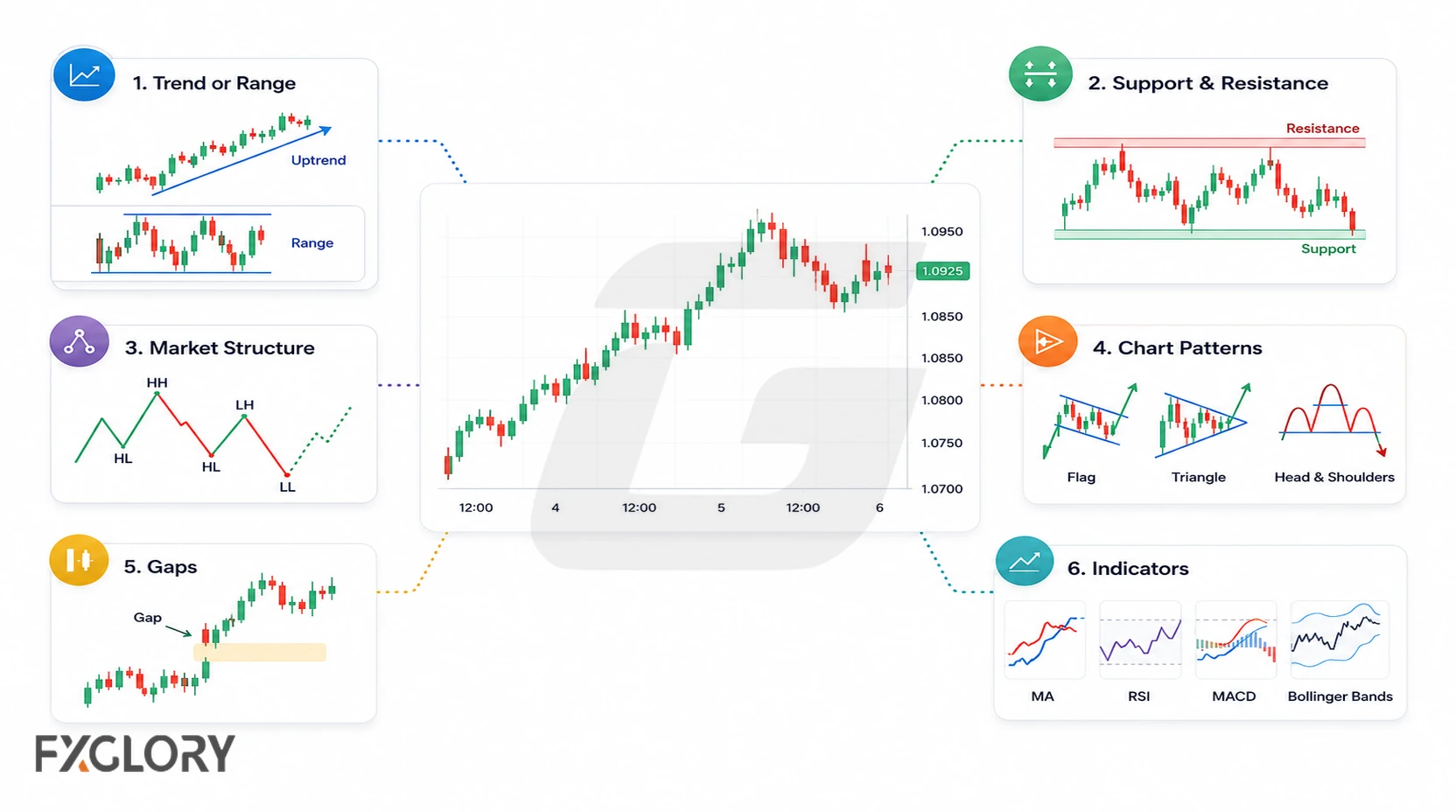
After the basic chart setup is clear, a trader may review deeper chart-reading layers. These layers should be added only when they help explain the current chart.
| Deeper Layer | What It Helps Read | Where to Go Deeper |
|---|---|---|
| Trend or range | Whether price is moving up, down, sideways, or unclear | the direction layer of the chart |
| Support and resistance | Areas where price has paused, rejected, broken, or returned before | the reaction-zone layer |
| Market structure | The swing arrangement behind trends, ranges, and transitions | the swing-by-swing map |
| Chart patterns | Named formations such as triangles, flags, and double tops | the named-shape layer |
| Gaps or unusual jumps | Visible spaces or jumps between shown price areas | the chart-jump risk layer |
| Indicators | Calculated tools that may support chart context | Keep indicators secondary unless the chart context is clear |
A clean chart read uses only the layers that actually explain the current chart. Forcing every layer onto every chart can make the analysis harder to understand.
Live Forex Charts vs Learning to Read Charts
A live forex chart updates as new quotes arrive, although update speed and the prices displayed depend on the platform and data feed.
The important distinction is between receiving data and interpreting it. Live quotes supply the latest chart information; chart reading explains that information through the pair, timeframe, current bar, surrounding structure, and trading conditions.
Common Mistakes When Reading Forex Charts
Chart-reading mistakes usually happen when a beginner skips the basics and jumps straight to a conclusion.
- Ignoring the currency pair: The chart cannot be understood if the base and quote currency are unclear.
- Ignoring the timeframe: A pattern on a 5-minute chart may not match the daily chart.
- Reading unfinished candles as final: The current candle can change before it closes.
- Confusing chart price with trading price: Bid, ask, spread, and execution can affect the actual fill.
- Jumping straight to patterns: A named pattern means little without trend, structure, and risk context.
- Overloading indicators: Too many tools can hide the basic price movement.
- Forcing trend or levels: If the chart needs heavy adjustment to make sense, the read may be weak.
- Ignoring spread, slippage, and news: A chart can look clean while trading conditions are unstable.
Example: Reading a EUR/USD Chart
Suppose EUR/USD is shown on a 1-hour candlestick chart. EUR is the base currency, USD is the quote currency, and each candle represents one hour of price movement for the pair.
The trader can first read the chart interface: the pair, the timeframe, the chart type, the price scale, and the time scale. Then the trader can review recent candles: where each candle opened, how high and low it moved, and where it closed.
If the current candle is still forming, its shape can change before the hour ends. After the basic chart data is clear, the trader can review whether the chart is directional, sideways, volatile, quiet, or unclear.
If that observation becomes a trade idea, the next steps are to define what would confirm or invalidate the view and size any position so the potential loss fits the account's chosen risk limit.
A Practical Way to Read Forex Charts
Reading forex charts starts with understanding how a currency pair's exchange rate is plotted against time. A beginner should identify the pair, base and quote currencies, price scale, time scale, timeframe, and chart type before moving into candles, trends, levels, patterns, indicators, or gaps.
Once those basics are clear, deeper analysis can be added selectively: direction, market structure, reaction areas, patterns, or indicators should help explain the chart rather than obscure it.
Before a chart observation becomes a live trade, check the current bid and ask, spread and execution conditions, define the invalidation point, and size the position to the chosen account-risk limit.