

What Are Forex Chart Patterns?
Forex chart patterns are recognizable structures created by repeated price swings, highs, lows, trendlines, support and resistance, or consolidation on a currency-pair chart.
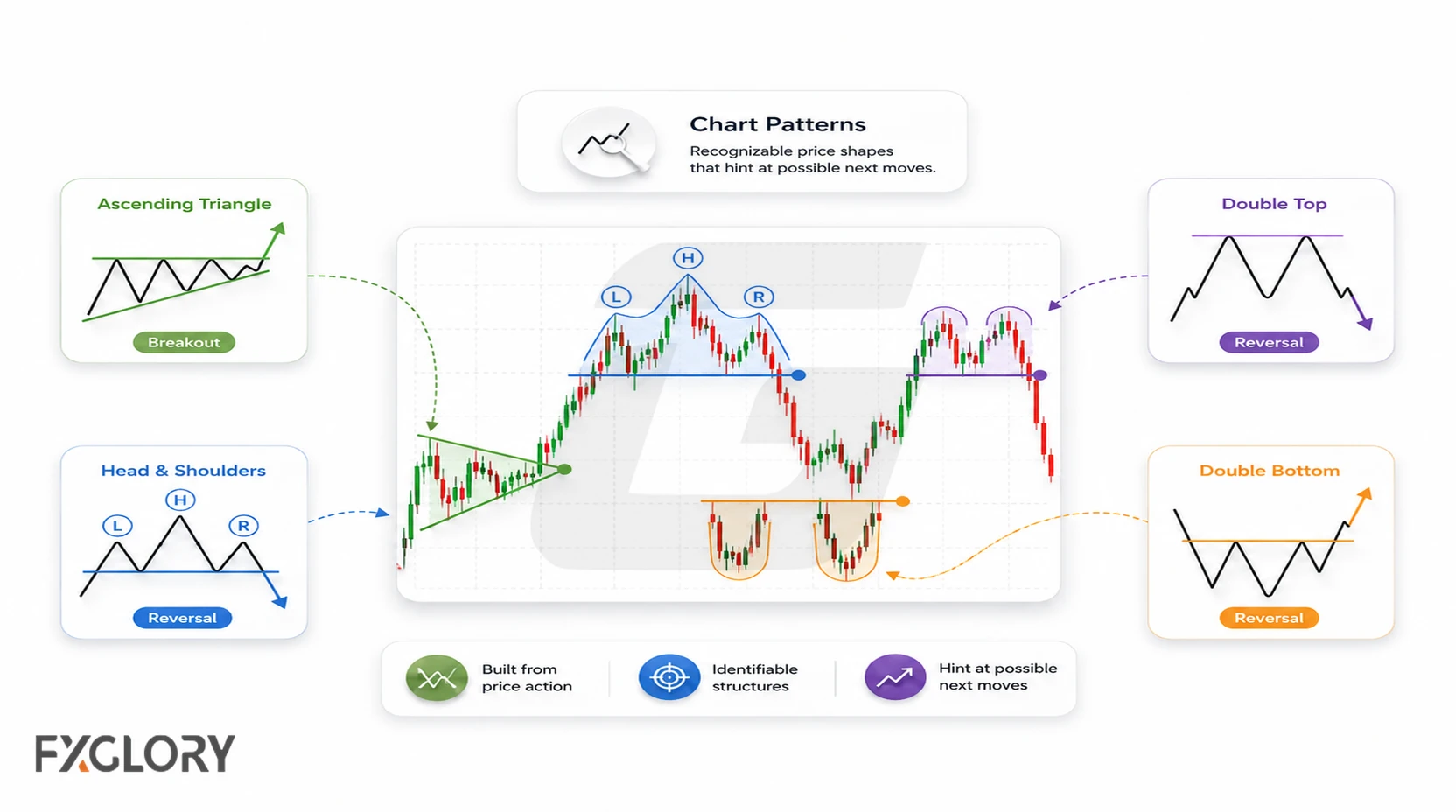
They help describe scenarios such as a trend losing strength, a market pausing, price compressing between boundaries, or a breakout being tested. The pattern name organizes the structure; it does not decide the trade.
For the broader chart-reading framework, start with the technical-analysis foundation.
How Forex Market Patterns Form
Patterns develop when price reacts repeatedly around visible areas. Buyers and sellers may defend a level, fail to extend a move, compress into a tighter range or retest a broken boundary.
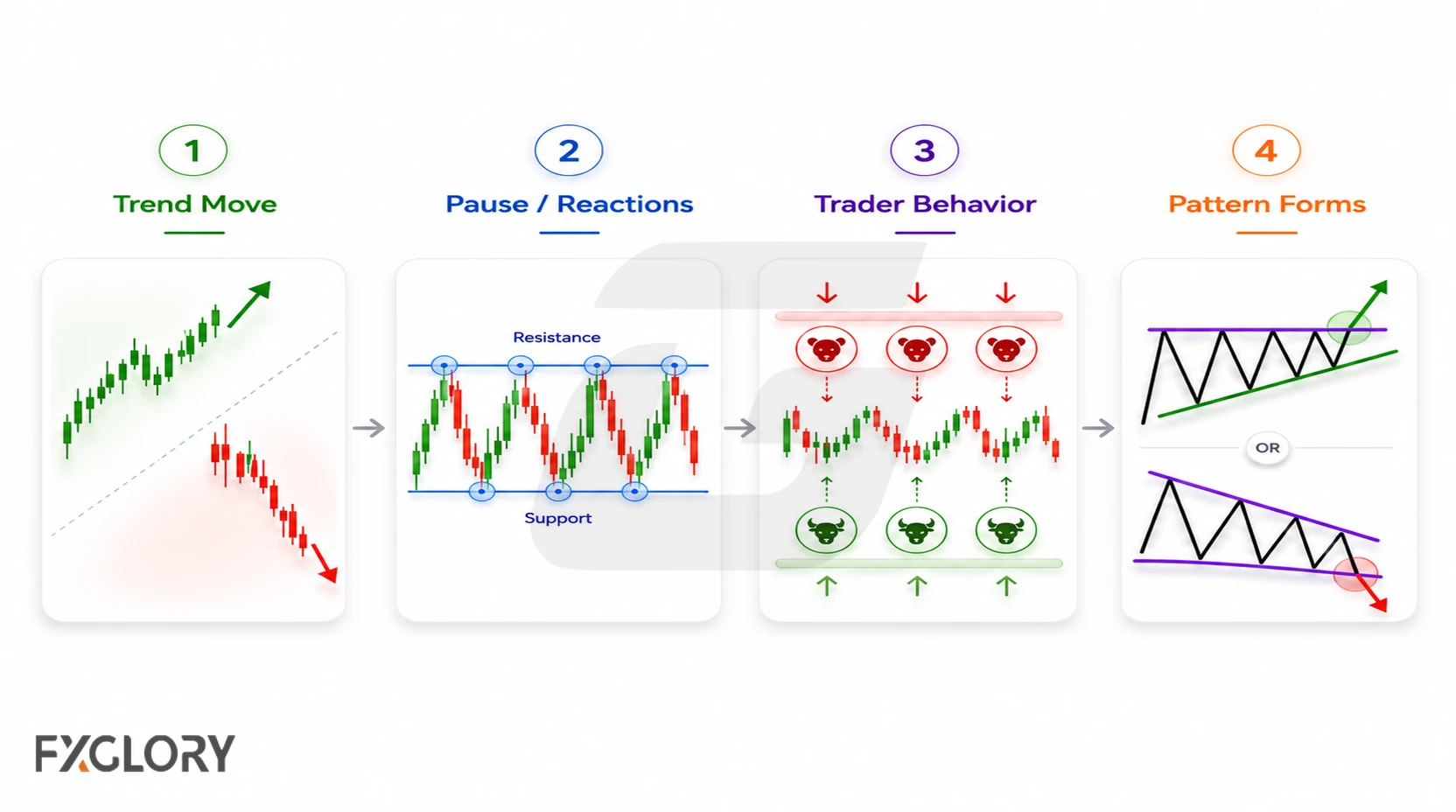
- Repeated highs or lows: Price reacts from similar areas more than once.
- Compression: Highs and lows move closer together.
- Failed continuation: Price attempts to extend a move but cannot hold the new area.
- Breakout attempt: Price moves beyond a visible boundary.
- Retest: Price returns to the broken area and either reacts from it or moves back through it.
The same geometric shape can carry different meaning in a strong trend, a sideways range or an unstable news period, so structure should always be read with context.
Chart Patterns vs Candlestick Patterns
| Type | Typical Scope | Examples |
|---|---|---|
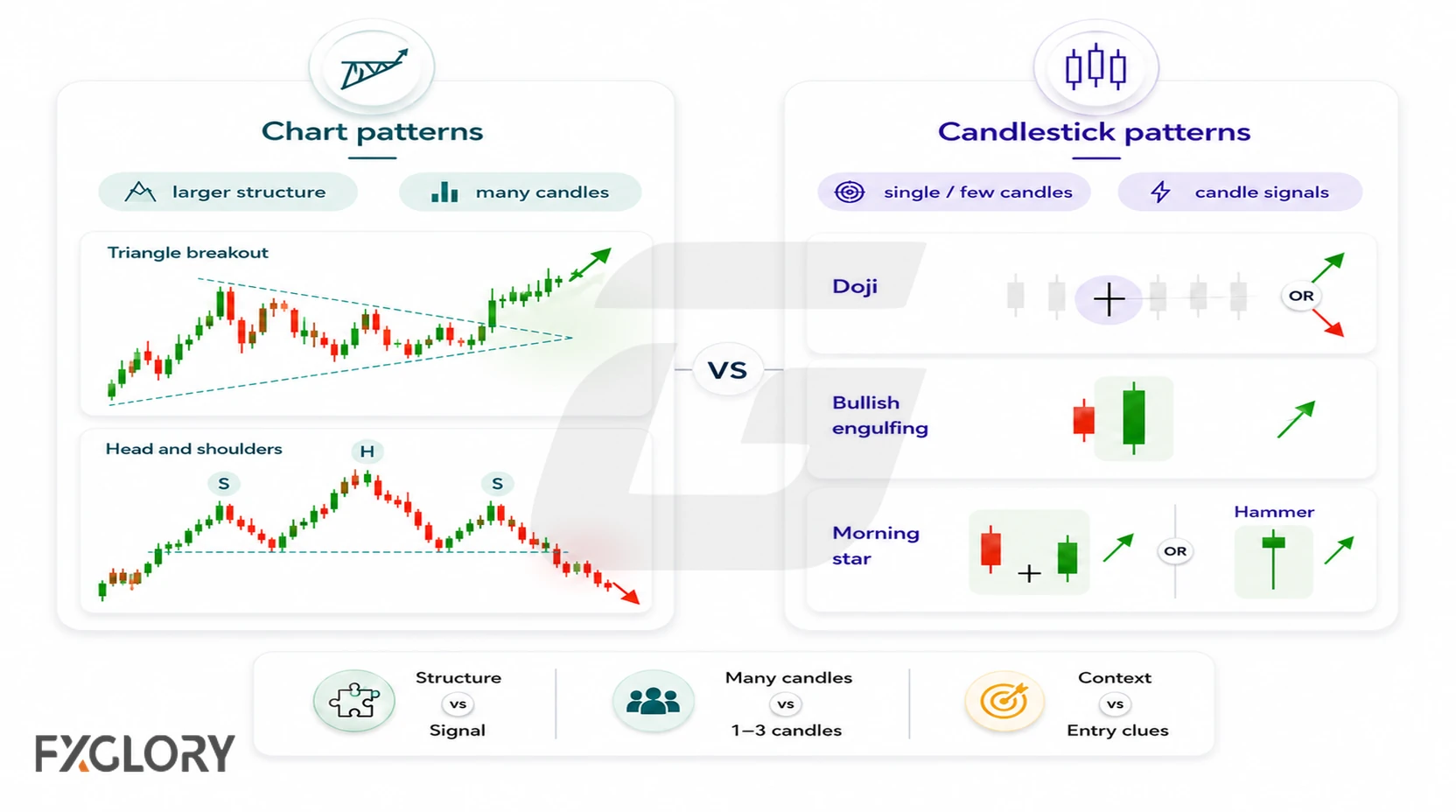
| Candlestick pattern | One candle or a small group of candles. | Doji, engulfing candle, hammer, shooting star. |
| Chart pattern | Multiple swings, boundaries or consolidation over a broader section of the chart. | Double top, head and shoulders, triangle, wedge, pennant. |
When a broad pattern needs candle-level context near a boundary, candlestick structure can provide additional detail.
Main Types of Forex Chart Patterns
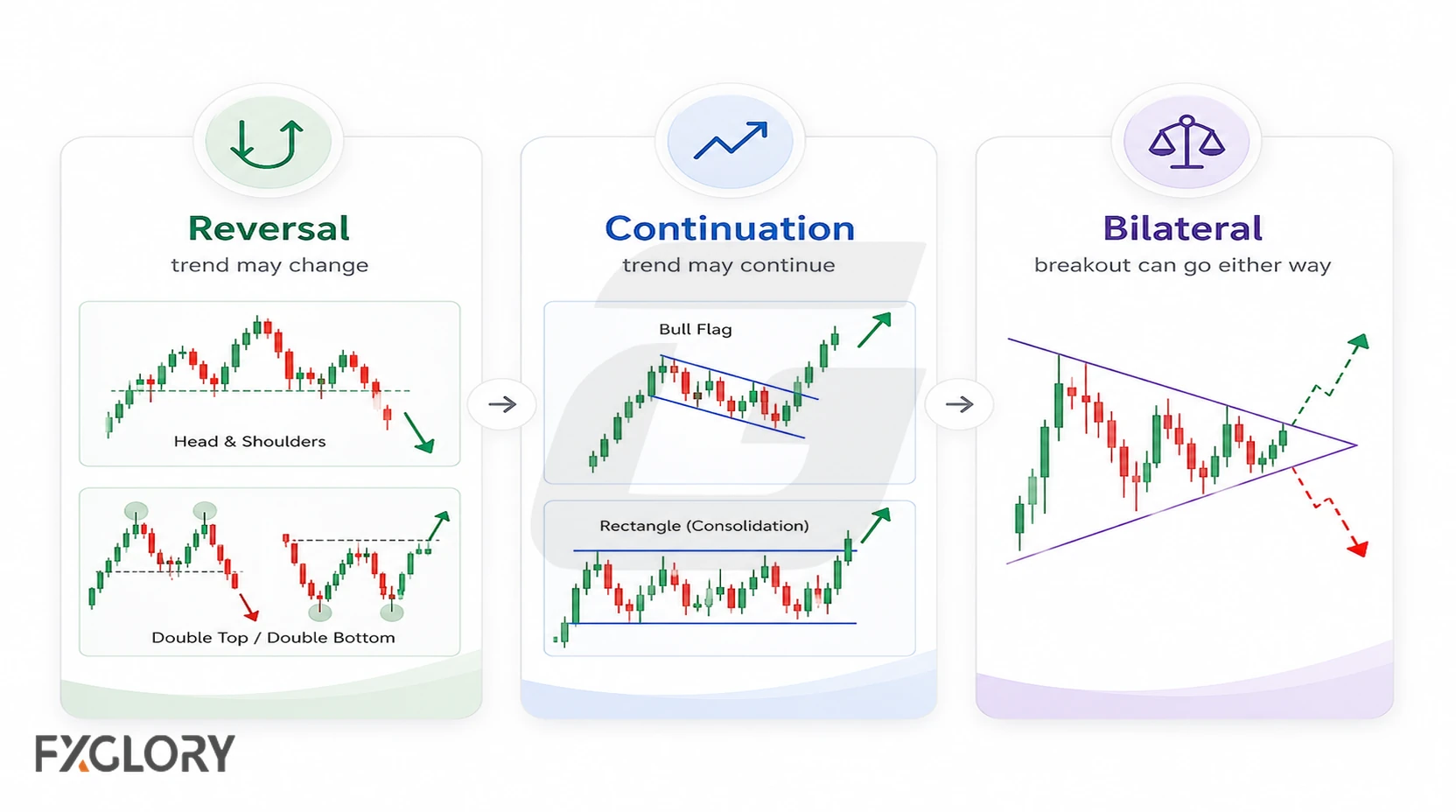
Most patterns are grouped by the market scenario they describe. The category gives a framework for analysis, not a prediction.
| Group | Typical Context | Examples |
|---|---|---|
| Reversal | A prior move may be losing strength. | Head and shoulders, double top, double bottom. |
| Continuation | A trend pauses before a possible continuation attempt. | Flags, pennants, rectangles, some triangles. |
| Neutral or bilateral | Price compresses without confirmed direction. | Symmetrical triangle, broad consolidation. |
| Ratio-based | Measured swing relationships are part of the structure. | Harmonic and butterfly patterns. |
Common Forex Chart Patterns by Function
| Pattern | Group | Key Structural Question | Guide |
|---|---|---|---|
| Double top | Reversal | Has price failed twice around a similar resistance area after a rise? | Double top |
| W pattern / double bottom | Reversal | Has price tested a similar support area twice after a decline? | W pattern |
| Head and shoulders | Reversal | Is price forming three major swings around a visible neckline? | Head and shoulders |
| Triangle | Neutral or continuation | Is price compressing between converging boundaries? | Triangle patterns |
| Wedge | Reversal or continuation | Is price narrowing inside rising or falling boundaries? | Wedge pattern |
| Pennant | Continuation | Did a strong move pause inside a compact converging structure? | Pennant pattern |
| Harmonic pattern | Ratio-based | Do the measured swings meet the required ratios? | Harmonic patterns |
For a compact reference, see the forex chart patterns cheat sheet.
Reversal Chart Patterns in Forex
Reversal chart patterns are studied after a clear prior move because the structure is meant to describe a possible loss of momentum or change in direction. Without a prior trend or directional move, the same shape may simply be part of a range.
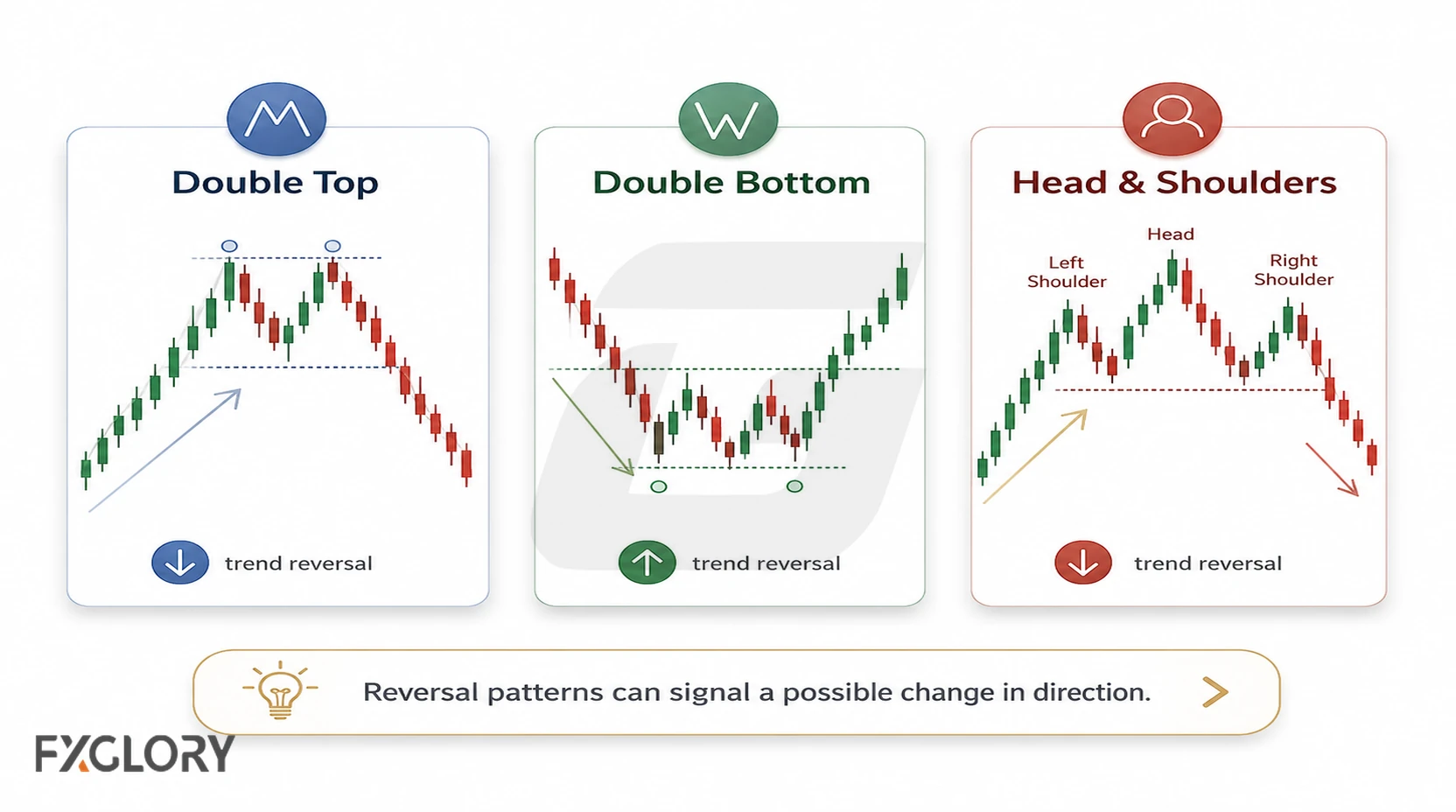
Common examples include head and shoulders, inverse head and shoulders, double tops and double bottoms. The important questions are whether the prior move is clear, whether the structure is complete and where the reversal idea becomes invalid.
For a dedicated explanation, see reversal patterns in forex.
Continuation Chart Patterns in Forex
Continuation patterns form during a pause inside an existing move. Flags, pennants, rectangles and some triangle or wedge structures can fit this category.
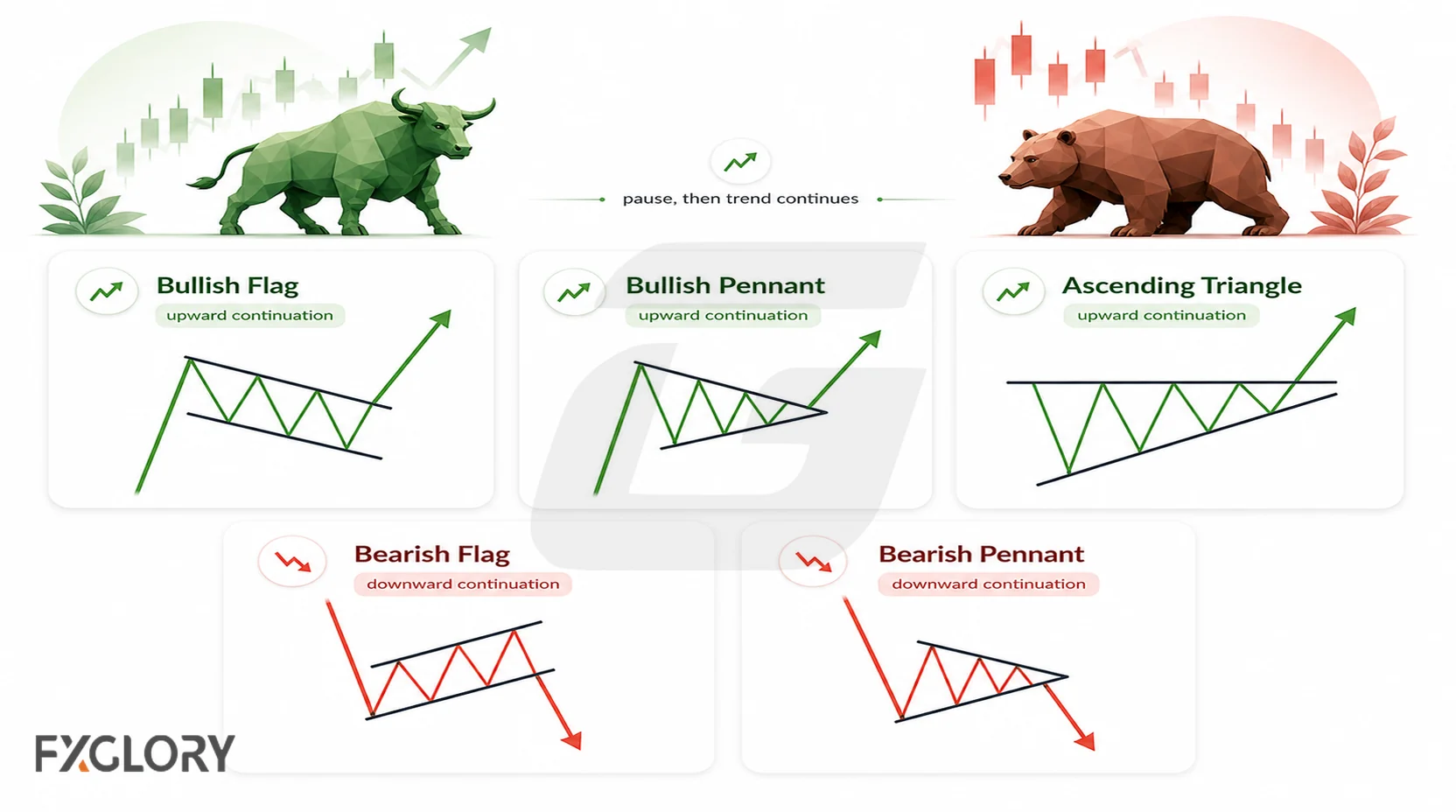
A pause does not guarantee continuation. The structure becomes more useful when price breaks or retests a boundary in a way that supports the existing trend. For more detail, see forex continuation patterns.
Neutral and Bilateral Forex Patterns
Neutral patterns describe compression without a confirmed direction. A symmetrical triangle is a common example: price narrows between converging boundaries while neither side has established a confirmed breakout.
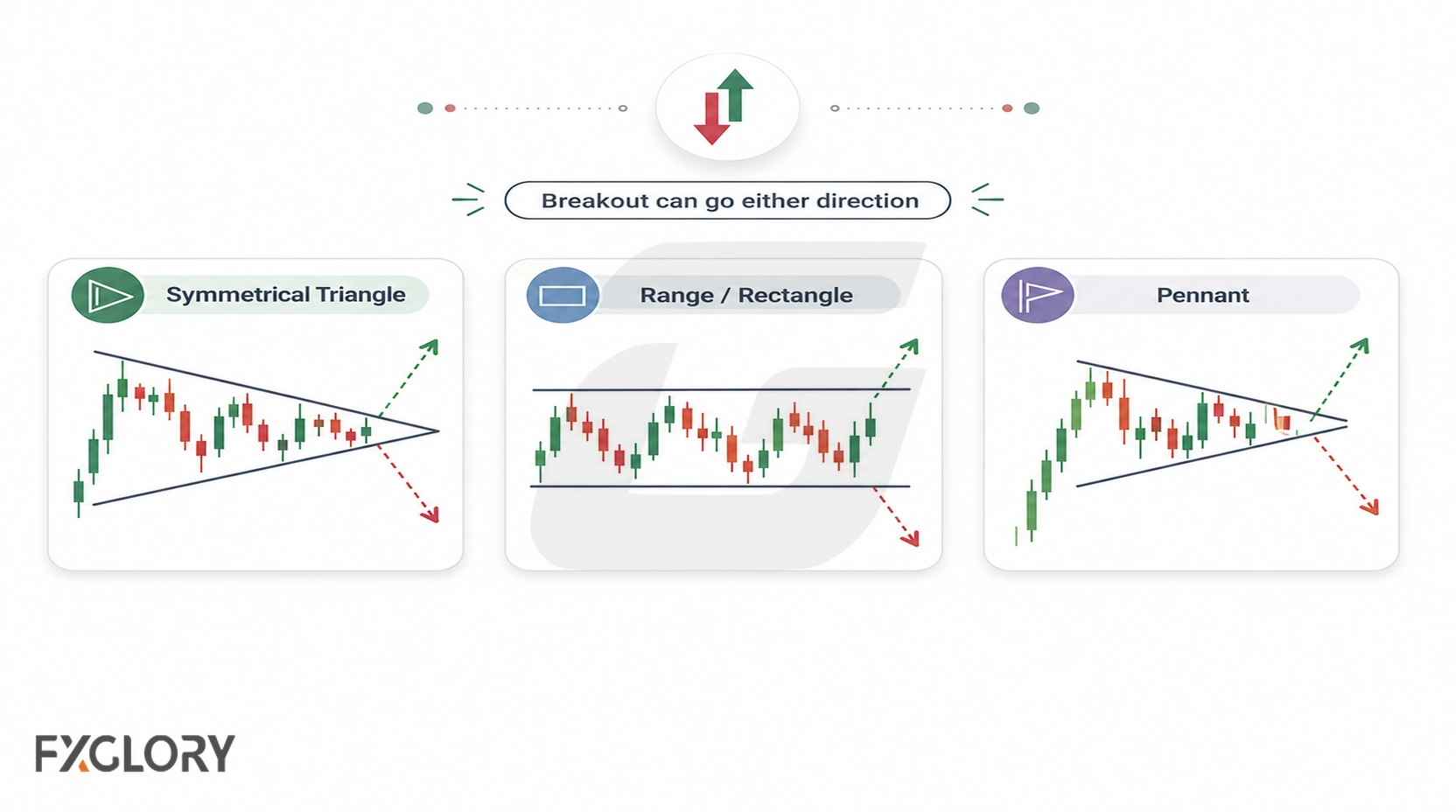
Ascending and descending triangles may carry directional expectations in some contexts, but the actual boundary behavior matters more than the label. See triangle patterns in forex for the main variations.
Strong vs Weak Forex Chart Patterns
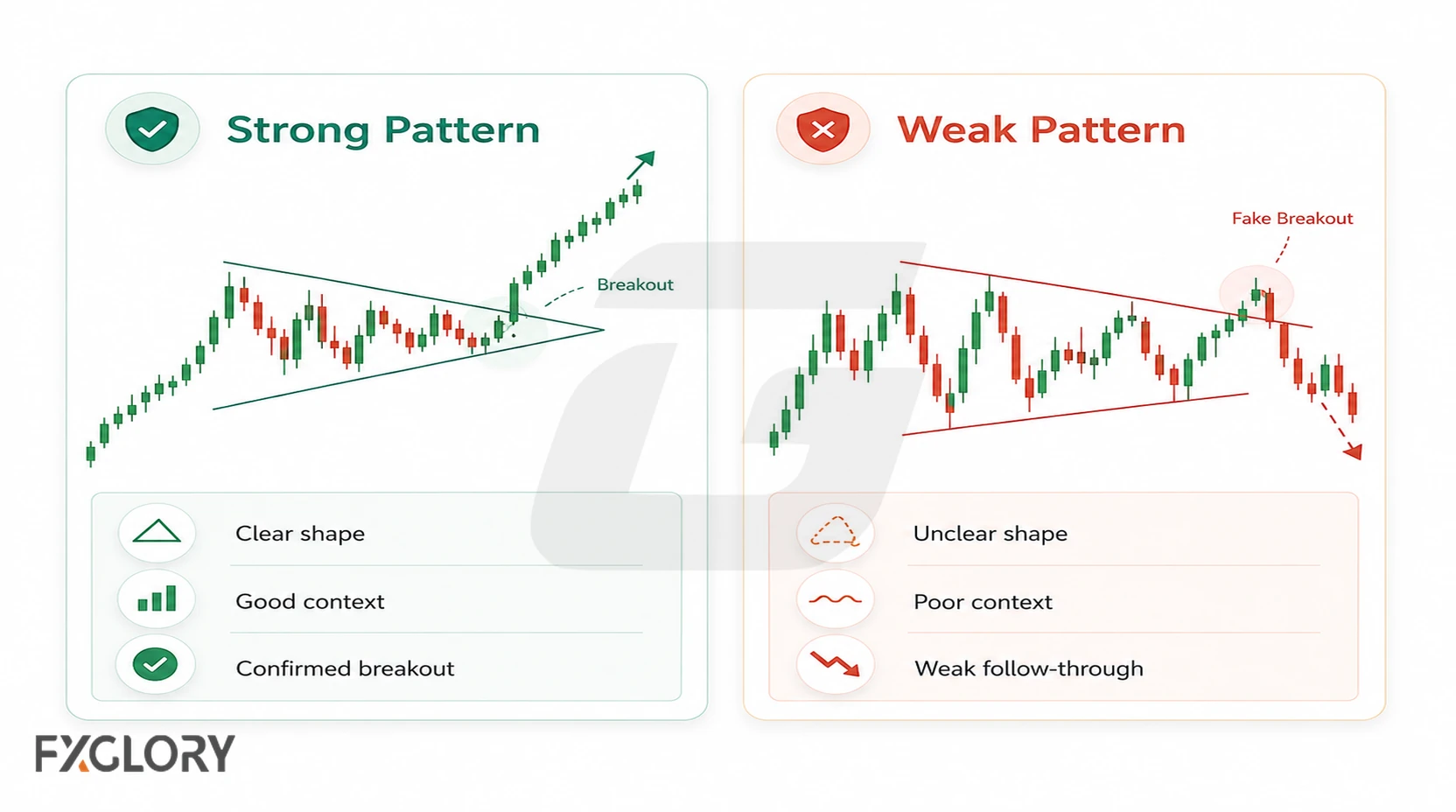
| Factor | Clearer Structure | Weaker Structure |
|---|---|---|
| Visibility | The pattern is recognizable without forcing trendlines. | The shape depends on ignoring obvious swings. |
| Prior context | The preceding trend or range is easy to describe. | The preceding market is already noisy or directionless. |
| Boundaries | Support, resistance, neckline or trendlines are visible. | Boundaries rely on one isolated spike. |
| Invalidation | There is a clear point where the setup is wrong. | The pattern has no objective failure point. |
How to Confirm a Forex Chart Pattern
Confirmation is the market behavior that supports the scenario after the structure has formed. It can reduce premature entries, but it cannot make the outcome certain.
- Mark the boundary: Identify the neckline, trendline, support, resistance or range edge that matters.
- Wait for price behavior: Look for a breakout, rejection or retest rather than assuming the pattern has already resolved.
- Check the close: A brief move through a boundary is different from price closing and holding beyond it.
- Review supporting context: Momentum, volatility, trend strength or candle behavior can add information.
- Define invalidation: Know what price behavior would make the scenario wrong.
If supporting indicators are useful, see forex technical indicators.
Invalidation, Retests and Target Logic
Invalidation is the price behavior that shows the pattern idea is no longer valid. It is different from a target, which is only a possible destination.
- Breakout invalidation: Price breaks a boundary and then returns and holds back inside the structure.
- Reversal invalidation: Price resumes the old trend and moves beyond the level that should have held.
- Continuation invalidation: Price breaks against the original trend scenario.
Some pattern methods estimate targets by measuring part of the structure and projecting that distance from a breakout point. These are planning techniques, not guaranteed outcomes. Retests are similar: a retest may support the breakout if the level holds, or expose a false break if price moves back through it.
Why Forex Chart Patterns Fail
- False breakout: Price crosses a boundary and quickly returns inside.
- Weak structure: The pattern is not clearly visible without forcing lines.
- News volatility: Economic or central-bank events can overwhelm the technical setup.
- Thin liquidity: Reduced participation can produce unstable moves through boundaries.
- Timeframe conflict: A lower-timeframe setup may oppose the broader structure.
- No invalidation: The trader has no objective point where the scenario is considered wrong.
Pattern failure is a normal possibility, which is why the setup should be connected to a risk plan before any live decision.
Forex Context: Sessions, News, Timeframes and Liquidity
Currency pairs trade across global sessions, so timing and market conditions can change the quality of a chart pattern.
- Sessions: A breakout during an active session may behave differently from one during a quiet period.
- News: Economic releases and central-bank events can quickly change volatility and spreads.
- Timeframes: A lower-timeframe pattern should be compared with higher-timeframe structure.
- Pairs: Different currency pairs have different volatility and liquidity profiles.
- Execution: Spread and slippage can matter around fast breakout or retest moves.
- Volume: Spot forex has no single centralized exchange-volume figure, so platform or tick-volume data should be treated as partial information.
For additional volatility context, ATR can help describe how far price is moving, while tick volume can provide platform-specific activity context.
A Beginner Workflow for Reading Forex Chart Patterns
- Choose the pair and timeframe: Set the chart you want to analyze before evaluating the price structure.
- Read the market condition: Decide whether price is trending, ranging, compressing or unclear.
- Mark important areas: Identify visible support, resistance, swing highs, swing lows and trendlines.
- Describe the structure before naming it: Explain what price is doing before assigning a pattern label.
- Classify the scenario: Decide whether it is reversal-focused, continuation-focused or neutral.
- Wait for confirmation: Review breakout, rejection, retest or other relevant behavior.
- Define invalidation: Mark where the idea becomes wrong.
- Check trading conditions: Consider spread, slippage, news, volatility and account risk.
Example: Reading a Forex Chart Pattern on GBP/USD
Suppose GBP/USD has been moving strongly and then compresses between lower highs and higher lows. That structure may resemble a symmetrical triangle.
The trader does not need to predict the direction in advance. A close above the upper boundary may create one scenario; a break below the lower boundary may create another. A brief breakout followed by a move back inside the triangle may instead indicate a false break.
The example becomes useful only when the boundary, confirmation condition and invalidation point can be stated clearly.
Common Mistakes With Forex Chart Patterns
- After-the-fact labeling: The structure only looks obvious after the move is complete.
- Entering before confirmation: The trader acts before price resolves the important boundary.
- Forcing the pattern: Lines are adjusted to fit a preferred pattern name.
- Ignoring broader structure: A lower-timeframe setup is treated independently of the larger market context.
- Using the name as a signal: The label replaces confirmation, invalidation and risk planning.
- Overloading the chart: Too many lines and indicators make the structure harder to read.