ATR Indicator Forex: Volatility, Range Size, and False Signals

Learn what ATR means in forex, how Average True Range measures volatility, why ATR does not show direction, and when ATR needs price structure, timeframe context, spread, slippage, and risk control.
 
Written byHenry Green
Published
Last updated

Key Take Aways

  • ATR, or Average True Range, reviews how much price has been moving on average over a selected period.
  • ATR measures volatility and range size, not bullish or bearish direction.
  • True Range checks normal candle range and absolute distance from the previous close before ATR smooths the result.
  • The 14-period ATR setting is commonly used, but there is no single best ATR setting for every pair, timeframe, or market condition.
  • ATR readings need price structure, support and resistance, timeframe context, spread, slippage, news risk, invalidation, and risk control.
Risk note: Forex trading involves risk of loss. ATR can help review volatility, range size, quiet conditions, and fast movement, but it does not guarantee price direction, profitable trades, breakout success, reversals, execution risk, or protection from spread, slippage, volatility spikes, leverage risk, news-event risk, or false signals.

What Is ATR in Forex?

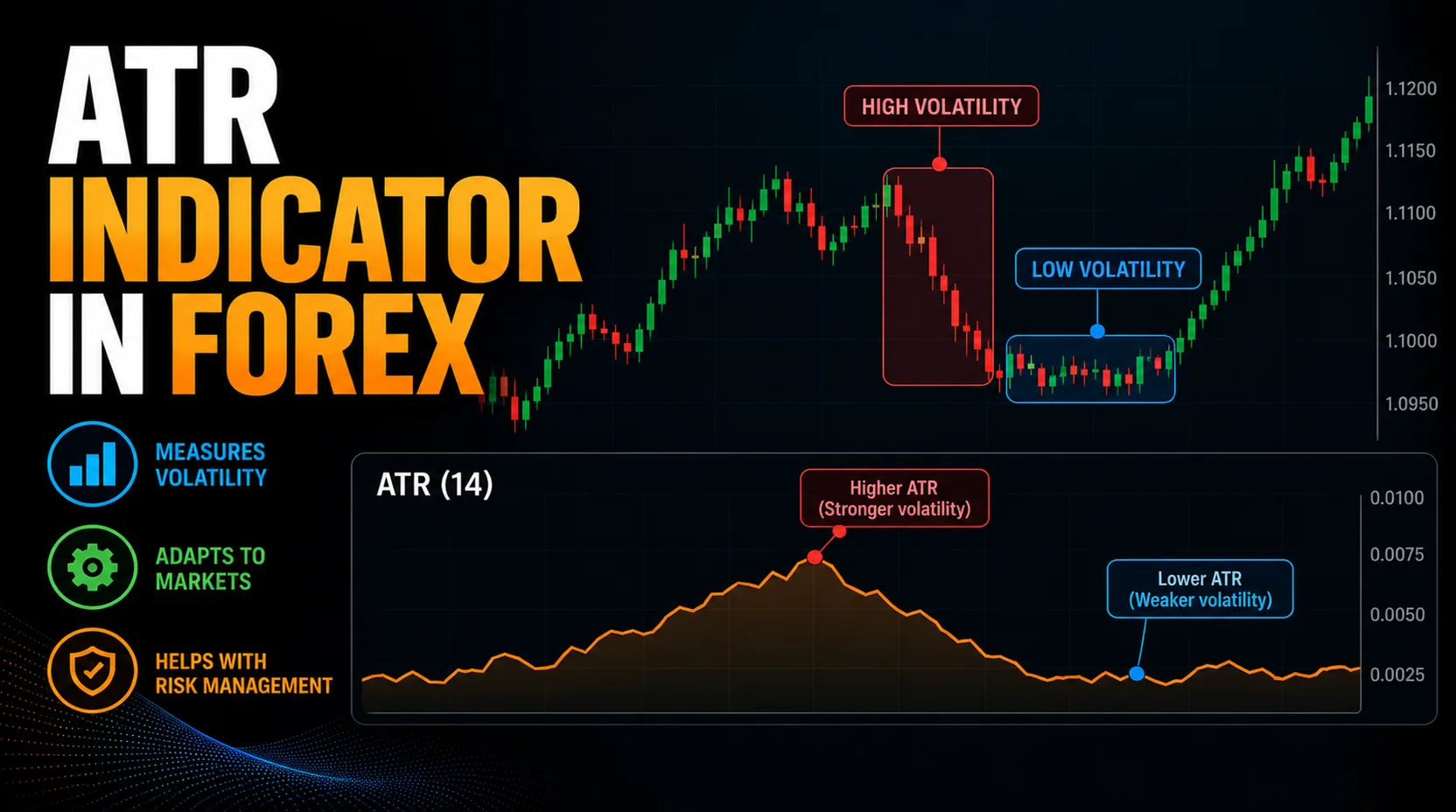
ATR stands for Average True Range. In forex trading, the ATR indicator is used to review how much price has been moving on average over a selected period.

ATR was introduced by J. Welles Wilder and is used across different markets. In forex, it is best understood as a volatility and range-size tool. It does not show whether price should move up or down.

This distinction matters. ATR can rise during an upward move, downward move, breakout attempt, news spike, or erratic chop. Direction still comes from price structure, not ATR.

Planning rule: Use ATR as a volatility and range-size review tool, not as a complete trading plan.

For the trend-strength side of this topic, review ADX trend-strength context.

How the ATR Forex Indicator Works

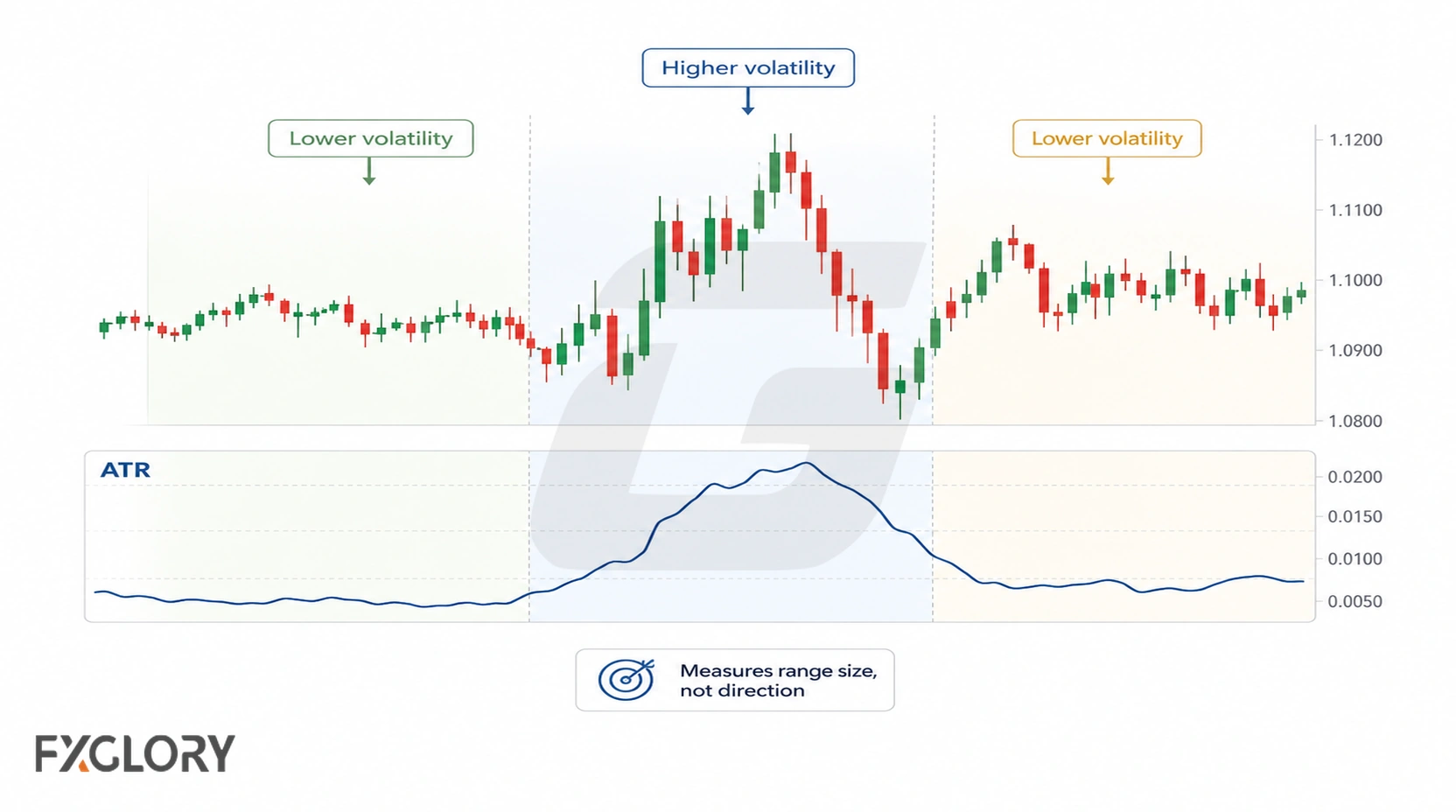
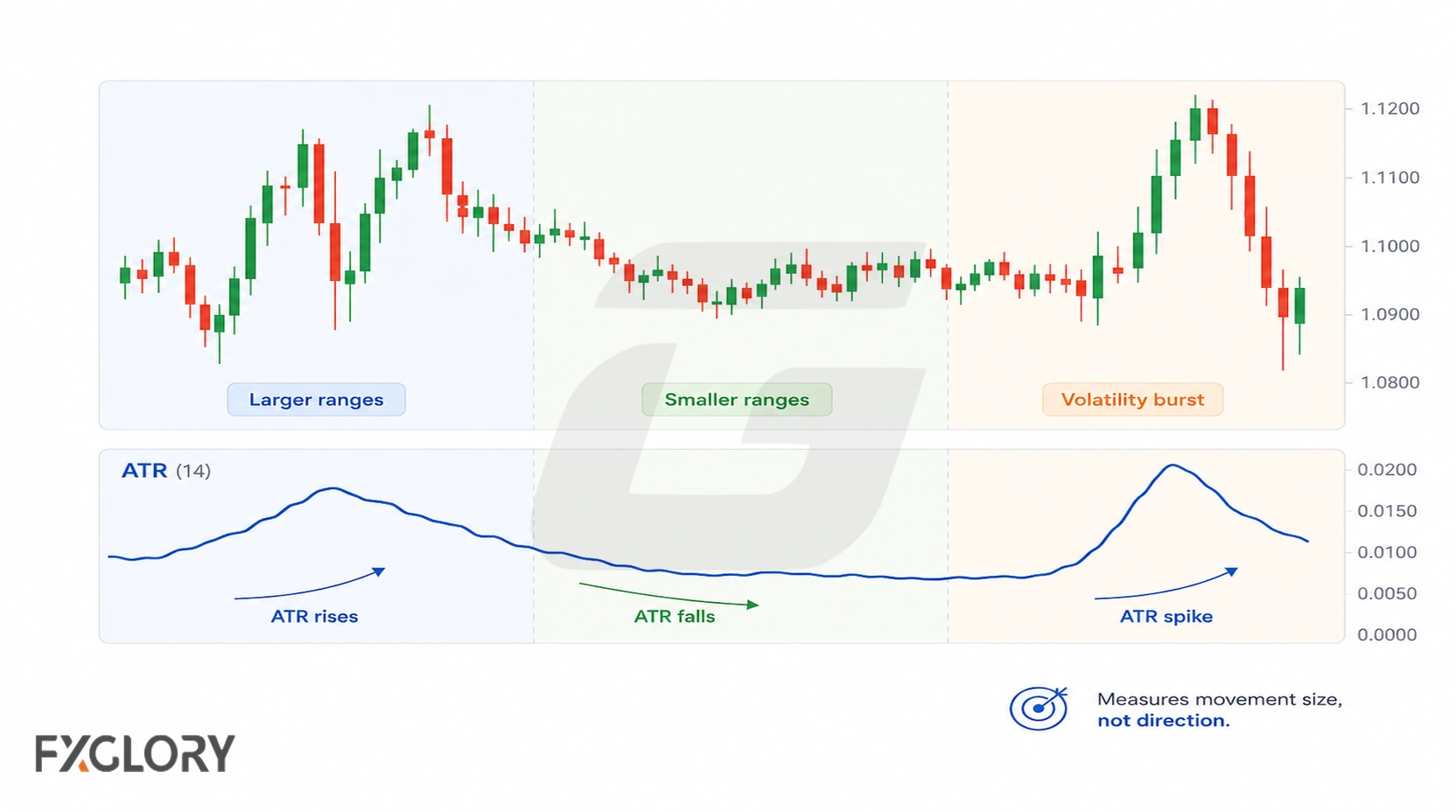
ATR reviews average movement range. When recent candles have larger ranges, ATR can rise. When recent candles become smaller or quieter, ATR can fall.

The ATR line is usually displayed below the price chart. A rising ATR reading shows that recent movement ranges are expanding. A falling ATR reading shows that recent movement ranges are contracting. Neither reading gives price direction by itself.

  • Rising ATR: Recent movement range may be expanding, but direction still needs price context.
  • Falling ATR: Recent movement range may be contracting, but this does not guarantee a breakout is coming.
  • Flat ATR: Volatility may be stable, but spread, session, and news context still matter.
  • Sudden ATR spike: Movement may be abnormal, news-driven, or difficult to manage clearly.
Avoid this mistake: ATR measures how much price has been moving. It does not show where price must go next.

True Range in Plain English

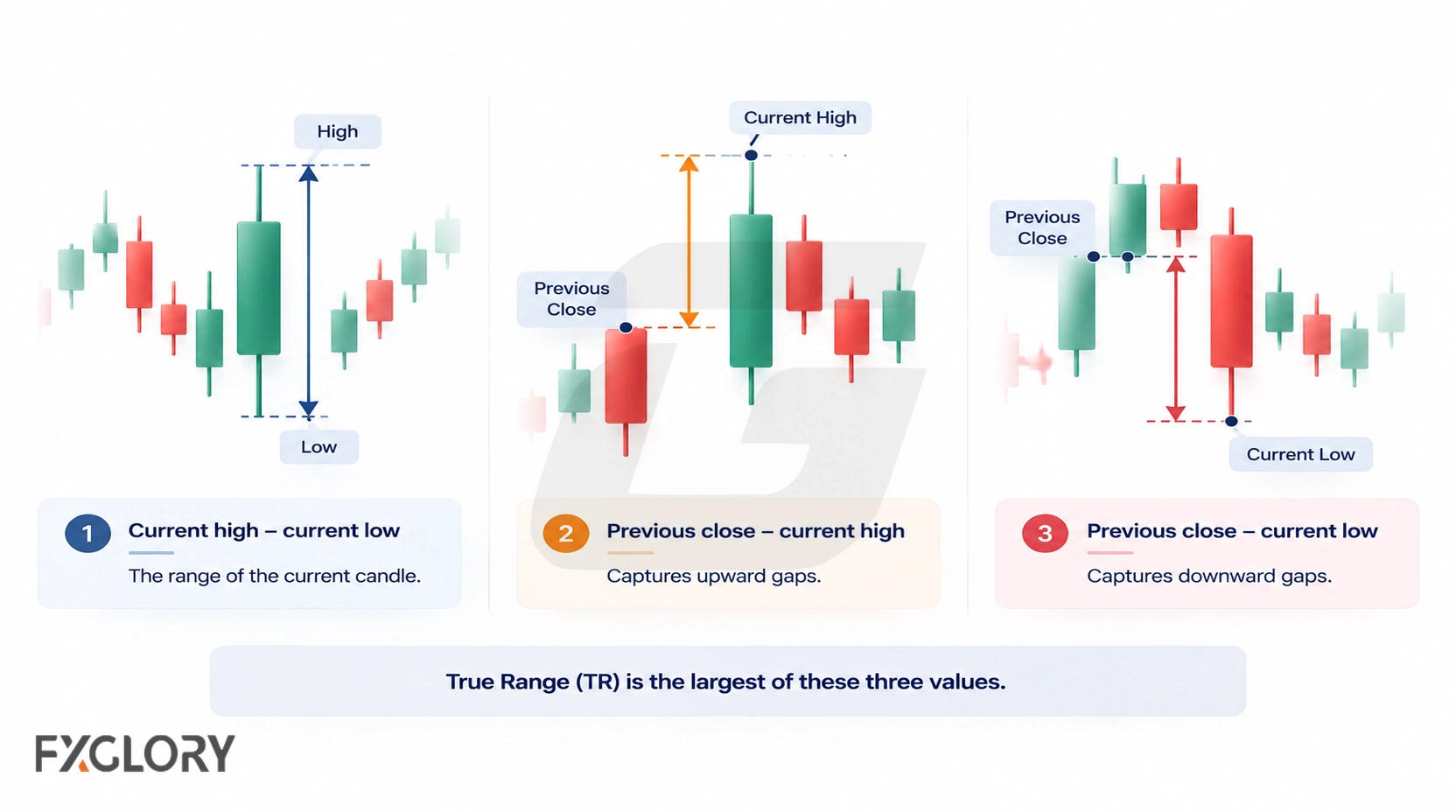
ATR starts with True Range. True Range looks at the largest relevant movement from the current candle and the previous close. This helps capture normal candle range and sudden jumps from one candle to the next.

True Range checkWhat it capturesWhy it matters
Current high minus current lowNormal candle rangeShows the visible high-to-low movement inside the candle
Absolute distance between current high and previous closeUpward jump from the previous closeCaptures movement that may not appear in the candle body alone
Absolute distance between current low and previous closeDownward drop from the previous closeCaptures downward gaps or sharp movement from the prior close

ATR then smooths True Range over the selected period, such as 14 periods, to create an average range reading.

True Range rule: True Range captures movement size. It still does not choose direction.

ATR Formula in Plain English

The ATR formula averages True Range over a selected lookback period. A common setting is 14 periods, but the period depends on the platform, timeframe, and chart context.

In plain English, ATR asks: how large has recent price movement been compared with the selected lookback window?

  • True Range: Measures the largest relevant movement from the current candle and previous close.
  • Lookback period: Decides how many candles are included in the average.
  • ATR value: Shows the smoothed average of recent True Range.
  • Chart timeframe: Changes what each period represents, such as minutes, hours, days, or weeks.
Formula note: The calculation explains range size. It still does not predict the next candle or remove the need for confirmation.

High ATR vs Low ATR in Forex

A high ATR reading means recent price ranges are larger. A low ATR reading means recent price ranges are smaller or quieter. Both readings need context.

High ATR does not confirm a trend. Low ATR does not guarantee a breakout. ATR only describes recent movement size.

ATR behaviorWhat it suggestsWhat it does not confirm
Rising ATRRecent range size is expandingDoes not confirm direction or breakout success
Falling ATRRecent range size is contractingDoes not guarantee a breakout or reversal
High ATRMovement has been larger than usual for that contextDoes not prove a clean trend is present
Low ATRMovement has been quieter than usual for that contextDoes not mean the market is safe or predictable
ATR spikeMovement may be abnormal or news-sensitiveDoes not mean the move is manageable
Volatility rule: Bigger movement is not the same as better direction. Quiet movement is not the same as lower risk.

ATR Measures Volatility, Not Direction
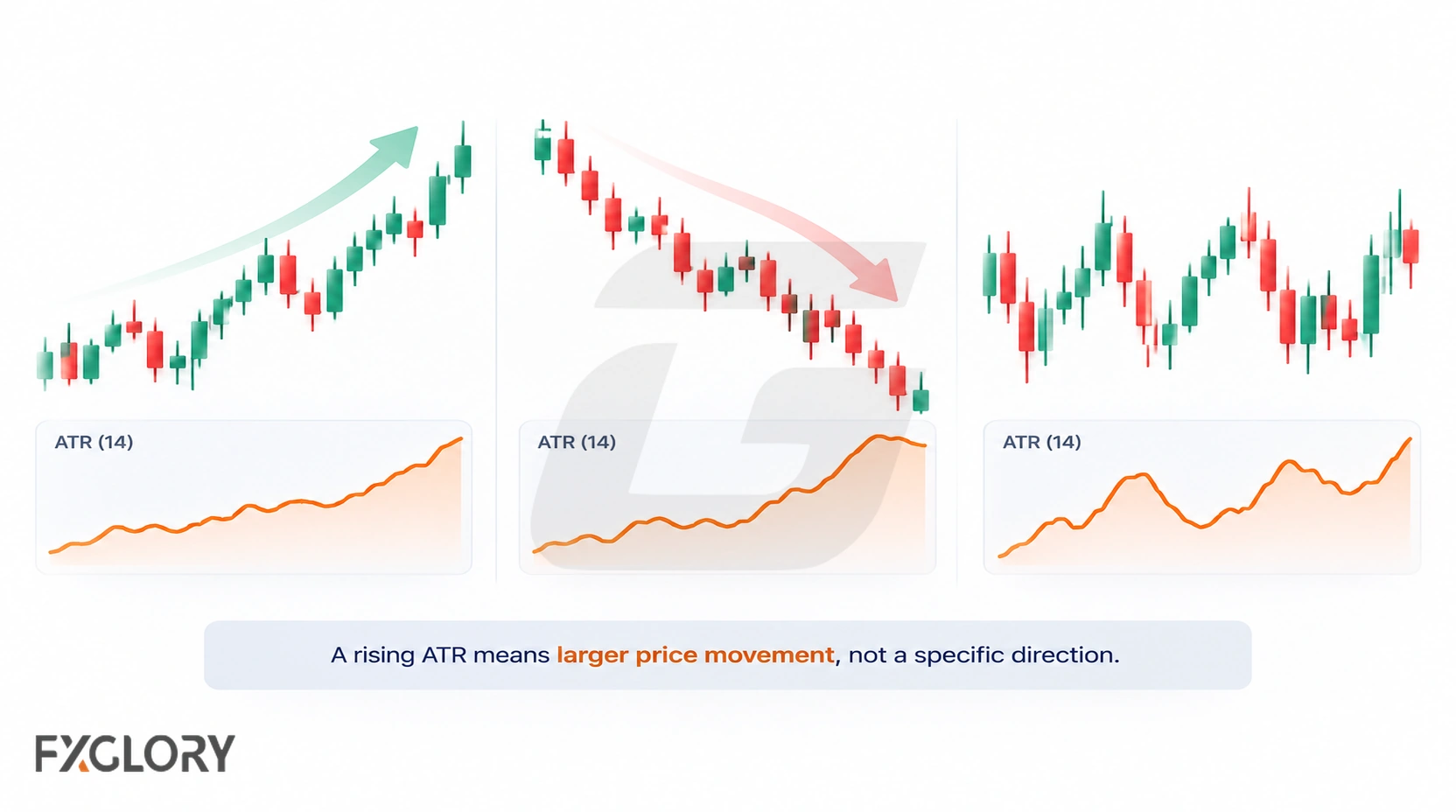
The most important ATR rule is simple: ATR does not show direction. It can rise while price moves upward, downward, sideways, or erratically.

Direction must be reviewed with price structure, trend context, support and resistance, moving averages, or another directional tool. ATR only helps review whether the movement size is expanding, contracting, or abnormal.

  • ATR rising during an up move: Range size is expanding, but the upward direction still needs price confirmation.
  • ATR rising during a down move: Range size is expanding, but the downward direction still needs price confirmation.
  • ATR rising during chop: Movement may be unstable rather than directional.
  • ATR falling during a range: Movement may be quiet, but compression does not guarantee breakout timing.
Direction rule: ATR answers how much price has been moving. It does not answer where price should move.

Why ATR Values Depend on Pair and Timeframe
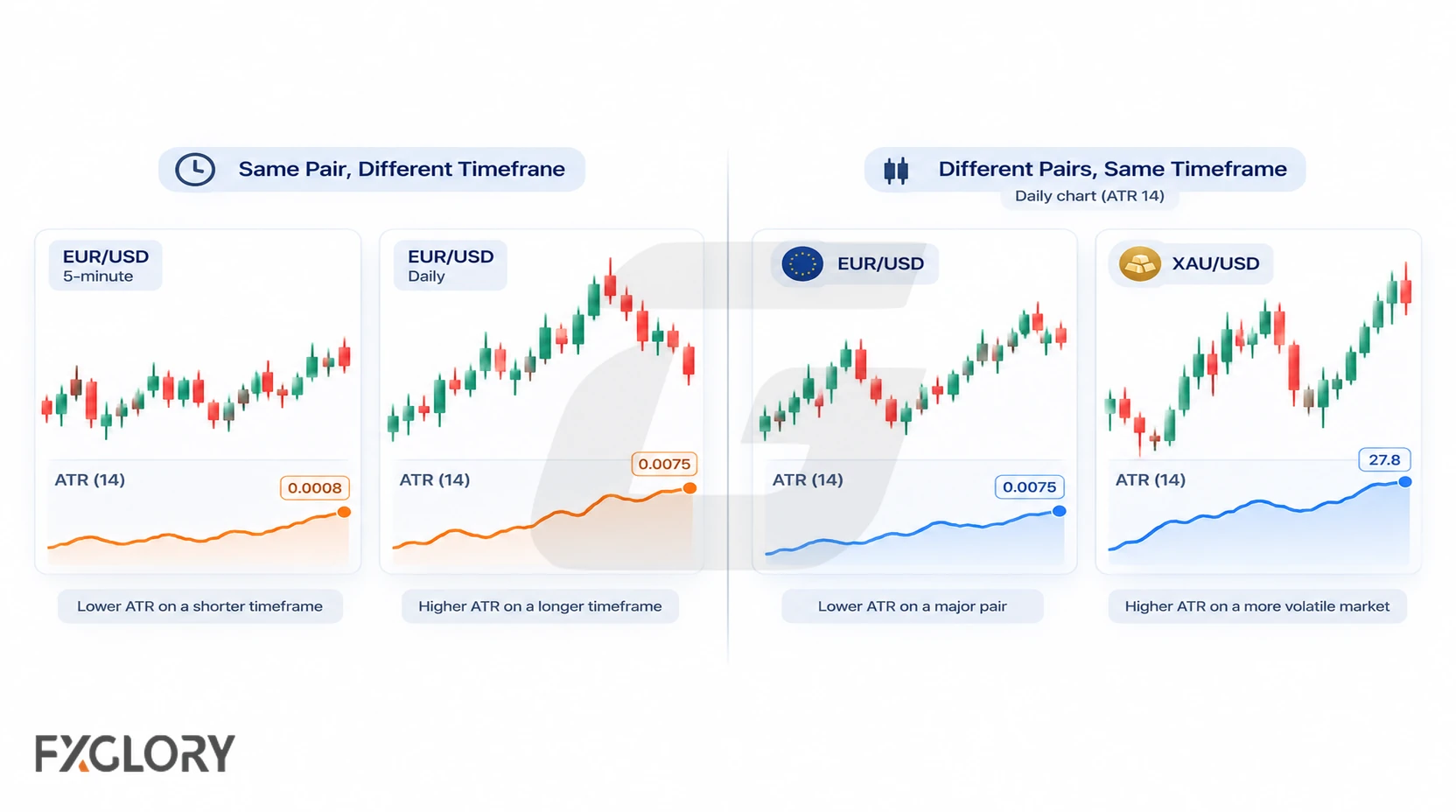
ATR values should be interpreted by pair, instrument, and timeframe. A quiet forex pair, a volatile currency pair, gold, and BTC/USD can all produce very different ATR readings.

The same rule applies to timeframes. A 14-period ATR on a 5-minute chart reviews 14 five-minute candles. A 14-period ATR on a daily chart reviews 14 daily candles. These readings should not be treated as the same thing.

ComparisonWhy it mattersBetter approach
EUR/CHF vs BTC/USDDifferent instruments can have very different movement rangesCompare each market with its own recent ATR history
5-minute ATR vs daily ATREach period represents a different time windowMatch ATR reading to the timeframe being reviewed
Gold vs major FX pairsPrice behavior and range size may differ sharplyReview volatility in the instrument's own context
Low-spread pair vs fast-moving marketSpread and execution conditions can affect practical useCheck trading conditions before trusting volatility assumptions
Comparison rule: Do not compare ATR values across random instruments as if they mean the same thing. Compare ATR with its own recent history on the same market and timeframe.

ATR Settings in Forex

The 14-period ATR setting is commonly used. This does not make it the best setting for every pair, timeframe, or market condition.

Shorter ATR settings react faster, but they can become noisy. Longer ATR settings smooth the reading, but they can react later. Changing settings only to make old examples look cleaner can create curve fitting.

  • Shorter setting: Faster reaction, more volatility noise.
  • Longer setting: Smoother reading, slower reaction.
  • 14-period setting: Common default, not a universal rule.
  • Timeframe mismatch: ATR period follows the chart timeframe.
  • Changing settings too often: Can make past examples look better without improving future review.
Settings rule: Test ATR settings inside a market condition before judging them. Do not choose settings only because they fit old examples.

ATR vs ADX, Bollinger Bands, and Other Volatility Tools

ATR is often compared with ADX, Bollinger Bands, and broader volatility indicators. These tools can overlap in topic, but they do not answer the same chart question.

ToolMain jobWhat ATR adds
ATRVolatility and average range-size reviewShows how much price has been moving on average
ADXTrend-strength reviewSeparates movement size from trend strength
Bollinger BandsVolatility bands around priceGives a separate range-size reading below the chart
Volatility indicatorsBroader volatility-tool categoryShows one specific way to read recent movement size
Moving averagesSmoothing and trend-following contextAdds volatility context around smoother trend tools

For related context, use the ADX trend-strength guide, the Bollinger Bands volatility-band guide, and the forex volatility indicator guide.

ATR vs ADX: ATR reviews volatility or range size. ADX reviews trend strength. A market can have high ATR without having a clean trend.

ATR and Risk Distance in Forex

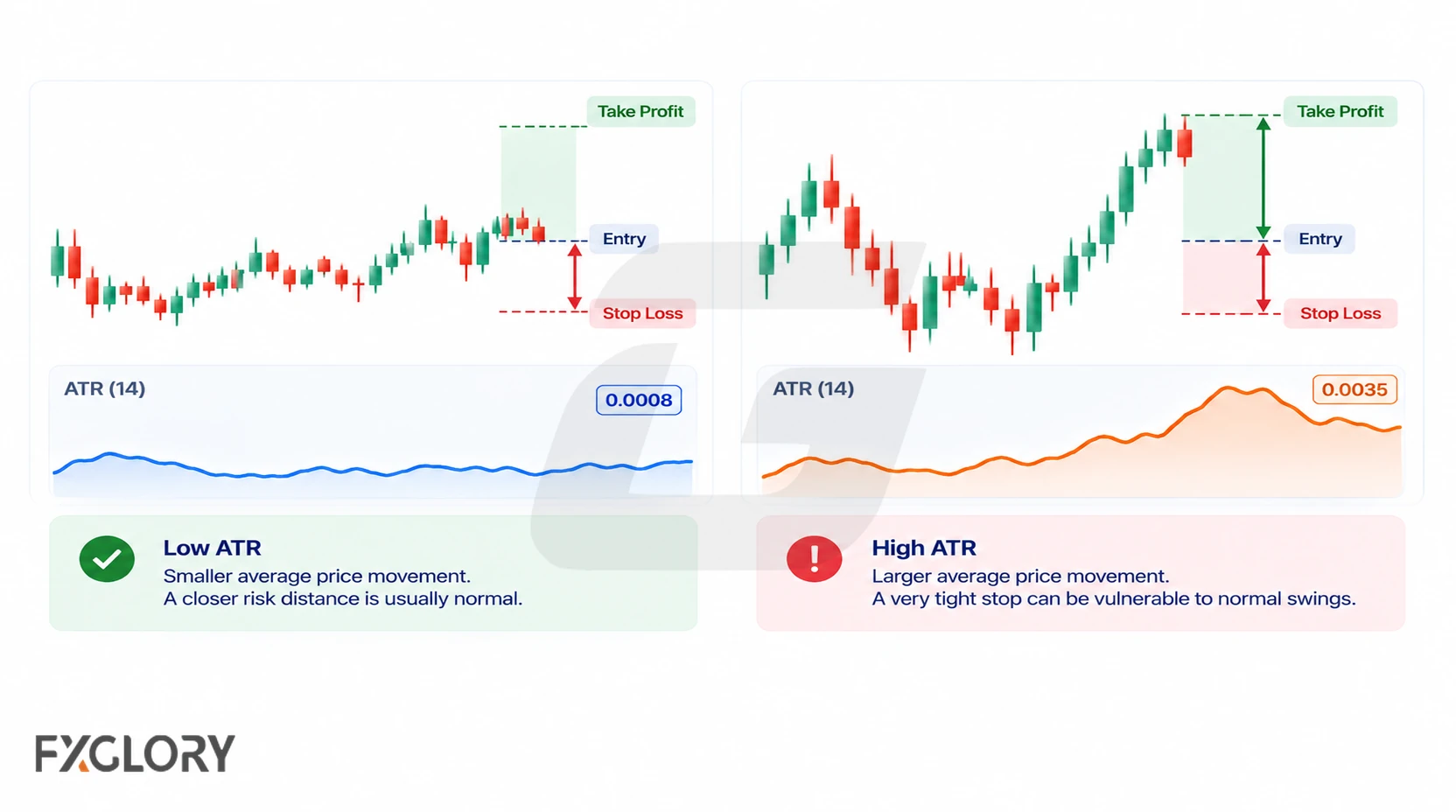
ATR is often used to review whether a planned distance is tight or wide compared with recent movement. This can be useful context, but ATR does not place stops, set targets, or decide position size by itself.

A small distance during high ATR conditions may be vulnerable to normal volatility. A large distance during low ATR conditions may create unnecessary exposure if the price idea does not justify that distance. Both situations still need account-risk rules, price structure, and invalidation.

  • ATR is context: It can show whether recent movement has been large or quiet.
  • ATR is not placement logic: It does not decide where a stop, target, or entry belongs.
  • ATR is not protection: Wider distance does not remove market risk, slippage, spread changes, or news risk.
  • ATR needs invalidation: A volatility reading is not enough unless the price idea has a clear point where it is wrong.
Risk-distance rule: ATR can support risk-distance review, but it should not replace position-size rules, invalidation, or risk control.

How to Use ATR in Forex Without Treating It as a Signal

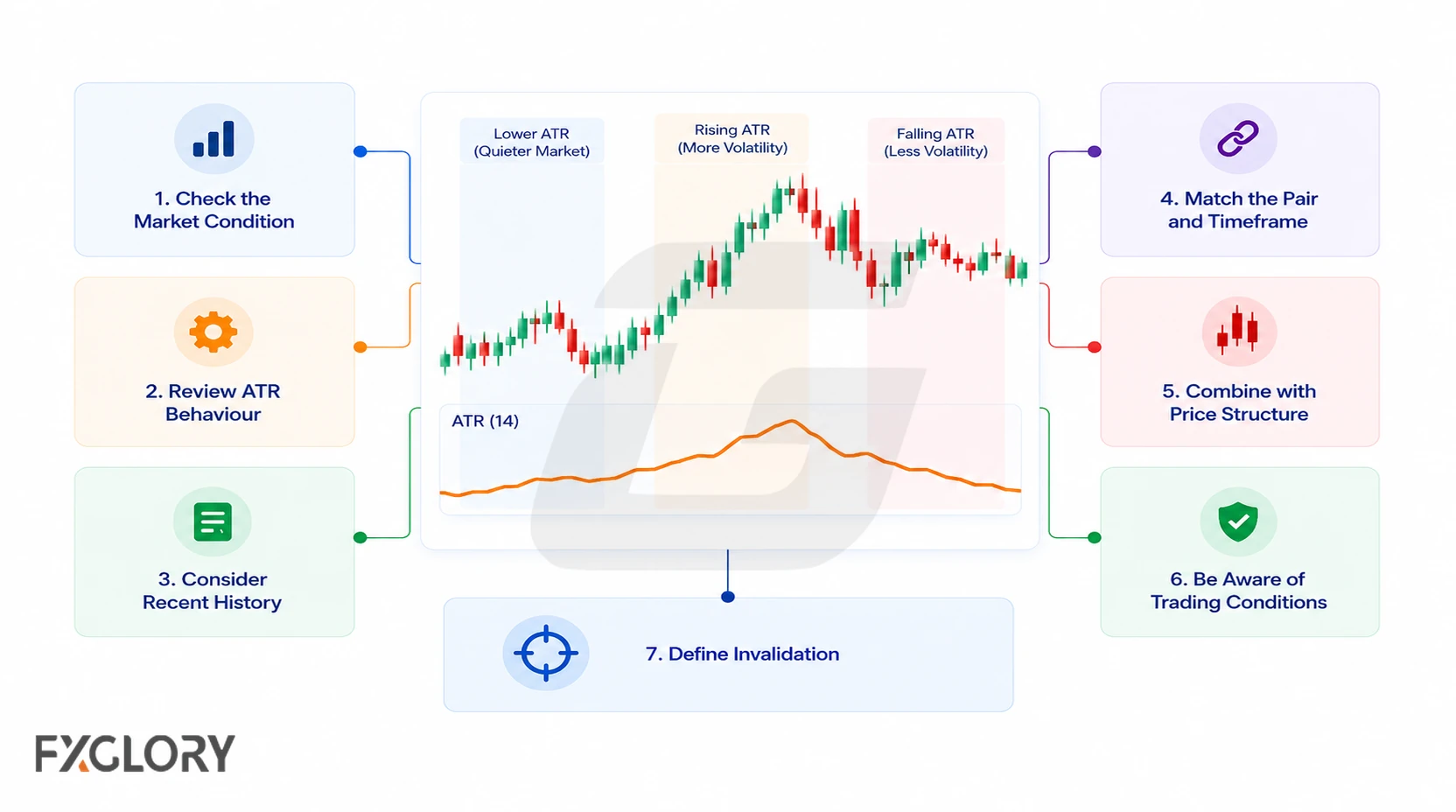
Start with market condition, then read ATR behavior, pair context, timeframe context, and price structure. The goal is to decide whether volatility context supports the chart question, not to turn ATR into a trade command.

  1. Name the condition: Quiet range, expanding movement, breakout attempt, trend, chop, or high volatility.
  2. Read ATR direction: Is ATR rising, falling, flat, or spiking?
  3. Compare ATR with recent history: Is the current reading normal, quiet, elevated, or abnormal for that market?
  4. Check pair and timeframe: Is the ATR reading being compared inside the same instrument and timeframe?
  5. Check price structure: Is price near support, resistance, a range edge, breakout area, or retracement zone?
  6. Check trading conditions: Are spread, slippage, news risk, and volatility regime manageable?
  7. Define invalidation: Know where the ATR-based idea is wrong before using it in a plan.
Use rule: ATR can support a review process, but it should not replace direction, structure, or risk control.

ATR with Confirmation Checks

An ATR reading becomes more useful when it is connected to price context. Confirmation does not remove risk, but it can reduce the chance of treating every volatility expansion or compression as a trade idea.

  • Price location: Is ATR expanding or contracting while price is near support, resistance, a range edge, or a retracement zone?
  • Market structure: Has price shown breakout, failed breakout, continuation, rejection, compression, or unclear chop?
  • Trend context: Is volatility expanding with a visible trend, against it, or inside disorderly movement?
  • Spread context: Is the spread large enough to affect practical use of the ATR reading?
  • News context: Is the ATR spike connected to event risk rather than normal market rhythm?
  • Risk rule: Can the trader explain where the idea is wrong before using it in a plan?

For confirmation beyond ATR, review support and resistance zones, market structure context, and price action in forex.

Live Market Examples: Matching ATR to Chart Questions

The first step is to identify the ATR question, not to treat every volatility change as a signal.

Market pageATR questionContext to check
EUR/CHF live chartIs ATR showing quiet movement inside a range?Range boundaries, support/resistance, and spread sensitivity
EUR/GBP live chartIs low ATR making small movements look more important than they are?Price location, market structure, and recent ATR history
GBP/USD live chartIs ATR expanding during directional movement?Trend context, structure reaction, and volatility regime
Gold live chartIs a larger ATR changing risk-distance assumptions?Volatility, support/resistance distance, and event risk
BTC/USD live chartIs an ATR spike reflecting unstable movement rather than clean direction?Spread, volatility, execution conditions, and structure clarity
Practical point: The market page shows the chart environment. ATR only helps organize one volatility and range-size question inside that environment.

ATR False-Signal Filters

Use these filters when the ATR indicator looks active but the chart condition does not support the reading.

FilterProblem it catchesWhat to check
Direction-confusion filterATR is treated as if it shows bullish or bearish directionPrice structure, trend context, and directional tools
High-volatility-without-trend filterLarge ranges are mistaken for clean trend strengthADX context, structure, and continuation quality
Low-ATR-breakout-assumption filterQuiet conditions are treated as guaranteed breakout setupRange boundaries, compression quality, and confirmation
Compression-fakeout filterLow ATR leads to early breakout assumptionsSupport/resistance reaction and failed-breakout risk
News-spike filterATR jumps because of event risk rather than normal movementNews calendar, spread behavior, and liquidity conditions
Spread-sensitivity filterATR is small compared with spread or execution costsPair conditions, session, and practical distance
Wrong-timeframe filterATR reading is taken from a timeframe that does not match the planChart timeframe and broader structure
Cross-instrument-comparison filterATR values are compared across unrelated marketsSame pair, same timeframe, and recent ATR history
Stop-distance-overfit filterATR multipliers are adjusted only to make old examples look cleanTesting across ranges, trends, news, and volatility
No-invalidation filterNo clear place where the idea is wrongRisk distance and invalidation rule

How to Test the ATR Indicator in Forex

ATR should be tested inside one market condition at a time. Testing it across random charts without separating quiet ranges, trends, breakouts, volatility spikes, and news conditions can create misleading results.

  1. Choose the ATR job: Volatility context, range-size review, compression check, expansion check, risk-distance review, or news-spike review.
  2. Choose the market condition: Quiet range, active range, trend, breakout attempt, high volatility, or unclear structure.
  3. Choose the setting: Record whether ATR uses 14 periods or another lookback.
  4. Match the timeframe: Record whether ATR is reviewed on the same timeframe as the chart question.
  5. Compare with recent history: Mark whether ATR is normal, quiet, elevated, or abnormal for that pair or market.
  6. Name the confirmation layer: Support/resistance, structure, trend context, volatility regime, spread, news risk, or invalidation.
  7. Define the trigger: Write the exact price behavior that would confirm the ATR reading.
  8. Define invalidation: Write the price behavior that would make the idea wrong.
  9. Check spread and slippage context: Record whether trading costs or execution conditions could affect the setup.
  10. Record the failure type: Direction confusion, volatility without trend, false compression, news spike, spread sensitivity, wrong timeframe, cross-instrument comparison, stop-distance overfit, or no invalidation.

ATR is useful only if it makes the volatility and range-size question clearer. If it encourages prediction, hides price structure, or cannot be tied to invalidation, it should not stay in the plan.

A Practical Way to Use ATR in Forex

Start with the market condition. Read ATR direction and recent-history context. Check the pair, timeframe, price structure, spread, slippage, news risk, confirmation, and invalidation. If the ATR reading does not make the volatility question clearer, ignore it.

ATR does not need to predict the next move. It only needs to support one part of a clear process: volatility review, range-size context, compression check, expansion check, risk-distance review, or news-spike filter.

For comparing ATR with other volatility tools, use the forex volatility indicator guide. For comparing ATR with trend, momentum, volatility, and strength tools, use the best indicators for forex guide.

Final risk reminder: ATR is only one part of a trading plan. Market condition, timeframe, structure, news, spread, slippage, volatility, leverage, position size, and account risk still matter.

Frequently Asked Questions

What is ATR in forex?

ATR, or Average True Range, is a volatility indicator that reviews how much a forex pair has been moving on average over a selected period.

Does ATR show direction?

No. ATR measures volatility and range size. It does not show whether price should move up or down.

What is True Range in ATR?

True Range is the greatest of current high minus current low, the absolute distance between current high and previous close, or the absolute distance between current low and previous close.

What does a high ATR mean in forex?

A high ATR means recent price ranges are larger. It does not confirm trend direction, breakout success, or reversal.

What does a low ATR mean in forex?

A low ATR means recent price ranges are smaller or quieter. It does not guarantee a breakout is coming.

What is the common ATR setting in forex?

The 14-period ATR setting is commonly used, but there is no single best setting for every pair, timeframe, or market condition.

Why do ATR values differ between pairs and timeframes?

ATR values differ because each pair or market has its own movement range, and each chart timeframe changes what one ATR period represents. A 14-period ATR on a 5-minute chart is not the same as a 14-period ATR on a daily chart.

Is ATR the same as ADX?

No. ATR reviews volatility or range size, while ADX reviews trend strength. A market can have high ATR without a clean trend.

Can ATR be used alone?

ATR should not be used alone. It should be checked with price structure, support and resistance, trend context, spread, slippage, news risk, invalidation, and risk control.

Related Contents

ADX ForexSeparate ATR volatility from ADX trend-strength context.
Forex Moving AverageCompare ATR range-size context with moving-average trend-following behavior.
Support and Resistance in ForexCheck whether ATR expansion or compression appears near a meaningful price area.

Practice ATR Range-Size Filters Before Trading Live

Use a free FXGlory demo account to practice reading ATR volatility, range-size changes, pair and timeframe context, confirmation, and false-signal filters before trading with real money.

Open a Free Demo Account