
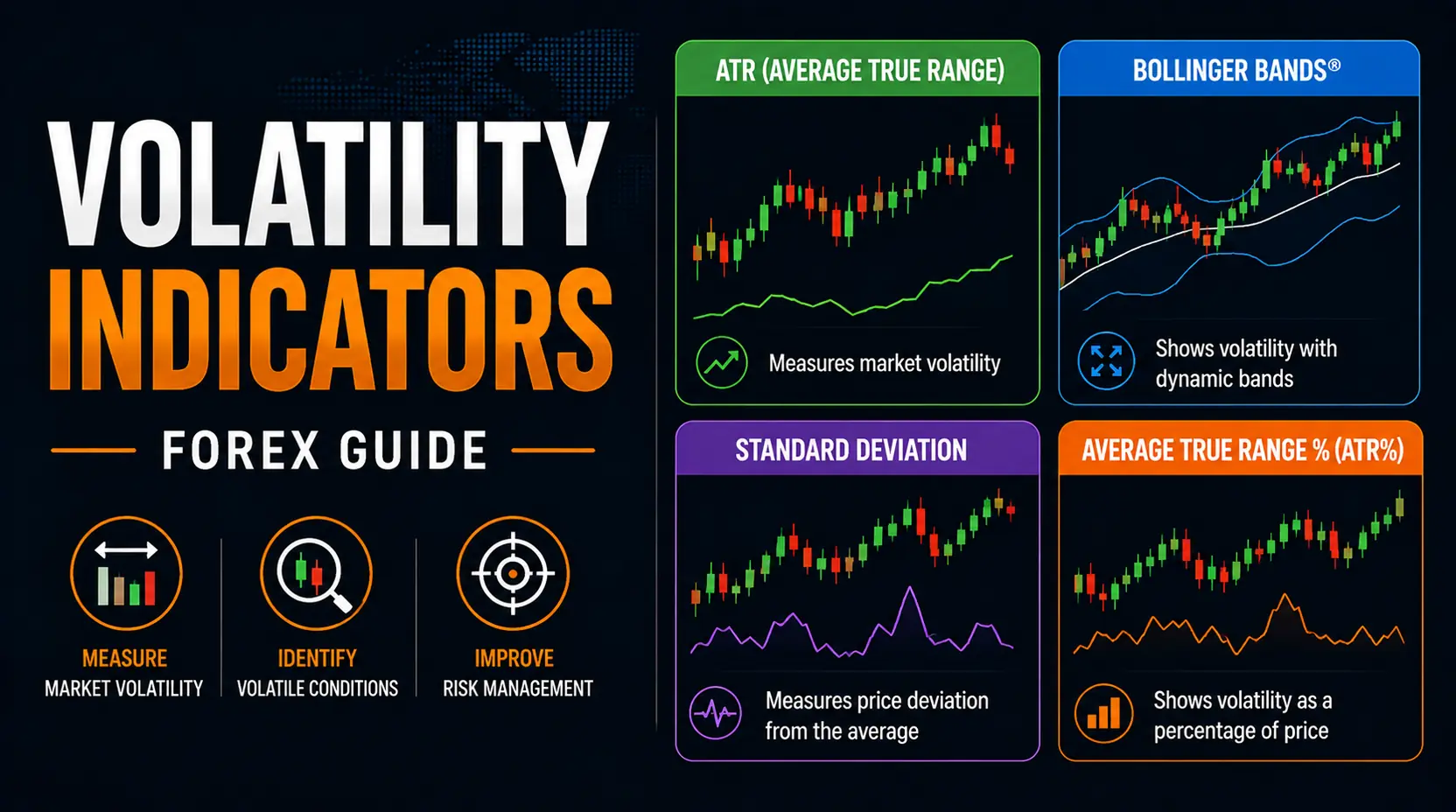
What Is a Volatility Forex Indicator Used For?
A volatility forex indicator is used to review how much price is moving, whether movement is expanding or contracting, and whether the planned risk distance still makes sense.
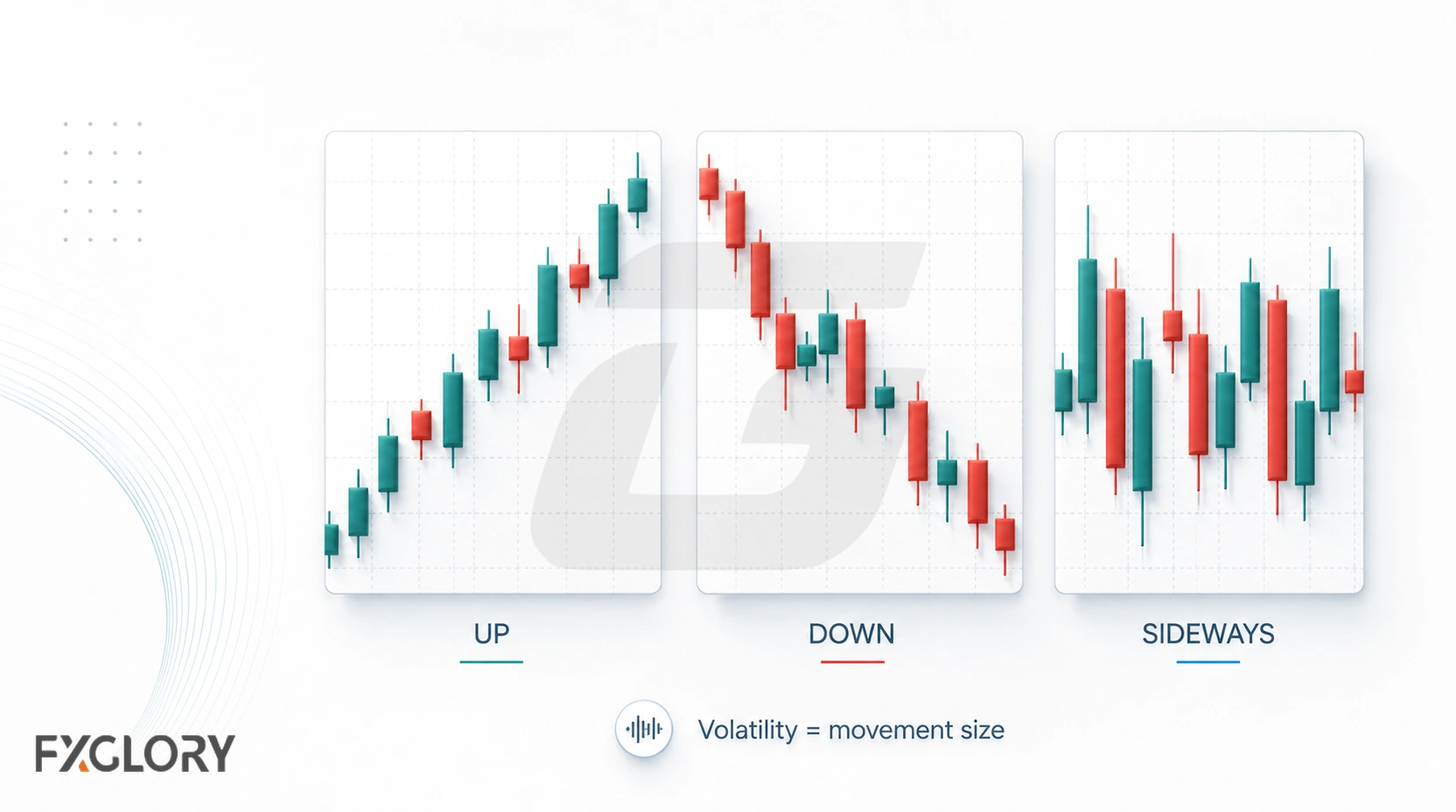
Volatility is not direction. A market can become more volatile while moving upward, downward, or sideways. A volatility reading should help with movement conditions, not decide bullish or bearish direction by itself.
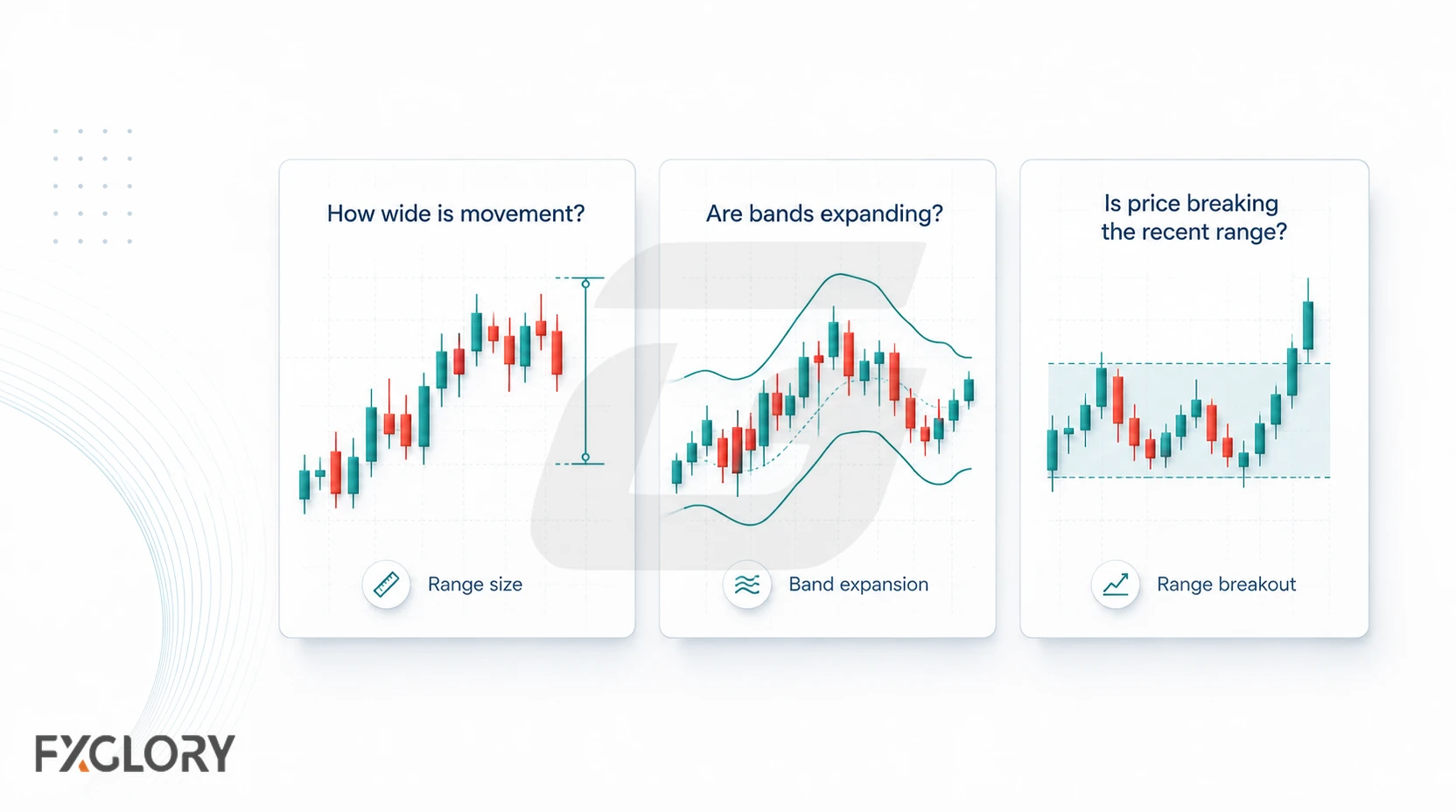
A volatility tool is easier to read when the chart question is clear. One tool may help with movement size, another may help with band expansion, and another may help compare current movement with a daily or normal range.
For the broader indicator category, review the forex technical indicators guide.
Choose the Volatility Tool by Chart Question
A volatility tool should answer one movement question at a time. A movement-size tool may not show range boundaries. A band tool may not define the full risk plan. A daily-range tool may not explain intraday structure.
| Volatility question | Possible tool type | What to avoid |
|---|---|---|
| How much has price been moving recently? | ATR movement-size review | Using movement size as bullish or bearish direction |
| Is movement expanding or contracting around price? | Bollinger Band expansion and contraction review, Keltner-style channels | Treating a band touch as a complete signal |
| Has the market moved far compared with a typical day? | Average Daily Range or daily range reference | Assuming price must stop or reverse at an average range |
| Is price stretched from a normal baseline? | Deviation or standard-deviation-style reference | Using stretched movement without structure or confirmation |
| Is the invalidation distance practical? | ATR, ADR, spread check, and structure distance | Ignoring position size, spread, or execution risk |
On-Chart vs Off-Chart Volatility Indicators
Volatility tools can appear directly on the price chart or in a separate indicator window. The format changes how the reading is used.
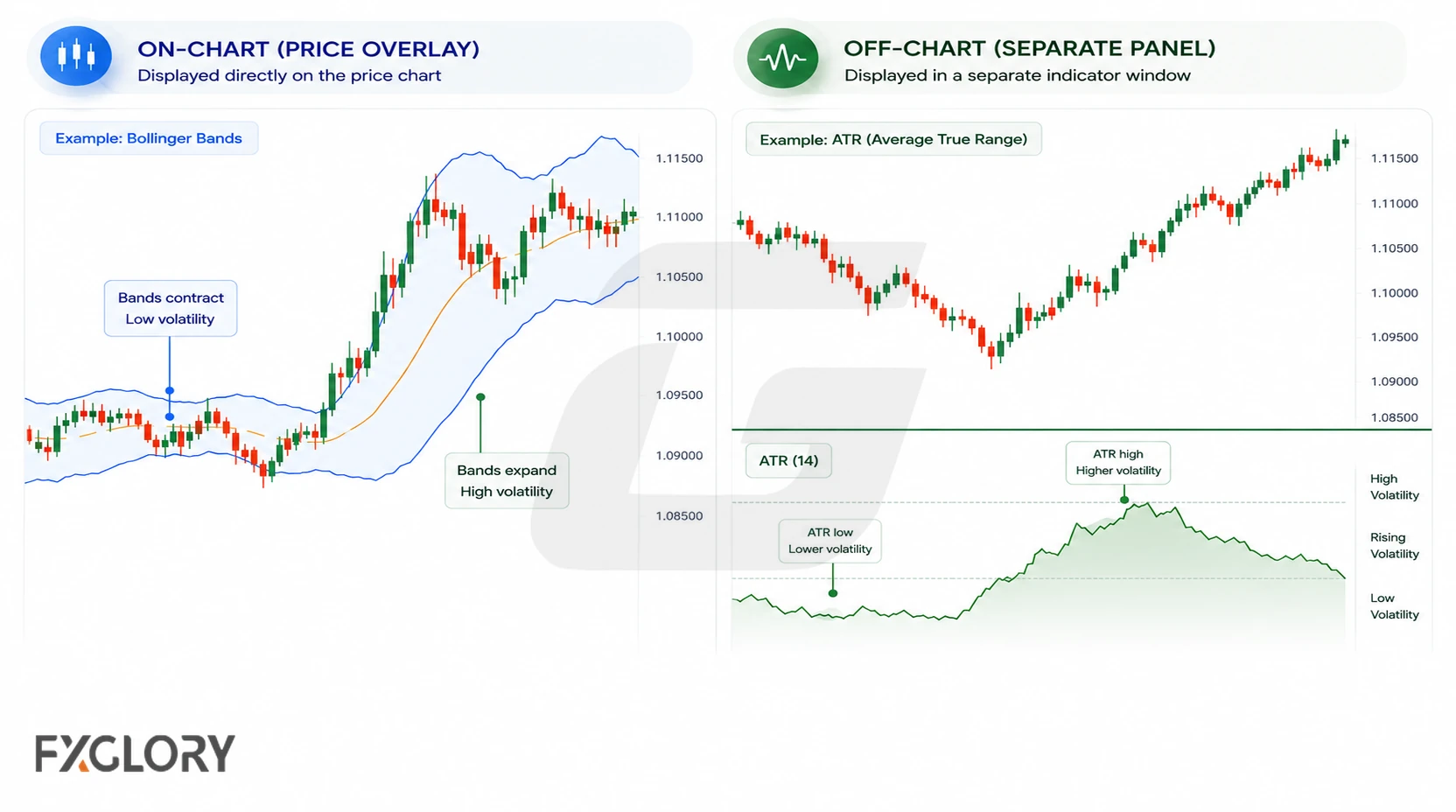
- On-chart volatility tools: Bollinger Bands, Keltner Channels, and Donchian Channels place movement structure around price.
- Off-chart volatility tools: ATR, Chaikin-style volatility tools, and some variation tools appear away from price and focus on movement size or range change.
- Range tools: Average Daily Range and range references compare current movement with recent or typical movement.
- Deviation tools: Deviation and standard deviation compare price movement with a baseline or normal range.
Popular Forex Volatility Indicator Tools
Each volatility tool answers a different movement question. Each one also has a different failure point, especially when news, spread changes, thin liquidity, or fast movement dominate the chart.
| Tool | Volatility role | Where it can fail | Safer use |
|---|---|---|---|
| ATR | Recent movement-size review | Does not show direction; can rise during upward or downward movement | Review ATR movement-size rules |
| Bollinger Bands | Expansion, contraction, squeeze, and band-context review | Band touches do not confirm reversal or continuation | Review Bollinger Band context |
| Average Daily Range | Daily movement context | Average range does not guarantee price must stop or reverse | Use only with current structure and session context |
| Deviation tools | Distance from baseline or normal range | Does not explain why price moved or where it must go next | Compare with structure and risk distance |
| Keltner Channels | Channel-based range and expansion review | Channel breaks can fail in choppy or news-driven movement | Use as context, not as a trade command |
| Donchian Channels | Recent high-low range and breakout-boundary review | Breakouts can repeatedly fail when structure is weak | Check follow-through and invalidation |
| Chaikin-style volatility tools | High-low range expansion or contraction review | Can be noisy during abrupt candles or feed-sensitive movement | Use only with price context |
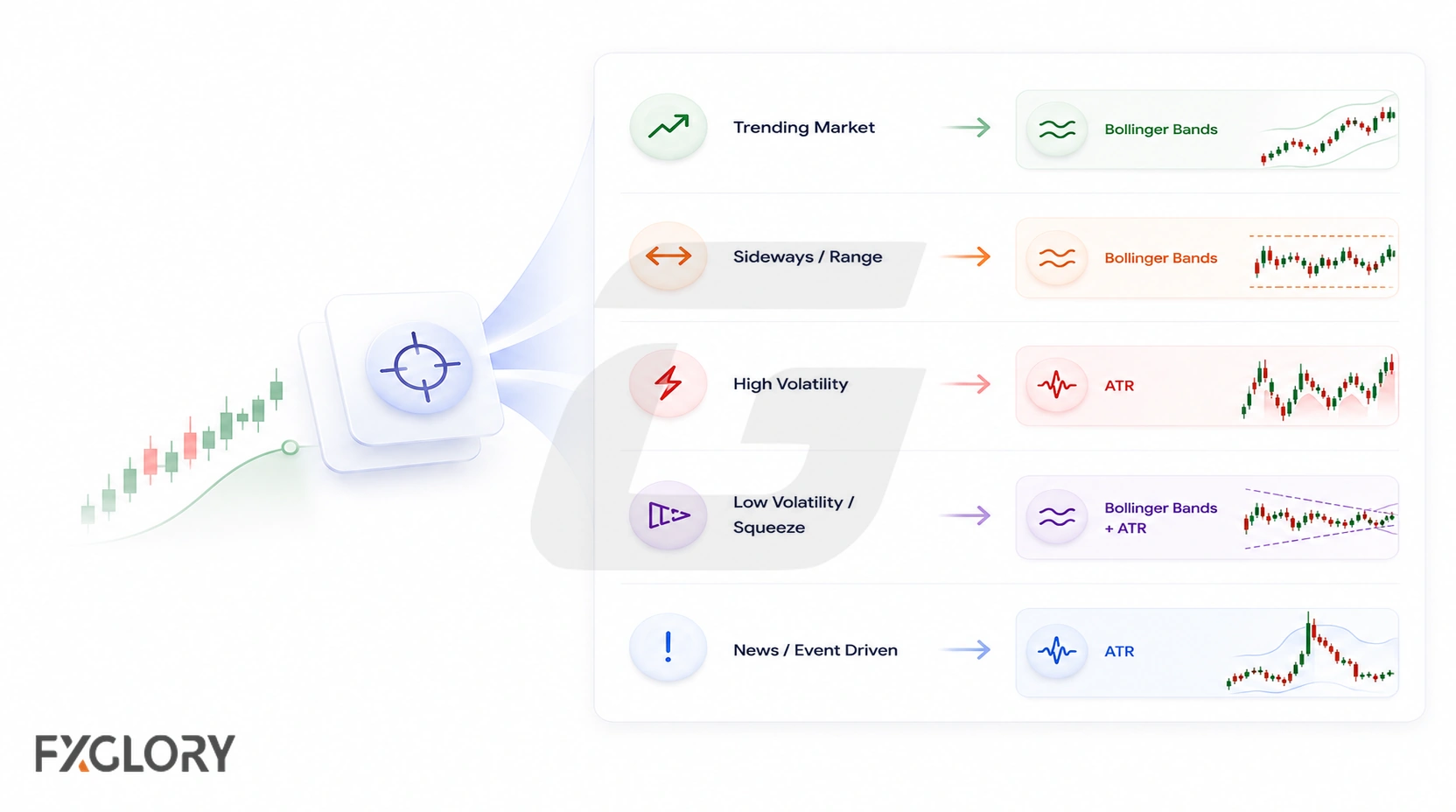
Which Volatility Tool Fits Each Market Condition?
The useful volatility tool changes when the market condition changes. Quiet compression, fast breakout attempts, wide trend movement, and range-bound markets do not need the same volatility check.
| Market condition | Volatility question | Main caution |
|---|---|---|
| Low volatility or compression | Is movement narrowing or pausing? | Compression can last longer than expected |
| High volatility or expansion | Is movement size widening beyond the plan? | Expansion does not show direction by itself |
| Breakout planning | Is price leaving a defined range with follow-through? | Volatility expansion alone does not confirm breakout success |
| Range planning | Is price moving near a reaction area with manageable movement? | Band or range extremes do not force reversal |
| Risk-distance review | Is invalidation still practical after movement expands? | A valid idea can still be too wide to manage |
| No-trade condition | Are spread, speed, or news conditions too unstable? | A clean indicator reading can still be unusable |
When volatility appears near a decision area, review market structure context and support and resistance zones before trusting the reading.
Volatility and Risk Distance
A volatility indicator is most useful when it helps check whether the distance to invalidation is practical. Wide movement can make a setup harder to manage, even when the directional idea looks clear.
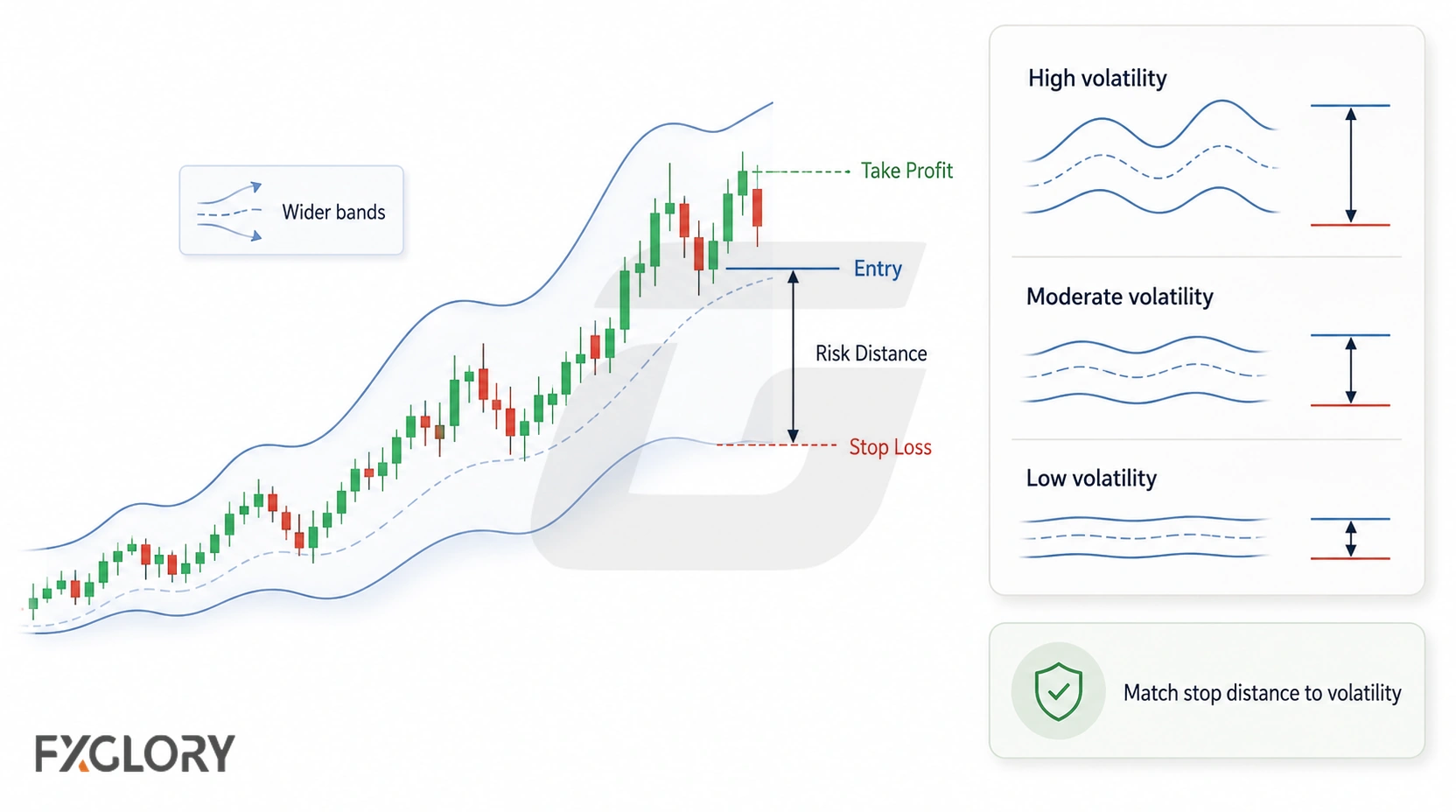
ATR and ADR can support the risk-distance question. They do not decide where a trade should be opened, and they do not remove the need for position sizing, invalidation, or account-risk limits.
- Movement too wide: The chart may require a stop or invalidation distance that does not fit the plan.
- Movement too quiet: The setup may sit inside a tight range with repeated false starts.
- Spread pressure: Wider spreads can make short-distance setups harder to manage.
- Fast movement: Slippage and execution conditions can matter more when volatility expands quickly.
- Unclear invalidation: If the trader cannot define where the idea is wrong, the volatility reading is incomplete.
Volatility Indicators Across Different Timeframes
Volatility should not be judged without a timeframe or lookback. Hourly, daily, weekly, and monthly volatility can give different answers because each one reads a different slice of price movement.
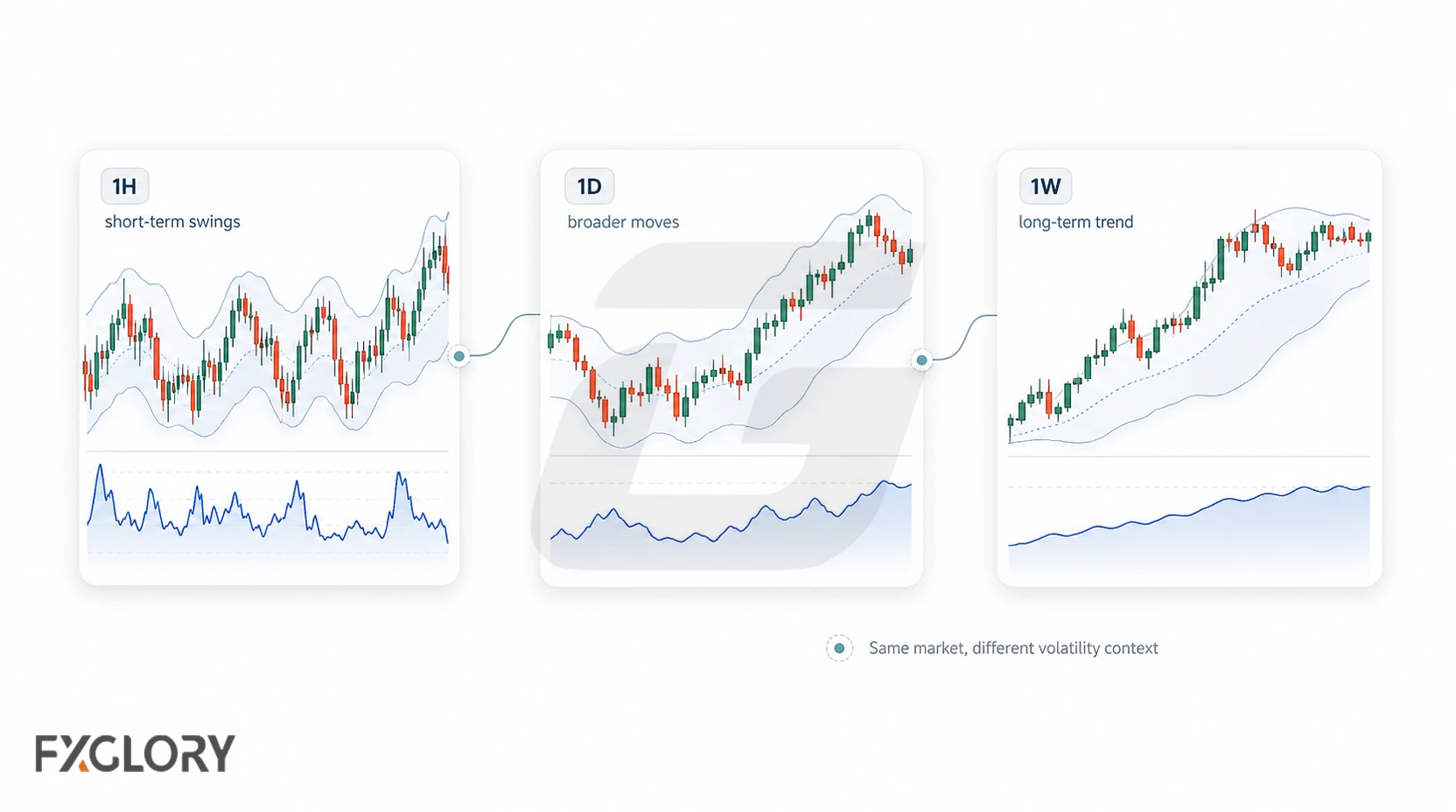
- Hourly volatility: Useful for intraday movement checks, but it can react strongly to short-term noise.
- Daily volatility: Useful for daily range context and session-level planning.
- Weekly or monthly volatility: Useful for broader movement context, but it may react more slowly to fresh changes.
- Short lookback: Reacts faster to current conditions, but it can overreact to temporary spikes.
- Longer lookback: Smooths the reading, but it can lag when the volatility regime changes.
- Daily range vs intraday volatility: A market can have a normal daily range but still move sharply during one session.
Comparing Volatility Across Forex Pairs and Markets
Volatility can also be compared across pairs or markets. A quiet pair, a fast-moving metal, and a volatile crypto market may need different risk-distance checks.
Pip movement alone can be misleading when different pairs have different prices, pip values, spreads, and typical ranges. Percentage movement, daily range, spread, trading conditions, timeframe, and lookback should also be considered when comparing markets.
- Pips: Useful for pair-level movement, but not always enough for comparing different instruments.
- Percentage movement: Useful for comparing relative movement across markets with different prices.
- Daily range: Useful for checking whether the current move is small, normal, or stretched compared with recent daily behavior.
- Timeframe and lookback: Hourly, daily, weekly, and monthly volatility can show different conditions.
- Live trading conditions: Useful for checking whether spread and contract conditions fit the planned setup.
Before comparing volatility across markets, review the chart, timeframe, lookback, spread, and the type of instrument being traded.
Market Context Examples: Matching Volatility Tools to Instruments
Use the market page for instrument context, then compare volatility-indicator behavior inside the charting setup where the relevant indicator is available.
| Market page | Volatility question | Context to check |
|---|---|---|
| Gold market page | What would movement-size expansion add to a fast metal-market review? | News risk, range expansion, risk distance, and level proximity |
| Silver market page | What would deviation or range context add if the move looks stretched? | Structure, support/resistance, spread, and invalidation |
| BTC/USD market page | What would a volatility check add during a fast and unstable move? | Spread, execution conditions, volatility, and structure clarity |
| GBP/USD market page | What would daily-range context add after a large session move? | Session context, structure, and remaining risk distance |
| EUR/CHF market page | What would compression context add if quiet movement turns into chop? | Range boundaries, spread sensitivity, and support/resistance |
Custom Volatility Indicators and Script Risk
Some traders use custom volatility indicators, adaptive bands, expected-move tools, or script-based volatility filters. These can be useful for organizing a chart, but the signal logic should be understandable before it is used.
A custom volatility tool can look clean in past examples and still fail when the volatility regime changes. Adaptive settings can also create overfitting risk when the tool is adjusted too closely to old price behavior.
- Calculation check: Can the trader explain what the tool measures?
- Timeframe check: Does the tool behave differently on faster or slower charts?
- Failure-mode check: Does the tool fail during news, gaps, fast reversals, or spread changes?
- Direction-mistake check: Is the tool being used as a direction signal?
- Overfitting check: Does the tool need constant setting changes to look useful?
When Forex Volatility Indicators Become Weak
Use these filters when a volatility indicator looks active but the market condition is not suitable for the plan.
| Filter | Problem it catches | What to check |
|---|---|---|
| Direction-mistake filter | ATR, ADR, or bands are used to predict direction | Separate direction from movement size |
| News-event filter | High-impact news or central-bank events dominate the chart | Calendar, spread, and volatility behavior |
| Spread filter | Spreads are too wide for the planned risk distance | Spread behavior and execution context |
| Fast-movement filter | Price moves too quickly to define invalidation | Structure, slippage risk, and position sizing |
| Compression-fakeout filter | Price repeatedly breaks and returns inside a tight range | Range boundaries and follow-through |
| Late-expansion filter | Volatility has already expanded and the setup would chase the move | Risk distance and pullback context |
| Session-transition filter | Liquidity changes around session opens, closes, or thin periods | Session timing and spread changes |
| No-invalidation filter | No clear place where the idea is wrong | Structure level and risk distance |
How to Test a Volatility Forex Indicator
A volatility indicator should be tested inside one market condition at a time. Testing it across random charts without separating compression, expansion, news, ranges, sessions, instrument type, timeframe, and lookback can create misleading results.
- Choose the volatility job: Movement size, expansion, compression, daily range, deviation, or risk distance.
- Choose the market: Record whether the test is on a currency pair, metal, or crypto market.
- Choose the timeframe and lookback: Record whether the indicator is being tested on an intraday, daily, weekly, or higher-timeframe chart.
- Record the condition: Quiet range, compression, breakout attempt, expansion, fast trend, news movement, or unclear movement.
- Define invalidation: Write the price behavior that would make the idea wrong.
- Record spread and slippage context: Note whether trading costs or execution conditions could affect the setup.
- Check news-event risk: Mark whether high-impact news or abnormal volatility was nearby.
- Check range comparison: Record whether the movement is small, normal, or stretched compared with recent behavior.
- Record sample size: Review enough examples before judging the indicator.
- Record the failure type: Direction mistake, late expansion, false breakout, excessive spread, news volatility, unclear structure, poor risk distance, or curve fitting.
A volatility indicator is useful only if it makes the movement-size or risk-distance question clearer. If it hides price structure, encourages direction guessing, or cannot be tied to invalidation, it should not stay on the chart.
A Practical Way to Use a Volatility Forex Indicator
Start with the volatility question. Choose one movement job. Review price context, spread, invalidation, and risk distance. If the reading does not make the movement condition clearer, leave it out of the decision.
A volatility indicator does not need to answer every chart question. It only needs to support one part of a clear process: movement size, expansion, compression, range context, deviation review, or risk-distance review.
For movement-size details, use the ATR guide. For band-expansion details, use the Bollinger Bands guide. For structure context, use the market structure guide.