
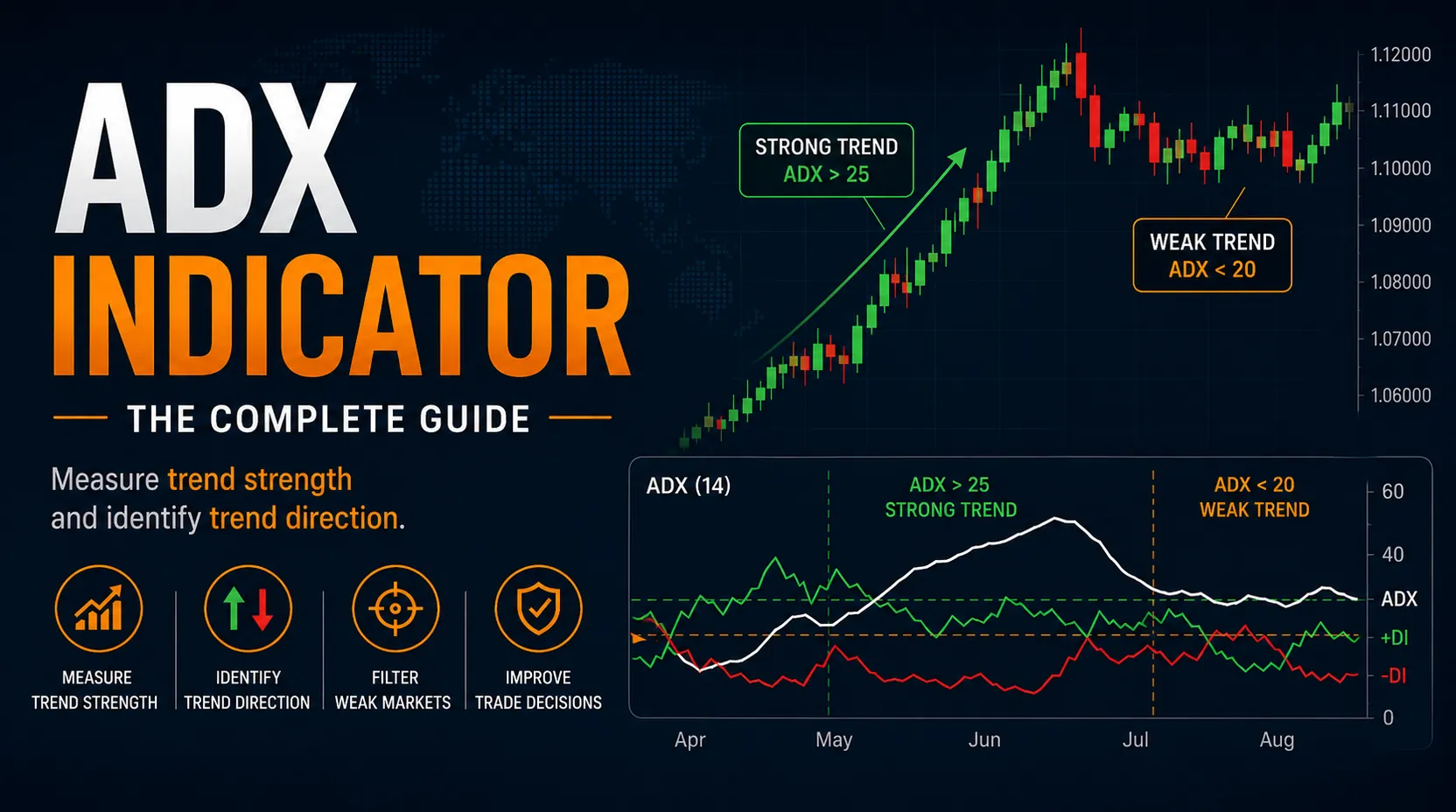
What Is ADX in Forex?
ADX stands for Average Directional Index. In forex trading, the ADX indicator is used to review trend strength. It does not show whether price should rise or fall by itself.
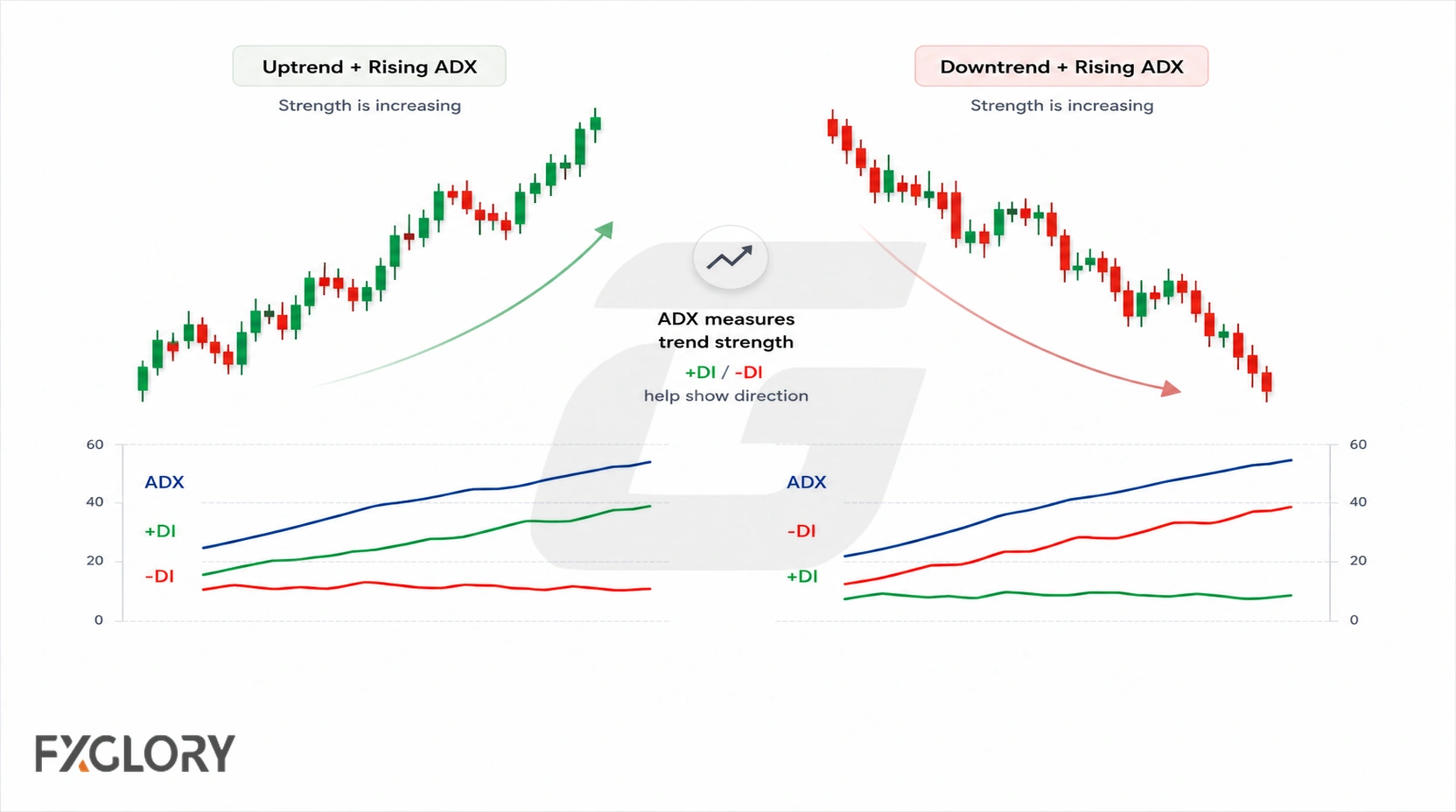
The indicator was introduced by J. Welles Wilder and is usually read with three parts: the ADX line, +DI, and -DI. The ADX line reviews strength. The +DI and -DI lines review directional pressure.
This distinction matters. A rising ADX can appear during a strong upward move or a strong downward move. The ADX line alone does not tell which side is leading.
For comparing ADX with other trend-side tools, review the trend-filter guide.
How the ADX Forex Indicator Works
ADX reviews whether a market is showing weak, rising, strong, fading, or unclear trend strength. It is commonly displayed below the price chart as a line moving between 0 and 100.
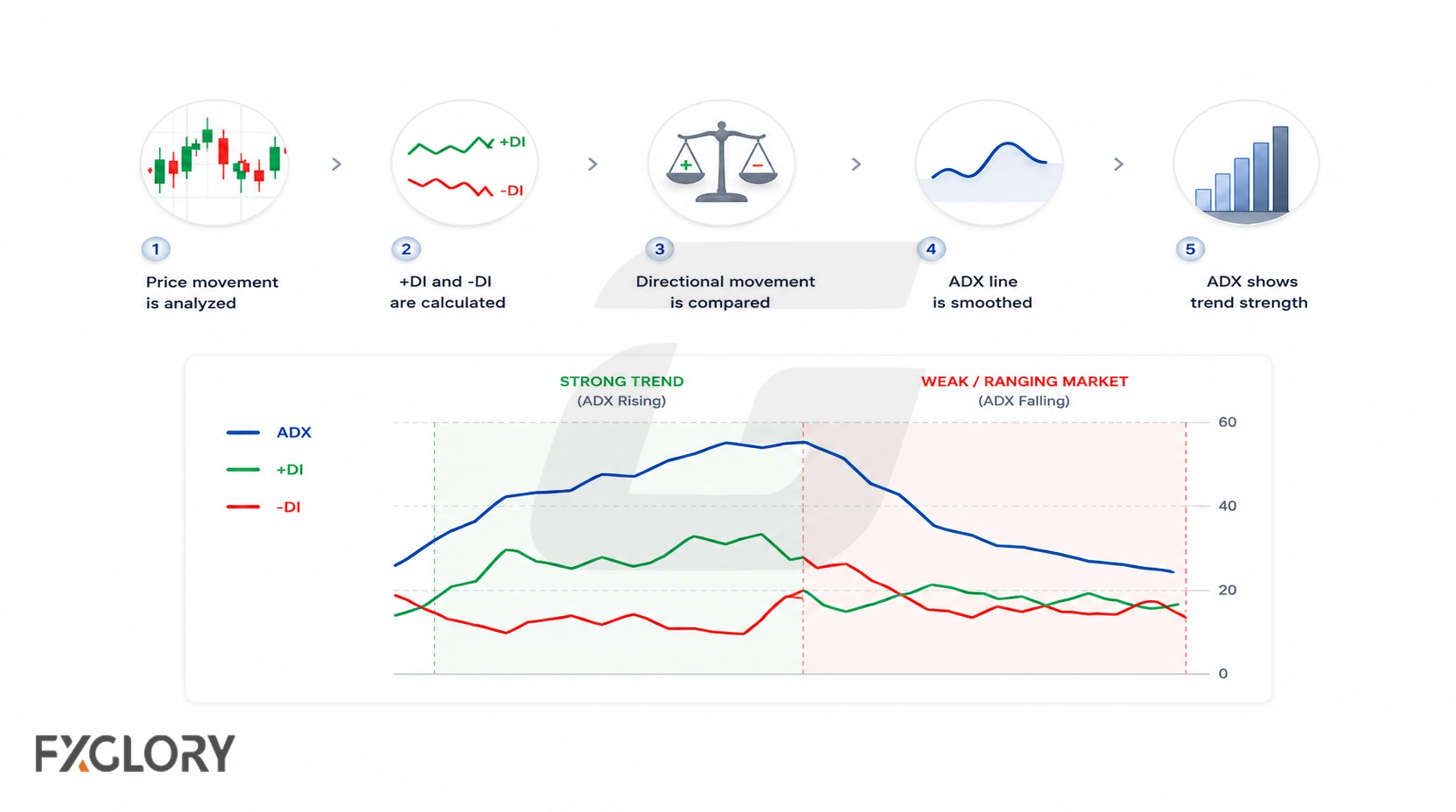
The ADX line does not care whether the trend is upward or downward. It only reviews strength. Directional pressure is usually reviewed through +DI and -DI, then checked against price structure.
- Rising ADX: Trend strength may be increasing, but direction still needs +DI/-DI and price context.
- Falling ADX: Trend strength may be fading, but this does not confirm reversal.
- Flat ADX: Trend strength may be unclear or the market may be quiet.
- High ADX: Strength may be strong, but the move may also be mature or late.
ADX Line, +DI, and -DI
ADX becomes easier to read when each component has a separate job. The ADX line, +DI, and -DI should not all be treated as the same signal.
| ADX component | What it reviews | What it does not do |
|---|---|---|
| ADX line | Trend strength | Does not show bullish or bearish direction by itself |
| +DI | Upward directional pressure | Does not confirm an entry by itself |
| -DI | Downward directional pressure | Does not confirm an entry by itself |
| DI gap | Distance between +DI and -DI | Does not prove that the trend is clean or manageable |
| DI crossover | Possible directional-pressure shift | Can whipsaw in range-bound or choppy markets |
ADX Formula in Plain English
ADX is calculated from directional movement and true range concepts. In plain English, it reviews how much directional movement exists compared with the market's recent range, then smooths that information into a trend-strength reading.
The formula is more complex than simple moving-average tools, but the chart-reading question is simple: is directional movement becoming stronger, weaker, or unclear?
- Directional movement: Reviews whether upward or downward movement is stronger across the selected period.
- True range context: Helps compare movement with recent range behavior.
- +DI and -DI: Review directional pressure before ADX is smoothed into a strength reading.
- ADX smoothing: Turns directional movement information into a trend-strength line.
ADX 20, 25, and 50 Levels in Forex
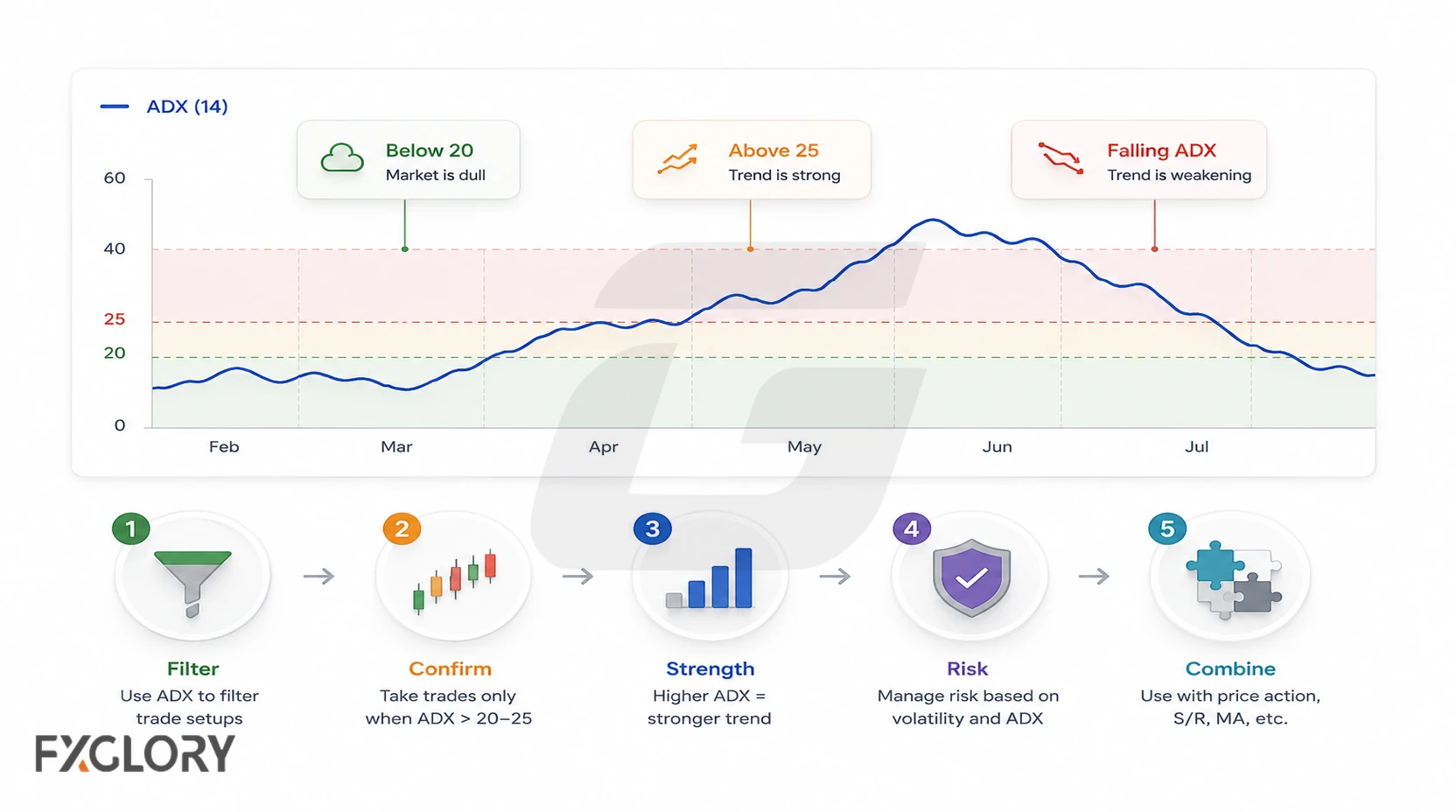
ADX levels are commonly used as trend-strength reference zones. They are not fixed rules and they do not confirm direction by themselves.
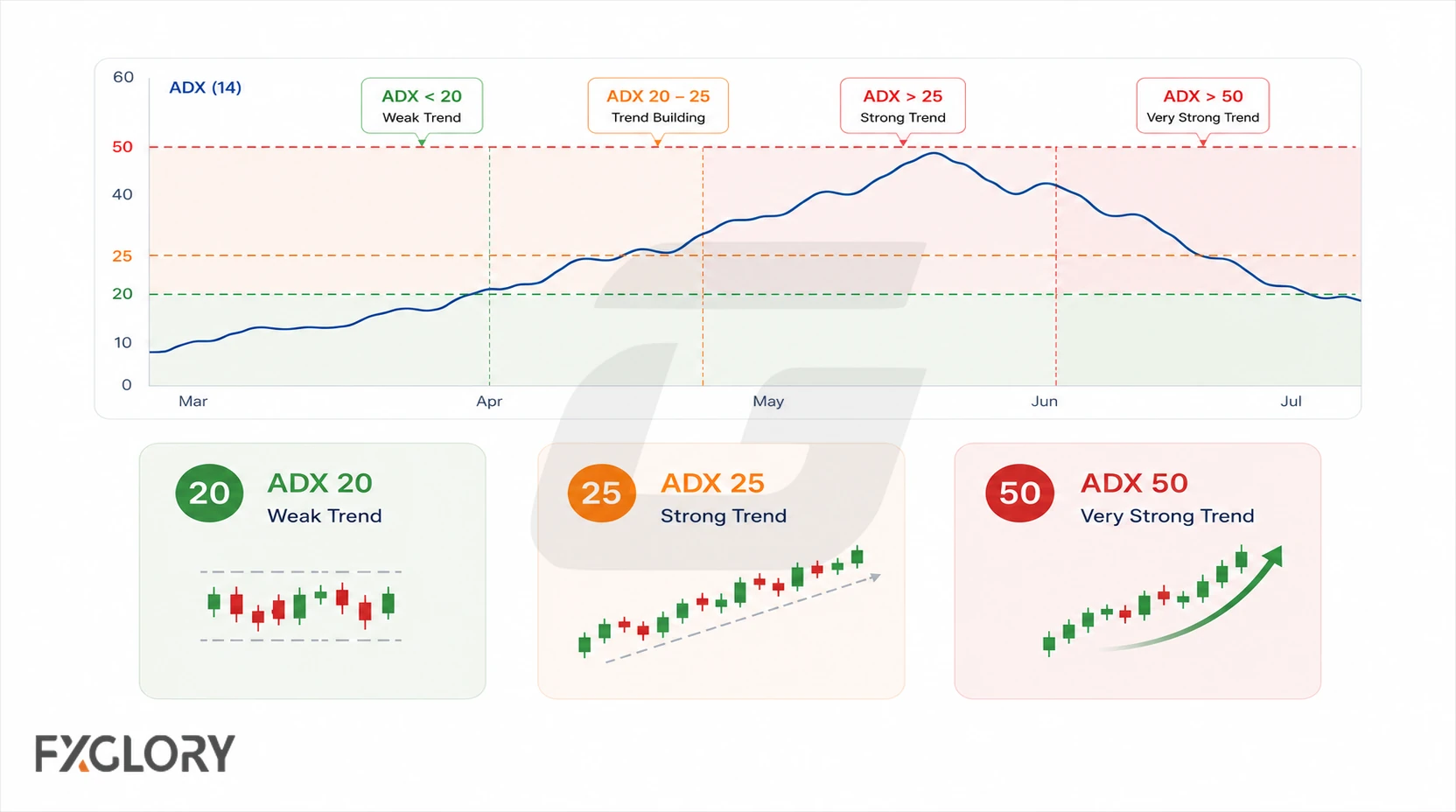
Different traders and platforms may use slightly different thresholds. The practical point is to avoid treating any one number as a guaranteed trend condition.
| ADX zone | Common interpretation | Main warning |
|---|---|---|
| Below 20 | Weak trend or range-risk area | Price may still move, but trend strength is unclear |
| 20 to 25 | Transition area | False starts and early trend assumptions are common |
| Above 25 | Stronger trend-strength context | Direction still needs +DI/-DI and price structure |
| Above 40 | Strong trend-strength reading | The move may already be developed |
| Above 50 | Very strong trend-strength reading | Strength can be late, mature, or volatile |
| Falling from high levels | Trend strength may be fading | Fading strength does not confirm reversal |
A high ADX reading can appear after much of the move has already developed, so high strength should not be confused with early opportunity.
Trend Strength vs Trend Direction
The most important ADX rule is the separation between strength and direction. ADX can rise while price trends upward or downward. The line itself does not say which side controls the move.
Directional pressure usually comes from +DI and -DI. Even then, +DI/-DI behavior should be checked beside price structure, support and resistance, volatility, and invalidation.
- ADX rising with +DI above -DI: Upward directional pressure may be stronger, but price still needs confirmation.
- ADX rising with -DI above +DI: Downward directional pressure may be stronger, but price still needs confirmation.
- ADX rising with messy DI behavior: Strength may be unclear or the market may be unstable.
- DI crossover without ADX strength: Directional-pressure shifts may be weak or range-bound.
ADX in Ranging Markets vs Trending Markets
ADX is often used as a market-regime filter. It can help review whether trend-following assumptions make sense or whether the chart may be too range-bound for that idea.
- Low ADX: The market may be ranging, quiet, or lacking clean directional strength.
- Rising ADX: Trend strength may be building, but early readings can still fail.
- High ADX: A trend may be strong, but the move may also be late or extended.
- Falling ADX: Trend strength may be fading, but fading does not mean reversal.
- Choppy DI lines: +DI and -DI may cross repeatedly when the market is unstable.
When ADX suggests strength but price structure is unclear, review market structure context before trusting the reading.
ADX Settings in Forex
The 14-period ADX setting is commonly used. This does not make it the best setting for every pair, timeframe, or market condition.
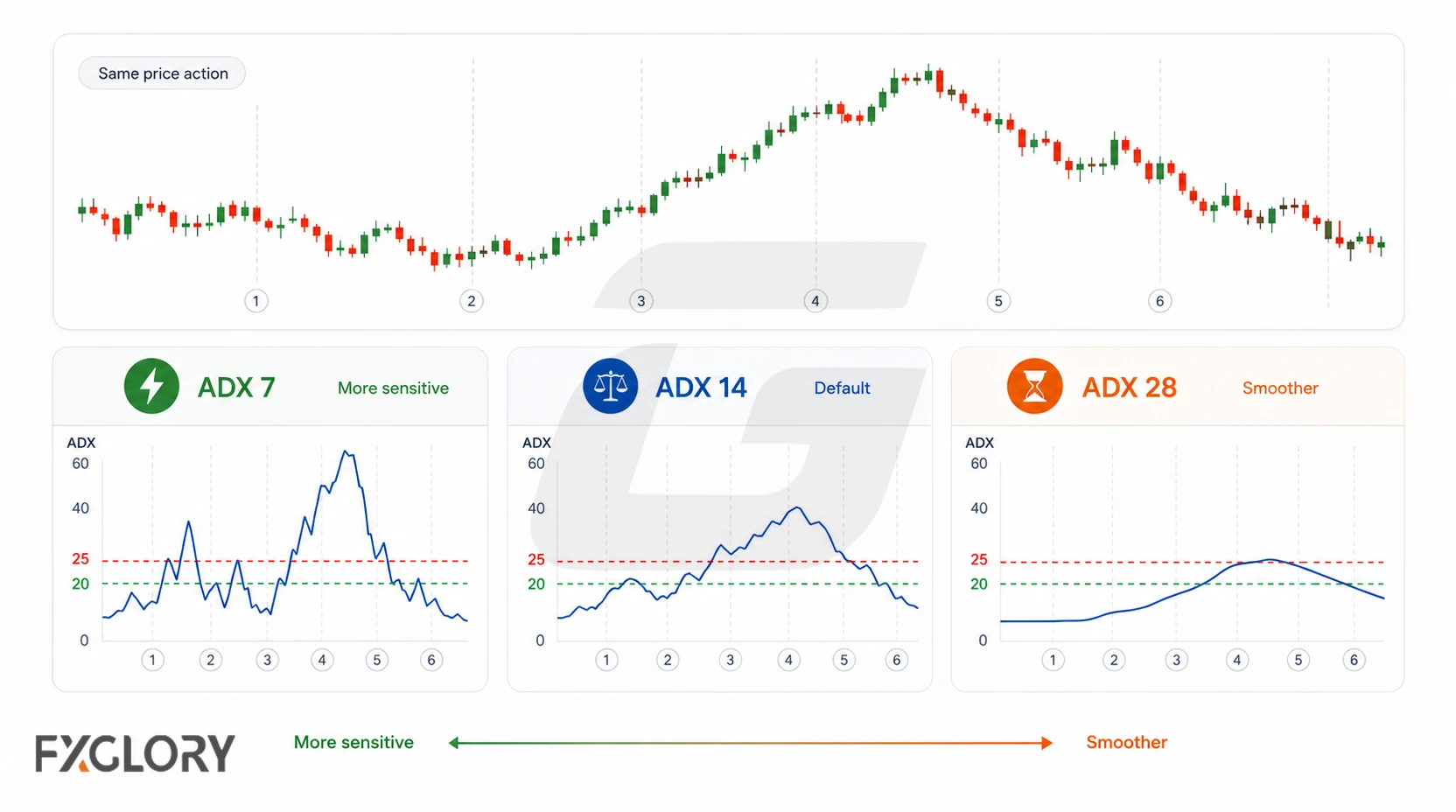
Shorter settings may react faster but can create more noise. Longer settings may smooth the reading but can react later. The same ADX setting can behave differently on a 5-minute chart, 1-hour chart, 4-hour chart, or daily chart because the lookback reads a different slice of price movement.
- Shorter setting: Faster reaction, more false warnings.
- Longer setting: Smoother reading, slower reaction.
- Threshold sensitivity: Settings can affect how often ADX reaches common reference zones.
- Timeframe mismatch: A lower-timeframe ADX warning may conflict with broader structure.
- Changing settings too often: Can create curve fitting if the trader adjusts the tool to make old examples look cleaner.
ADX vs ATR, MACD, Moving Averages, and RSI
ADX is often compared with other indicators, but each tool has a different job. ADX should not replace volatility tools, momentum tools, or price structure.
| Tool | Main job | What ADX adds |
|---|---|---|
| ADX | Trend-strength review | Shows whether strength is weak, rising, strong, fading, or unclear |
| ATR | Volatility and range-size review | Separates trend strength from simple movement size |
| MACD | Moving-average momentum review | Helps check whether momentum appears inside a stronger or weaker trend regime |
| Moving Average | Smoothing and trend-following context | Adds strength context behind the visible moving-average slope |
| RSI | Gains-and-losses momentum pressure | Helps decide whether oscillator warnings appear inside a weak or strong trend environment |
For related context, use the MACD momentum guide, the moving-average guide, and the ATR volatility guide.
How to Use ADX in Forex Without Treating It as a Signal
Start with market condition, then read ADX strength, ADX slope, +DI/-DI pressure, and price structure. The goal is to decide whether trend-strength context supports the chart question, not to turn ADX into a trade command.
- Name the condition: Range, trend, pullback, breakout, chop, or high volatility.
- Read ADX slope: Is ADX rising, falling, flat, or unstable?
- Read the ADX zone: Is ADX below 20, near 20/25, above 25, above 40, or falling from a high level?
- Check +DI/-DI pressure: Which directional line is above the other, and is the gap clean or noisy?
- Check price structure: Is price showing a clean trend, range, breakout, failed continuation, or unclear movement?
- Check volatility and news: Is the market moving cleanly, or are news risk and unstable spreads dominating?
- Define invalidation: Know where the ADX-based idea is wrong before using it in a plan.
ADX with Confirmation Checks
An ADX reading becomes more useful when it is connected to price context. Confirmation does not remove risk, but it can reduce the chance of treating every ADX rise or DI cross as a trade idea.
- Price location: Is ADX changing while price is near support, resistance, a range edge, or a retracement zone?
- Market structure: Has price shown continuation, failed continuation, breakout, retest, higher low, lower high, or another structure clue?
- Directional pressure: Is +DI above -DI, -DI above +DI, or are both lines crossing repeatedly?
- Trend context: Is the ADX reading with a visible trend, after an extended move, or inside chop?
- Volatility context: Is the market clean enough to define invalidation, or moving too quickly to manage clearly?
- Risk rule: Can the trader explain where the idea is wrong before using it in a plan?
For confirmation beyond ADX, review support and resistance zones, forex trend structure, and price action in forex.
Live Market Examples: Matching ADX to Chart Questions
The first step is to identify the ADX question, not to treat every rising ADX line or DI cross as a signal.
| Market page | ADX question | Context to check |
|---|---|---|
| EUR/CHF live chart | Is low ADX pointing to range-risk conditions? | Range boundaries, support/resistance, and repeated DI crosses |
| EUR/GBP live chart | Are +DI and -DI whipsawing near a range boundary? | Price location, market structure, and ADX slope |
| GBP/USD live chart | Is rising ADX supported by clean directional pressure? | +DI/-DI gap, structure reaction, and trend context |
| Gold live chart | Is high ADX appearing late in a strong move? | Volatility, trend maturity, and support/resistance distance |
| BTC/USD live chart | Is high volatility being mistaken for clean trend strength? | Spread, volatility, execution conditions, and structure clarity |
Custom ADX Indicators and Dashboard Caution
Some traders use custom ADX dashboards, multi-timeframe ADX tools, DI alerts, market-regime labels, color changes, or ADX combinations with ATR, moving averages, Bollinger Bands, or Stochastic. These tools can make scanning easier, but the logic should be understandable before it is used.
A custom ADX tool can look clean in old examples and still fail when market condition changes. Dashboard labels can also hide whether the tool is using standard ADX, modified thresholds, or delayed confirmation.
- Calculation check: Can the trader explain what was changed from standard ADX?
- Alert-timing check: Does the alert appear after candle close, or does it change while the candle is forming?
- Threshold check: Are 20, 25, 40, or 50 levels being treated as hard rules?
- Market-regime check: Does the tool fail during chop, news, low liquidity, or fast volatility?
- Overfitting check: Does the tool need constant threshold changes to look useful?
ADX False-Signal Filters
Use these filters when the ADX indicator looks active but the chart condition does not support the reading.
| Filter | Problem it catches | What to check |
|---|---|---|
| Range-risk filter | ADX is low or flat while price moves sideways | Range boundaries and repeated DI crosses |
| DI-whipsaw filter | +DI and -DI keep crossing without clean structure | Chop, timeframe noise, and price location |
| Late-trend filter | ADX rises after a move is already developed | Trend maturity, distance from structure, and volatility |
| Falling-from-high filter | ADX drops from high levels and gets mistaken for reversal | Price reaction, structure change, and directional pressure |
| No-direction filter | ADX rises but +DI/-DI pressure is unclear | DI gap, price structure, and broader trend context |
| No-level filter | ADX reading appears away from a meaningful price area | Support, resistance, retracement, or structure point |
| Volatility-confusion filter | Fast movement is mistaken for clean trend strength | ATR context, news risk, abnormal spreads, and liquidity |
| Timeframe-conflict filter | Lower-timeframe ADX conflicts with broader structure | Higher timeframe trend and market structure |
| Threshold-overfit filter | ADX levels are adjusted only to make old examples look cleaner | Testing across ranges, trends, news, and volatility |
| No-invalidation filter | No clear place where the idea is wrong | Risk distance and invalidation rule |
How to Test the ADX Indicator in Forex
ADX should be tested inside one market condition at a time. Testing it across random charts without separating ranges, trends, pullbacks, volatility, and news conditions can create misleading results.
- Choose the ADX job: Range filter, trend-strength review, +DI/-DI pressure check, breakout context, or trend-fading review.
- Choose the market condition: Range, trend, pullback, high volatility, quiet movement, or unclear structure.
- Choose the setting: Record whether ADX uses 14 periods or another lookback.
- Name the confirmation layer: Support/resistance, structure, trend context, volatility, DI pressure, or invalidation.
- Define the trigger: Write the exact price behavior that would confirm the ADX reading.
- Define invalidation: Write the price behavior that would make the idea wrong.
- Record signal timing: Note whether ADX responded early, late, after a mature move, or during chop.
- Check spread and slippage context: Record whether trading costs or execution conditions could affect the setup.
- Check news-event risk: Mark whether high-impact news or abnormal volatility was nearby.
- Record the failure type: DI whipsaw, range-risk, late trend, falling ADX confusion, threshold overfit, no direction, no structure, timeframe conflict, or volatility confusion.
ADX is useful only if it makes the trend-strength question clearer. If it encourages prediction, hides price structure, or cannot be tied to invalidation, it should not stay in the plan.
A Practical Way to Use ADX in Forex
Start with the market condition. Read ADX slope and level. Check +DI/-DI pressure. Compare the reading with price structure, volatility, confirmation, and invalidation. If the ADX reading does not make the trend-strength question clearer, ignore it.
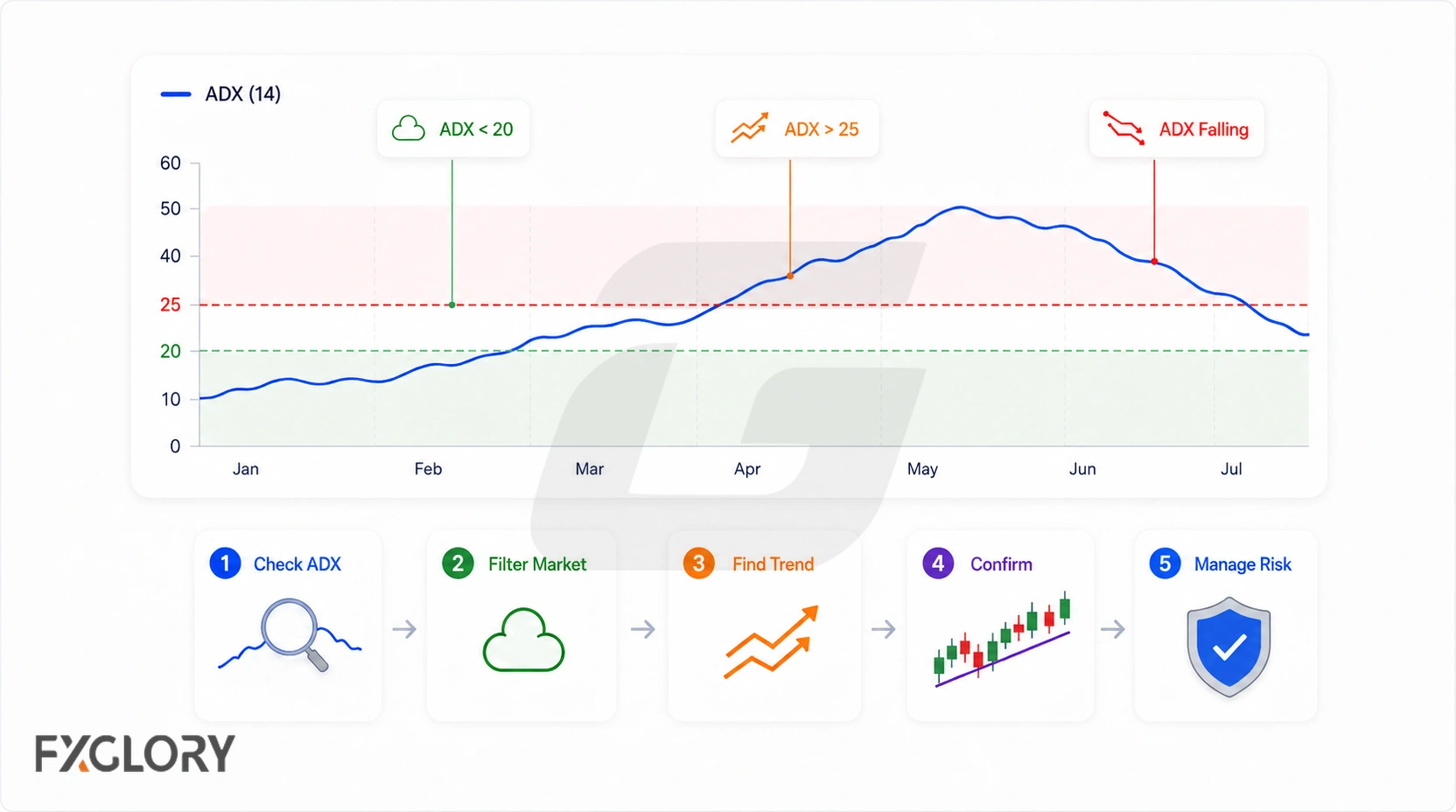
ADX does not need to predict the next move. It only needs to support one part of a clear process: market-regime review, trend-strength context, directional-pressure check, range-risk filter, or confirmation review.
For a broader comparison across trend and momentum tools, use the forex trend indicator guide. For comparing ADX with trend, momentum, volatility, and strength tools, use the best indicators for forex guide.