
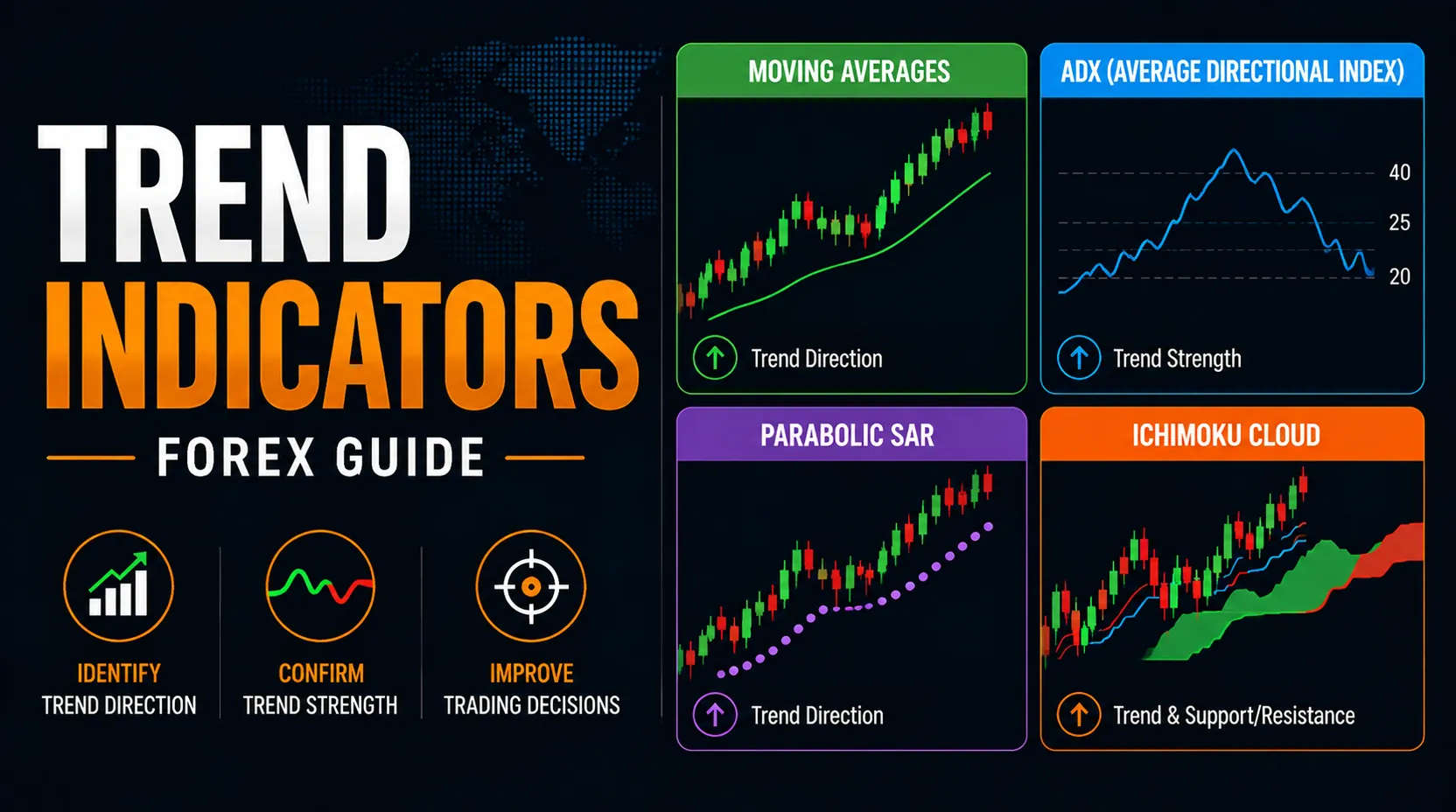
What Is a Forex Trend Indicator Used For?
A forex trend indicator is used after the chart question is clear. The question may be direction, strength, confirmation, trailing review, timeframe alignment, or whether the market is too unclear to use.
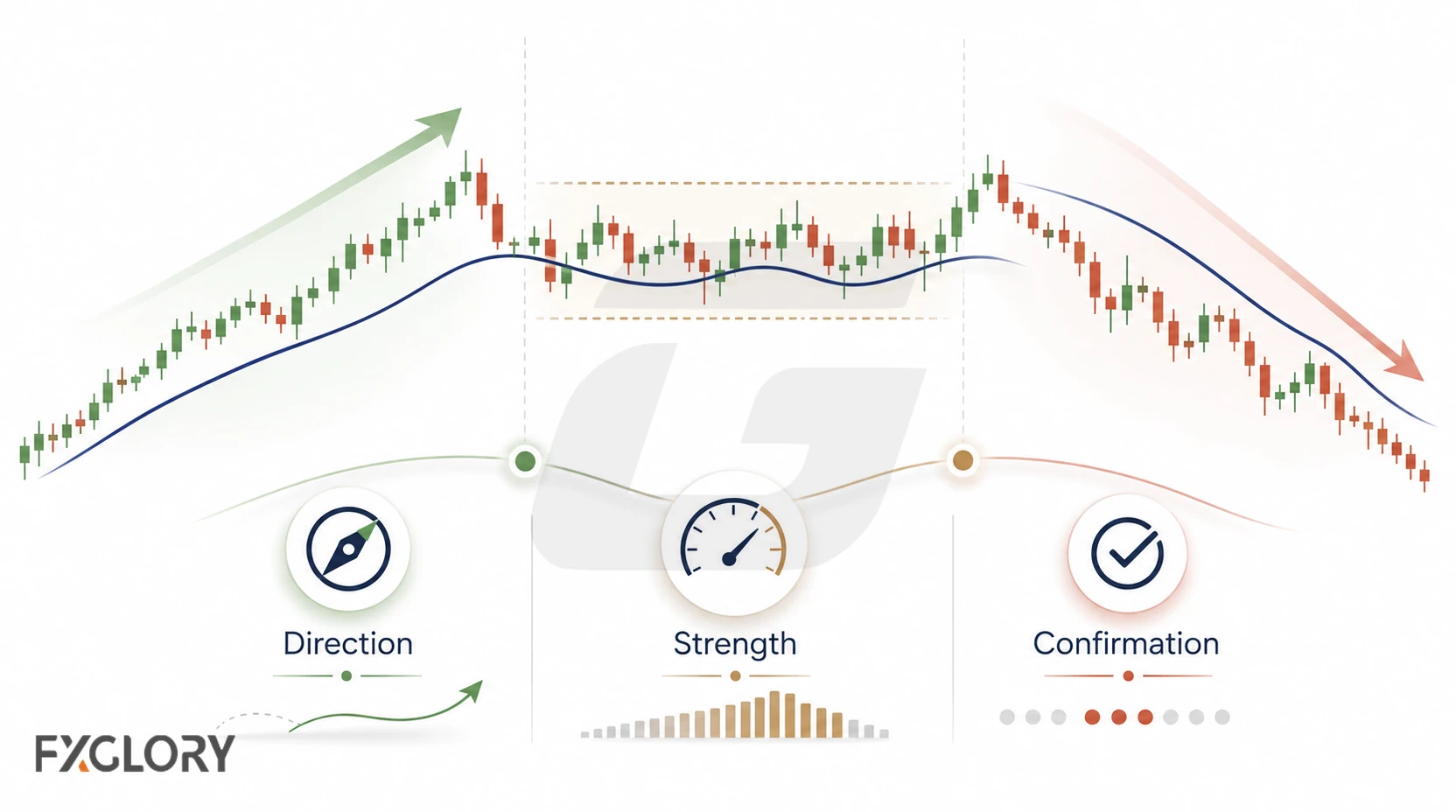
A trend indicator is easier to read when its job is clear. One tool may help with direction, another may help with strength, and another may help with confirmation. Mixing those jobs can make the chart look cleaner than the decision really is.
Trend context starts with price structure before any indicator reading. Review how forex trends form and weaken before relying on a trend tool.
Choose the Trend Tool by Chart Question
A trend tool should answer one job at a time. A direction tool may not measure strength. A strength tool may not show direction. A confirmation tool may still be late.

| Trend question | Possible tool type | What to avoid |
|---|---|---|
| Is price generally moving upward, downward, or sideways? | Moving average, price structure, Ichimoku-style context, Alligator-style line separation | Treating a direction line as a complete strategy |
| Does the movement have strength? | ADX trend-strength review | Using strength as bullish or bearish direction by itself |
| Does momentum support the trend idea? | MACD confirmation review, moving-average alignment | Trusting repeated crosses inside sideways price action |
| Is the move still organized after entry? | Trailing average, Parabolic SAR-style reference, ATR-style risk-distance review | Moving stops or holding trades without invalidation |
| Is the chart too choppy to use? | ADX, flat-average check, tangled-line check, market structure | Forcing a trend setup in a range |
Popular Forex Trend Indicator Tools
The tools below are grouped by the trend question they can help review. Each one has a different failure point, especially when price is flat, choppy, extended, or news-driven.
| Tool | Trend role | Where it can fail | Next step |
|---|---|---|---|
| Moving Average | Direction, slope, price-position reference | Flat or choppy markets where price crosses repeatedly | Use the dedicated moving-average page when available |
| ADX | Trend-strength review | Does not show bullish or bearish direction by itself | Review ADX strength rules |
| MACD | Momentum and trend-confirmation review | Repeated crossovers inside sideways markets | Review MACD confirmation rules |
| Ichimoku-style context | Broader trend, momentum, and context-zone review | Chart overload when the trader cannot explain each line | Use only when the line logic is clear |
| Alligator-style line separation | Separation, compression, and tangled-market review | Overlapping lines during flat movement | Use only as a context filter, not a trade command |
| Parabolic SAR-style dots | Trailing and directional reference after a move is visible | Repeated flips inside ranges | Pair with structure and invalidation |
| ATR | Volatility and risk-distance support, not trend direction | Confusing movement size with trend direction | Review ATR range-size context |
Trend Direction vs Trend Strength vs Trend Confirmation
A common mistake is asking one indicator to do every trend job. Direction, strength, confirmation, following, and trailing are separate chart questions.
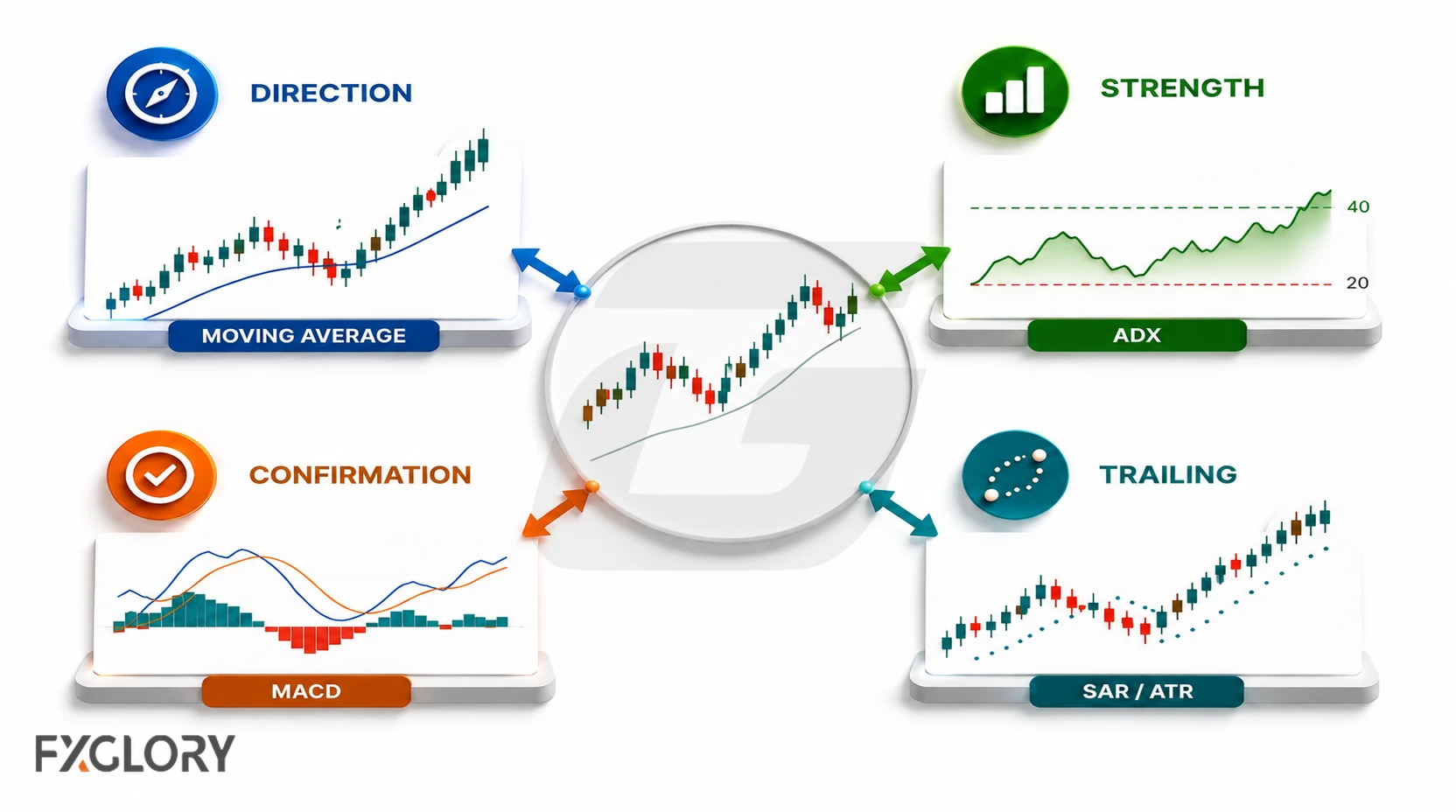
- Trend direction: Is price generally moving upward, downward, or sideways?
- Trend strength: Does the move have enough strength to avoid weak chop?
- Trend confirmation: Does momentum, structure, or another reference support the trend idea?
- Trend following: Is the trader trying to follow direction after the trend is already visible?
- Trailing review: Is the move still organized enough to manage an open trade?
Trend Indicators Across Different Timeframes
A trend indicator can show different conditions on different timeframes. A higher timeframe may show broader direction, while a lower timeframe may show a pullback, pause, or noise inside that broader move.
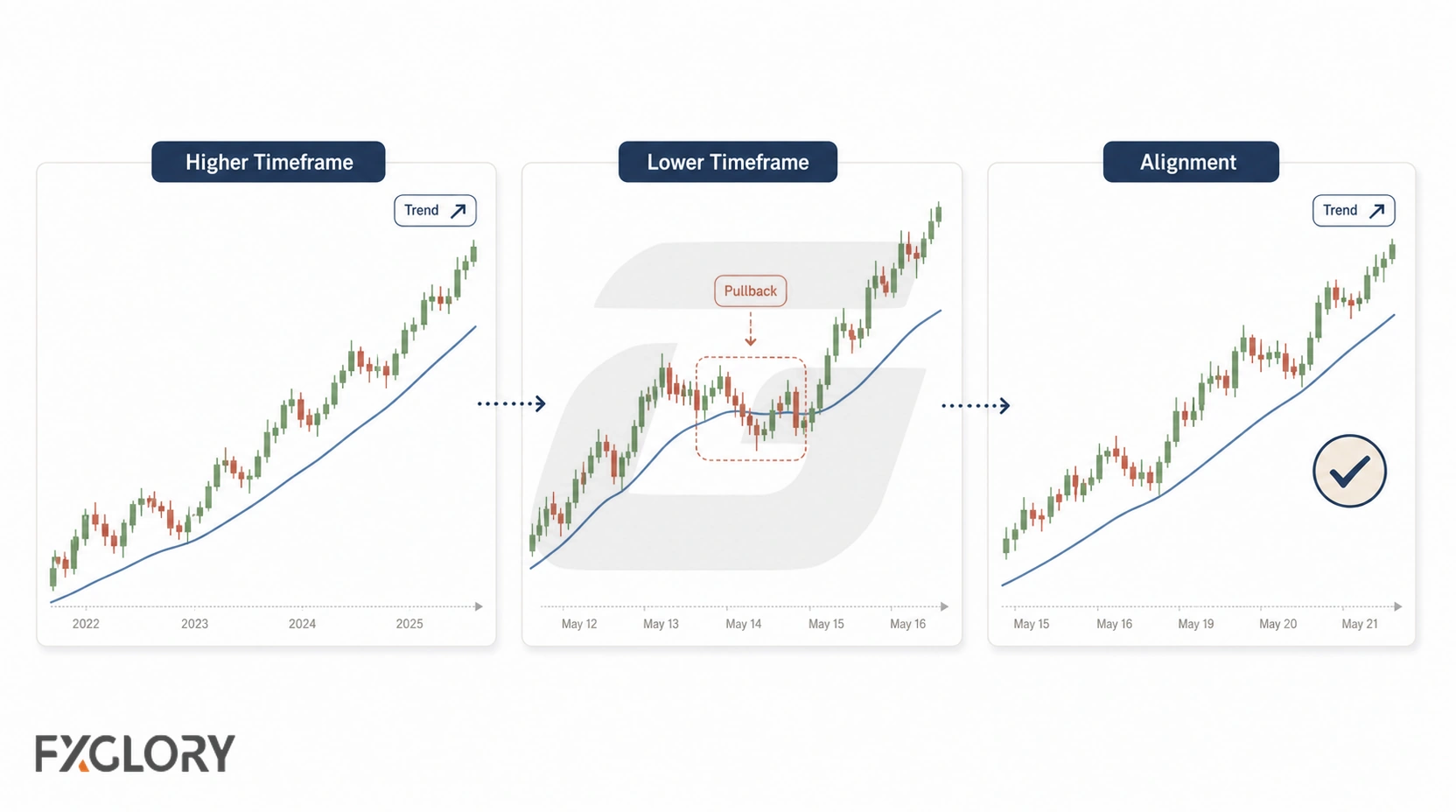
- Higher timeframe direction: Review whether the broader chart is trending, ranging, or unclear before trusting a lower-timeframe trend reading.
- Lower timeframe pullback: A move against the broader direction may be a pullback rather than a full reversal.
- Timeframe conflict: Reduce trust when the lower-timeframe reading fights the broader structure and invalidation is unclear.
- Short-timeframe noise: Faster charts can create more crosses, flips, and false trend readings.
- Alignment check: A trend reading is easier to review when direction, structure, and risk distance make sense on the chosen timeframe.
Which Trend Tool Fits Each Market Condition?
The useful trend tool changes when the chart condition changes. A tool that helps in a clean trend may become weak when price flattens, ranges, or flips repeatedly.
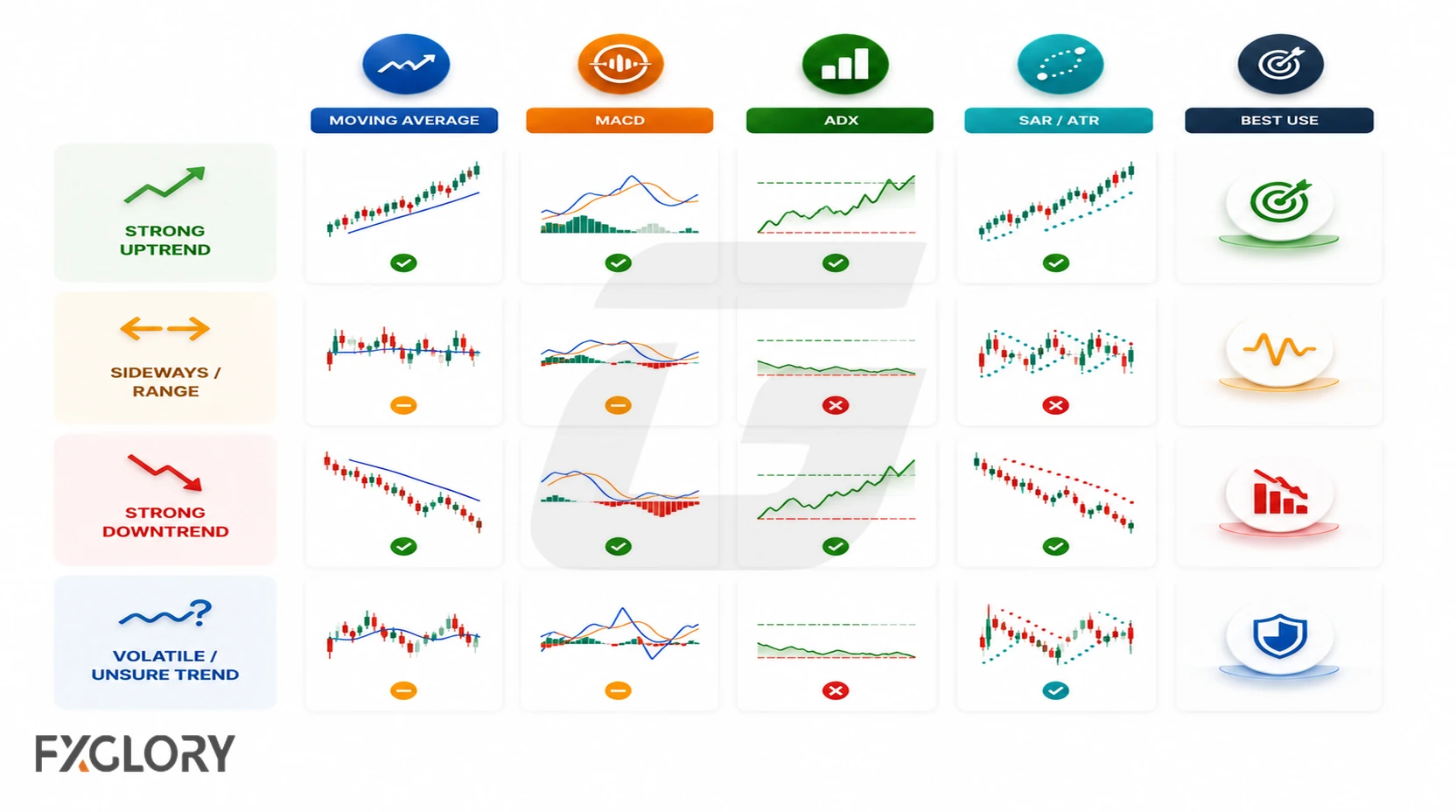
| Market condition | Trend-tool question | Main caution |
|---|---|---|
| Clear trend | Does the tool support direction, strength, or confirmation? | Late entries can chase price after the move is mature |
| New trend attempt | Is structure changing, or is the reading only a noisy flip? | A single crossover is not enough |
| Pullback inside trend | Is the pullback controlled or breaking structure? | Lower-timeframe signals can overstate reversal risk |
| Weak or choppy market | Should the trader stand aside? | Trend indicators can whipsaw repeatedly |
| Extended move | Is risk distance still practical? | A correct trend reading can still be late |
When trend condition is unclear, review forex market structure, support and resistance zones, and chart-reading context before relying on a trend indicator.
Trend Indicator Combinations Without Overload
A trend-indicator combination should answer separate questions. If every tool repeats the same message, the chart may look confirmed without giving better information.
- Direction plus strength: A direction reference plus ADX can review whether the chart has direction and strength.
- Direction plus momentum: A direction reference plus MACD can compare trend direction with momentum.
- Broader trend context: A context-zone tool plus market structure can review whether price is above, below, or inside a broader zone.
- Trend separation: Line-separation tools plus price structure can review whether the chart is opening into trend or tangling into chop.
- Trend with risk distance: A direction reference plus ATR can review direction while checking whether movement size makes the plan impractical.
Custom Trend Indicators and Repainting Risk
Some traders use visual trend indicators that change color, print arrows, or summarize trend direction. These tools can be convenient, but the logic should be understandable before they are used.
A trend reading may change while the current candle is still open. That is different from a signal that changes after the candle closes. If a tool repaints closed-candle signals, past examples may look cleaner than the real-time experience.
- Signal stability: Does the signal stay fixed after the candle closes?
- Logic clarity: Can the trader explain what price or indicator condition creates the signal?
- Failure mode: Does the tool fail in flat, choppy, or news-driven conditions?
- Overfitting risk: Does the tool look good only after settings are adjusted to past examples?
Why Trend Indicators Still Need Price Action
A trend indicator can describe direction or strength, but price structure shows where the idea may be wrong. Breaks, pullbacks, failed continuation attempts, and reaction zones matter before the indicator is used for a decision.
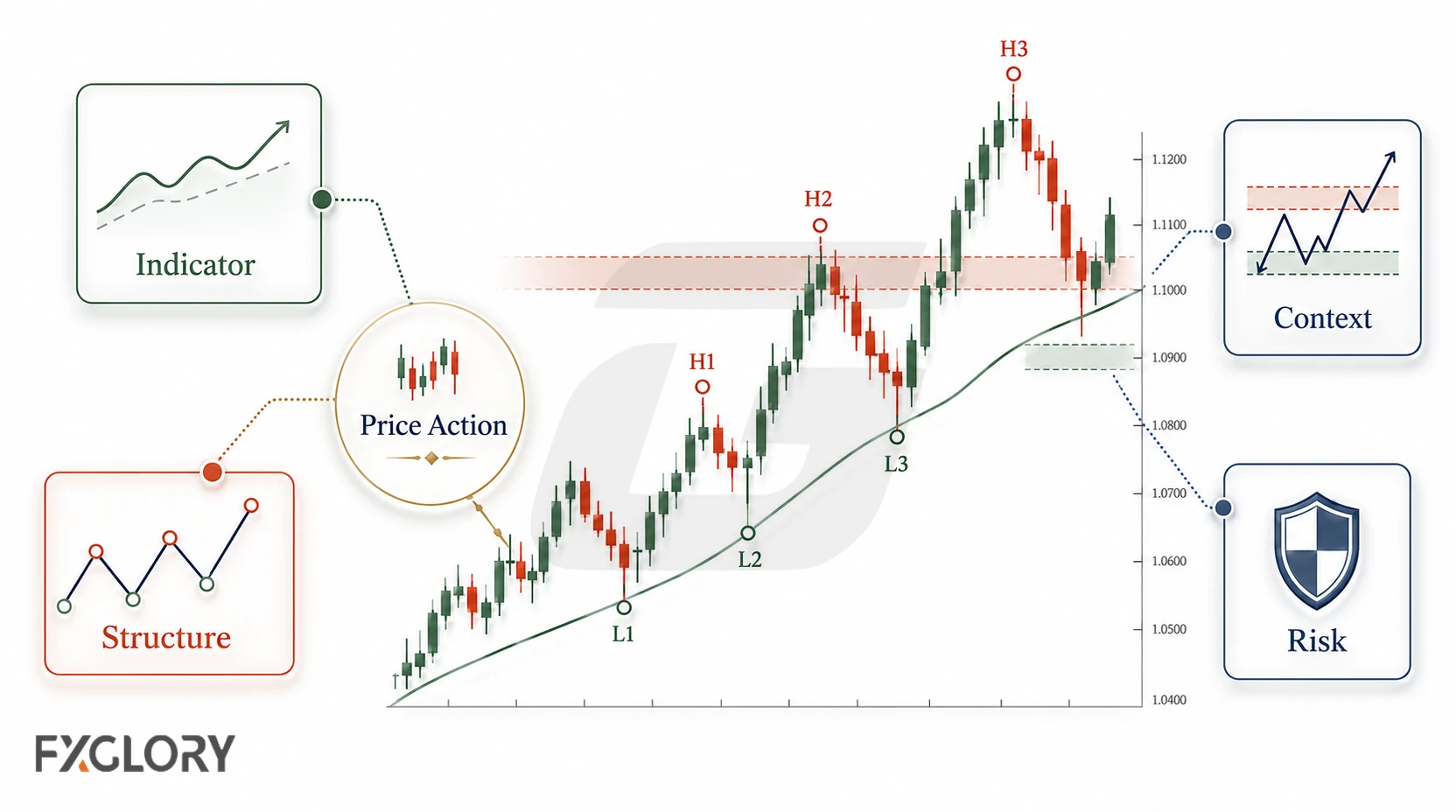
A direction tool may show smoother movement, but forex trend structure shows whether the move is organized. ADX may show strength, but price action shows whether the move has usable structure. MACD may show confirmation, but support and resistance can show whether price is reacting near a meaningful zone.
Market Context Examples: Matching Trend Indicators to Instruments
Use the market page for instrument context, then compare trend-indicator behavior inside the charting setup where the relevant indicator is available.
| Market page | Trend question | Context to check |
|---|---|---|
| GBP/USD market page | What would a direction tool add if price is cleanly trending or repeatedly crossing the reference? | Market structure, spread, timeframe, and invalidation |
| NZD/USD market page | What would confirmation add if a pullback still appears inside a broader trend? | Support/resistance, structure break risk, and follow-through |
| Gold market page | What would strength and volatility context add if a move expands quickly? | News risk, movement size, risk distance, and level proximity |
| BTC/USD market page | What would a trend-confirmation check add during a fast and volatile move? | Execution conditions, spread, volatility, and structure clarity |
When Forex Trend Indicators Become Weak
Use these filters when a trend indicator looks active but the chart condition is weak.
| Filter | Problem it catches | What to check |
|---|---|---|
| Flat-average filter | Price crosses a flat direction reference repeatedly | Range condition and no-trade rule |
| Tangled-lines filter | Multiple trend lines overlap without separation | Compression, chop, and structure clarity |
| Weak-strength filter | Strength reading does not support the directional idea | ADX-style strength context and price structure |
| Repeated-crossover filter | Crosses repeat inside sideways price action | Range boundaries and false-signal history |
| Late-entry filter | Price is already far from the trend reference | Risk distance, pullback context, and invalidation |
| Timeframe-conflict filter | Lower-timeframe reading fights broader structure | Higher-timeframe direction and risk plan |
| No-invalidation filter | No clear place where the trend idea is wrong | Structure level and risk distance |
| Event-risk filter | News, abnormal spreads, or fast volatility overpower the setup | News context, spread behavior, and liquidity |
How to Test a Forex Trend Indicator
A trend indicator should be tested inside one market condition at a time. Testing it across random charts without separating trends, ranges, volatility, timeframes, and news conditions can create misleading results.
- Choose the trend job: Direction, strength, confirmation, trailing review, or no-trade filter.
- Choose the timeframe: Record whether the tool is being tested on a higher timeframe, lower timeframe, or both.
- Choose the market condition: Clean trend, new trend attempt, pullback, extended move, weak chop, or high volatility.
- Define the trigger: Write the exact event that would confirm the idea.
- Define invalidation: Write the price behavior that would make the trend idea wrong.
- Record sample size: Review enough examples before judging the indicator.
- Record spread and slippage context: Note whether trading costs or execution conditions could affect the setup.
- Check news-event risk: Mark whether high-impact news or abnormal volatility was nearby.
- Check rule changes: Note whether the rule was changed after a losing or unclear example.
- Record the failure type: Late signal, false signal, chop, timeframe conflict, news volatility, unclear structure, poor risk distance, or curve fitting.
A trend indicator is useful only if it makes the decision clearer. If it hides price structure, repeats another tool, or cannot be tied to invalidation, it should not stay on the chart.
A Practical Way to Use a Forex Trend Indicator
Start with price structure. Choose one trend job. Pick the tool that answers that job. Define confirmation, invalidation, and risk. If the indicator does not make the trend question clearer, remove it.
A trend indicator does not need to answer every chart question. It only needs to support one part of a clear process: direction review, strength review, confirmation review, trailing context, timeframe alignment, or no-trade filtering.
For strength details, use the ADX guide. For momentum-confirmation details, use the MACD guide. For volatility and risk-distance context, use the ATR guide.