
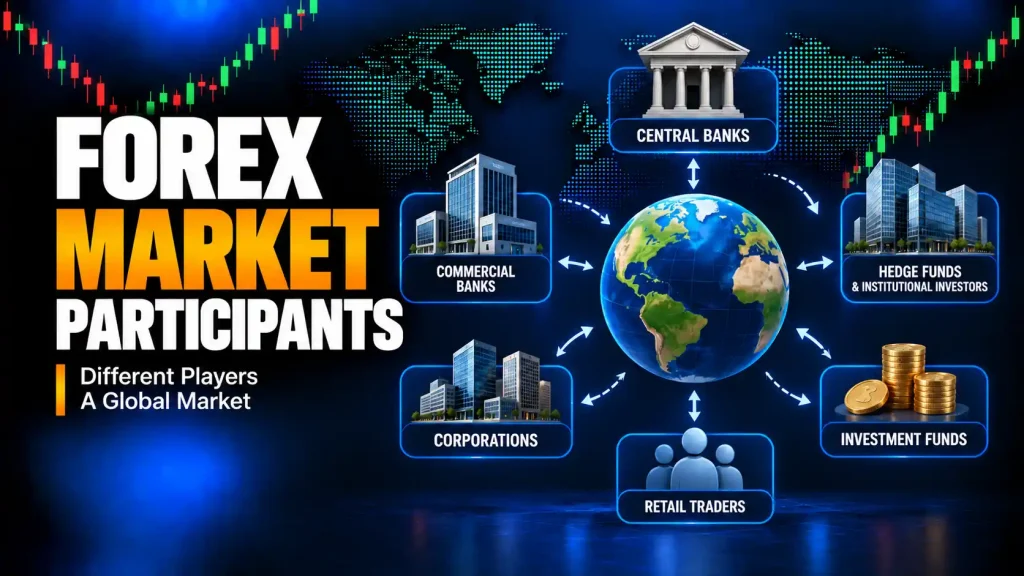
Quick Answer: Who Are Forex Market Participants?
No single entity controls the forex market. Forex is decentralized, so prices are shaped by central banks, banks, liquidity providers, funds, corporations, brokers, traders, and market venues acting at the same time.
In simple terms, forex participants are the institutions, companies, platforms, oversight bodies, and individuals that create demand, supply, liquidity, pricing, access, and price movement in the currency market.
The forex market is shaped by participants with different goals. Some trade for policy reasons, some for business needs, some for liquidity, some for hedging, and some for speculation.
The simplest way to understand forex market participants is this:
Central banks influence policy. Banks and liquidity providers shape day-to-day pricing. Corporations create real currency demand. Funds and institutions create large trading flows. Brokers provide access. Retail traders participate through platforms.
This guide explains the main groups involved in forex and how their actions can influence prices, liquidity, spreads, and market conditions.
Who Controls the Forex Market?
No single participant controls the forex market. Forex is decentralized, so exchange rates are shaped by the combined actions of banks, liquidity providers, central banks, corporations, hedge funds, brokers, and traders.
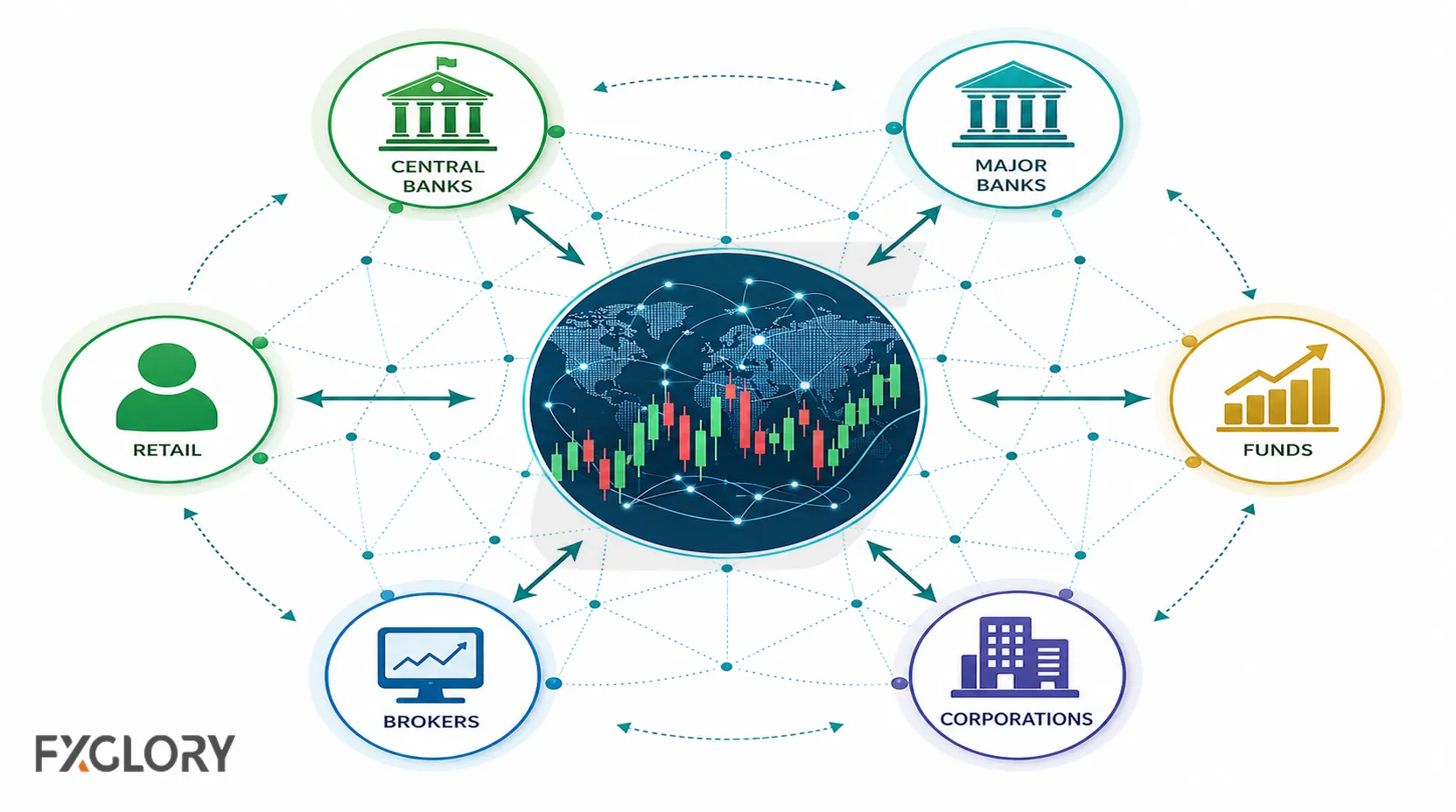
Some participants can influence the market more than others. A central-bank interest-rate decision can move a currency sharply. Large banks and liquidity providers can affect day-to-day pricing and available liquidity. Major funds can create large directional flows. Corporations can create real demand when they convert or hedge currency exposure.
But influence is not the same as control. No retail trader, broker, bank, or government controls every tick in EUR/USD, GBP/USD, USD/JPY, or any other major pair. The closest thing to control in forex is temporary influence through policy, liquidity, or large order flow.
| Question | Better Answer |
|---|---|
| Who controls forex? | No single participant controls the whole market. |
| Who influences forex most? | Central banks, large banks, institutional flows, and major macro events. |
| Who provides liquidity? | Banks, market makers, electronic liquidity providers, brokers, and trading venues. |
| Who uses forex for business? | Corporations, importers, exporters, and multinational firms. |
| Who trades forex for profit? | Hedge funds, asset managers, prop firms, banks, and retail traders. |
Why Forex Has No Single Controller
Forex is a decentralized market. That means there is no single global exchange setting one official price for every trader in the world. Instead, forex prices come from networks of banks, liquidity providers, brokers, ECNs, trading venues, institutions, and platforms.
Much of spot forex is traded over the counter, meaning transactions occur through networks of counterparties rather than through one central exchange order book. ECNs, or electronic communication networks, are electronic venues where participants can access, match, or route liquidity electronically.
Trading venues can include ECNs, bank platforms, broker platforms, liquidity aggregators, and other electronic marketplaces. This is different from a centralized stock exchange, where a listed stock trades on a specific exchange order book.
In forex, pricing can depend on liquidity sources, trading venue, broker model, account type, market session, volatility, and available order flow. This is also why two retail platforms may show slightly different bid/ask quotes at the same moment. The difference may come from liquidity sources, spread policy, account type, execution model, market volatility, or available depth.
The better question is not only “who controls the forex market?” The better question is: which participants are influencing price, liquidity, spread, and volatility right now?
Main Forex Market Participants
The main forex participants can be grouped by purpose. Some participants provide liquidity. Some manage policy. Some trade for business needs. Some hedge risk. Some speculate on price movement.
| Participant | Why They Participate | Main Market Effect |
|---|---|---|
| Central banks and governments | Policy, reserves, intervention, currency stability. | Interest-rate expectations, policy shocks, currency confidence. |
| Commercial and investment banks | Client flow, interbank trading, market making, payments. | Liquidity, bid/ask quotes, large order flow. |
| Liquidity providers and market makers | Quoting prices and supporting execution. | Spread, market depth, execution liquidity. |
| Hedge funds and asset managers | Speculation, hedging, macro positioning, portfolio flows. | Large directional trades, volatility, positioning shifts. |
| Corporations and multinational companies | Imports, exports, overseas operations, profit repatriation, hedging. | Real currency demand, conversion flows, hedge adjustments. |
| Brokers and trading platforms | Retail access, accounts, margin, platforms, execution. | Retail pricing display, execution environment, account terms. |
| Retail traders | Speculation and short-term trading. | Smaller individual flow and collective retail sentiment. |
| Regulators and oversight bodies | Market integrity, broker supervision, disclosure standards. | Rules, compliance expectations, client-protection frameworks. |
Participant Hierarchy: Who Has the Most Influence?
Not all forex participants have the same influence. A central bank can affect an entire currency through interest-rate policy. A major bank can handle large order flow. A multinational company can create large demand when hedging or converting revenue. A retail trader usually participates on a much smaller scale.
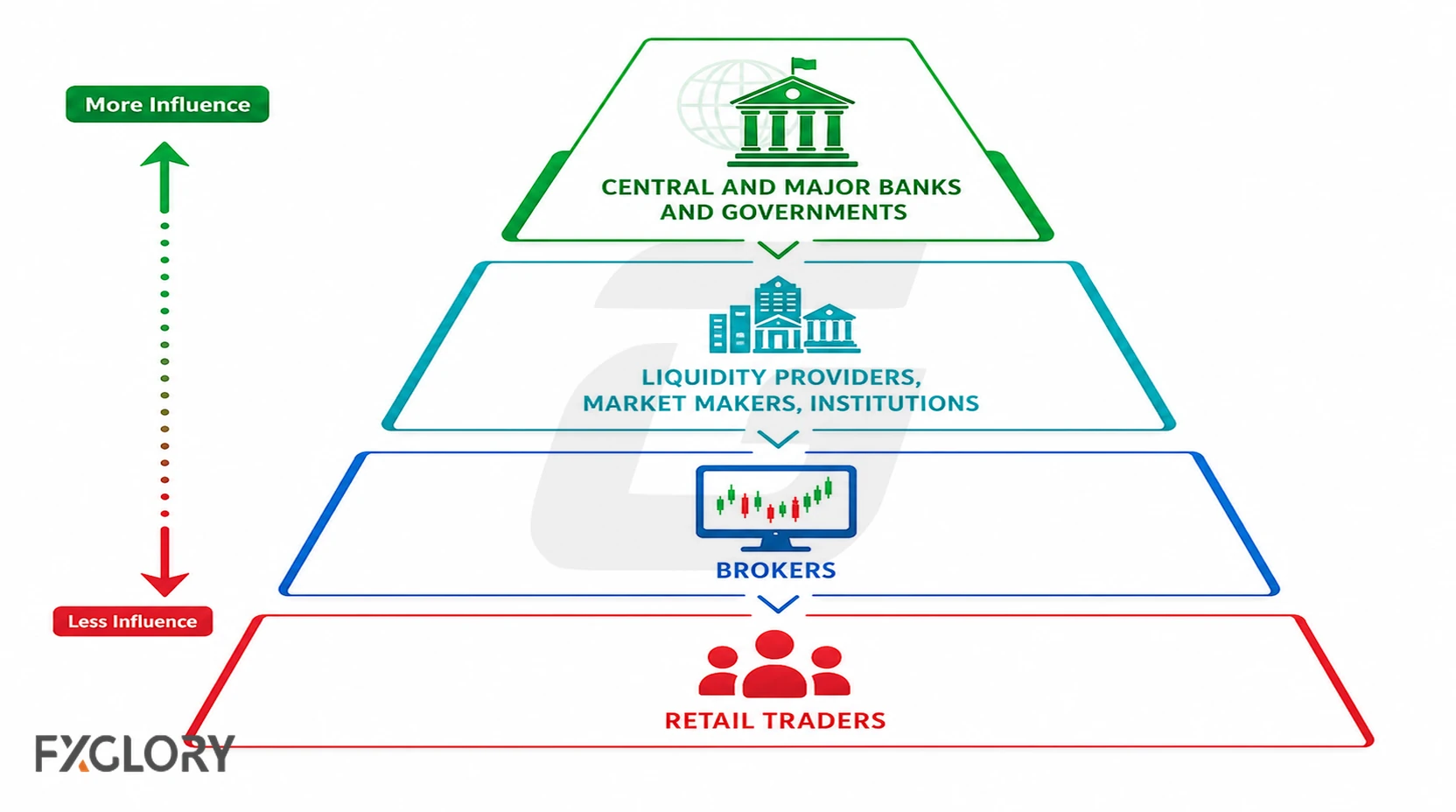
| Level | Participant | Typical Area of Influence |
|---|---|---|
| 1 | Central banks and governments | Policy, reserves, interest rates, intervention, currency stability. |
| 2 | Major banks and interbank market | Liquidity, quotes, large transactions, institutional order flow. |
| 3 | Liquidity providers and market makers | Bid/ask pricing, execution liquidity, spread formation. |
| 4 | Hedge funds, asset managers and institutions | Speculation, hedging, macro trades, portfolio allocation. |
| 5 | Corporations and multinational companies | Trade payments, hedging, currency conversions, real-economy demand. |
| 6 | Brokers and platforms | Retail access, pricing display, execution, account terms. |
| 7 | Retail traders | Individual trading activity and collective retail sentiment. |
This is a simplified hierarchy, not a fixed power ranking. Influence changes by currency pair, market session, news event, liquidity, volatility, and market conditions. Central banks may dominate policy events, banks and liquidity providers may dominate pricing and execution, funds may dominate positioning, governments may dominate crisis events, and corporations may create major real-economy flows at specific times.
Participant influence can also look different in major pairs than in minor or exotic pairs. Major pairs usually have deeper liquidity and more institutional participation, while exotic pairs can move more sharply because of thinner liquidity, local policy risk, capital-flow changes, or intervention concerns.
Central Banks and Governments
Central banks are among the most influential forex market participants because currencies are closely tied to interest rates, inflation, economic growth, reserve policy, and monetary guidance.
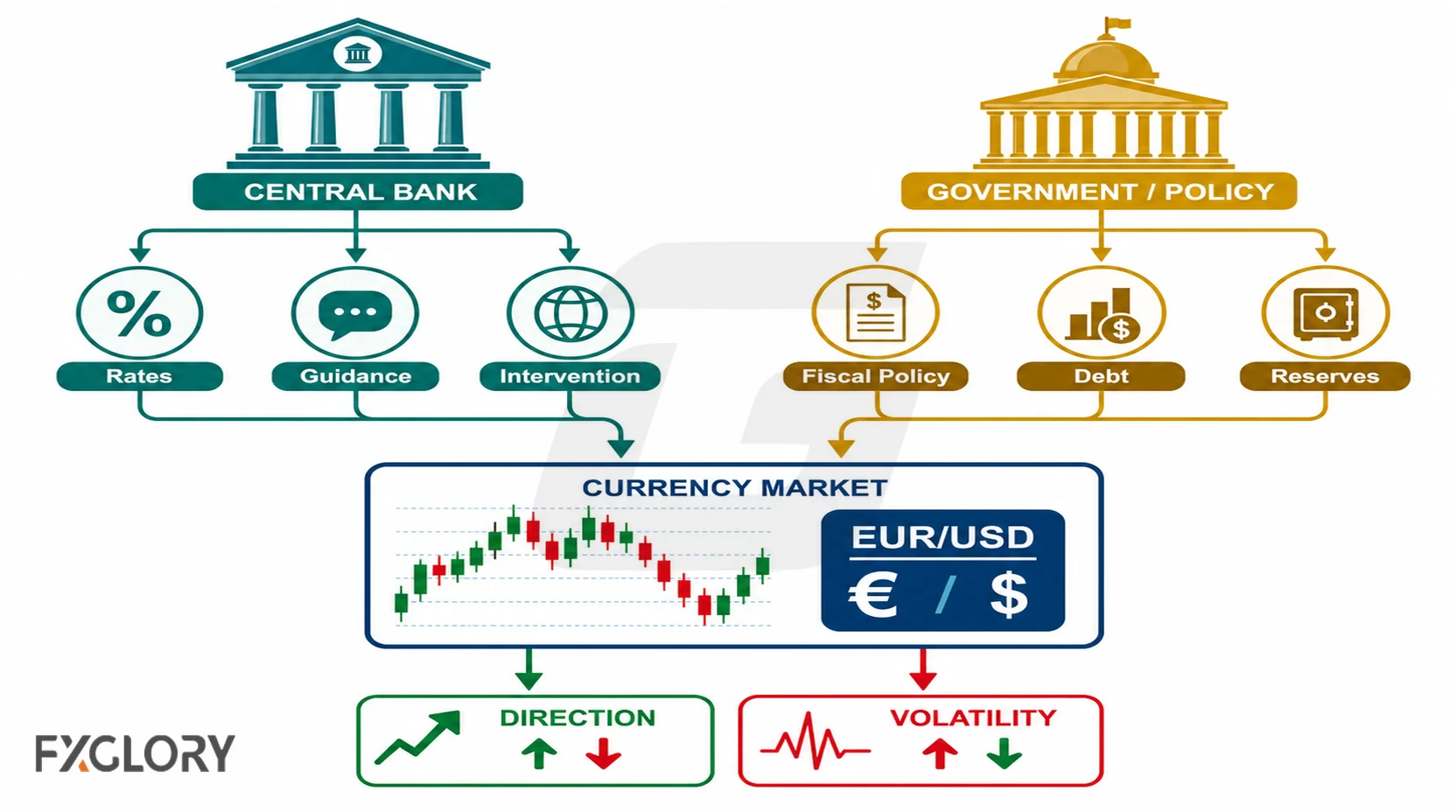
Governments can also influence currencies through fiscal policy, finance-ministry statements, capital controls, sanctions, sovereign-debt concerns, trade policy, exchange-rate regimes, and coordinated intervention with central banks. Government influence is usually strongest during policy shifts, currency stress, geopolitical events, or crisis periods.
Markets often move when central-bank actions or language differ from what traders expected. A rate decision may matter less than the surprise between expected policy and actual policy. Currency reactions can also depend on inflation expectations and real-rate expectations, not only headline interest rates.
Central banks can influence currencies through:
- Interest-rate decisions: Higher or lower rates can affect currency demand and yield expectations.
- Monetary policy guidance: Speeches, statements, and forecasts can shift market expectations.
- Verbal intervention: Officials may try to influence a currency through public comments rather than immediate buying or selling.
- Direct currency intervention: A central bank may buy or sell currency directly when it wants to influence exchange-rate conditions.
- Foreign-exchange reserves: Reserve management can affect currency demand and market confidence, especially in major reserve currencies such as the U.S. dollar, euro, yen, and pound.
- Exchange-rate policy: Some governments or central banks may manage, peg, or guide their currency more actively than others.
Central banks do not control every intraday move, but they can strongly affect medium-term trends and sudden volatility. Retail traders should watch central-bank calendars, policy decisions, speeches, inflation reports, and employment data because these can change currency expectations quickly.
Commercial Banks and the Interbank Market
Large commercial and investment banks are central to forex liquidity. They handle major client transactions, trade with other banks, quote prices, manage currency risk, and participate in the interbank market.
The interbank market is the network where major banks and financial institutions trade currencies with each other. Retail traders usually do not access the interbank market directly; they access pricing through brokers, platforms, liquidity relationships, or trading products offered by their provider.
Access to liquidity is often tiered. Larger institutions may see deeper liquidity, different pricing, or more direct access than smaller participants. Retail traders usually see forex through the pricing, liquidity sources, execution model, and product structure made available by their broker or platform.
A market maker quotes both a buy price and a sell price. The market maker may earn through spread while managing inventory, risk, and client flow.
Order flow means the stream of buy and sell orders entering the market. Large order flow from banks, institutions, funds, or corporations can affect short-term price movement, especially when liquidity is thin.
Banks may participate in forex for several reasons:
- serving corporate, institutional, and government clients,
- managing their own currency exposure,
- providing liquidity and bid/ask quotes,
- facilitating international payments,
- handling large transactions that can affect short-term price movement.
For retail traders, this matters because bank liquidity and interbank pricing can influence spreads, execution quality, and volatility. For bid and ask basics, see bid and ask price in forex.
Liquidity Providers and Market Makers
Liquidity means how easily orders can be executed without causing large price disruption. Deep liquidity usually means tighter spreads and smoother execution. Thin liquidity can mean wider spreads, more slippage, and sharper price movement.
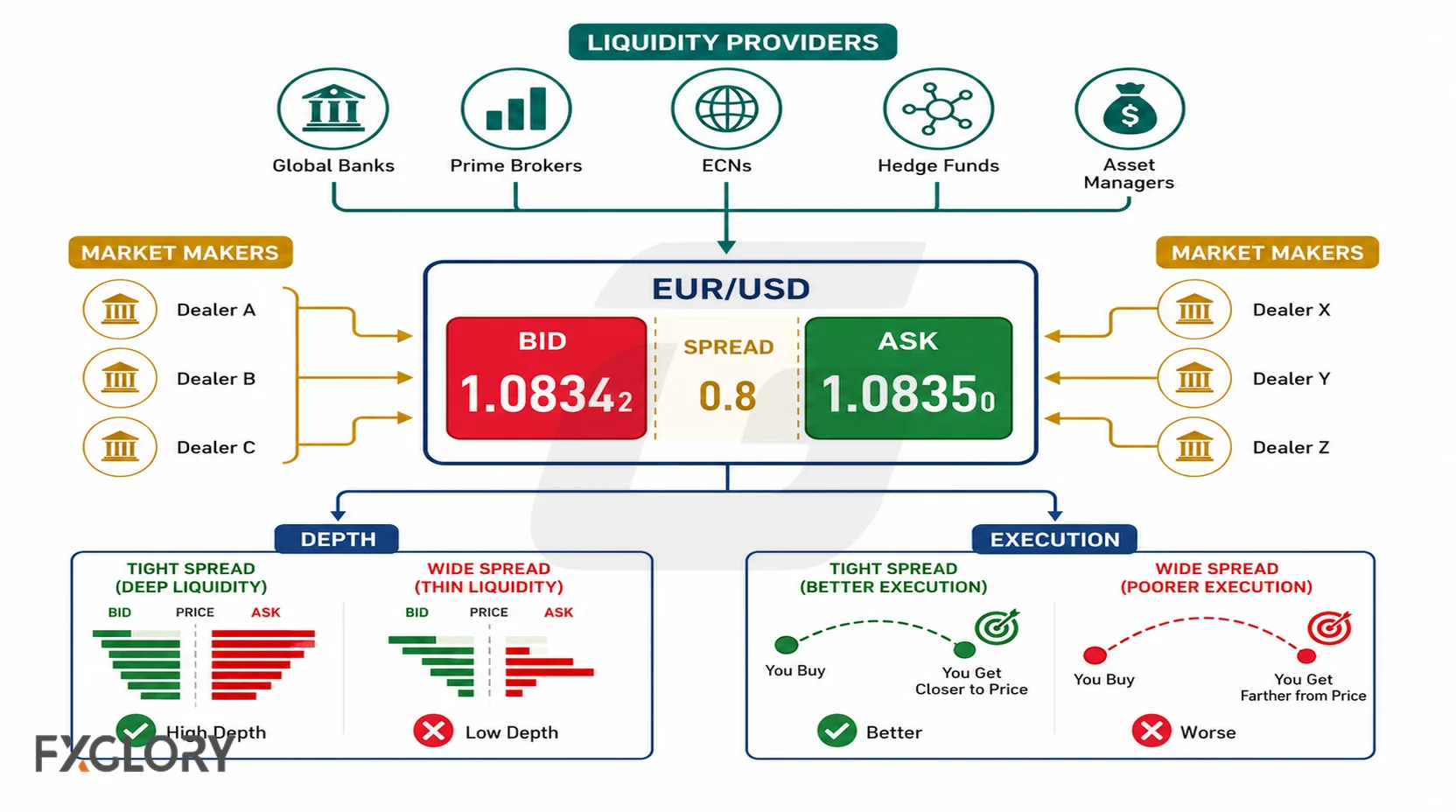
Deep liquidity means there are enough orders or quotes near the current price to absorb trading without large movement. Thin liquidity means there may not be enough available depth near the current price, so orders can move through worse prices more quickly.
Liquidity providers and market makers help create a tradable market by quoting buy and sell prices. They may include banks, non-bank market makers, electronic liquidity providers, and trading firms using electronic systems and algorithms.
Their role is important because they help determine:
- Bid and ask prices: The prices available for buying and selling.
- Spread: The difference between bid and ask.
- Market depth: How much can be traded at or near a price.
- Execution quality: Whether orders can be filled quickly and at expected prices.
- Short-term liquidity: How easily traders can enter or exit during active or thin conditions.
Liquidity can change. Around major news, during thin sessions, or in volatile markets, liquidity providers may widen quotes or reduce available depth. Spreads often widen because liquidity providers quote more defensively when volatility, uncertainty, or inventory risk rises. That can lead to wider spreads, slippage, or faster price movement.
Hedge Funds, Asset Managers, Institutions and Companies
Large funds and institutions participate in forex for speculation, hedging, portfolio allocation, and macro positioning. Their trades can be large enough to affect price movement, especially when many institutions are positioned in the same direction.
Hedge funds may trade forex based on interest-rate expectations, inflation, economic growth, risk sentiment, geopolitical events, or relative currency strength.
Prop firms and proprietary trading desks may trade currencies for speculative strategies, short-term opportunities, arbitrage-style setups, or macro positioning. Their impact depends on size, strategy, liquidity, and timing.
Asset managers may trade currencies to manage international portfolios, hedge overseas holdings, or adjust exposure between regions.
Corporations and multinational companies trade forex because they have real business needs. They may need to pay foreign suppliers, receive foreign revenue, repatriate profits, fund overseas operations, or hedge exchange-rate risk. Corporations may hedge through forwards, swaps, options, or other currency products depending on their needs, risk policy, and jurisdiction.
These participants do not control the forex market, but their flows can matter, especially around benchmark fixing windows, month-end, quarter-end, major data releases, or major changes in interest-rate expectations. A fixing is a benchmark time when reference exchange rates are calculated or used for transactions.
Brokers and Trading Platforms
Brokers and platforms are the way many retail traders access forex. A broker gives access to prices, charts, trading platforms, order execution, margin terms, account tools, and customer infrastructure.
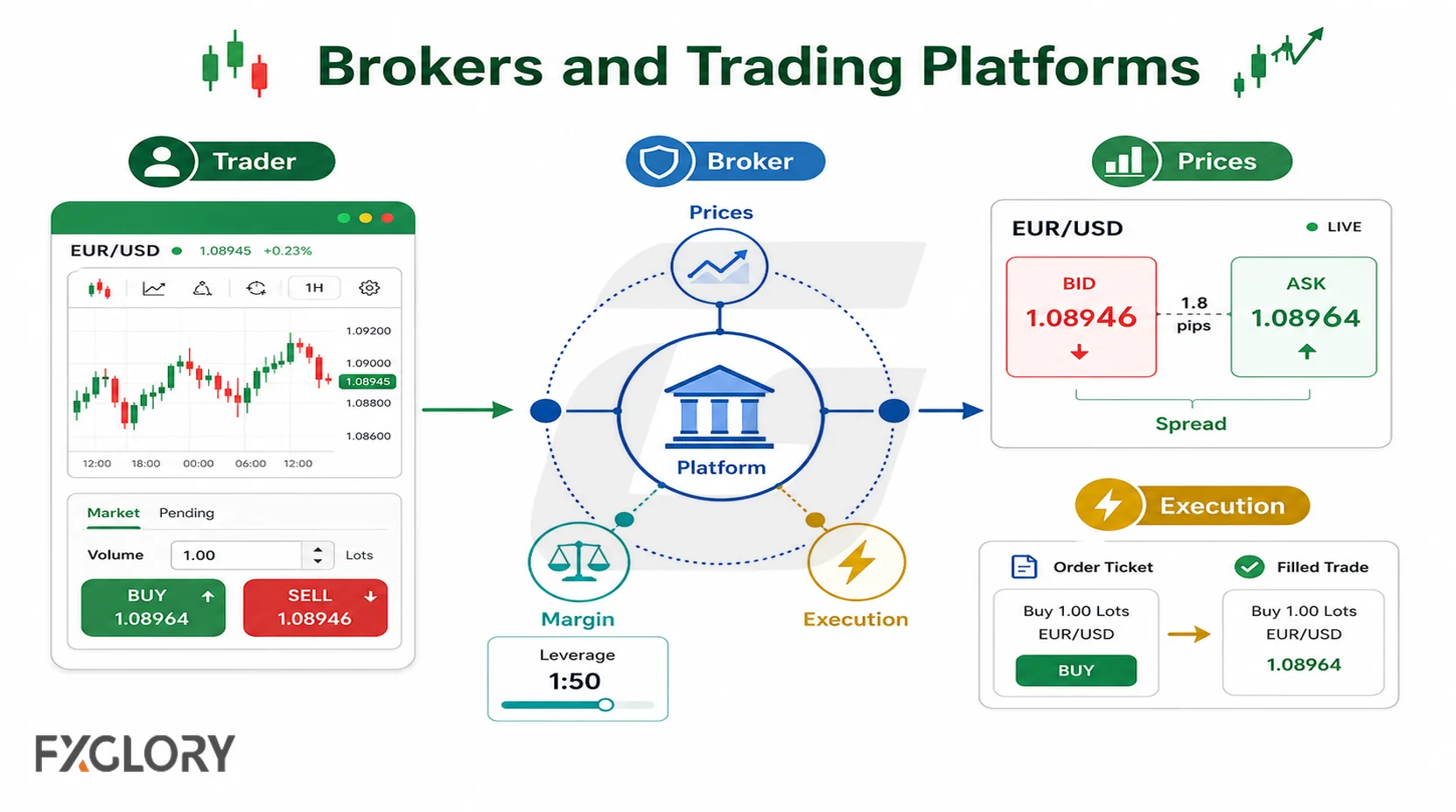
A broker does not control the entire forex market. A broker may affect the price, spread, execution, and rules available to its own clients, but that is not the same as controlling global exchange rates.
Broker execution models differ, so traders should understand order handling, pricing source, spread policy, liquidity relationships, product structure, risk disclosures, and account terms before trading.
Retail access may be spot-style forex, forex CFDs, or another product structure depending on the broker, platform, entity, account type, and jurisdiction. The product structure matters because pricing, margin, execution, costs, and client protections can differ.
For more on contract-based retail access, see forex CFD trading. For the broader difference between forex as a market and CFDs as a product structure, see forex vs CFD.
What regulators do and do not control
Regulators do not usually set EUR/USD, GBP/USD, USD/JPY, or other exchange rates tick by tick. Their role is different. Regulators influence market integrity by supervising brokers and financial firms, enforcing conduct standards, setting disclosure requirements, investigating abuse, and creating client-protection frameworks.
Regulation can affect how brokers advertise, disclose risk, handle client funds, provide leverage, report transactions, or manage complaints. It can influence trust and market conduct, but it is not the same as controlling every forex price movement.
Retail Traders
Retail traders are individuals who access forex through brokers, trading platforms, and retail account structures. They usually trade for speculation, short-term opportunity, portfolio interest, or personal market participation.
Retail traders are much smaller than banks, central banks, corporations, and large funds. A single retail trader does not move EUR/USD, and retail traders should not assume their order flow has the same market impact as interbank or institutional flow.
That does not mean retail traders are irrelevant. Retail activity can contribute to short-term sentiment in popular pairs, especially when many traders react to the same news, trend, technical level, or market narrative. But major-pair liquidity and large-scale price formation remain dominated by larger participants.
Retail traders should be honest about scale. They are not trading in the same way as central banks or tier-one banks. That is why risk control, position sizing, spreads, slippage, and leverage matter. For related risk basics, see best leverage for forex.
How Participants Affect Price, Spread and Liquidity
Different forex market participants affect the market in different ways. Some influence the long-term direction of a currency. Others affect short-term liquidity, bid/ask spreads, volatility, or execution conditions.
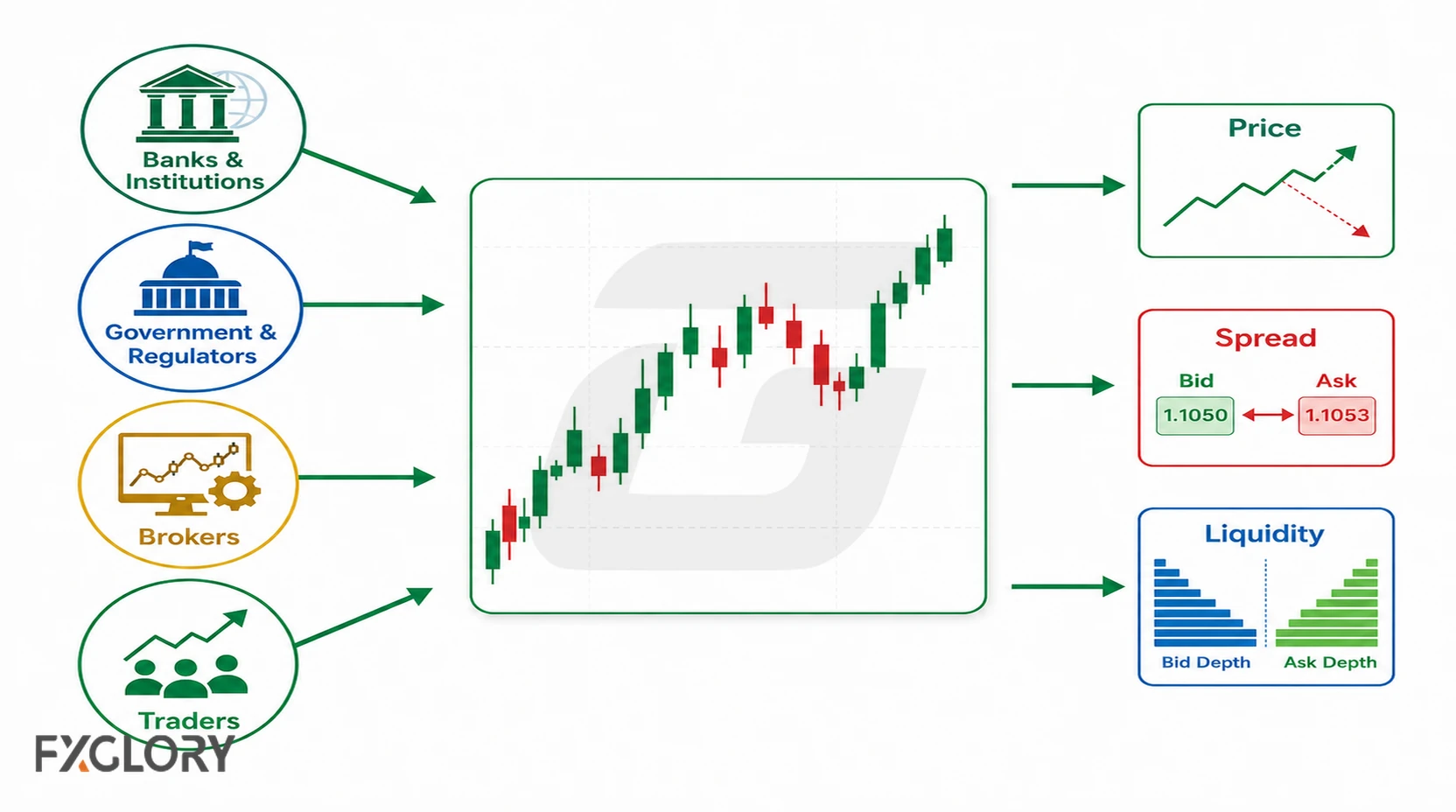
| Participant | Main Market Effect |
|---|---|
| Central banks | Interest-rate expectations, policy shocks, intervention risk, currency stability. |
| Commercial banks | Liquidity, bid/ask pricing, large client flow, interbank transactions. |
| Liquidity providers | Spread, market depth, quote availability, execution liquidity. |
| Hedge funds | Speculative flow, volatility, macro positioning, crowded trades. |
| Asset managers | Portfolio flows, hedging demand, rebalancing activity. |
| Corporations | Real currency demand and supply from trade, payments, and hedging. |
| Brokers | Retail access, platform pricing, account terms, margin, execution experience. |
| Retail traders | Individual trading activity and collective retail sentiment. |
| Regulators | Market integrity, broker supervision, disclosure rules, client-protection standards. |
Spreads can widen when volatility rises, liquidity providers reduce quote depth, market sessions become thin, or major news affects market conditions.
News moves markets when it changes expectations and participants respond with orders. The same headline can produce different price reactions depending on positioning, liquidity, prior expectations, and the size of participant response.
For price movement basics, see how to calculate pips in forex.
What Retail Traders Should Watch
Retail traders cannot control what major participants do, but they can watch the signals that often reveal participant behavior.
- Central-bank decisions: Rate decisions, policy statements, speeches, and inflation targets can reshape currency expectations.
- Economic data: Inflation, jobs, GDP, retail sales, and trade data can affect rate expectations and market sentiment.
- Risk sentiment: Safe-haven currencies and risk-sensitive currencies can react differently when markets become nervous or optimistic.
- Market sessions: Liquidity can change across Asian, European, and U.S. sessions as different participants become active.
- Session overlap: Activity may increase when major sessions overlap, while thin periods can lead to wider spreads or sharper moves.
- Spreads and slippage: Wider spreads or worse execution can signal thinner liquidity or higher volatility.
- Intervention risk: Sudden comments or actions from central banks or finance ministries can move currencies sharply.
- Institutional positioning: Large funds and asset managers can contribute to trend continuation or sharp reversals.
- Corporate and hedging flows: Large real-economy flows may matter around fixings, month-end, quarter-end, or major business events.
- Benchmark fixing windows: Some institutional and corporate flows may cluster around common fixing times, which can affect short-term price behavior.
The point is not to copy large institutions. The point is to understand which participants may be active and how their behavior can affect price, spread, liquidity, volatility, execution, and risk.
Common Myths About Forex Market Participants
Many beginner misunderstandings come from thinking forex is controlled by one hidden group or one simple cause. Avoid these myths:
- Myth 1: One bank controls forex. Large banks influence liquidity and order flow, but no single bank controls the entire market.
- Myth 2: Central banks control every daily move. Central banks are powerful, but daily price movement also reflects liquidity, data, sentiment, positioning, and order flow.
- Myth 3: Brokers control the whole forex market. Brokers affect the retail trading experience, but they do not control global exchange rates.
- Myth 4: Brokers move the whole forex market against retail traders. Brokers can affect their own execution environment, but global major-pair prices are shaped by much larger liquidity networks and participants.
- Myth 5: Retail traders move major pairs alone. Individual retail traders are small compared with banks, funds, corporations, and central banks.
- Myth 6: News alone moves forex. News matters, but the size and direction of the move depend on expectations, liquidity, positioning, and participant reaction.
- Myth 7: Smart money always wins. Large participants may have more scale and information, but they can still be wrong, crowded, forced to unwind, or surprised by policy and data.
- Myth 8: The largest participant always wins. Large participants can still be affected by unexpected policy, data, liquidity changes, and risk events.
- Myth 9: Decentralized means unstructured. Forex is decentralized, but it still has strong liquidity networks, professional participants, pricing competition, and regulatory oversight in many jurisdictions.
Quick Recap: Forex Market Participants
Forex market participants include central banks, governments, commercial banks, investment banks, liquidity providers, market makers, hedge funds, asset managers, corporations, brokers, platforms, regulators, and retail traders.
No single participant controls the forex market. Forex is decentralized, and prices are shaped by policy decisions, liquidity, institutional flows, corporate demand, speculation, news, sentiment, and execution conditions.
The most influential participants are usually central banks, major banks, liquidity providers, large institutions, hedge funds, asset managers, and corporations. Retail traders participate through brokers and are smaller individually, but they still need to understand how larger participants can affect price, spread, liquidity, volatility, and execution.