
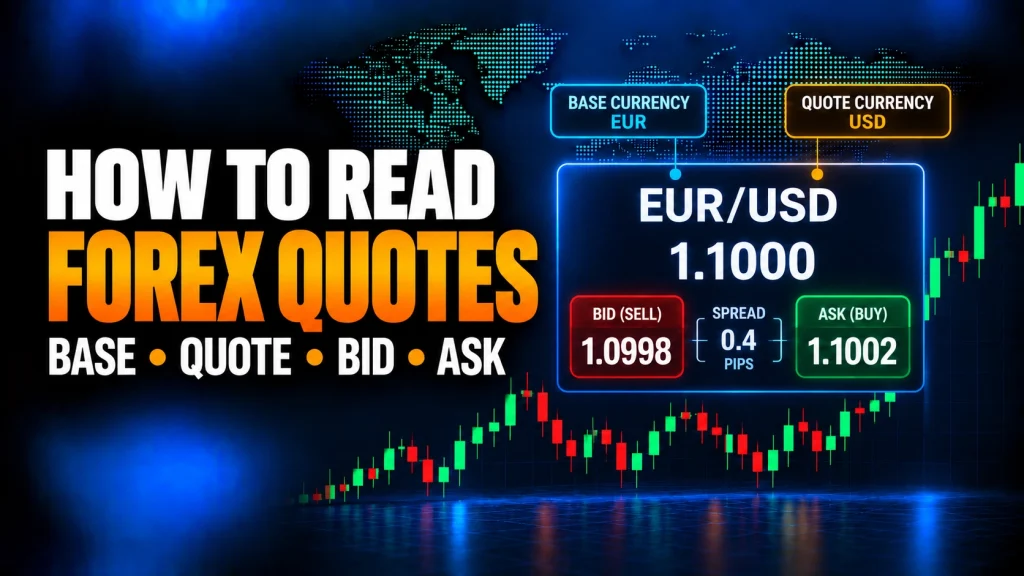
Quick Answer: How to Read a Forex Quote
A forex quote, also called a forex quotation, is the exchange rate for a currency pair. The simplest way to read it is: 1 base currency equals X quote currency.
For example, if EUR/USD is quoted at 1.1000, EUR is the base currency, USD is the quote currency, and 1 euro costs 1.1000 US dollars.
What Is a Forex Quote?
A forex quote is the price of one currency compared with another currency. Because currencies are traded in pairs, a quote always includes two currencies: the currency being priced and the currency used to express that price.
In a quote such as EUR/USD 1.1000, the pair is EUR/USD and the price is 1.1000. This means one euro is valued at 1.1000 US dollars. If the quote changes, the relationship between the two currencies has changed.
Forex quotes help answer four beginner questions:
- What am I trading? The currency pair.
- What does the price mean? The exchange rate between the base and quote currency.
- Where would I buy or sell? The ask and bid prices.
- What changed? The quote movement, often measured in pips.
Currency Pairs: Base Currency vs Quote Currency
A currency pair is two currencies shown together so their values can be compared. The first currency is the base currency. The second currency is the quote currency, sometimes called the counter currency.
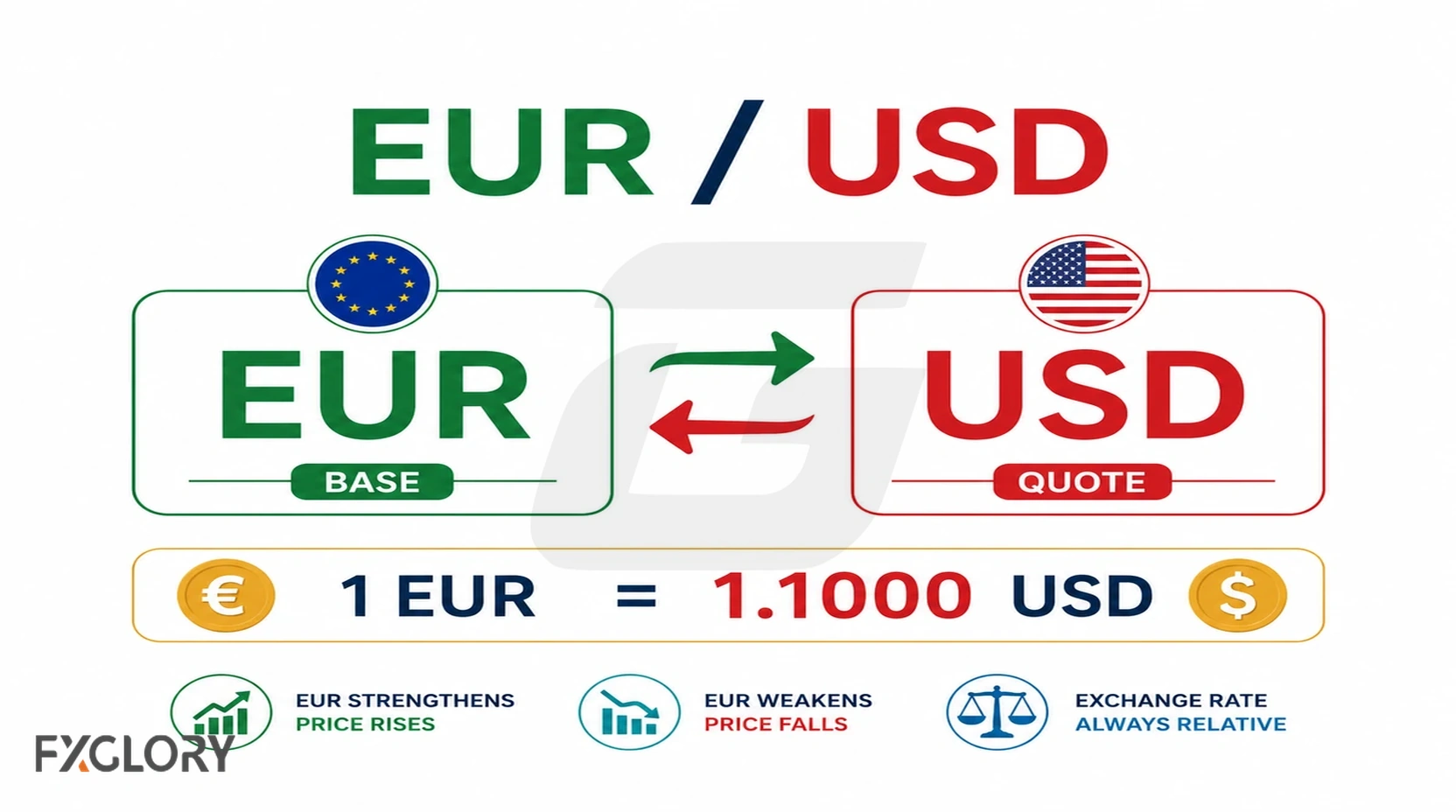
The base currency is the unit being priced. The quote currency is the unit used to measure that price. It is also the currency in which the pair's price movement is expressed.
| Pair | Base Currency | Quote Currency | Simple Meaning |
|---|---|---|---|
| EUR/USD | EUR | USD | One euro is priced in US dollars. |
| GBP/JPY | GBP | JPY | One British pound is priced in Japanese yen. |
| USD/CAD | USD | CAD | One US dollar is priced in Canadian dollars. |
Currency pairs can include major pairs, minor pairs, and exotic pairs. Major pairs include the most widely traded currencies, while minor and exotic pairs may have different liquidity and spread conditions. The same reading rule still applies: first currency is base, second currency is quote.
Some finance sources also use terms such as direct quote and indirect quote depending on the viewer's home currency. Beginners can start with the simpler pair rule: first currency is base, second currency is quote.
How to Read Any Forex Quote in 4 Steps
A simple way to read any quote is to use the four-step quote-reading framework: Pair → Price → Bid/Ask → Pips.
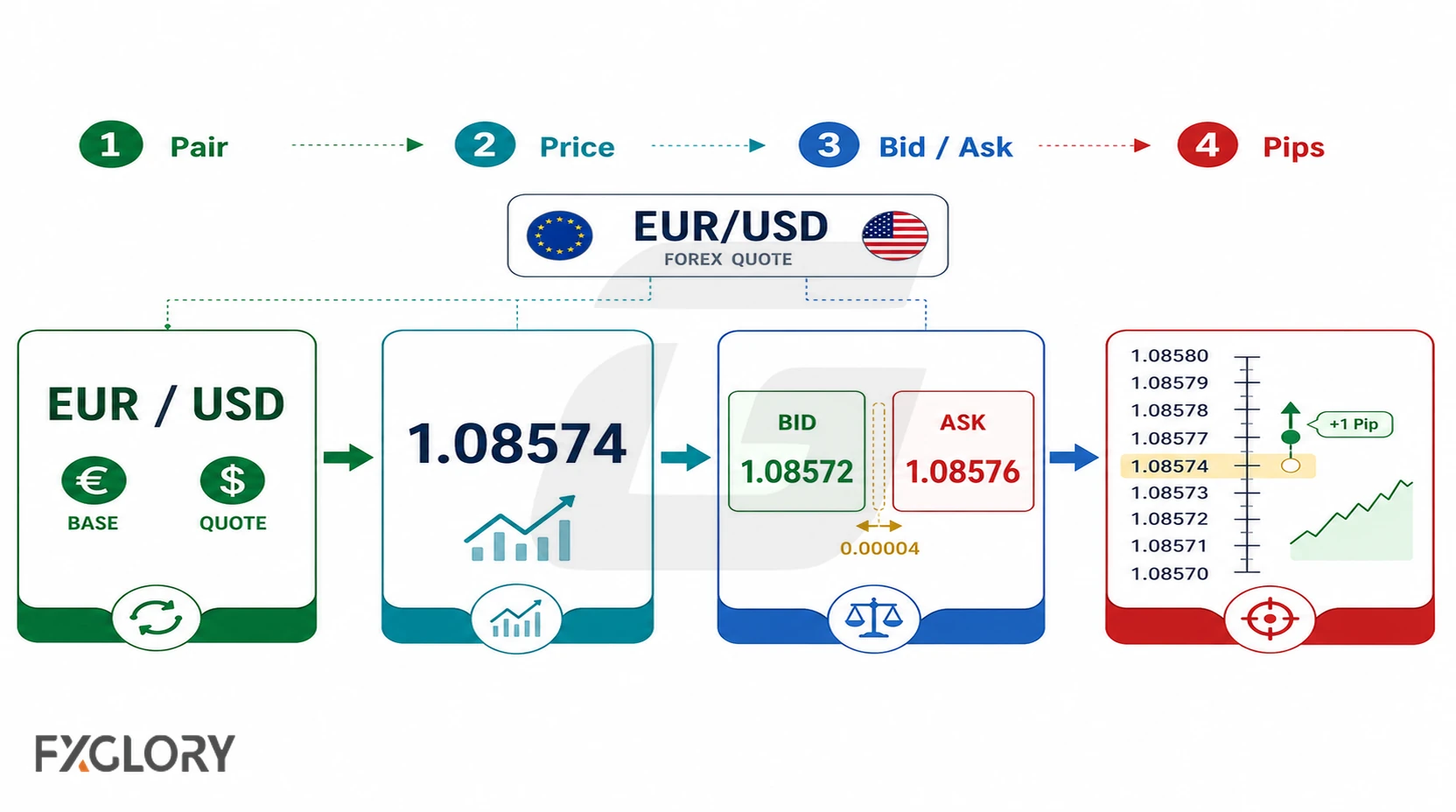
| Step | What to Read | Beginner Question |
|---|---|---|
| 1. Pair | Identify the base and quote currency. | What two currencies are being compared? |
| 2. Price | Translate the quote into plain English. | How much quote currency equals 1 base currency? |
| 3. Bid/Ask | Check the buy and sell prices. | Which price applies if I buy or sell? |
| 4. Pips | Measure price movement. | How far did the quote move? |
How to Read EUR/USD as a Live Forex Quote
EUR/USD is one of the clearest examples for learning how to read forex quotes. If EUR/USD is quoted at 1.1000, the quote means 1 euro costs 1.1000 US dollars.
Using the four-step framework: Pair = EUR/USD, Price = 1.1000, Bid/Ask = check the live two-way price, and Pips = measure how far the quote moves from one price to another.
| Part of the Quote | EUR/USD Example | Meaning |
|---|---|---|
| Pair | EUR/USD | Euro compared with US dollar. |
| Base currency | EUR | The currency being priced. |
| Quote currency | USD | The currency used to express the price. |
| Price | 1.1000 | 1 EUR costs 1.1000 USD. |
| If EUR/USD rises | 1.1000 to 1.1050 | EUR strengthens against USD. |
| If EUR/USD falls | 1.1000 to 1.0950 | EUR weakens against USD. |
To practice with a real market-style layout, open the EUR/USD live price page and apply the same Pair → Price → Bid/Ask → Pips process. Identify the pair, displayed price, bid/ask or buy/sell values, spread, and chart movement before interpreting the quote.
How to Read Live Forex Quotes on Price Pages
Live price pages can show several values at once, so first determine what each displayed number represents. The core quote-reading rule stays the same, but a live page may also show a chart, separate bid/ask or buy/sell prices, spread, and pip or point information.
Use this checklist when reading a live forex quote:
- Pair: Which two currencies are being compared?
- Price: What does the displayed live quote mean in plain English?
- Bid/ask or buy/sell: Which value applies to buying or selling?
- Spread: What is the difference between the two-way prices?
- Chart movement: Is the quote rising or falling over time?
- Pip or point display: Which decimal movement is being shown?
Some live pages may also show contract size, minimum trade size, margin conditions, leverage conditions, or other trading details. Treat those as platform conditions, not as the basic definition of the quote.
What Are You Buying or Selling in a Forex Quote?
When a trader buys or sells a forex pair, the action applies to the base currency. Buying a pair means buying the base currency and selling the quote currency. Selling a pair means selling the base currency and buying the quote currency.
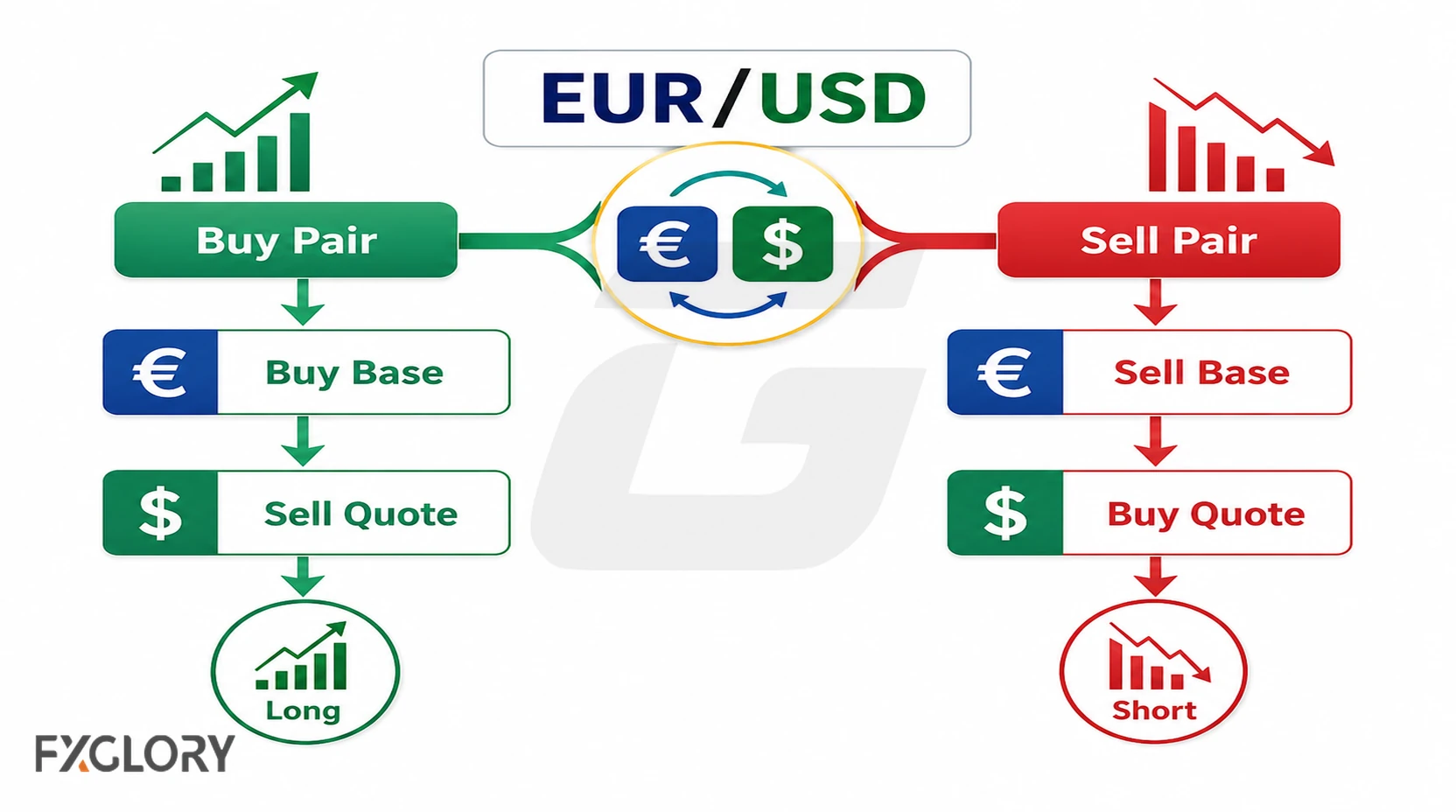
| Action | Example | What Happens | Typical Price Used |
|---|---|---|---|
| Buy the pair | Buy EUR/USD | Buy EUR and sell USD. | Ask price |
| Sell the pair | Sell EUR/USD | Sell EUR and buy USD. | Bid price |
If a trader buys EUR/USD, the trader is buying euros and selling US dollars. This is often called going long. If a trader sells EUR/USD, the trader is selling euros and buying US dollars. This is often called going short.
What Happens When a Forex Quote Rises or Falls?
Quote direction tells you how the base currency is changing relative to the quote currency. A rising quote means one unit of the base currency buys more of the quote currency; a falling quote means it buys less.
For EUR/USD, a rise therefore means EUR has strengthened relative to USD, while a fall means EUR has weakened relative to USD.
| Quote Movement | Plain-English Meaning | Example |
|---|---|---|
| EUR/USD rises | One euro buys more US dollars than before. | EUR/USD moves from 1.1000 to 1.1050. |
| EUR/USD falls | One euro buys fewer US dollars than before. | EUR/USD moves from 1.1000 to 1.0950. |
| USD/JPY rises | One US dollar buys more Japanese yen than before. | USD/JPY moves from 145.00 to 146.00. |
| USD/JPY falls | One US dollar buys fewer Japanese yen than before. | USD/JPY moves from 145.00 to 144.00. |
For example, if EUR/USD moves from 1.1000 to 1.1010, one euro now buys $0.0010 more than before. In many standard examples, that is a 10-pip move.
Bid, Ask, Spread and Two-Way Forex Quotes
Many live forex quotes are shown as two prices instead of one. This is called a two-way quote. The two prices are the bid and the ask.
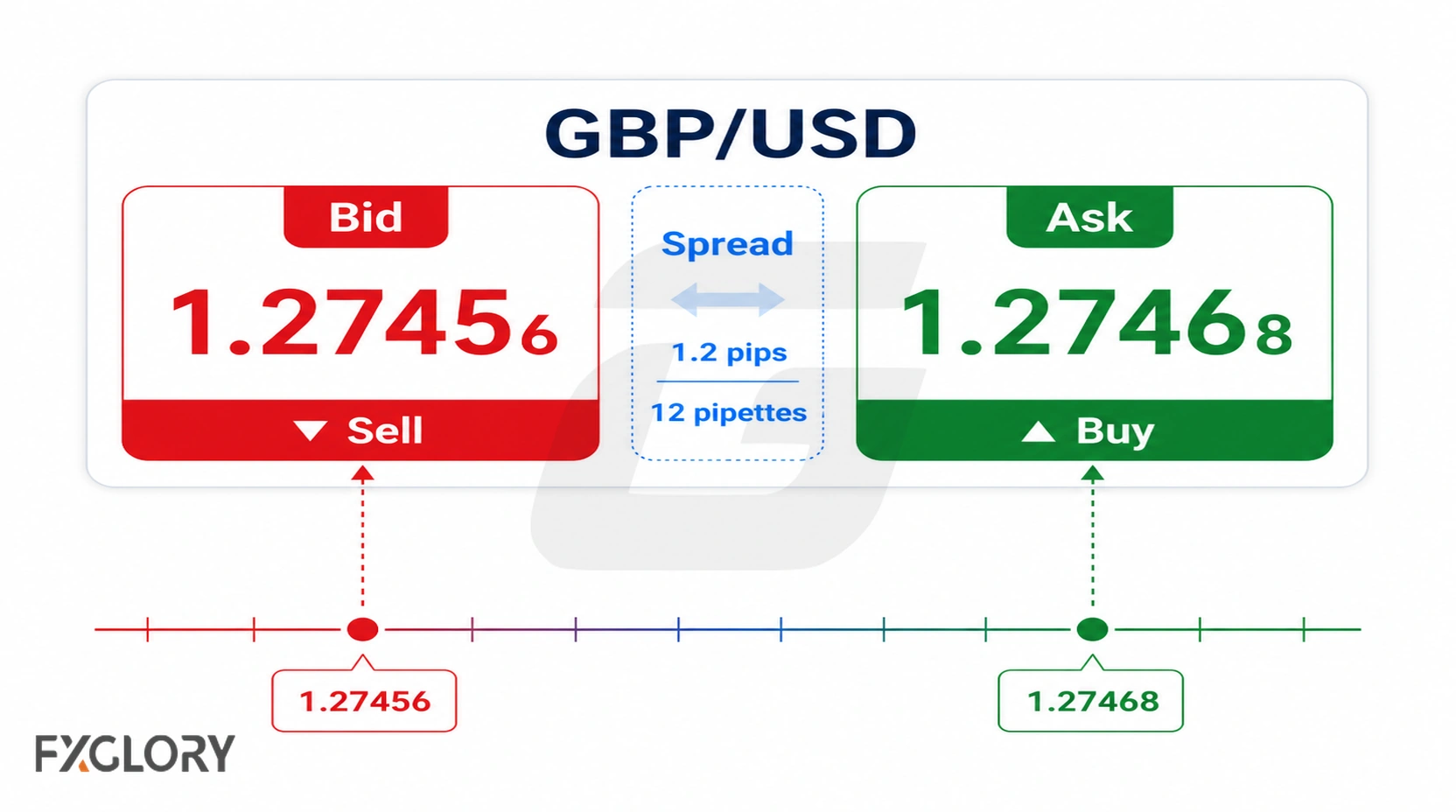
- Bid price: The price at which a trader can usually sell the base currency.
- Ask price: The price at which a trader can usually buy the base currency.
- Spread: The difference between the bid price and the ask price.
The bid is usually lower than the ask. When comparing two-way quotes, check the size of the spread rather than treating the two displayed prices as interchangeable.
How to Read a Two-Way Forex Quote
A two-way quote shows both the selling price and the buying price. Depending on the platform label, these may appear as bid/ask or sell/buy values.
| Two-Way Quote | Bid | Ask | Spread | Meaning |
|---|---|---|---|---|
| GBP/USD 1.3050 / 1.3053 | 1.3050 | 1.3053 | 0.0003, or 3 pips | Sell at the bid, buy at the ask. |
The same logic applies to EUR/USD live quotes, where buy/sell or bid/ask values may be shown separately. If a trader buys a pair, the ask price is usually the relevant price. If a trader sells a pair, the bid price is usually the relevant price.
For a deeper explanation, see bid and ask price in forex.
Forex Quote vs Forex Chart
A forex quote shows the current or displayed exchange rate for a currency pair. A forex chart shows how that price has moved over time.
- Quote: Shows the current price or two-way price for the pair.
- Chart: Shows price movement over time.
- Vertical axis: Usually shows price.
- Horizontal axis: Usually shows time.
The chart price may show bid, ask, midpoint, or another displayed price depending on the platform. Actual trade execution still depends on the relevant bid or ask price and the trading conditions at the time.
Pips, Points, Quote Currency and Profit/Loss
Forex quote movement is often measured in pips. For many major pairs such as EUR/USD, GBP/USD, and AUD/USD, one pip is commonly the fourth decimal place. A move from 1.1000 to 1.1001 is one pip.
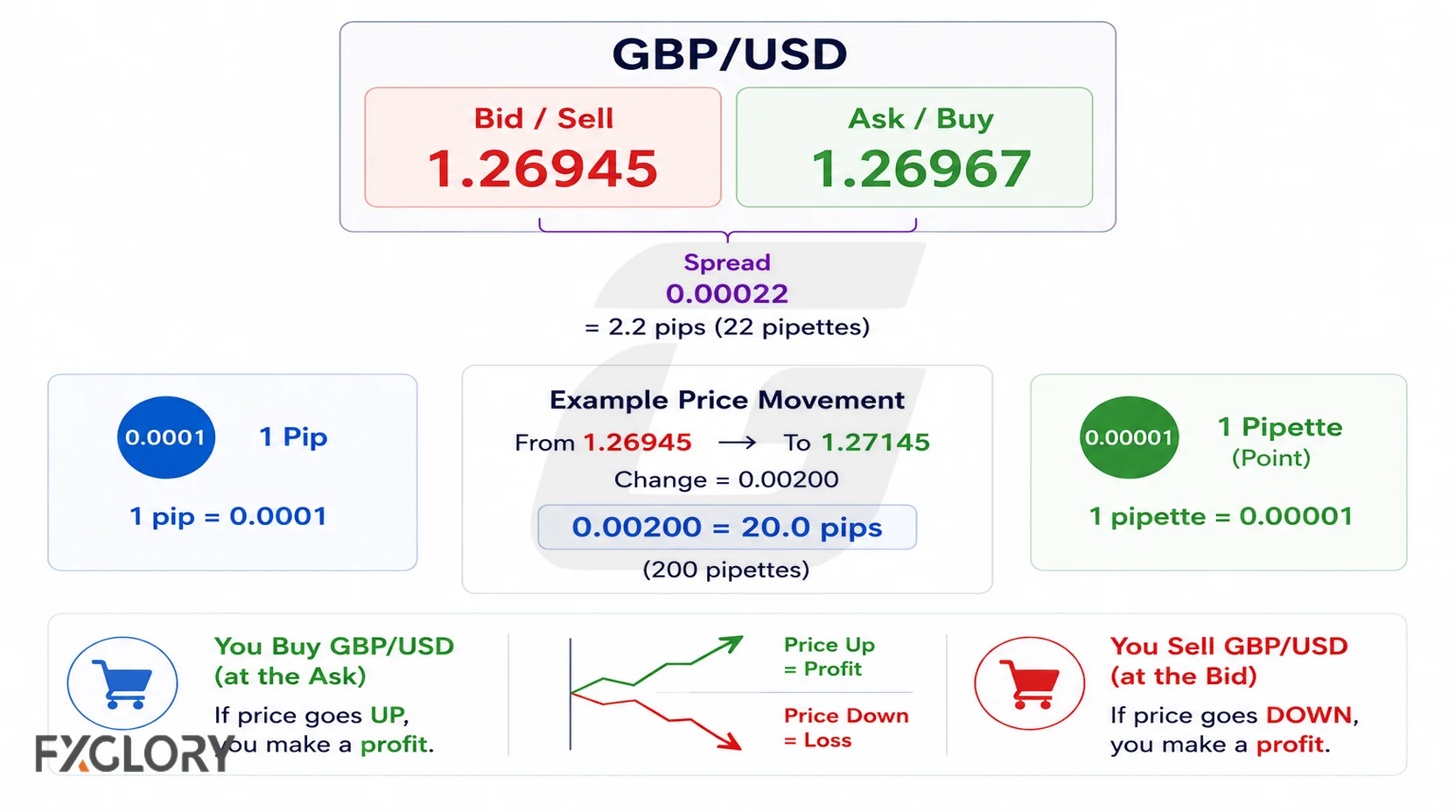
| Pair Type | Example Quote | Common Pip Example | Meaning |
|---|---|---|---|
| Most non-JPY pairs | EUR/USD 1.1000 | 1.1000 to 1.1001 | One pip in many standard examples. |
| JPY pairs | USD/JPY 145.00 | 145.00 to 145.01 | One pip in many JPY-pair examples. |
| Fractional pip / point | EUR/USD 1.10000 | 1.10000 to 1.10001 | A smaller quoted increment on some platforms. |
Some platforms show fractional pips or points. A fractional pip is a smaller movement than a standard pip. Some platforms may use point size to describe the smallest quoted price increment on that platform. A point can be smaller than a pip depending on the platform, so check how the platform defines point size.
How Quote Currency Connects to Pip Value and P/L
The quote currency matters because it is the currency used to express the price of the base currency. It can affect how pip value and profit or loss are calculated, especially when the account currency is different from the quote currency.
For example, if EUR/USD moves from 1.1000 to 1.1010, the quote has moved 10 pips in many standard examples. In EUR/USD, that price movement is expressed in USD. If the account currency is also USD, pip-value examples are usually easier to follow. If the account currency is different, conversion may be needed.
The quote shows price movement. Lot size turns that movement into money impact. For the position-size side, see what is lot size in forex. To learn pips in more detail, see what is a pip in forex trading.
Common Beginner Mistakes When Reading Forex Quotes
Many quote-reading mistakes come from looking at the number without reading the full pair. Beginners should watch for these problems:
- Ignoring currency order: EUR/USD and USD/EUR do not mean the same thing.
- Forgetting the base currency: The first currency is the one being priced.
- Forgetting the quote currency: The second currency shows what the base currency is priced in.
- Misreading quote direction: If EUR/USD rises, EUR is strengthening against USD. If EUR/USD falls, EUR is weakening against USD.
- Confusing bid and ask: Buying usually happens at the ask, while selling usually happens at the bid.
- Ignoring the spread: The difference between bid and ask is part of the cost of trading.
- Assuming all pairs use the same decimals: JPY pairs often look different from pairs such as EUR/USD.
- Thinking pips equal profit automatically: Pip movement becomes money impact only after lot size and pip value are considered.
- Reading chart price as execution price: The displayed chart price may not be the exact bid or ask used for a trade.
Quick Recap: Reading Forex Quotes
Start by identifying the base and quote currencies, then translate the number into plain language. If a two-way price is shown, distinguish the bid from the ask and note the spread. Use pips to describe how far the quote has moved.
For a broader introduction to pairs, pips, lots, leverage, and risk, return to forex basics for beginners.