

Quick Answer: What Is Lot Size in Forex?
The lot size selected on an order ticket determines the position's currency-unit size. That position size then affects pip value, notional exposure, margin requirements, and the amount the account can gain or lose as price moves.
What Is a Standard Lot in Forex?
A standard lot is typically 100,000 units of the base currency. The base currency is the first currency in the pair.
For example, 1.00 lot of EUR/USD typically represents 100,000 euros, while 1.00 lot of USD/JPY typically represents 100,000 U.S. dollars. The instrument specifications determine the exact contract size and permitted trade increments on a particular platform.
Forex Lot Sizes: Standard, Mini and Micro Lots
Common forex lot conventions scale the standard lot into smaller fractions:
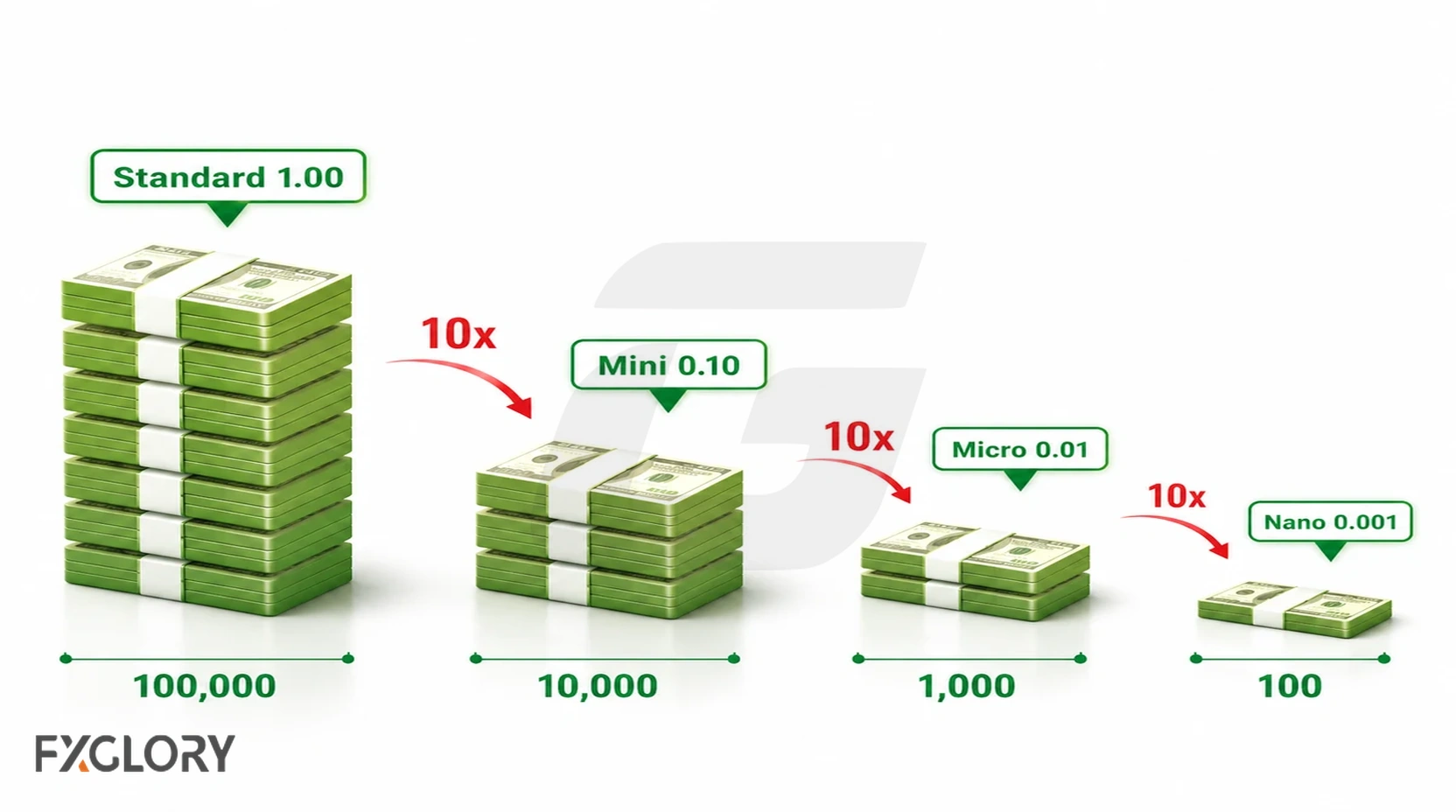
| Lot Type | Order Size | Typical Base-Currency Units |
|---|---|---|
| Standard lot | 1.00 | 100,000 units |
| Mini lot | 0.10 | 10,000 units |
| Micro lot | 0.01 | 1,000 units |
These are common forex conventions. The minimum, maximum, and permitted lot increments depend on the instrument, account type, broker, and platform specifications.
Units, Contract Size, Volume and Position Size
Several platform terms describe related but distinct parts of trade sizing:
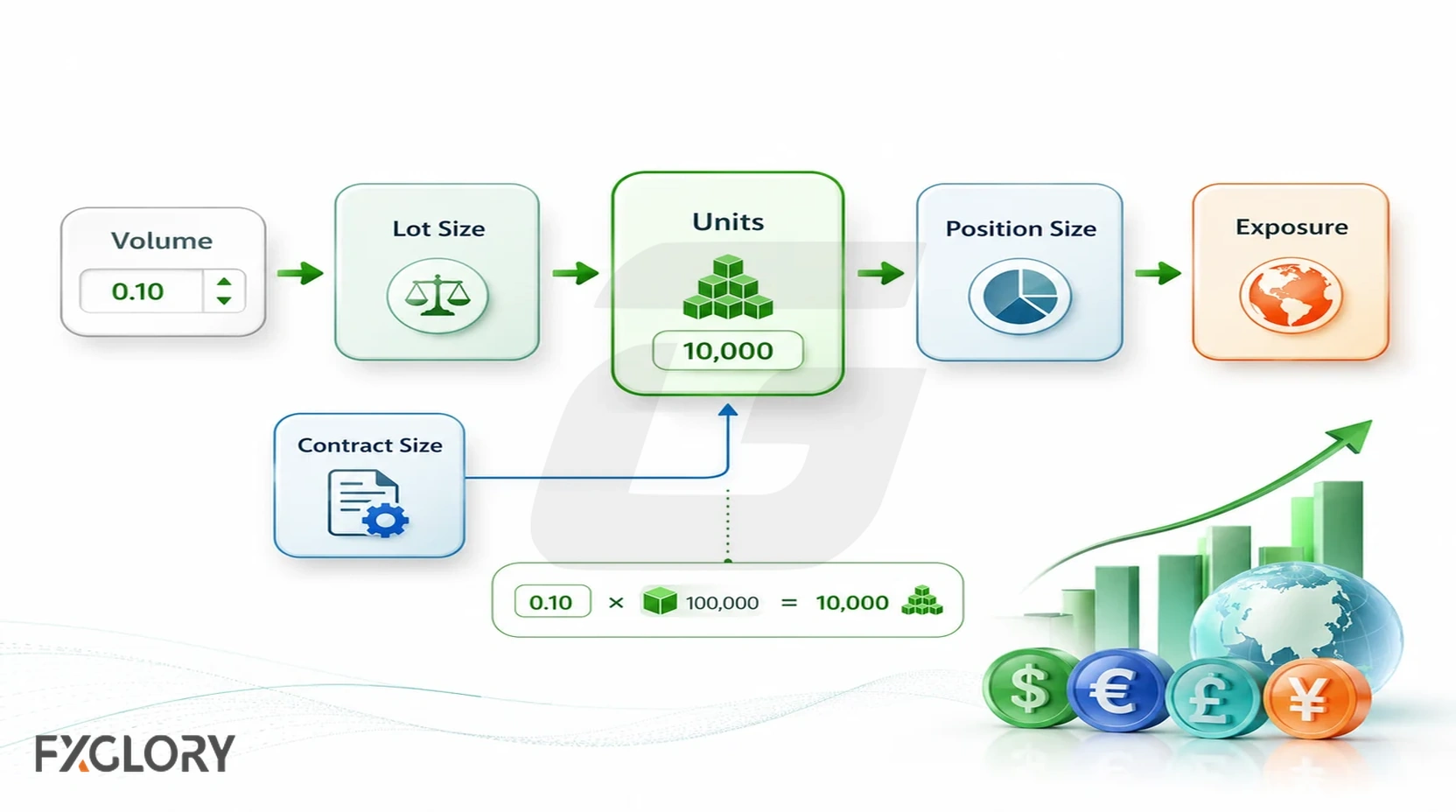
- Unit: One unit of the base currency.
- Contract size: The number of base-currency units represented by 1.00 lot for the instrument.
- Lot size: The number of lots or fractional lots selected.
- Volume: A platform label often used for the lot-size input.
- Position size: The total amount of the instrument represented by the open trade.
- Exposure: The market exposure created by that position.
For example, if the contract size is 100,000 units and the trader selects 0.01 lot, the position represents 1,000 units of the base currency.
For base- and quote-currency basics, see how to read forex quotes.
How Much Is 1 Lot in Forex?
For a typical spot-forex contract with a 100,000-unit contract size, 1.00 lot represents 100,000 units of the base currency. That describes the unit size of the position, not the cash amount required to open it.
The position's notional value depends on the exchange rate. If EUR/USD is 1.1000, 100,000 euros have a notional value of about $110,000.
The margin requirement can be much smaller than the notional value when leverage is used. Margin is a funding requirement for the leveraged position; it is not the same as the position's notional value or its potential loss.
1.00, 0.10 and 0.01 Lots by Currency Pair
Decimal lot sizes are fractions of a standard lot. The units refer to the pair's base currency.
| Pair | 1.00 Lot | 0.10 Lot | 0.01 Lot |
|---|---|---|---|
| EUR/USD | 100,000 EUR | 10,000 EUR | 1,000 EUR |
| GBP/USD | 100,000 GBP | 10,000 GBP | 1,000 GBP |
| USD/JPY | 100,000 USD | 10,000 USD | 1,000 USD |
| AUD/USD | 100,000 AUD | 10,000 AUD | 1,000 AUD |
A 0.01 lot size therefore typically represents 1,000 units of the base currency. Exact trade-size availability still depends on the instrument and account specifications.
Lot Size and Notional Value
Notional value is the market value represented by the full position. It is useful for understanding how large the market exposure is, even when only a fraction of that amount is required as margin.
| Concept | What It Describes | EUR/USD Example at 1.1000 |
|---|---|---|
| Units | Base-currency quantity | 100,000 EUR for 1.00 lot |
| Notional value | Market value represented by the position | About $110,000 |
| Margin | Funds required to open or maintain the leveraged position | Depends on leverage and account rules |
| Trade risk | Potential loss under the trade plan | Depends on position size, stop distance, execution, and costs |
How Lot Size Connects to Pips and Pip Value
A pip measures price movement. Pip value converts a one-pip move into a monetary amount for the selected position size.
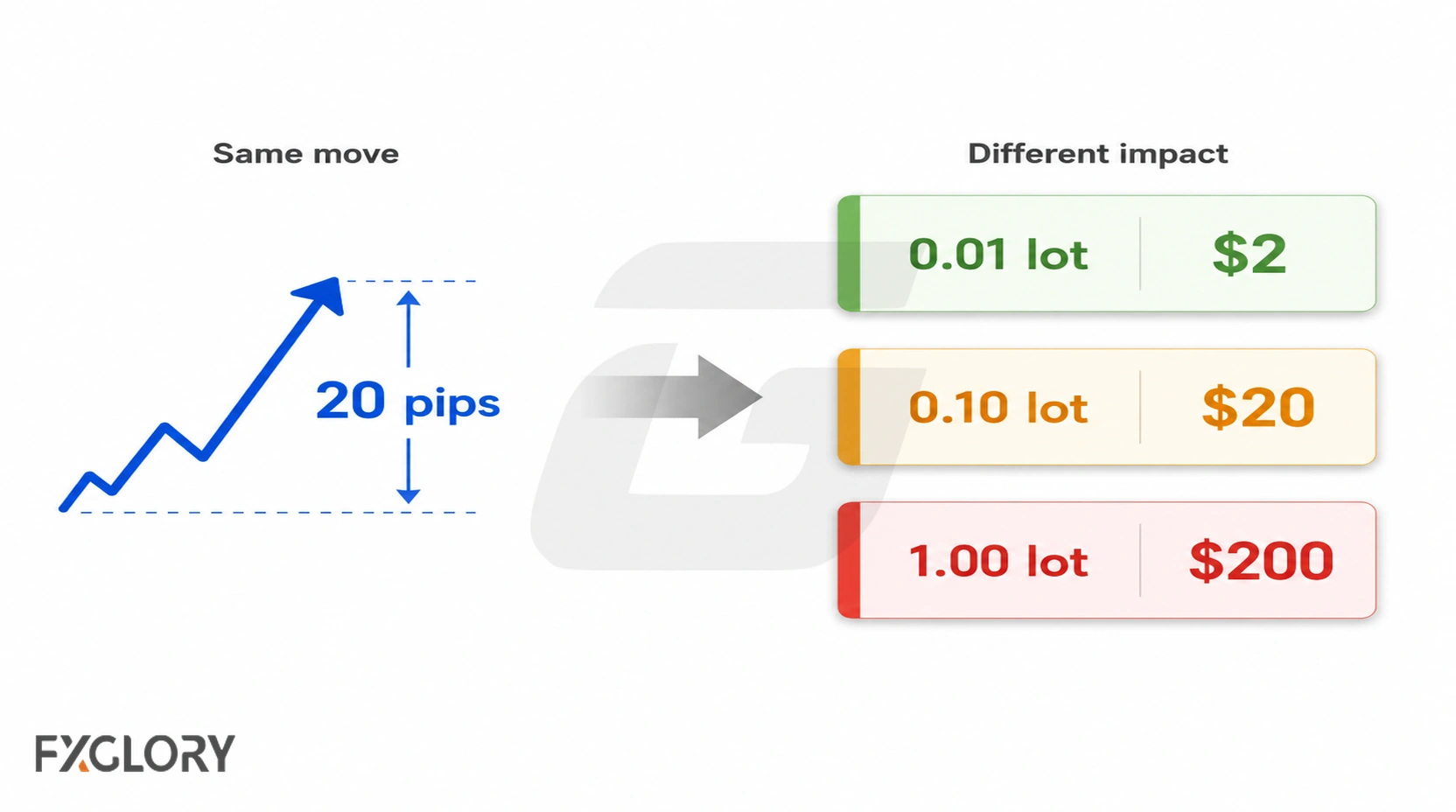
For EUR/USD when pip value is expressed in U.S. dollars, common simplified examples are approximately:
- 1.00 lot: $10 per pip.
- 0.10 lot: $1 per pip.
- 0.01 lot: $0.10 per pip.
These values are examples for EUR/USD under the stated currency setup, not universal pip values. Other pairs or account currencies can require a currency conversion.
For the underlying calculation, see what is a pip in forex trading.
Lot Size, Leverage and Margin
Lot size defines the position size. Leverage affects how much margin is required to control that position, while margin is the amount of funds the platform requires to open or maintain it.
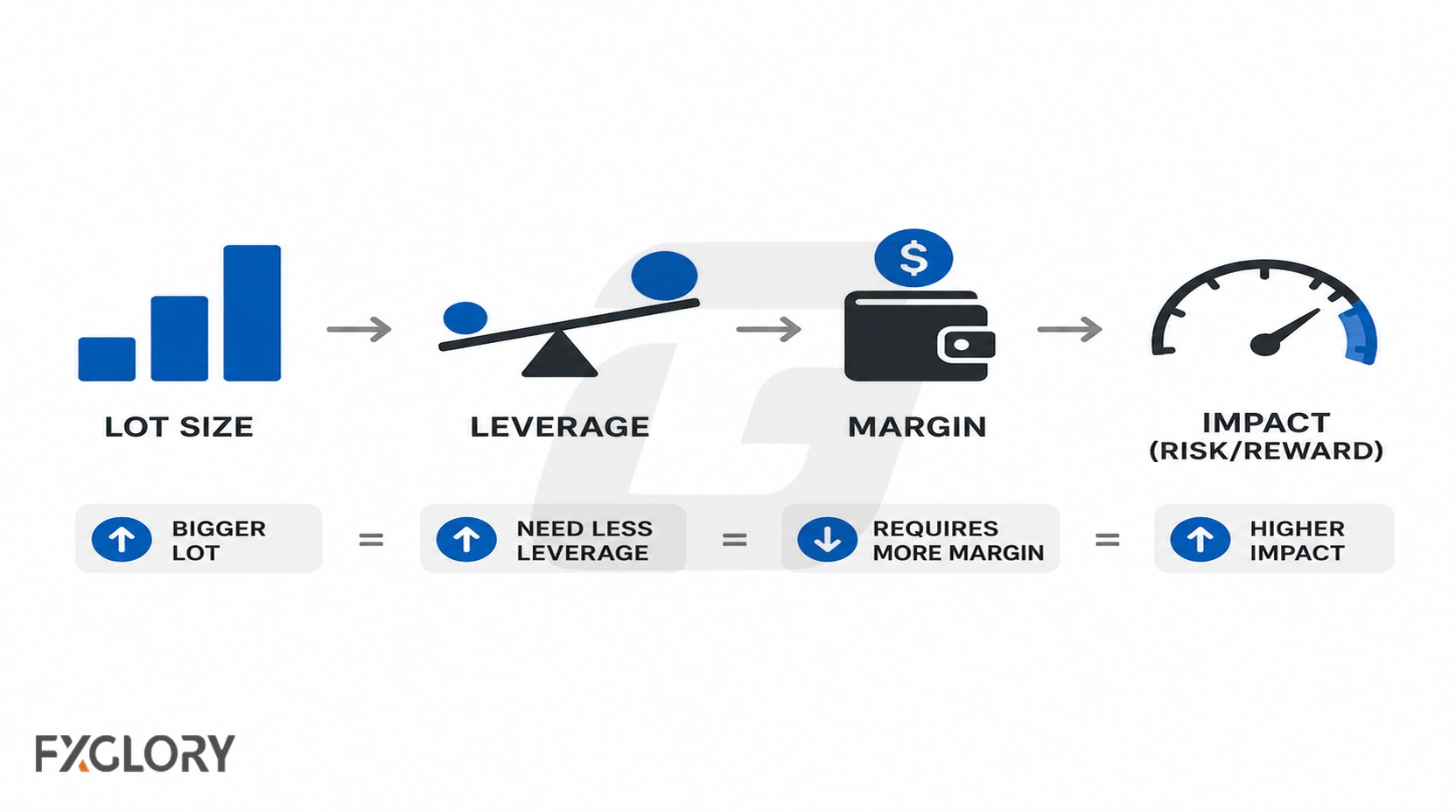
A platform may permit a large position because the margin requirement is low, but that does not mean the position fits the trader's risk limit. The monetary impact of price movement still depends heavily on position size.
For more detail, see what is leverage in forex trading.
Forex Risk Management and Lot Size Formula
A risk-based lot-size calculation starts with the amount of money the trader is prepared to lose if the stop is reached.
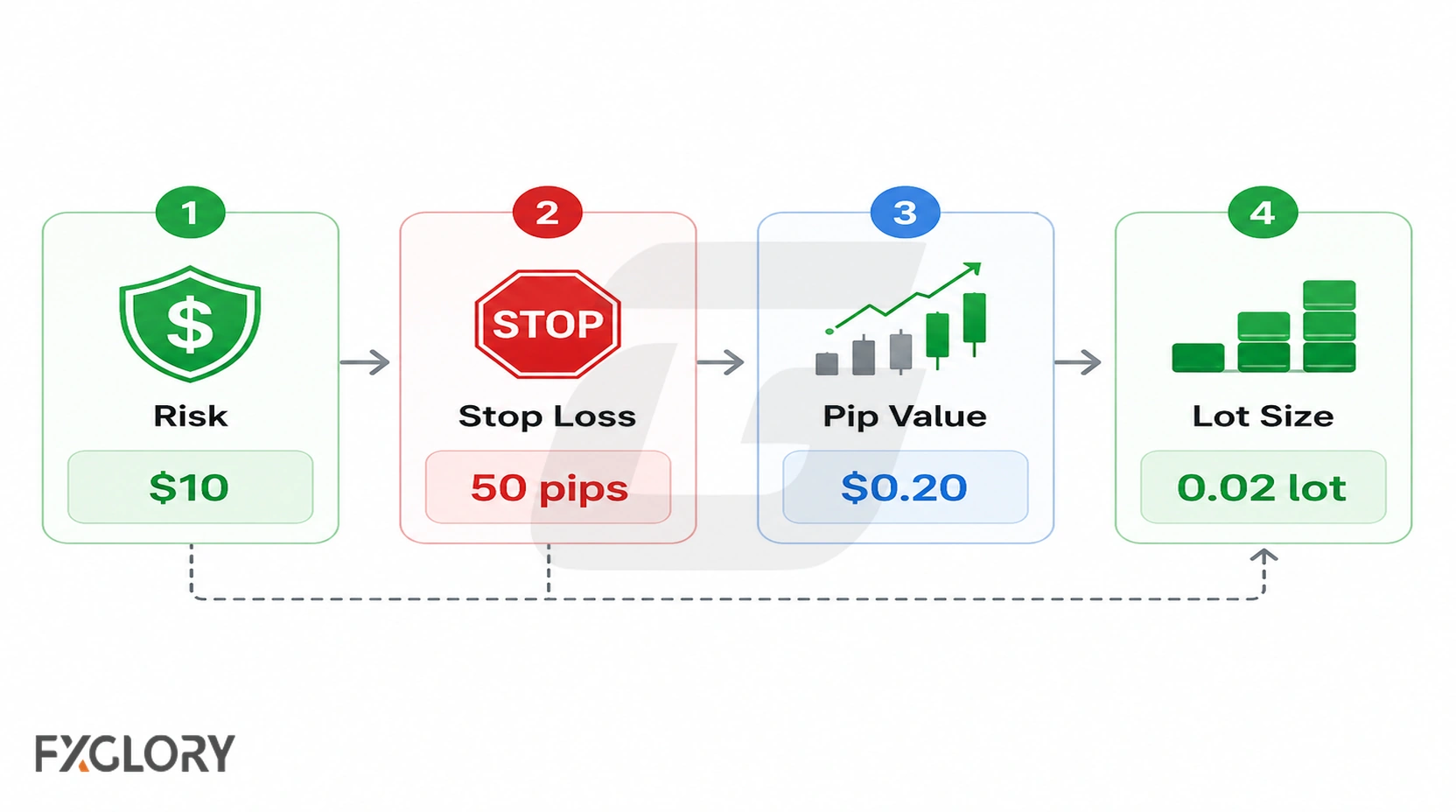
For example, if planned money risk is $10 and the stop is 50 pips away, the target value is $0.20 per pip. If 1.00 lot of the chosen pair is worth $10 per pip in the relevant account currency, the simplified calculation is $0.20 ÷ $10 = 0.02 lots.
The exact result can differ with the pair, exchange rate, account currency, and platform conventions, so the platform's contract details or a position-size calculator should be used to confirm the value.
Worked Example: Margin, Risk and Lot Size
Suppose a trader has a $1,000 account, plans to risk $10 on a trade, and places the stop 50 pips from entry. The target monetary value is therefore $0.20 per pip.
| Lot Size | Example Pip Value on EUR/USD | 50-Pip Move | Compared With $10 Plan |
|---|---|---|---|
| 0.01 lot | About $0.10 per pip | About $5 | Below planned risk |
| 0.02 lot | About $0.20 per pip | About $10 | Matches simplified plan |
| 0.10 lot | About $1 per pip | About $50 | Above planned risk |
| 1.00 lot | About $10 per pip | About $500 | Far above planned risk |
These are simplified EUR/USD examples before spread, slippage, swap, and other trading costs. Their purpose is to show why the same stop distance can produce very different monetary risk as position size changes.
Margin can tell a very different story. Using the earlier $110,000 EUR/USD notional example, 1:100 leverage would imply about $1,100 of margin in a simplified calculation, while 1:500 leverage would imply about $220. The position's notional value remains about $110,000 in both cases.
Common Beginner Mistakes With Forex Lot Size
- Choosing size from desired profit: Position size should come from the risk plan rather than a target income amount.
- Choosing size from available margin: Margin availability does not show whether the potential loss fits the account.
- Confusing lot size with leverage: Lot size describes the position; leverage changes the margin required to control it.
- Confusing margin with risk: Required margin is not the same as planned or maximum loss.
- Ignoring stop-loss distance: Position size and stop distance must be considered together.
- Assuming pip value is identical across pairs: The monetary pip value can require conversion for different pair and account-currency combinations.
- Ignoring spread and slippage: Execution costs can increase the realized result beyond a simplified stop-distance calculation.
A forex trading plan template can help document position-sizing and risk rules before a trade is placed.