

Quick Answer: Forex Trading Plan Template
The plan acts as an operating rulebook rather than a prediction tool. Its value comes from making decisions explicit before market pressure or emotion can change them.
What Is a Forex Trading Plan?
A forex trading plan is a written set of rules for selecting markets, entering and managing trades, controlling risk, and reviewing execution. It should be specific enough that you can tell whether a proposed trade follows the plan before you place the order.
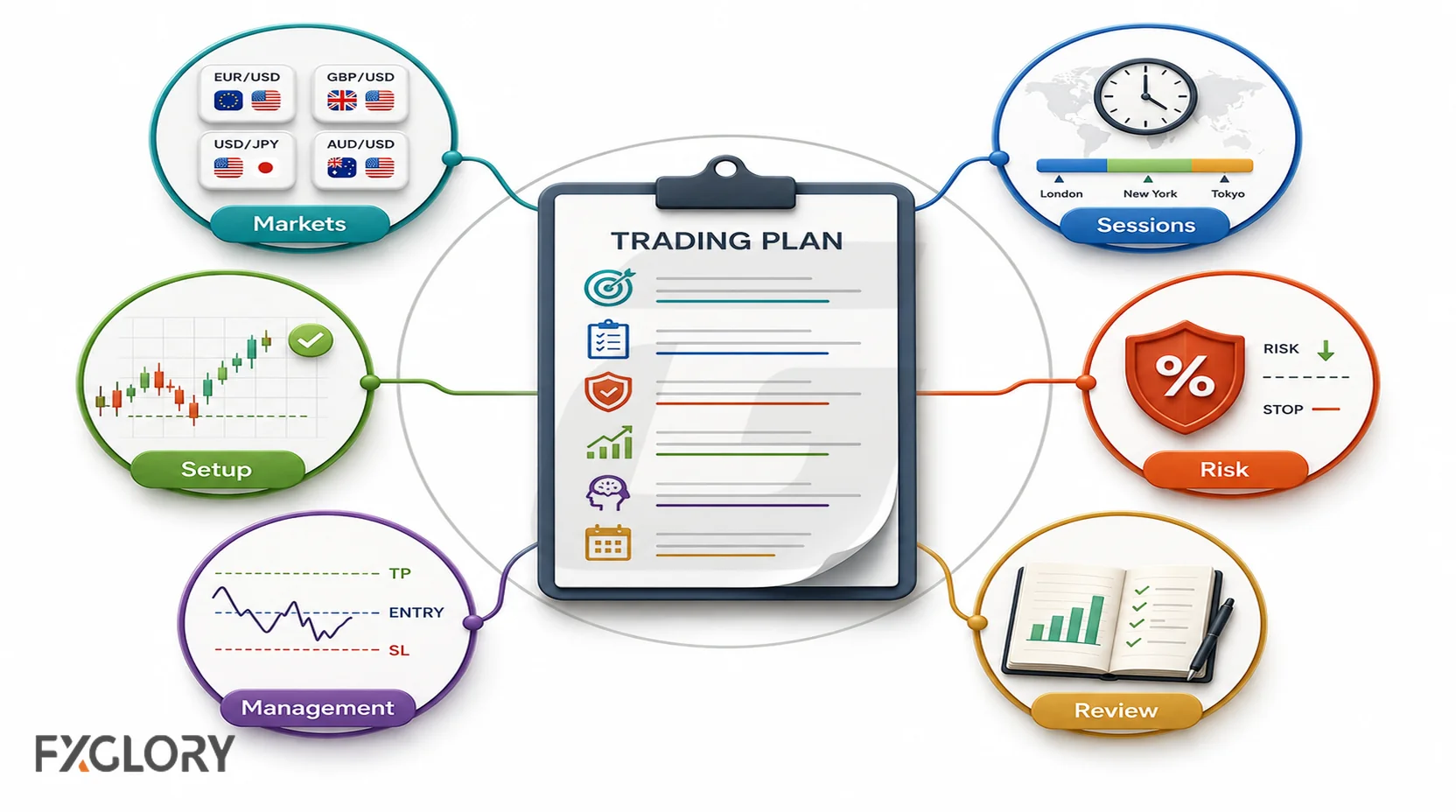
For example, “I trade EUR/USD when it looks good” is not a testable rule. A usable plan states which pairs and sessions are allowed, what setup qualifies, what invalidates it, how the stop is set, and how position size is calculated.
Trading Plan vs Strategy vs Journal
These three tools have different jobs and work best together.
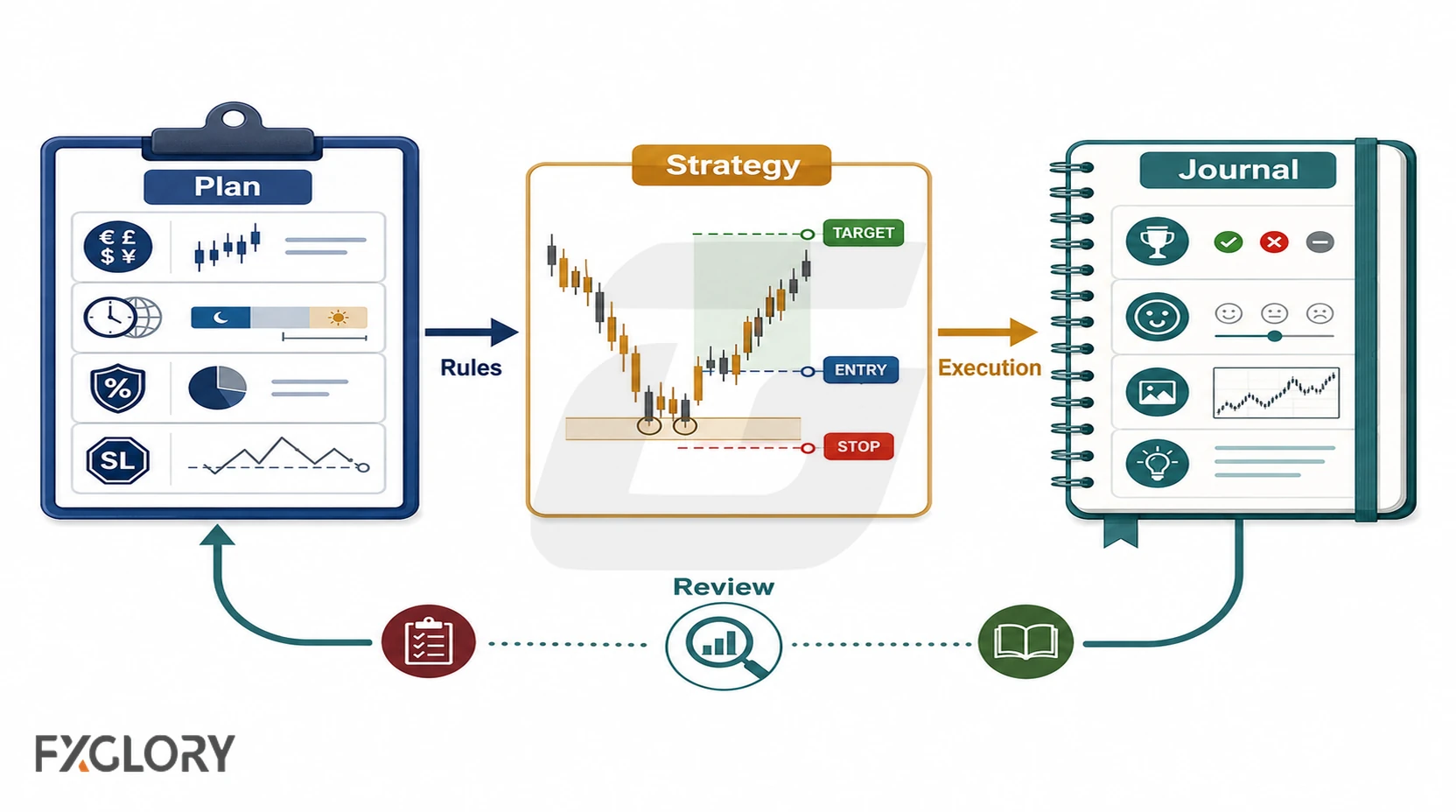
| Tool | Main job | Typical content |
|---|---|---|
| Trading plan | Sets the boundaries for trading and risk. | Allowed markets, sessions, risk limits, do-not-trade rules, review process. |
| Trading strategy | Defines how a setup is identified and traded. | Market condition, entry trigger, invalidation, target and management logic. |
| Trading journal | Creates a record for evaluating execution and results. | Trade details, screenshots, risk, outcome, rule-following, mistakes and lessons. |
Copy-Ready Forex Trading Plan Template
Complete this worksheet before relying on it for live decisions. Once the rules are stable, transfer only the rules you need during execution into the one-page version below.
1. Trader Profile
- Account type: Demo / small live / live account
- Trading experience: ___
- Account currency: ___
- Trading style: Scalping / day trading / swing trading / position trading
- Time available: ___ hours per day or week
- Primary process objective: ___
2. Allowed Markets and Sessions
- Allowed pairs: ___
- Excluded pairs: ___
- Allowed sessions: Asian / London / New York / London-New York overlap
- Maximum spread: ___ pips or ___ account-currency cost
- News restriction: No new trade within ___ minutes before or after specified high-impact events unless the strategy explicitly allows it.
- Rollover rule: Check expected swap or rollover charges before holding a position past rollover.
3. Strategy and Setup Rules
- Strategy name: ___
- Required market condition: Trend / range / breakout / pullback / other
- Direction timeframe: ___
- Entry timeframe: ___
- Required setup conditions: ___
- Setup invalidation: ___
- Minimum planned reward-to-risk: ___
4. Entry Rules
- Entry trigger: ___
- Required confirmation: ___
- Allowed order type: Market / limit / stop
- Cancel the setup if: ___
- Before entry: Define the stop and calculate position size.
5. Stop-Loss and Take-Profit Rules
- Stop-loss method: Technical invalidation / fixed distance / volatility-based / other
- Maximum stop distance: ___ pips
- If the stop is wider than planned: Reduce size to remain within the risk limit or skip the trade.
- Take-profit method: Fixed target / support-resistance / trailing / partial exit / other
- Time-based exit: ___
- Break-even rule: ___
- Trailing-stop rule: ___
6. Position Size, Exposure and Risk Rules
- Maximum risk per trade: ___% of equity or ___ fixed amount
- Position sizing: Calculate lot size from the monetary risk limit, stop distance and pip value before entry.
- Maximum daily loss: ___%
- Maximum weekly loss: ___%
- Maximum open risk: ___% across all open trades
- Maximum correlated exposure: ___
- Maximum effective leverage: ___ : 1
- Losing-streak response: After ___ losses, stop trading, reduce risk or review according to the written rule.
- Recovery rule: Do not increase size simply to recover previous losses.
Effective leverage is the ratio of notional market exposure to account equity. It describes how much exposure the account is carrying; it does not change the size of the market's price movement.
7. Trade Management Rules
- When the stop may be moved: ___
- When an early exit is allowed: ___
- Partial-profit rule: ___
- Maximum holding time: ___
- Trade invalidation after entry: ___
- Discipline rule: Do not change stops, targets or size solely because of fear, greed or an urge to recover a loss.
8. Psychology and Discipline Rules
- Emotional red flags: ___
- Do not trade when: tired / angry / rushed / distracted / trying to recover losses
- After a losing streak: ___
- After an unusually large win: ___
- After a rule breach: ___
9. Journal Fields
- Date and time: ___
- Pair and session: ___
- Setup and entry: ___
- Stop-loss and target/management plan: ___
- Position size and planned risk: ___
- Exit and result: ___
- Spread or execution issue: ___
- Did I follow the plan? Yes / No
- Emotion or decision-quality note: ___
- Mistake, screenshot and lesson: ___
10. Review Schedule
- After each trade: Complete the journal.
- Weekly: Review rule-following, repeated mistakes, setup quality and risk control.
- Monthly or after a meaningful trade sample: Review performance patterns before making major strategy or plan changes.
- Immediate review: Correct a serious risk-control or execution-process problem without waiting for a larger sample.
One-Page Forex Trading Plan
The one-page plan is the execution version of the worksheet: only the rules you need to approve, size, manage or reject a trade.
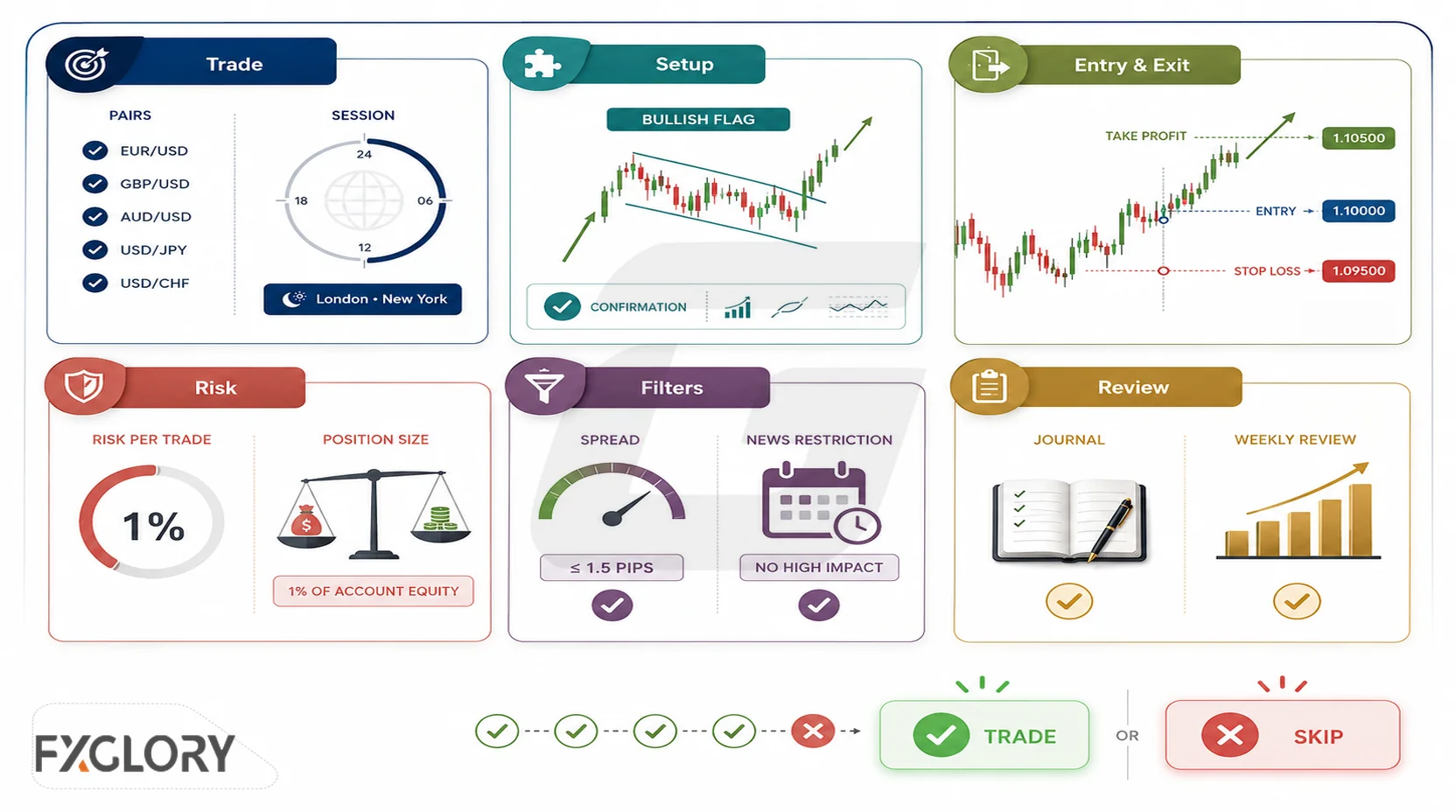
| Plan Field | My Rule |
|---|---|
| Allowed pairs and session | ___ |
| Setup and entry trigger | ___ |
| Stop-loss method | ___ |
| Target / management method | ___ |
| Risk per trade | ___ |
| Daily / weekly stop rules | ___ |
| Open-risk / correlation limit | ___ |
| Maximum effective leverage | ___ |
| Spread and news filters | ___ |
| Do-not-trade conditions | ___ |
| Journal and review rule | ___ |
Sample Forex Trading Plan
This filled example is illustrative, not a recommendation, signal or promise of profit. Its purpose is to show how vague intentions can be converted into measurable rules.
| Plan Area | Illustrative Rule |
|---|---|
| Account / style | Demo or small live account; intraday trading. |
| Allowed markets | EUR/USD and GBP/USD during the London-New York overlap. |
| Setup | Trend pullback: 1-hour chart for direction and 15-minute chart for entry confirmation. |
| Entry | Enter only after the setup checklist is complete and the stop is defined. |
| Stop-loss | Place the stop beyond the technical invalidation point; reduce size or skip the trade if the distance conflicts with the risk limit. |
| Target | Minimum planned reward-to-risk of 1:1.5; reward-to-risk does not predict win probability. |
| Risk per trade | Maximum 1% of account equity. |
| Daily / weekly limit | Stop after 2% daily loss; stop live trading for the week after 5% weekly drawdown. |
| Open risk | No more than 2% planned open risk across all trades. |
| Correlated exposure | No more than two open trades dependent on the same currency direction. |
| Effective leverage | Maximum 10:1. |
| News / spread | No new trade within 30 minutes before or after specified high-impact news; skip if the pair's spread exceeds the written limit. |
| Rollover | Check expected swap or rollover before holding past rollover. |
| Discipline | No trading when angry, rushed, tired, distracted or trying to recover a loss. |
| Review | Journal every trade and review rule-following, average R, drawdown, repeated mistakes and execution issues before changing major rules. |
Forex Risk Management Rules
The risk section should define what the account may lose or expose before a trade is approved. It should not depend on how attractive the setup feels.
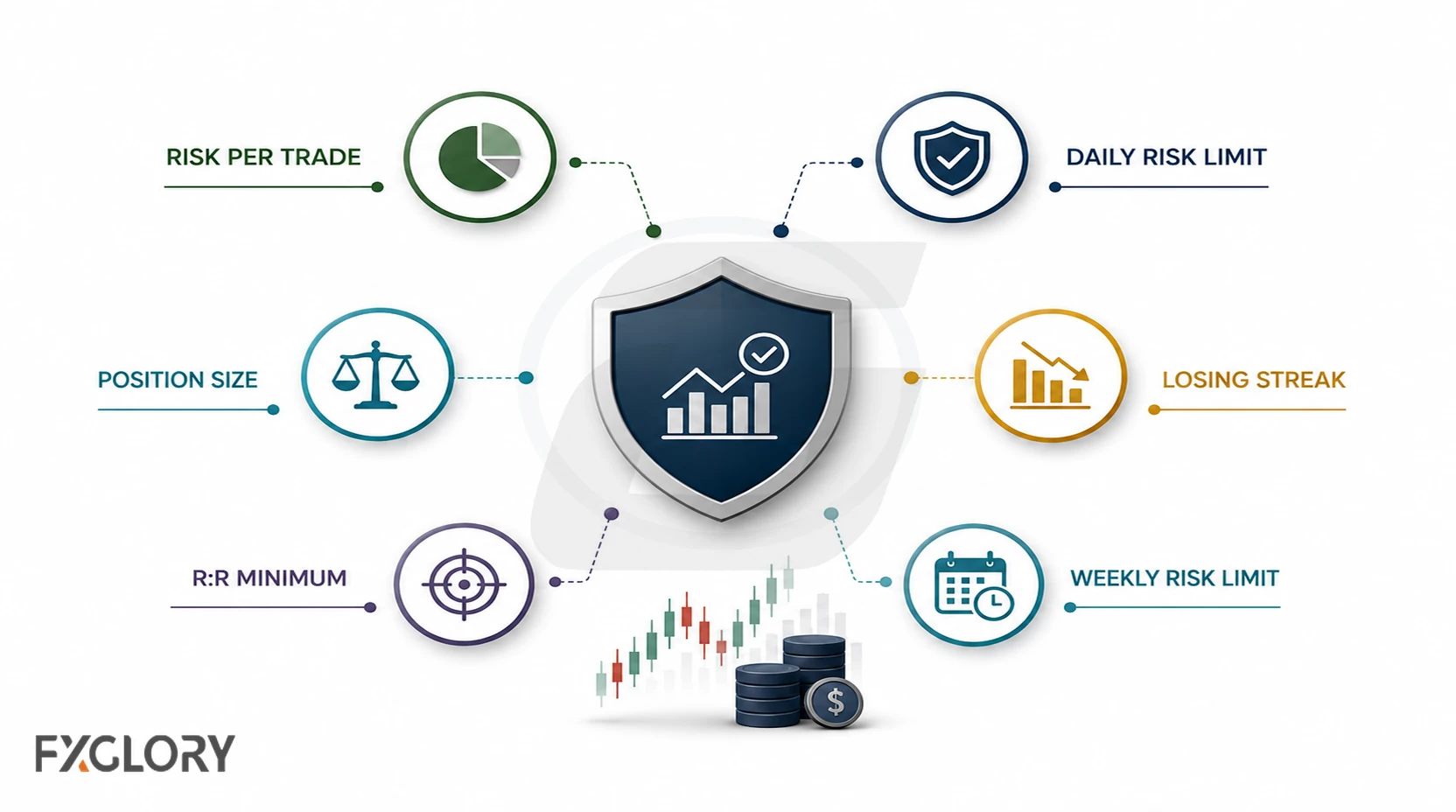
- Per-trade risk: Set the maximum planned loss for one trade.
- Daily and weekly limits: Define when new trading must stop.
- Open risk: Limit the combined planned risk of simultaneous positions.
- Correlation: Treat several positions driven by the same currency or market theme as related exposure.
- Effective leverage: Limit total notional exposure relative to equity rather than assuming available broker leverage is the amount you must use.
- Stop execution: Remember that slippage can make the realized loss larger than the loss implied by the planned stop price.
For pip and risk calculations, see how to calculate pips in forex. For leverage planning, see best leverage for forex.
Entry, Exit and Trade Management Rules
Entry and exit rules should make the trade testable before it is placed. Write conditions that can be answered with yes, no or a specific value.
| Before entry | After entry |
|---|---|
| Allowed pair and session | Stop movement rule |
| Required setup and trigger | Partial-exit rule |
| Spread and news filters | Break-even or trailing rule |
| Stop level and position size | Time-based exit |
| Target or management method | Post-entry invalidation condition |
Changing a stop, target or position size is not automatically wrong; the issue is whether the change was allowed by a rule written before the trade.
Forex Pre-Trade Checklist
Use the checklist to approve or reject the trade. If a required item fails, the trade does not qualify under the plan.
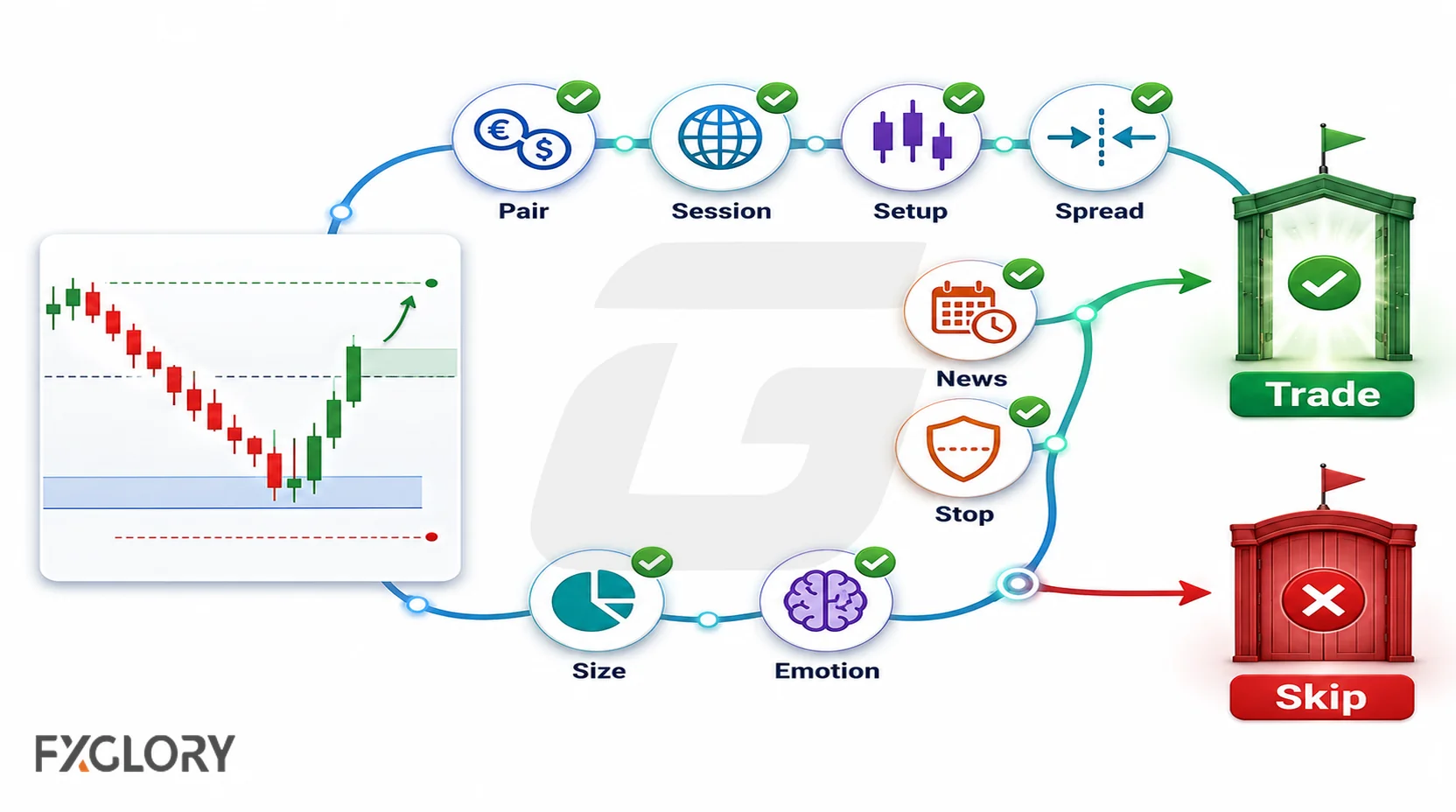
- Market: Is the pair and session allowed?
- Setup: Are all required setup and entry conditions present?
- Execution conditions: Are spread, liquidity, volatility and news conditions within the plan?
- Risk exit: Is the stop defined at a level consistent with the setup?
- Position size: Does the calculated size keep planned risk within the limit?
- Exposure: Do open risk, correlated exposure and effective leverage remain within limits after this trade?
- Management: Is the target or trade-management method defined?
- Readiness: Am I following the plan rather than reacting to emotion or a desire to recover a loss?
For trade mechanics, see forex trading examples. For spread basics, see bid and ask price in forex.
Do-Not-Trade Rules
Do-not-trade rules define the conditions that override an otherwise attractive setup.
| Block the trade when | Why it matters |
|---|---|
| The setup or entry trigger is incomplete | The trade does not meet the tested strategy conditions. |
| The stop or position size cannot be defined within the risk limit | The account risk is not controlled before entry. |
| Spread, news, liquidity or volatility fails the written filter | Execution conditions differ from those the plan permits. |
| A daily, weekly, open-risk or exposure limit has been reached | The account has already reached a predefined risk boundary. |
| The pair or session is outside the plan | The trade falls outside the conditions you intend to evaluate. |
| You are trading to recover a loss or are not in a condition to follow the rules | Decision quality is being driven by emotion rather than the plan. |
Trading Journal and Review Schedule
The journal supplies evidence for improving the plan. Record enough information to separate strategy results from execution mistakes and changing market conditions.

At minimum, record the pair, session, setup, entry, stop, target or management plan, position size, planned risk, exit, result, execution issues, rule-following status, screenshot and lesson.
Review on a schedule that is frequent enough to catch repeated mistakes but not so reactive that one ordinary win or loss rewrites the plan. Major changes are more defensible after a meaningful sample of comparable trades; serious risk-control failures should be corrected immediately.
How to Test and Improve the Plan
Testing asks two separate questions: does the strategy behave as expected, and can you execute the plan consistently?
- Backtesting: Check the setup and rules on historical data while recognizing that past conditions do not guarantee future results.
- Demo or forward testing: Observe the plan in real-time conditions without or with minimal live-capital exposure.
- Small-size live testing: Evaluate execution, costs and decision discipline under real account conditions.
- Review by rule: Separate losses that occurred while following the plan from losses caused by breaking it.
- Change one variable deliberately: When possible, avoid changing several rules at once because that makes the effect of each change harder to evaluate.
Common Mistakes in Forex Trading Plans
- Vague rules: “Trade good setups” cannot be tested or audited.
- Risk limits without sizing rules: A percentage limit is incomplete if position size is not tied to stop distance and pip value.
- Using available leverage as a target: Broker-available leverage is a ceiling, not a requirement for actual exposure.
- Changing rules after isolated outcomes: One normal win or loss is weak evidence for a major plan change.
- Ignoring execution conditions: Spread, slippage, liquidity, volatility, news and rollover can affect realized results.
- Mixing plan breaches with strategy performance: A journal should distinguish a valid strategy loss from a loss caused by not following the plan.
- Overcomplicating the live checklist: Keep supporting detail in the worksheet and the execution rules in the one-page plan.
Weak Plan vs Strong Plan
Specific rules are easier to follow and review than intentions.
| Weak wording | More testable wording |
|---|---|
| I trade EUR/USD when it looks good. | I trade EUR/USD only in my allowed session when every setup condition and entry trigger is present. |
| I risk a small amount. | I calculate position size so the planned stop-loss risk stays within my predefined per-trade limit. |
| I use a stop-loss sometimes. | I do not enter unless the risk exit is defined and the resulting size fits my risk limit. |
| I trade when I see opportunity. | I trade only after market, setup, execution, risk and readiness checks pass. |
| I change the plan when it stops working. | I review rule-level evidence over a meaningful sample and document why a change is being made. |