

Quick answer: An economic calendar forex strategy uses scheduled releases, affected currencies, forecast data, actual results, previous readings, revisions, and event timing to prepare for possible volatility. The calendar helps traders plan; it does not decide entries by itself.
What Is An Economic Calendar Forex Strategy?
An economic calendar forex strategy is a structured way to read scheduled market events before they affect currency pairs. The trader checks when an event is due, which currency it may affect, how important the event is expected to be, what the market forecast is, what the previous result was, and whether the actual result changes the market's expectations.
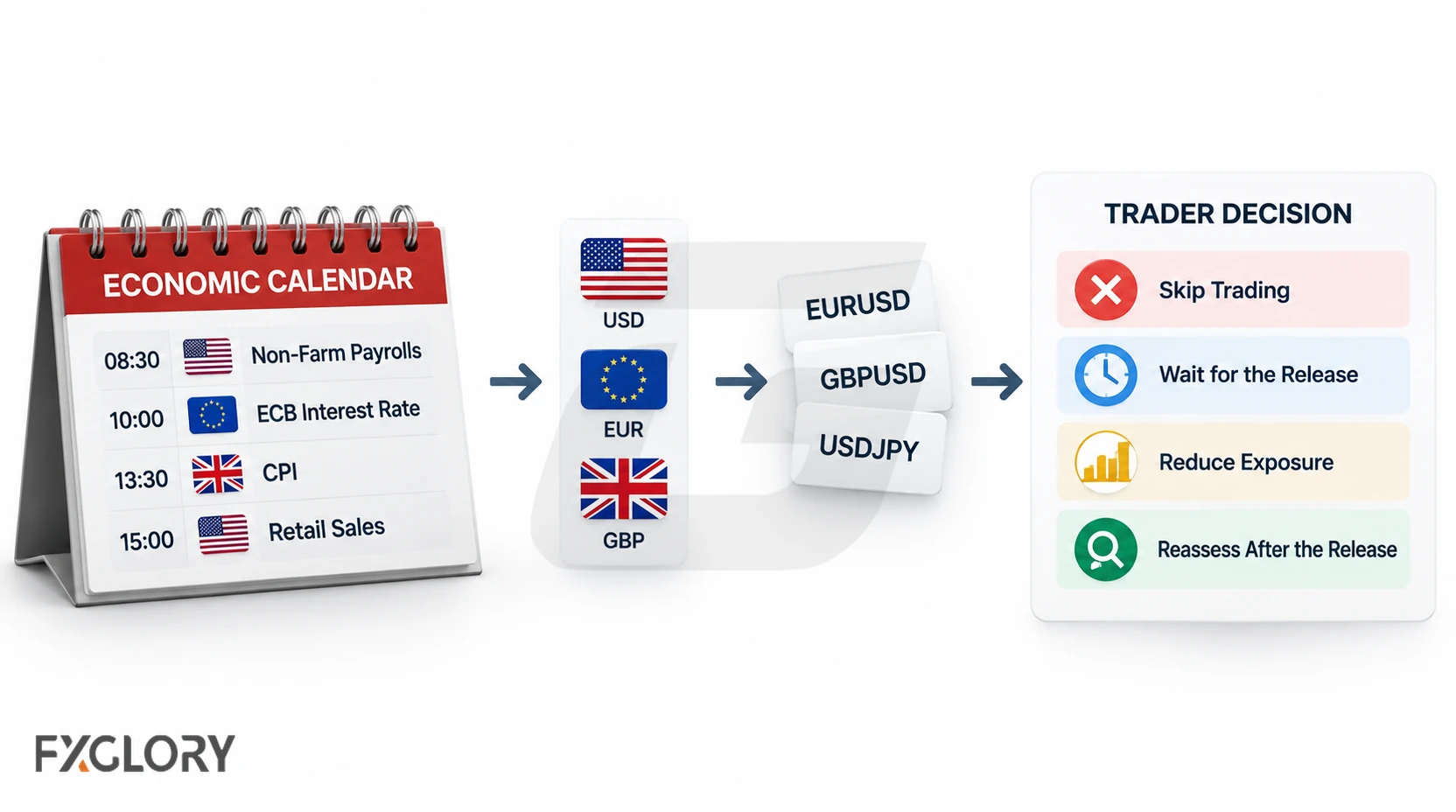
The strategy is not about trading every release. It is about deciding whether an upcoming event should change the plan. Sometimes the best decision is to avoid a trade, reduce exposure, wait for the first reaction to settle, or delay an entry until spread and liquidity conditions are more normal.
Economic-calendar review fits naturally inside a broader forex fundamental strategy, because calendar events often update the market's view of growth, inflation, employment, central-bank policy, and risk sentiment.
The Calendar Is Not A Trading Signal
A calendar event can be important without creating a valid trade. A trader still needs chart context, spread review, position size, stop or invalidation logic, and a rule for what happens if the first market reaction reverses.
This distinction matters because many traders read the calendar in a simple way: good data means buy the currency, bad data means sell the currency. Real market reaction can be different. Price may move before the release, reverse after the first spike, ignore the data because it was expected, or react more to revisions and central-bank expectations than to the headline number.
| Calendar Observation | Weak Use | Better Use |
|---|---|---|
| High-impact event is scheduled. | Enter because volatility is expected. | Check whether the pair, spread, chart level, and risk rule justify any action. |
| Actual result beats forecast. | Assume the currency must rise. | Compare the result with expectations, revisions, prior positioning, and the other currency in the pair. |
| Event causes a first spike. | Chase the candle. | Review whether the move holds, reverses, or becomes too extended for a controlled entry. |
| Release looks unclear. | Force an interpretation. | Skip or wait until the market shows a cleaner reaction. |
Economic Calendar vs Fundamental Strategy
The economic calendar is a tool. A fundamental strategy is the wider process that decides how economic information becomes a currency-bias review. The calendar gives scheduled timing and data fields; the strategy decides whether that information changes the trade plan.
For example, an inflation release may matter because it can influence central-bank expectations. A jobs report may matter because it can change how traders view growth, wage pressure, and policy timing. A GDP release may matter because it updates the market's view of economic strength. Those ideas become useful only when they are compared against the other currency in the pair and checked against price structure.
If the event is mainly about policy expectations, the trader can review it with a central-bank policy framework. If the question is broader currency bias, the fundamental strategy page is the better parent guide.
Economic Calendar vs News Trading
An economic calendar strategy and a news trading strategy are related, but they should not do the same job. The calendar process starts before the release. It helps the trader identify scheduled risk, affected currencies, forecast data, time zones, possible spread changes, and whether an existing or planned trade should be avoided, reduced, delayed, or reviewed later.
News trading is the execution side around the event itself. It deals with whether to trade before, during, or after the release, how to handle the first spike, whether price confirms or reverses, and how to control slippage, whipsaws, and fast order movement. A trader can use the calendar without trading the news. In many cases, the calendar is most useful because it gives a reason not to trade during unstable conditions.
| Process | Main Job | Weak Use | Better Use |
|---|---|---|---|
| Economic calendar review | Prepare for scheduled event risk. | Assume every high-impact release must be traded. | Decide whether to skip, wait, reduce exposure, or watch for post-release confirmation. |
| News trading | Manage execution around the event reaction. | Chase the first candle without a plan. | Use predefined spread, trigger, invalidation, slippage, and cancellation rules. |
| Fundamental review | Judge whether the event changes the broader currency outlook. | Read one data point as the whole story. | Compare the result with expectations, revisions, central-bank context, and the other currency in the pair. |
How To Read Economic Calendar Fields
Economic calendars may look different across websites and platforms, but the useful fields are usually similar. A trader should know what each field means before using it to make a decision.
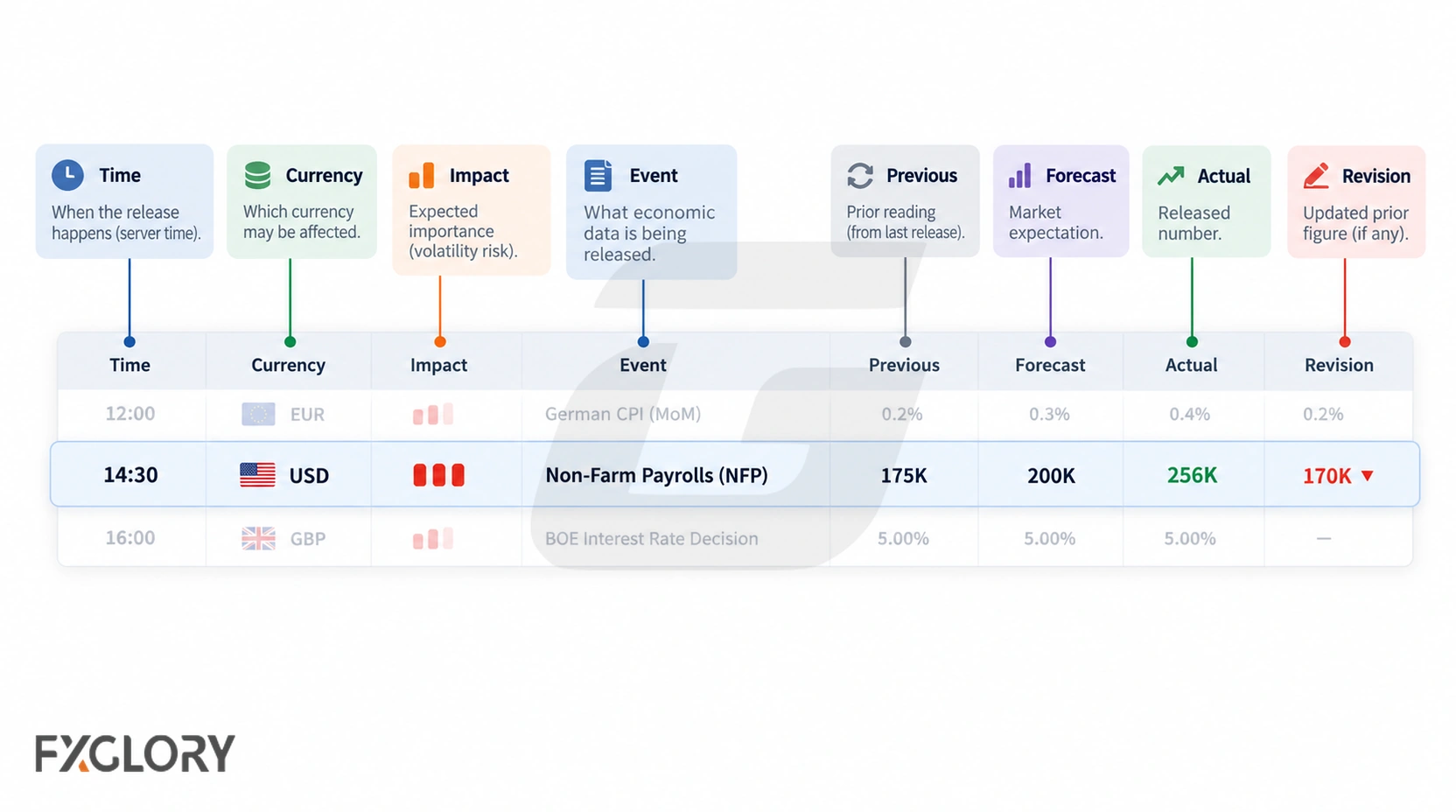
| Calendar Field | What It Means | How To Use It Carefully |
|---|---|---|
| Release time | The scheduled time of the event. | Confirm the time zone and check whether it falls inside an active trading session. |
| Country or currency | The economy or currency most directly linked to the release. | Match the event to pairs that include that currency. |
| Impact level | A low, medium, or high importance label. | Use it as a filter, not as a guarantee of movement. |
| Event name | The type of release, such as CPI, GDP, NFP, PMI, or rate decision. | Know why that event matters under the current market theme. |
| Previous | The last reported value. | Use it as context and check whether it was revised. |
| Forecast or consensus | The market's expected value before the release. | Use it as the baseline for measuring surprise. |
| Actual | The released value. | Compare it with forecast, previous, revision, and price reaction. |
| Revision | A later change to a previously published value. | Do not judge the release only by the first number if revisions change the story. |
A calendar becomes more useful when the trader filters it to the currencies and event categories that matter for the pairs being reviewed. Filtering can reduce noise and prevent a trader from reacting to releases that do not match the trading plan.
Build A Calendar Watchlist
A useful calendar review does not require watching every release from every country. The stronger process is to build a watchlist around the pairs, sessions, and event types that can actually affect the trade plan.
Start with the pairs under review, then filter the calendar by the base and quote currencies. For EUR/USD, both EUR and USD events matter. For GBP/JPY, both GBP and JPY events matter. After that, filter by impact level, event category, trading session, and release time. This keeps the trader focused on relevant event risk instead of reacting to unrelated headlines.
| Filter | How It Helps | Caution |
|---|---|---|
| Currency or country | Connects the event to the pair being reviewed. | A major USD release can still affect many non-USD pairs indirectly through risk sentiment. |
| Impact level | Highlights events more likely to affect volatility and execution. | Impact labels are not guarantees, and market focus can change. |
| Event category | Separates inflation, employment, growth, central-bank, housing, trade, and sentiment data. | The most important category depends on the current market theme. |
| Time zone | Prevents planning errors around release time. | Always check the calendar time against the trading platform and local time. |
| Session window | Shows whether the event occurs during active liquidity or a thinner period. | Events near rollover, holidays, or session transitions may carry extra execution risk. |
Forecast, Actual, Previous, And Revision
Forecast, actual, previous, and revision are the most important data fields for many calendar events. They help the trader understand whether the release changed expectations or simply confirmed what the market already expected.
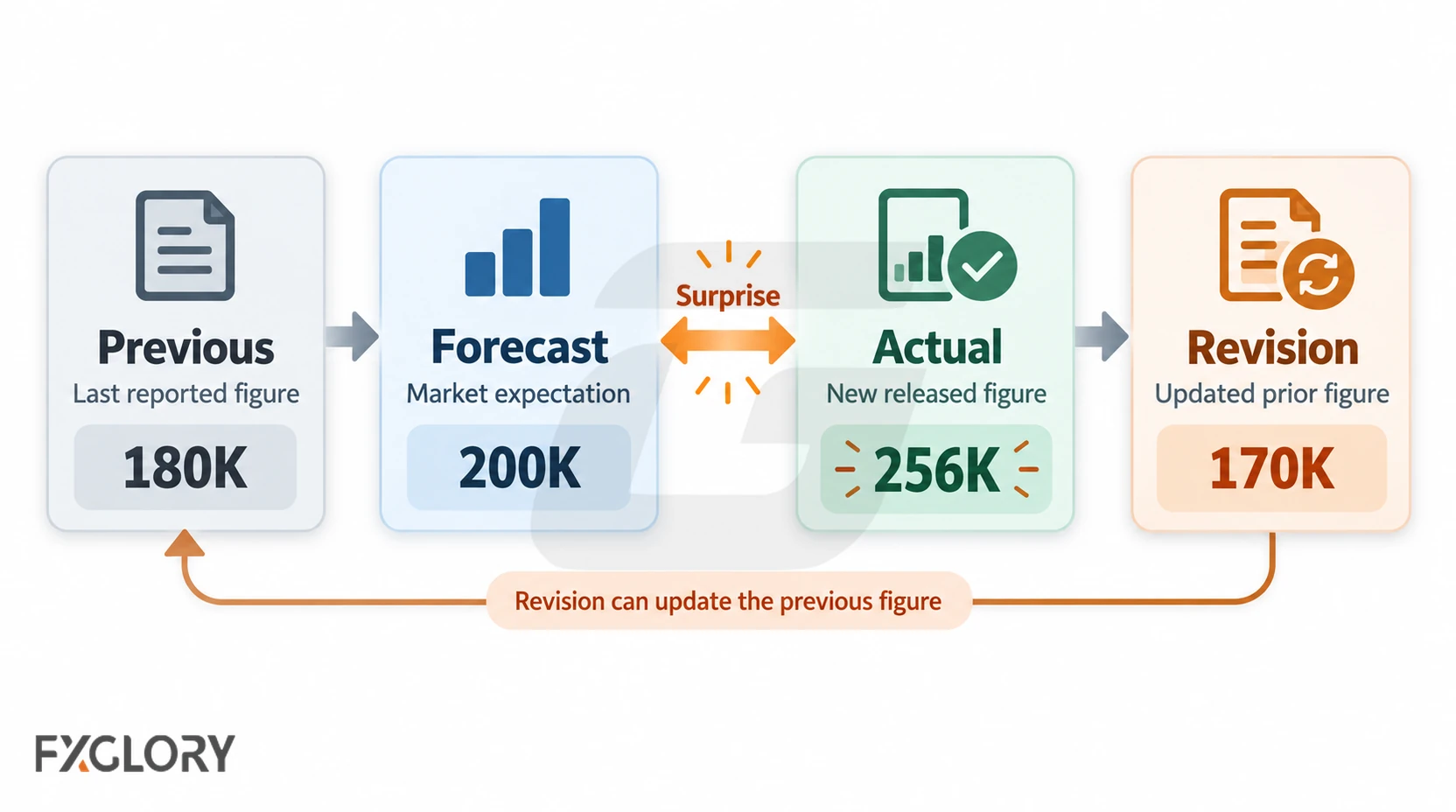
Forecast is the expected value before the release. Actual is the released value. Previous is the last reported value. Revision changes a previously reported number and can sometimes matter as much as the new headline.
The relationship between these fields is more important than the headline alone. A currency may react strongly when actual data differs from forecast in a meaningful way. A currency may also ignore a release if the result matches expectations, or reverse if the first print looks strong but revisions weaken the wider picture.
Some releases also contain a headline number and detail fields. Inflation may include headline and core readings. Employment may include job growth, unemployment, wages, and participation. PMI data may include manufacturing, services, composite, prices, and new orders. A headline beat can lose strength if the details are mixed, revised, or less important than the current market theme.
| Release Problem | Why It Matters | Review Question |
|---|---|---|
| Headline beats but details weaken | The first number may not describe the full report. | Did the market focus on the headline or the details? |
| Actual misses but previous is revised higher | The trend may look different after revision. | Did the revision change the baseline? |
| Data matches forecast | The event may already be priced in. | Did guidance, revisions, or price reaction still change expectations? |
| Different releases arrive together | Mixed data can create conflicting reactions. | Which release is the market treating as dominant? |
Impact Level And Event Importance
Most calendars label events by expected importance or volatility. This can help a trader focus on events that may affect spread, liquidity, and price movement. It should not be treated as a certainty.
Low-impact events may create little reaction in normal conditions. Medium-impact events may matter when they match the market's current theme. High-impact events can move markets, but they can also produce confusing reactions if the result is mixed or already priced in.
| Impact Label | Typical Use | Risk Note |
|---|---|---|
| Low | Usually watched for context. | May still matter if liquidity is thin or the market is sensitive to the topic. |
| Medium | Reviewed when it affects the pair or theme. | Can become important when it changes expectations. |
| High | Requires planning before opening or holding trades. | Can create spread widening, slippage, false breaks, or fast reversals. |
Matching Events To Currency Pairs
Calendar planning starts with the affected currency. A U.S. release may affect USD pairs. A U.K. release may affect GBP pairs. A eurozone release may affect EUR pairs. A Japanese release may affect JPY pairs.
Forex pairs are relative. If a trader buys EUR/USD, the trade is long EUR and short USD. If the trader sells EUR/USD, the trade is short EUR and long USD. A calendar event should be checked against both sides of the pair, because the other currency can support, weaken, or override the calendar idea.
For broader pair selection, review FXGlory's currency-pairs market hub. The goal is not to trade every currency with an event. The goal is to focus on the pairs where the event is relevant and where chart conditions are reviewable.
High-Impact Forex Events To Watch
The most important calendar events can change over time. Markets may focus on inflation during one period, employment during another, and central-bank guidance during another. A useful calendar strategy reviews the event inside the current market theme.
| Event Type | Why It Can Matter | What To Review |
|---|---|---|
| Central-bank rate decisions | They can change or confirm interest-rate expectations. | Decision, statement, vote split, projections, and press conference tone. |
| Inflation data | Inflation can influence future policy expectations. | Headline, core reading, trend, forecast gap, and revision. |
| Employment data | Labor strength can affect growth and rate expectations. | Jobs, unemployment, wages, participation, and revisions. |
| GDP and growth data | Growth can affect confidence and policy outlook. | Actual vs forecast, previous revision, and market theme. |
| Retail sales and consumption | Consumer demand can influence growth and inflation views. | Headline, core, trend, and whether the currency is sensitive to consumption data. |
| PMI and sentiment surveys | They can provide early signals about business conditions. | Manufacturing, services, composite, and whether the reading crossed expansion or contraction thresholds. |
| Trade balance | Trade flows can matter for some currencies and economies. | Exports, imports, commodity sensitivity, and current market focus. |
| Speeches and statements | Central-bank officials can shift expectations without changing rates. | Hawkish or dovish tone, policy timing, inflation language, and market reaction. |
Before The Release: Planning Rules
Pre-release planning is where the economic calendar is most useful. A trader can prepare before volatility appears instead of making decisions after a candle has already moved.
- Check the week ahead: Mark high-impact releases for the currencies you trade.
- Confirm the time zone: A wrong time-zone setting can make the plan useless.
- Identify affected pairs: Match the event to the base and quote currencies of each pair.
- Read forecast and previous data: Know what the market is likely comparing the new release against.
- Check open exposure: Decide whether existing trades should be held, reduced, moved, or left unchanged under the written plan.
- Mark nearby levels: Review support, resistance, range edges, and invalidation zones before the release.
- Define the action plan: Choose skip, wait, reduce exposure, trade after confirmation, or follow an existing system rule.
Calendar planning also connects with trading-session behavior. Use session and timing context to check whether the release happens during liquid hours, an overlap period, or a thinner market window.
During The Release: Execution Risk
The release window can behave very differently from normal chart conditions. Spreads can widen, liquidity can thin, orders can fill at worse prices than expected, and candles can move before a trader can read the full data.
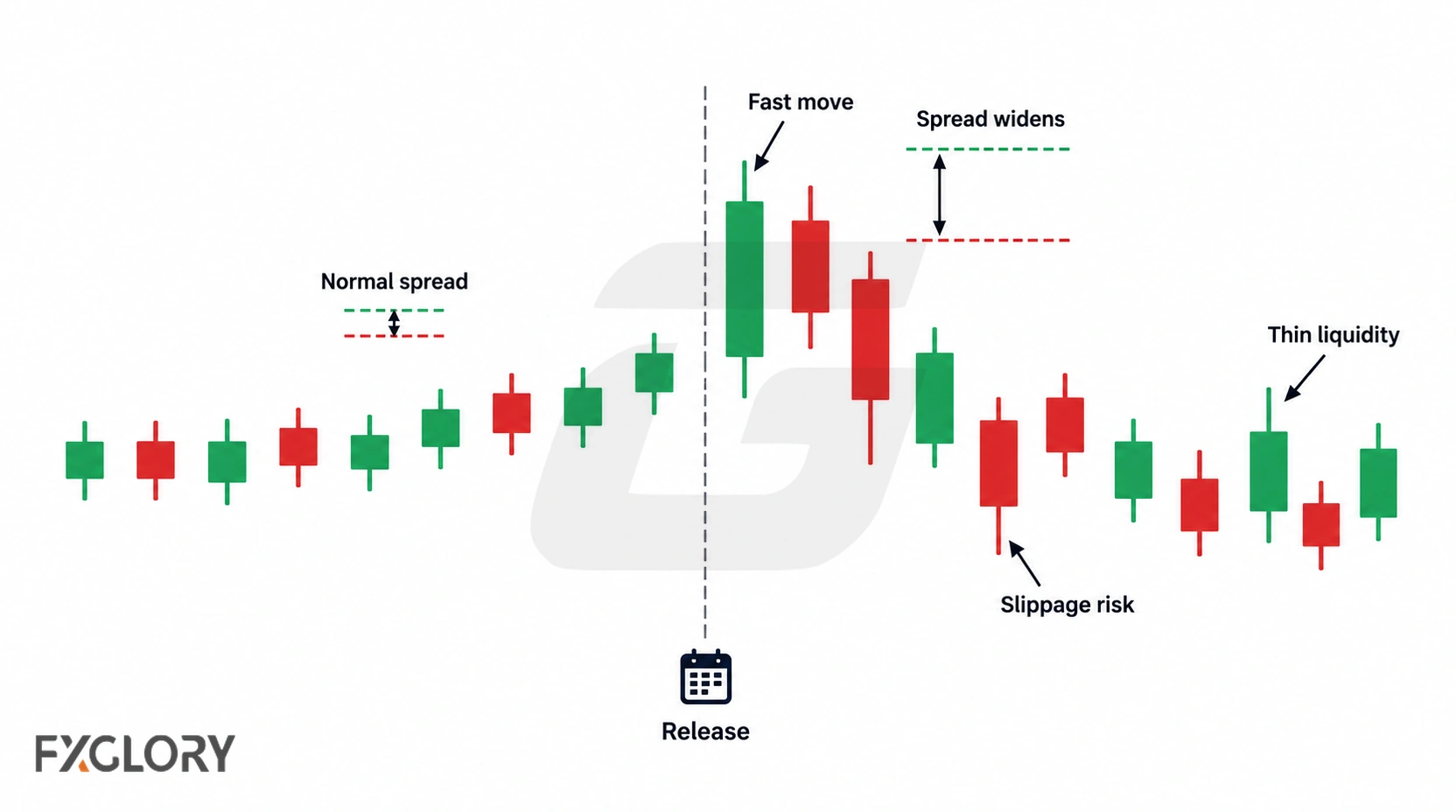
A calendar strategy should include a release-window rule before the event begins. Some traders skip the first seconds or minutes. Some wait for the candle to close. Some avoid the release completely and use the data only to reassess existing positions later. The important point is that the rule is written before volatility expands.
When a release is high impact, small stops and small targets can become unreliable because execution conditions may change quickly. Review FXGlory's spread information when planning strategies that depend on tight event-window costs.
After The Release: Confirmation And Reassessment
Post-release review asks whether the market accepted the new information. The first spike is not always the final direction. Price may spike, reverse, range, or build a cleaner continuation after traders finish interpreting the release.
After the release, review these questions:
- Did actual data beat, miss, or match the forecast?
- Did previous data receive an important revision?
- Did the pair move in the expected direction, or was the reaction opposite?
- Did price hold beyond a level, or did the move fail quickly?
- Did spreads and liquidity return to conditions that fit the trade plan?
- Does the event change the central-bank or fundamental bias?
Trade timing still needs a trigger, invalidation, and exit logic. Use entry and exit rules to separate a calendar observation from an actual trade plan.
Time Zones, Sessions, And Trading Windows
Economic calendars depend on time settings. A release shown in GMT, local broker time, New York time, or the trader's device time can create confusion if the calendar is not set correctly.
A trader should also consider the session around the release. A high-impact U.S. release during the New York session may behave differently from a lower-impact release during a thin-liquidity period. A release near rollover, market open, or a session transition can add cost and execution uncertainty.
Spread, Slippage, Liquidity, And Margin
Calendar events can affect more than direction. They can affect the cost and quality of execution. A plan that looks reasonable in normal spreads may become weaker during a high-impact release.
| Risk Factor | Why It Matters Around Releases | Planning Check |
|---|---|---|
| Spread | Wider spreads can make entries worse and stops closer than planned. | Do not use a setup that depends on normal spreads during abnormal conditions. |
| Slippage | Fast price movement can create fills away from the requested price. | Plan for execution difference, not only chart levels. |
| Liquidity | Depth may thin before or during important releases. | Avoid assuming candles will move smoothly through levels. |
| Leverage | Leverage can magnify losses during fast event movement. | Check whether the account can handle the planned risk. |
| Margin | Open positions may face larger swings and margin pressure. | Review margin before holding through a release. |
Use FXGlory's margin calculator before holding or opening positions around major releases, and review leverage conditions when event volatility could make normal position size too aggressive.
Economic Calendar Decision Sequence
A calendar strategy becomes more useful when it follows a repeatable sequence. The sequence below keeps the process practical and avoids turning one release into an emotional decision.
- Choose the pair: Start with the currency pair already being reviewed.
- Filter the calendar: Show only events relevant to the base and quote currencies.
- Check impact level: Mark events that could change volatility or execution conditions.
- Read previous and forecast: Know the baseline before the actual release.
- Check the market theme: Decide whether inflation, jobs, growth, or central-bank policy is currently important.
- Mark chart context: Note support, resistance, trend, range, or invalidation areas.
- Decide the action: Skip, wait, reduce exposure, trade only after confirmation, or follow a tested system rule.
- Review costs and margin: Check spread, slippage risk, leverage, and margin impact.
- Write the cancellation rule: Know when the calendar idea is no longer tradable.
If the calendar review becomes part of a repeatable strategy, place it inside a complete trading-system structure instead of treating each event as a standalone decision.
No-Trade Conditions
Some calendar conditions are better treated as reasons to skip. A no-trade rule protects the account from forced interpretations and unstable execution.
- Skip when the release is not relevant to the pair being reviewed.
- Skip when the actual result, revision, and guidance send mixed messages.
- Skip when the first reaction already moved too far and leaves poor reward-to-risk room.
- Skip when spreads, liquidity, or slippage conditions do not fit the planned setup.
- Skip when the trader has not defined stop, invalidation, target, time rule, or exit logic.
- Skip when another high-impact release is due before the trade idea can be reviewed properly.
- Skip when margin or leverage exposure is too high for fast event movement.
- Skip when the trade exists only because the trader wants action during news.
For account-level planning, use forex risk-management rules before deciding whether a calendar event is worth trading around.
Testing And Review Before Live Trading
Economic-calendar planning should be tested before live exposure. A trader can review past events to see how the pair behaved before, during, and after the release.
Useful review notes include the event name, affected currency, forecast, actual, previous, revision, pre-release spread, first candle reaction, post-release structure, trade action, slippage, stop or invalidation result, and whether the setup followed the written plan.
The goal is not to prove that every release can be traded. The goal is to learn which events are meaningful for the chosen pairs, which conditions are too unstable, and which calendar reactions are better skipped.
Economic Calendar Forex Strategy Checklist
| Checklist Item | Question To Answer Before The Trade |
|---|---|
| Event relevance | Does the release affect the base or quote currency in the pair? |
| Time zone | Is the calendar time confirmed against the trader's local time and trading platform? |
| Impact level | Is the event low, medium, or high impact under current market conditions? |
| Expectation | What are the forecast and previous values? |
| Revision risk | Could a revised previous value change the interpretation? |
| Market theme | Is the market currently focused on inflation, jobs, growth, rates, or risk sentiment? |
| Chart context | Is price near a meaningful level, range edge, trend area, or invalidation zone? |
| Execution condition | Are spread, slippage, liquidity, leverage, and margin acceptable for the plan? |
| Action rule | Will the trader skip, wait, reduce exposure, or trade only after confirmation? |
| Cancellation rule | What makes the calendar idea invalid? |
Event-Timing Test Notes For Economic Calendar Forex Strategy
This hypothetical educational event-timing model uses one economic-calendar rule: high-impact event filtering, affected-currency matching, a 6-candle pre-release range, a 30-minute post-release waiting period, completed-candle breakout confirmation, ATR and stop-distance filters, a 1.2R target comparison, a range-failure exit, and spread/slippage sensitivity. It does not test discretionary fundamental interpretation, central-bank tone analysis, first-spike news trading, forecast-surprise modeling, every event type, or every economic-calendar method.
The model reviewed EURUSD, GBPUSD, USDJPY, AUDUSD, USDCAD, and USDCHF on public yfinance 15-minute OHLC data where available. Event timing comes from a one-time public TradingView/Reuters economic-calendar snapshot. Forecast, actual, previous, and revision fields are recorded when supplied, but this rule model uses event timing and post-release price confirmation rather than assigning bullish or bearish meaning to the data release.
| Rule Area | Educational Model Rule |
|---|---|
| Strategy type | High-impact economic-calendar event filter with post-release range confirmation |
| Event filter | High-impact events only, with event currency matching the base or quote currency of the reviewed pair |
| Events loaded | 73 high-impact events from the one-time snapshot |
| Pre-release range | Last 6 completed 15-minute candles before the event timestamp |
| Range width filter | At least 3 pips and no more than 80 pips |
| Waiting period | No trade during the first 30 minutes after the event |
| Signal search window | Next 2 hours after the waiting period |
| Long confirmation | Completed 15-minute close 0.10 to 1.00 ATR(14) above the pre-release range high, with close in the upper 40% of the candle range |
| Short confirmation | Completed 15-minute close 0.10 to 1.00 ATR(14) below the pre-release range low, with close in the lower 40% of the candle range |
| Entry | Next 15-minute open after the completed signal candle |
| Stop | Beyond the opposite side of the pre-release range with a 0.10 ATR(14) buffer |
| Stop-distance filter | At least 4 pips and no more than 100 pips |
| Target comparison | Fixed 1.2R target from entry |
| Failure exit | Exit at 15-minute close back inside the pre-release range against the trade |
| Maximum holding review | 12 fifteen-minute candles after entry |
The review records event count, candidate count, accepted trades, rejected candidates, rejection reasons, trade count, win rate, average win in R, average loss in R, expectancy in R, profit factor, maximum drawdown in R, worst losing streak, average holding period, pair-level behavior, event-currency behavior, direction-level behavior, exit reasons, and spread/slippage sensitivity.
| Cost Input | Assumptions Used |
|---|---|
| Spread | 0.5, 1.5, and 3.0 pips |
| Slippage | 0.1, 0.5, and 1.0 pips per side |
| Baseline comparison | 1.5-pip spread and 0.5-pip slippage per side |
| Swap and rollover | Not included |
Educational Event-Timing Test Results
The hypothetical event-timing test used public yfinance 15-minute OHLC data and one public economic-calendar snapshot. The baseline cost assumption used a 1.5-pip spread and 0.5-pip slippage per side. The baseline result was negative, with expectancy of -0.1011R and total net result of -5.3569R.
| Calendar-Control Metric | Result |
|---|---|
| Raw calendar items found | 1298 |
| Normalized snapshot events saved | 991 |
| High-impact events loaded | 73 |
| Candidates reviewed | 89 |
| Accepted trades | 53 |
| Rejected candidates | 36 |
| Acceptance rate | 59.55% |
| Rejection reason | Same-pair overlap: 36 |
| Price data window | 2026-04-06T23:00:00 to 2026-06-29T13:45:00 UTC |
| Baseline Metric | Result |
|---|---|
| Number of trades | 53 |
| Win rate | 33.96% |
| Average win | 0.5503R |
| Average loss | -0.436R |
| Expectancy | -0.1011R |
| Profit factor | 0.649 |
| Maximum drawdown | -6.9575R |
| Worst losing streak | 8 |
| Average holding period | 5.66 fifteen-minute candles |
| Median holding period | 3 fifteen-minute candles |
| Total net result | -5.3569R |
| Pair | Trades | Win Rate | Expectancy | Profit Factor | Max Drawdown | Total Net |
|---|---|---|---|---|---|---|
| AUDUSD | 8 | 25.0% | -0.2098R | 0.1136 | -1.554R | -1.6787R |
| EURUSD | 11 | 36.36% | -0.1153R | 0.6595 | -1.3702R | -1.2688R |
| GBPUSD | 9 | 55.56% | 0.0445R | 1.1915 | -0.7041R | 0.4006R |
| USDCAD | 10 | 60.0% | 0.3242R | 3.5877 | -0.6689R | 3.2422R |
| USDCHF | 4 | 0.0% | -0.5484R | 0.0 | -1.3431R | -2.1937R |
| USDJPY | 11 | 9.09% | -0.3508R | 0.0592 | -4.1014R | -3.8584R |
| Event Currency | Trades | Win Rate | Expectancy | Profit Factor | Total Net |
|---|---|---|---|---|---|
| AUD | 1 | 0.0% | -0.4023R | 0.0 | -0.4023R |
| CAD | 2 | 100.0% | 0.7217R | Infinity | 1.4433R |
| CHF | 1 | 0.0% | -0.5676R | 0.0 | -0.5676R |
| EUR | 4 | 25.0% | -0.121R | 0.6657 | -0.4839R |
| GBP | 1 | 100.0% | 1.0963R | Infinity | 1.0963R |
| JPY | 2 | 0.0% | -0.3683R | 0.0 | -0.7365R |
| USD | 42 | 33.33% | -0.1359R | 0.5287 | -5.7061R |
| Direction | Trades | Win Rate | Expectancy | Profit Factor | Total Net |
|---|---|---|---|---|---|
| Long | 24 | 29.17% | -0.158R | 0.4933 | -3.7922R |
| Short | 29 | 37.93% | -0.054R | 0.7988 | -1.5647R |
| Exit Reason | Count |
|---|---|
| range failure close | 33 |
| stop loss | 1 |
| target 1.2R | 5 |
| time exit | 14 |
| Spread | Slippage Per Side | Trades | Expectancy | Profit Factor | Max Drawdown | Total Net |
|---|---|---|---|---|---|---|
| 0.5 pips | 0.1 pips | 53 | -0.0023R | 0.9895 | -3.3204R | -0.1218R |
| 0.5 pips | 0.5 pips | 53 | -0.0462R | 0.8152 | -4.4111R | -2.4485R |
| 0.5 pips | 1.0 pips | 53 | -0.1011R | 0.649 | -6.9575R | -5.3569R |
| 1.5 pips | 0.1 pips | 53 | -0.0572R | 0.778 | -4.9204R | -3.0302R |
| 1.5 pips | 0.5 pips | 53 | -0.1011R | 0.649 | -6.9575R | -5.3569R |
| 1.5 pips | 1.0 pips | 53 | -0.1559R | 0.5237 | -9.5039R | -8.2653R |
| 3.0 pips | 0.1 pips | 53 | -0.1395R | 0.5578 | -8.74R | -7.3928R |
| 3.0 pips | 0.5 pips | 53 | -0.1834R | 0.4721 | -10.8775R | -9.7195R |
| 3.0 pips | 1.0 pips | 53 | -0.2383R | 0.3862 | -13.6713R | -12.6279R |
What This Event-Timing Test Shows
The baseline result was negative under the 1.5-pip spread and 0.5-pip slippage-per-side assumption: 53 trades, 33.96% win rate, -0.1011R expectancy, and -5.3569R total net result. This is an event-timing and cost-risk observation from one hypothetical rule model, not proof of future live-trading performance.
Pair-level behavior was mixed. USDCAD and GBPUSD were positive in this run, while USDJPY, USDCHF, AUDUSD, and EURUSD were negative. Those pair-level figures should be read carefully because the sample was small. Event-currency splits outside USD were especially small, so they should not be used as currency rankings.
Cost sensitivity was important. The lowest tested cost setting was almost flat at -0.0023R expectancy, while the baseline and higher-cost settings were negative. Calendar-based planning should review spread, slippage, waiting time, event relevance, pair selection, and post-release confirmation together.