

What Is The Best Time To Trade Forex?
The best time to trade forex is usually the window when the selected currency pair has enough participation, liquidity, and movement for the strategy being used. For many major pairs, the London/New York overlap is one of the most watched windows because two major sessions are active at the same time.
That does not mean every trader should trade only that overlap. A trader in California may find that window too early. A trader in Australia may find it late at night. A trader watching AUD, NZD, or JPY pairs may also find useful movement during Sydney or Tokyo activity. A trading window only belongs in the plan when the pair is active, the spread is acceptable, scheduled news is understood, and the trader can monitor the setup without rushing.
This page focuses on trading sessions and local time. For chart intervals such as 5M, 15M, 1H, or Daily, use the forex timeframe guide.
Forex Market Hours Vs Best Trading Time
The forex market is commonly discussed as a 24-hour market during the trading week, but activity is not equal across all hours. An open market only means orders may be available; it does not mean the selected pair has the movement, spread, or structure required by the plan.
The best trading time is the part of the day when the selected pair has enough activity for the trader's method without creating conditions that are too fast, too thin, or too news-driven.
- Market hours: When forex trading is generally available during the trading week.
- Session activity: When regional financial centers are active.
- Pair activity: When the currencies in a pair are more likely to attract participation.
- Strategy fit: Whether the session's movement works for the trader's timeframe, stop distance, and risk rules.
The Main Forex Trading Sessions
Forex activity is usually grouped into major sessions: Sydney, Tokyo, London, and New York. The exact clock times can shift because countries apply daylight saving time differently, so traders should confirm the current session schedule with platform time and an economic calendar.
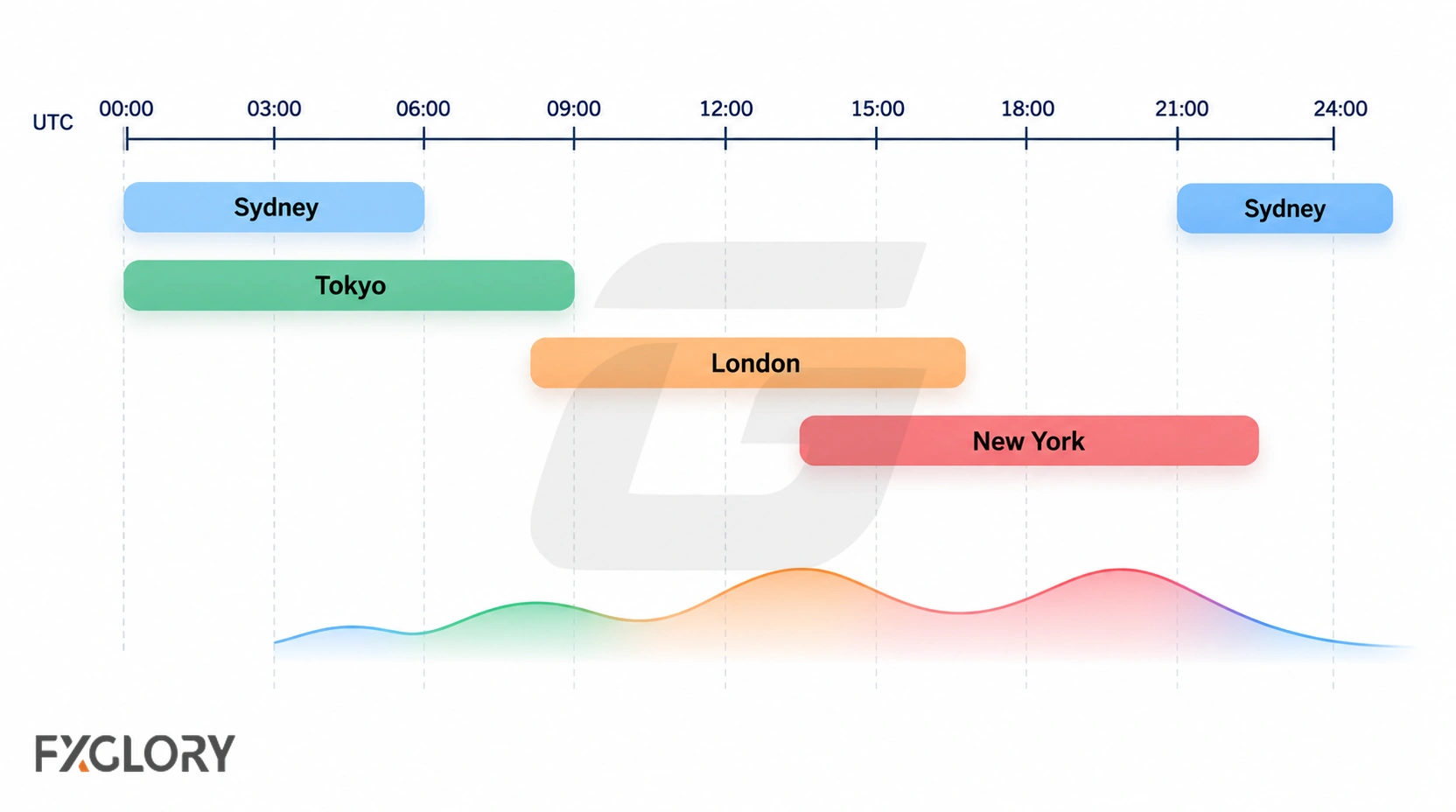
| Session | Common role | Pairs often watched | Main caution |
|---|---|---|---|
| Sydney | Early-week and Asia-Pacific activity | AUD, NZD, and regional crosses | Some pairs may be quieter outside local drivers |
| Tokyo | Asian-session liquidity and JPY activity | USD/JPY, EUR/JPY, AUD/JPY, AUD/USD | Movement may be different from London/New York behavior |
| London | Major European activity and broad market participation | EUR/USD, GBP/USD, EUR/GBP, major USD pairs | Open-period volatility can be fast for unplanned entries |
| New York | US activity and USD-driven movement | EUR/USD, GBP/USD, USD/JPY, USD/CAD, major USD pairs | US data releases can change conditions quickly |
Best Forex Session Overlaps
Session overlaps matter because two regions are active at the same time. More participation can increase movement, but it can also increase speed and execution pressure.
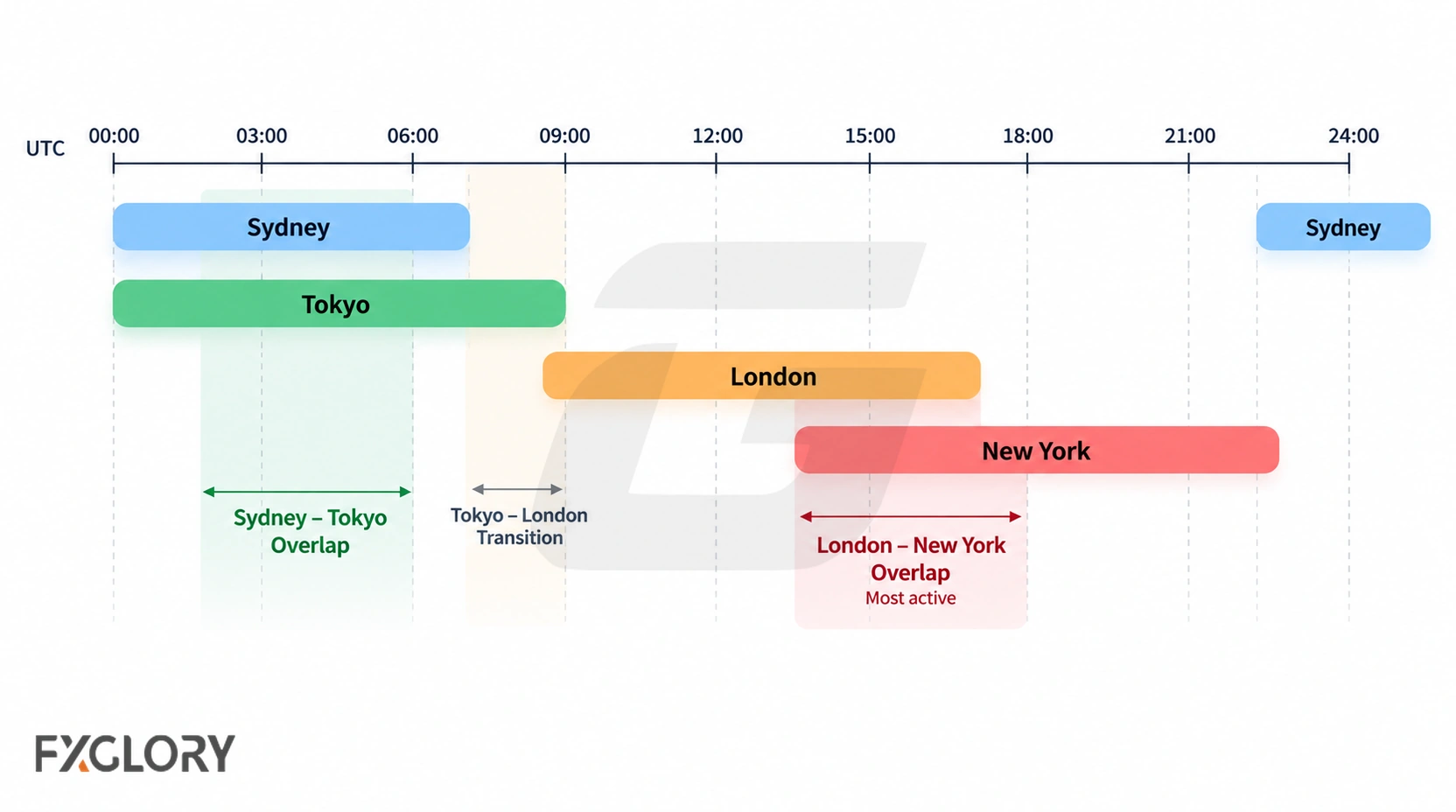
| Overlap | Why traders watch it | Often relevant for | Risk filter |
|---|---|---|---|
| London/New York | Two major sessions are active, often creating strong participation in major pairs | EUR/USD, GBP/USD, USD/CAD, USD/CHF, major USD pairs | Check US and European news before entry |
| Sydney/Tokyo | Asia-Pacific activity is active at the same time | AUD/USD, NZD/USD, AUD/JPY, NZD/JPY, USD/JPY | Some pairs can remain range-bound without a clear driver |
| Tokyo/London transition | Asian-session positioning meets early European activity | JPY crosses, EUR/JPY, GBP/JPY, EUR/USD | Conditions can shift quickly from quiet to active |
Best Time To Trade Forex By Local Time
Local time matters because a good market window is not useful if the trader cannot monitor it consistently. The table below gives practical orientation for the London/New York overlap, which is often watched for major pairs.
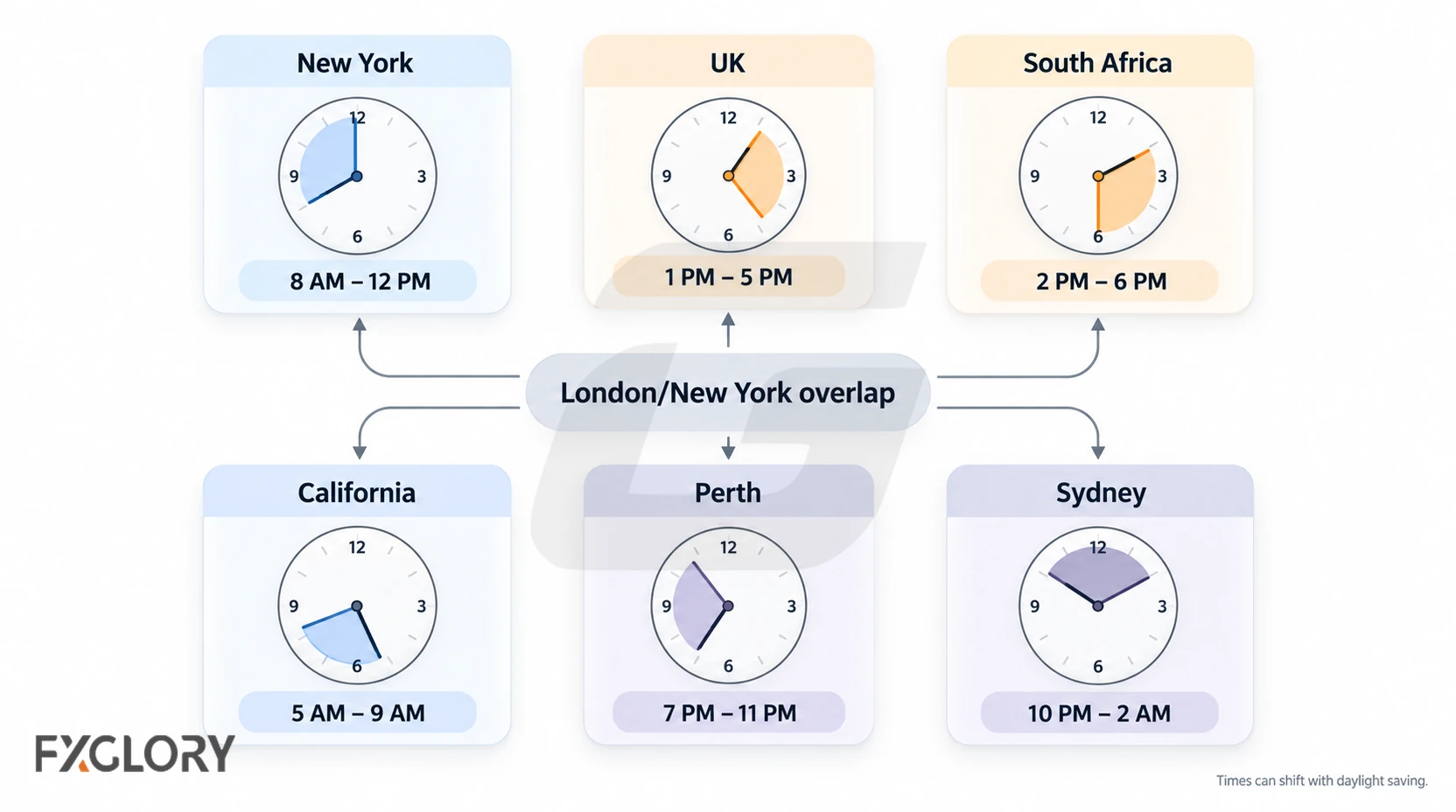
| Location | Common London/New York overlap window | Practical note |
|---|---|---|
| USA / Eastern Time (ET) | Often around 8:00 AM to 12:00 PM ET | Fits many US morning trading routines, but US news releases must be checked |
| California / Pacific Time (PT) | Often around 5:00 AM to 9:00 AM PT | Useful for early traders; otherwise test Asian-session pairs or slower plans |
| UK time | Often around 1:00 PM to 5:00 PM UK time | London activity begins earlier; the overlap adds New York participation |
| South Africa Standard Time (SAST) | Often around 2:00 PM to 6:00 PM or 3:00 PM to 7:00 PM SAST | The shift depends on UK and US daylight-saving alignment |
| Australia Eastern Time (Sydney/Melbourne) | Often late evening to after midnight, roughly 10:00 PM to 2:00 AM or 12:00 AM to 4:00 AM depending on DST | London/New York may be impractical for some traders; Sydney/Tokyo may fit AUD, NZD, and JPY pairs better |
| Western Australia / Perth time | Often evening to late evening, roughly 7:00 PM to 11:00 PM or 9:00 PM to 1:00 AM depending on DST | More practical than eastern Australia for some London/New York overlap monitoring |
These are planning windows, not entry signals. The clock narrows the watchlist; the setup still decides whether there is a trade. Australian state-level time differences can change the practical window, so traders should convert the session to their city before testing. Australian traders often compare Sydney/Tokyo activity for AUD, NZD, and JPY pairs with late-night London/New York activity for USD majors.
Best Time To Trade Forex Pairs
The best time to trade forex pairs depends on which currencies are involved. A practical starting rule is to match the pair to the session of one or both currencies, then confirm spread, scheduled news, and setup conditions before trading.
| Pair group | Sessions often watched | Why | Planning filter |
|---|---|---|---|
| EUR/USD | London, New York, London/New York overlap | EUR and USD activity can both be present | Check eurozone and US news timing |
| GBP/USD | London, New York, London/New York overlap | UK and US participation can affect movement | Watch UK and US data windows |
| USD/CAD | New York and London/New York overlap | USD and CAD activity often aligns with North American hours | Check US and Canadian data releases |
| USD/JPY and JPY crosses | Tokyo, London transition, New York | JPY activity may appear during Asian hours and later USD-driven periods | Avoid assuming the same behavior across every session |
| AUD/USD and NZD/USD | Sydney, Tokyo, London/New York when USD is active | AUD/NZD activity can appear in Asia-Pacific hours, while USD activity matters later | Match the pair to the session being tested |
Start with the Forex Market hub or the available currency pairs, then test one pair during one session before comparing several markets at once.
Best Time To Trade Forex By Trading Style
Different styles need different session behavior. Scalping needs movement that remains practical after spread. Day trading needs enough session structure to form setups within one trading window. Swing trading can use session timing for execution, but the clock should not replace setup quality.
| Trading style | Session priority | Related guide |
|---|---|---|
| Scalping | Active windows with enough movement after spread; avoid quiet periods where targets are too small after costs | fast-chart scalping timeframe routine |
| Day trading | London open, New York open, or London/New York overlap depending on pair; avoid forcing trades after the active window fades | intraday chart routine |
| Swing trading | Session timing matters less than setup quality, but entries still need spread, news, and stop-distance checks | multiple-timeframe planning |
Times To Avoid Or Treat Carefully
Some trading windows can be less suitable because movement is thin, spreads may be less favorable, or volatility is dominated by scheduled events. These windows are not automatically impossible to trade, but they need stricter rules.
- Quiet transition periods: Movement may become choppy when one session fades and another has not fully started.
- Around daily rollover or session handoff: Spreads and execution conditions may become less suitable for short-target plans.
- Major news without a plan: Data releases can overpower normal session behavior.
- Late Friday trading: Liquidity, spread behavior, and holding risk can change near the market close.
- Holidays and thin markets: Lower participation can make price action less reliable.
- Trading outside the trader's alert hours: A strong session is not useful if the trader is tired or cannot monitor risk.
Use FXGlory spread information when comparing active and quiet windows, especially for scalping or short-target intraday plans.
How To Choose Your Own Forex Trading Window
Start with the pair and strategy, then choose the clock window that gives that plan enough movement after spread. Do not start with the clock alone.
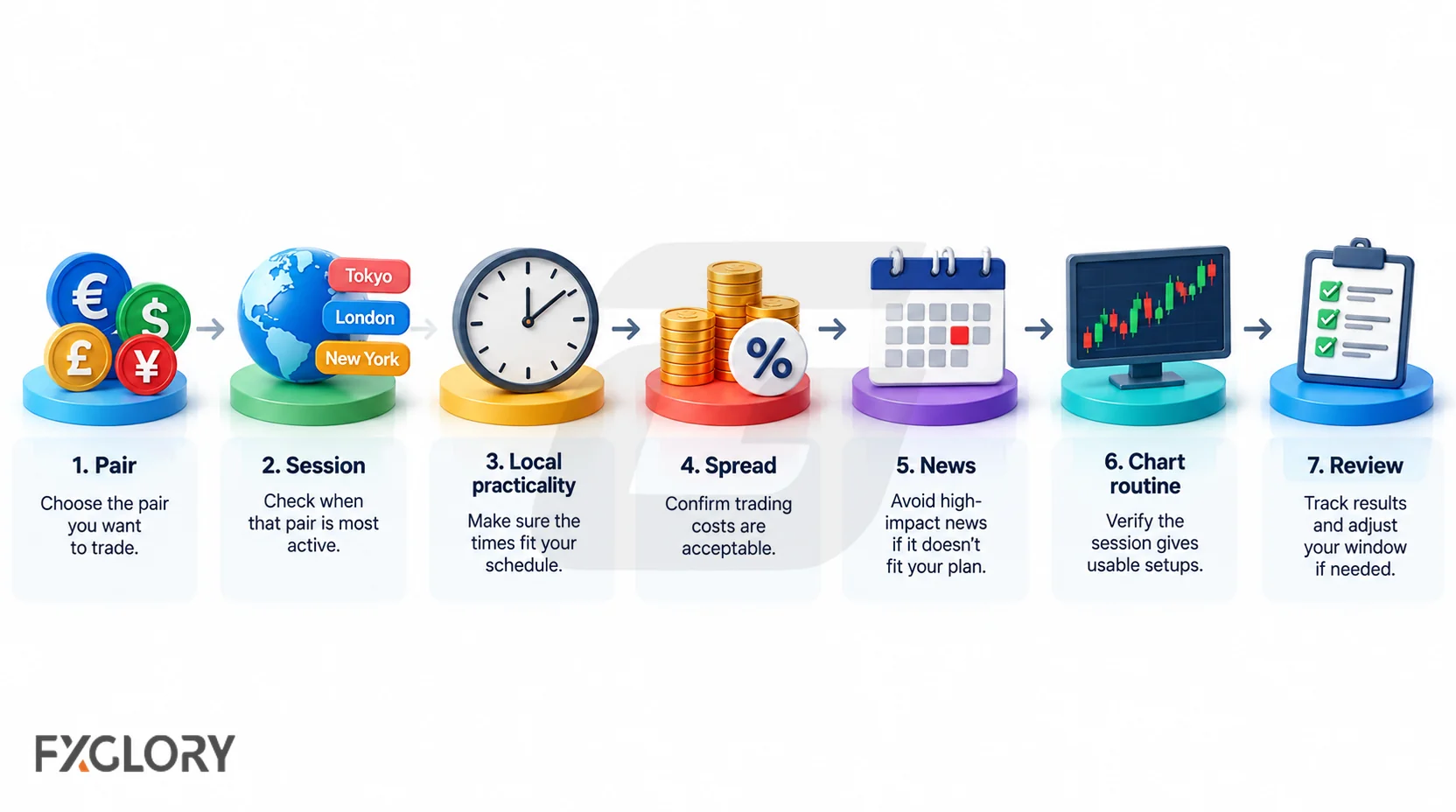
- Pick the pair first: Decide whether the pair is more connected to London, New York, Tokyo, Sydney, or a combination.
- Pick the session second: Choose the session where that pair usually has enough movement for the plan.
- Check local practicality: Make sure the window fits the trader's schedule and attention level.
- Check the spread: Shorter-term plans need stricter cost filters.
- Check the news calendar: Avoid treating scheduled event risk as normal session volatility.
- Choose the chart routine: Match the trading window with the timeframe routine used for entry and review.
- Review by session: Track whether losses came from poor timing, poor setup, spread impact, news risk, or rule-breaking.
If the trading window also needs multiple chart checks, use a context-to-trigger chart routine instead of switching time frames randomly during the session.
Practice One Trading Window Before Trading Live
A session plan should be tested before live trading. Choose one pair, one local trading window, one chart routine, and one review method. Avoid changing all of them at the same time.
- Before the session: Mark the pair, session, expected news events, and chart routine.
- During the session: Record spread conditions, setup quality, and whether price movement matches the plan.
- Before entry: Check stop distance, spread, news timing, and invalidation.
- After exit: Record whether the trade followed the planned window or was forced outside it.
- After several sessions: Decide whether the time window fits the pair and strategy before testing a new window.
Use the demo account information to practice one forex trading window before applying it to live trading conditions. Review FXGlory trading platforms when building a workspace for session monitoring, chart review, and trade planning.
Session-Timing Test Notes For Best Time To Trade Forex
This hypothetical educational session-timing model uses one 15-minute timing rule: fixed UTC session windows, a 4-candle opening range, completed-candle breakout confirmation, ATR and stop-distance filters, an opening-range stop, a 1.2R target comparison, a session-end time exit, and spread/slippage sensitivity. It does not test scalping, day trading, swing trading, news trading, discretionary session selection, every local timezone, every pair, or every forex session method.
The baseline timing window is the London/New York overlap proxy from 13:00 to 16:00 UTC. The same rule is also reviewed across Sydney/Tokyo, London, London/New York, and late low-activity UTC windows as a session sensitivity check. These windows are fixed UTC test inputs, not personalized local-time recommendations.
| Rule Area | Educational Model Rule |
|---|---|
| Strategy type | 15-minute session opening-range breakout timing model |
| Baseline window | London/New York overlap proxy, 13:00 to 16:00 UTC |
| Session sensitivity windows | 00:00 to 04:00 UTC, 07:00 to 11:00 UTC, 13:00 to 16:00 UTC, and 20:00 to 23:00 UTC |
| Opening range | First 4 completed 15-minute candles inside the tested session |
| Opening-range width | At least 2 pips and no more than 50 pips |
| Volatility filter | ATR(14) at least 0.5 pip and no more than 30 pips |
| Long confirmation | Completed 15-minute close 0.10 to 0.80 ATR(14) above the opening range high, with close in the upper 40% of the candle range |
| Short confirmation | Completed 15-minute close 0.10 to 0.80 ATR(14) below the opening range low, with close in the lower 40% of the candle range |
| Entry | Next 15-minute open after the completed signal candle |
| Stop | Beyond the opposite opening-range boundary with a 0.10 ATR(14) buffer |
| Stop-distance filter | At least 3 pips and no more than 60 pips |
| Target comparison | Fixed 1.2R target from entry |
| Time exit | Final available 15-minute candle close inside the same session window |
| Trade frequency | Maximum 1 trade per pair per session window per UTC date |
The review records trade count, win rate, average win in R, average loss in R, expectancy in R, profit factor, maximum drawdown in R, worst losing streak, average holding period, baseline-window behavior, session-window behavior, pair-level behavior, direction-level behavior, exit reasons, and spread/slippage sensitivity.
| Cost Input | Assumptions Used |
|---|---|
| Spread | 0.5, 1.5, and 3.0 pips |
| Slippage | 0.1, 0.5, and 1.0 pips per side |
| Baseline comparison | 1.5-pip spread and 0.5-pip slippage per side |
| Swap and rollover | Not included |
Educational Session-Timing Test Results
The baseline London/New York overlap proxy result was negative under the 1.5-pip spread and 0.5-pip slippage-per-side assumption. These figures come from one hypothetical 15-minute opening-range timing model and do not prove that any forex session is better or worse for future live trading.
| Baseline Metric | Result |
|---|---|
| Timing window | London/New York overlap proxy, 13:00 to 16:00 UTC |
| Number of trades | 187 |
| Win rate | 36.36% |
| Average win | 0.4157R |
| Average loss | -0.5605R |
| Expectancy | -0.2055R |
| Profit factor | 0.4238 |
| Maximum drawdown | -38.399R |
| Worst losing streak | 7 |
| Average holding period | 4.93 fifteen-minute candles |
| Median holding period | 5 fifteen-minute candles |
| Total net result | -38.4272R |
Session-Window Baseline Results
| Session Window | Trades | Win Rate | Expectancy | Profit Factor | Max Drawdown | Total Net Result |
|---|---|---|---|---|---|---|
| Sydney/Tokyo proxy | 237 | 30.38% | -0.3414R | 0.2506 | -80.6075R | -80.9055R |
| London proxy | 237 | 32.49% | -0.2441R | 0.3794 | -56.7146R | -57.8607R |
| London/New York overlap proxy | 187 | 36.36% | -0.2055R | 0.4238 | -38.399R | -38.4272R |
| Late low-activity proxy | 141 | 7.8% | -0.647R | 0.0376 | -92.0703R | -91.2257R |
Pair-Level Baseline Results
| Pair | Trades | Win Rate | Expectancy | Profit Factor | Max Drawdown | Total Net Result |
|---|---|---|---|---|---|---|
| EURUSD | 27 | 33.33% | -0.2734R | 0.2895 | -7.3526R | -7.3817R |
| GBPUSD | 33 | 36.36% | -0.3097R | 0.3556 | -9.6745R | -10.2205R |
| USDJPY | 31 | 32.26% | -0.1422R | 0.4927 | -4.7556R | -4.4084R |
| AUDUSD | 27 | 33.33% | -0.2067R | 0.4912 | -8.21R | -5.5812R |
| USDCAD | 34 | 52.94% | -0.0156R | 0.9276 | -3.5591R | -0.5312R |
| USDCHF | 35 | 28.57% | -0.2944R | 0.2336 | -9.5366R | -10.3041R |
Direction-Level Baseline Results
| Direction | Trades | Win Rate | Expectancy | Profit Factor | Max Drawdown | Total Net Result |
|---|---|---|---|---|---|---|
| Long | 106 | 33.96% | -0.21R | 0.3729 | -22.2335R | -22.2617R |
| Short | 81 | 39.51% | -0.1996R | 0.4818 | -15.9106R | -16.1655R |
Exit Reason Counts
| Exit Reason | Count |
|---|---|
| session time exit | 150 |
| stop loss | 25 |
| target 1.2R | 12 |
Spread And Slippage Sensitivity
| Spread | Slippage Per Side | Trades | Win Rate | Expectancy | Profit Factor | Total Net Result |
|---|---|---|---|---|---|---|
| 0.5 pips | 0.1 pips | 187 | 42.78% | -0.0973R | 0.6618 | -18.1863R |
| 0.5 pips | 0.5 pips | 187 | 38.5% | -0.1454R | 0.5416 | -27.1823R |
| 0.5 pips | 1.0 pips | 187 | 36.36% | -0.2055R | 0.4238 | -38.4272R |
| 1.5 pips | 0.1 pips | 187 | 37.43% | -0.1574R | 0.5154 | -29.4313R |
| 1.5 pips | 0.5 pips | 187 | 36.36% | -0.2055R | 0.4238 | -38.4272R |
| 1.5 pips | 1.0 pips | 187 | 28.34% | -0.2656R | 0.3345 | -49.6721R |
| 3.0 pips | 0.1 pips | 187 | 30.48% | -0.2476R | 0.3587 | -46.2986R |
| 3.0 pips | 0.5 pips | 187 | 26.74% | -0.2957R | 0.2989 | -55.2946R |
| 3.0 pips | 1.0 pips | 187 | 25.67% | -0.3558R | 0.2394 | -66.5395R |
What This Session-Timing Test Shows
In this rule model, the London/New York overlap proxy had the least negative baseline among the tested windows, with -0.2055R expectancy and -38.4272R total net result. That does not make it a proven best time to trade forex. It only shows that this fixed-window opening-range rule behaved less poorly there than in the Sydney/Tokyo proxy, London proxy, and late low-activity proxy during the limited intraday sample.
The late low-activity proxy was the weakest tested window, with -0.647R expectancy and -91.2257R total net result. The cost table also shows that lower assumed spread and slippage reduced losses, while higher trading costs made the same timing rule worse. The practical takeaway is that timing can filter conditions, but the session alone cannot repair a weak setup, poor cost conditions, or execution limits.
Use the result as a review prompt: choose one pair, one session, one rule set, and one cost assumption before comparing windows. Do not use this test as proof that any session will perform better in live trading.