

What Is The Best Time Frame To Trade Forex?
The best time frame to trade forex is the chart that matches the trader's strategy, available screen time, decision speed, and risk rules. There is no single forex best time frame for every trader, pair, session, or account size.
A beginner who checks charts a few times a day may work more clearly from the daily and 4-hour charts than from a 1-minute chart. A day trader may use the 4-hour or 1-hour chart for direction, the 15-minute chart for the setup, and the 5-minute chart only to refine the trigger. A scalper may use 1-minute to 15-minute charts, but the plan must account for spread, slippage, fast decisions, and overtrading.
What Forex Time Frames Actually Change
A forex time frame controls how much market activity is shown inside each candle. On a 5-minute chart, one candle summarizes five minutes of price movement. On a daily chart, one candle summarizes one trading day. That difference changes signal frequency, stop distance, holding time, and the pressure placed on the trader.
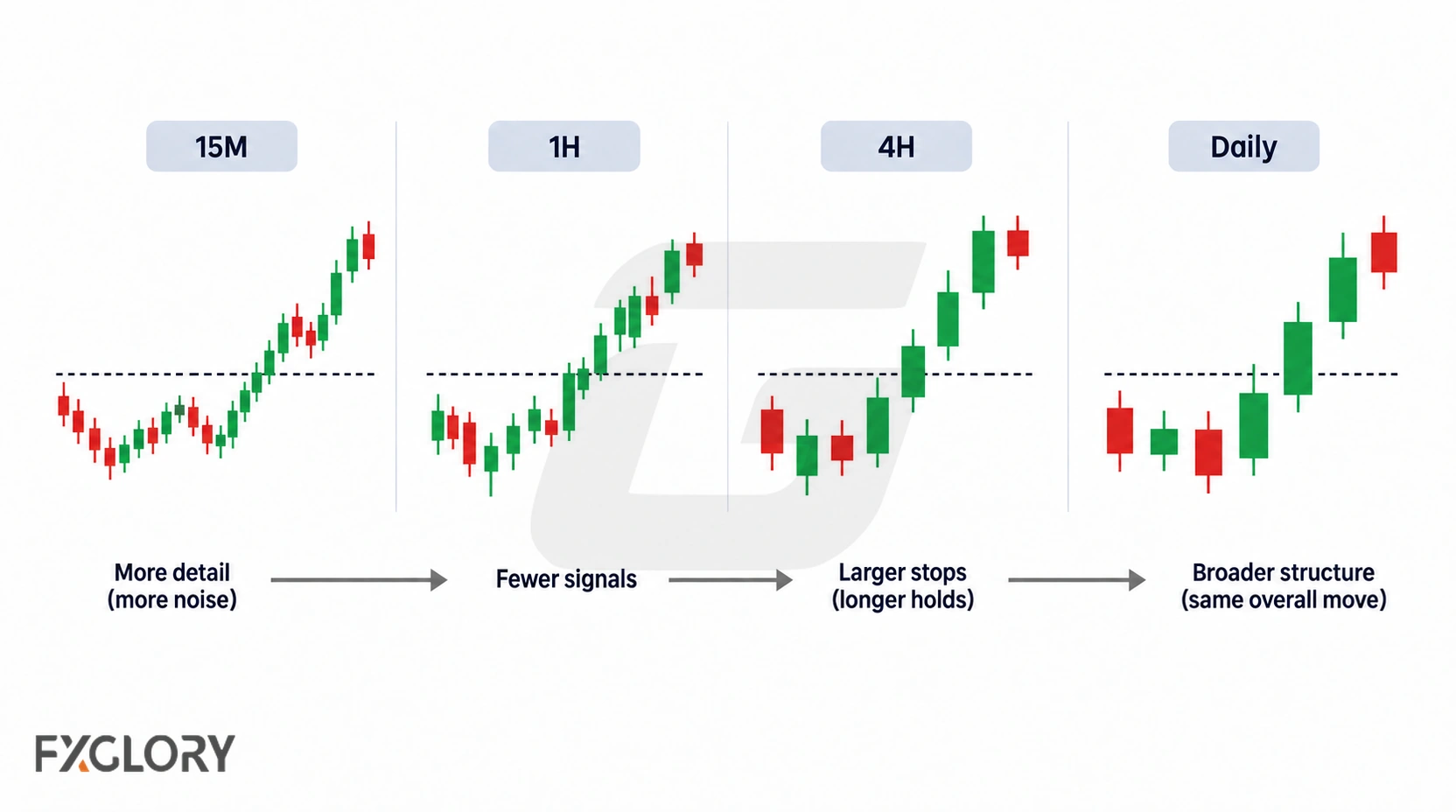
Lower time frames usually create more signals and more noise. Higher time frames usually create fewer signals and wider structure. Neither is automatically safer. Risk depends on position size, leverage, stop placement, market conditions, and whether the trade follows a written plan.
Before choosing a chart, decide whether it will be used for context, setup, entry, or management. A broader strategy framework should define the chart's job before the trader decides where to enter.
Quick Time Frame Map By Trading Style
| Trading style | Common chart time frames | Main use | Main caution |
|---|---|---|---|
| Scalping | 1M, 5M, 15M | Short-lived entries, fast exits, intraday volatility | Spread, slippage, execution speed, and overtrading matter more |
| Day trading | 5M, 15M, 30M, 1H, with 4H context | Intraday bias, setup location, session-based execution | Lower-chart signals can conflict with higher-chart structure |
| Swing trading | 4H, Daily, sometimes Weekly context | Multi-day pullbacks, trend continuation, range breaks | Stops may be wider, so position size and margin need planning |
| Position trading | Daily, Weekly, Monthly | Large market themes, broad trends, major zones | Longer exposure increases patience, event-risk, and drawdown pressure |
Treat the table as a filter. The final chart choice still depends on the expected move after spread, the distance to invalidation, the session being traded, and how often the trader can monitor the position.
Best Forex Time Frame For Beginners
The 4-hour and daily charts are often better starting points for beginners because they slow the decision process. A slower chart gives more time to mark trend direction, support or resistance, invalidation, stop distance, and position size before an order is placed.
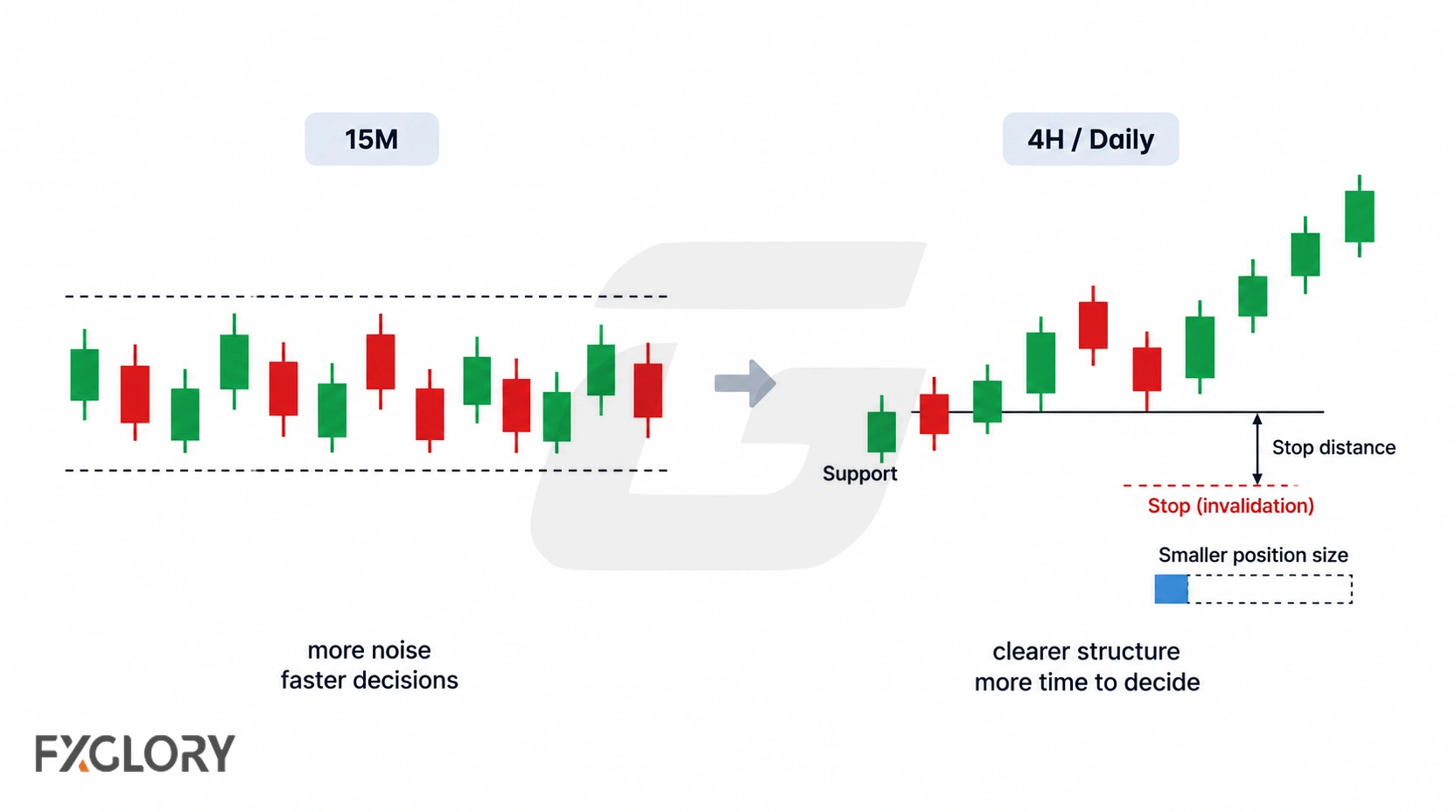
This does not make higher time frames low-risk. A daily-chart setup can require a wider stop than a 15-minute setup, so the position size must be adjusted. A trader can still lose money on a slow chart by entering late, ignoring event risk, using excessive leverage, or moving the stop after the trade is open.
Best Timeframes To Trade Forex By Style
Scalping: 1M To 15M
Scalping uses short time frames because the trader is trying to work with small intraday price movements. The main danger is treating every candle as a new opportunity. Short charts can create many signals, but more signals also mean more spread paid, more execution decisions, and more chances to trade poor conditions.
Before using a 1-minute or 5-minute chart, the trader should check whether the expected move is large enough compared with the spread and normal noise. This is why spread context matters more for short-term plans than for wider multi-day setups.
Day Trading: Context First, Trigger Second
For day trading forex, a controlled structure can use the 4-hour or 1-hour chart for direction, the 15-minute chart for the setup, and the 5-minute chart only for trigger refinement. The lower chart should not create a trade by itself when the higher chart shows no clean location.
This keeps the trader from treating every small fluctuation as a separate opinion. The higher time frame answers where the market is trading from. The trading time frame defines the setup and invalidation. The lower time frame is optional.
Swing Trading: 4H And Daily
Swing trading usually needs charts that show multi-day structure without hiding the entry area. The 4-hour and daily charts often fit that role. They can show pullbacks, continuation, support or resistance reactions, and range breaks without requiring constant screen time.
The trade-off is stop distance. A structure-based stop on a daily chart may be wider than a stop on a 15-minute chart. The chart is only useful if the position size and margin requirement fit the plan. Use the margin calculator before testing wider-stop ideas.
Position Trading: Daily, Weekly, And Monthly
Position trading uses higher time frames because the idea is built around broader market structure and longer holding periods. Daily, weekly, and monthly charts can help identify major zones and larger invalidation areas. This style usually gives fewer trades and requires patience through deeper pullbacks.
The risk changes rather than disappears. Longer exposure can mean larger swings, more event risk, and fewer opportunities to correct poor planning.
How Multiple Time Frame Analysis Should Work
Multiple time frame analysis is useful only when each chart has one job. It becomes a problem when a trader keeps switching charts until one of them supports a trade.
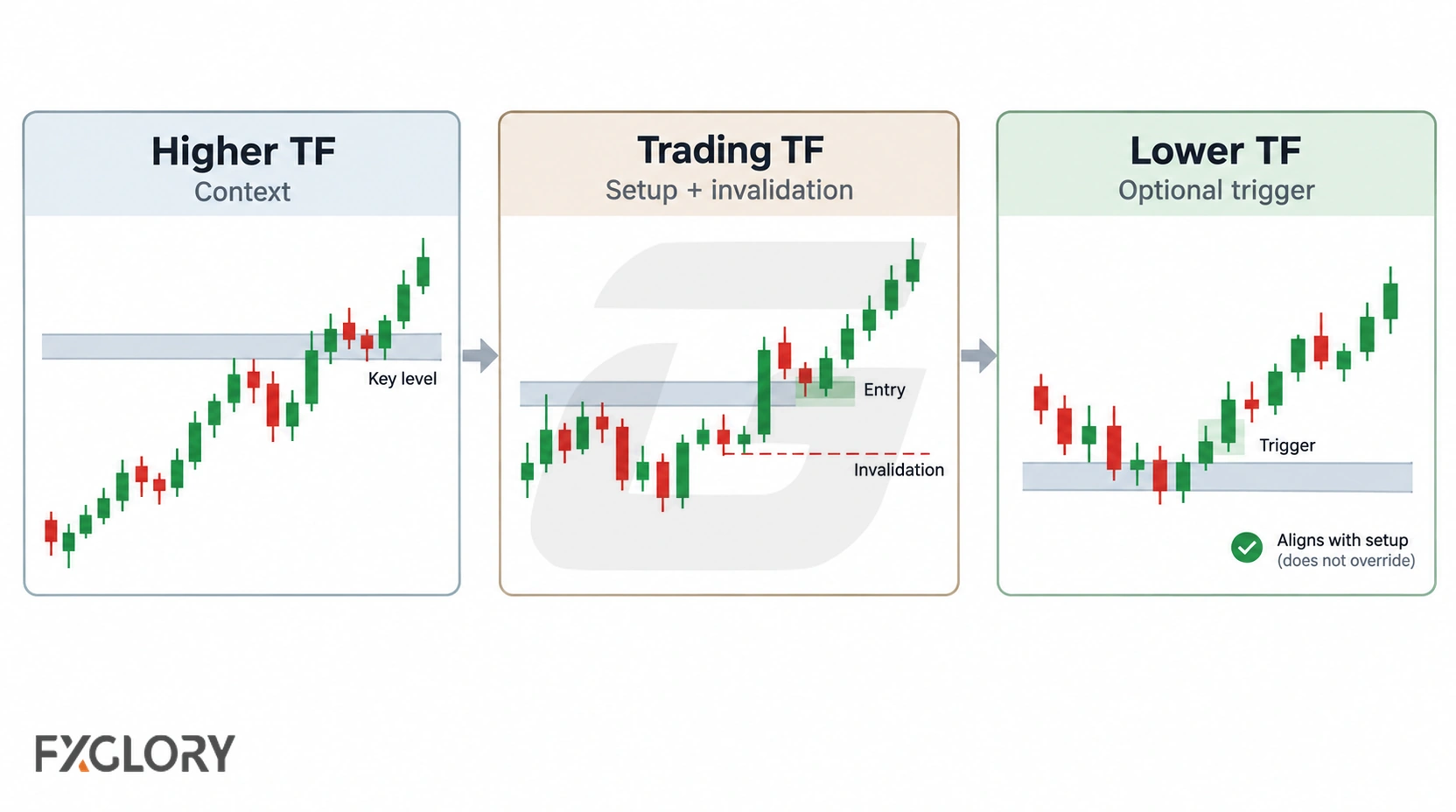
| Chart role | Purpose | Day-trading example | Swing-trading example |
|---|---|---|---|
| Higher time frame | Context, trend, major levels, market condition | 4H or 1H | Weekly or Daily |
| Trading time frame | Setup, entry area, invalidation | 15M | 4H |
| Lower time frame | Optional trigger refinement | 5M | 1H or 30M |
A simple relationship between charts, such as 1H to 15M or Daily to 4H, keeps the structure readable. Adding more charts can create conflicting signals if the plan does not say which chart has priority.
A clean trading setup framework separates context, trigger, invalidation, risk, and review so the trader does not use time frames as after-the-fact justification.
Time Frame Vs Trading Session: Separate Decisions
The best timeframe to trade forex and the best time to trade forex are different questions. A timeframe is the chart interval, such as 5M, 15M, 1H, 4H, Daily, or Weekly. A trading session is the part of the day when certain markets and participants are active.
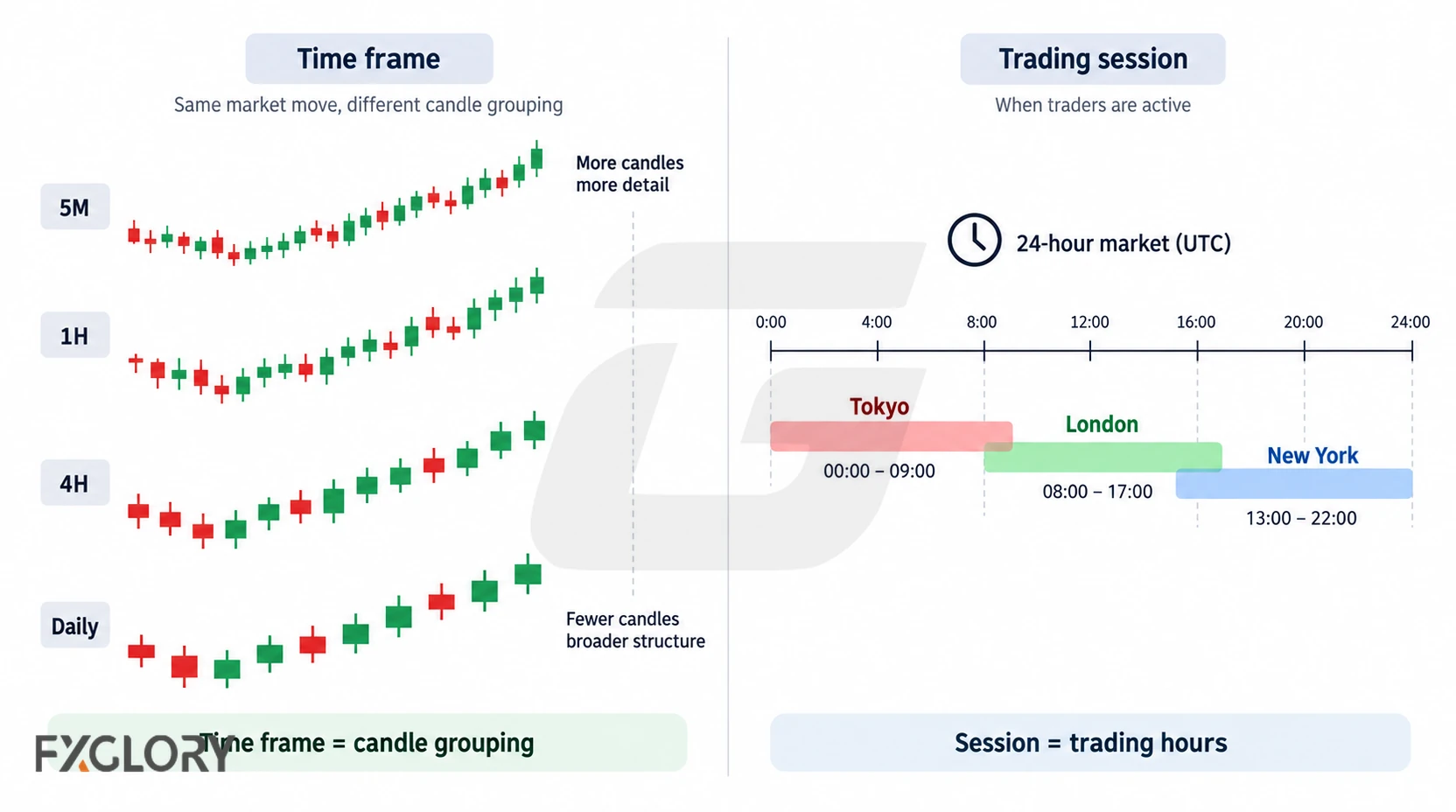
Session conditions can change how the same chart behaves. A 5-minute chart during a quiet period may produce slow, choppy movement. A 5-minute chart during a more active overlap, such as the London/New York overlap for many major pairs, may move faster and require quicker decisions. Daylight-saving changes, news timing, and pair selection can also affect liquidity and volatility.
For that reason, choose the pair and session together with the chart. Start from the currency pairs section, then test whether the selected pair behaves clearly enough on the chosen chart during the trader's available hours.
How To Choose The Best Forex Time Frame For Your Plan
Pick the chart after defining how often it can be monitored, where invalidation sits, and whether the expected move is large enough after spread. Starting with the chart first often leads to timeframe hopping.
- Set available screen time: A trader who can check charts twice a day should not build a plan around 1-minute decisions.
- Choose the holding style: Decide between scalping, day trading, swing trading, or position trading before choosing chart intervals.
- Select one context chart: Use it for broad trend, range, volatility, and major levels.
- Select one setup chart: Use it for the entry area, invalidation, and trade structure.
- Add a lower trigger chart only if it helps: Remove it if it creates hesitation or contradictory signals.
- Check spread sensitivity: Lower time frames need stricter cost checks because expected moves are usually smaller.
- Check stop distance and margin: Higher time frames may need wider stops, so position size must be adjusted.
- Write skip conditions: Stand aside when the chart is choppy, the session is too quiet, news risk is too high, or invalidation is unclear.
Two Quick Timeframe Examples
Example 1: Limited Screen Time
A trader who can review charts before and after work may choose Daily for context and 4H for planning. The plan might ignore 5-minute triggers completely because the trader cannot monitor them consistently. The chart choice is built around availability, not excitement.
Example 2: Intraday Trader
A trader who can monitor one active session may use 1H for context, 15M for setup location, and 5M only when the 15M setup is already valid. If the 1H chart is unclear, the lower chart does not get permission to create a trade.
Common Timeframe Mistakes
- Timeframe hopping: Changing charts repeatedly until a trade looks acceptable.
- Letting the lower chart control the trade: Taking a 5-minute signal directly into a major higher-timeframe level without context.
- Choosing speed because the slower chart feels boring: A faster chart usually increases decision pressure.
- Ignoring spread on short charts: A small target can become unrealistic when the spread is too large relative to the expected move.
- Using wide-chart stops with oversized positions: Higher time frames can require wider invalidation, so position size must adjust.
- Moving the stop because another chart looks different: The stop belongs to the setup, not to the chart selected after entry.
- Treating every session the same: Quiet periods, active overlaps, and news releases can make the same time frame behave differently.
Practice The Timeframe Plan Before Trading Live
A timeframe plan should be tested before it is used with real money. Choose one pair, one context chart, one setup chart, and one trigger rule. Record the entry reason, invalidation, stop distance, planned target area, session, spread condition, and whether the trade followed the written rules.
Do not test several chart combinations at the same time. A clean test might compare Daily plus 4H for swing planning, or 1H plus 15M for day trading. The useful test is whether the trader can repeat the same chart routine without changing charts to justify a trade.
The platform should support the chart routine rather than complicate it. Review FXGlory trading platforms before building a multi-chart workspace with context, setup, and execution charts.
Timeframe Comparison Study Notes For Best Time Frame To Trade Forex
This hypothetical educational study compares 15M, 1H, 4H, and Daily charts with the same completed-candle breakout-and-retest rule model. It reviews signal frequency, stop distance, holding time, whipsaw exits, and spread/slippage sensitivity. It does not identify one universal best forex timeframe.
The model reviewed EURUSD, GBPUSD, USDJPY, AUDUSD, USDCAD, and USDCHF using public yfinance 15-minute OHLC data where available. The 1H, 4H, and Daily candles are resampled from the same 15-minute data so the timeframes are compared over the same available calendar window.
| Study Area | Educational Model Rule |
|---|---|
| Study type | Same-rule timeframe comparison across 15M, 1H, 4H, and Daily candles |
| Base data | Public yfinance 15-minute OHLC data |
| Resampled charts | 1H, 4H, and Daily candles created from the same 15-minute data window |
| Range rule | Previous 10 completed candles |
| Volatility filter | Range width between 0.75 and 4.00 ATR(10) |
| Long setup | Completed candle closes 0.10 to 0.80 ATR(10) above the range high, with close in the upper 40% of the candle range |
| Short setup | Completed candle closes 0.10 to 0.80 ATR(10) below the range low, with close in the lower 40% of the candle range |
| Entry | Next candle open after the completed signal candle |
| Stop | Beyond the signal candle extreme with a 0.25 ATR(10) buffer |
| Target comparison | Fixed 1.2R target from entry |
| Whipsaw exit | Exit on close back through the broken range boundary against the trade |
| Maximum holding review | 12 completed candles after entry on each timeframe |
| Overlap filter | One open trade per pair per timeframe |
The review records trade count, win rate, average win in R, average loss in R, expectancy in R, profit factor, maximum drawdown in R, worst losing streak, average holding period in bars and hours, total net R, timeframe-level behavior, pair-level behavior, direction-level behavior, whipsaw exits, exit reasons, and spread/slippage sensitivity.
| Cost Input | Assumptions Used |
|---|---|
| Spread | 0.5, 1.5, and 3.0 pips |
| Slippage | 0.1, 0.5, and 1.0 pips per side |
| Baseline comparison | 1.5-pip spread and 0.5-pip slippage per side |
| Swap and rollover | Not included |
Educational Timeframe Comparison Study Results
The hypothetical same-rule timeframe comparison study produced a negative baseline result under the 1.5-pip spread and 0.5-pip slippage-per-side assumption. The run accepted 2,345 trades from 2,948 candidates, with 603 candidates rejected by the same-pair/timeframe overlap filter.
| Baseline Metric | Result |
|---|---|
| Accepted trades | 2,345 |
| Win rate | 28.49% |
| Average win | 0.8011R |
| Average loss | -0.9219R |
| Expectancy | -0.4310R |
| Profit factor | 0.3462 |
| Maximum drawdown | -1010.8003R |
| Worst losing streak | 39 trades |
| Average holding period | 3.5500 bars / 3.1100 hours |
| Total net result | -1010.8095R |
| Whipsaw exit rate | 48.96% |
Baseline Results By Timeframe
| Timeframe | Trades | Win Rate | Expectancy | Profit Factor | Max Drawdown | Total Net Result | Avg Hold Hours | Whipsaw Exit Rate |
|---|---|---|---|---|---|---|---|---|
| 15M | 1,677 | 28.21% | -0.4919R | 0.2980 | -824.9149R | -824.9242R | 0.9000 | 49.79% |
| 1H | 514 | 29.38% | -0.3137R | 0.4641 | -160.8891R | -161.2248R | 3.3800 | 45.33% |
| 4H | 130 | 28.46% | -0.1543R | 0.6618 | -25.5371R | -20.0549R | 13.8200 | 54.62% |
| Daily | 24 | 29.17% | -0.1919R | 0.5734 | -5.6196R | -4.6057R | 94.0000 | 37.50% |
Baseline Results By Pair
| Pair | Trades | Win Rate | Expectancy | Total Net Result | Whipsaw Exit Rate |
|---|---|---|---|---|---|
| AUDUSD | 361 | 29.36% | -0.5051R | -182.3487R | 48.75% |
| EURUSD | 367 | 29.97% | -0.4893R | -179.5898R | 44.14% |
| GBPUSD | 433 | 29.56% | -0.4277R | -185.2109R | 44.57% |
| USDCAD | 373 | 29.76% | -0.2375R | -88.5943R | 52.82% |
| USDCHF | 440 | 26.59% | -0.4843R | -213.0979R | 51.59% |
| USDJPY | 371 | 25.88% | -0.4366R | -161.9679R | 52.02% |
Spread And Slippage Sensitivity By Timeframe
| Timeframe | 0.5 Spread / 0.1 Slippage | 1.5 Spread / 0.5 Slippage | 3.0 Spread / 1.0 Slippage |
|---|---|---|---|
| 15M | -0.2205R | -0.4919R | -0.8689R |
| 1H | -0.1758R | -0.3137R | -0.5051R |
| 4H | -0.0917R | -0.1543R | -0.2411R |
| Daily | -0.1641R | -0.1919R | -0.2305R |
What This Timeframe Comparison Study Shows
The baseline result was negative across all compared timeframes in this exact rule model. The 15M chart produced the largest number of trades and the largest total net loss, while the 4H chart had the least negative baseline expectancy. The Daily sample had only 24 baseline trades, so its figures are too small to treat as a broad daily-chart conclusion.
The comparison shows timeframe behavior, not a ranking of the best chart interval. Shorter charts created more observations and stronger cost sensitivity, while higher charts reduced signal frequency and changed holding time. Whipsaw exits remained a major result driver across the comparison.
Use the result as a review prompt: test one timeframe routine with one pair, one rule set, one cost assumption, and one risk model before comparing chart intervals. Do not use this study as proof that any timeframe will perform better in live trading.