

What Is A Forex News Trading Strategy?
A forex news trading strategy is a rule-based plan for reviewing currency-pair movement around economic releases, central-bank events, political headlines, or unexpected market news. The strategy does not simply ask whether the headline is good or bad. It asks whether the event was expected, whether the result surprised the market, which currency is affected, how price reacts, whether spreads and liquidity allow execution, and where the trade idea becomes invalid.
News can create fast movement because traders adjust expectations about interest rates, inflation, growth, employment, trade flows, risk sentiment, or central-bank policy. The movement can be sharp, but it can also be messy. A strong release may already be priced in. A weak release may be ignored. The first candle can reverse. A second release or revision can change the meaning of the first number.
For scheduled news, the event, release time, affected currency, forecast and previous reading are available for advance planning; the actual result and any newly announced revision must be assessed only after publication. Entry, invalidation, exit, cost limits and no-trade conditions must be prepared before the intended execution window.
For the wider rule set that connects setup, entry, invalidation, exit, risk, and review, use the complete trading-system framework.
News Trading vs Fundamental Strategy
News trading and fundamental trading overlap, but they are not the same process. News trading is usually event-driven and short-term. It focuses on the reaction to a specific release, speech, headline, or surprise. A broader fundamental strategy studies economic conditions over a longer period and builds a view from policy, inflation, growth, employment, capital flows, and relative currency strength.
This distinction matters because a trader can be right about a long-term fundamental theme and still lose on a short-term news trade. A currency may be fundamentally supported over weeks, but a single release can create a temporary reversal. A currency may weaken after a rate hike if the hike was expected and the central bank sounds less hawkish than traders anticipated.
| Approach | Main Question | Typical Time Focus | Main Risk |
|---|---|---|---|
| News trading | How did price react to this specific event? | Minutes, hours, or a few sessions | Fast volatility, slippage, false reaction, spread widening |
| Fundamental strategy | How do economic and policy conditions affect currency value? | Days, weeks, or longer | Slow thesis change, delayed reaction, conflicting data |
| Technical strategy | What does price structure show? | Any timeframe selected by the trader | Pattern failure, late entry, false break, weak context |
| Combined review | Does the event reaction agree with structure and risk? | Depends on the plan | Adding too many reasons after the trade is already open |
Central-bank communication is one area where news and fundamentals meet. A rate decision may be important, but the wording around future policy can matter as much as the decision itself. If central-bank language is the main issue, review how hawkish and dovish signals can affect currency expectations.
Why News Moves Forex Prices
Forex prices move when market participants adjust the relative value of one currency against another. News can change that view by affecting expected interest rates, growth, inflation, risk appetite, capital flows, or demand for a currency.
The important point is expectation. A release does not move price only because it is positive or negative. It moves price when the result changes what traders expected, confirms or rejects existing positioning, or changes the expected path of central-bank policy.
| News Driver | Why It Can Matter | Reading Caution |
|---|---|---|
| Interest-rate decision | Changes or confirms the return expected from holding a currency | The statement and forward guidance may matter more than the headline rate |
| Inflation data | Can affect expectations for tightening, holding, or cutting rates | Core inflation, revisions, and central-bank tolerance can change the reading |
| Employment data | Can affect expectations for spending, growth, wages, and policy | Headline job growth can conflict with unemployment, wages, or revisions |
| GDP and growth data | Can change views on economic strength | Markets may focus on future policy impact rather than the number alone |
| Trade balance | Can affect demand for a currency through imports and exports | Impact depends on country, timing, and whether the result was expected |
| Risk sentiment | Can shift capital toward or away from perceived safer currencies or metals | Risk-on and risk-off moves can override a single domestic release |
| Political or geopolitical news | Can change uncertainty, liquidity, and capital-flow assumptions | Unexpected headlines are harder to prepare for than scheduled data |
News movement is closely tied to volatility. If the release expands the normal range of price movement, review how volatility changes risk distance before treating the move as a clean opportunity.
Scheduled vs Unexpected News
Scheduled news is known before the release. Traders can see the time, affected currency, forecast, previous reading, and expected impact level on an economic calendar. Scheduled events include central-bank rate decisions, inflation reports, employment data, GDP, retail sales, PMI data, and trade balance figures.
Unexpected news arrives without the same preparation window. It may include political shocks, geopolitical escalation, emergency central-bank comments, sudden policy changes, natural disasters, financial-stability concerns, or other headlines that change risk sentiment. These events can be harder to trade because the timing, spread behavior, first reaction, and duration of impact are less clear.
| News Type | Preparation Possible? | Common Risk | Better Response |
|---|---|---|---|
| Scheduled economic release | Yes; release time, forecast, previous value, and affected currency can be reviewed | Spread widening, whipsaw, priced-in result, data revision | Prepare event plan and no-trade rules before release |
| Central-bank decision | Yes; decision time and prior guidance are usually known | Statement, vote split, press conference, or tone can override headline rate | Read the decision with guidance and market expectation |
| Scheduled speech | Partly; timing is known, wording is not | One phrase can change rate expectations | Wait for clearer market reaction if the statement is unclear |
| Unexpected headline | No; timing and content are unknown | Thin liquidity, fast repricing, unreliable first reaction | Stand aside unless a separate risk-event rule exists |
| Second-wave update | Sometimes; revisions, press questions, or follow-up comments can appear later | Initial trade idea becomes outdated | Reassess instead of assuming the first move remains valid |
Economic Calendar And Event Preparation
An economic calendar helps organize scheduled news before volatility begins. The calendar does not decide the trade; it gives the trader a preparation list. The important fields are release time, affected currency, event name, expected impact, forecast, previous result, and later the actual result and any revision.
Before the release, record the forecast and previously published values; the actual result and any new revisions can only be assessed once published. Their interpretation is covered in the dedicated expectation-rule section. Preparation should happen before the release window, rather than after the first spike has reduced available target room.
| Calendar Field | What To Check | Common Mistake |
|---|---|---|
| Release time | Exact scheduled time, time zone, and the relevant trading session. | Preparing after the event has already begun. |
| Affected currency | Whether the release concerns the base or quote currency, or a documented common driver of the pair. | Assuming every pair responds in the same way. |
| Impact level | The calendar provider’s impact classification and why the event matters for the selected pair. | Treating the classification as a guarantee of a tradable move. |
Calendar preparation should also record whether the event falls during the main trading session for the affected currencies, around a market open or close, or near a transition between sessions. Compare observed spreads and available quotes for that pair rather than assuming any named session is liquid. For calendar-planning details, see the economic calendar forex strategy; for session context, use the forex trading-time guide.
Which Forex News Events Matter Most?
The most important events are the ones that can change expectations for interest rates, growth, inflation, employment, risk sentiment, or cross-border capital flow. The same event does not always carry the same weight. Inflation may dominate one market environment, while employment or central-bank guidance dominates another.
| Event | What Traders Usually Compare | Why The Reaction Can Be Mixed |
|---|---|---|
| Central-bank rate decision | Decision vs expectation, vote, statement, projections, press conference | The headline decision may be expected while guidance surprises |
| Central-bank speech | Tone, inflation concern, labor-market view, future policy hints | One comment may be interpreted differently across markets |
| CPI or inflation data | Actual vs forecast, core vs headline, monthly vs yearly pace | Higher inflation can support the currency through rate expectations or hurt it through growth concerns |
| Employment report | Jobs, unemployment, wages, participation, revisions | Strong jobs can support a currency, but wage or revision details can change the reading |
| GDP | Growth vs forecast and previous period | Markets may focus more on inflation or central-bank reaction than growth alone |
| Retail sales | Consumer strength, revision, core reading | A strong number can be offset by inflation or household-stress concerns |
| PMI and survey data | Expansion or contraction, services vs manufacturing | Survey data may move expectations before hard data arrives |
| Trade balance | Surplus, deficit, export demand, import pressure | The impact depends on whether trade flows are central to that currency's story |
| Geopolitical or fiscal news | Risk, stability, policy credibility, capital flows | Risk sentiment can dominate local currency logic |
Use the release type to decide which currency pair deserves review. A U.S. inflation release can affect USD pairs, a U.K. employment release can affect GBP pairs, and a euro-area central-bank event can affect EUR pairs. For available markets, start from the FXGlory currency-pairs hub.
Forecast, Actual, Previous, And Revision Rule
The expectation rule is the center of forex news trading. The market reaction often depends less on whether the number is good or bad in isolation and more on whether it is different from what traders expected.
Before publication, record the forecast and previously published figure. Once the announcement is available, compare the actual with the forecast and check whether the earlier figure was revised. A new revision can change the apparent direction of the latest result; none of these data fields alone establishes how the currency must move.
| Data Field | What It Means | Why It Matters |
|---|---|---|
| Forecast | The expected value before the release | Price may already reflect this expectation |
| Actual | The value released at the event time | The first reaction often compares this with forecast |
| Previous | The prior reported value | Shows whether the new data improves or weakens from the earlier period |
| Revision | A change to a previously reported value | A revision can strengthen, weaken, or reverse the meaning of the headline result |
| Market positioning | How traders appeared to lean before the release | A crowded pre-release view can create reversal risk after the event |
| Central-bank relevance | Whether the data changes likely policy | A release matters more when it changes rate expectations or guidance |
A positive release can make a currency fall if the result was expected, if the market wanted a stronger number, if previous data was revised down, if another part of the report was weak, or if traders had already bought the currency before the release. A negative release can be ignored if the market expected worse or if the central bank is focused on a different issue.
Priced-In News, Revisions, And Second Reactions
News can be priced in before the release. That means the market may already reflect the expected result. In that case, an on-forecast result may create little movement, and a result that looks strong on the surface may still disappoint if traders expected something stronger.
Revisions can also change the reaction. A new result may look positive, but a negative revision to the previous result can weaken the message. A new result may look weak, but an upward revision or supportive central-bank tone can change how traders interpret it.
| Situation | Possible Market Reading | Better Review Rule |
|---|---|---|
| Actual matches forecast | The result may already be priced in. | Wait for price reaction instead of assuming direction. |
| Actual beats forecast | The affected currency may strengthen if the beat changes expectations. | Check whether the beat was already expected or offset by another detail. |
| Actual misses forecast | The affected currency may weaken if the miss changes expectations. | Check whether the market expected an even weaker result. |
| Previous result is revised | The old baseline changes, which can alter the meaning of the new number. | Read the release package, not only the headline. |
| First spike reverses | The first reaction may have been liquidity-driven or based on a fast headline read. | Use a separate confirmation rule before considering a new entry. |
| Second-wave move appears | Price may move again after traders digest details, revisions, or press-conference language. | Do not treat the first candle as the full event. |
Before, During, Or After The News?
A forex news strategy should define when the trader is allowed to act. Trading before, during, and after a release are different methods. Switching between them during the event usually creates inconsistent risk.
| Timing Method | What It Means | Main Risk | Better Rule |
|---|---|---|---|
| Before the release | The trader enters before data is published, based on expectation or positioning | The actual result or revision can oppose the trade immediately | Use only if the thesis, invalidation, risk, and event exposure are written before entry |
| At the release | The trader reacts as the data appears | Spreads, slippage, delayed execution, and erratic first candles can distort the plan | Avoid impulse orders unless the execution rule has been tested under similar conditions |
| After the first spike | The trader waits for initial volatility, then reviews whether the move holds | Target room may shrink after waiting | Trade only if structure, spread, invalidation, and remaining room still fit |
| No trade | The trader skips the event | Missing a move can create fear of missing out | Treat a skipped release as a valid outcome when conditions do not fit |
A trader should also record the affected pair's observed spread and quote behavior around the chosen release window; a pre-release timing rule cannot be substituted with a first-spike or delayed-entry rule after seeing the result.
Retail Reality: The First Seconds Are Not Equal
The first seconds after a high-impact release are not a normal chart environment. Prices can reprice faster than a manual trader can read the full release, compare revisions, check spreads, and place an order. Liquidity can also withdraw or change quickly, so the visible price may not behave like a stable quote.
A manually entered order may arrive after the move has already covered most of the planned target. If the specified entry window closes before a valid fill or price has passed the planned level, use the no-trade rule; do not move the entry merely to regain participation.
For a first-spike approach, the relevant questions are whether the complete release can be interpreted before the order is sent, whether the quoted price is executable, and whether a worse fill still fits the planned stop and size. A sharp reversal can also cancel the first-reaction idea before a manual order is confirmed. These constraints differ from the more detailed cost and order-type checks in the execution-risk section.
Three Phases Of A News Move
A news-event chart can display distinct pre-release behavior, an immediate reaction, and later follow-through or reversal. Those observed phases help classify price behavior; they do not require the trader to take a position in each phase.
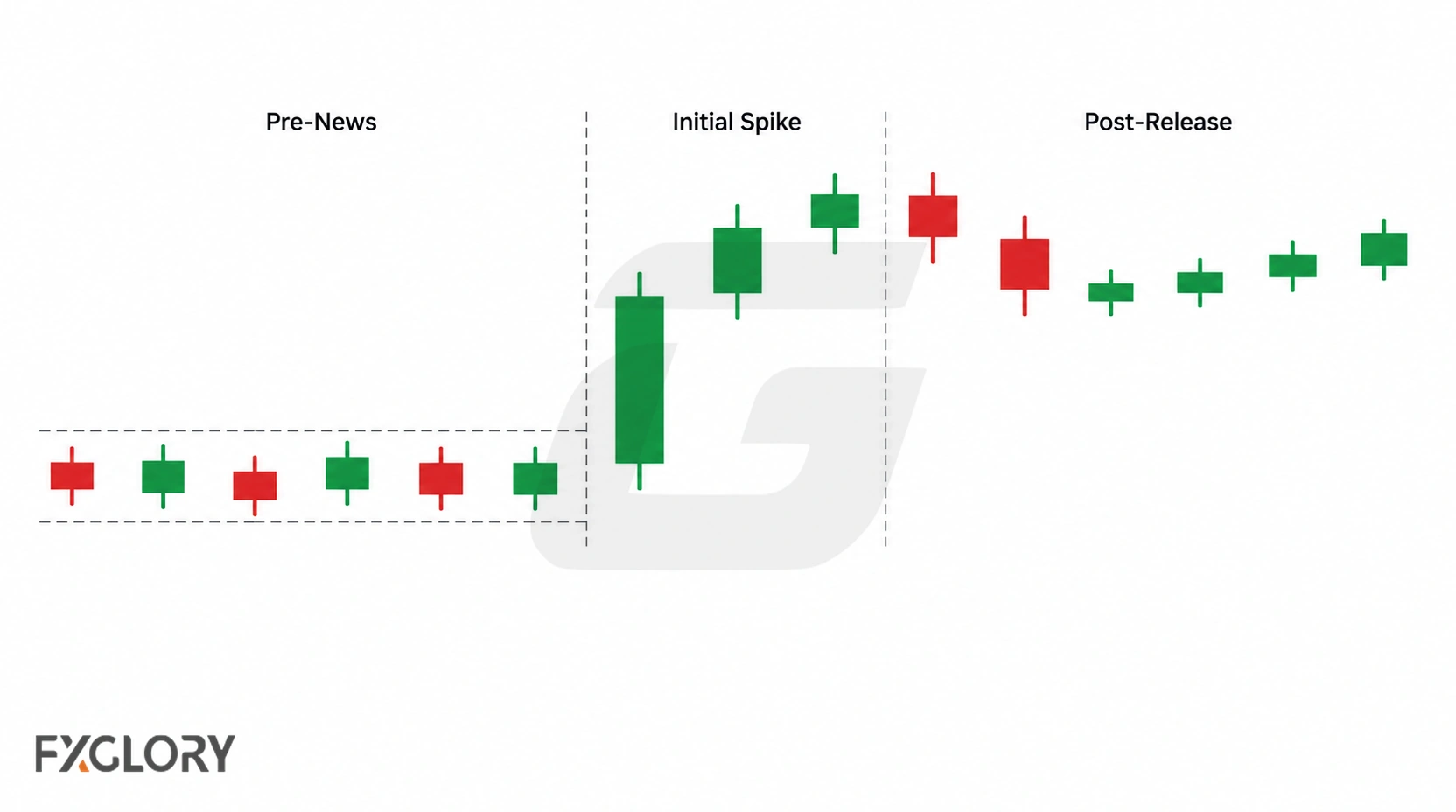
Before the release, price may drift, consolidate, or form a range, but those chart movements do not reveal why they occurred or predict the event’s direction. The initial spike can move quickly beyond that range; a first wick is not the same as a completed-candle breakout, and execution conditions must still be checked.
After the first reaction, compare completed candles with the original range and the planned trigger. Price may consolidate, continue beyond the range, or return inside it as additional details emerge. A continuation or reversal should be classified from observable price structure, and the original trade idea must be reassessed if its specified invalidation condition occurs.
Directional vs Non-Directional News Trading
News traders often use either directional or non-directional logic. Directional logic means the trader has a view on which currency should strengthen or weaken after the event. Non-directional logic tries to trade volatility without predicting the final direction.
| Approach | How It Works | Risk | Where It Can Go Wrong |
|---|---|---|---|
| Directional bias | Trader expects one currency to strengthen or weaken from the release | Actual data, revision, or market reaction can oppose the view | Trader focuses on the headline and ignores expectations or positioning |
| Post-release directional | Trader waits for data and reaction before choosing direction | Entry may be late and target room smaller | Trader chases the first candle after most movement already occurred |
| Non-directional volatility | Trader tries to trade the movement caused by news rather than direction | Whipsaw, double triggering, spread widening, and slippage | Trader assumes volatility equals opportunity without an invalidation rule |
| Straddle-style logic | Buy-stop and sell-stop style ideas are placed around price before a release | False breaks, widened spreads, both sides affected, poor fills | Trader treats straddle as automatic news exposure instead of a tested order plan |
A forex straddle strategy requires specific order-distance, spread, stop and cancellation rules. Both orders may trigger before a cancellation completes. Account permissions for short-duration trades and rapid opposite positions must be checked first; two pending orders are not an exemption from FXGlory trading conditions.
Post-Release Confirmation Method
Post-release confirmation is a more patient way to review news. Instead of guessing the outcome before the data or reacting inside the first seconds, the trader waits for the initial spike to show direction, then checks whether price holds, rejects, consolidates, or reverses.
This method can reduce some impulse decisions, but it does not remove risk. By the time confirmation appears, part of the move may already be gone. The remaining target must still make sense after spread, slippage, stop distance, and nearby support or resistance.
| Confirmation Step | Question | Continue Only If |
|---|---|---|
| Initial spike | Did price move sharply after the release? | The move is not already too extended for the planned stop and target |
| Hold or rejection | Does price hold beyond a level or return inside the old range? | The reaction creates a clear structure to review |
| Spread check | Has spread returned to a level that fits the plan? | The target is not damaged by cost |
| Invalidation | Where is the post-news idea wrong? | The stop or cancellation level is clear before entry |
| Second-wave risk | Is another release, speech, revision, or press conference still active? | The trade is not exposed to unplanned follow-up risk |
Use entry, invalidation, and exit rules to decide whether a post-release reaction is still actionable or only a late chart observation.
Spike Fade vs Continuation Review
After the first news spike, some traders review whether the move is likely to fade back toward the pre-news area or continue in the breakout direction. Neither idea should be treated as a signal. Both require context, spread review, invalidation, and a reason the first reaction still matters.
| Post-News Idea | What It Reviews | Weak Use |
|---|---|---|
| Spike fade review | Whether the first move was overextended, liquidity-driven, or rejected after details were digested. | Trader sells strength or buys weakness only because the first candle is large. |
| Continuation review | Whether price stabilizes and continues after the release changes expectations. | Trader chases the first spike without waiting for structure or spread normalization. |
| Range return | Whether price breaks out and then returns inside the pre-release range. | Trader assumes every failed break becomes an opposite trade. |
| Stand-aside result | Whether the event is too mixed, thin, or extended to review cleanly. | Trader forces a trade because the event was high impact. |
If the post-news move forms around a visible level, use support and resistance rules for level quality instead of treating the spike itself as a complete setup.
News Breakout From Pre-Release Consolidation
Some news trades start from a visible range before the release. A consolidation may be visible on the chart before publication. After the release, price can break above or below that range; price alone cannot identify exactly which orders or traders caused the move.
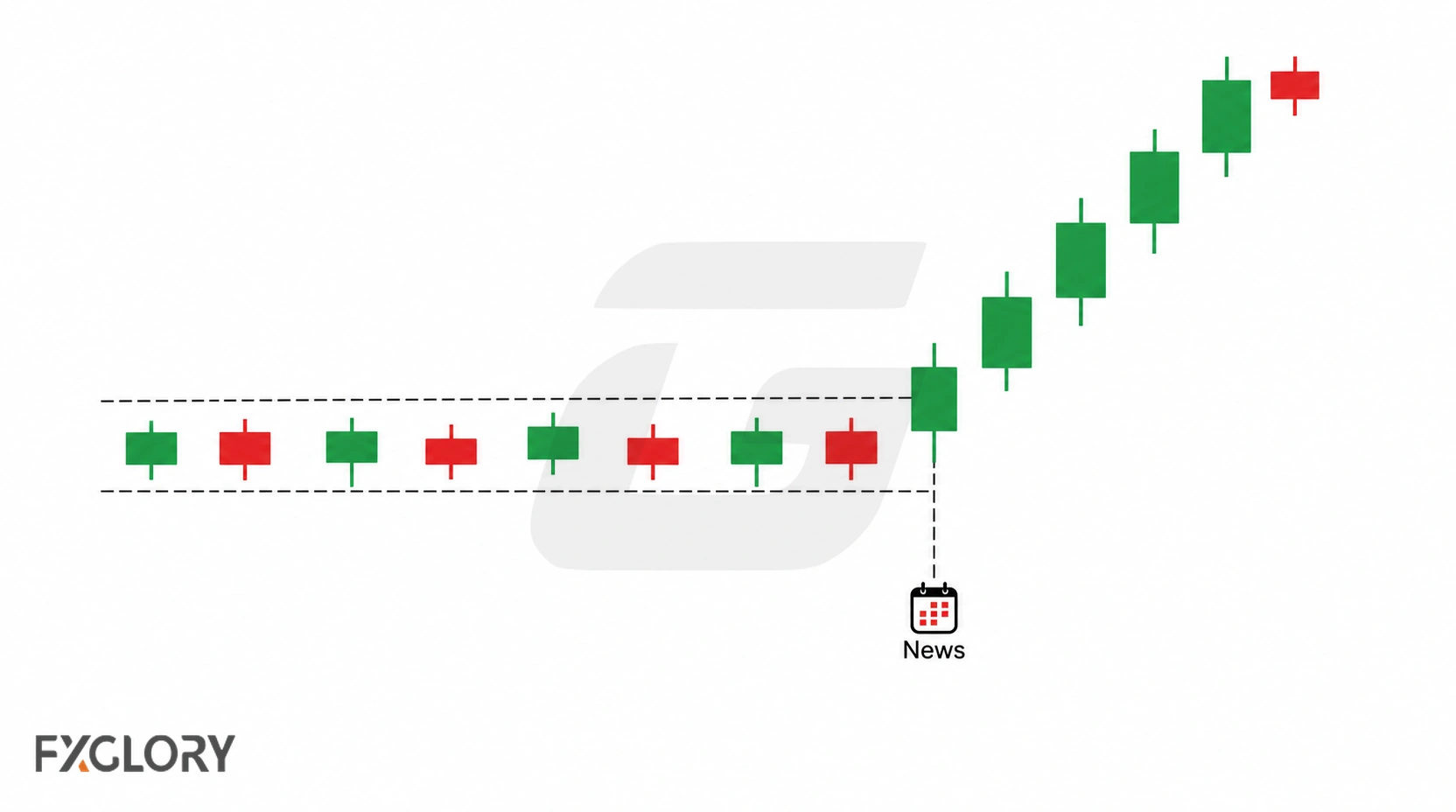
The risk is that the first break can be false. Spread can widen around the range edge. A stop can be triggered by a spike before price returns inside the range. A breakout that looks clean after the fact may have been difficult to execute in real time.
| Breakout Component | Useful Version | Weak Version |
|---|---|---|
| Pre-release range | Clear support and resistance form before the event | Range is drawn after the spike to fit the move |
| Break candle | Price closes or holds beyond the level under the written rule | Trader enters on the first wick through the level |
| Spread condition | Spread and target room still fit the plan | Wide spread turns the range edge into a poor entry area |
| Retest or hold | Price respects the broken area or builds structure after the move | Price breaks and immediately returns inside the range |
| Exit plan | Target, trailing rule, time rule, or invalidation is known | Trader holds because the release felt important |
For full breakout structure, retests, fakeouts, and cancellation rules, use the forex breakout strategy guide.
Choosing Currency Pairs For News Trading
Pair selection should begin with the affected currency. A U.S. release usually makes USD pairs relevant for review. A U.K. release makes GBP pairs relevant. Euro-area data makes EUR pairs relevant. Japanese data makes JPY pairs relevant. A trader should also check whether the pair is liquid enough, whether the spread fits the plan, and whether the session supports execution.
Currency-pair direction matters. If the affected currency is the base currency, strength in that currency can push the pair higher under normal conditions. If the affected currency is the quote currency, strength in that currency can push the pair lower. That relationship can be distorted by wider risk sentiment, another currency's news, or a market reaction that was already priced in.
| Release Area | Pairs Usually Reviewed First | Extra Check |
|---|---|---|
| United States | USD pairs | USD is involved in many major pairs, but the other currency still matters |
| Euro area | EUR pairs | Country-level data may not affect EUR the same way as ECB-level events |
| United Kingdom | GBP pairs | Check whether the release occurs during active GBP liquidity |
| Japan | JPY pairs | Risk sentiment and yield expectations can affect JPY reaction |
| Switzerland | CHF pairs | Safe-haven behavior can change the reaction during global stress |
| Australia or New Zealand | AUD or NZD pairs | Commodity and China-related sentiment may influence reaction |
Before choosing a pair, review available forex markets on the currency-pairs page. If the event creates movement across timeframes, separate higher-timeframe context from the entry chart with multiple-time-frame analysis.
Spread, Slippage, Liquidity, And Execution Risk
Execution risk is one of the most important parts of a forex news trading strategy. A release can create a valid market idea but still be a poor trade if spread widens, liquidity thins, price jumps past the planned level, or the stop distance becomes too large for the account.
During major news, a trader may see a different trading environment from normal conditions. Bid and ask prices can move quickly. Pending orders can trigger in unstable conditions. Market orders can be filled at the available price rather than the price the trader expected. Stops can execute under worse conditions when price moves fast.
| Execution Issue | Why It Matters | Better Rule |
|---|---|---|
| Spread widening | Entry cost increases and small targets become weaker | Check spread conditions before accepting the setup |
| Thin liquidity | Price can jump between levels and fills can worsen | Review liquidity risk before trading the first spike |
| Slippage | Entry, stop, or exit may occur away from the intended price | Reduce or skip exposure when slippage would break the plan |
| Leverage exposure | A small fast move can create larger account impact | Review leverage conditions and use account-level limits |
| Margin pressure | Fast adverse movement can pressure available margin | Use the margin calculator before risk is active |
| Platform workflow | Fast events leave little time to correct order mistakes | Practice order workflow on the available trading platforms before live exposure |
| Account conditions | Trading conditions can affect position handling | Review trading account conditions before using any fast strategy |
Order-Type And Pending-Order Caution
News trading often tempts traders to use market orders, stop orders, or pending orders close to the release. Each order type can behave differently when the market is moving quickly. A pending order can trigger during spread expansion. A market order can fill at the next available price. A stop can execute after price has already jumped beyond the planned level.
| Order Issue | Possible Problem During News | Planning Rule |
|---|---|---|
| Market order | Fill price may differ from the price expected on screen. | Do not use impulse execution without slippage tolerance and position-size review. |
| Pending stop order | Order may trigger on a spike or widened spread. | Place only under a tested rule that accounts for spread and invalidation. |
| Very tight stop | Normal news noise can trigger the stop quickly. | Use invalidation, volatility, and account risk instead of an arbitrary small distance. |
| Small target | Spread and slippage can consume the practical target room. | Accept the setup only if target room remains after trading costs. |
Forex News Trading Decision Sequence
A news strategy should follow the same sequence each time. If the trader starts with a fast candle and then searches for reasons afterward, the decision cannot be reviewed cleanly.
| Step | Decision | Continue Only If |
|---|---|---|
| 1. Event selection | Identify the release, speech, or headline being reviewed | The event concerns the pair's base or quote currency, or an explicitly identified shared market driver |
| 2. Expectation check | Record forecast and prior value before publication; review actual result and revisions after publication | Published figures are available, conflicting components are identified, and the plan has an observable reaction trigger |
| 3. Pair selection | Choose the pair most directly affected by the release | The pair has acceptable spread, liquidity, and session conditions |
| 4. Timing method | Use before-release, during-release, post-release, or no-trade rules | The chosen timing method was written before the event |
| 5. Market context | Review trend, range, consolidation, support, resistance, or volatility state | A predefined range boundary, support/resistance area, completed candle, or other measurable condition is visible |
| 6. Execution check | Review spread, slippage risk, platform workflow, and order type | Execution conditions do not break the plan |
| 7. Entry trigger | Define the exact condition that starts risk | The trigger appears without chasing an already exhausted move |
| 8. Invalidation | Define where the news idea is wrong or canceled | The stop or cancellation rule is clear before entry |
| 9. Exit rule | Set target, trail, time exit, partial exit, or invalidation exit | The exit is not invented after the trade becomes stressful |
| 10. Account risk | Check position size, leverage exposure, margin, and daily limit | Exposure and the proposed order method fit the specific account conditions and the event-risk limit |
For account-level sizing and loss-limit rules, use the forex risk-management strategy guide. For trend context after the release, use the trend-trading decision framework.
No-Trade Conditions Around News
No-trade conditions are essential in news trading because the market can move quickly enough to make late decisions expensive. A skipped release is not a failed strategy. It is the correct result when the plan's conditions are not present.
| No-Trade Condition | Why It Matters | Action |
|---|---|---|
| Spread is wider than the plan allows | Entry cost and stop distance may no longer make sense | Skip until spread conditions normalize |
| Price already moved too far | Chasing can leave poor target room and wide invalidation | Wait for a new structure or stand aside |
| Data is mixed | Headline, core, revision, and guidance may conflict | Wait for clearer market interpretation |
| First reaction reverses quickly | The initial spike may have been liquidity-driven or overextended | Do not re-enter without a separate setup |
| No clear invalidation | The trader cannot define where the idea is wrong | Do not open the trade |
| Another release or speech is due | Second-wave risk can change the trade logic | Wait until the event sequence is clearer |
| Liquidity is thin | Fills, stops, and exits may become unreliable | Reduce exposure or skip according to the written rule |
| Position size depends on hope | Fast movement can turn small errors into larger account pressure | Size only after stop distance and margin are known |
| Trade exists because of fear of missing out | Urgency can replace structure | Stand aside and review the event later |
| Daily risk rule is already reached | News volatility can encourage recovery trading | Stop trading for the session |
Testing And Review Before Live Trading
A forex news trading strategy should be tested before it is used with real funds. Testing does not mean finding one dramatic event that worked. It means reviewing many events and recording whether the same rules could be followed under different spread, volatility, and reaction conditions.
Record both taken and skipped events. Skipped events reveal whether the trader can follow no-trade rules when price moves without them. Taken events reveal whether the entry, invalidation, exit, and risk decisions were written before the release or improvised during volatility.
- Record the event name, release time, affected currency, forecast, actual, previous result, and revision.
- Record whether the event was scheduled, unexpected, or part of a wider central-bank communication sequence.
- Record whether the release was clearly better, worse, mixed, or already expected by the market.
- Record the selected pair and why that pair was chosen.
- Record spread behavior before, during, and after the release.
- Record the first spike, reversal, continuation, consolidation, or failed break.
- Record whether the trade used pre-release, during-release, post-release, or no-trade timing.
- Record the entry trigger, invalidation, stop distance, target, time exit, and cancellation rule.
- Record slippage, order behavior, stop behavior, and whether the execution matched the plan.
- Record position size, margin use, leverage exposure, and account-level loss limit.
- Record whether the result came from following rules or from reacting emotionally.
Testing should also include platform workflow. A trader should know how orders, chart views, alerts, stops, and account information behave before volatility increases.
News-Timing Test Notes For Forex News Trading Strategy
This hypothetical educational news-timing model uses one post-news timing rule. It reviews high-impact calendar events, builds a pre-release range, identifies the first 15-minute spike after the release, compares first-spike timing with 15-minute, 30-minute, and 60-minute confirmation timing, applies spread and slippage assumptions, and records whipsaw exits. It does not test pre-release positioning, straddle orders, discretionary headline reading, first-second execution, spike fading, every news event type, or every news trading method.
The model reviewed EURUSD, GBPUSD, USDJPY, AUDUSD, USDCAD, and USDCHF on public yfinance 15-minute OHLC data where available. Event timing comes from a one-time public TradingView/Reuters economic-calendar snapshot saved with the backtest record. The model uses post-release price reaction; it does not assign bullish or bearish meaning from actual, forecast, previous, or revision values.
| Rule Area | Educational Model Rule |
|---|---|
| Strategy type | High-impact news first-spike versus post-news waiting-period confirmation model |
| Event filter | High-impact events only, with event currency matching the base or quote currency of the reviewed pair |
| Pre-release range | Last 8 completed 15-minute candles before the event timestamp |
| Range width filter | At least 3 pips and no more than 120 pips |
| First-spike candle | First completed 15-minute candle starting at or after the event timestamp |
| First-spike direction | Close outside the pre-release range by 0.15 to 1.50 ATR(14), with close near the candle extreme |
| Timing variants | First spike, 15-minute confirmation, 30-minute confirmation, and 60-minute confirmation |
| Confirmation rule | Confirmation direction must match the first spike, hold outside the pre-release range, close on the correct side of EMA(20), and avoid excessive extension |
| Entry | Next 15-minute open after the timing-variant signal candle |
| Stop | Beyond the opposite side of the pre-release range with a 0.20 ATR(14) buffer |
| Target comparison | Fixed 1.2R target from entry |
| Whipsaw exit | Exit when a completed 15-minute candle closes back inside the pre-release range against the trade |
| Maximum holding review | 8 fifteen-minute candles after entry |
The review records event count, event-pair candidates, first-spike candidates, accepted trades, rejected candidates, rejection reasons, trade count, win rate, average win in R, average loss in R, expectancy in R, profit factor, maximum drawdown in R, worst losing streak, average holding period, timing-variant behavior, pair-level behavior, event-currency behavior, whipsaw exits, exit reasons, and spread/slippage sensitivity.
| Cost Input | Assumptions Used |
|---|---|
| Spread | 0.5, 1.5, and 3.0 pips |
| Slippage | 0.1, 0.5, and 1.0 pips per side |
| Baseline comparison | 1.5-pip spread and 0.5-pip slippage per side |
| Swap and rollover | Not included |
Educational News-Timing Test Results
The hypothetical news-timing test used public yfinance 15-minute OHLC data and a one-time public economic-calendar snapshot. The baseline cost assumption used a 1.5-pip spread and 0.5-pip slippage per side. The overall baseline result was positive, with expectancy of 0.3886R and total net result of 6.2175R. The first-spike variant was negative, with -0.2877R expectancy and a 75.0% whipsaw exit rate.
The 16 accepted entries are timing-variant observations, not necessarily 16 independent news events. There are only four observations per variant, so apparent differences between timing methods are especially unstable.
A qualifying event can contribute several alternative timing observations when each rule is satisfied. Comparing those related scenarios does not establish how 16 independent live trades would perform.
| News-Timing Control Metric | Result |
|---|---|
| Raw calendar items found | 281 |
| Normalized snapshot events saved | 238 |
| High-impact events loaded | 11 |
| Event-pair candidates | 31 |
| First-spike candidates | 12 |
| Accepted trades | 16 |
| Rejected candidates | 51 |
| Rejection reasons | No valid first spike or pre-release range: 19; same-pair timing-variant overlap: 32 |
| Calendar snapshot window | 2026-05-01T07:32:53.913Z to 2026-06-30T07:32:53.913Z |
| Baseline Metric | Result |
|---|---|
| Number of trades | 16 |
| Win rate | 81.25% |
| Average win | 0.5927R |
| Average loss | -0.496R |
| Expectancy | 0.3886R |
| Profit factor | 5.1786 |
| Maximum drawdown | -1.0723R |
| Worst losing streak | 2 |
| Average holding period | 6.5 fifteen-minute candles |
| Median holding period | 8 fifteen-minute candles |
| Total net result | 6.2175R |
| Whipsaw exit rate | 18.75% |
Timing-Variant Baseline Results
| Timing Variant | Trades | Win Rate | Expectancy | Profit Factor | Total Net Result | Whipsaw Exit Rate |
|---|---|---|---|---|---|---|
| First spike | 4 | 25.0% | -0.2877R | 0.2266 | -1.1507R | 75.0% |
| 15-minute confirmation | 4 | 100.0% | 0.7542R | Infinity | 3.0168R | 0.0% |
| 30-minute confirmation | 4 | 100.0% | 0.5959R | Infinity | 2.3836R | 0.0% |
| 60-minute confirmation | 4 | 100.0% | 0.492R | Infinity | 1.9679R | 0.0% |
Pair-Level Baseline Results
| Pair | Trades | Win Rate | Expectancy | Profit Factor | Total Net Result | Whipsaw Exit Rate |
|---|---|---|---|---|---|---|
| EURUSD | 4 | 75.0% | 0.3125R | 4.0074 | 1.25R | 25.0% |
| GBPUSD | 4 | 100.0% | 0.6202R | Infinity | 2.4808R | 0.0% |
| USDCAD | 4 | 75.0% | 0.3515R | 3.4392 | 1.406R | 25.0% |
| USDCHF | 4 | 75.0% | 0.2702R | 3.1793 | 1.0807R | 25.0% |
Exit Reasons
| Exit Reason | Trades |
|---|---|
| target 1.2R | 1 |
| time exit | 12 |
| whipsaw close back inside range | 3 |
Spread And Slippage Sensitivity By Timing Variant
| Timing Variant | Cost Setting | Spread / Slippage Per Side | Expectancy | Total Net Result | Whipsaw Exit Rate |
|---|---|---|---|---|---|
| First spike | Low tested cost | 0.5 / 0.1 | -0.2258R | -0.9032R | 75.0% |
| First spike | Baseline cost | 1.5 / 0.5 | -0.2877R | -1.1507R | 75.0% |
| First spike | High tested cost | 3.0 / 1.0 | -0.3736R | -1.4945R | 75.0% |
| 15-minute confirmation | Low tested cost | 0.5 / 0.1 | 0.8154R | 3.2617R | 0.0% |
| 15-minute confirmation | Baseline cost | 1.5 / 0.5 | 0.7542R | 3.0168R | 0.0% |
| 15-minute confirmation | High tested cost | 3.0 / 1.0 | 0.6692R | 2.6767R | 0.0% |
| 30-minute confirmation | Low tested cost | 0.5 / 0.1 | 0.6552R | 2.6207R | 0.0% |
| 30-minute confirmation | Baseline cost | 1.5 / 0.5 | 0.5959R | 2.3836R | 0.0% |
| 30-minute confirmation | High tested cost | 3.0 / 1.0 | 0.5136R | 2.0542R | 0.0% |
| 60-minute confirmation | Low tested cost | 0.5 / 0.1 | 0.5471R | 2.1883R | 0.0% |
| 60-minute confirmation | Baseline cost | 1.5 / 0.5 | 0.492R | 1.9679R | 0.0% |
| 60-minute confirmation | High tested cost | 3.0 / 1.0 | 0.4154R | 1.6617R | 0.0% |
What This News-Timing Test Shows
The aggregate baseline describes this particular set of accepted timing variants rather than a sequence of independent live-account events. Its positive result must be interpreted alongside event overlap, missing real execution data, and the fact that only USD-linked events reached the accepted sample.
The first-spike cases suffered more whipsaw exits in this sample than the later-confirmation cases. However, four observations in each variant cannot establish that waiting reliably outperforms immediate execution. The reported "Infinity" profit factor for some four-trade variants means no gross losing returns occurred within that tiny group; it does not mean unlimited profit or a dependable edge.
Across the tested cost assumptions, greater spread and slippage reduced expectancy. This comparison is useful for designing more rigorous research with distinct events, longer coverage and realistic account-level execution; it is not a recommendation for a particular waiting period.
Forex News Trading Checklist
Before a news release becomes a trade, the checklist below should already be clear.
- Identify the release, speech, headline, or unexpected event.
- Confirm the affected currency and the pair being reviewed.
- Before the release, note forecast and previous result; after publication, check actual data and any revision.
- Ask whether the result was already priced in.
- Decide whether the trade is pre-release, during-release, post-release, or no trade.
- Check whether the market is trending, ranging, consolidating, or already extended.
- Review support, resistance, range edges, or breakout levels before entry.
- Check spread, liquidity, slippage risk, order type, platform workflow, and the account's restrictions on the proposed news-trading method.
- Reject the trade if the first spike already removed practical target room.
- Define the entry trigger before risk starts.
- Define the invalidation point before entry.
- Calculate position size after stop distance is known.
- Review leverage exposure and margin before placing the order.
- Set the exit method before entry: target, trail, time exit, invalidation, or no trade.
- Cancel the trade if the data is mixed, revisions change the reading, or a second-wave event changes the context.
- Stop trading if the daily risk rule or emotional-control rule is reached.