
Quick Answer: What Does Hawkish Mean in Forex?
The market impact comes from what a hawkish message changes about the expected path of interest rates. Because currencies trade in pairs, traders also compare that shift with the policy outlook for the other currency.
Hawkish Meaning in Forex
Hawkish is a description of monetary-policy tone. A central bank is generally considered more hawkish when it is more willing to keep policy restrictive in order to control inflation, even if that may weigh on growth or borrowing.
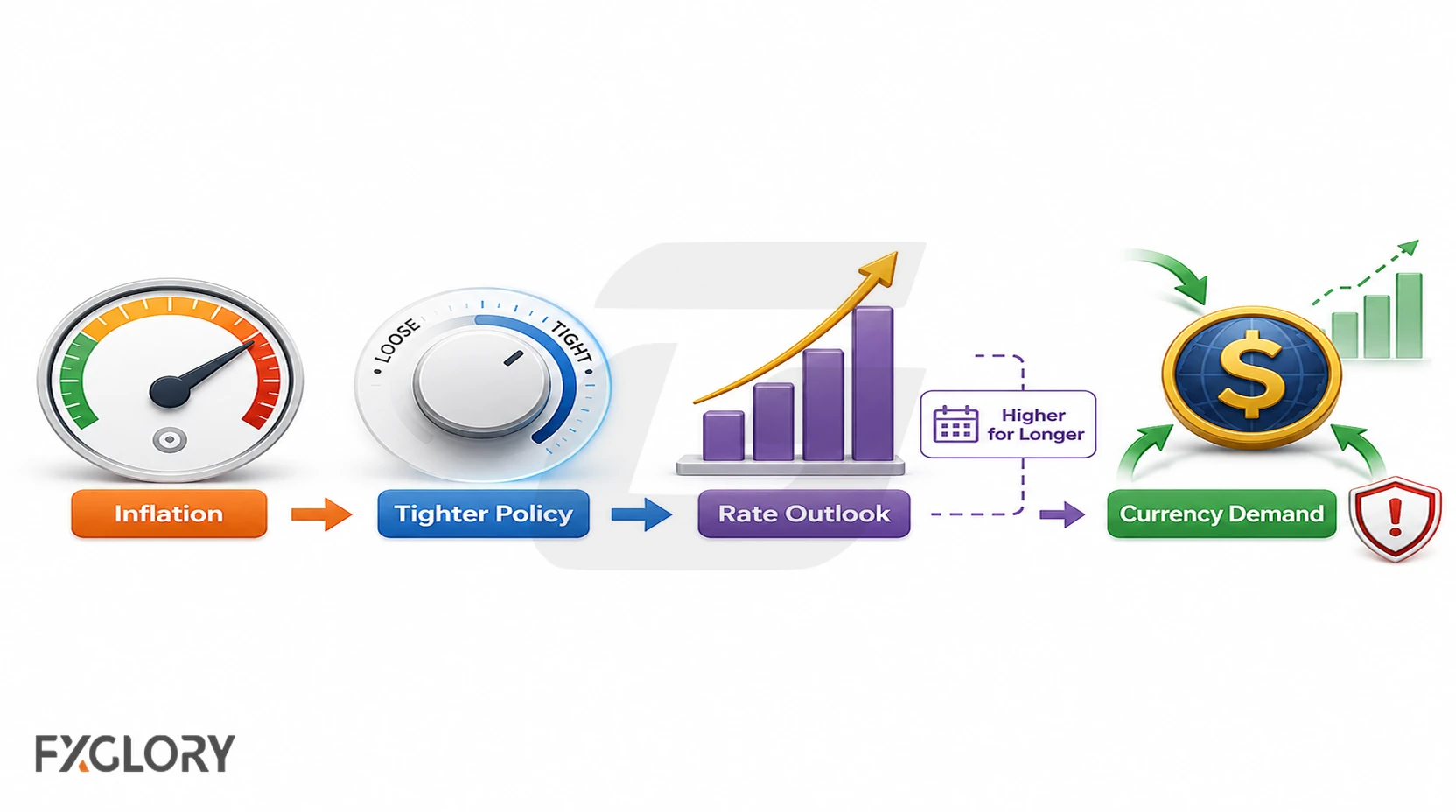
Hawkish signals can include:
- interest rates may rise,
- rates may stay high for longer,
- inflation remains too high,
- future rate cuts may be delayed,
- stimulus may be reduced,
- balance-sheet policy may tighten,
- policy may need to remain restrictive.
Reduced stimulus means the central bank is providing less policy support through tools such as asset purchases or unusually easy financial conditions. Balance-sheet tightening generally means reducing, or no longer expanding, asset holdings in a way that can tighten financial conditions.
Hawkish vs Dovish in Forex
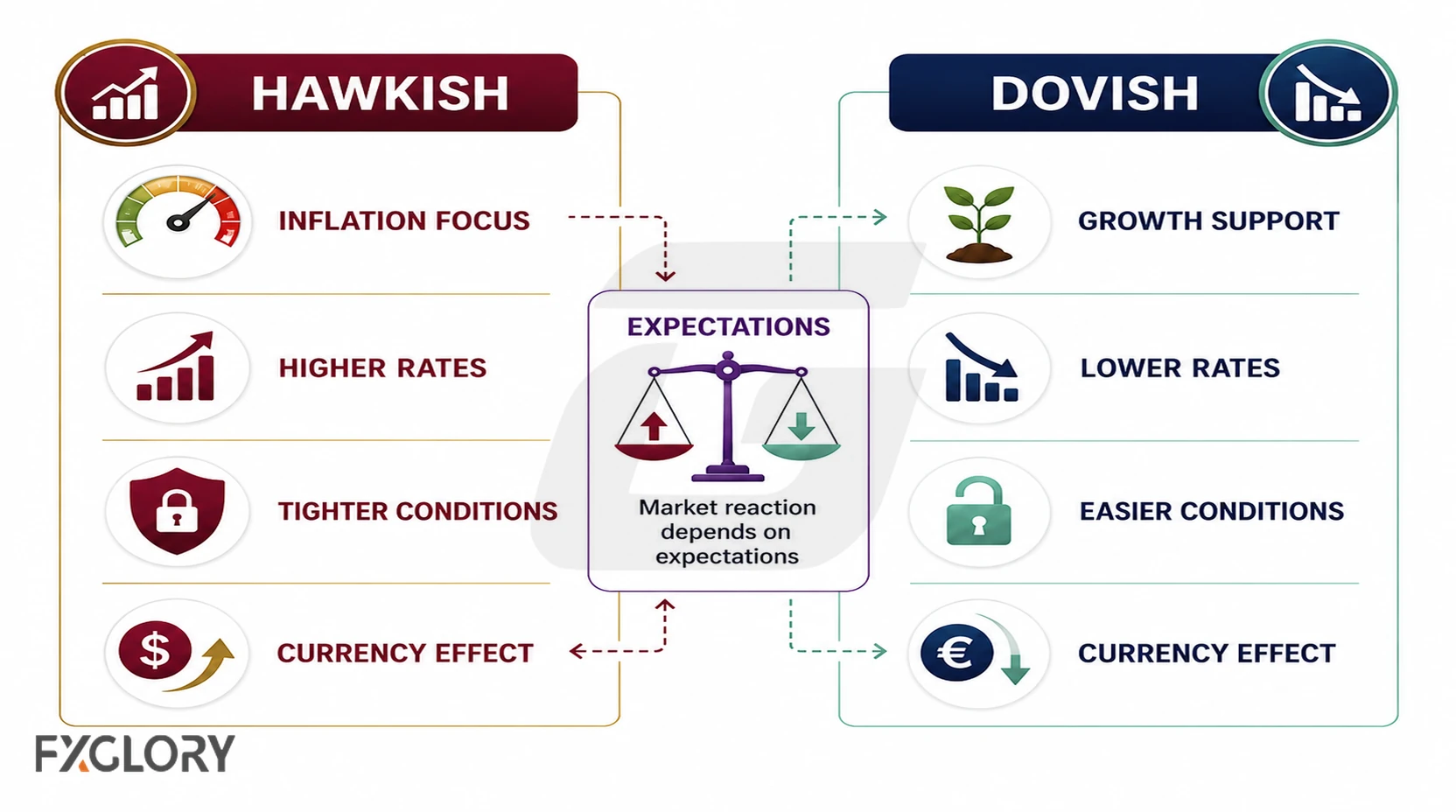
Hawkish and dovish describe opposite monetary-policy biases. Hawkish policy leans toward tighter financial conditions to control inflation, while dovish policy leans toward easier conditions to support growth, employment, or borrowing.
| Term | Policy Bias | Main Focus | Possible Forex Effect |
|---|---|---|---|
| Hawkish | Higher rates, tighter policy, or fewer cuts. | Control inflation. | Can support the currency if the policy path becomes relatively tighter. |
| Dovish | Lower rates, looser policy, or more cuts. | Support growth, jobs, or borrowing. | Can weigh on the currency if the policy path becomes relatively easier. |
The labels describe policy direction; the actual currency move depends on what changes in expected interest-rate differentials and broader market conditions.
Why Hawkish Policy Can Support a Currency
Hawkish policy can support a currency when it raises expected returns on assets denominated in that currency relative to alternatives.
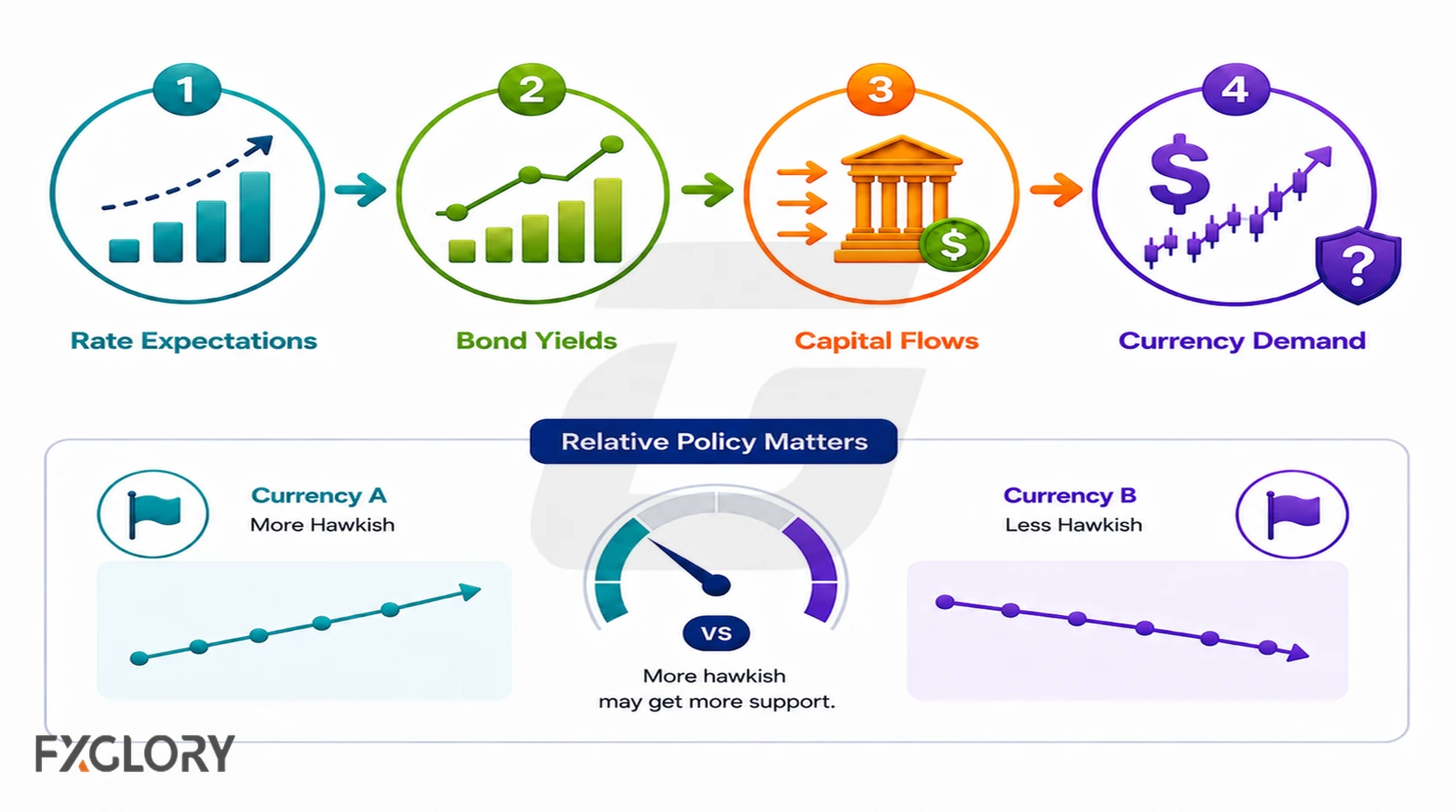
Common transmission channels include:
- Rate expectations: Traders may price a higher future policy-rate path.
- Bond yields: Government yields may rise as markets adjust to tighter expected policy.
- Capital flows: Higher expected returns can attract demand for bonds and other assets denominated in that currency.
- Inflation credibility: Confidence that the central bank will contain inflation can influence longer-term expectations.
- Interest-rate differentials: A wider expected yield advantage can make one currency relatively more attractive than another.
This is why central-bank communication can move major pairs such as EUR/USD, GBP/USD, USD/JPY, and USD/CAD even when the current policy rate itself does not change.
Expected vs Unexpected Hawkish Signals
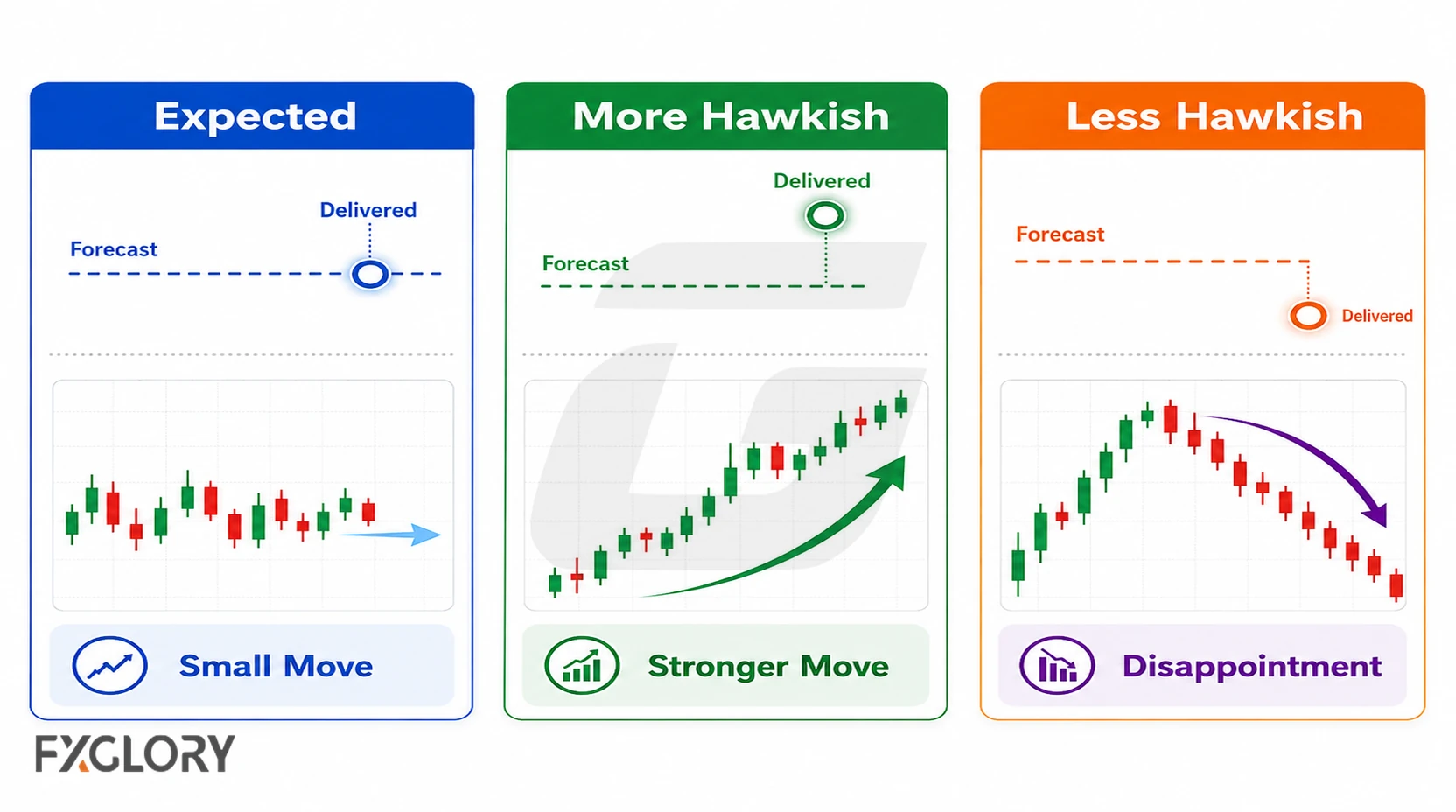
Forex markets respond to the difference between what traders had already priced and what the central bank actually communicates. A hawkish message can have a small effect if it confirms the existing consensus, while a surprise shift can cause a larger repricing.
| Situation | Possible Market Reaction |
|---|---|
| Hawkish and already expected | Limited movement because little new information is being added. |
| More hawkish than expected | The currency may strengthen as markets price a tighter future rate path. |
| Less hawkish than expected | The currency may weaken if traders had anticipated a tougher stance. |
| Hawkish but growth concerns rise | An initial currency gain may fade if tighter policy is seen as damaging growth. |
| Hawkish during thin liquidity | The first move may be unusually sharp or unstable. |
Priced in means an expected event or policy path has already been reflected in market prices before the announcement. Traders may use forecasts, rate-probability tools, government-bond yields, central-bank projections, and positioning to judge how much of a policy outcome is already expected.
Hawkish Central-Bank Signals
A central bank does not need to raise rates to sound hawkish. The stance can appear in rate decisions, policy statements, press conferences, projections, voting patterns, meeting minutes, inflation reports, and speeches.
| Signal | Why Traders May Call It Hawkish |
|---|---|
| Rate hike | Policy is being tightened. |
| Higher inflation forecast | Persistent inflation may justify tighter policy. |
| Higher-for-longer language | Markets may expect later or fewer rate cuts. |
| Further tightening may be appropriate | Future rate hikes remain possible. |
| More policymakers projecting hikes | The expected policy path shifts upward. |
| Less support for rate cuts | Easing may be delayed. |
| Balance-sheet reduction | Monetary support or liquidity is being withdrawn. |
| Inflation remains elevated | The central bank is signaling continued concern about price pressures. |
Common hawkish phrases include:
- Inflation remains elevated.
- Upside inflation risks remain.
- Further tightening may be appropriate.
- Policy needs to remain restrictive.
- Rates may stay higher for longer.
- Premature easing would be risky.
- The committee remains vigilant.
The wording matters because traders are trying to infer the future policy path rather than reading the current rate decision in isolation.
Hawkish Fed Example
A hawkish Fed means the Federal Reserve is signaling a relatively tight U.S. policy path, for example by emphasizing inflation risks, keeping rates high for longer, delaying cuts, or leaving further tightening possible.
Forex traders often assess the Fed through:
- FOMC statements: Official policy language released after a rate decision.
- Fed Chair press conferences: Guidance on inflation, risks, and the likely policy path.
- Dot plot projections: FOMC participants' projections for future policy rates.
- FOMC minutes: Details of policy debate and committee concerns.
- Federal Reserve speeches: Comments from voting and non-voting officials.
- CPI and PCE inflation: Inflation data that can influence expected policy.
- Nonfarm Payrolls: Labor-market data that can affect inflation and rate expectations.
- Treasury yields: A market signal that can reflect changing expectations for U.S. rates.
For example, if the Fed shifts toward a tighter expected path while the European Central Bank shifts toward an easier one, that change in the U.S.-euro rate differential can put downward pressure on EUR/USD. If both policy outlooks move in the same direction by a similar amount, the pair reaction may be smaller.
How Hawkish News Affects Forex Pairs
Because every forex pair contains two currencies, the relevant question is how the policy outlook for one side changes relative to the other.
| Scenario | Possible Pair Logic |
|---|---|
| Fed tightens its outlook while ECB outlook softens | USD may gain relative support against EUR as the expected rate differential moves toward the dollar. |
| Fed message is hawkish but weaker than forecast | USD may fall if markets had positioned for a more restrictive path. |
| Bank of England turns more hawkish while Fed is unchanged | GBP may receive support against USD if UK rate expectations rise relative to U.S. expectations. |
| Bank of Japan unexpectedly tightens its guidance | JPY may strengthen if traders price a less accommodative future policy path. |
| Both central banks shift by a similar amount | The pair may move less because the relative policy gap changes only modestly. |
Hawkish hold, dovish hike and hawkish cut
The headline rate decision does not always capture the policy message:
- Hawkish hold: Rates stay unchanged, but guidance suggests they may remain high or rise later.
- Dovish hike: Rates rise, but guidance points toward a pause or earlier future cuts.
- Hawkish cut: Rates fall, but by less than expected or with guidance pointing to fewer future cuts.
For example, if markets expected a 50-basis-point cut but the central bank cuts only 25 basis points and signals little appetite for further easing, traders may interpret the overall decision as hawkish despite the rate reduction.
Trading Risks Around Hawkish News
Central-bank surprises can move currency pairs quickly, and execution conditions may deteriorate around policy decisions, inflation releases, speeches, or other high-impact events.
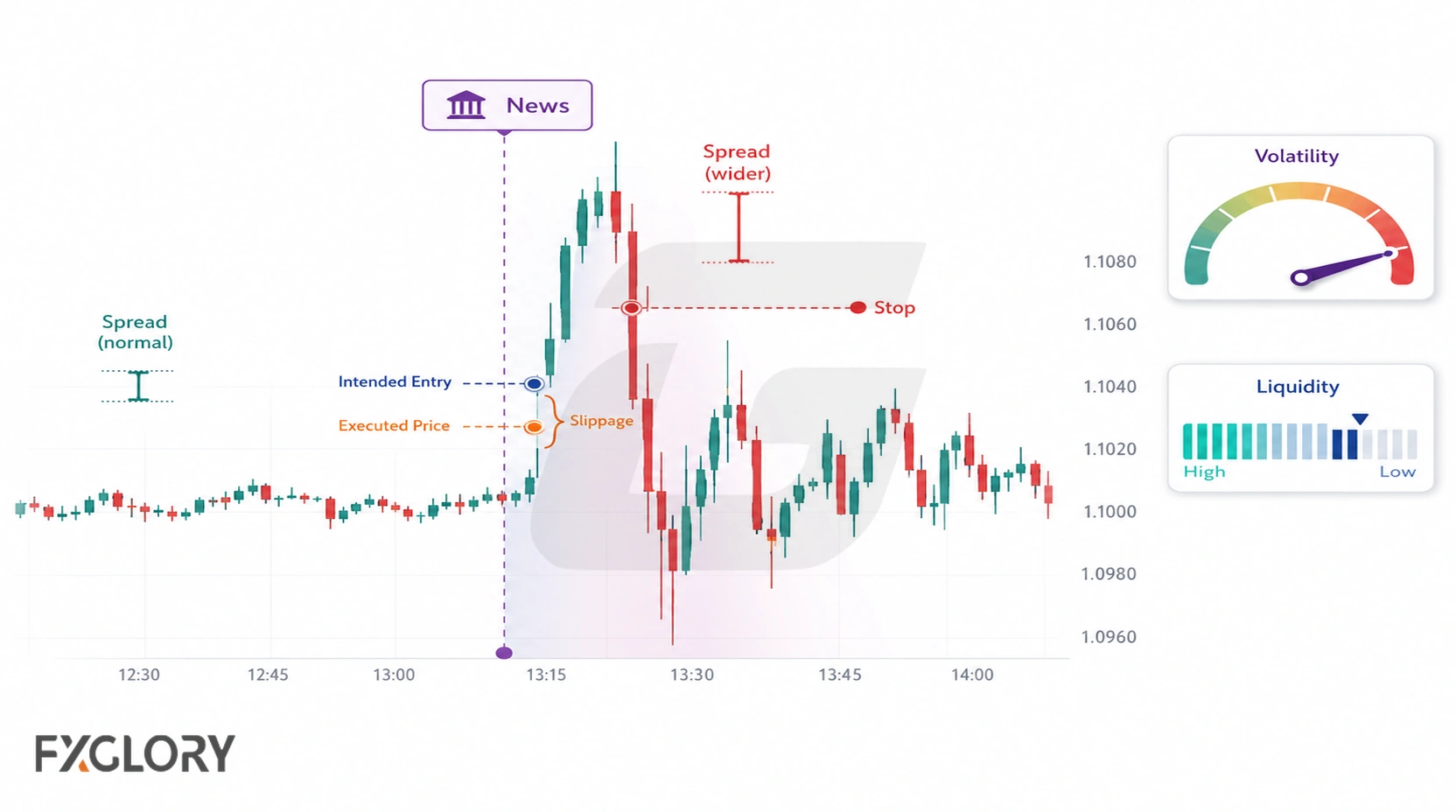
- Fast volatility: Price can move sharply within seconds or minutes.
- Spread widening: Bid/ask spreads may widen as liquidity providers quote more defensively.
- Slippage: Orders may execute at a different price than expected.
- Stop-loss pressure: Rapid price swings can trigger stops quickly.
- Reversals and whipsaws: The first move can fade or reverse as traders digest the full message.
- Thin liquidity: Reduced depth can make price moves less stable.
For related basics, see what is volatility in forex, what is liquidity in forex, and bid and ask price in forex.
Hawkish Forex Checklist
- Identify the central bank and event: Rate decision, statement, press conference, minutes, speech, inflation report, or economic-data release.
- Compare the message with expectations: Determine whether the policy path became tighter, easier, or stayed broadly unchanged.
- Check what changed: Rates, projections, inflation forecasts, voting patterns, balance-sheet policy, or forward guidance.
- Compare the other currency: Assess the second central bank in the pair rather than viewing one currency in isolation.
- Watch government-bond yields: Yield moves can help show whether rate expectations actually changed.
- Check volatility, spreads, and liquidity: Execution conditions can worsen around high-impact events.
- Watch the follow-through: Determine whether the first move is holding, stalling, or reversing.
- Control position size and leverage: Fast policy-driven moves can create outsized account swings.
Common Myths About Hawkish Forex News
- Myth: A rate hike is always hawkish. The market may read a hike as dovish if it is smaller than expected or paired with softer future guidance.
- Myth: Hawkish policy is automatically good for the economy. Tighter policy can help control inflation but may also slow growth and borrowing.
- Myth: Dovish policy is automatically bad. Easier policy can support growth even while reducing expected returns on the currency.
- Myth: The current policy rate tells the whole story. Forward guidance, projections, voting patterns, and the expected path of future rates can matter more than the current setting.
- Myth: The first market move is definitive. Central-bank events can produce reversals as traders process the full statement and press conference.
Quick Recap: Hawkish Meaning in Forex
Hawkish describes a relatively tight monetary-policy stance focused on controlling inflation. For forex, the most important practical questions are whether the policy path changed, whether that change was already expected, and how it compares with the other currency in the pair.
Rate decisions, guidance, bond yields, and market expectations all help explain the reaction. Around major central-bank events, volatility and execution risk can also increase.