
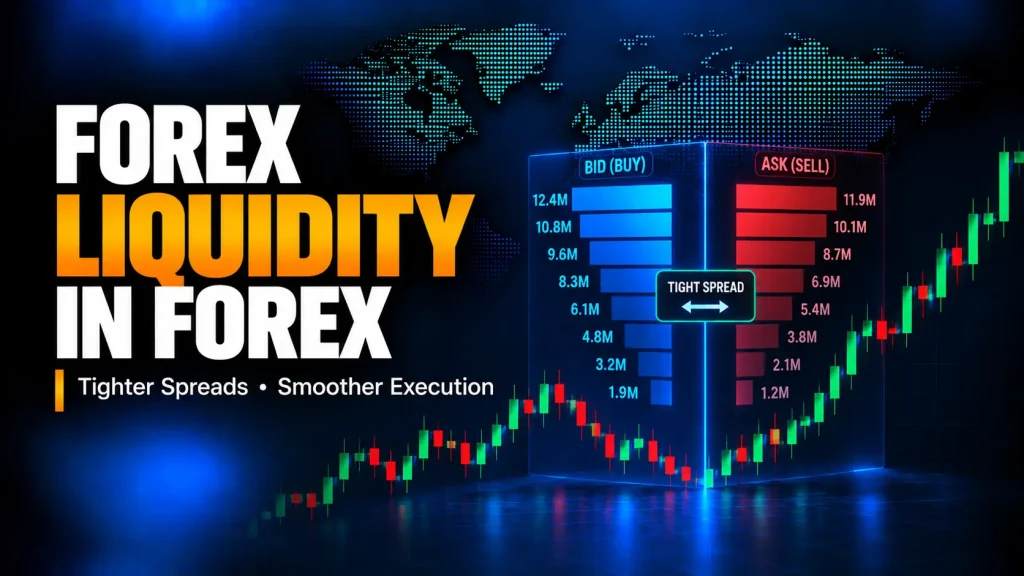
Quick Answer: What Is Liquidity in Forex?
In practical trading terms, liquidity affects how closely the quoted price matches the price at which an order is actually filled. Deep conditions tend to support tighter spreads and more stable execution, while thin conditions can increase trading costs and execution uncertainty.
Available depth also matters. If there are fewer quotes or orders near the current price, a trade may consume the available liquidity and execute across less favorable price levels.
A quote is the bid and ask price shown for a currency pair at a given moment. A fill is the price and amount at which an order actually executes. In liquid conditions, the quote and the fill are often close. In thin or fast markets, the final fill can be worse than the price a trader expected.
For retail traders, liquidity shows up most clearly in spread behavior, slippage, fill quality and how reliably positions can be opened or closed.
Retail traders do not see the full global forex liquidity pool. They usually experience liquidity through a broker, platform, account type, product structure, pricing source, and execution rules.
Forex Liquidity Meaning
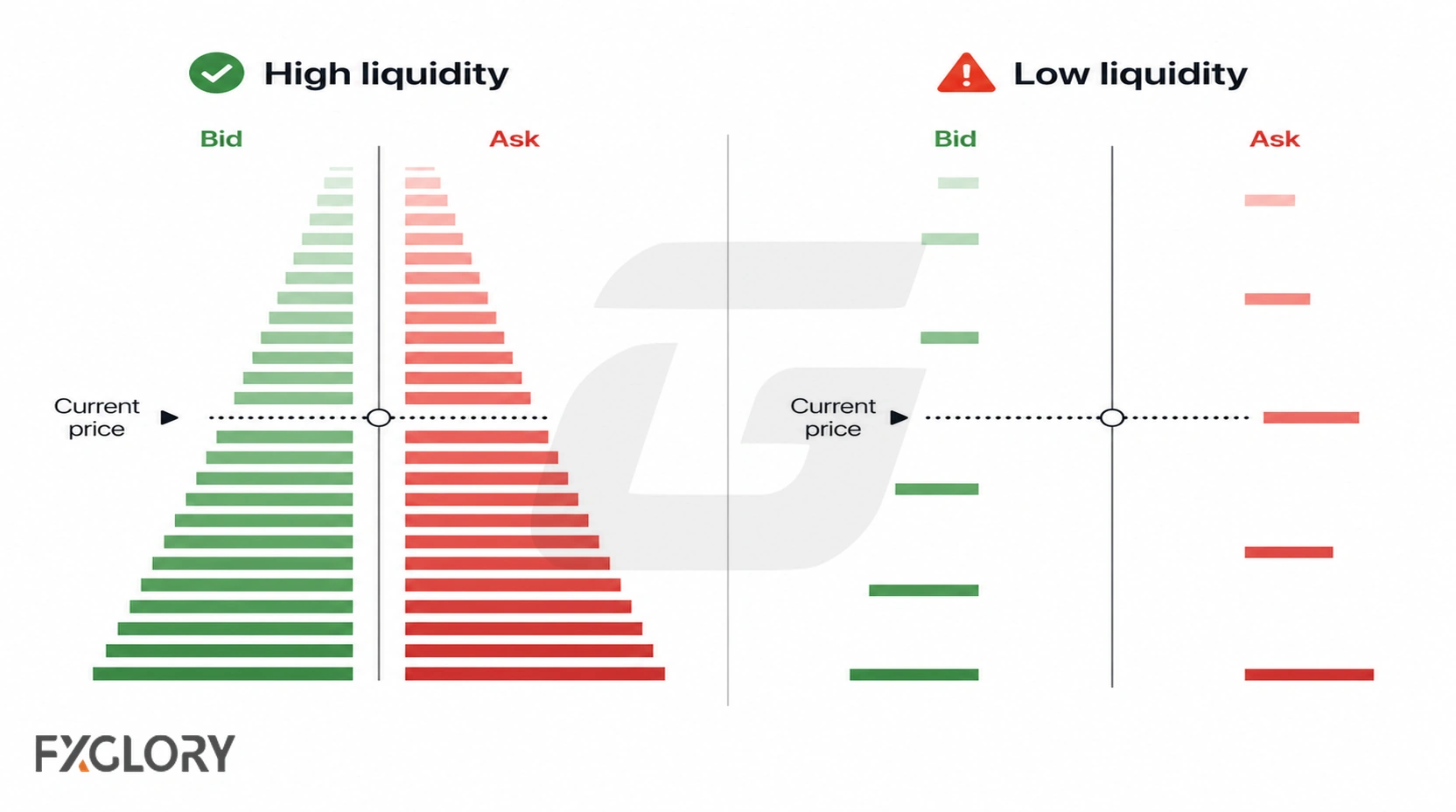
The practical depth of the forex market depends on how much buying and selling interest is available around the current price. The more depth there is across nearby price levels, the more easily orders can usually be absorbed without large execution changes.
Liquidity is not a fixed property. It can change minute by minute depending on the pair, session, news, volatility, broker, liquidity provider behavior, and market risk.
In simple terms:
- High liquidity means many participants are willing to trade near the current price.
- Low liquidity means fewer participants or less available depth near the current price.
- Deep liquidity means there are enough available quotes or orders at multiple nearby price levels to absorb trades more smoothly.
- Thin liquidity means price may jump or slip more easily because there is not enough depth near the current price.
Market depth means how much buying and selling interest is available at different price levels near the current price. If there is not enough available depth at the quoted price, part or all of an order may execute at the next available price.
Liquidity is not only about whether a market is open. A currency pair can be tradable but still have poor liquidity at certain times, around certain events, or through certain pricing sources.
Why Liquidity Matters in Forex Trading
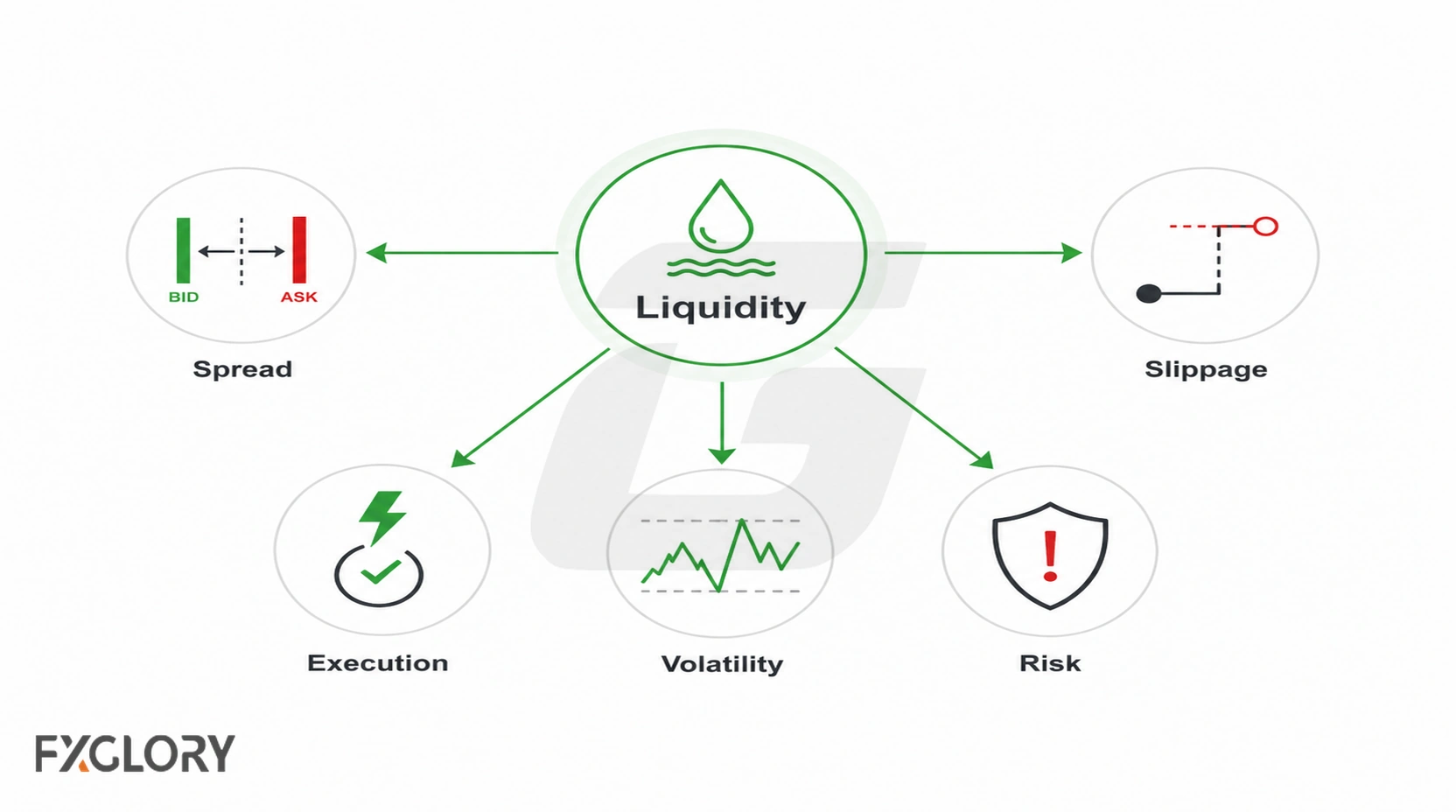
Liquidity matters because it affects the practical cost and risk of every trade. A trader may focus on direction, but execution quality depends heavily on liquidity.
| Liquidity Factor | Why It Matters |
|---|---|
| Spread | High liquidity usually supports tighter bid/ask spreads; low liquidity can widen spreads. |
| Slippage | Thin liquidity can cause orders to fill at a worse price than expected. |
| Execution | Deep liquidity can help trades execute more smoothly, while poor liquidity can create unstable fills. |
| Order size | Larger orders need more available depth and may experience more slippage in thin conditions. |
| Volatility | Low liquidity can make price jumps sharper because fewer orders are available to absorb flow. |
| Risk management | Stops, exits, and position sizing can be affected when spreads widen, price gaps, or liquidity drops. |
Liquidity risk is the risk that a trader cannot enter, manage, or exit a position near the expected price because available depth disappears, spreads widen, or execution conditions change.
A trading setup can look good on a chart but still become risky if liquidity is poor. This is why traders should check spread, session, news timing, pair type, order type, and position size before entering a position.
A stop order may execute worse than the stop level if liquidity is thin, price gaps, or the platform converts the stop into a market order according to its rules.
High Liquidity vs Low Liquidity in Forex
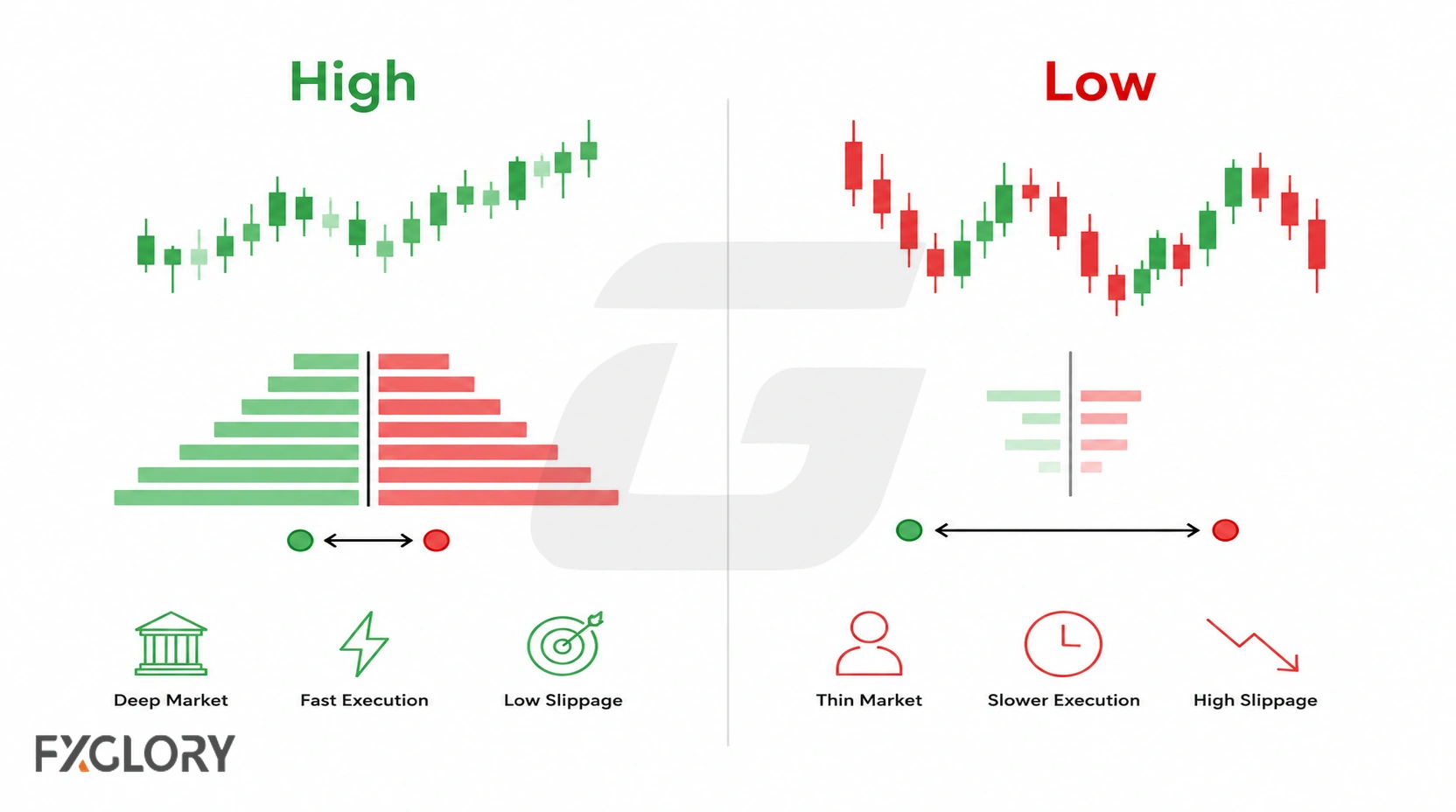
High and low liquidity create very different trading conditions.
| Condition | High Liquidity | Low Liquidity |
|---|---|---|
| Spread | Usually tighter. | Often wider. |
| Execution | Usually smoother under normal conditions. | Can be unstable, delayed, rejected, requoted, or filled worse depending on broker and product rules. |
| Slippage | Usually lower, but still possible. | More likely and potentially larger. |
| Price movement | Often more orderly under normal conditions. | Can be jumpy or erratic. |
| Common examples | Major pairs during active sessions. | Exotic pairs, holidays, rollover, early Monday open, late Friday conditions, thin sessions, or sudden news. |
High liquidity does not mean risk-free. A liquid pair can still move sharply during major data releases, central-bank decisions, geopolitical events, or sudden shifts in risk sentiment. Liquidity helps trading conditions, but it does not remove market risk.
How Liquidity Affects Spread, Slippage and Execution
Liquidity has a direct effect on spread, slippage, and the final price a trader receives.
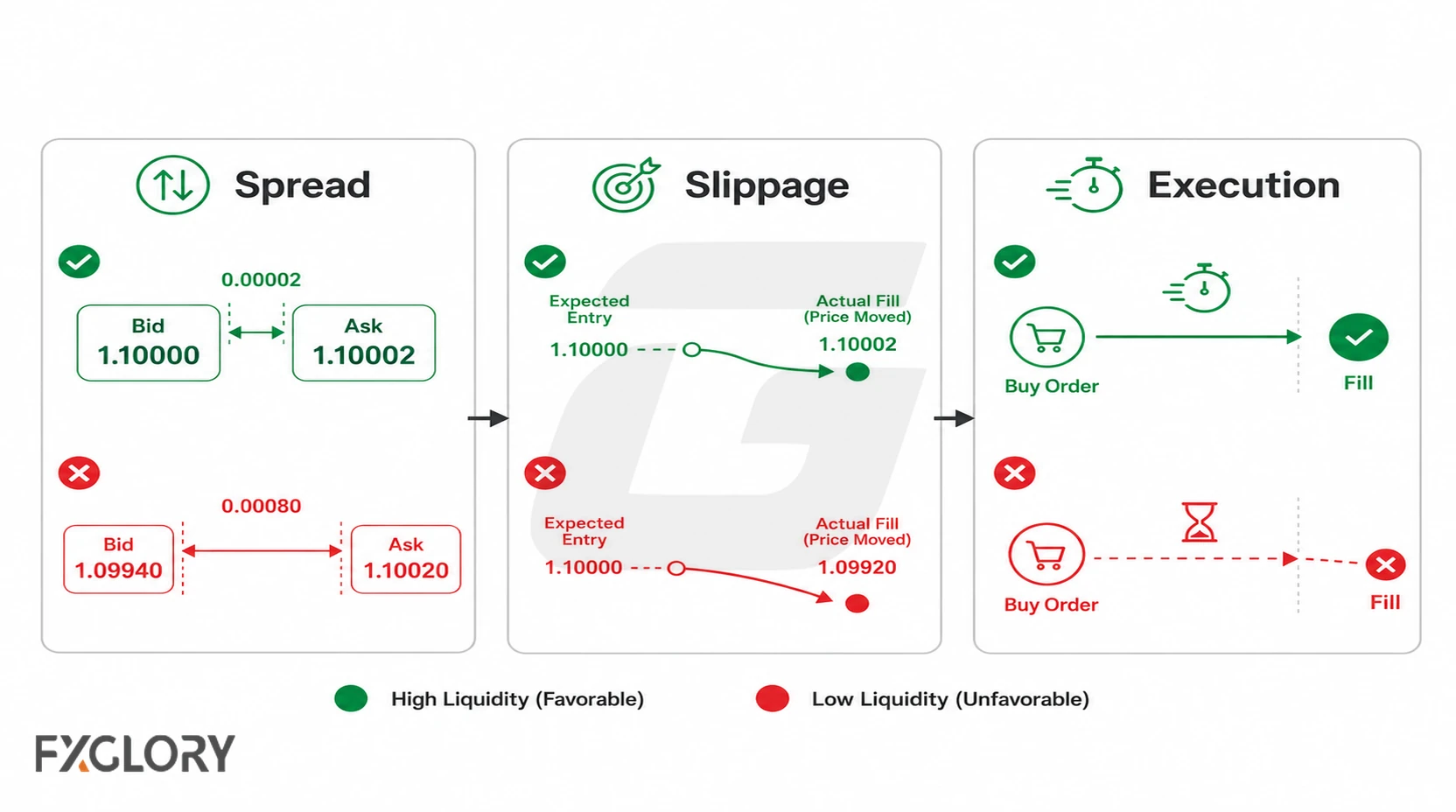
The spread is the difference between the bid price and the ask price. When liquidity is deep, there are usually more buyers and sellers near the current price, which can help keep spreads tighter. When liquidity is thin, liquidity providers may quote more defensively, and spreads may widen.
Slippage happens when an order executes at a different price than expected. Slippage can be positive or negative, although traders usually notice it most when the fill is worse. Slippage can occur in fast markets, thin markets, or when order size is larger than available depth at the quoted price.
If there is not enough bid/ask depth at the displayed price, the order may fill partly or fully at another price. This is why the chart price, quoted price, and final fill price are not always the same.
Retail traders do not trade directly with the entire global liquidity pool. They trade through the pricing, liquidity relationships, execution model, order rules, account type, and product structure available through their broker or platform.
For related basics, see bid and ask price in forex.
Who Provides Liquidity in Forex?
Forex liquidity comes from a network of participants. No single source provides all liquidity for the entire market.
ECNs, or electronic communication networks, are electronic venues that connect participants and help route or match liquidity electronically. A market maker provides bid and ask quotes and manages the risk of taking the other side of flow or offsetting exposure elsewhere.
| Liquidity Source | Role in Forex Liquidity |
|---|---|
| Major banks | Quote prices, handle client flow, trade in the interbank market, and provide large-scale liquidity. |
| Non-bank liquidity providers | Use electronic systems, pricing models, and market-making strategies to quote liquidity. |
| Market makers | Quote buy and sell prices and manage inventory, risk, and flow. |
| ECNs and trading venues | Connect participants and help route or match liquidity electronically. |
| Brokers | Give retail traders access to pricing, platforms, order execution, margin terms, and liquidity relationships. |
| Institutions and funds | Create large order flow that can add or remove liquidity depending on market conditions. |
| Retail traders | Participate through brokers, usually with much smaller individual order flow. |
A retail trader usually does not access the deepest interbank liquidity directly. Retail traders access forex through a broker or platform, and that broker’s pricing, execution model, account type, product structure, and liquidity relationships can affect the trader’s experience.
Broker-displayed liquidity, platform depth, or visible pricing should not be treated as the entire global forex market. Retail depth can be useful, but it may represent only the liquidity available through that platform, account, product, or venue.
For more on the groups behind liquidity, see forex market participants.
Currency Pairs, Trading Sessions and News
Liquidity changes by currency pair. Major currency pairs usually have deeper liquidity because they involve larger economies, more banks, more institutional flow, more global demand, and more active pricing.
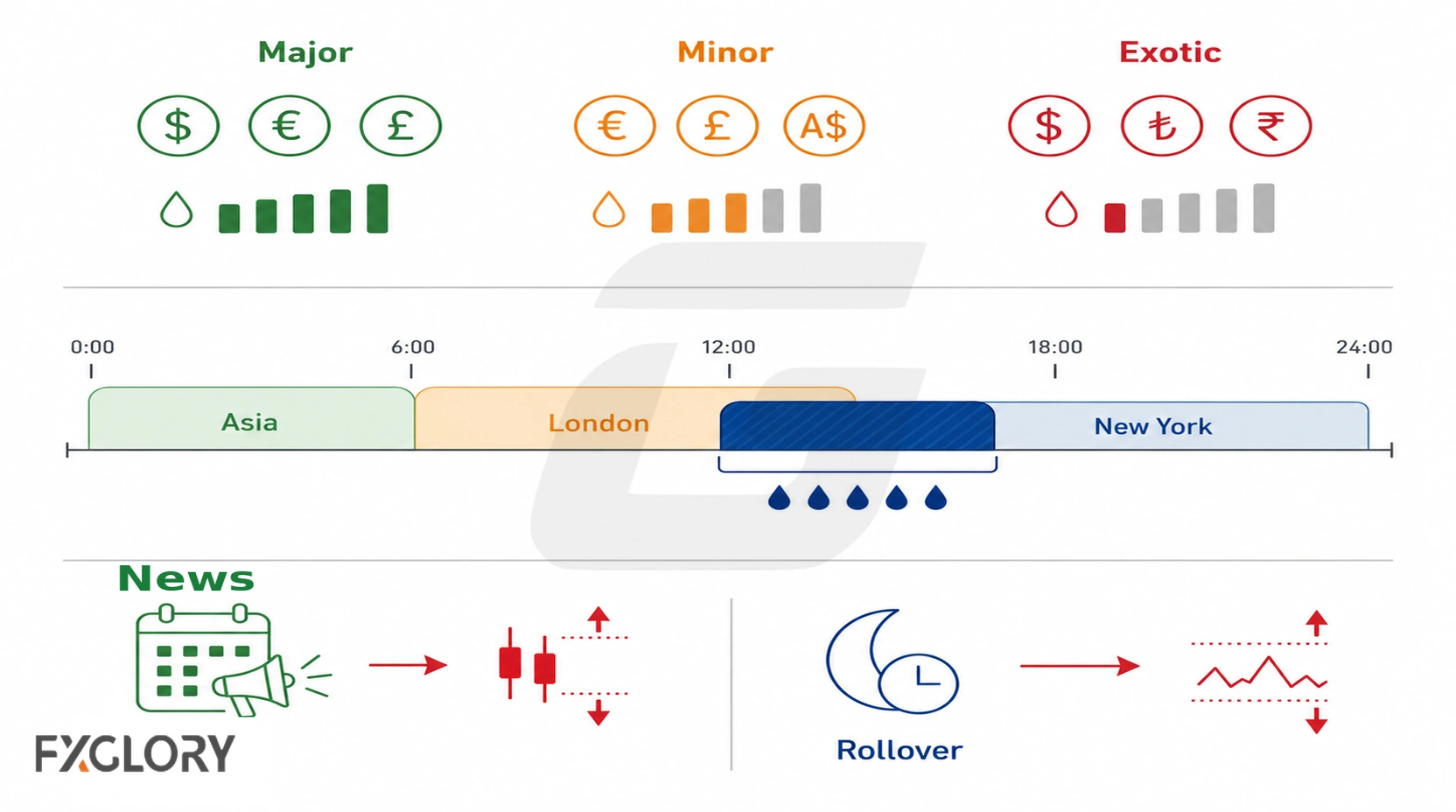
Many of the most liquid pairs involve the U.S. dollar because the U.S. dollar is heavily used in global trade, reserves, funding, and financial markets.
Major pairs usually include the U.S. dollar and another major currency. Minor pairs usually involve major currencies but do not include the U.S. dollar. Exotic pairs usually include one major currency and one less heavily traded currency.
Major pairs that are often highly liquid include EUR/USD, USD/JPY, GBP/USD, USD/CHF, AUD/USD, USD/CAD, and NZD/USD. These pairs often have tighter spreads than many minor or exotic pairs under normal conditions.
Minor and exotic pairs can still be tradable, but they may have wider spreads, less depth, sharper moves, and more slippage. This is especially true during local holidays, political events, thin sessions, or unexpected news.
Forex liquidity also changes throughout the trading week. It is often stronger when major financial centers are active and weaker during quieter periods.
Liquidity can be affected by:
- Trading sessions: Activity changes as Asia, Europe, London, and New York become active.
- London-New York overlap: The London-New York overlap is often one of the most active liquidity windows for major pairs.
- U.S. data and Federal Reserve events: For USD pairs, liquidity, spreads, and volatility can change sharply around U.S. CPI, Nonfarm Payrolls, FOMC decisions, and Federal Reserve speeches.
- Economic news: Inflation, jobs, GDP, retail sales, and central-bank decisions can change liquidity quickly.
- Rollover: Rollover is the daily period when positions may be carried to the next trading day and swap or financing adjustments may apply.
- Holidays: Holidays in major financial centers can reduce participation even if the forex market is technically open.
- Market open and close: Sunday/Monday open after the weekend and late Friday conditions can show gaps or thin liquidity.
- Risk events: Geopolitical shocks, surprise policy changes, or crisis headlines can make liquidity disappear quickly.
News does not move price only because a headline appears. News moves price when it changes expectations and market participants respond with orders. If many participants try to trade in the same direction while liquidity is thin, price can move sharply.
For rollover and overnight cost basics, see what is swap in forex.
Liquidity can also differ between spot-style forex, forex CFDs, and other retail product structures. For contract-based retail forex mechanics, see forex CFD trading.
Liquidity vs Volume vs Volatility
Liquidity, volume, and volatility are related, but they are not the same thing.
| Term | Meaning | Forex Example |
|---|---|---|
| Liquidity | How easily a pair can be traded without large price disruption. | EUR/USD usually has deep liquidity during active sessions. |
| Volume | How much trading activity occurs. | A session with many trades may show stronger activity. |
| Volatility | How much and how quickly price moves. | A news release can make price move sharply. |
High volume can support liquidity, but it is not the same as liquidity. A market can have high activity and still become difficult to trade if everyone wants to trade in the same direction.
In spot forex, platform volume or tick volume may not represent the entire global market because there is no single centralized global spot forex volume feed. A platform may show useful activity data, but it should not be treated as full-market volume.
High volatility does not always mean low liquidity. A major pair can be liquid and volatile during important news. But if liquidity providers reduce depth or widen spreads, volatility and poor execution can become more dangerous.
A high-volume news candle may still have poor execution if liquidity providers pull quotes, widen spreads, or reduce available depth while many orders arrive at once.
Liquidity zones vs market liquidity
This page focuses on market liquidity: the ability to trade near the quoted price with minimal price disruption. That is different from liquidity-zone trading strategies used in some chart-analysis communities.
Some traders use the phrase liquidity zones to describe chart areas where many orders may be located. These zones may appear around recent highs, recent lows, support, resistance, trendline breaks, or obvious stop-loss areas.
In trading communities, liquidity is sometimes used as shorthand for stop clusters, order areas, or chart levels. That is not the same as overall market liquidity.
| Concept | Meaning |
|---|---|
| Market liquidity | How easily a currency pair can be bought or sold without large price disruption. |
| Liquidity zone | A chart area where traders believe many orders may be resting. |
Do not confuse educational liquidity concepts with guaranteed trading signals. A chart area may look like a liquidity zone, but price can still behave differently depending on news, order flow, spread, available depth, and market conditions.
How to Check Liquidity Before Trading
Retail traders cannot see the entire global forex liquidity network, but they can still assess practical liquidity conditions by checking the pair, spread, timing, volatility, order characteristics, position size and broker execution environment.
- Check the currency pair and pair type: Major pairs usually have deeper liquidity than minor or exotic pairs, which can affect spread, depth and slippage risk.
- Check whether spreads are normal for that pair: A wider-than-normal spread can signal thinner liquidity or higher risk.
- Check the session: Liquidity can change across Asian, European, London, and New York trading hours.
- Check session overlap: Activity may increase when major sessions overlap.
- Check the economic calendar: Major news can cause sudden spread widening and slippage.
- Check rollover timing: Conditions can become thinner around rollover depending on broker and pair.
- Check recent volatility: Fast movement can change liquidity and execution quality.
- Check market depth if available: Some platforms show depth or order-book-style information, but retail depth may not represent the whole market.
- Check order type: Market orders prioritize execution, limit orders prioritize price, and stop orders can become market orders depending on platform rules.
- Check whether a stop-loss could slip: A stop may execute worse than expected if liquidity is thin or price gaps.
- Check position size relative to available liquidity: Larger positions can be more sensitive to slippage, and a position that is small in EUR/USD may be large relative to available depth in a thin exotic pair.
- Check broker conditions: Pricing, liquidity sources, execution model, account type, and product structure can affect the trading experience.
The goal is not to find perfect liquidity. The goal is to avoid entering trades when liquidity conditions make the trade more expensive, unstable, or difficult to manage.
Common mistakes about forex liquidity
Many beginner mistakes come from assuming liquidity is always stable. Avoid these errors:
- Thinking forex is always equally liquid: Forex is generally liquid, but liquidity changes by pair, session, broker, news, and volatility.
- Assuming broker-displayed liquidity equals global liquidity: Retail pricing and platform depth may not represent the entire decentralized forex market.
- Confusing liquidity with volume: Volume is activity; liquidity is ease of execution without major price disruption.
- Confusing liquidity with volatility: Volatility measures price movement, not available depth.
- Assuming tight spread means no risk: Spreads can widen quickly during news or thin conditions.
- Ignoring slippage: A chart price is not always the same as the final execution price.
- Using market orders in thin liquidity without understanding slippage: Market orders prioritize execution, but the final fill can be worse than expected.
- Trading exotic pairs like major pairs: Exotic pairs may have wider spreads, thinner liquidity, and sharper price jumps.
- Entering before major news without checking liquidity: Liquidity can change dramatically during data releases or central-bank events.
- Trading around rollover without understanding spread widening: Liquidity can thin around rollover and trading costs can change quickly.
- Holding large positions through thin conditions: Position size matters more when liquidity is poor.
- Thinking liquidity zones guarantee reversals: Chart-based liquidity zones are ideas, not certainties.
- Ignoring broker execution terms: Liquidity access, spread policy, order handling, and product structure can affect retail execution.
Quick Recap: Forex Liquidity
Liquidity is not constant. It changes with pair type, session, news, available depth and the pricing environment offered by a broker or platform.
For retail traders, the practical signs are spread behavior, slippage, fill quality and whether orders can be managed near expected prices. Platform depth can be useful, but it does not represent the entire decentralized forex market.
Keep liquidity separate from volume and volatility: volume measures activity, volatility measures price movement, and liquidity describes how easily trades can be executed without major price disruption.