
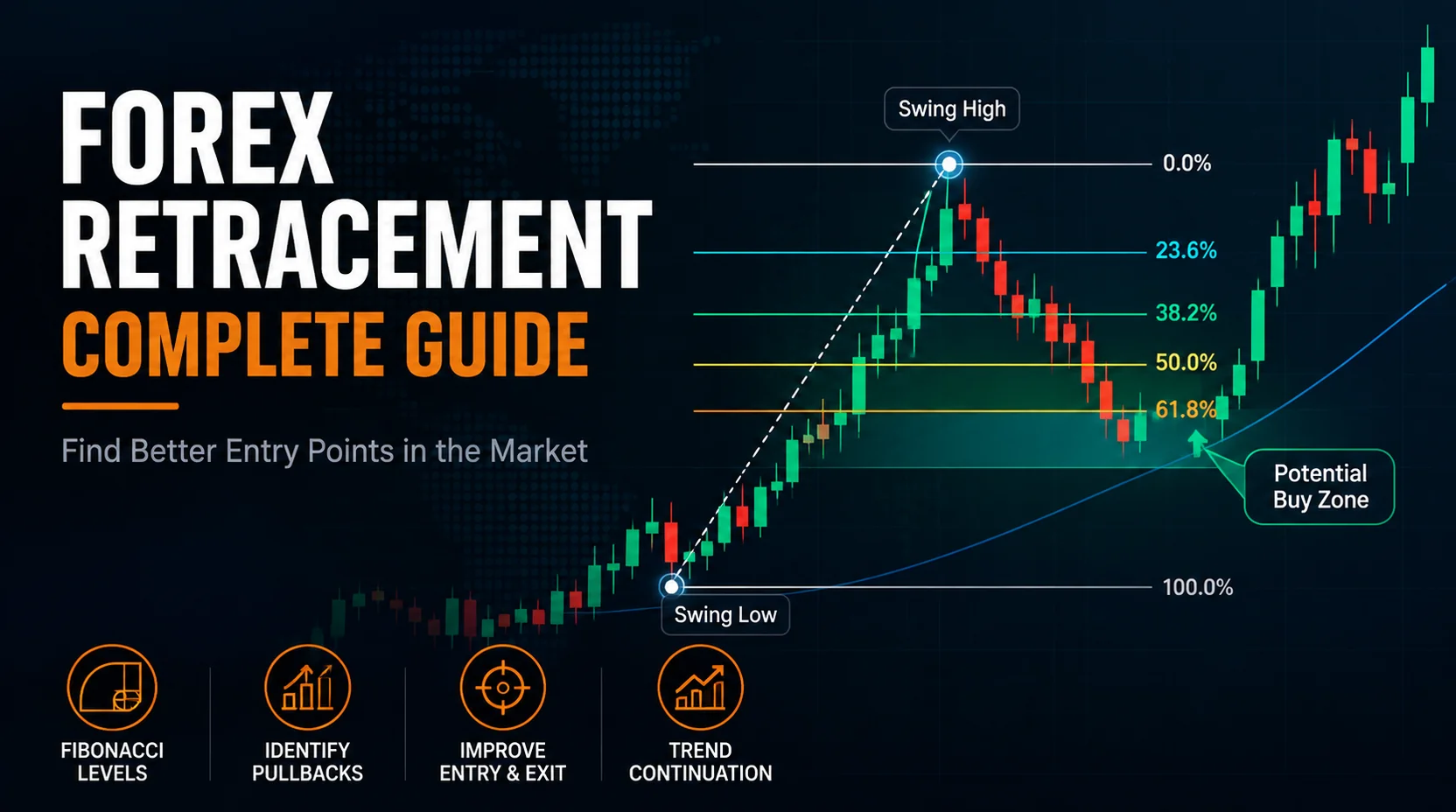
What Is a Retracement in Forex?
A retracement in forex is a temporary counter-move against a broader price move, if the broader context remains intact. It can appear during an upward move, a downward move, or a larger chart condition that is still developing.
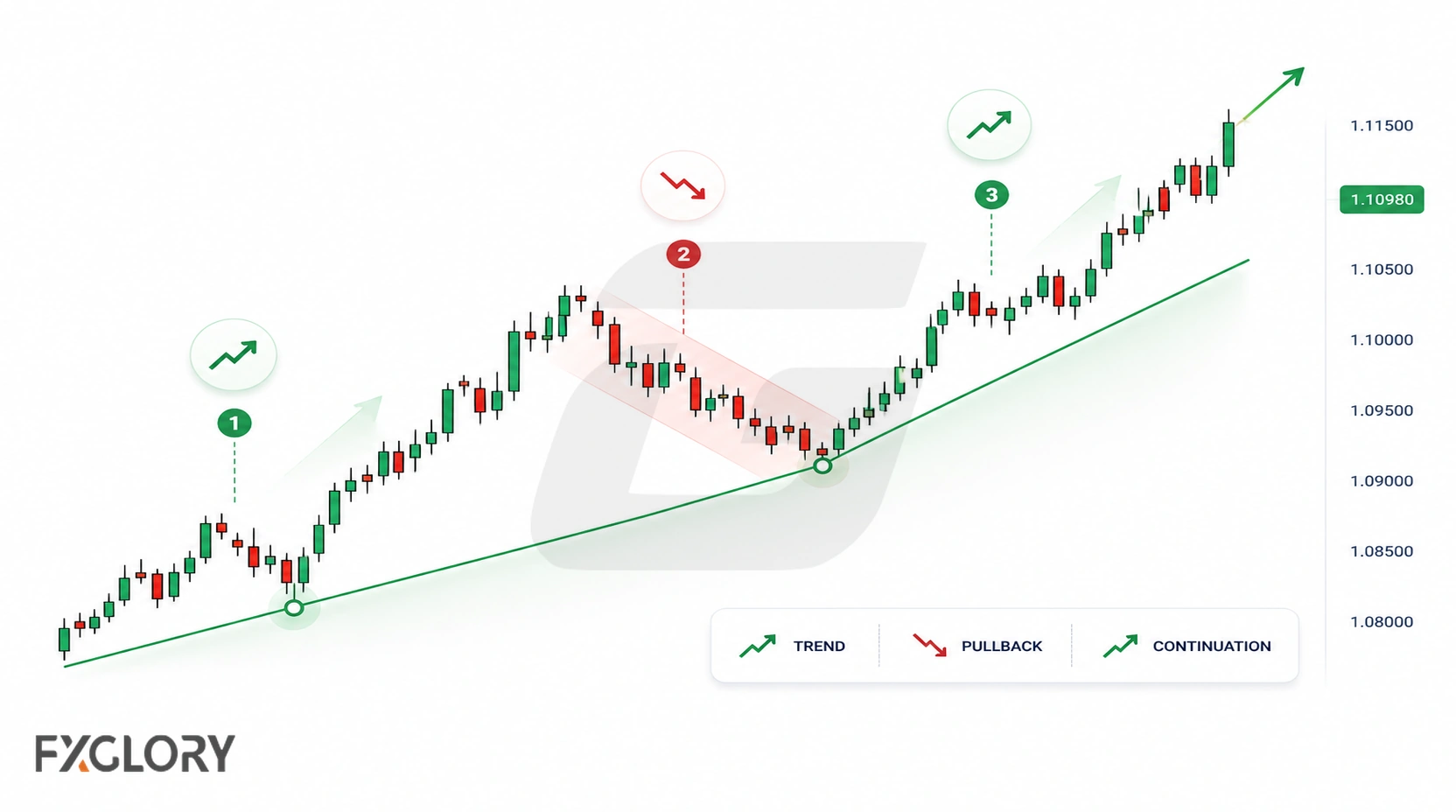
In an upward move, a retracement may appear as price moves lower for a period before the broader direction is tested again. In a downward move, a retracement may appear as price moves higher for a period before the broader direction is tested again.
A retracement is expected to be temporary, but the trader does not know that in real time. Until the chart confirms otherwise, the move can still become a reversal.
A retracement is easiest to label after the chart shows whether the original direction survived.
This page focuses on retracement as a chart concept inside forex technical analysis. For the broader framework, start with the full technical-analysis roadmap.
Retracement vs Pullback vs Reversal
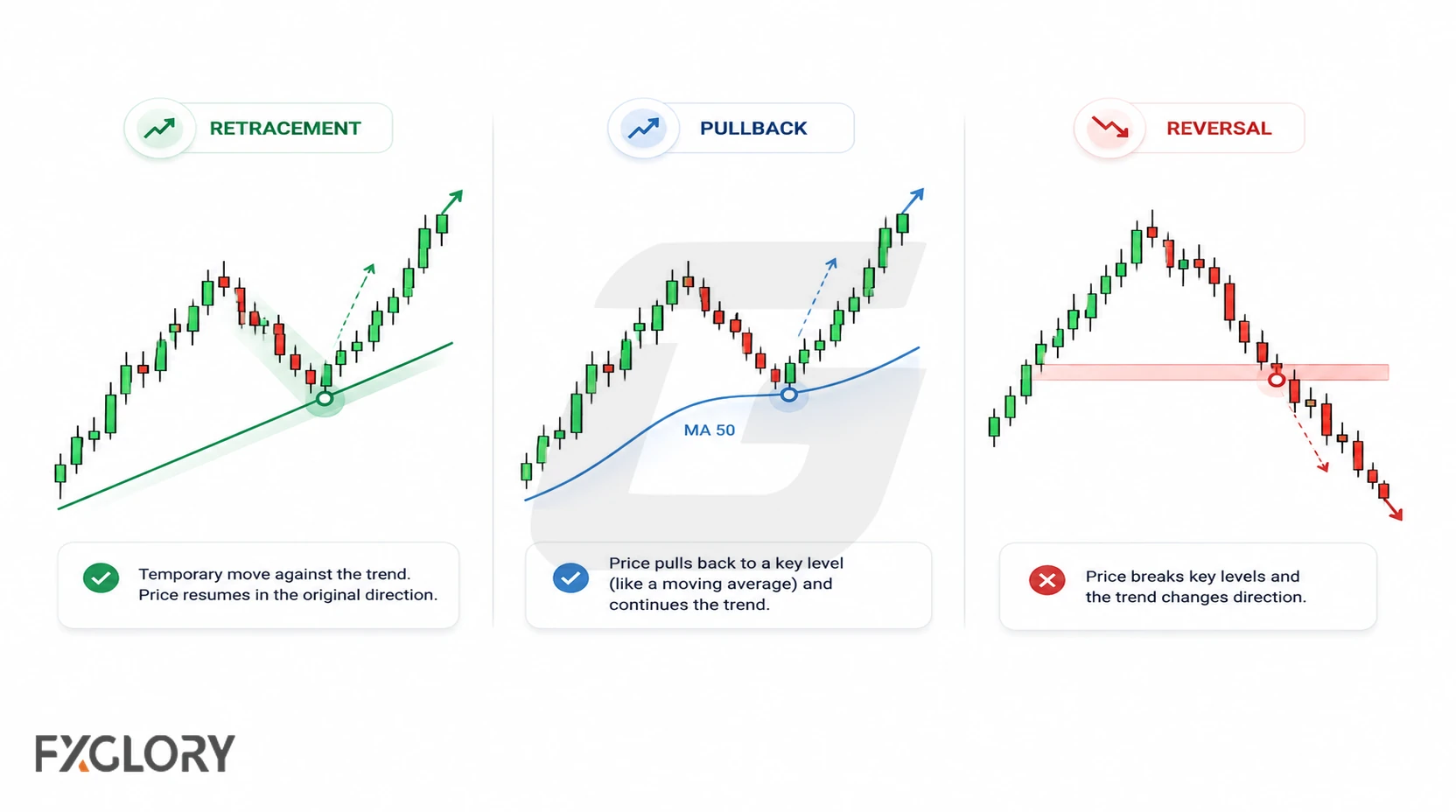
Retracement, pullback, and reversal are often used near each other, but they should not be treated as the same idea.
| Term | Meaning | Main Risk |
|---|---|---|
| Retracement | A temporary counter-move inside a broader move, if the broader context remains intact | The move may become a reversal |
| Pullback | A plain-language term often used for a counter-move against recent direction | It is often used loosely, so context matters |
| Reversal | A broader direction change where the old trend idea is no longer valid | It may only become clear after damage is already visible |
Pullback is often used as a plain-language term for a counter-move. Retracement is the technical-analysis framing of that counter-move inside a broader move.
The difference matters because calling a move a retracement too early can create false confidence. A counter-move may be temporary, but it may also be the first part of a larger direction change.
Why Retracements Happen in Forex
Retracements can happen for several reasons. The reason is not always visible from the chart alone, so the move should be reviewed with context.
- Short-term profit-taking: After a strong move, some traders may close or reduce exposure.
- Temporary imbalance: Price may move back after a sharp advance or decline.
- Return toward previous areas: Price may revisit areas that were active earlier on the chart.
- News digestion: A market reaction may pause or partially unwind after new information.
- Lower-timeframe counter-movement: A smaller chart may move against the broader direction.
- Broader move pausing: Direction can slow before continuing, moving into a range, or reversing.
None of these reasons proves that the original move will continue. They only help explain why price may move against the recent direction for a period.
How Traders Review a Forex Retracement
A retracement should be reviewed as a chart scenario, not as an automatic trade idea. The goal is to ask whether the broader move is still intact or whether the counter-move is changing the chart.
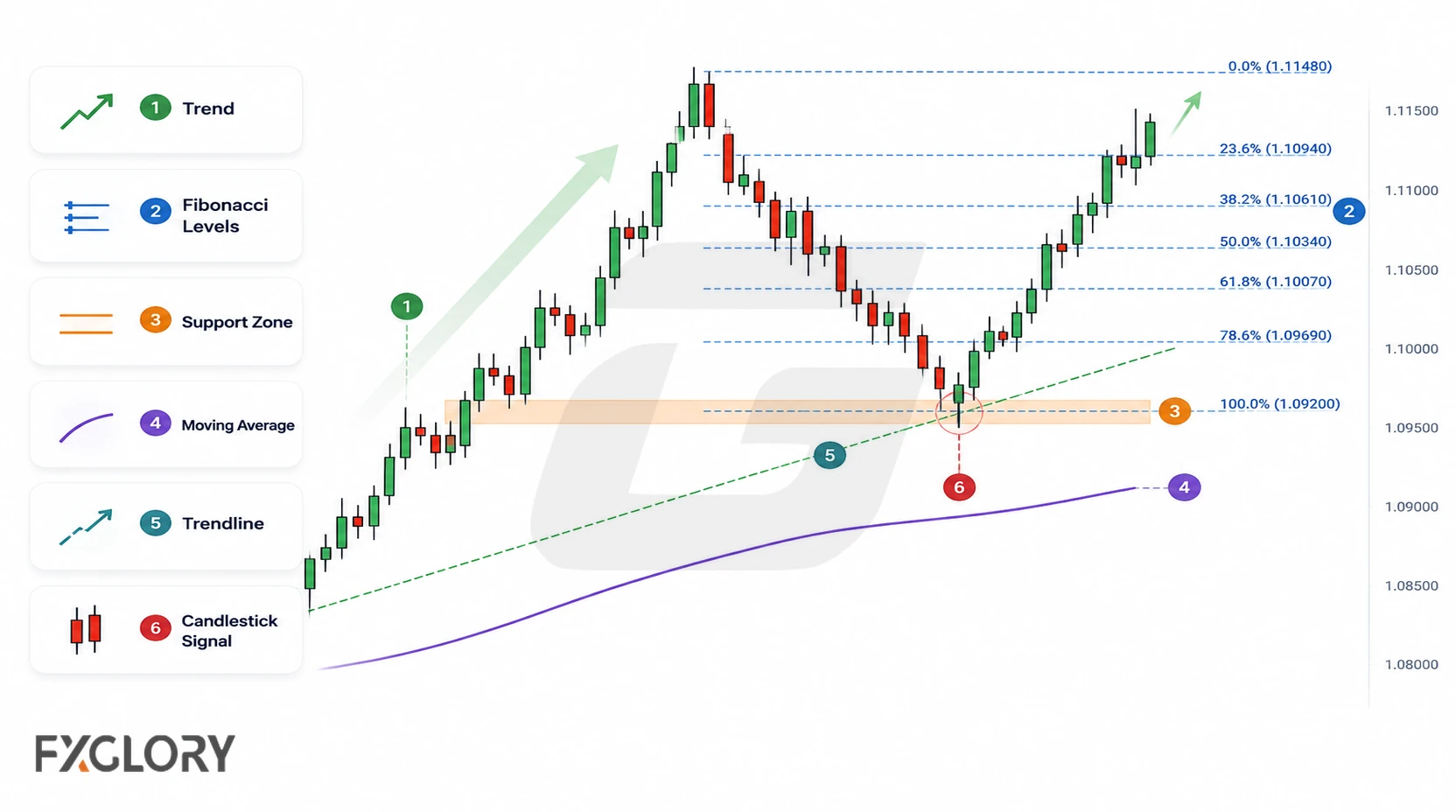
- Start with the chart basics: The pair, timeframe, chart type, and current price area should be clear first. For this foundation, use the chart-reading basics before judging the pullback.
- Check the direction before the pullback: Was price moving upward, downward, sideways, or unclear before the counter-move? Use the direction before the pullback when the broader direction needs review.
- Check swing behavior: Is the counter-move damaging the swing behavior behind the original move, or is the broader move still intact? For that context, use the swing map behind the retracement.
- Check historical reaction areas: Has price reached an area where it reacted before?
- Use Fibonacci only as one measuring tool: Fibonacci can help measure a pullback inside a selected swing, but it does not confirm continuation. For that tool, use the ratio-zone retracement tool.
- Check timeframe context: A small retracement on one timeframe may be part of a larger move on another timeframe.
- Define invalidation: What would show that the retracement idea is wrong?
A retracement can create a chart scenario, but it does not create a trade by itself.
How a Retracement May Become a Reversal
The difficult part of retracement analysis is that a temporary counter-move and the early stage of a reversal can look similar.
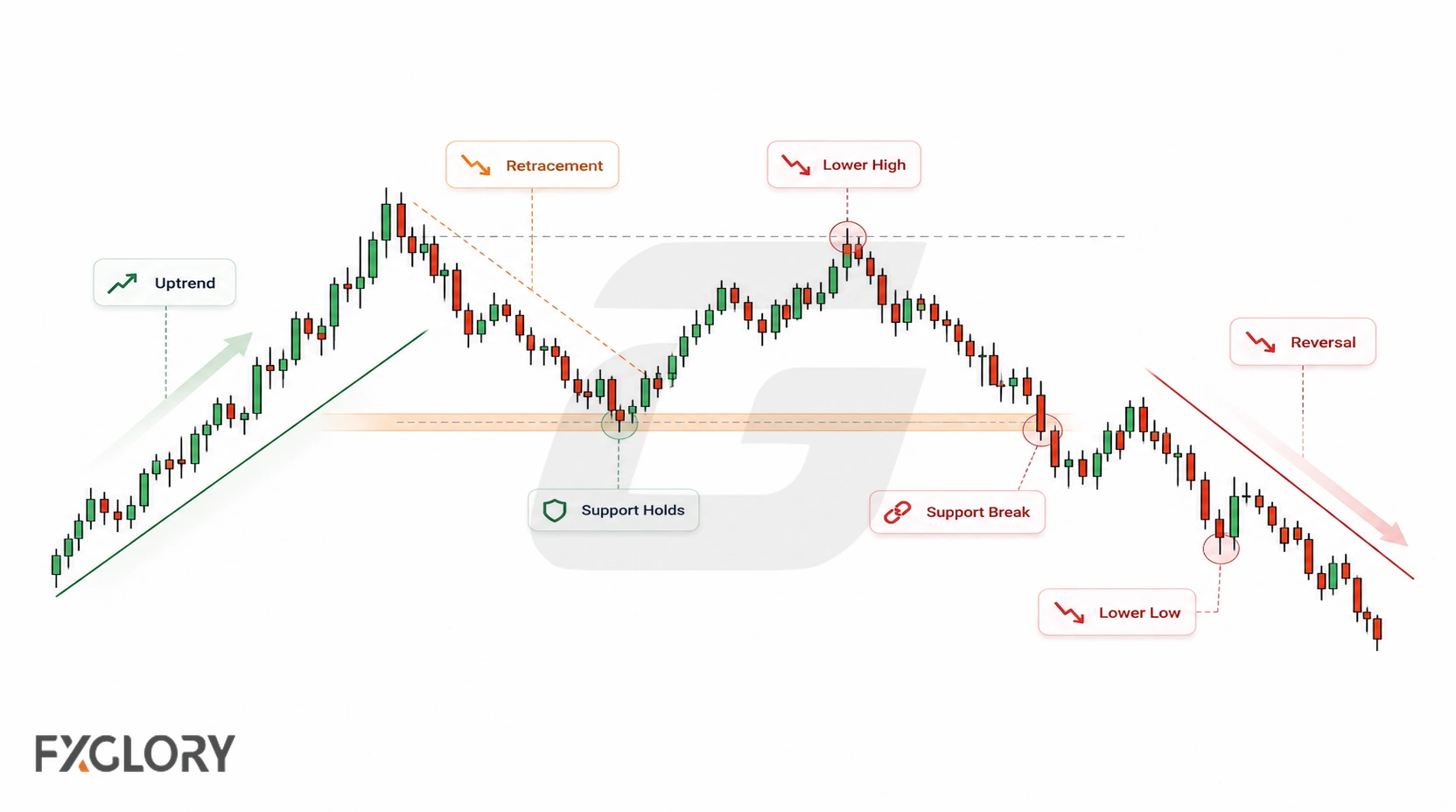
A failed retracement is often only obvious after the old trend idea is damaged. That damage may appear as deeper counter-movement, broken swing behavior, repeated failure to continue, or a broader shift into sideways movement.
| Condition | What It May Suggest | Why Caution Matters |
|---|---|---|
| Small counter-move | The broader move may still be intact | It can still deepen |
| Deep counter-move | The original move may be weakening | Depth alone does not prove reversal |
| Repeated failure to continue | The chart may be losing directional strength | The market may still range instead of reverse |
| Clear damage to prior swing behavior | The old direction idea may need review | The reversal may already be underway |
The safest way to read this is not to predict the label too early. The trader should keep asking whether the original direction still has evidence behind it.
Timeframes and Forex Retracements
Retracements depend on timeframe. A counter-move that looks large on a lower timeframe may be small inside the broader chart.
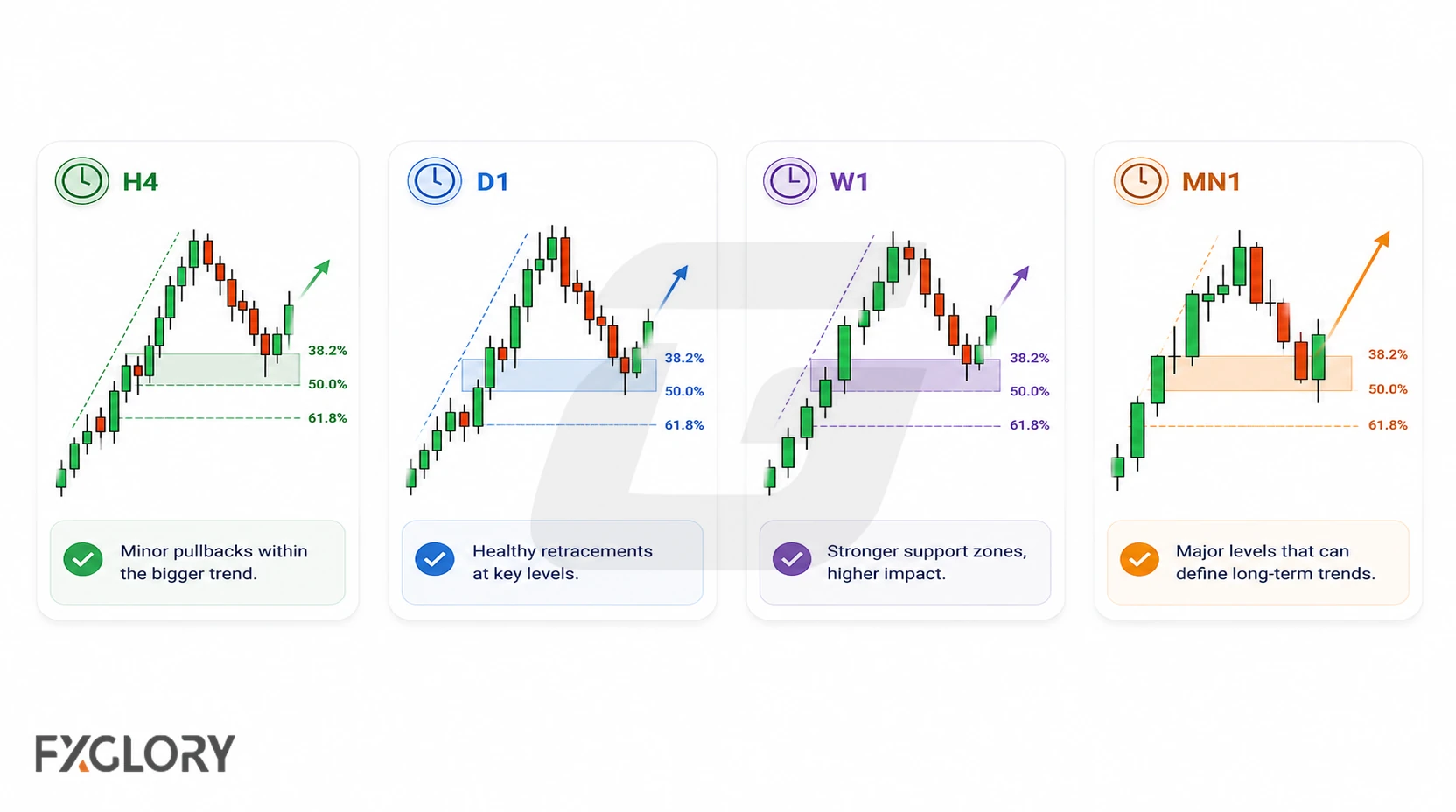
- Higher timeframe: Shows the broader direction or range condition.
- Lower timeframe: Shows more detail inside the counter-move, but also more noise.
- Conflicting timeframes: One timeframe may show a retracement while another shows a possible reversal or range.
- Unclear timeframe: A retracement reading is incomplete if the timeframe is not defined.
A retracement should always be described with the pair and timeframe. Without that, the label is too vague to be useful.
When a Retracement Is Not Clear Enough
Not every counter-move deserves a retracement label. Some charts are too messy, fast, or conflicted for a clean reading.
- No clear prior move: There is no obvious broader direction before the counter-move.
- Messy range: Price is overlapping too much to separate trend and counter-move.
- Timeframe conflict: The counter-move looks temporary on one timeframe but serious on another.
- News-driven movement: A sudden event can change price faster than the chart context updates.
- Forced interpretation: The trader calls it a retracement because they want the old direction to continue.
- Weak invalidation: The trader cannot explain where the retracement idea is wrong.
- Unstable conditions: Spread, volatility, or liquidity conditions make the chart harder to use for a live decision.
If price keeps overlapping instead of moving back toward the old direction, the chart may be shifting into a range rather than showing a clean retracement.
Common Mistakes With Forex Retracements
Retracement mistakes usually come from assuming the original direction must return.
- Calling every dip a retracement: A counter-move can become a reversal.
- Assuming continuation: The original direction may fail instead of resume.
- Ignoring timeframe: A small pullback on one timeframe may be a larger change on another.
- Overusing Fibonacci: A ratio zone does not prove that the pullback will stop.
- Ignoring swing behavior: The broader move may already be damaged.
- Ignoring historical reaction areas: Previous chart areas can still matter.
- Holding the label too long: Calling the move a retracement after the old idea is damaged can create false confidence.
- No invalidation: The trader cannot explain where the retracement idea fails.
Example: Retracement on GBP/USD
Suppose GBP/USD has been moving upward on the timeframe being studied. Price then moves lower for several candles.
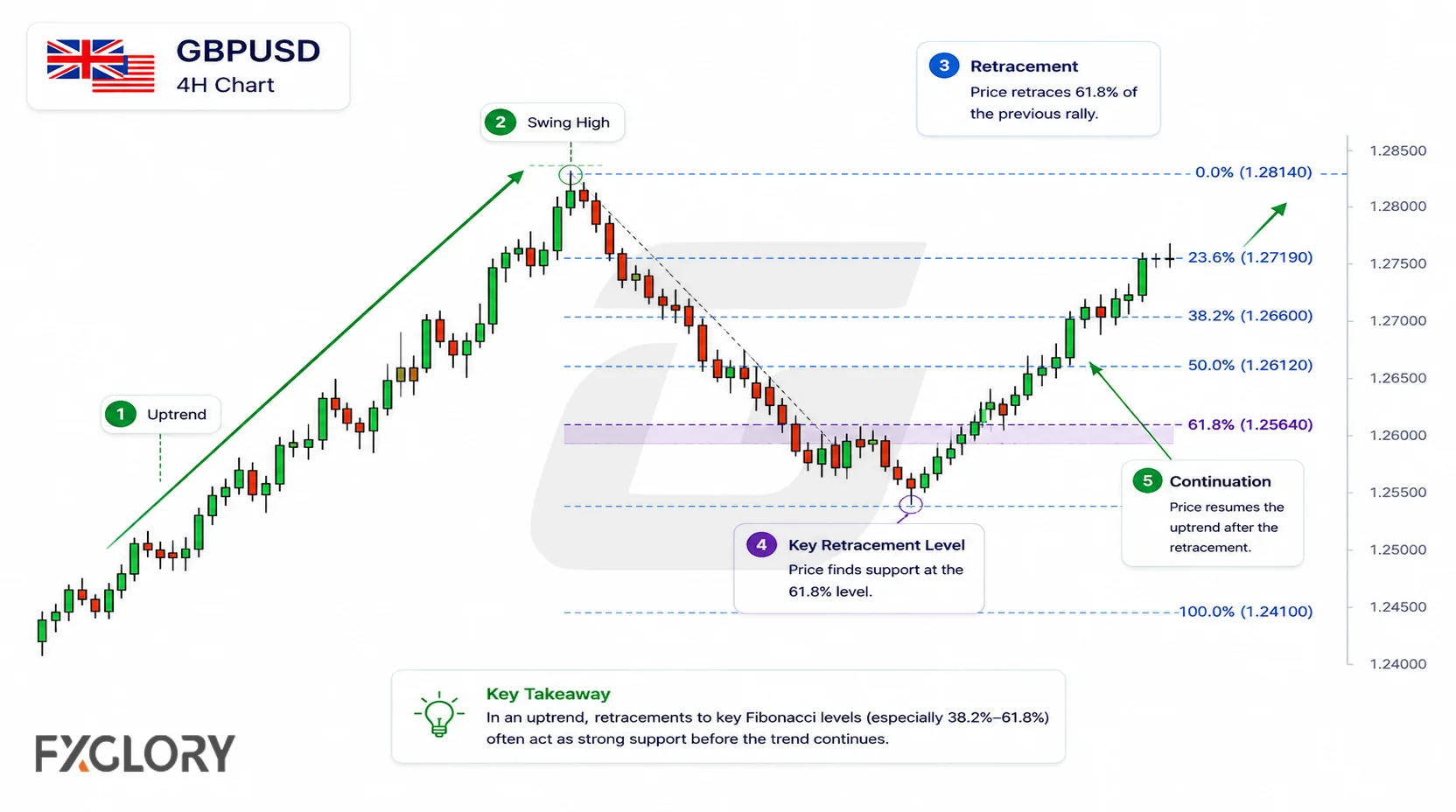
A beginner may describe that lower move as a possible retracement only while the broader upward context still has evidence behind it. The label does not mean GBP/USD must rise again. The move could deepen, turn sideways, or become part of a reversal.
A safer review would check the direction before the pullback, the swing behavior, the timeframe, any nearby historical reaction areas, and whether the counter-move damages the original idea. If the chart stops supporting the old direction, the retracement label should be questioned.
A Safer Way to Think About Forex Retracements
A forex retracement is a temporary counter-move inside a broader price move, if the broader context remains intact. The word temporary matters, but it is not known with certainty while the move is happening.
The safer approach is to treat a retracement as a question: is the original direction still intact, or is the counter-move becoming something larger?
Before using real money, the trader should know what moved first, what moved against it, what would prove the retracement idea wrong, and how much risk is attached.