
Forex Vs Crypto Trading: Quick Comparison
Forex trading prices one national currency against another, while crypto trading prices a digital asset against a currency or another quoted asset. At FXGlory, both forex and cryptocurrency instruments are offered on a 24/5 market schedule, subject to instrument and platform conditions.
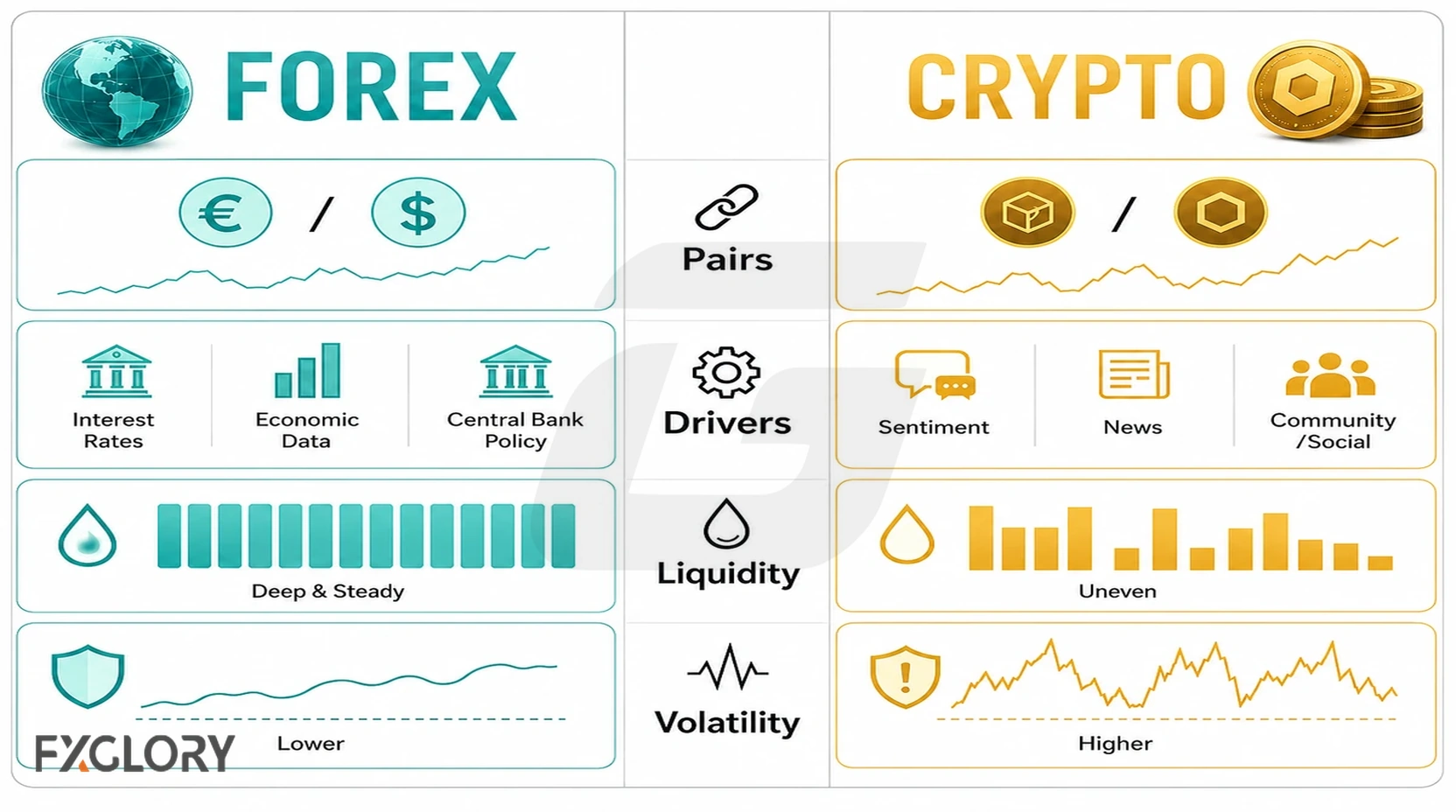
| Comparison point | Forex trading | Crypto trading |
|---|---|---|
| Market type | Currency-pair trading, such as EUR/USD, GBP/USD, or USD/JPY. | Digital-asset pair trading, such as BTC/USD, ETH/USD, XRP/USD, or LTC/USD. |
| FXGlory market schedule | 24/5 market access, subject to instrument and platform conditions. | 24/5 market access, subject to instrument and platform conditions. |
| Main price drivers | Interest rates, inflation, employment data, central-bank policy, trade flows, liquidity, and risk sentiment. | Market sentiment, liquidity, regulation, network developments, exchange-related events, and asset-specific news. |
| Liquidity profile | Major currency pairs often have deep participation, especially during active sessions. | Liquidity can vary widely by asset, venue, and market conditions. |
| Volatility profile | Major pairs may move less dramatically than many crypto assets, but leveraged positions can still create significant account risk. | Crypto pairs can show larger and faster price swings, which can increase slippage and execution risk. |
| Key risk consideration | Position size and leverage can create high exposure even when price moves appear relatively small. | Sharp price changes and uneven liquidity can make risk harder to control. |
How Forex And Crypto Trading Work
Forex trading
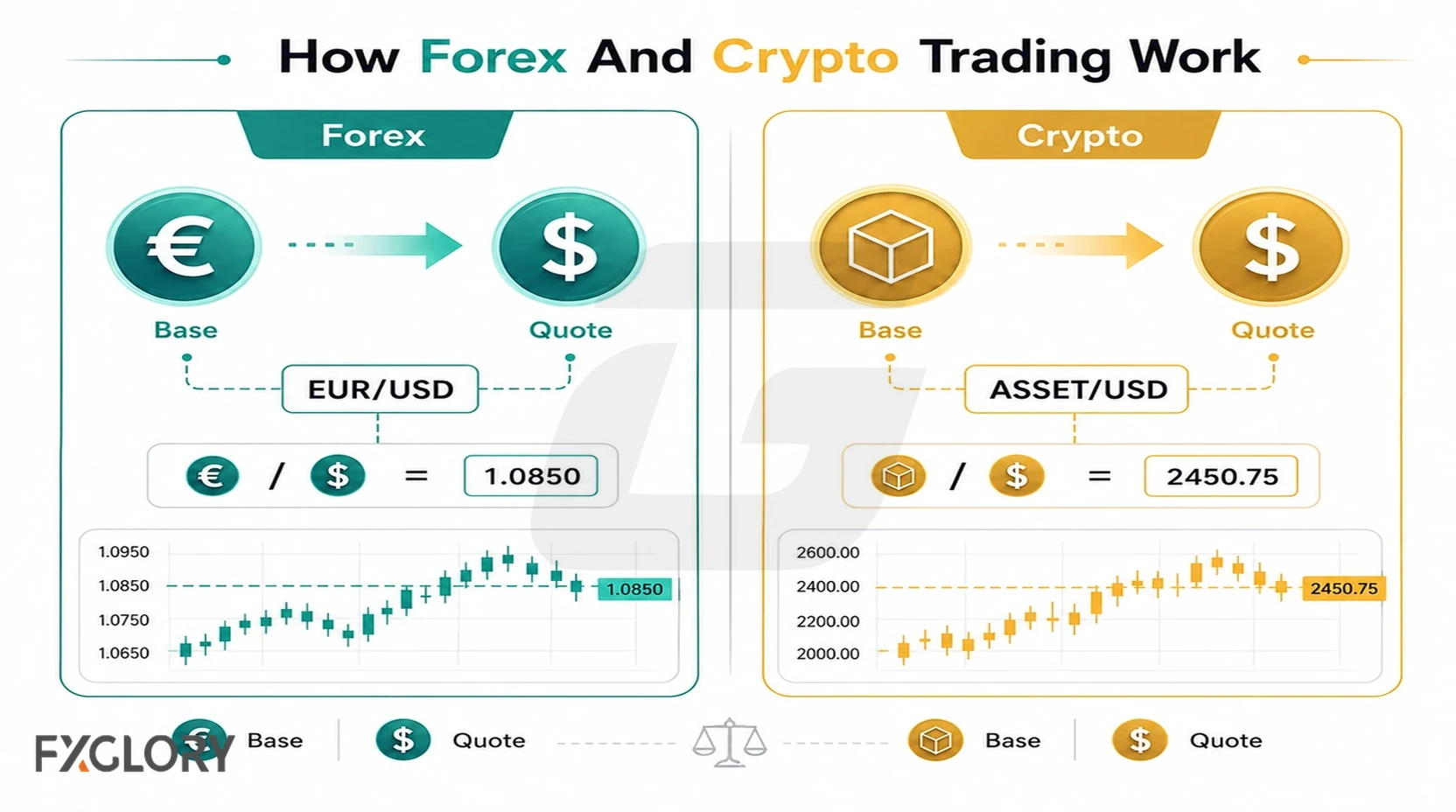
Forex trading is based on currency pairs. EUR/USD compares the euro with the U.S. dollar, while GBP/JPY compares the British pound with the Japanese yen. Buying a pair means buying the first currency and selling the second; selling the pair does the reverse.
For the foundation behind currency pairs, exchange rates, pips, spreads, leverage, margin, and beginner risk concepts, use the Forex Basics for Beginners guide before comparing markets in detail.
Crypto trading
In this FXGlory context, crypto trading means reviewing digital-asset pairs such as BTC/USD or ETH/USD. The trader is still analyzing a quoted market, but the asset being priced is a cryptocurrency rather than a national currency.
FXGlory lists cryptocurrency markets separately from currency pairs. Beginners can review Bitcoin, Ethereum, Bitcoin Cash, Ripple, and Litecoin pairs through the FXGlory cryptocurrency markets.
Forex Vs Bitcoin Trading
Forex vs Bitcoin trading is a narrower version of the broader forex-versus-crypto comparison. Forex pairs compare national currencies, while Bitcoin pairs price Bitcoin against another quoted asset such as the U.S. dollar or euro.
| Point | Forex pairs | Bitcoin pairs |
|---|---|---|
| Underlying idea | Relative value between two currencies. | Bitcoin priced against a currency or another quoted asset. |
| Typical analysis focus | Economic data, central banks, rate expectations, liquidity, and global risk sentiment. | Bitcoin-specific news, market sentiment, liquidity, regulation, and broader crypto-market conditions. |
| Volatility risk | Can rise sharply around major data releases or periods of thin liquidity. | Can change sharply in response to asset-specific or market-wide crypto events. |
Market Hours, Liquidity And Volatility
Liquidity
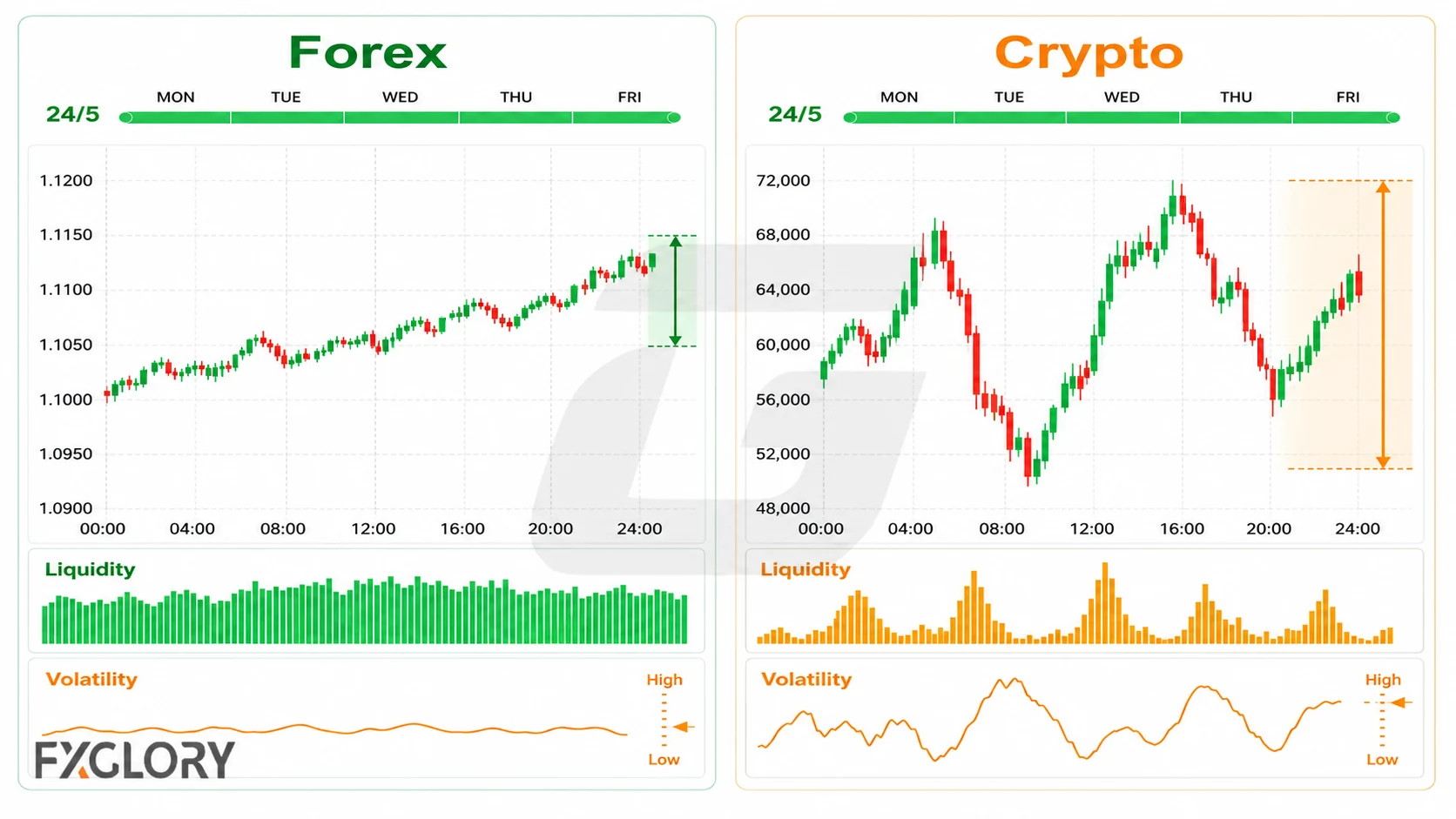
Liquidity describes how easily orders can be matched without causing unstable price movement. Major forex pairs often have deep participation, especially during active sessions. Crypto liquidity can also be strong in widely traded assets, but it may vary more sharply by asset, venue, and market conditions.
Weak liquidity can widen spreads, increase slippage, and make exits harder. A beginner comparing FXGlory currency-pair markets with crypto pairs should therefore compare actual trading conditions rather than chart direction alone.
Volatility
Volatility describes how much price moves. Major forex pairs may often show smaller visible swings than many crypto markets, but a larger leveraged position can still create substantial account risk. Crypto pairs can move more sharply, which can increase both opportunity and execution difficulty.
What Moves Forex Prices Vs Crypto Prices?
Forex prices often react to interest-rate expectations, inflation, employment data, central-bank communication, political developments, trade flows, commodity links, and global risk sentiment.
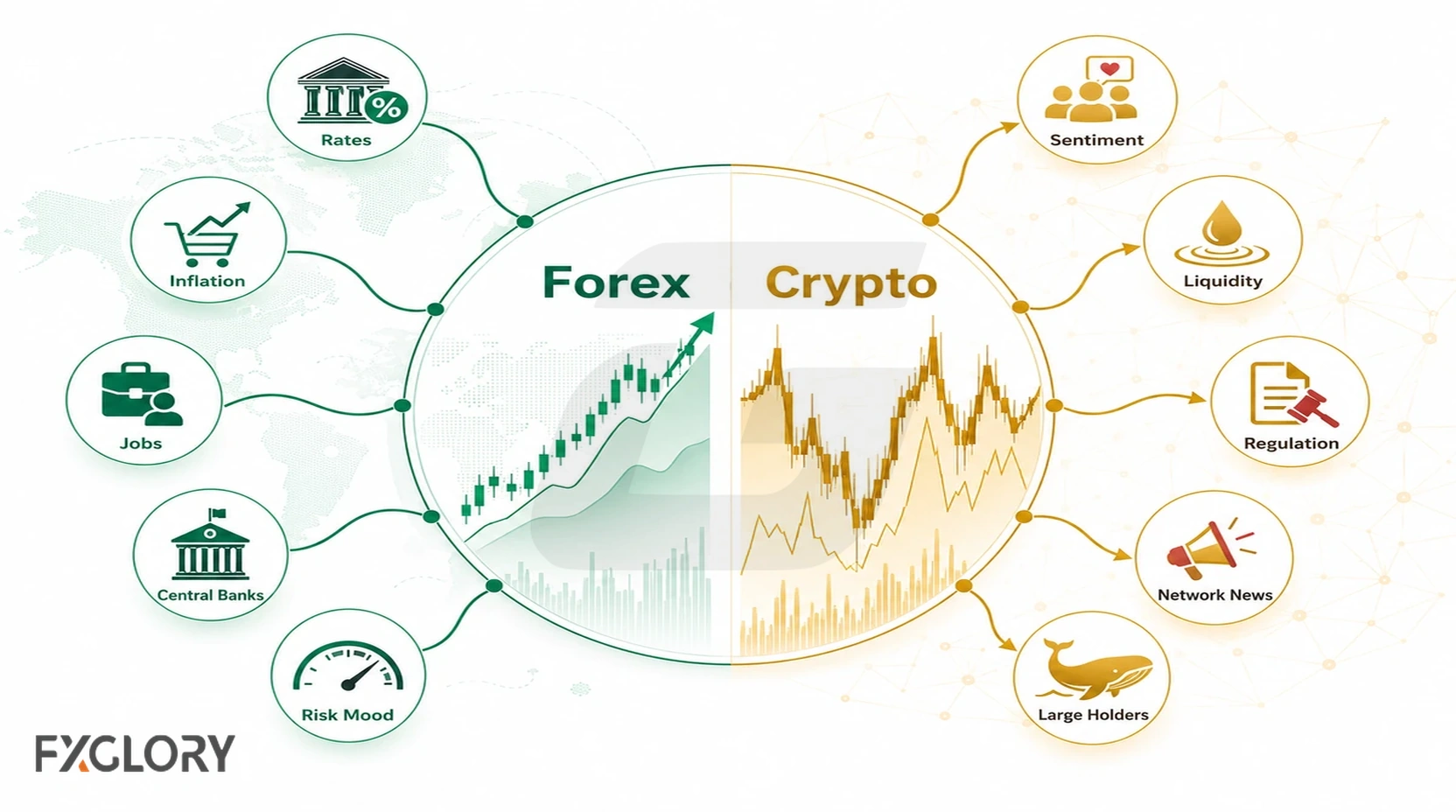
Crypto prices can react to market sentiment, liquidity, regulatory developments, network changes, exchange-related events, large-holder activity, and asset-specific demand. Different crypto assets can respond differently to the same market event.
Costs, Spreads, Slippage And Execution
The cost of trading includes more than the visible price move. Spread, slippage, liquidity, order type, and execution conditions can all affect the entry and exit price.
In forex, the bid is the price at which the market buys the base currency from the trader, while the ask is the price at which the market sells it. The spread is the difference between those two prices. For a focused explanation, review the buy-and-sell side of a quote.
In crypto trading, spread and execution still matter. A well-known asset can still have changing depth, spread, or slippage. FXGlory publishes a current spread table that should be checked before comparing instruments.
- Spread: The difference between the bid and ask price.
- Slippage: The difference between the expected price and the executed price.
- Liquidity: The ability of the market to absorb orders without unstable price movement.
- Execution conditions: The market and platform conditions present when the order is filled.
Leverage, Margin And Risk Control
Leverage allows a trader to control a position larger than the account balance alone would permit. Available leverage does not increase the profit or loss of an unchanged position; risk increases when leverage is used to take a larger position relative to account equity.
A relatively small price move can therefore create a significant account impact when the position is large. The same principle applies to both forex and crypto instruments.
Before using leverage, a trader should check FXGlory account leverage conditions, the relevant instrument conditions, and the margin impact of the chosen position size.
Regulation, Ownership And Access Model
Forex and crypto products are not offered under identical rules everywhere. Trading terms, account access, protections, and product structure can vary by provider, jurisdiction, and instrument.
Crypto trading through a broker should also not be assumed to be the same as holding coins in a personal wallet or transferring assets through a crypto exchange. Before trading a crypto instrument, check what is being traded, how the price is quoted, what hours apply, and which product conditions govern the trade.
Crypto Vs Forex: Which Market Should A Beginner Study First?
There is no universal first choice. A more useful comparison is which market structure, price drivers, costs, and risks the trader can understand and monitor consistently.
| Study preference | Market that may be more relevant to study | Why |
|---|---|---|
| Currency relationships, central banks, and economic data | Forex | Those factors are central to many forex price moves. |
| Bitcoin and major digital-asset news | Crypto | Asset-specific developments play a larger role in crypto markets. |
| Comparing deeper major-pair liquidity | Forex | Major currency pairs often have broad participation during active sessions. |
| Studying sharper price swings and asset-specific sentiment | Crypto | Many crypto markets can show faster and larger visible moves. |
Beginners can compare both market types in a demo environment before deciding whether either one fits their trading plan and risk limits.
Final Thoughts on Forex Vs Crypto Trading
Forex and crypto trading differ most clearly in what is traded, what drives prices, how liquidity behaves, and how volatility can affect execution. Forex is centered on currency relationships and macroeconomic drivers, while crypto includes asset-specific risks and can show sharper changes in sentiment and liquidity.
Neither market removes the need to understand spreads, position size, leverage, execution, and the product conditions that apply to the instrument being traded.