

Quick Answer: Best Forex Trading Tips
The best forex trading tip is not to search for a perfect strategy. It is to trade only when risk, setup, timing, position size, spread, news and emotional state all pass your checklist.
The rule to remember:
Forex trading tips should be repeatable rules for risk control, not shortcuts for forcing trades.
This page focuses on beginner-safe forex trading advice. It does not promise profits, does not provide trade signals and does not replace a trading plan.
Forex Tips vs Forex Tricks
Forex tricks can be dangerous when they mean shortcuts, oversized risk, blind copying or trading without a plan. A useful tip should make trading more controlled, repeatable and reviewable.
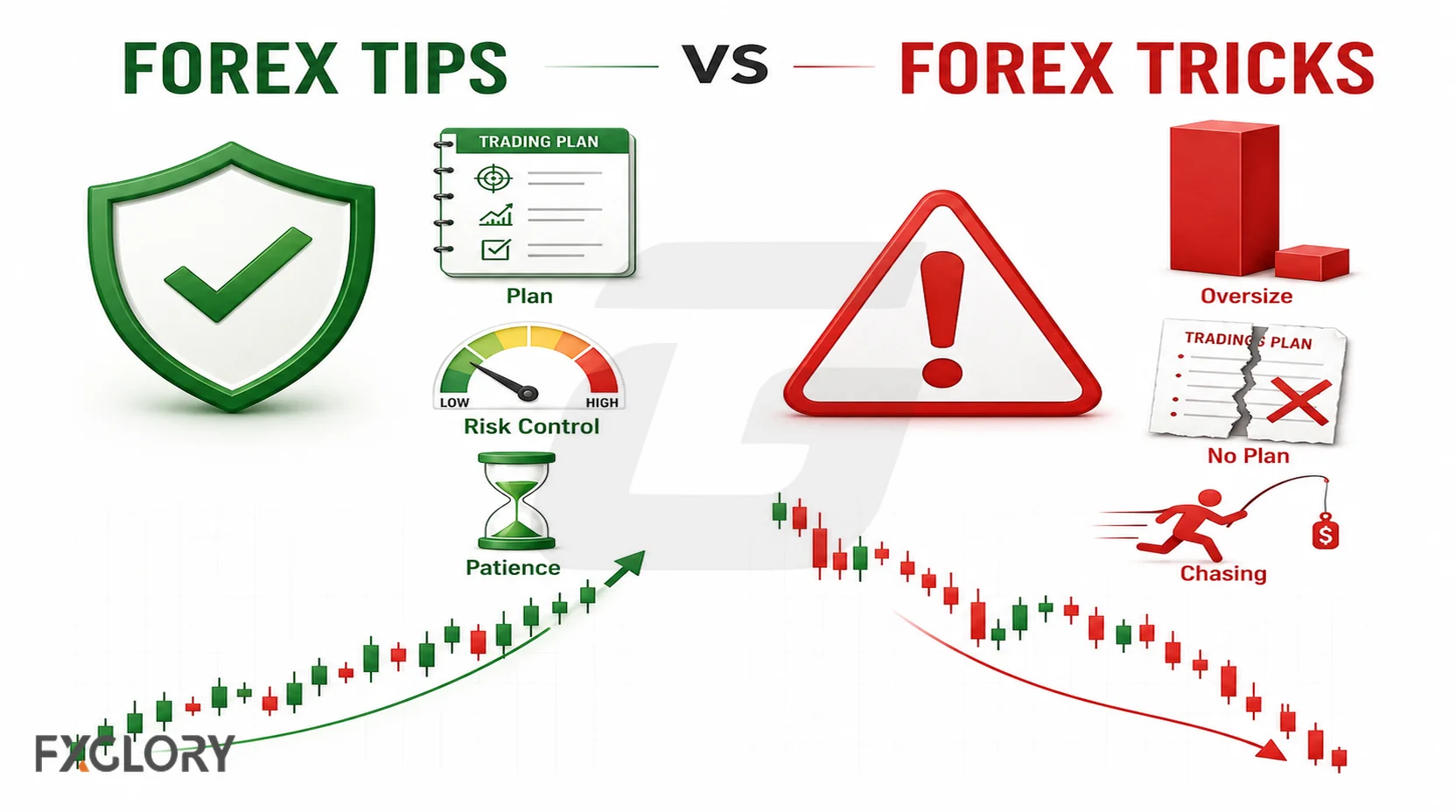
| Forex Tip | Forex Trick |
|---|---|
| A repeatable rule that controls risk. | A shortcut that promises easy results. |
| Requires a stop-loss, position size and plan. | Encourages trading bigger or faster without proof. |
| Can be reviewed in a journal. | Often depends on emotion, hype or signals. |
| Helps you decide when not to trade. | Pushes you to trade more often. |
Use forex tips as rules. Avoid tricks that make trading sound easy, urgent or guaranteed.
Best Forex Trading Tips at a Glance
The table below turns common forex advice into practical rules and shows the mistake each rule helps prevent.
| Tip | Practical Rule | Mistake It Prevents |
|---|---|---|
| Learn the basics first | Learn pairs, pips, spread, bid/ask, margin, leverage, volatility, liquidity and swap before live trading. | Trading without knowing how profit, loss and costs work. |
| Use a trading plan | Write allowed pairs, sessions, setups, risk limits, entries and exits before trading. | Random entries and emotional decisions. |
| Start with demo or small size | Practice execution and journaling before increasing live risk. | Losing money while learning basic platform and order mistakes. |
| Risk a fixed amount | Set a maximum risk per trade before entry. | Oversizing because a trade feels strong. |
| Define the stop-loss first | Know where the trade is wrong before opening it. | Holding losing trades with no exit plan. |
| Control leverage | Use leverage only within your planned position size. | Making losses larger than expected. |
| Check conditions | Review spread, news, liquidity and volatility before entry. | Entering during poor execution conditions. |
| Journal every trade | Record setup, reason, risk, result, emotion and mistake. | Repeating mistakes without noticing patterns. |
| Review after a sample | Study 20 to 30 trades before changing major rules. | Switching strategy after one normal loss. |
| Stop after rule breaks | Pause after revenge trading, daily loss limit or emotional trading. | Turning one mistake into a larger drawdown. |
1. Learn the Forex Basics Before Trading
Beginners should not start live trading before they understand the mechanics of a forex trade. A strategy is not enough if the trader does not understand how pips, spreads, leverage and position size affect the result.
Before trading forex, learn these basics:
- Currency pairs: Forex trades compare one currency against another.
- Base and quote currency: The first currency is the base; the second is the quote.
- Pips: Pips measure price movement and help calculate profit and loss.
- Bid and ask: The bid is usually where you sell, and the ask is usually where you buy.
- Spread: The difference between bid and ask, and one of the main trading costs.
- Margin: The required amount to open or maintain a leveraged position.
- Leverage: A tool that can increase both exposure and loss size.
- Liquidity: How easily a trade can be executed near the quoted price.
- Volatility: How much and how quickly price moves.
- Swap or rollover: Overnight charges or credits that may apply when trades stay open past rollover.
For a basic starting point, see what is forex. For practical trade mechanics, see forex trading examples.
2. Use a Trading Plan Before You Trade
A trading plan turns forex tips into rules. Without a plan, every trade can become a new emotional decision.
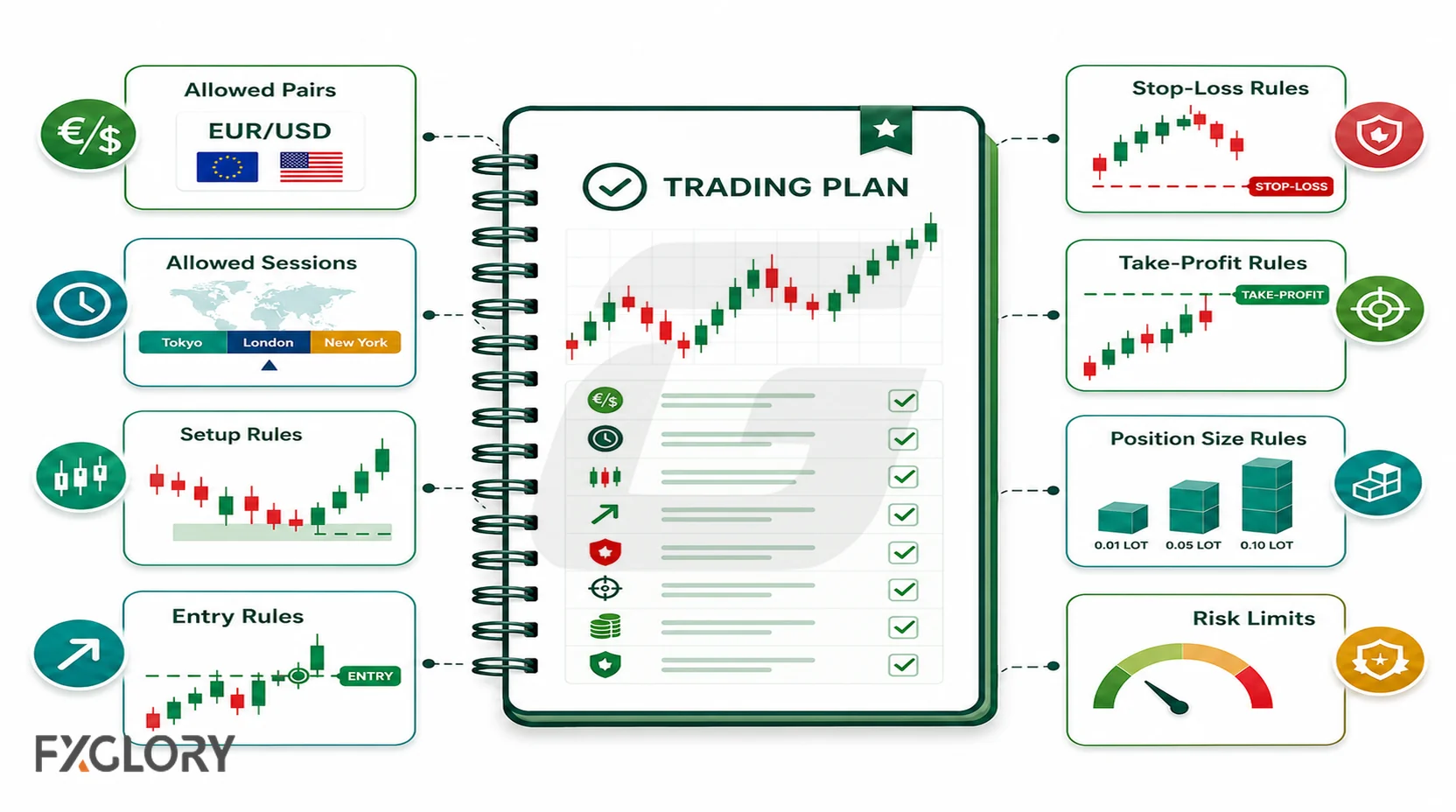
Your forex trading plan should define:
- Allowed pairs: Which currency pairs you trade.
- Allowed sessions: When you trade.
- Setup rules: What must be present before a trade is allowed.
- Entry rules: What confirms the trade.
- Stop-loss rules: Where the trade is wrong.
- Take-profit rules: How targets or exits are planned.
- Position-size rules: How lot size is calculated.
- Risk limits: Maximum risk per trade, per day and across open trades.
- Do-not-trade rules: Conditions that block trading.
- Review rules: When performance is reviewed.
A plan does not guarantee profit. It helps make your decisions specific, repeatable and reviewable. For a copy-ready structure, see the forex trading plan template.
3. Start With Demo or Small Size
Beginners should focus on learning process before increasing risk. A demo account can help you practice platform use, order types, stop-loss placement, journaling and trade review without live capital risk.
Demo trading has limits. It cannot fully copy live emotions, slippage, spread changes or the pressure of losing real money. Still, it is useful for reducing basic execution mistakes.
A safer beginner progression is:
- Learn the mechanics: Understand pairs, pips, spread, leverage, margin and stop-losses.
- Practice on demo: Place trades, set stops and journal results.
- Build a trading plan: Define pairs, sessions, risk and do-not-trade rules.
- Use small size if moving live: Keep risk low while testing behavior and execution.
- Increase only after review: Do not increase size until rule-following and journaling are consistent.
Starting small does not remove risk. It simply limits the damage while you learn how you behave under market pressure.
4. Risk Only a Small Amount Per Trade
Risk management is the center of forex trading. A trade should not be opened just because the setup looks attractive. Risk should be calculated first.
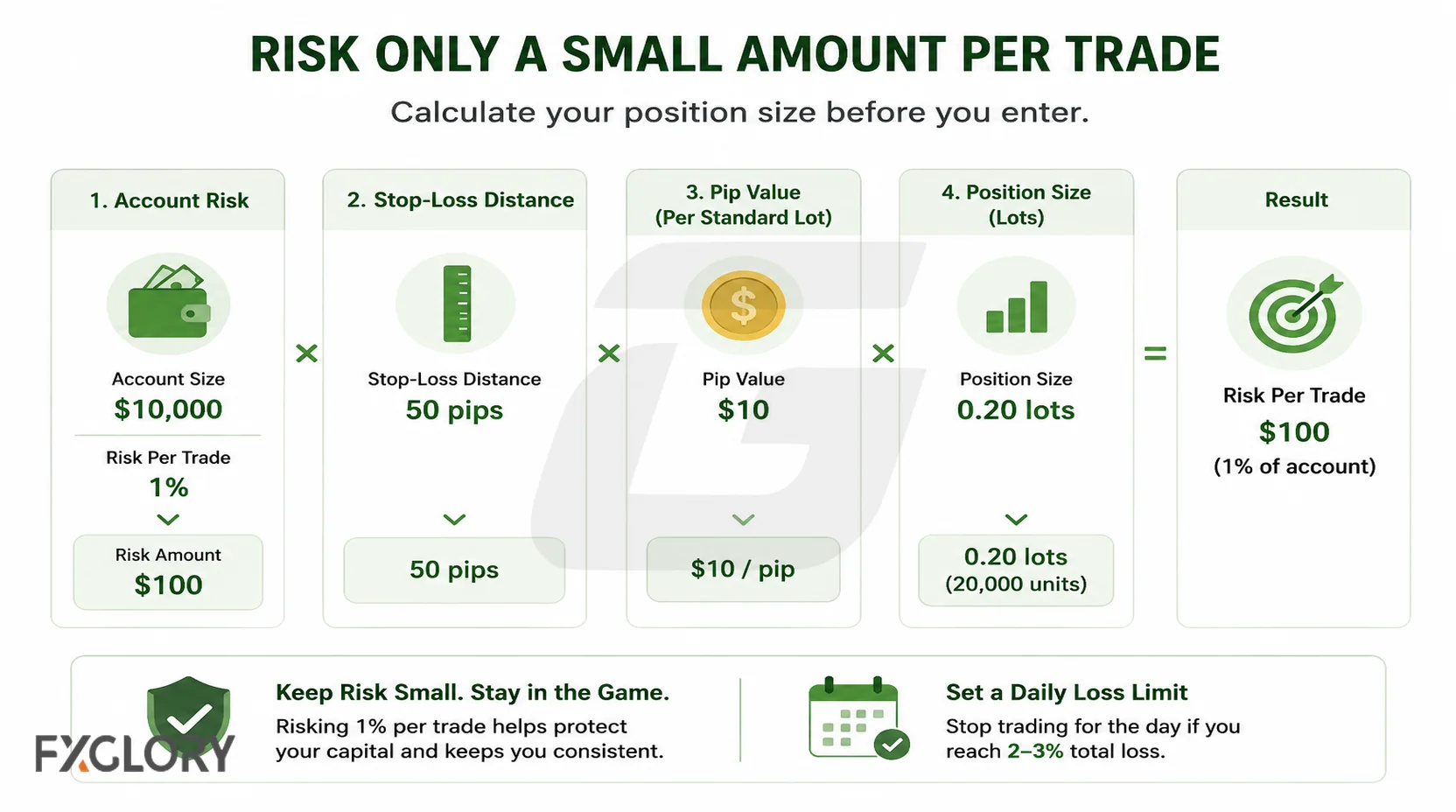
A practical risk rule is:
Position size should be based on account risk, stop-loss distance and pip value before entry.
A beginner risk checklist should include:
- Maximum risk per trade: How much can be lost if the stop-loss is hit?
- Stop-loss distance: How far is the stop from the entry?
- Pip value: What is each pip worth for this position size?
- Lot size: Does the position size match the risk limit?
- Daily loss limit: When must trading stop for the day?
- Open risk: How much is at risk across all open trades?
- Correlation risk: Are multiple trades depending on the same currency or market theme?
A 30-pip stop can be small or large depending on lot size. A wide stop does not automatically make a trade safer. It may simply require a smaller position. For pip math, see how to calculate pips in forex.
5. Control Leverage Instead of Letting It Control You
Leverage can make larger positions easier to open, but it does not make the trade less risky. Profit and loss are still based on the full position size.
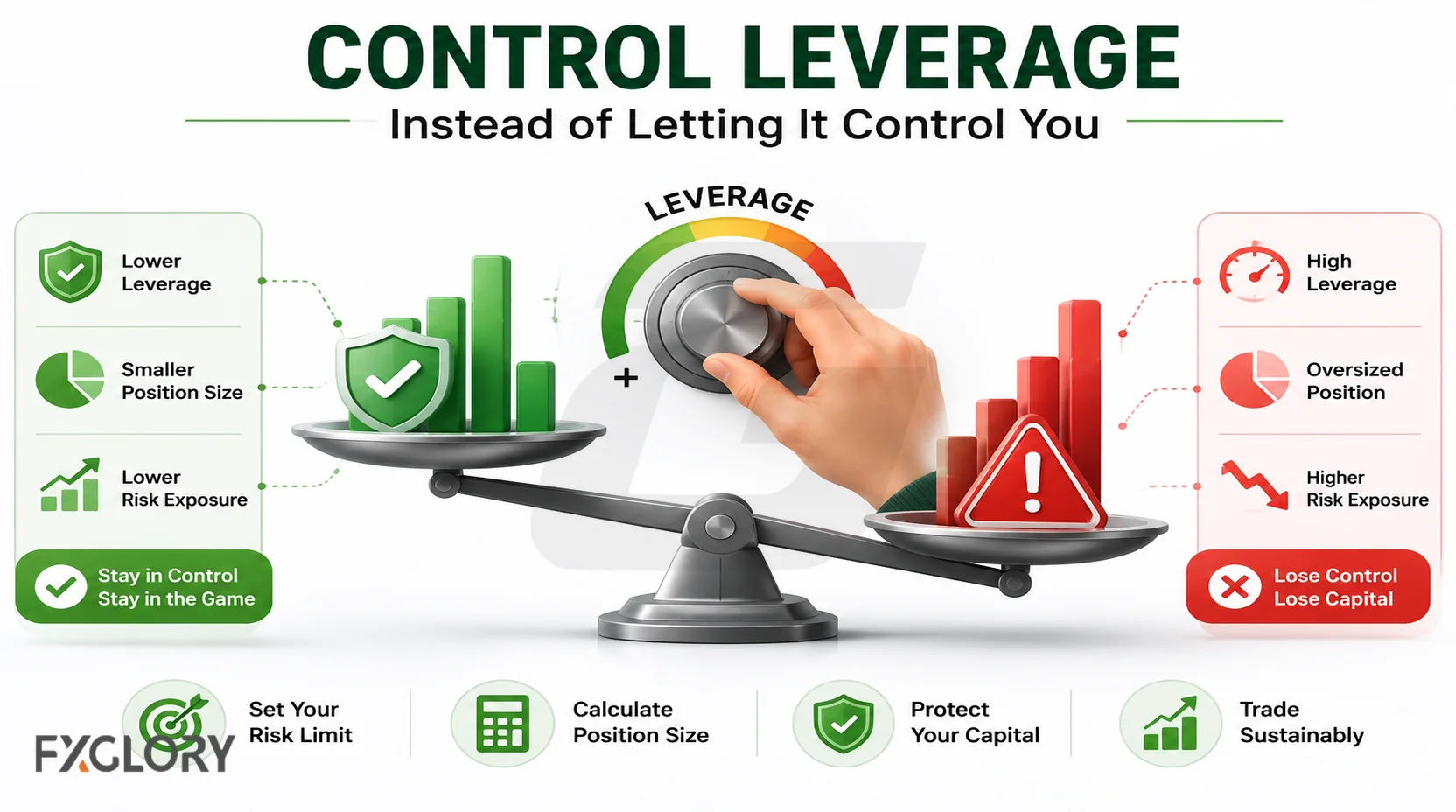
The safer rule is:
Use leverage only to support the position size allowed by your risk plan. Do not use leverage to make a trade feel more exciting or recover losses faster.
Bad leverage behavior includes:
- increasing lot size after a loss,
- opening a bigger trade because margin is available,
- using the same lot size on every setup regardless of stop distance,
- ignoring open risk across multiple trades,
- trading without knowing the maximum loss if the stop is hit.
For leverage planning, see best leverage for forex.
Forex Risk Checklist Before Every Trade
Use this checklist before opening any forex trade. If one item fails, the trade should usually be skipped or resized.
| Risk Check | Question to Answer Before Entry |
|---|---|
| Setup | Is the setup complete according to my plan? |
| Stop-loss | Is the stop-loss defined before entry? |
| Position size | Did I calculate lot size from account risk, stop distance and pip value? |
| Risk amount | Is the possible loss within my risk limit? |
| Spread | Is the spread acceptable for this pair and setup? |
| News | Is high-impact news far enough away according to my plan? |
| Leverage | Is total exposure within my leverage rule? |
| Daily limit | Have I stayed below my daily loss limit? |
| Open risk | Is total open risk still within my plan? |
| Emotional state | Am I calm enough to follow the trade plan? |
The purpose of this checklist is not to make every trade safe. The purpose is to stop trades where the risk is unclear, oversized or emotional.
6. Check Spread, News, Liquidity and Volatility
A good setup can still perform poorly if trading conditions are bad. Before entering a forex trade, check whether the market is suitable for your plan.
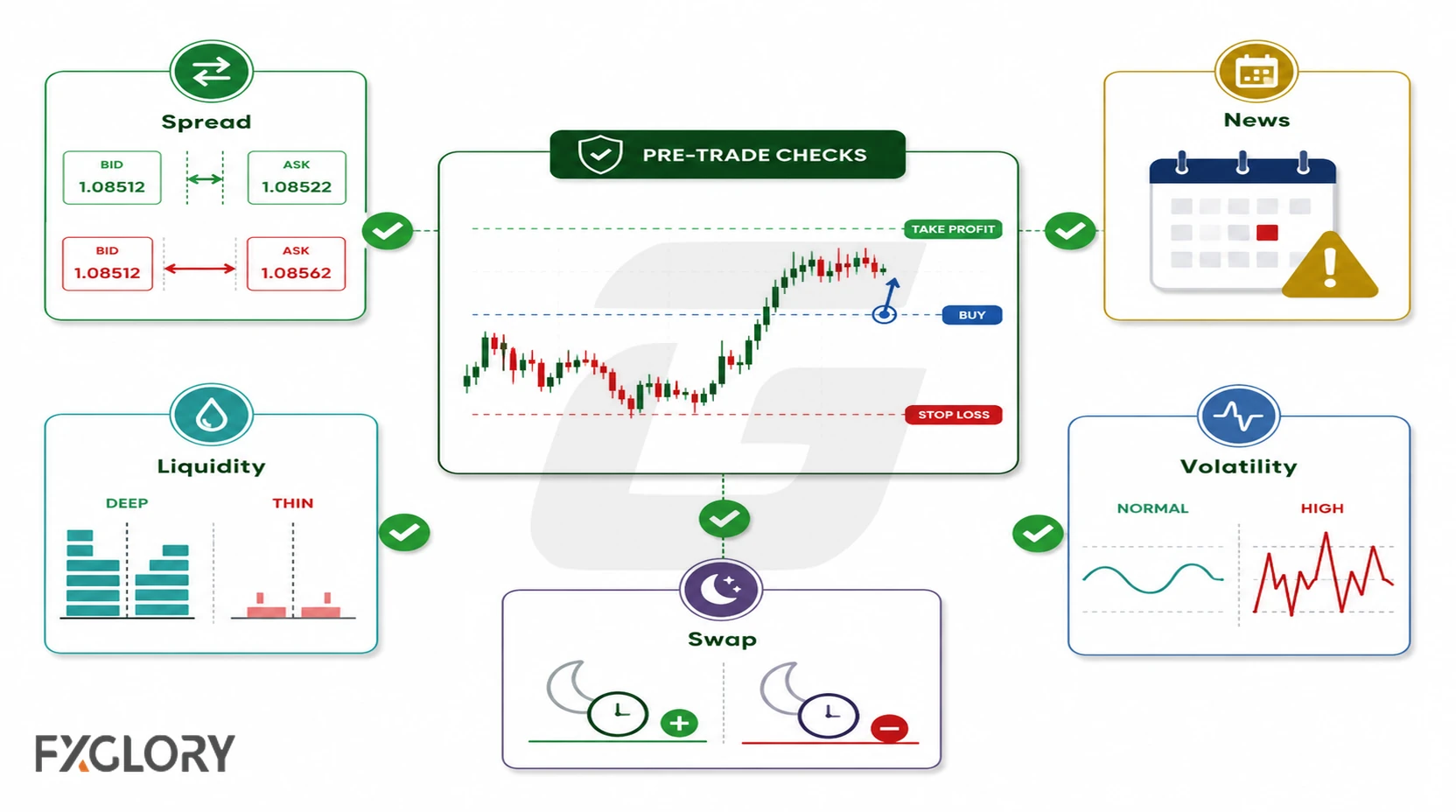
| Condition | What to Check | Why It Matters |
|---|---|---|
| Spread | Is the bid/ask spread within your plan? | Wide spreads increase trading cost and can hurt short-term trades. |
| News | Is high-impact news close? | News can trigger fast moves, slippage and spread widening. |
| Liquidity | Can the trade likely execute near the quoted price? | Thin liquidity can increase poor fills and slippage. |
| Volatility | Does the stop distance fit current movement? | Low volatility can limit movement; high volatility can widen stops and increase loss size. |
| Swap | Will the trade stay open past rollover? | Overnight swap or rollover charges can affect holding costs. |
Commission-free does not always mean cost-free. Spread, slippage, swap, platform conditions and execution quality can all affect the final result. For related basics, see bid and ask price in forex, what is liquidity in forex, what is volatility in forex and what is swap in forex.
7. Keep Pairs, Sessions and Strategies Simple
Beginners do not need to trade every pair, session or setup. More choice often creates more mistakes.
A simple approach can mean:
- trading only a few major pairs at first,
- choosing one or two trading sessions,
- using one defined setup instead of many random ideas,
- avoiding pairs with spreads or movement you do not understand,
- reviewing a sample of trades before adding more markets.
No strategy fits every market condition. A trend setup may fail in a range. A breakout setup may struggle in choppy price action. A news-driven market can behave differently from a quiet market. The goal is not to trade everything. The goal is to know which conditions your plan allows.
Keep timeframes aligned
Many beginners mix signals from random timeframes. One chart may look bullish, another may look bearish, and the trader enters without a clear plan.
A cleaner approach is to choose a higher timeframe for context and a lower timeframe for entry. For example, a trader may use a higher timeframe to identify trend direction and a lower timeframe to plan entry and stop placement. The key is to define this before trading, not after price starts moving.
Watch correlation risk
Correlation risk means several trades can depend on the same currency or market theme. For example, taking multiple USD-based trades may create more dollar exposure than the trader intended.
A trader may think they have three separate trades, but if all three depend on the same currency move, the account risk may be concentrated. This is why trading plans often include maximum open risk and maximum correlated exposure rules. For more market background, see forex market participants.
Beginner Focus vs What to Avoid at First
Beginners do not need advanced strategy stacking before they can manage basic risk. Build consistency first, then add complexity only after your plan and journal show that you can follow rules.
| Beginner Focus | Avoid at First |
|---|---|
| One or two major pairs | Too many pairs and hidden correlation risk. |
| One defined setup | Switching strategies after every loss. |
| Demo or small-size practice | Full-size live risk before rules are tested. |
| Fixed risk per trade | Changing lot size based on emotion. |
| Clear stop-loss discipline | Moving stops because of fear or hope. |
| Simple journal review | Trading from memory with no records. |
| Fewer sessions | Trading whenever price moves. |
| Basic market conditions | Heavy news trading or complex multi-timeframe guessing. |
8. Journal Every Trade and Review Expectancy
A trading journal is not just a record of wins and losses. It shows whether the trader followed the plan and whether the strategy has enough evidence to review.
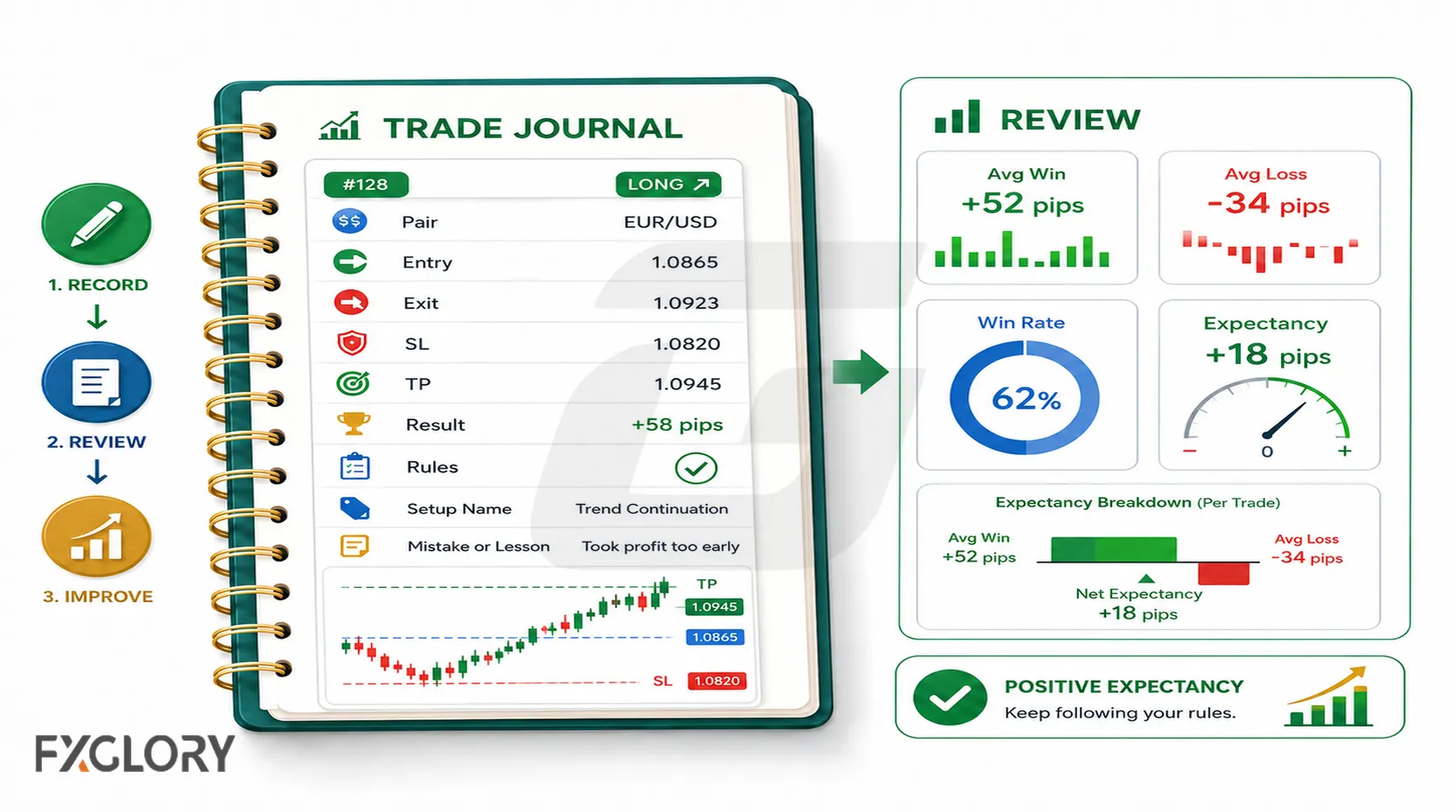
Record these fields after each trade:
- Date and session
- Currency pair
- Setup name
- Entry, stop-loss and target
- Position size and risk amount
- Spread or execution issue
- Reason for entry
- Emotion before and during the trade
- Exit result
- Rule followed?
- Mistake or lesson
- Screenshot or chart note
Do not judge a strategy from one trade or win rate alone. Review a meaningful sample and look at:
- Win rate: How often trades win.
- Average win: How large winning trades are.
- Average loss: How large losing trades are.
- Risk-to-reward behavior: Whether winners are large enough compared with losses.
- Rule-following rate: How often the plan was followed.
- Best and worst setups: Which conditions perform better or worse.
- Spread and slippage issues: Whether execution costs are affecting results.
- Emotional mistakes: Whether behavior, not strategy, caused losses.
This is the beginner-friendly version of expectancy: do not ask only whether you won. Ask whether your average wins, average losses, risk control and rule-following make the plan worth continuing.
9. Check Broker and Scam Safety Before Depositing
Broker safety is part of forex trading risk. Before opening an account, review the broker information available to you, including account conditions, costs, trading terms, available protections and applicable requirements in your jurisdiction.
Check:
- Regulation: Verify the broker with the relevant regulator for your jurisdiction where applicable.
- Disciplinary history: Check whether public warnings or disciplinary records are available.
- Withdrawal rules: Read withdrawal conditions, processing rules, account restrictions and identity-verification requirements.
- Withdrawal friction: Be cautious if withdrawals are delayed, blocked, restricted or tied to new deposit requests.
- Fees and costs: Understand spreads, commissions, swaps, inactivity fees and other charges.
- Execution conditions: Know how spreads, slippage, order types and platform rules work.
- Offshore risk: Understand what protections may or may not apply if using an offshore broker.
- Social-media pressure: Be cautious of anyone promising easy profits, guaranteed returns or urgent deposits.
- Signal sellers: Do not follow signals blindly without knowing entry, stop-loss, position size and risk.
10. First 30 Days: A Beginner Forex Learning Plan
Beginners often need sequence more than another random list of tips. Use the first month to build basics, process and discipline before increasing risk.
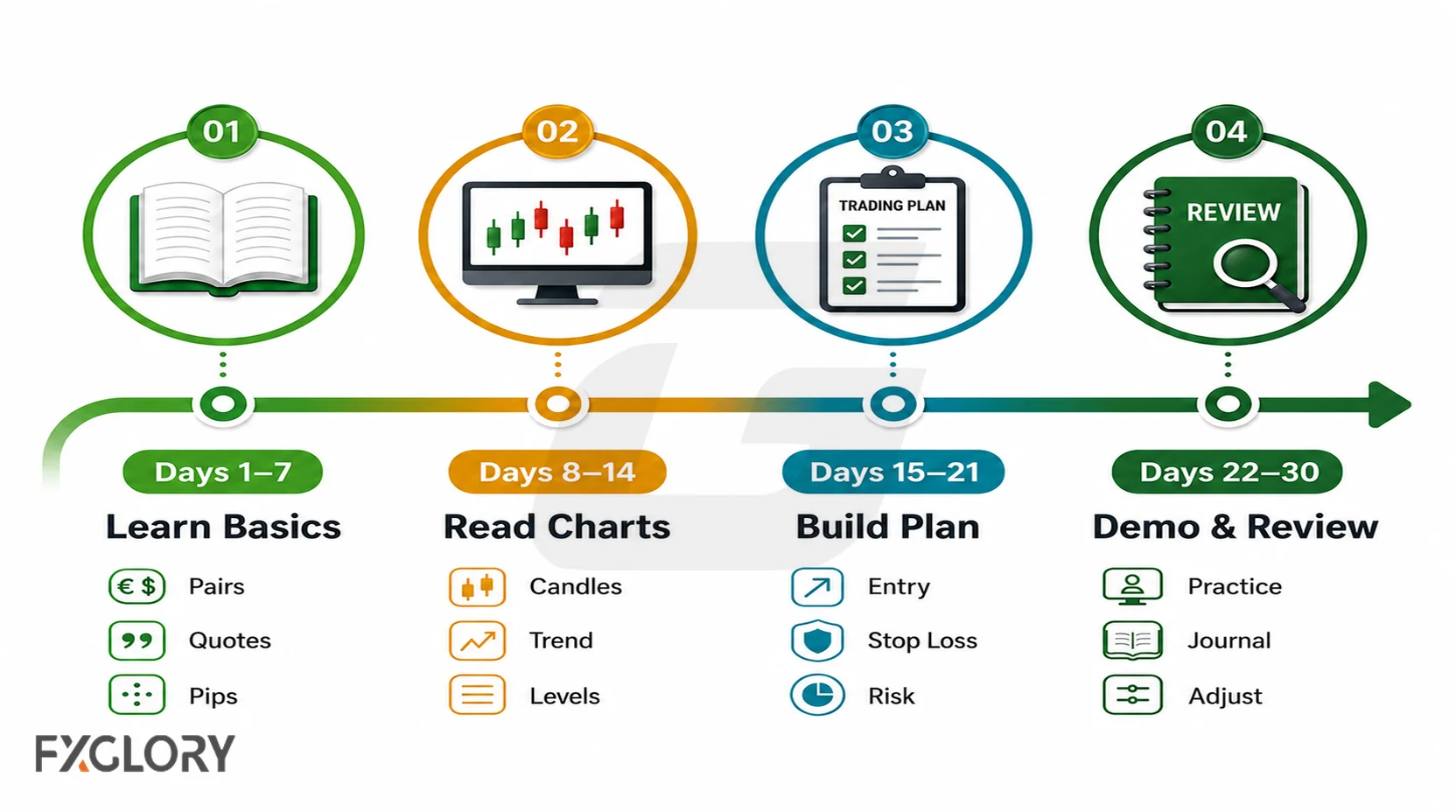
| Period | Focus | Goal |
|---|---|---|
| Days 1 to 7 | Learn forex mechanics: pairs, pips, spread, bid/ask, leverage, margin, liquidity, volatility and swap. | Understand how trades, costs and risk work. |
| Days 8 to 14 | Use demo only. Practice entries, exits, stop-losses, take-profits and journaling. | Reduce platform and execution mistakes. |
| Days 15 to 21 | Write a trading plan with allowed pairs, sessions, setup rules, risk limits and do-not-trade rules. | Stop making random decisions. |
| Days 22 to 30 | Review a sample of demo or small-size trades. Study rule-following, mistakes, costs and emotional behavior. | Fix process errors before increasing risk. |
This 30-day plan is not a path to guaranteed profit or a deadline for using live risk. Some traders may need much longer before risking live capital. The purpose is to slow down, learn mechanics and avoid preventable beginner mistakes.
Forex Do-Not-Trade Checklist
Many beginner losses come from trades that should never have been opened. Use this checklist before entry.
| Do Not Trade If | Better Rule |
|---|---|
| The setup is incomplete. | Trade only when all setup rules are present. |
| The stop-loss is unclear. | Define the risk exit before entry. |
| The position size is too large. | Calculate lot size from account risk, stop distance and pip value. |
| The spread is above your limit. | Skip the trade or wait for conditions to normalize. |
| High-impact news is too close. | Follow your news filter. |
| Your daily loss limit is hit. | Stop trading for the day. |
| You want to recover a loss. | Take a break instead of revenge trading. |
| You are tired, angry or distracted. | Trade only when your emotional state fits your plan. |
| You are chasing a missed move. | Wait for the next valid setup. |
| You do not understand the trade. | Skip signals or ideas you cannot explain. |
A skipped bad trade is not a missed opportunity. It is risk avoided.
Dangerous Forex Tips to Avoid
Some advice sounds confident but encourages poor risk control. Be careful with tips that push bigger size, more trades or less planning.
| Dangerous Tip | Why It Is Dangerous | Better Rule |
|---|---|---|
| Use more leverage to grow faster. | Larger exposure can magnify losses quickly. | Use only the position size allowed by your risk plan. |
| Remove your stop so price has room. | No stop can turn a planned loss into an uncontrolled loss. | Define invalidation before entry. |
| Trade every news release. | News can create slippage, spread widening and fast reversals. | Trade news only if your tested plan allows it. |
| Double after a loss. | Recovery sizing can quickly damage the account. | Stop or reduce size after losing streaks. |
| Follow signals without thinking. | You may not know the stop, risk or logic. | Understand entry, exit and risk before any trade. |
| Switch strategy after one loss. | One trade is not enough evidence. | Review a meaningful sample of trades. |
| Trade more to learn faster. | More trades can mean more mistakes and more cost. | Focus on quality trades and review. |
Common Myths About Forex Trading Tips
Beginner forex advice often gets distorted into myths. Avoid these:
- Myth 1: More trades mean more profit. More trades can mean more spread cost, more mistakes and more emotional pressure.
- Myth 2: High leverage is a shortcut. Leverage can magnify losses as well as gains.
- Myth 3: A high win rate is enough. A high win rate can still lose money if losses are much larger than wins.
- Myth 4: No stop-loss gives the trade more room. No stop-loss can leave risk uncontrolled.
- Myth 5: Demo success guarantees live success. Live trading can involve different emotions, costs, slippage and execution conditions.
- Myth 6: A profitable example is a signal. An example teaches mechanics; it does not predict the next market move.
- Myth 7: Forex can quickly replace income. Forex trading is risky and should not be treated as guaranteed income.
- Myth 8: News trading is easy. News can cause fast moves, whipsaws, slippage and spread widening.
- Myth 9: Forex tips can replace a plan. Tips are useful only when they become rules inside a trading plan.
- Myth 10: A complex strategy is always better. Beginners often benefit from fewer pairs, fewer sessions, smaller size and clearer rules.
Quick Recap: Forex Trading Tips
Forex trading tips should not be treated as shortcuts or secret tricks. The useful tips are practical rules that help traders control risk, avoid emotional decisions and review results honestly.
The strongest beginner habits are simple: understand the mechanics, follow a written plan, manage risk before entry and review trades to improve decision-making.
Do not judge trading by one win, one loss or a high win rate alone. Review a meaningful sample and study average win, average loss, rule-following, spread costs, slippage and emotional mistakes.
Forex trading advice cannot guarantee profit. It can only help you build better habits and avoid common mistakes.