
Quick Answer: Long and Short in Forex
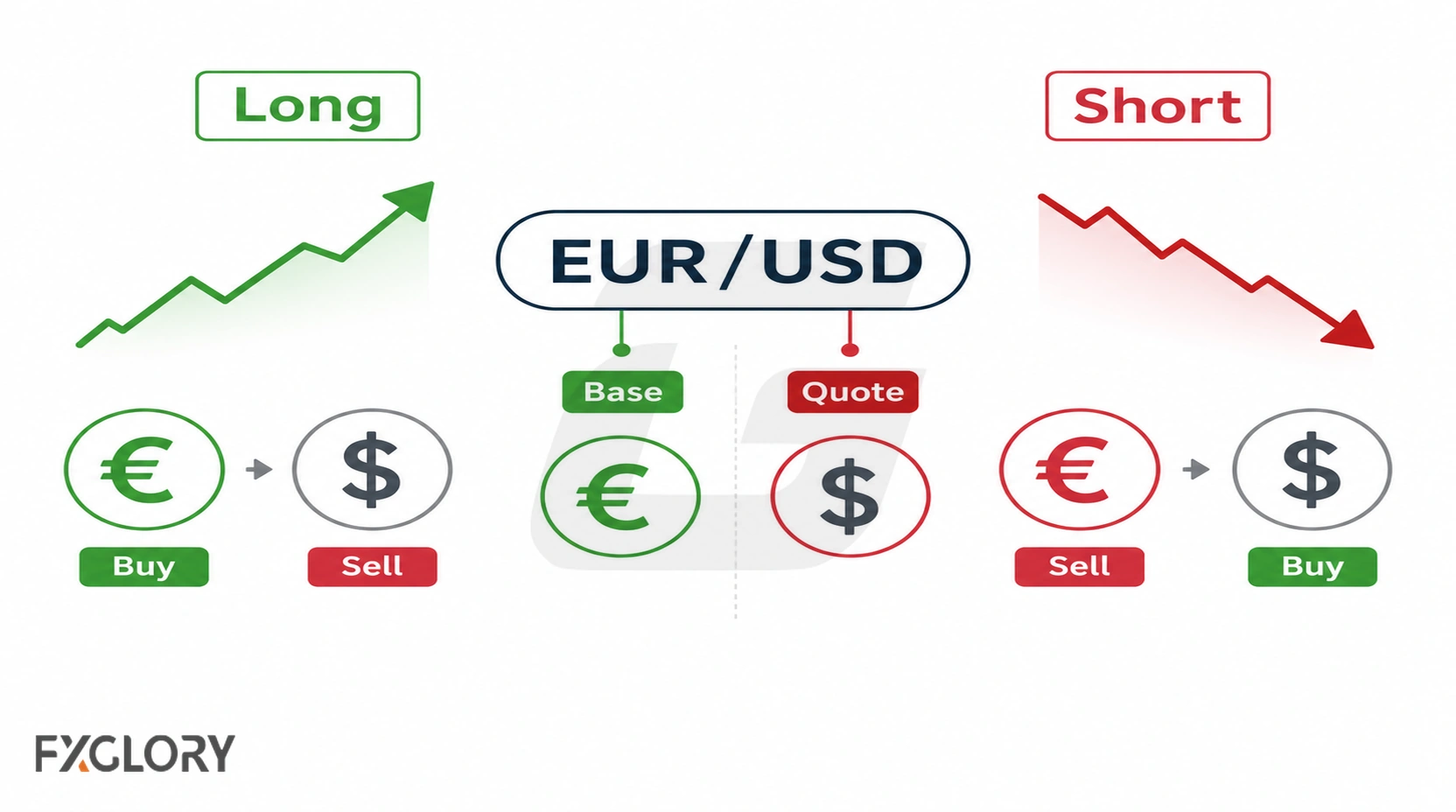
Because forex is quoted in pairs, the direction refers to the base currency, which is the first currency in the pair. Buying EUR/USD means buying EUR against USD; selling EUR/USD means selling EUR against USD.
What Do Long and Short Mean in Forex?
A forex position expresses a view on one currency relative to another. A long position is a buy position on the pair, while a short position is a sell position on the pair.
These terms do not describe how long a trade stays open. A long position can last minutes, and a short position can remain open much longer, depending on the strategy and trade plan.
For EUR/USD, EUR is the base currency and USD is the quote currency. For USD/JPY, USD is the base currency. To identify each side of a pair, see reading forex quotes.
Long, Short or No Trade?
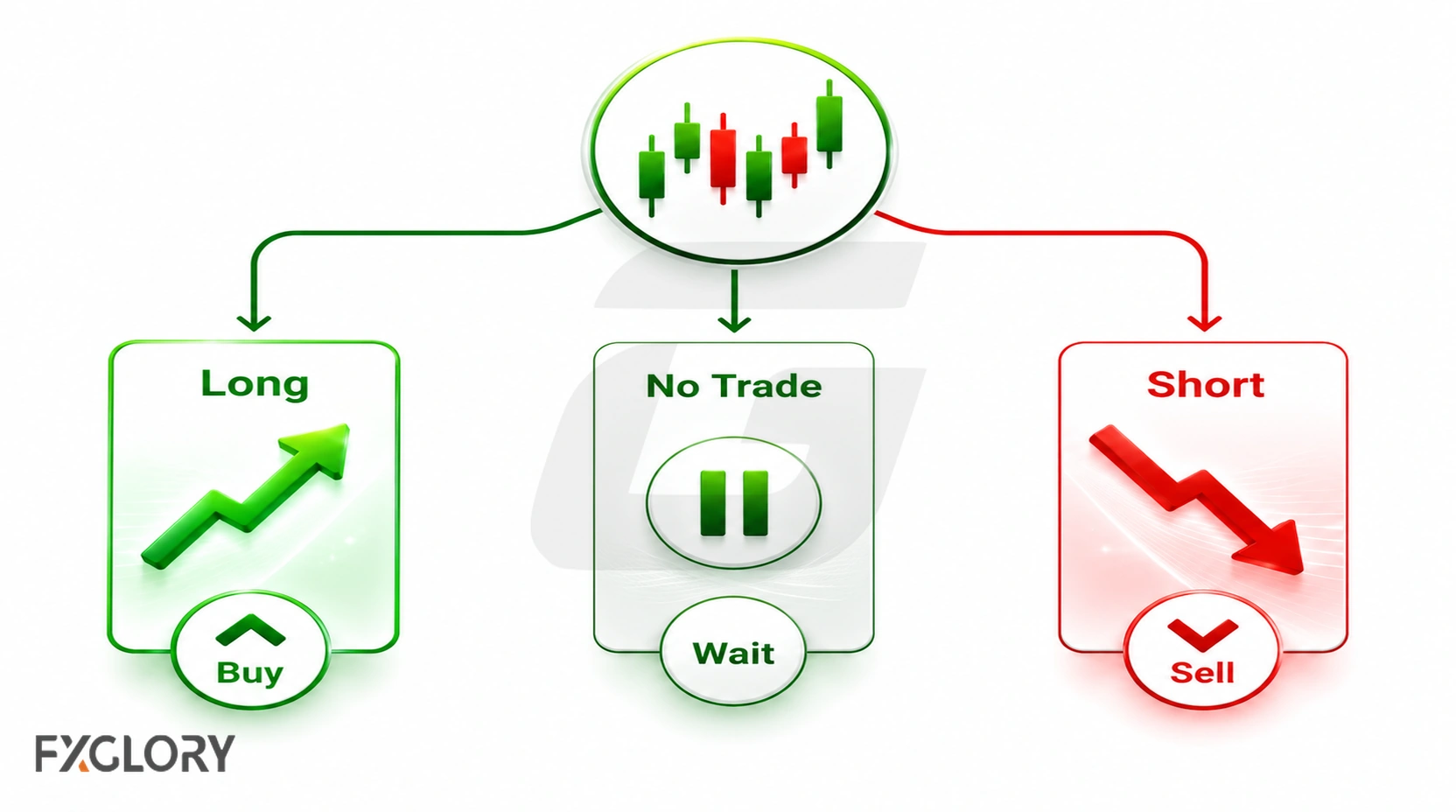
The purpose of analysis is not to force a Buy or Sell decision. It is to decide whether the current setup supports a long position, a short position, or no position at all.
| Market View | Action | What It Means | What Must Happen |
|---|---|---|---|
| Base currency may strengthen | Buy / Go long | Take a long position on the pair. | The pair needs to rise for the directional idea to work. |
| Base currency may weaken | Sell / Go short | Take a short position on the pair. | The pair needs to fall for the directional idea to work. |
| Setup is unclear or risk does not fit | No trade | Stay out of the market. | Wait for conditions that match the plan. |
You can practice reading direction on the EUR/USD live price page before creating a demo trade plan.
Buying and Selling Currency Pairs: The Base-Currency Rule
Every forex pair contains a base currency and a quote currency. Buying the pair means buying the base currency and selling the quote currency. Selling the pair means selling the base currency and buying the quote currency.
| Pair Action | Base Currency | Quote Currency |
|---|---|---|
| Buy EUR/USD | Buy EUR | Sell USD |
| Sell EUR/USD | Sell EUR | Buy USD |
| Buy USD/JPY | Buy USD | Sell JPY |
| Sell USD/JPY | Sell USD | Buy JPY |
This is why “selling forex” does not mean selling currencies in general. It means selling a specific pair and therefore taking a directional position on its base currency relative to its quote currency.
How to Buy or Sell Forex in Simple Steps
Once the direction is clear, the next task is to translate the idea into an order without losing control of risk.
| Step | What to Check |
|---|---|
| 1. Choose the pair | Identify the base and quote currencies. |
| 2. Define the setup | Decide whether the plan supports long, short, or no trade. |
| 3. Check the price side | Buying usually uses the ask price; selling usually uses the bid price. |
| 4. Size the risk | Set position size, stop loss, and maximum planned loss before entry. |
| 5. Review the order | Check order type, spread, margin, stop loss, take profit, and execution details. |
| 6. Place or skip | Enter only if the setup and risk still match the plan. |
On many trading platforms, Buy opens a long position and Sell opens a short position. Many platforms also allow a trader to open a sell position first and later close it with a buy action, subject to product, account, platform, and margin rules.
Buying usually uses the ask price and selling usually uses the bid price. For a fuller explanation of why these prices differ, see bid and ask price in forex.
Long and Short Forex Examples With EUR/USD
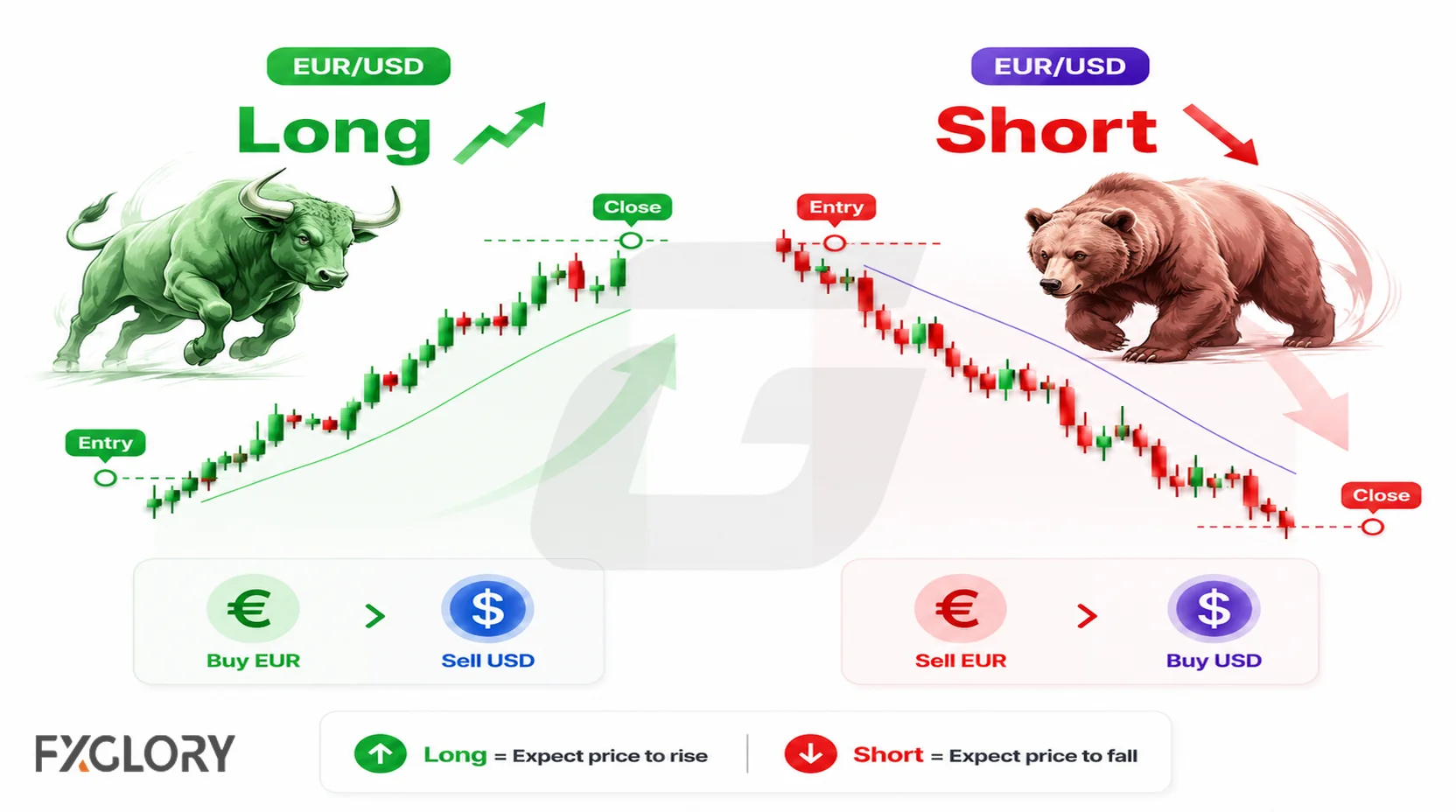
EUR/USD is a simple way to see the mechanics because EUR is the base currency and USD is the quote currency.
Example 1: Going long EUR/USD
A trader expects EUR to strengthen against USD and buys EUR/USD.
- Direction: Long EUR/USD.
- Currency relationship: Buy EUR and sell USD.
- Directional outcome: The idea benefits from EUR/USD rising and is hurt by EUR/USD falling.
Example 2: Going short EUR/USD
A trader expects EUR to weaken against USD and sells EUR/USD.
- Direction: Short EUR/USD.
- Currency relationship: Sell EUR and buy USD.
- Directional outcome: The idea benefits from EUR/USD falling and is hurt by EUR/USD rising.
Simple price outcomes
| Trade | Entry | Exit | Pair Moved | Directional Result |
|---|---|---|---|---|
| Long EUR/USD | 1.1000 | 1.1050 | Up | Direction worked. |
| Long EUR/USD | 1.1000 | 1.0950 | Down | Direction failed. |
| Short EUR/USD | 1.1000 | 1.0950 | Down | Direction worked. |
| Short EUR/USD | 1.1000 | 1.1050 | Up | Direction failed. |
These examples show direction only. They do not calculate profit or loss because lot size, spread, pip value, swap, margin, slippage, and execution conditions can change the monetary result.
Before Clicking Buy or Sell in Forex
A direction idea is not enough by itself. Before placing the order, check that the trade ticket matches the plan.
| Check | Question |
|---|---|
| Pair | Am I trading the intended currency pair? |
| Direction | Does the setup support long, short, or no trade? |
| Price | Which bid or ask price applies to this order? |
| Order type | Am I using the intended market, limit, stop, or other order type? |
| Spread | Is the current spread acceptable for the plan? |
| Lot size | Does position size fit the planned risk? |
| Stop loss | Where is the trade idea invalidated? |
| Take profit | Where is the planned exit target, if one is used? |
| Margin | What margin may be required? |
Some platforms use a dedicated Close function, while others handle exits differently. Review the platform's order process before using live funds so that an attempted exit does not unintentionally create or alter a position.
For a broader step-by-step workflow, see how to trade forex.
Risk Management for Long and Short Forex Positions
Long and short positions face opposite price-direction risk, but the size of the potential loss depends on how the position is structured.
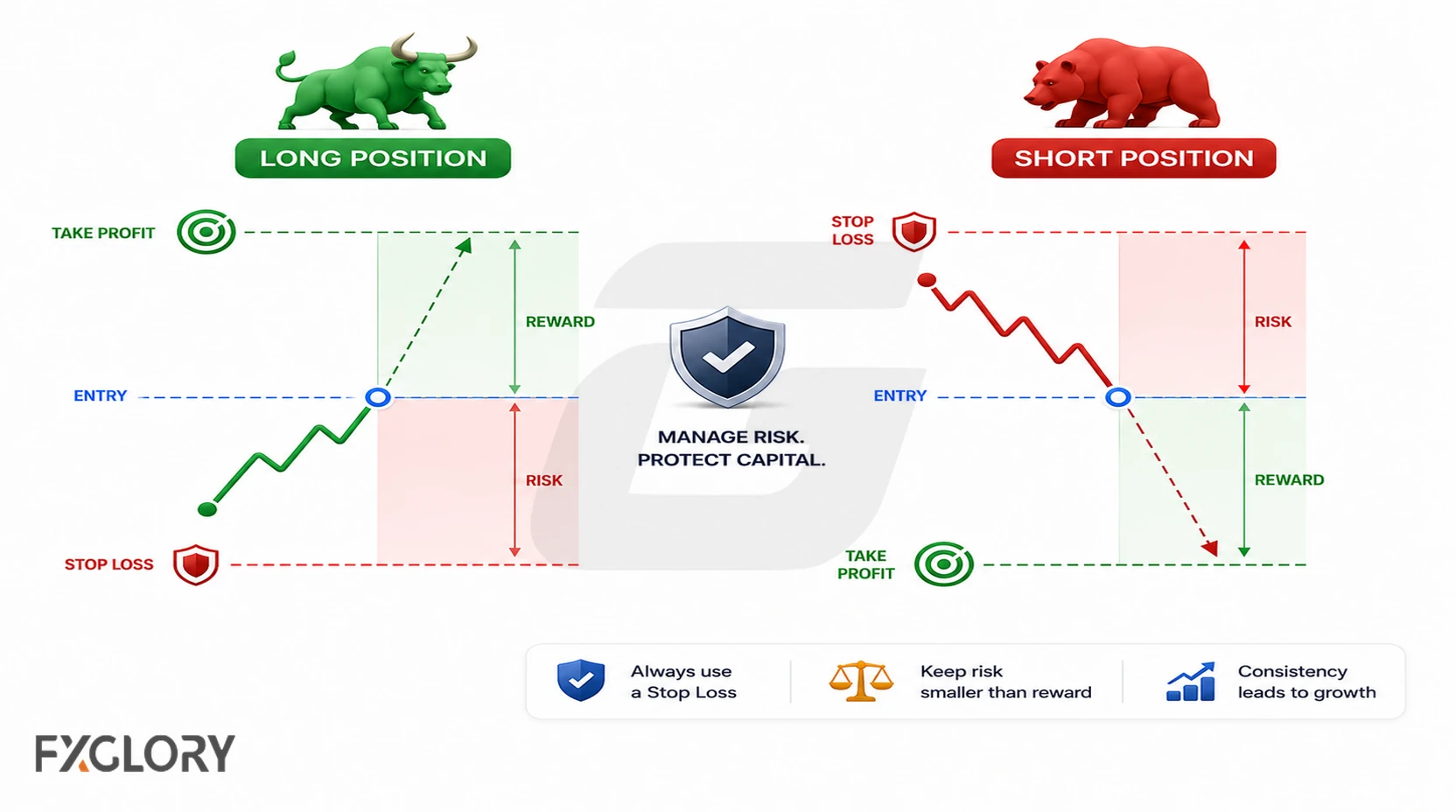
- Stop-loss placement: A long trade may place a stop below entry, while a short trade may place a stop above entry. The exact level should come from the setup rather than an arbitrary distance.
- Position size: Larger lot size increases the monetary impact of a given price move.
- Leverage and margin: Leverage can make a position too large for the account even when the directional idea is reasonable.
- Spread and slippage: Trading costs and execution can affect both entry and exit.
- Volatility: Faster or larger price swings can increase the chance that price reaches a stop or produces worse execution.
Short is not automatically riskier than long, and long is not automatically safer than short. Compare the planned loss, position size, stop distance, leverage, margin, and market conditions before entering either direction.
For more on sizing, see what is lot size in forex.
Common Beginner Mistakes With Long and Short Forex Trades
- Confusing direction with duration: Long and short say nothing about how long a trade will remain open.
- Forgetting which currency is the base: The first currency in the pair determines what is being bought or sold.
- Chasing a move: A recent rise is not automatically a reason to buy, and a recent fall is not automatically a reason to sell.
- Ignoring the bid/ask spread: Entry and exit prices can differ from the chart price a beginner is watching.
- Using an unfamiliar close workflow: An opposite-side action can behave differently across platforms and account types.
- Oversizing with leverage: A reasonable market view can still produce excessive account risk when position size is too large.
- Entering without an invalidation point: Without a planned stop or exit rule, the trader has not defined where the idea is wrong.
- Forcing a trade: If the setup or risk does not fit the plan, staying out is a valid decision.