

Quick Answer: Can You Trade Forex With $100?
A $100 account has limited room for losses and trading costs. That makes position sizing more important than the deposit amount by itself.
For example, if 0.01 lot is worth roughly $0.10 per pip on a USD-quoted major pair, a 20-pip stop is about $2 before costs and a 30-pip stop is about $3. On a $100 balance, those are approximately 2% and 3% of the account.
How Do You Trade Forex With $100?
Start with the maximum dollar loss you are prepared to accept on the trade, then work backward to the position size.
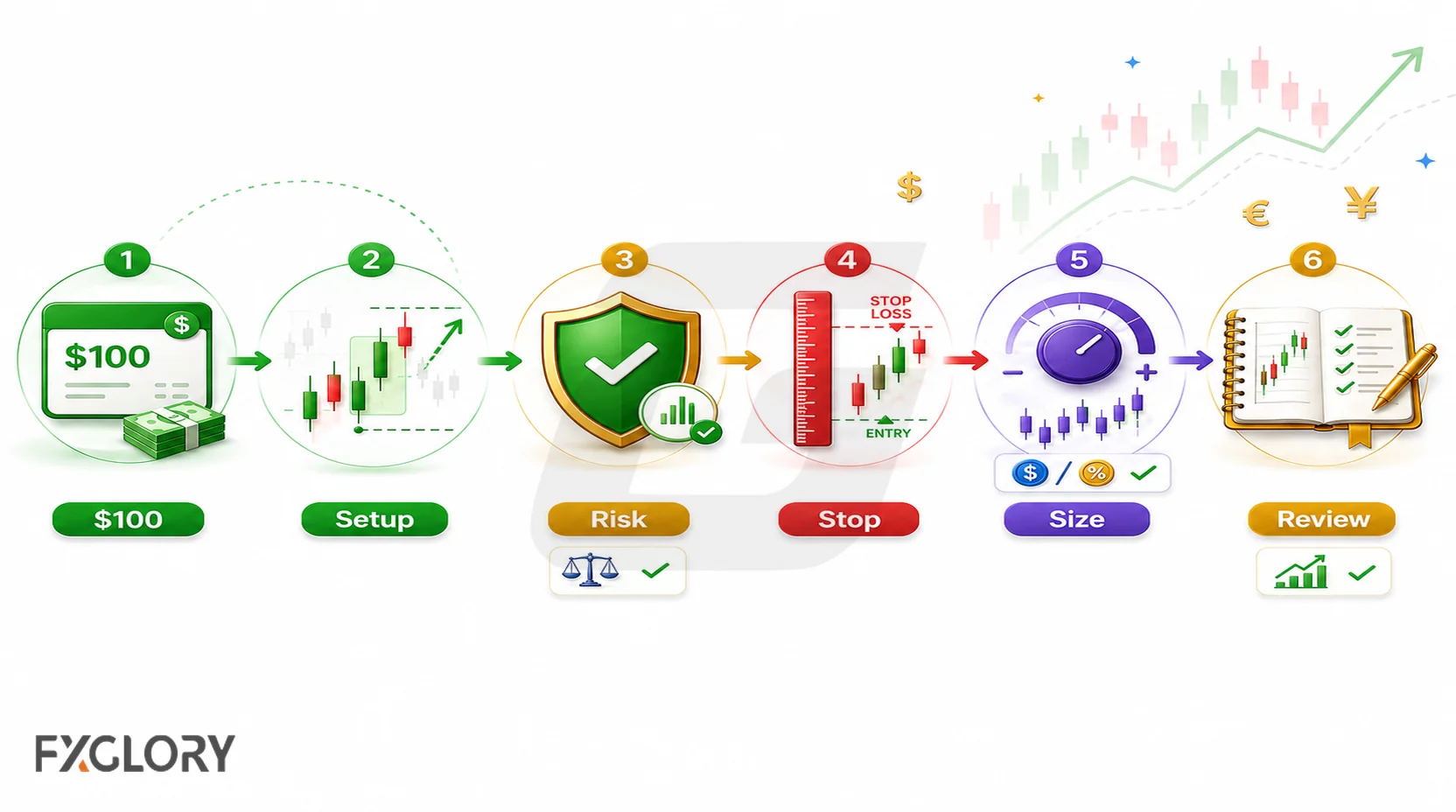
- Practice the platform first: Use demo until order entry, stop-loss placement, and lot sizing are familiar.
- Set a dollar risk limit: Decide the maximum loss before choosing the trade size.
- Choose the stop-loss distance: Define how many pips the trade needs based on the setup.
- Calculate the maximum pip value: Divide planned dollar risk by stop-loss pips.
- Compare that with the minimum available position size: If the platform minimum creates too much risk, skip the trade.
- Check spread, slippage, and margin: Trading costs and margin use can make a borderline setup unsuitable.
- Check total open exposure: Several small positions can create more combined risk than one trade.
- Record the result: Journal the setup, lot size, risk, execution, and any rule violations.
Simple $100 trade-planning example
Assume the planned loss is $1 and the stop is 20 pips.
Maximum pip value = planned dollar risk ÷ stop-loss pips
$1 ÷ 20 = $0.05 per pip
If the smallest available position is worth about $0.10 per pip, that 20-pip stop would risk about $2 before spread, slippage, swap, or other costs. In that case, the position is larger than the $1 plan allows.
What Can You Realistically Do With a $100 Forex Account?
A $100 account can be enough to test live execution with real money, but the account size limits how much risk can be taken without large percentage swings.
- Practice live execution: See how orders, spread, slippage, and stop losses behave outside demo conditions.
- Test position sizing: Learn whether the platform’s minimum lot size works with the stop distances your setups require.
- Build a trade journal: Track rule-following, execution, and emotional decisions using a small amount of capital.
- Measure cost sensitivity: On a small balance, spread and other costs are easier to see as a percentage of the account.
What a $100 account generally cannot do is turn small percentage returns into meaningful dollar income. For example, a 5% gain on $100 is $5 before any withdrawals or other costs. Pursuing much larger dollar gains requires much larger percentage returns or more capital, and larger percentage targets often involve more risk.
For broader starting-capital planning, see how much do you need to start trading forex.
FXGlory Account Requirements to Check
For an FXGlory-specific $100 example, current published account conditions matter.
- Standard account deposit: FXGlory’s account page lists a $1 minimum deposit for the Standard account and a $100 minimum for MT5.
- Minimum Standard lot size: FXGlory’s published minimum is 0.01 lot.
- Position-size step: The current account table lists a 0.01-lot step for Standard accounts.
- Spread and execution: Check the current pair and account conditions because spread affects small-account risk directly.
- Margin and stop-out rules: Review the rules that apply to the account and platform before opening a trade.
- Negative-balance protection: FXGlory’s Helpdesk says negative-balance protection is provided, while also noting that use of a bonus can produce a temporary negative balance that the system later nullifies.
Risk, Lot Size and Leverage Math for a $100 Account
The most useful calculation is the relationship between stop distance and pip value.
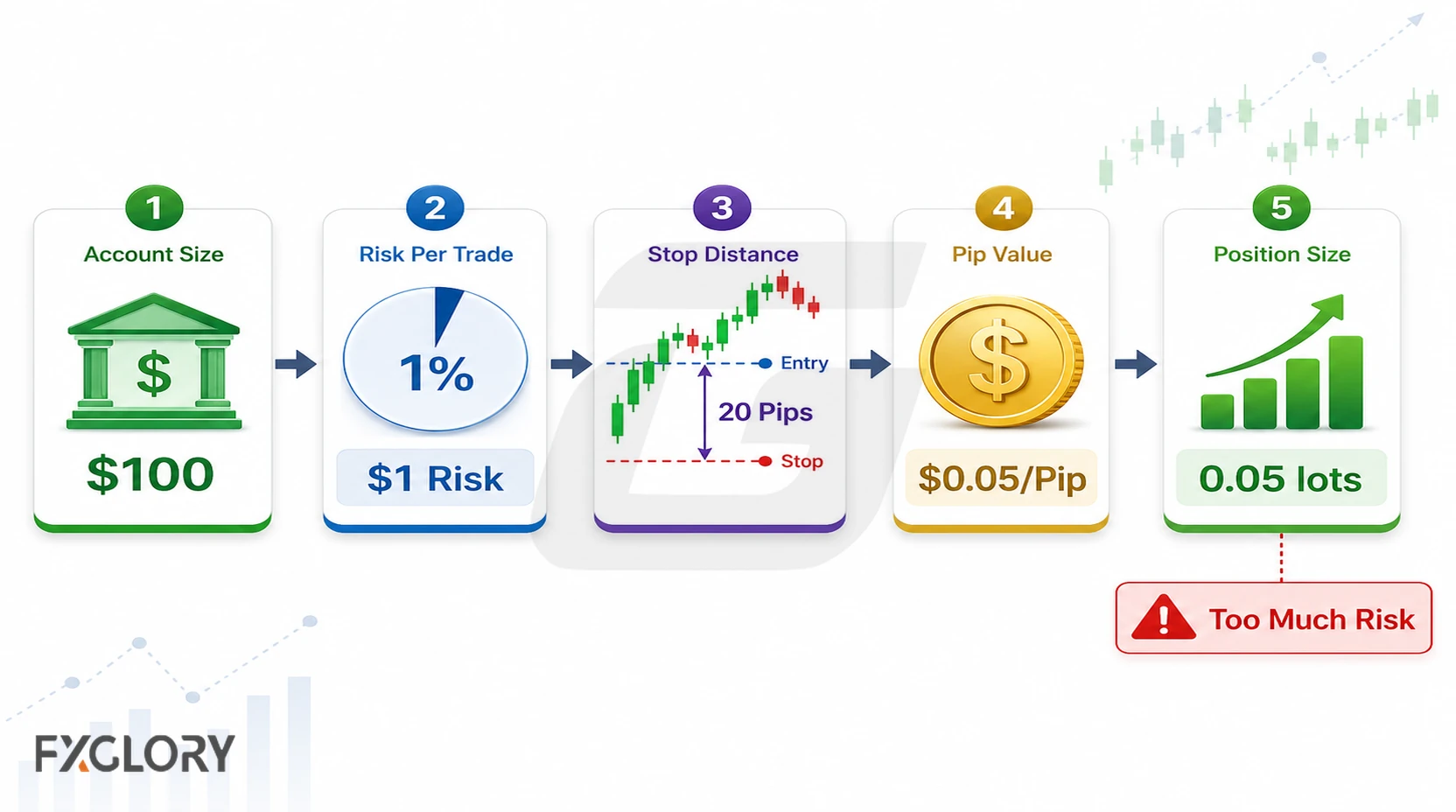
Trade risk = stop-loss pips × pip value
Maximum pip value = planned dollar risk ÷ stop-loss pips
| Planned Risk | Dollar Risk on $100 | 20-Pip Stop: Max Pip Value | 30-Pip Stop: Max Pip Value |
|---|---|---|---|
| 1% | $1 | $0.05/pip | About $0.033/pip |
| 2% | $2 | $0.10/pip | About $0.067/pip |
| 3% | $3 | $0.15/pip | $0.10/pip |
| 5% | $5 | $0.25/pip | About $0.167/pip |
These percentages are arithmetic examples, not recommendations or guarantees. They show why the platform’s minimum position size can become the limiting factor on a small account.
Lot size and pip value
A standard lot is 100,000 units of the base currency, a mini lot is 10,000 units, and a micro lot is 1,000 units. For many USD-quoted major pairs, 0.01 lot is roughly $0.10 per pip, although exact pip value depends on the pair, exchange rate, and account currency.
| Position Size | Units of Base Currency | Approx Pip Value on Many USD-Quoted Majors | Effect of 20-Pip Move |
|---|---|---|---|
| 1.00 lot | 100,000 | About $10/pip | About $200 |
| 0.10 lot | 10,000 | About $1/pip | About $20 |
| 0.01 lot | 1,000 | About $0.10/pip | About $2 |
For position-size basics, see what is lot size in forex. For detailed pip calculations, see how to calculate pips in forex.
How leverage changes margin on a $100 account
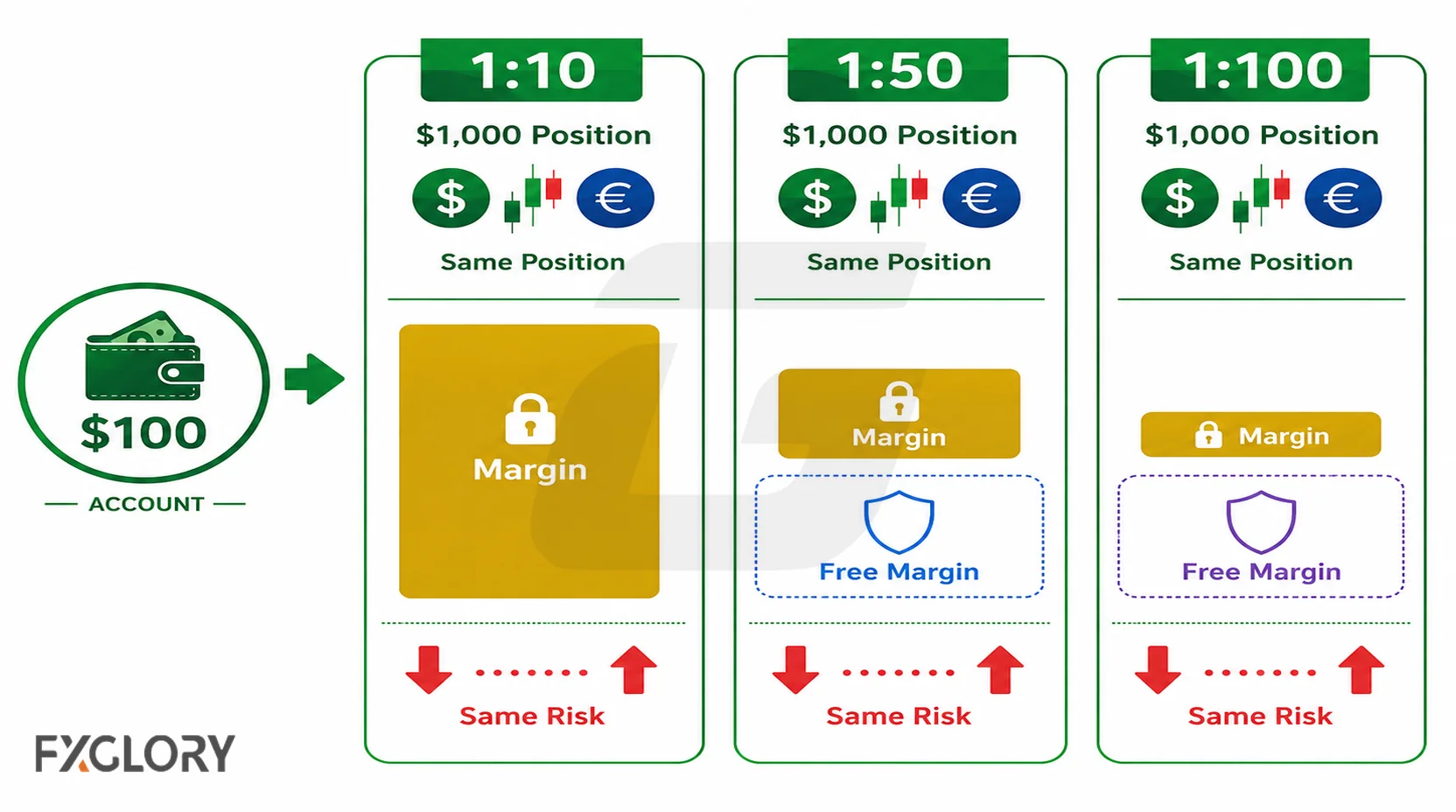
Leverage changes the margin required to hold a given position. It does not change the price movement or pip value of that same position.
| Position Exposure | Leverage | Approx Margin Needed | What Changes |
|---|---|---|---|
| $1,000 | 1:10 | About $100 | Most of the account is tied up as margin. |
| $1,000 | 1:50 | About $20 | Less margin is required. |
| $1,000 | 1:100 | About $10 | Still less margin is required. |
The $1,000 position has the same underlying exposure in each row. Only the margin requirement changes.
For choosing leverage more carefully, see best leverage for forex.
Rules and Stop Signals for a $100 Forex Account
Because the account is small, ordinary trading costs and a few losing trades can consume a noticeable percentage of the balance. The rules should therefore be tied to measurable risk rather than vague limits on the number of trades.
- Define the maximum combined open risk: Add the planned loss across all open positions.
- Check total exposure: Several trades can create concentrated risk even if each one is individually small.
- Do not increase the stop after entry to avoid taking a planned loss: That increases the risk after the trade is open.
- Stop when the pre-set daily loss limit is reached: The limit should be chosen before trading.
- Pause after repeated rule violations: A sequence of process errors is more useful to review than to trade through.
- Do not add size to recover losses: Increasing exposure after a loss can compound account damage.
Simple trade journal template
- Pair traded
- Entry and exit
- Lot size
- Pip value
- Stop-loss distance
- Planned dollar risk
- Spread at entry
- Reason for the trade
- Rule followed or broken
- Emotion before and after the trade
What to Trade and Avoid With a $100 Account
For a small account, the relevant characteristics are spread, liquidity, stop distance, and whether the minimum lot size can be made to fit the risk plan. There is no universally best currency pair or strategy.
- Prefer conditions with lower transaction costs: A wide spread can consume a large share of a small target or stop.
- Avoid setups that require a stop too wide for 0.01 lot: If the minimum size exceeds the planned loss, the setup does not fit.
- Be cautious around high-impact news: Slippage and fast spread changes can exceed the planned execution assumptions.
- Watch correlated exposure: Multiple positions involving the same currency can behave like one larger directional bet.
Use the EUR/USD live price page to review price movement and spread conditions. For spread basics, see bid and ask price in forex.
Common mistakes to avoid with $100
- Fast account-flipping goals: Turning $100 into a large amount requires extreme percentage growth.
- Oversized lot sizes: Even 0.01 lot can be too large when the stop is wide relative to the planned risk.
- Multiple correlated trades: Combined exposure can be much larger than it first appears.
- Trading without checking costs: Spread and slippage matter more when the account balance is small.
- Widening stops after entry: This increases the planned loss.
- Repeated deposits without reviewing mistakes: Adding funds can hide an unresolved process problem.
Can You Make or Lose Money Trading Forex With $100?
Can you make money trading forex with $100?
A profitable trade can increase a $100 balance, but the dollar gain remains small unless the percentage return is large. The examples below show arithmetic scale only; they are not forecasts, targets, or typical results.
| Return Example | Dollar Change on $100 | What It Shows |
|---|---|---|
| 2% | $2 | Small dollar change. |
| 5% | $5 | Still a small dollar amount. |
| 10% | $10 | Large percentage change for a small account. |
| 20% | $20 | Very large percentage change if treated as a repeatable target. |
For realistic profit expectations, see can you really make money trading forex.
Can you lose the full $100?
Yes. Repeated losses, oversized positions, spread, slippage, margin pressure, and emotional decisions can reduce or exhaust the balance.
FXGlory states that it provides negative-balance protection through its margin-call and stop-out framework. Its Helpdesk also notes an exception involving the use of a bonus: the balance can become negative, after which the system nullifies the negative amount so the next deposit starts from zero.
First 30 Days: A Practical $100 Learning Framework
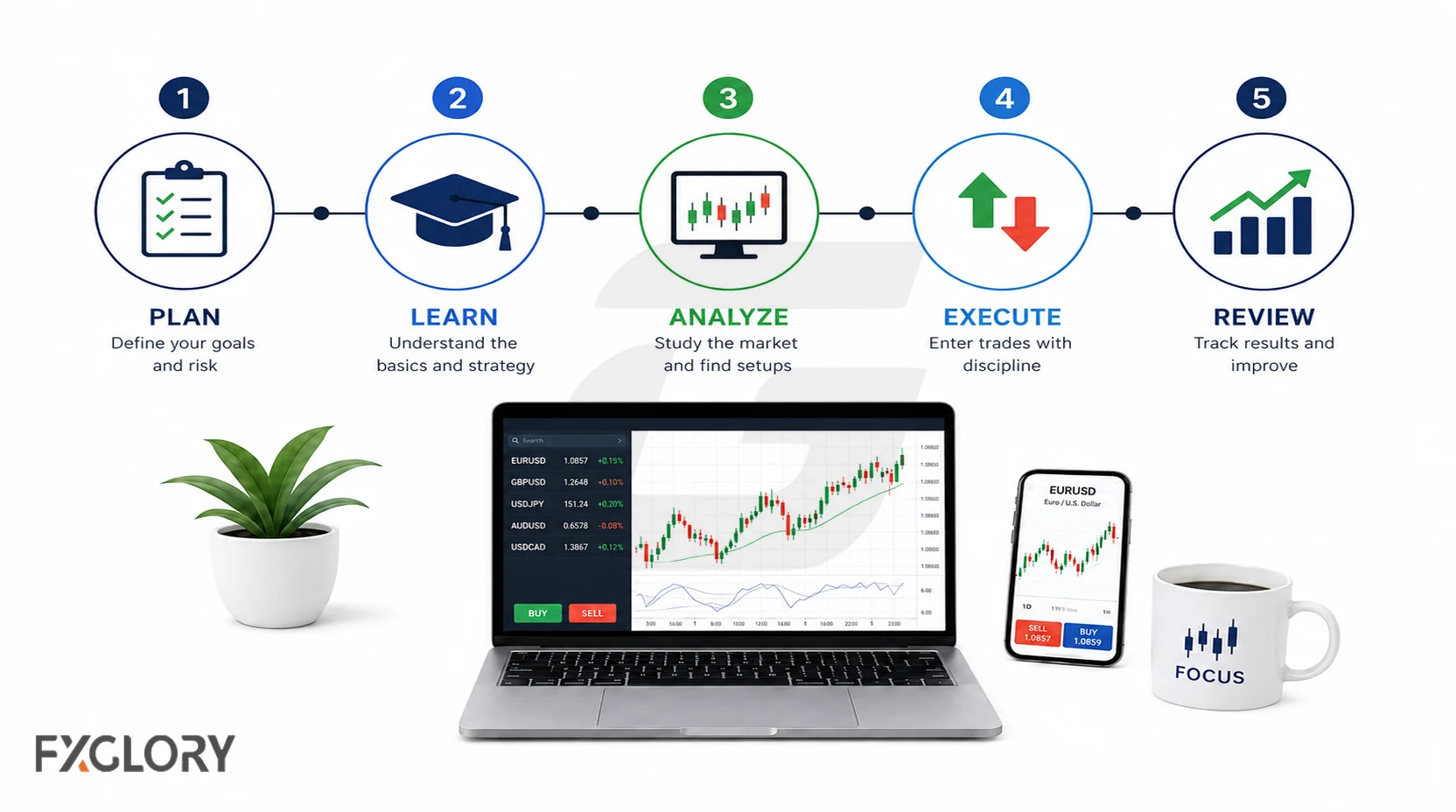
- Days 1-7: Use demo or the minimum live size and verify order placement, stop-loss behavior, pip value, and platform controls.
- Days 8-14: Focus on one pair or one setup and record planned risk versus actual execution.
- Days 15-21: Review average loss, average win, spread impact, rule violations, and total open exposure.
- Days 22-30: Evaluate whether position sizing stayed within the plan before considering any change in size.
Do not increase position size simply because a small number of trades were profitable. Use the journal to identify whether the process was repeatable and whether losses stayed within the planned limits.
Quick Recap: How to Trade Forex With $100
A $100 balance can be enough to place live forex trades, but the minimum position size must still fit the required stop distance and dollar risk. On FXGlory’s published Standard account conditions, the minimum trade size is 0.01 lot.
For a small account, the practical sequence is: define the maximum dollar loss, choose the stop distance, calculate the maximum pip value, check whether 0.01 lot fits, then review spread, margin, leverage, and total exposure before entry.
If the smallest position creates more risk than the plan allows, the correct conclusion is that the trade does not fit the account under those conditions.