
Quick Answer: Stocks vs Forex
The useful comparison is not which market is universally better, but how each market works and which risks, time horizon and research style fit the trader.
Stocks vs Forex at a Glance
| Feature | Forex | Stocks |
|---|---|---|
| What is traded | Currency pairs such as EUR/USD. | Shares of companies or stock-based products, depending on the instrument. |
| Ownership | No company ownership. | Direct shares may represent company ownership. |
| Main drivers | Interest rates, inflation, central banks, economic data and risk sentiment. | Earnings, valuation, management, sector trends and company news. |
| Market hours | Active across much of the working week. | Usually centered on exchange trading hours, with extended sessions in some markets. |
| Liquidity | Often high in major pairs during active sessions. | Varies substantially by company and share. |
| Leverage and margin | Often margin-based for retail traders. | Depends on broker, account type, product and jurisdiction. |
| Typical use | Often active trading, speculation or currency hedging. | Can be active trading or long-term investing. |
Main Difference: What You Trade
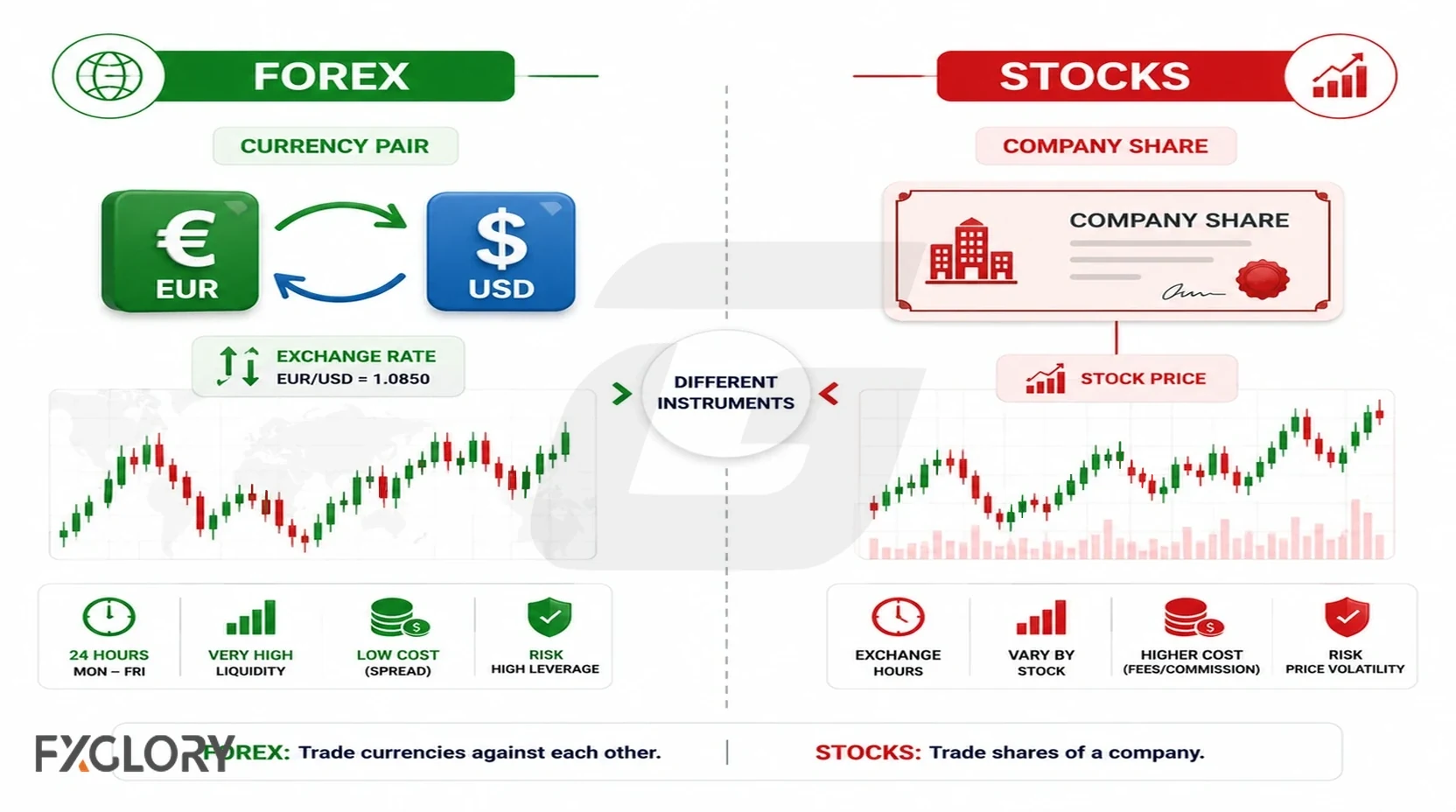
Forex trading means trading one currency against another. In EUR/USD, EUR is the base currency and USD is the quote currency, so the position reflects the exchange rate between them.
Stock trading can mean buying or selling company shares directly or using products linked to stock prices, depending on the broker, account and jurisdiction. Stock analysis often focuses more heavily on the company itself.
For the basic mechanics of currency-pair trading, see what is forex.
Ownership vs Currency Trading
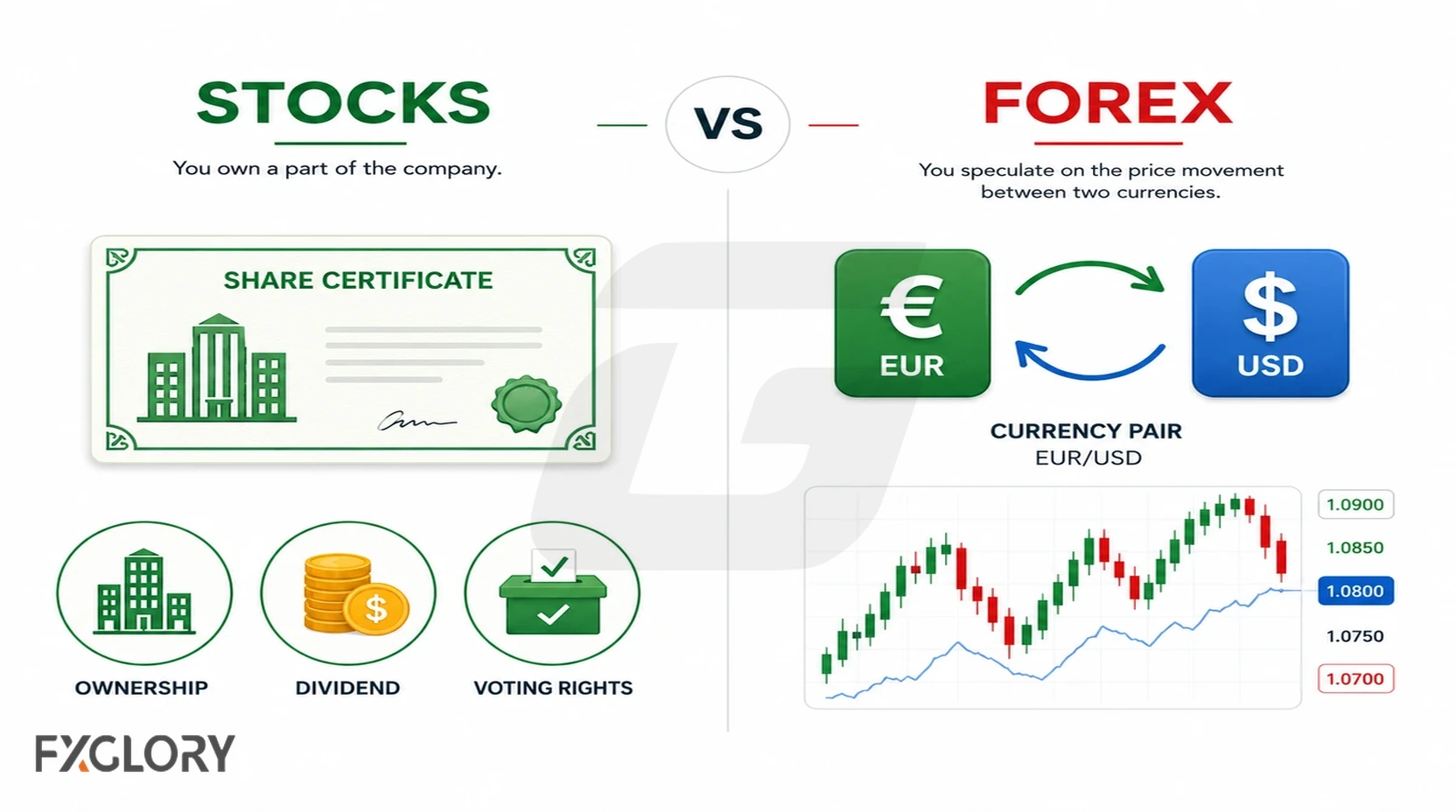
Direct shares may represent ownership in a company and can carry rights such as dividends or voting rights, depending on the company, share class and jurisdiction. Forex positions do not provide company ownership or company dividends.
Market Hours, Liquidity and Volatility
Market Hours
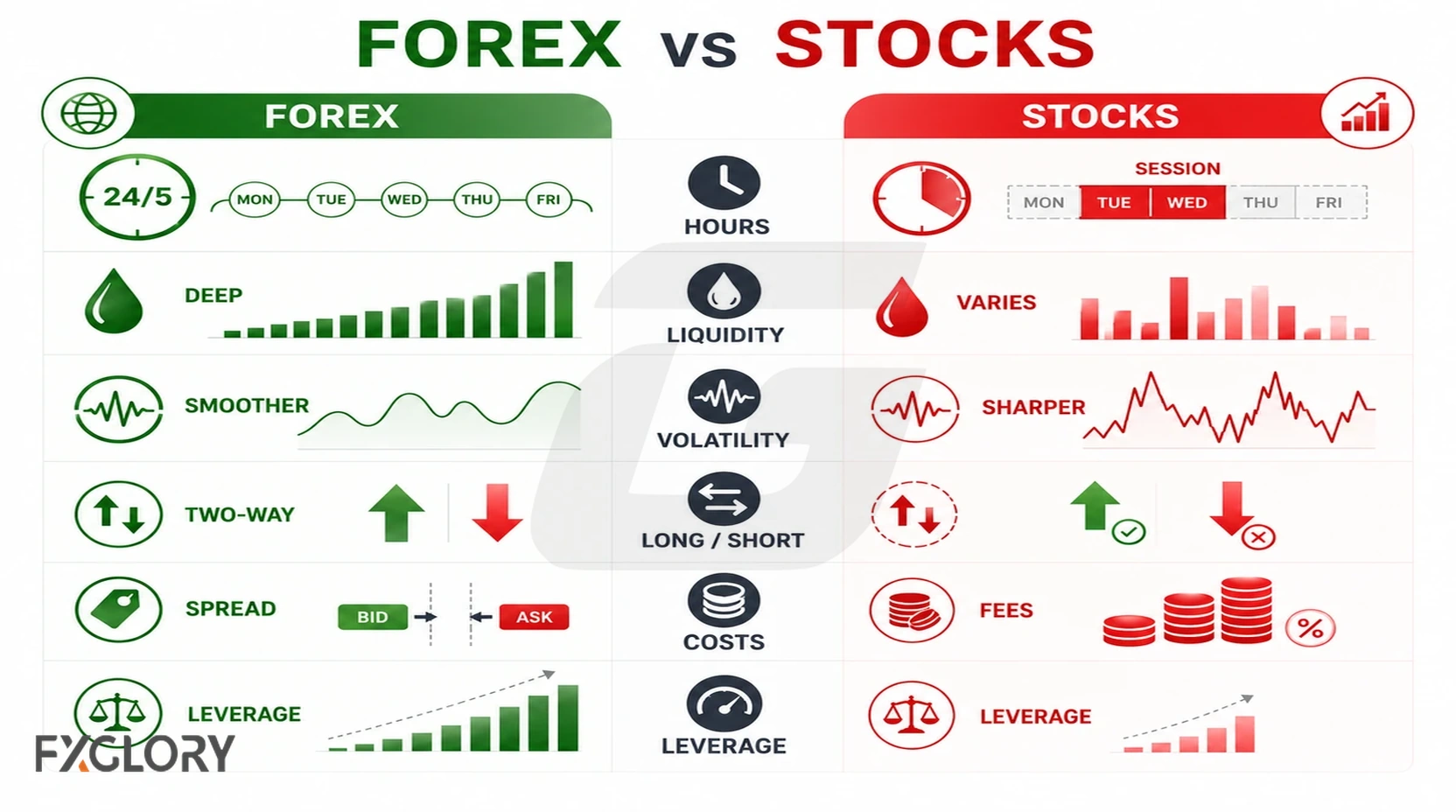
Forex follows major financial centers around the world and is active across much of the working week. Stocks are usually tied more closely to exchange sessions, although some markets offer premarket or after-hours trading.
Longer hours can provide flexibility, but they can also make it easier to trade when tired or outside a defined plan. Clear exchange sessions can create stronger time boundaries, while stocks can still gap between sessions after earnings or major news.
Liquidity and Volatility
Liquidity in forex is often deepest in major pairs during active sessions. Stock liquidity depends heavily on the individual security; a large-cap stock can behave very differently from a thinly traded small-cap stock.
Volatility also has different drivers. Forex can react sharply to economic releases and central-bank decisions, while stocks can move rapidly around earnings, company announcements or sector news. Volatility describes the size and speed of price movement, not its direction.
For deeper forex context, see what is liquidity in forex and what is volatility in forex.
Long and Short Trading
Forex naturally involves buying one currency while selling another, so long and short views are built into currency-pair trading. Stock traders can also take long or short exposure, but short selling can depend on stock availability, broker rules, margin requirements and the product being used.
For practical forex examples, see forex trading examples.
Leverage, Margin and Trading Costs
Leverage and Margin
Forex trading often gives retail traders access to margin-based positions. Leverage changes the amount of market exposure a trader can control relative to margin or account equity; it does not magnify the market's percentage price movement.
If leverage is used to take a larger position, the same price move can have a larger monetary effect on the account. Stock margin can create the same type of exposure effect, although the rules vary by market, broker, account and jurisdiction.
For more detail, see best leverage for forex.
Costs
| Cost Type | Forex | Stocks |
|---|---|---|
| Spread | Bid-ask spread is often a core trading cost. | Bid-ask spread can matter, especially in less liquid shares. |
| Commission | May be built into the spread or charged separately. | Broker commissions may apply, depending on market and account. |
| Financing | Swap or rollover may apply when positions remain open overnight. | Margin interest or other financing may apply when borrowing is involved. |
| Execution | Slippage can occur around news or thin liquidity. | Slippage and price gaps can occur, especially around company news. |
Neither market is automatically cheaper. Compare the total cost relevant to the trading style rather than a single headline fee. For forex spread and rollover basics, see bid and ask price in forex and what is swap in forex.
Market Drivers: Forex vs Stocks
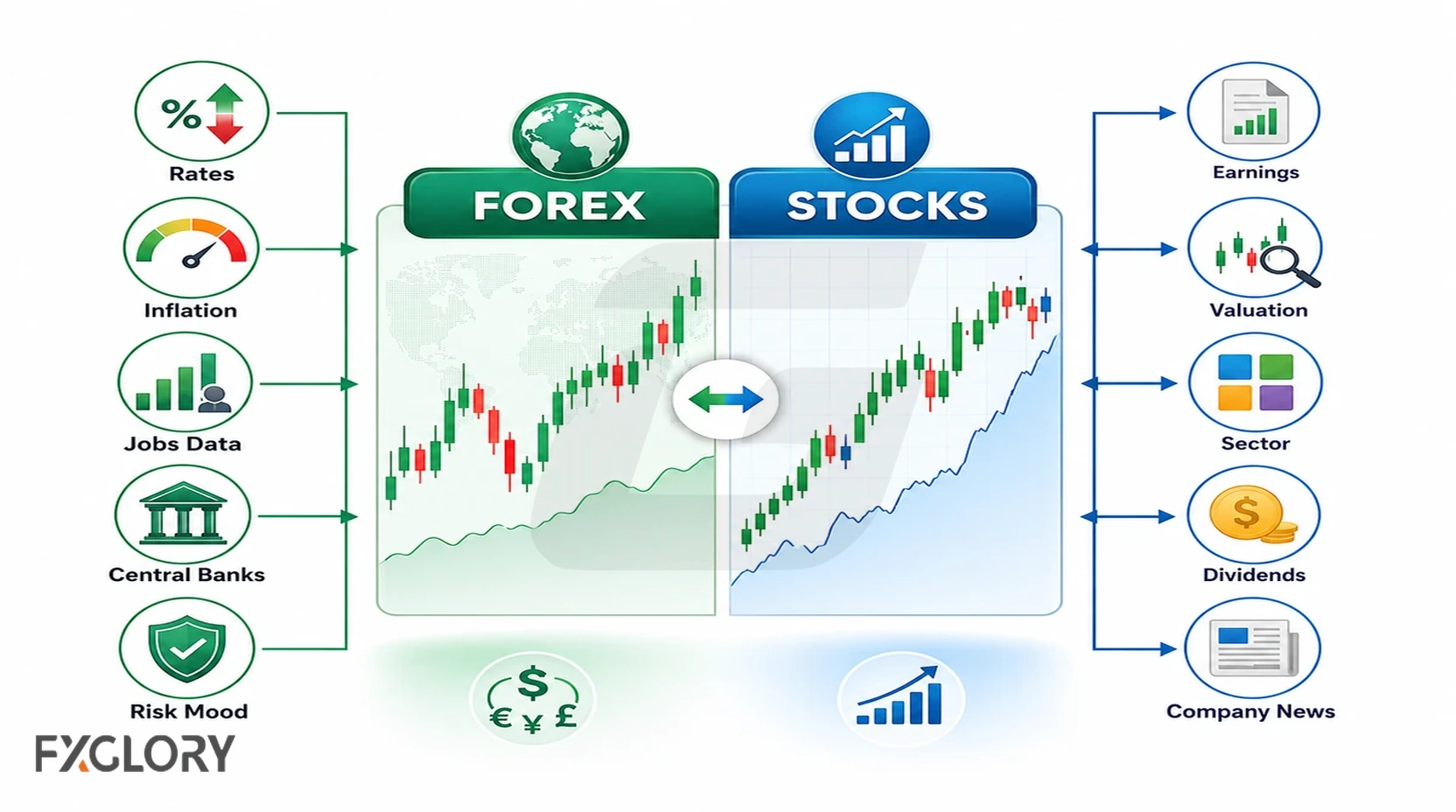
| Driver | Forex | Stocks |
|---|---|---|
| Interest rates | Central-bank expectations can strongly affect currencies. | Rates can affect borrowing costs, valuations and sectors. |
| Inflation and economic data | Can influence currency expectations and policy outlook. | Can affect broad market sentiment, costs and consumer demand. |
| Company earnings | Usually indirect. | A direct driver of individual stock prices. |
| Policy and geopolitics | Can affect exchange rates and risk sentiment. | Can affect sectors, supply chains and broader market sentiment. |
Forex analysis usually requires more attention to macroeconomic relationships, while stock analysis often requires more attention to company and sector information. For context on currency-market participants, see forex market participants.
Day Trading Stocks vs Forex
Day trading is a trading style, not a market. A trader can day trade either stocks or forex, and each market creates a different execution environment.
| Area | Forex Day Trading | Stock Day Trading |
|---|---|---|
| Instrument selection | Often a smaller set of major pairs. | Potentially thousands of shares to screen. |
| Key conditions | Session timing, spread, liquidity, macro news and leverage. | Stock liquidity, gaps, company news, sector movement and margin rules. |
| Common execution risk | Spread widening, news spikes and oversized exposure. | Gaps, low-volume shares and sudden company-specific news. |
Account rules, short-selling rules and margin requirements can vary by broker and jurisdiction, so they should be checked before trading either market.
Which Market May Fit You?
The choice depends on the kind of analysis, time horizon and market structure you want to work with.
| Forex May Fit Better If You Prefer | Stocks May Fit Better If You Prefer |
|---|---|
| Currency pairs and macroeconomic analysis. | Company and sector research. |
| Active trading across global sessions. | Exchange-centered sessions or longer-term investing. |
| Monitoring a smaller set of major instruments. | Choosing from a larger universe of companies and sectors. |
| Working with spread, swap and currency correlations. | Working with earnings, valuation, dividends and company-specific risk. |
Those are structural differences, not guarantees of better results. A trader still needs risk limits, position sizing and a review process in either market.
For more on forex-specific benefits and risks, see advantages of forex trading.
Forex or Stocks for Beginners?
Neither market is automatically suitable for beginners. Stocks may feel more intuitive because a share can represent a familiar company, while forex may be easy to access through demo accounts and smaller position sizes.
Familiarity and access are not substitutes for product knowledge. A beginner in forex should understand pairs, pips, spreads, leverage and position sizing. A beginner in stocks should understand company risk, liquidity, order types, diversification and the difference between direct shares and stock-based derivatives.
Decision Checklist: Stocks or Forex?
- Instrument: Do I understand exactly what I am trading?
- Ownership: Am I buying direct shares or only taking price exposure?
- Drivers: Am I more comfortable analyzing macroeconomic data or company-specific information?
- Costs: Do I understand spread, commission, financing, swap or other relevant charges?
- Exposure: Do I understand how margin and position size affect account risk?
- Liquidity: Is the specific pair or stock liquid enough for my trade size and style?
- Time horizon: Am I day trading, swing trading, position trading or investing?
- Process: Do I have entry, exit, risk and review rules before committing capital?