

Quick Answer: What Is the Best Leverage for Forex?
In practical terms, leverage is a margin tool. It changes how much capital must be set aside to control a given notional position. It does not make that unchanged position more or less sensitive to price movement.
For the basic mechanics of leverage, see what is leverage in forex trading.
Best Leverage Is Not Maximum Leverage
Available leverage is the maximum ratio the account or instrument permits. Effective leverage is the actual open exposure compared with account equity.
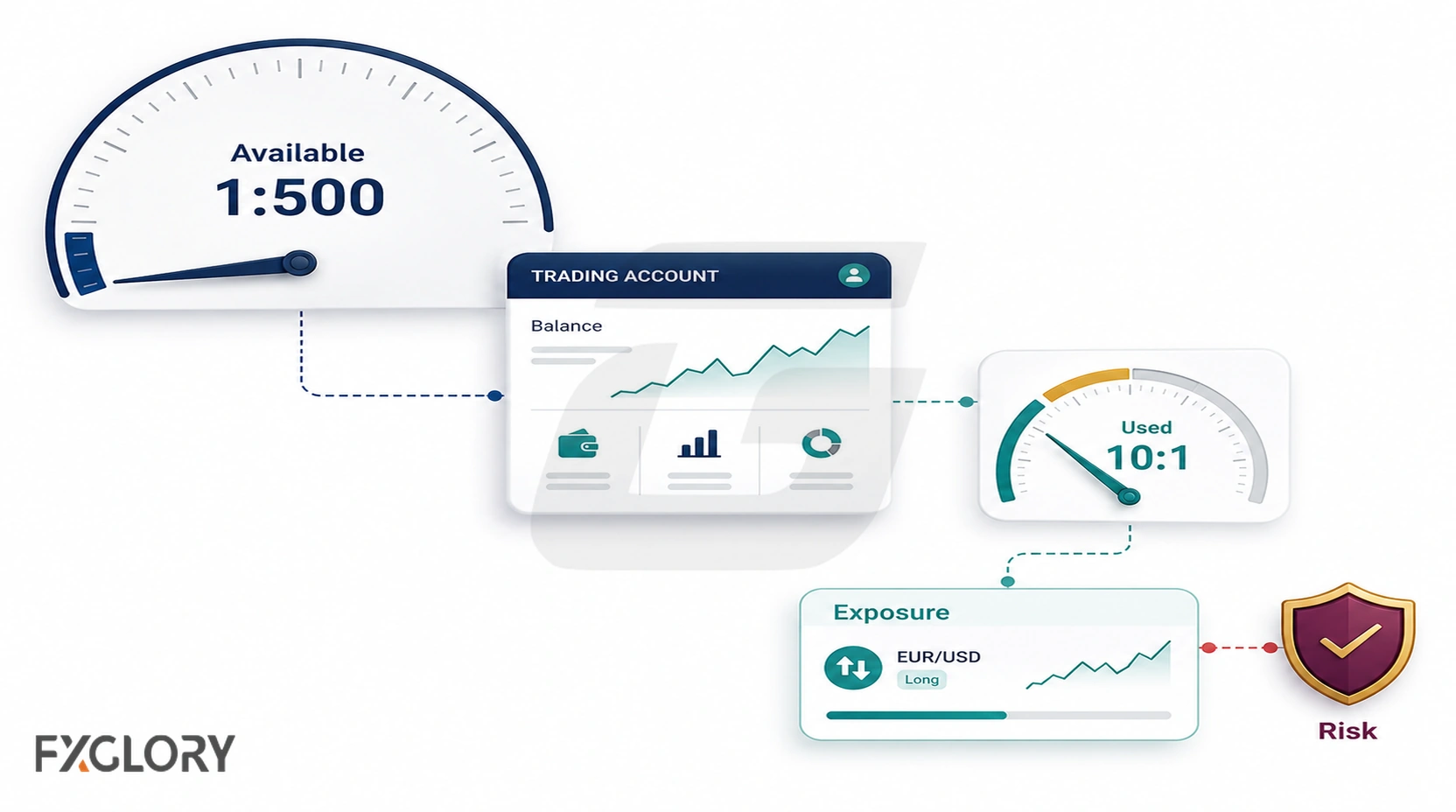
This distinction matters because a trader does not have to use all available leverage. A higher available ratio can provide flexibility in margin usage, while the actual position size determines how much exposure is opened.
What Leverage Should You Use in Forex?
Start with the trade plan rather than a target leverage ratio. Before selecting leverage, define:
- Account equity: The capital currently supporting open and planned positions.
- Planned monetary risk: The amount the trade is allowed to lose if the exit condition is reached.
- Stop-loss distance: The distance between entry and the planned invalidation level.
- Position size: The lot size or notional exposure that fits the risk limit.
- Required margin: The funds the platform requires for that position at the selected leverage.
- Free margin: The equity remaining after used margin is accounted for.
- Total open exposure: Existing positions that already contribute to effective leverage.
Once the position size is fixed by the risk plan, compare the margin requirement under the leverage settings available to the account. A higher available ratio may reduce the margin required for an eligible position, which can leave more free margin available. That flexibility is useful only when the position size itself still fits the risk plan.
Effective Leverage and Required Margin
Effective leverage is a planning measure that compares open market exposure with account equity:
For example, $10,000 of total open exposure against $1,000 of account equity equals 10:1 effective leverage.
| Account Equity | Total Open Exposure | Effective Leverage |
|---|---|---|
| $1,000 | $5,000 | 5:1 |
| $1,000 | $10,000 | 10:1 |
| $1,000 | $25,000 | 25:1 |
| $1,000 | $50,000 | 50:1 |
Required margin
For a simple leveraged forex example, required margin can be estimated from the position's notional value and the applicable leverage ratio:
The equivalent margin-rate form is:
These are planning formulas, not universal broker calculations. Actual margin can depend on the instrument, account type, contract specification, open positions, and platform rules.
For example, if a $10,000 notional position is eligible for 1:100 leverage, the simplified margin estimate is $100. At 1:50, the simplified estimate is $200.
Same position, different leverage
The table below holds the notional position constant at $10,000. Only the simplified margin requirement changes.
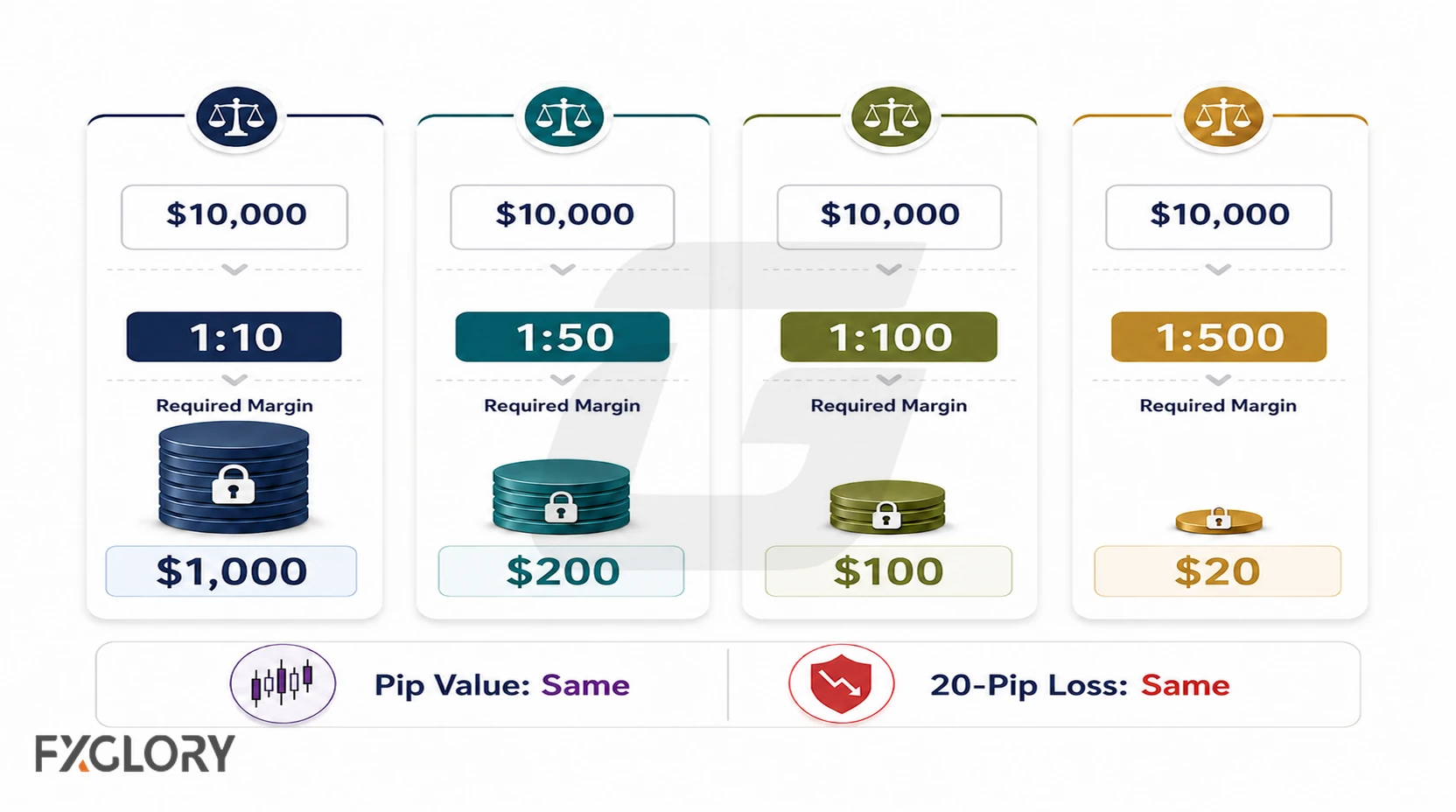
| Notional Position | Leverage | Simplified Margin |
|---|---|---|
| $10,000 | 1:10 | $1,000 |
| $10,000 | 1:50 | $200 |
| $10,000 | 1:100 | $100 |
| $10,000 | 1:500 | $20 |
Because the position is unchanged, its pip value is unchanged as well. The leverage ratio affects margin access, not the price movement of that fixed position.
Used margin, free margin and margin level
- Used margin: Funds allocated to support open leveraged positions.
- Free margin: Equity remaining after used margin is accounted for.
- Margin level: A platform percentage comparing equity with used margin.
- Margin call and stop-out: Platform thresholds that can trigger warnings or automatic position closure when account equity falls relative to required margin.
Exact calculations and thresholds depend on the account and platform, so current trading conditions should be checked rather than inferred from a generic example.
High Leverage: 1:100, 1:500 and Higher
Higher available leverage can reduce the margin required for an eligible position and provide more flexibility in how account equity is allocated. The main risk arises when that additional capacity is used to increase position size beyond the trader's predefined loss limit.
Is 1:100 leverage good for forex?
Whether 1:100 is appropriate cannot be determined from the ratio alone. The relevant questions are the position size it will support, the margin it will use, the remaining free margin, and the potential loss under the trade plan.
Is 1:500 leverage good for forex?
The same principle applies to 1:500. It can require less margin for a given eligible position than 1:100, which may leave more free margin available. Position size should still be determined from the risk plan rather than from the maximum exposure the account can access.
Does leverage affect profit or pip value?
For an unchanged position, leverage does not change pip value or the price movement of the trade. Leverage can change the possible profit or loss only indirectly if the trader uses it to open a larger position.
Leverage and Small Accounts
Higher available leverage can give a small account more flexibility in margin usage because the same eligible position may require less margin. The useful comparison is therefore between the margin requirement and the position's planned risk.
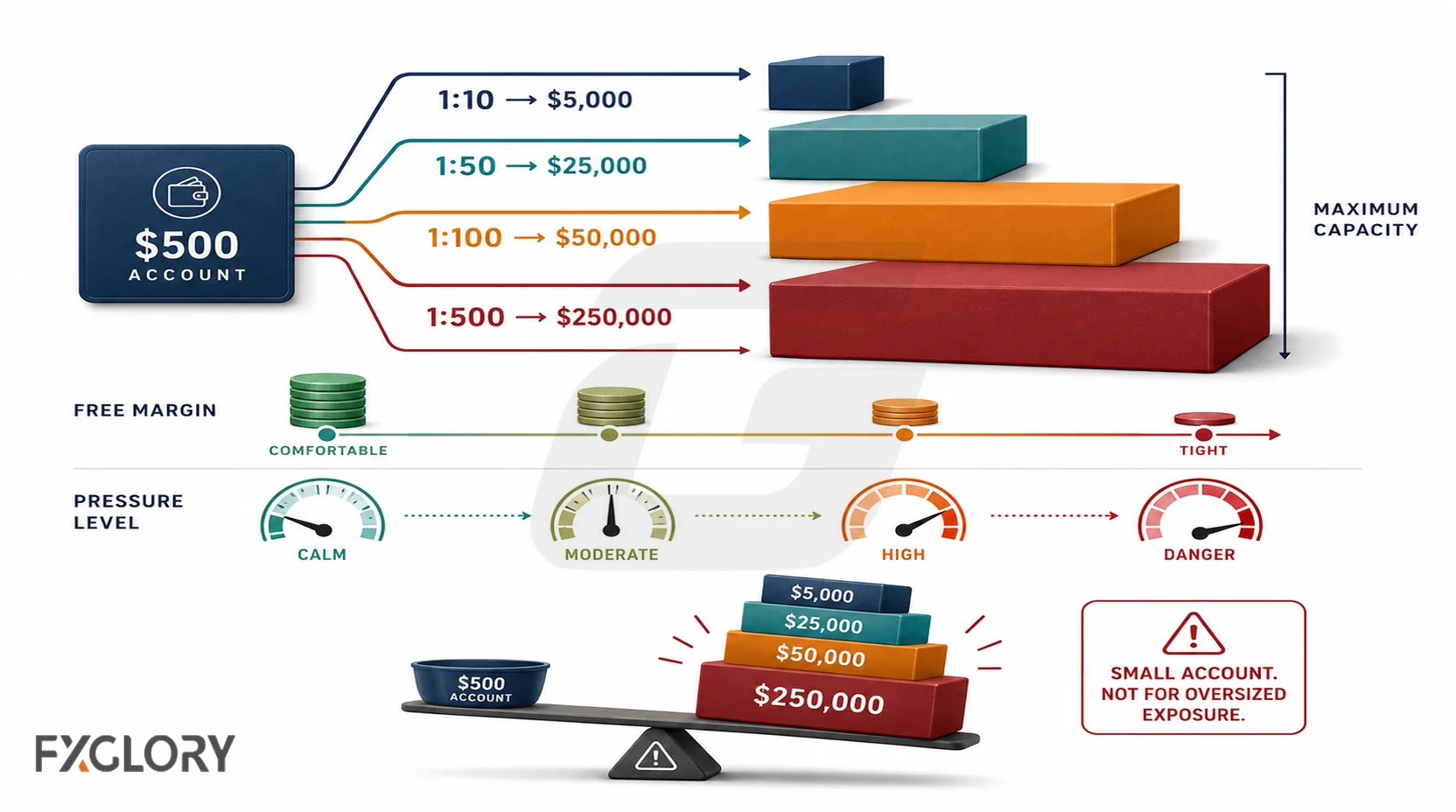
| Account Equity | Available Leverage | Maximum Theoretical Exposure |
|---|---|---|
| $500 | 1:10 | $5,000 |
| $500 | 1:50 | $25,000 |
| $500 | 1:100 | $50,000 |
| $500 | 1:500 | $250,000 |
The table shows theoretical capacity rather than a recommended position size. A trader can use only part of that capacity and keep the actual position aligned with the planned monetary risk.
Multiple positions should be considered together. Three $10,000 positions against $1,000 of equity represent $30,000 of open notional exposure, or 30:1 effective leverage in this simplified planning measure.
How to Choose Forex Leverage
Use a risk-first sequence:
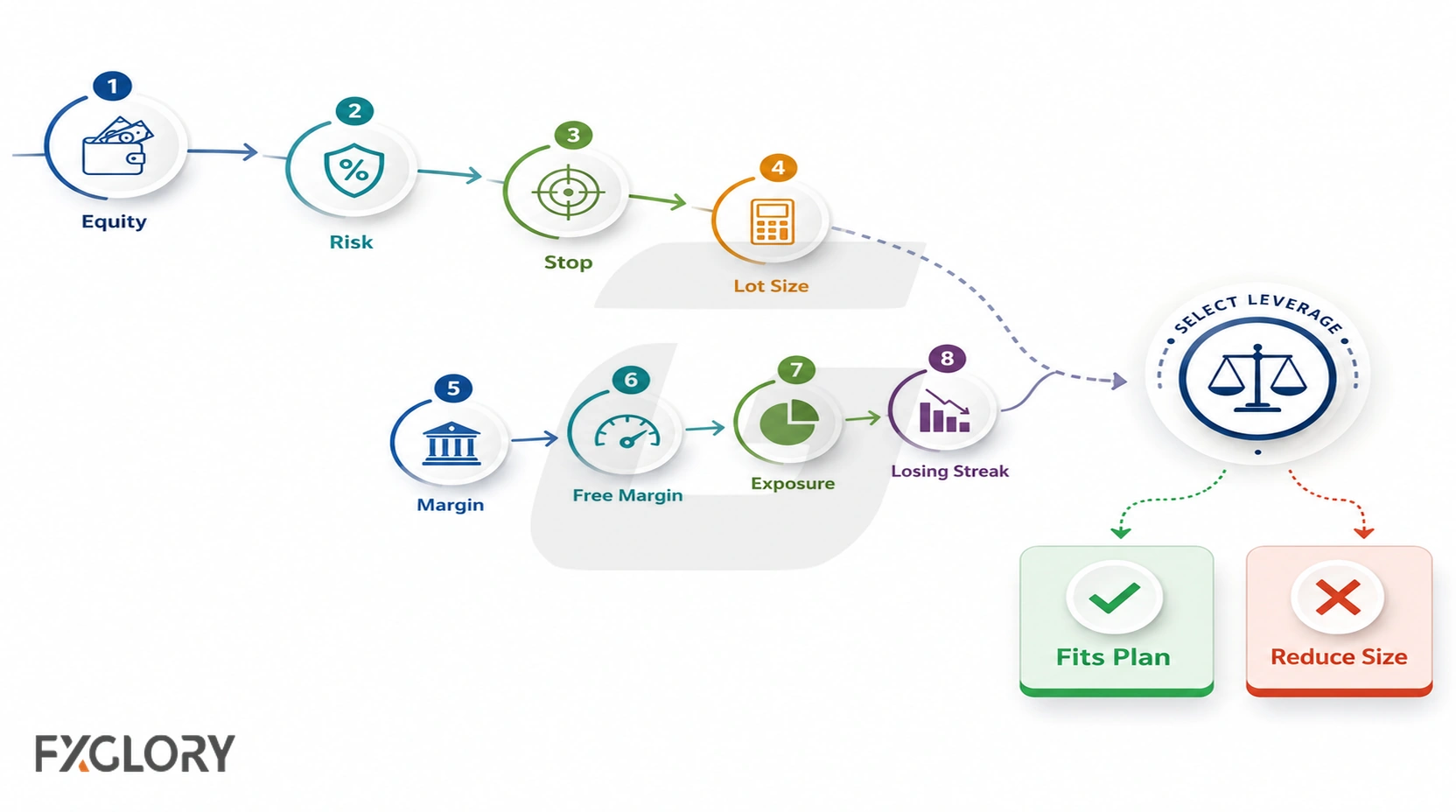
| Step | Question |
|---|---|
| 1. Define account equity | How much capital is currently supporting the account? |
| 2. Set the loss limit | How much money is the trade allowed to lose? |
| 3. Set the stop distance | Where is the trade invalidated? |
| 4. Calculate position size | What lot size fits that loss limit and stop distance? |
| 5. Estimate margin | How much margin does that fixed position require at the selected leverage? |
| 6. Check free margin | How much equity remains available after the position is opened? |
| 7. Add existing exposure | What is the effective leverage after all open positions are included? |
| 8. Verify account conditions | Do the account and instrument specifications permit the planned trade? |
For position-size context, see what is lot size in forex.
Common Mistakes When Choosing Forex Leverage
- Using the maximum ratio as a position-size target: The account limit does not define the amount that fits the risk plan.
- Choosing leverage before position size: Risk and stop distance should determine the position first.
- Confusing margin with loss risk: Required margin is not the same as the amount a trade can lose.
- Ignoring effective leverage: Several open positions can create much more exposure than one order suggests.
- Assuming a lower margin requirement changes pip value: The unchanged position keeps the same market exposure and pip value.
- Ignoring margin-call and stop-out rules: Account thresholds affect how adverse price movement interacts with used and free margin.