
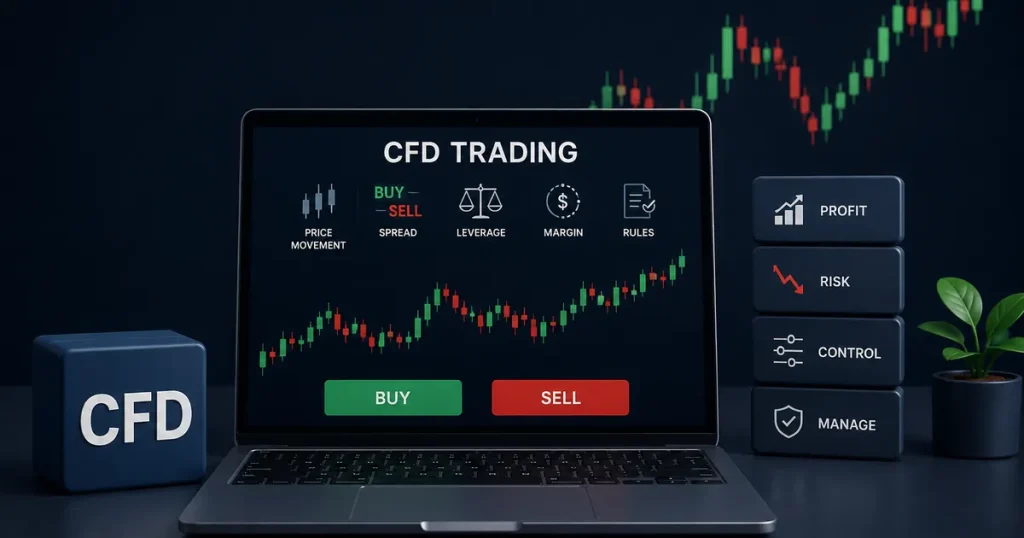
Quick Answer: What Is CFD Trading in Forex?
The important distinction is product structure. A EUR/USD CFD gives exposure to EUR/USD price movement through a contract; it does not turn the trading account into a holding of euros and US dollars.
This page focuses on the mechanics of a forex CFD trade: direction, entry and exit, position size, pip value, spread, funding, margin, leverage, and product rules. For the broader comparison between forex as a market and CFDs as a product type, see forex vs CFD.
CFD Meaning in Forex
CFD means contract for difference. In the forex context, the contract references a currency pair such as EUR/USD, GBP/USD, USD/JPY, or AUD/USD.
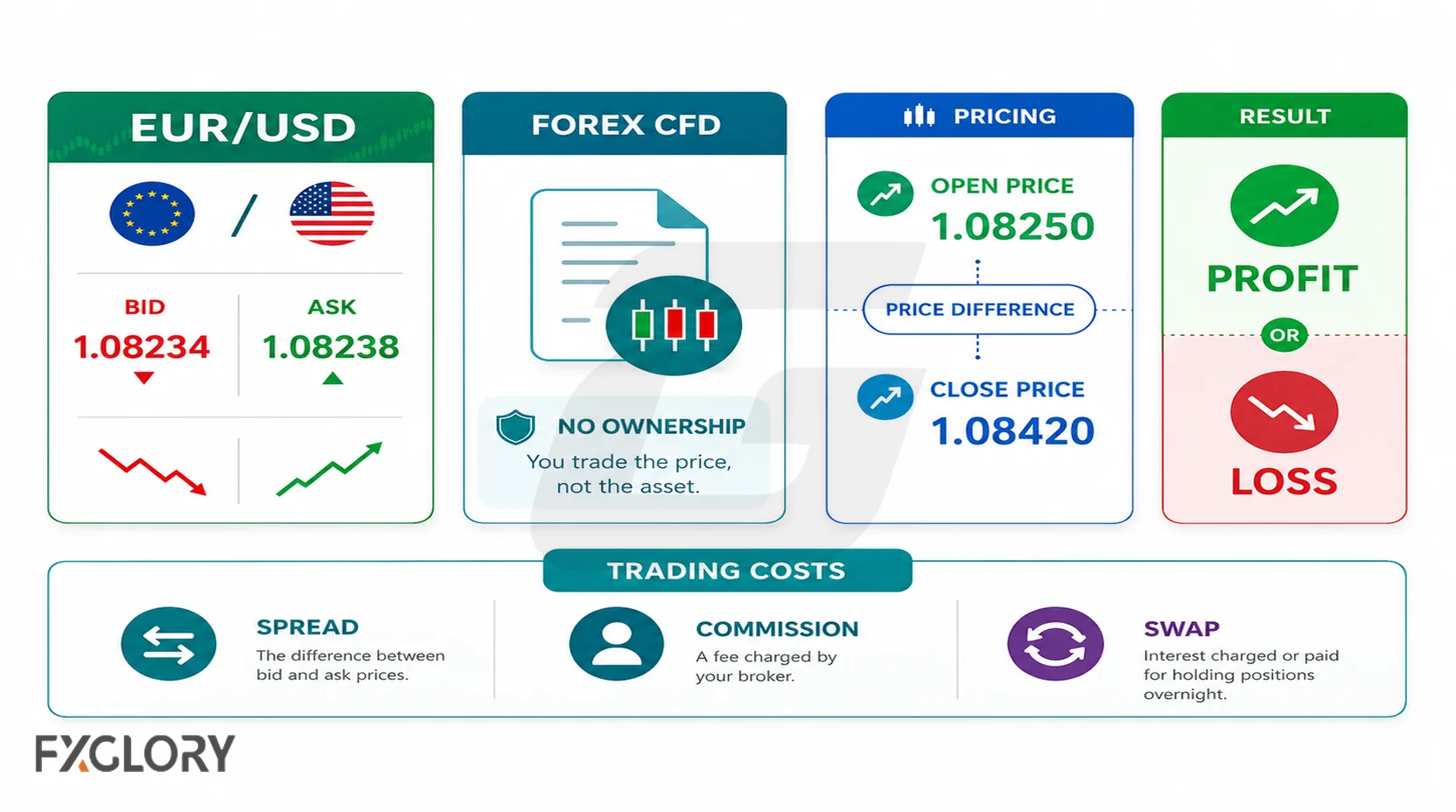
The opening and closing prices determine the market movement captured by the trade. Whether that movement produces a gain or loss depends on trade direction and position size.
- If the market moves in the direction of the position, the gross result is positive before costs.
- If it moves against the position, the gross result is negative.
- Spread, commission, overnight funding or swap, slippage, and currency conversion can change the final account result.
There are two common ways to express the gross calculation:
- Price-based: price change × relevant position units, adjusted for long or short direction and the product's contract specification.
- Pip-based: pip movement × pip value, adjusted for trade direction.
These are two ways of expressing the same market movement; position size and pip value are related but are not interchangeable quantities.
Forex CFD Trade Anatomy and Ownership
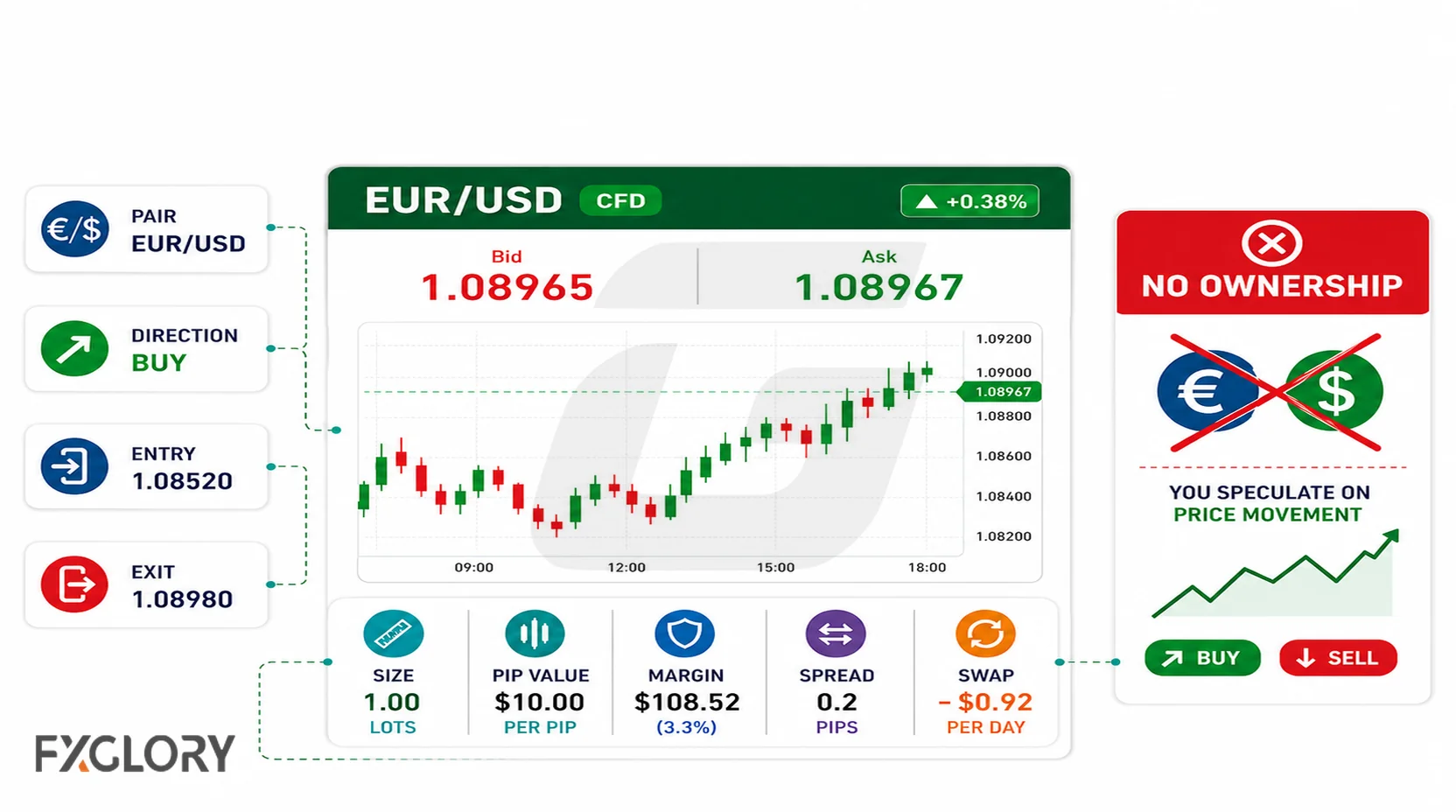
A forex CFD trade can be broken into the instrument being tracked, the direction of the position, the opening and closing prices, the size of the exposure, and the costs or account rules that affect the final result.
| Part of a Forex CFD Trade | Meaning |
|---|---|
| Currency pair | The market the CFD tracks, such as EUR/USD or GBP/USD. |
| Direction | Long for exposure to a rise in the pair, or short for exposure to a fall. |
| Entry price | The price at which the position opens. |
| Exit price | The price at which the position closes. |
| Price movement | The change between entry and exit, interpreted according to trade direction. |
| Position size | The amount of market exposure controlled by the trade. |
| Pip value | The monetary value of one pip for that position. |
| Account currency | The currency in which profit, loss, fees, or conversions may be shown. |
| Margin | Funds or account equity required under the product rules to open or maintain the position. |
| Spread | The difference between the bid and ask prices. |
| Swap / overnight funding | A possible charge or credit when a position is held past the applicable rollover time. |
Do you own currency when trading forex CFDs?
No. A forex CFD normally provides contractual exposure to the pair rather than delivery of the underlying currencies. For example, opening a EUR/USD CFD position does not by itself convert the account balance into euros.
The pair still matters because it determines how the price is quoted. In EUR/USD, EUR is the base currency and USD is the quote currency; account-currency conversion and product specifications then determine how profit, loss, margin, and fees appear in the account.
How Forex CFD Trading Works
A forex CFD position generally involves the following steps:
- Choose a currency pair: For example, EUR/USD.
- Confirm the product type: Verify that the instrument is a forex CFD and review its contract specification.
- Choose direction: A long position is exposed to a rise in the pair; a short position is exposed to a fall.
- Choose position size: Position size determines the scale of market exposure and influences pip value.
- Review margin and leverage: Check the required margin and the total exposure created by the position.
- Review pricing and costs: Check the spread, any commission, and any costs that may apply if the position remains open.
- Open the position: Execution occurs at the applicable market price under the platform's order and pricing rules.
- Close the position: The gross result reflects the market move and position size; the net result also reflects execution and applicable costs.
The CFD may closely follow the referenced currency pair, but it remains a product offered under specific broker terms. Contract size, execution, margin, funding, and account protections can therefore differ between providers or entities.
Example of a Forex CFD Trade
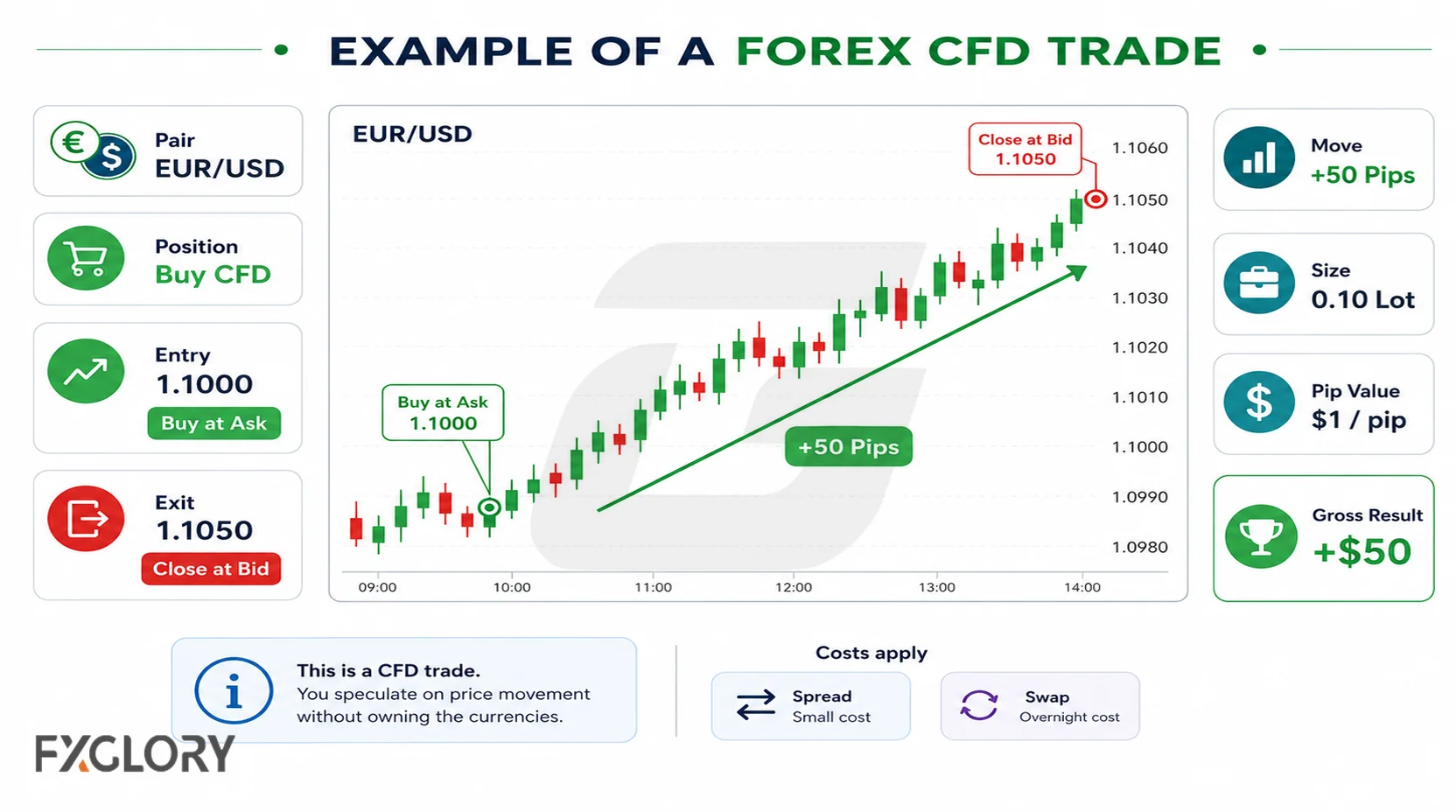
Here is a simplified EUR/USD CFD example. The figures illustrate the calculation only; they are not expected performance.
| Trade Detail | Example |
|---|---|
| Currency pair | EUR/USD CFD |
| Direction | Buy / long |
| Simplified entry level | 1.1000 |
| Simplified exit level | 1.1050 |
| Movement | 50 pips in favor |
| Illustrative pip value | $1 per pip |
| Gross result | 50 pips × $1 per pip = $50 before applicable costs |
| Net result | Depends on the gross result, execution prices, and any spread, commission, funding, slippage, or conversion charges that apply. |
If the same 50-pip move were against a long position, the illustrative gross result would be -$50 before applicable costs. The $1-per-pip figure is only an example; actual pip value depends on position size, pair, account currency, and product specifications.
For pip-value basics, see how to calculate pips in forex. For position-size basics, see what is lot size in forex.
Long and Short Forex CFDs
Forex CFDs can usually be traded in either direction. A long position is exposed to a rise in the currency pair, while a short position is exposed to a fall.
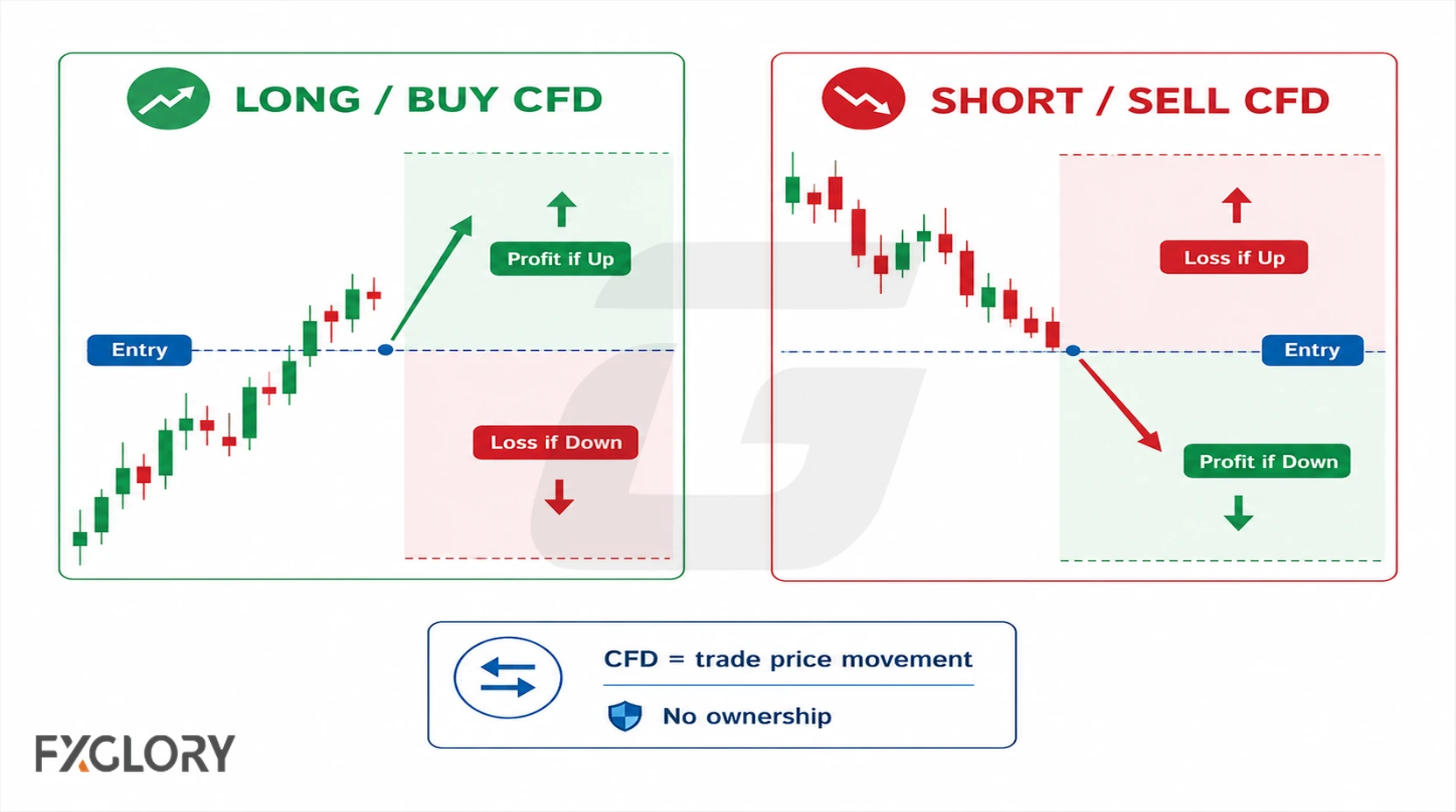
- Long EUR/USD: A rise in EUR/USD produces a favorable market move for the position; a fall produces an unfavorable move.
- Short EUR/USD: A fall in EUR/USD produces a favorable market move for the position; a rise produces an unfavorable move.
Neither direction is inherently safer. The account impact depends on how far the market moves, the size of the position, execution, and applicable costs.
For more detail, see long and short in forex.
Forex CFD Costs and Net Result
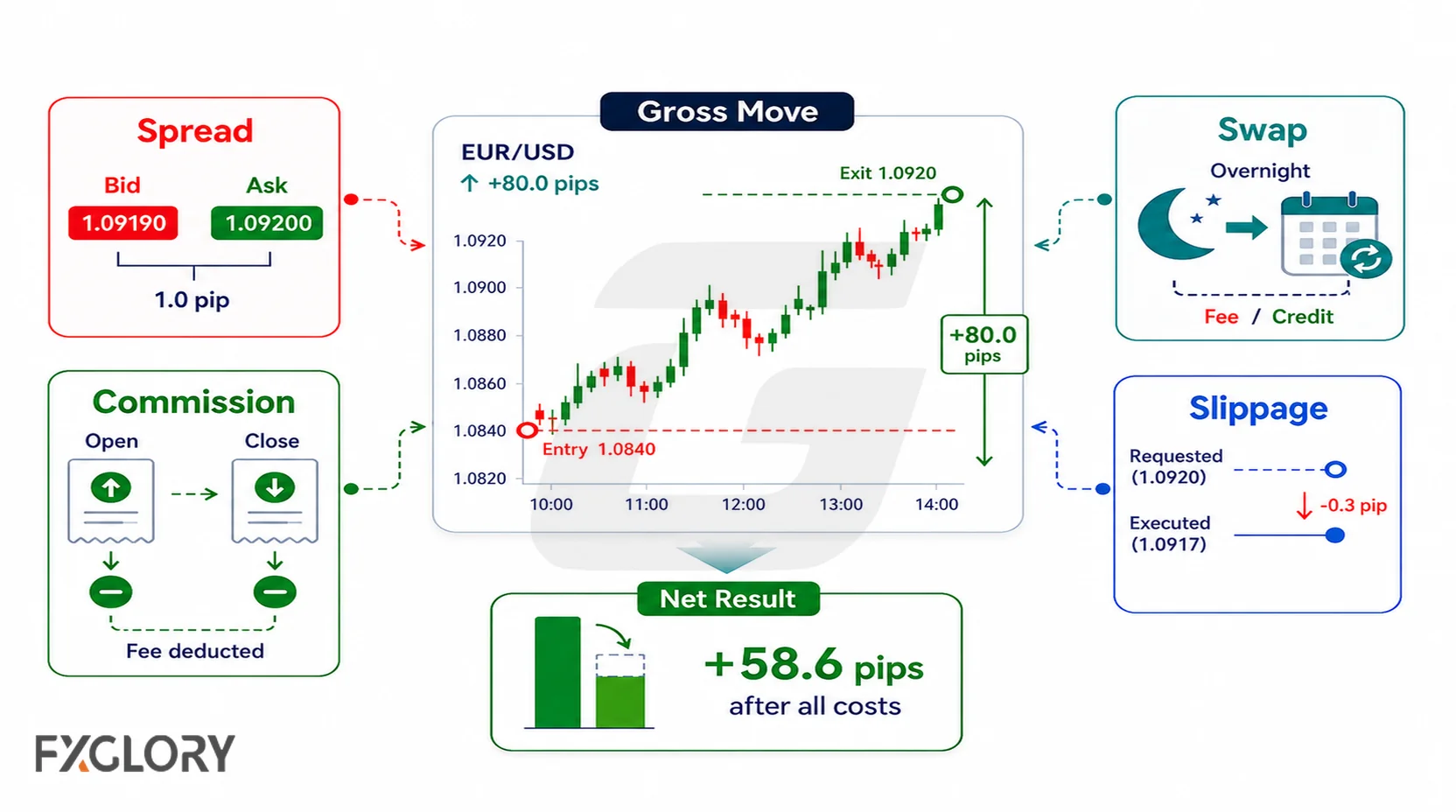
The net result of a forex CFD is not determined by market movement alone. Depending on the broker, account, execution, and holding period, several costs or adjustments may apply.
| Cost or Adjustment | When It Matters |
|---|---|
| Spread | Through the difference between the bid and ask prices used to enter or exit. |
| Commission | If the account or product charges a separate commission. |
| Swap / overnight funding / rollover | If the position remains open across the broker's applicable rollover time. |
| Slippage | If the executed price differs from the requested or expected price. |
| Currency conversion | If profit, loss, or fees need to be converted into the account currency. |
How is the total trading cost of a forex CFD position calculated?
There is no single universal cost formula because broker pricing models differ. A practical way to estimate the total is to add the costs that actually apply to the position: spread impact + commission + overnight funding or swap + conversion charges, then account for any difference caused by slippage in the actual execution prices.
Some trades will not incur every item. For example, a position closed before rollover may have no overnight funding charge, while an account with spread-only pricing may not charge a separate commission.
For spread basics, see bid and ask price in forex. For overnight funding basics, see what is swap in forex.
Leverage, Margin and Forex CFD Risk
Forex CFDs often use leverage, which means the market exposure can be larger than the margin posted to support the position. Profit and loss are therefore driven by the full position exposure rather than by the margin amount alone.
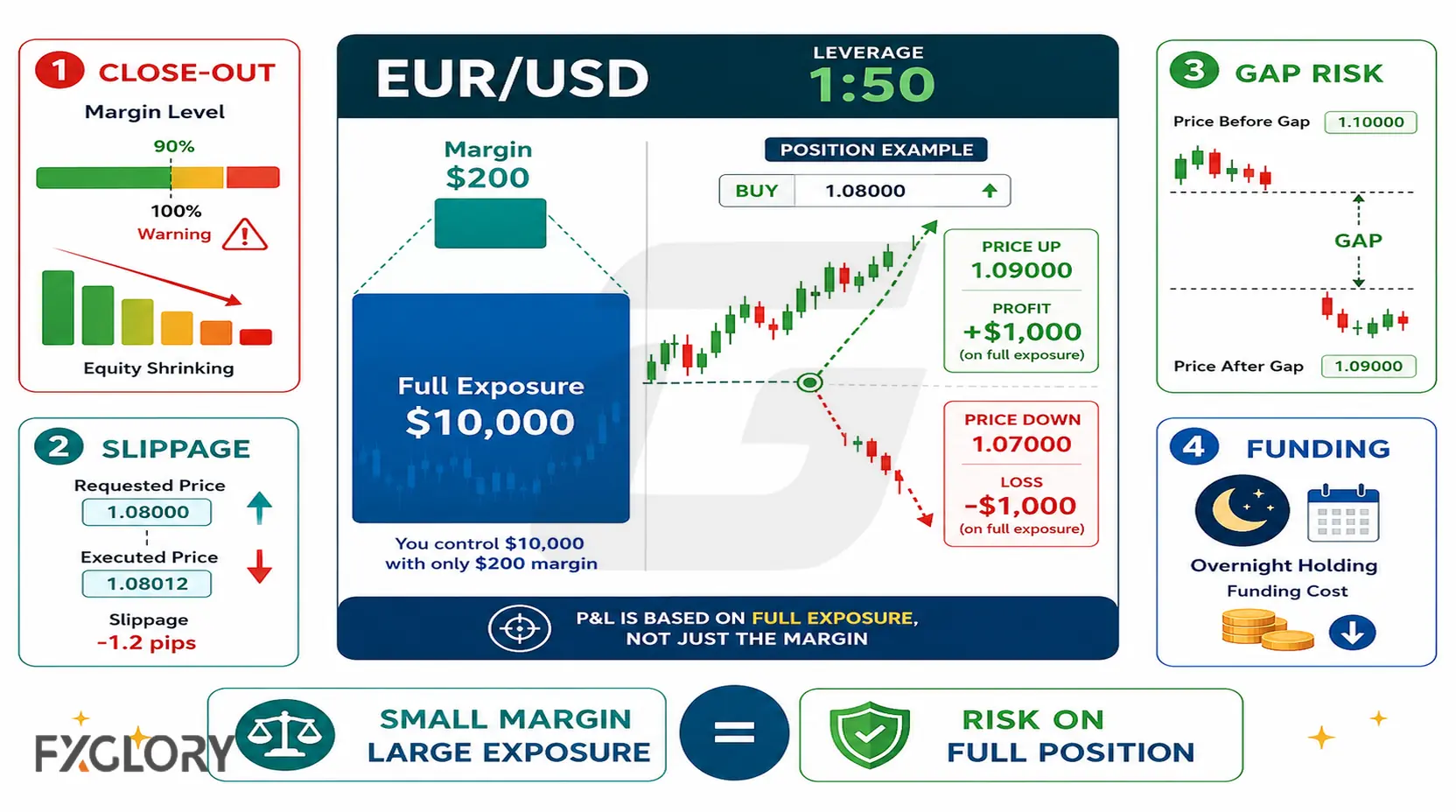
Margin is the amount of funds or equity required under the product rules to open or maintain the position; it is not a cap on possible loss. Account protections, where applicable, can affect final loss treatment.
| Item | Example |
|---|---|
| Position exposure | $10,000 |
| Margin requirement | 1% |
| Margin needed | $100 |
| Adverse move example | A 1% adverse move on $10,000 exposure is about $100 before costs in this simplified example. |
Other risk factors include margin close-out, slippage, market gaps, accumulated holding costs, frequent trading costs, and broker-specific execution or order-handling rules.
For a deeper explanation of leverage, see best leverage for forex.
Before Trading Forex CFDs: Product Checklist
Before opening a position, verify the contract specification, exposure, pricing, and account rules rather than relying on the currency-pair symbol alone.
- Confirm the product type: Verify that the instrument is a forex CFD and review its own contract rules.
- Check the pair, base currency, and quote currency: Understand what the quoted price represents.
- Check account currency conversion: Know how profit, loss, fees, and conversions may appear in the account.
- Check contract size and lot size: Know how much exposure the position creates.
- Check total exposure: Identify the full position value that market movement acts on.
- Calculate pip value: Estimate how much a one-pip move represents for the chosen position size.
- Check margin and leverage: Review required margin, leverage terms, and close-out rules.
- Check transaction and holding costs: Review spread, commission, and any funding or conversion charges that may apply.
- Check trading hours and rollover rules: Know when the product trades and when overnight adjustments can be applied.
- Check execution risks: Review how slippage, gaps, and order execution are handled.
- Check jurisdiction and protections: Confirm whether the product is available and what protections apply to the account.
What to check on a currency pair page
A useful pair page can help connect the concepts above to pair-specific information such as the live price, bid/ask, spread, contract size, minimum lot, pip value, margin, swap rates, trading hours, and rollover rules. Final contract terms should still be confirmed in the platform, account documents, or broker product specification.
You can use a live pair page such as EUR/USD live price to review market and pair-level information before checking the exact contract terms that apply to your account.
Regulation, jurisdiction and account protections
Forex CFD rules vary by region. Some jurisdictions restrict CFD access or apply retail protections such as leverage limits, margin close-out rules, standardized risk warnings, and negative balance protection.
Rules can also differ between broker entities under the same brand. Check the entity you are contracting with, your client classification, applicable leverage limits, negative balance protection, margin close-out rules, risk warnings, and product restrictions.
Common Mistakes With Forex CFDs
The most consequential errors are usually misidentifying the product, underestimating exposure, or overlooking how execution and costs affect the account result.
- Assuming the pair symbol tells you the product: EUR/USD can be offered as a CFD, spot-style forex product, futures contract, or another instrument with different rules.
- Treating margin as the trade's full economic exposure: The margin requirement is only the amount needed under the product rules to support the position.
- Choosing position size before estimating pip value: This can make the account impact of an ordinary market move larger than expected.
- Confusing a chart price with the executable price: The displayed chart may not show the exact bid or ask used for entry or exit.
- Ignoring execution quality: Slippage or gaps can make the actual fill different from the expected price.
- Assuming identical rules across brokers: Contract size, margin, pricing, funding, and protections can differ even for the same currency pair.
- Ignoring jurisdiction and entity: Retail CFD availability and protections depend on where and with which legal entity the account is held.
Quick Recap: CFD Trading in Forex
A forex CFD is a derivative way to take long or short exposure to a currency pair without physically exchanging the two currencies. The gross result can be expressed using price movement and position units or, when working in pips, by multiplying pip movement by pip value.
The net account result can differ from the gross market move because of execution and applicable charges such as spread, commission, funding, slippage, or conversion. Before trading, check the instrument's contract specification, exposure, margin and leverage terms, costs, jurisdiction, and account protections.