
Quick Answer: What Is Forex and CFD Trading?
The easiest way to understand forex and CFD trading is this:
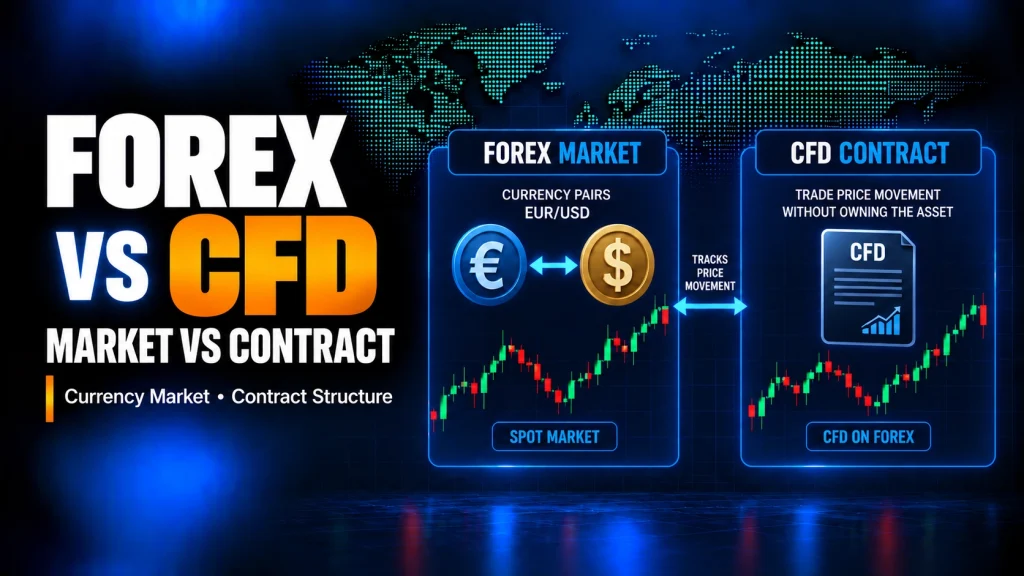
Forex describes the market or asset class. CFD describes the contract structure.
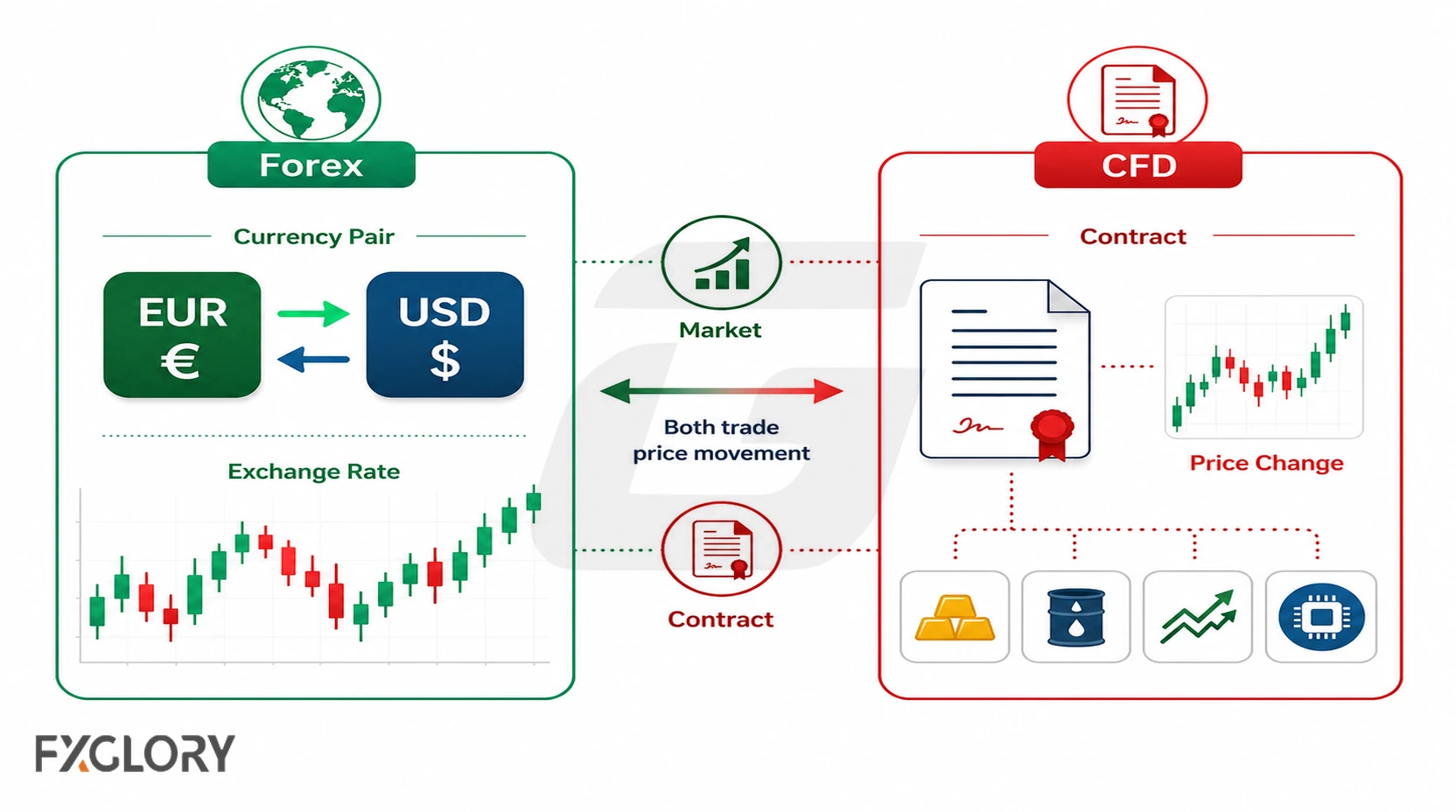
No, forex itself is not a CFD. A forex CFD is one way to trade currency-pair price movement through a contract rather than owning the underlying currencies.
In a forex vs CFDs comparison, remember that forex is the market and CFDs are contract products. A CFD can track forex, shares, indices, commodities, and other markets where available.
The underlying asset is the market or instrument the CFD price is based on. For a forex CFD, the underlying market is the currency pair. For a stock CFD, the underlying market is the stock price.
Is Forex a CFD?
No. Forex is not automatically a CFD. Forex is the global market for exchanging and speculating on currency pairs such as EUR/USD, GBP/USD, USD/JPY, and AUD/USD. A CFD is a derivative contract that lets traders speculate on price movement without owning the underlying asset.
You can trade forex through CFDs with some brokers, but that does not mean all forex trading is CFD trading. The exact structure depends on the broker, product, account type, client classification, and jurisdiction.
For example, EUR/USD can be offered as a forex CFD on one platform, as spot-style forex exposure on another platform, or as a currency futures contract through an exchange-traded product. The pair name may be the same, but the contract can be different.
| Question | Answer |
|---|---|
| Is forex a market? | Yes. Forex is the currency market. |
| Is CFD a market? | No. CFD is a contract type. |
| Can CFDs track forex? | Yes. A forex CFD tracks a currency pair. |
| Can forex be traded without CFDs? | Yes. Depending on broker model and jurisdiction, forex may be offered through spot-style forex, futures, or another structure. |
| Do forex CFDs give currency ownership? | No. They provide contract-based exposure to price movement. |
Are Forex and CFD Trading the Same?
They can overlap, but they describe different parts of a trade. Forex relates to currency-pair exposure, while CFD refers to a contract structure that can be used for that exposure.
- Forex trading: Trading currency-pair price movement.
- CFD trading: Trading a contract for difference based on an underlying market.
- Forex CFD trading: Trading a CFD whose underlying market is a currency pair.
So CFD vs forex trading is really a comparison between a contract structure and a currency market. The better question is not only whether the product is called forex or CFD. The better question is: what exact product are you trading?
Forex vs CFDs: The Core Difference
The practical difference is found in the product specifications. When comparing two platforms, check whether the currency pair is offered through a CFD or another structure because costs, margin rules, and contract terms may differ.
- Forex describes the market: currency pairs.
- CFD describes the instrument: a contract for difference.
- Forex CFD describes the overlap: a CFD that tracks a currency pair.
This is why the phrase “forex and CFDs” can be confusing. Forex tells you the asset class. CFD tells you the product structure.
Forex, Forex CFDs and Other CFDs Compared
Forex, forex CFDs, and non-forex CFDs may look similar on a trading platform because each can show price charts, buy and sell buttons, leverage, margin, and spreads. But they are not identical products.
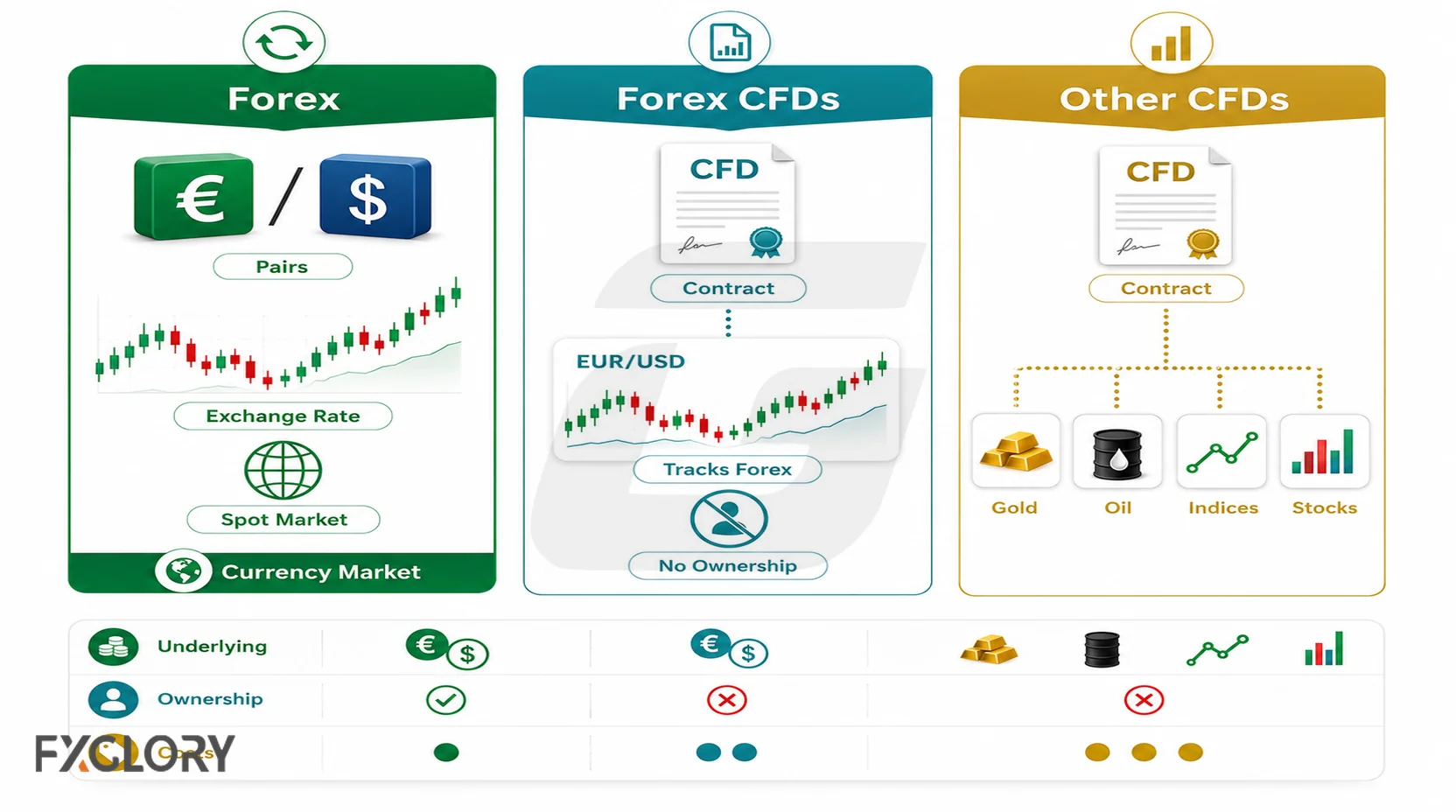
Forex vs forex CFD
| Feature | Forex | Forex CFD |
|---|---|---|
| Main exposure | Currency pairs. | Currency pairs through a CFD. |
| Ownership | Retail forex usually gives currency-pair price exposure, not physical delivery. | No physical currency ownership. |
| Costs | Spread, commission, swap, or rollover may apply. | Spread, commission, overnight funding, swap, or rollover may apply. |
| Product rules | Depend on broker, account type, and jurisdiction. | Depend on CFD contract terms, account type, and jurisdiction. |
Forex CFD vs other CFDs
| Feature | Forex CFD | Other CFDs |
|---|---|---|
| Main exposure | Currency pairs through a CFD. | Shares, indices, commodities, and other markets where available. |
| Ownership | No ownership of the underlying currencies. | No ownership of the underlying asset. |
| Trading hours | Usually follows FX market and platform rules. | Depends on the underlying market and broker rules. |
| Costs | Spread, commission, overnight funding, swap, or rollover may apply. | Spread, commission, overnight funding, and instrument-specific costs may apply. |
Do not assume that the same symbol means the same product everywhere. A trader may see EUR/USD on two platforms, but one product may be spot-style forex, another may be a forex CFD, and another may be a futures contract.
How Forex CFDs Work
A forex CFD is a contract that follows the price movement of a currency pair. The trader does not take delivery of the underlying currencies. Instead, profit or loss depends on how the CFD price changes between opening and closing the position.
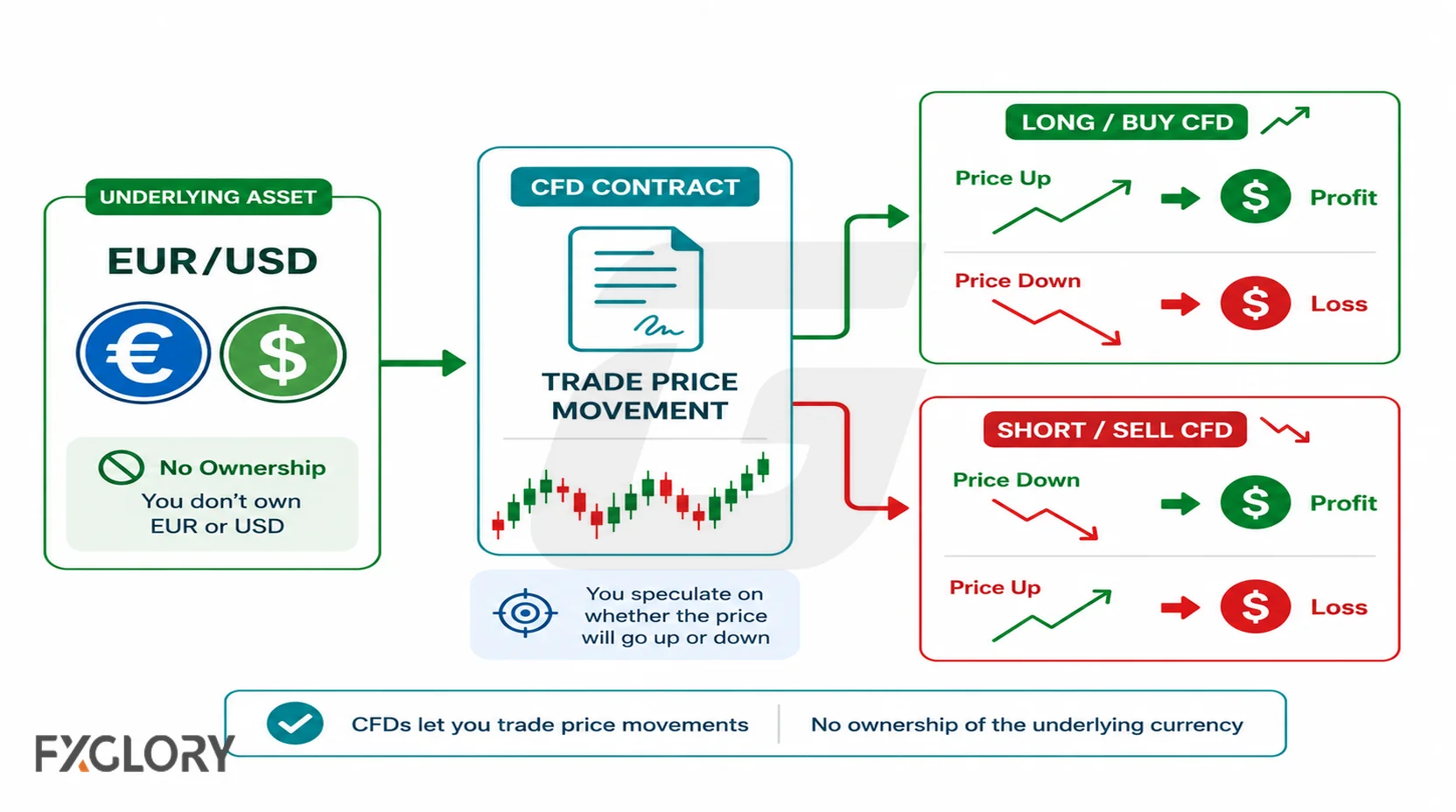
For example, a trader who buys a EUR/USD CFD is speculating that EUR/USD will rise. If EUR/USD rises after entry, the CFD position may gain before costs. If EUR/USD falls, the CFD position may lose. The spread means the position may start with a small cost immediately after entry.
A forex CFD may closely track the underlying currency pair price, but it is still a contract offered under specific broker terms. Because product terms can differ, use the checklist below before placing a forex CFD trade.
For pip and lot-size basics, see how to calculate pips in forex and what is lot size in forex.
Ownership and Costs in Forex and CFDs
Do you own the currency when trading forex CFDs?
No. With forex CFDs, you do not receive euros, dollars, yen, pounds, or other currencies in your account. You are speculating on the price movement of the currency pair through a contract.
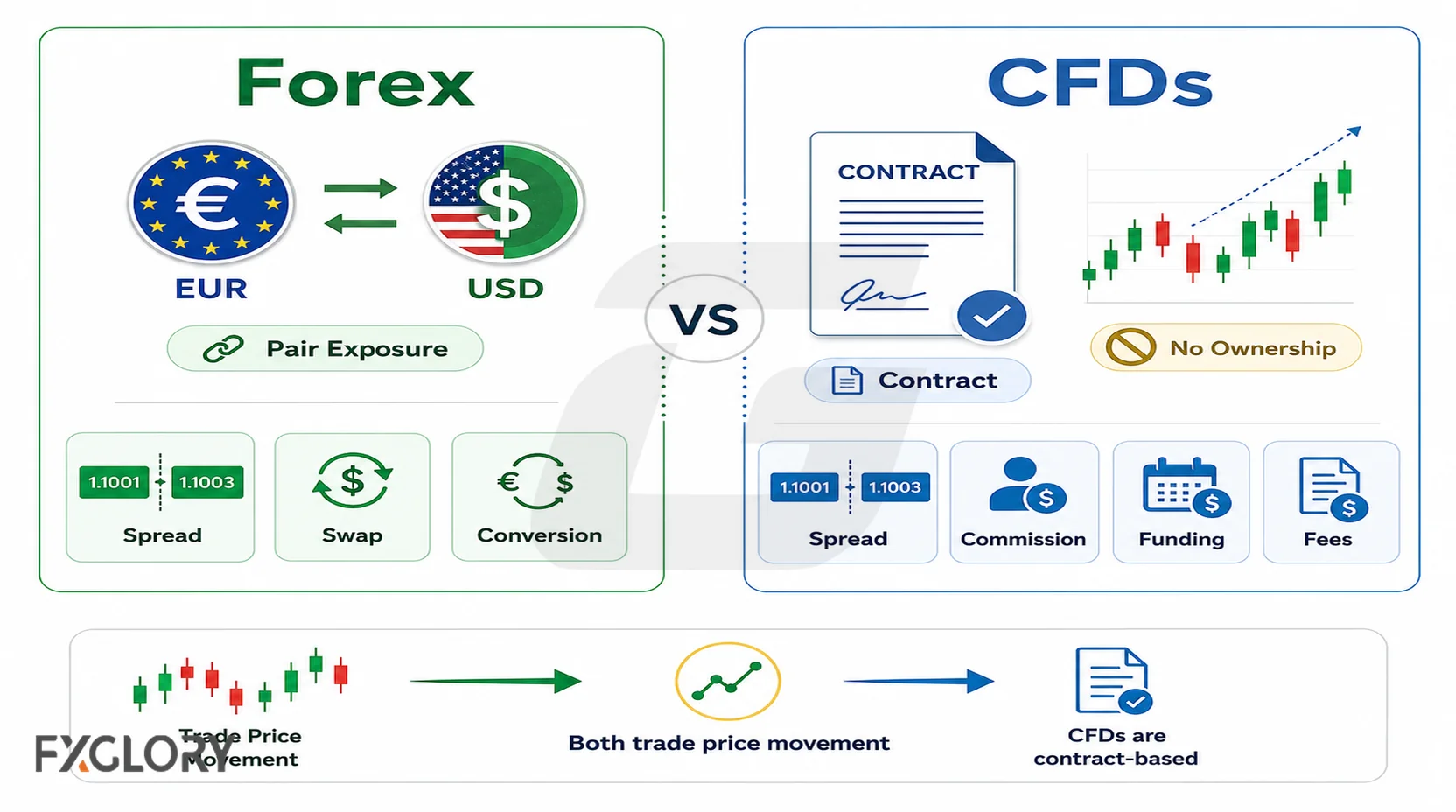
Even when trading a currency pair, your account balance is not automatically converted into the base currency. A forex CFD position may show profit or loss in your account currency, but it does not mean you own the base currency or quote currency.
In a pair such as EUR/USD:
- EUR is the base currency.
- USD is the quote currency.
- Price movement shows how many US dollars one euro is worth.
- Profit, loss, pip value, conversion, and margin treatment depend on product specifications and account setup.
For buy and sell position basics, see long and short in forex.
Costs: spread, commission, swap and overnight funding
Forex and CFDs can both involve trading costs. The exact costs depend on the broker, account type, product, position size, market, and holding period.
| Cost | When It Usually Matters |
|---|---|
| Spread | Usually affects entry and exit through the difference between bid and ask price. |
| Commission | May apply when a trade is executed, depending on account and product type. |
| Swap / overnight funding / rollover | May apply when a position remains open overnight. |
| Currency conversion | May apply if the instrument currency differs from the account currency. |
| Product-specific fees | May apply depending on broker and instrument terms. |
Spread is not the same as swap. Spread usually affects entry and exit through the difference between bid and ask price. Swap, rollover, or overnight funding may apply when a position remains open overnight.
Overnight funding can accumulate, which can make leveraged CFD positions costly to hold for long periods. Comparing only one cost line can be misleading because forex and CFD products may use different cost models.
For spread basics, see bid and ask price in forex. For overnight cost basics, see what is swap in forex.
Before Trading Forex CFDs: Product Checklist
Before trading a forex CFD or comparing forex and CFDs, check the product details. The same currency pair can behave differently depending on the contract structure and broker rules.
- Confirm product type: Is this spot-style forex, forex CFD, futures, or another product?
- Check contract size: How much exposure does one contract or lot represent?
- Check minimum lot size: What is the smallest tradable position?
- Calculate pip value: How much does one pip movement affect the account?
- Check quote currency and account currency: How will profit, loss, pip value, and conversion be handled?
- Check margin and leverage: What margin is required, and how much exposure does the trade create?
- Check spread and commission: What transaction costs apply?
- Check swap or overnight funding: What happens if the position is held overnight?
- Check trading hours: When can the instrument be traded?
- Check liquidity, slippage, and gap risk: Could execution price differ from the expected price?
- Check execution and counterparty terms: What rules apply to execution, pricing, order handling, and disputes?
- Check protections: Does negative balance protection, margin close-out, or any other retail protection apply?
- Check jurisdiction: Is this product available and regulated where you trade?
What to check on a currency pair page
When available, a useful pair page should help traders review live bid/ask, spread, pip value, lot size, margin requirement, swap long, swap short, trading hours, and contract specifications before trading. Do not rely only on the pair name; use the product specification table or platform details to confirm what exact product you are trading.
You can use a live pair page such as EUR/USD live price to review live price movement and pair-level information, then confirm contract specifications in the trading platform or account documents before placing a trade.
Leverage, Margin and CFD Risk
Forex and CFD trading often use leverage. Leverage can make a larger position possible with a smaller margin deposit, but it also magnifies the effect of price movement on the account.
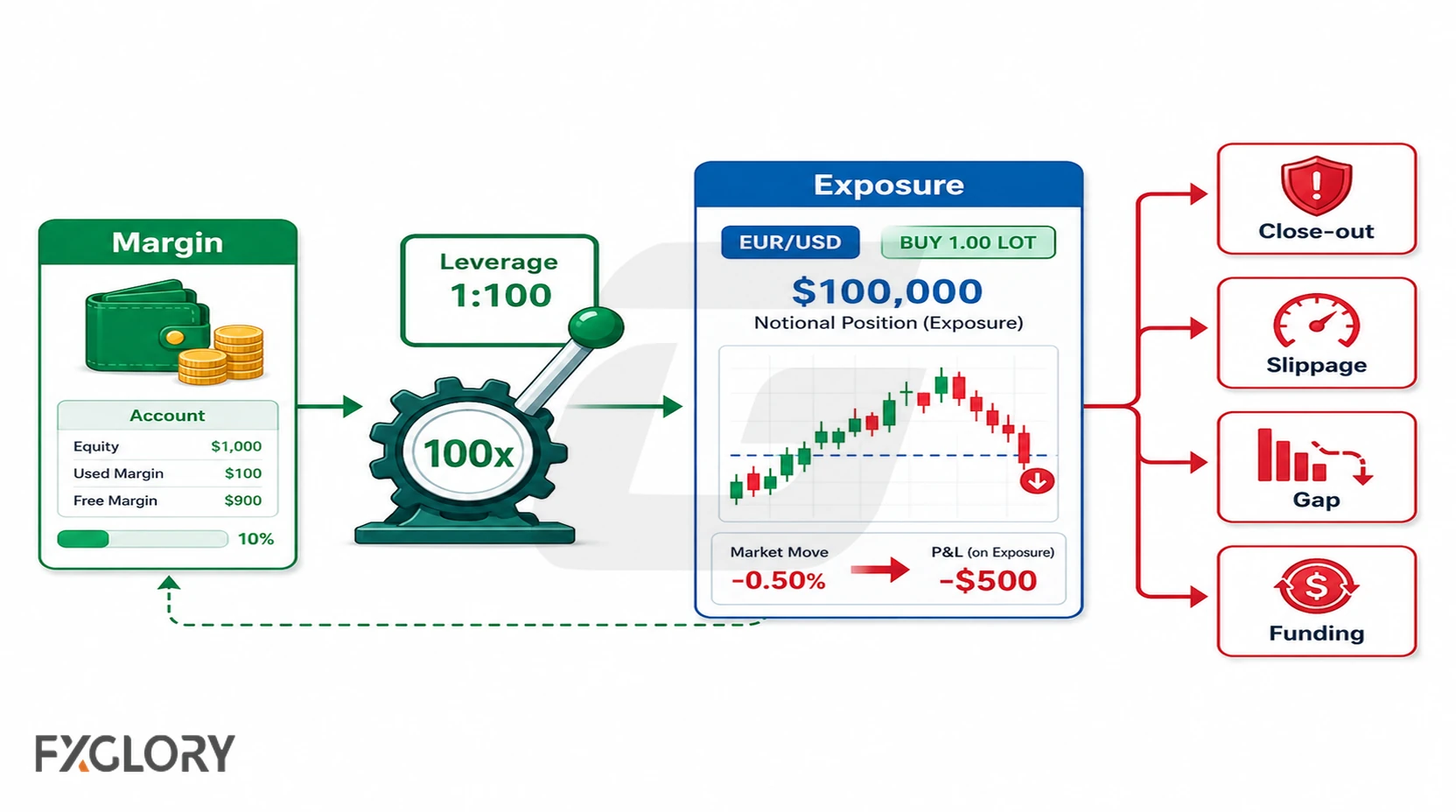
In some regions, regulators restrict retail CFD leverage and require protections such as margin close-out rules, standardized risk warnings, or negative balance protection. Exact rules depend on the jurisdiction, broker entity, product type, account type, and client classification.
| Risk or Protection | Why It Matters |
|---|---|
| Leverage | Magnifies gains and losses based on position size. |
| Margin requirement | Shows how much account equity is needed to open or maintain a position. |
| Margin close-out | The broker may close positions if account equity falls below required levels. |
| Negative balance protection | May limit losses to account funds where required, but rules vary by jurisdiction and broker entity. |
| Liquidity and slippage | The execution price may differ from the expected price, especially during fast or thin markets. |
| Gap risk | Price may jump between available prices, which can affect stops and execution. |
| Overnight funding | Holding costs can accumulate for multi-day positions. |
| Broker counterparty and product terms | With many OTC or CFD products, the broker or platform is part of the contract structure. This can affect pricing, execution, order handling, and dispute terms. |
| Jurisdiction | Product availability, leverage caps, warnings, protections, and restrictions differ by region. |
Lower margin does not mean lower risk. A position can still lose money based on the full exposure, not just the margin required to open it.
Do not assume a CFD product available through one broker entity is available under another entity. A broker group may operate different entities with different rules, product permissions, leverage limits, warnings, and protections.
Before trading forex and CFDs, check whether CFDs are available in your country, which broker entity you are trading with, whether you are classified as retail or professional, what leverage limits apply, whether negative balance protection applies, what margin close-out rules apply, and whether the product is spot-style forex, forex CFD, futures, or another structure.
For more detail, see best leverage for forex.
How to Compare Forex and CFD Products
Neither forex nor CFDs are automatically better. The better fit depends on the trader's goal, product availability, costs, risk tolerance, platform access, account rules, and whether the trader understands the contract specifications.
The table below is a product-comparison framework, not a recommendation.
| Trader Goal | Product Question to Ask | Why It Matters |
|---|---|---|
| Currency-pair-only focus | Is the product spot-style forex or forex CFD? | The trader mainly wants exposure to exchange-rate movement. |
| Multi-asset trading from one platform | Are CFDs available for the markets you want? | CFDs may cover forex, indices, commodities, shares, and other markets where available. |
| Need ownership of the underlying asset | Does the product provide ownership? | CFDs do not provide ownership of the underlying asset. |
| Need an exchange-traded standardized contract | Would futures fit the requirement better? | Currency futures trade as standardized contracts on exchanges. |
| Beginner learning | Can you practice in demo first? | New traders should compare product specs before risking live money. |
| Long-term holding | What overnight funding, swap, or holding costs apply? | Holding costs can accumulate over time. |
If you want direct ownership of an asset, CFDs are usually not the right structure. If you want short-term leveraged exposure to price movement, CFDs may be one available structure, depending on local rules and broker terms.
Common Mistakes When Comparing Forex and CFDs
Many beginner mistakes come from treating forex, forex CFDs, and other CFDs as if they are the same product. Avoid these mistakes:
- Assuming forex is always a CFD: Forex is the currency market; CFD is one possible contract structure.
- Assuming CFDs are one market: CFDs can track forex, shares, indices, commodities, and other markets where available.
- Assuming a CFD gives ownership of the underlying asset: Forex CFDs and other CFDs usually provide price exposure, not ownership.
- Assuming the same EUR/USD symbol has the same margin and costs everywhere: The pair name can be the same while contract terms differ.
- Ignoring jurisdiction: CFD availability, leverage, and protections vary by country and broker entity.
- Ignoring product specifications: The same pair can have different contract size, margin, fees, and execution rules on different platforms.
- Thinking lower margin means lower risk: Lower margin makes the position easier to open, but losses are based on exposure and price movement.
- Ignoring overnight funding: Holding costs can accumulate, especially for multi-day CFD positions.
- Comparing one cost line only: Total cost can include spread, commission, swap, conversion, slippage, and product-specific fees.
- Using too much leverage: Both forex and CFDs can magnify losses when position size is too large.
- Skipping demo practice before understanding the contract: Beginners should understand contract size, margin, pip value, and costs before risking live funds.
Quick Recap: Forex and CFD Trading
Before trading, identify the exact product structure, review its costs and contract specifications, and understand how leverage and margin affect exposure.