

Quick Answer: What Is Forex Futures Trading?
The standard terms are forex futures trading and currency futures trading. The market itself is commonly called the currency futures market or forex futures market.
Standardization covers items such as contract size, minimum price movement, listed contract months, and settlement method. Margin requirements are separate from those core contract terms and can change over time.
Not every forex broker offers exchange-listed futures. Access can depend on the broker, platform, account approval, product availability, and jurisdiction.
Before entering a position, identify the exact contract and month, then check its tick value, margin requirements, trading hours, liquidity, expiration schedule, settlement method, and applicable fees.
Forex Futures Meaning
Standardization is what separates a currency futures contract from an open-ended spot forex position. The exchange specifies the product code, contract size, minimum price movement, listed contract months, trading schedule, and settlement method.
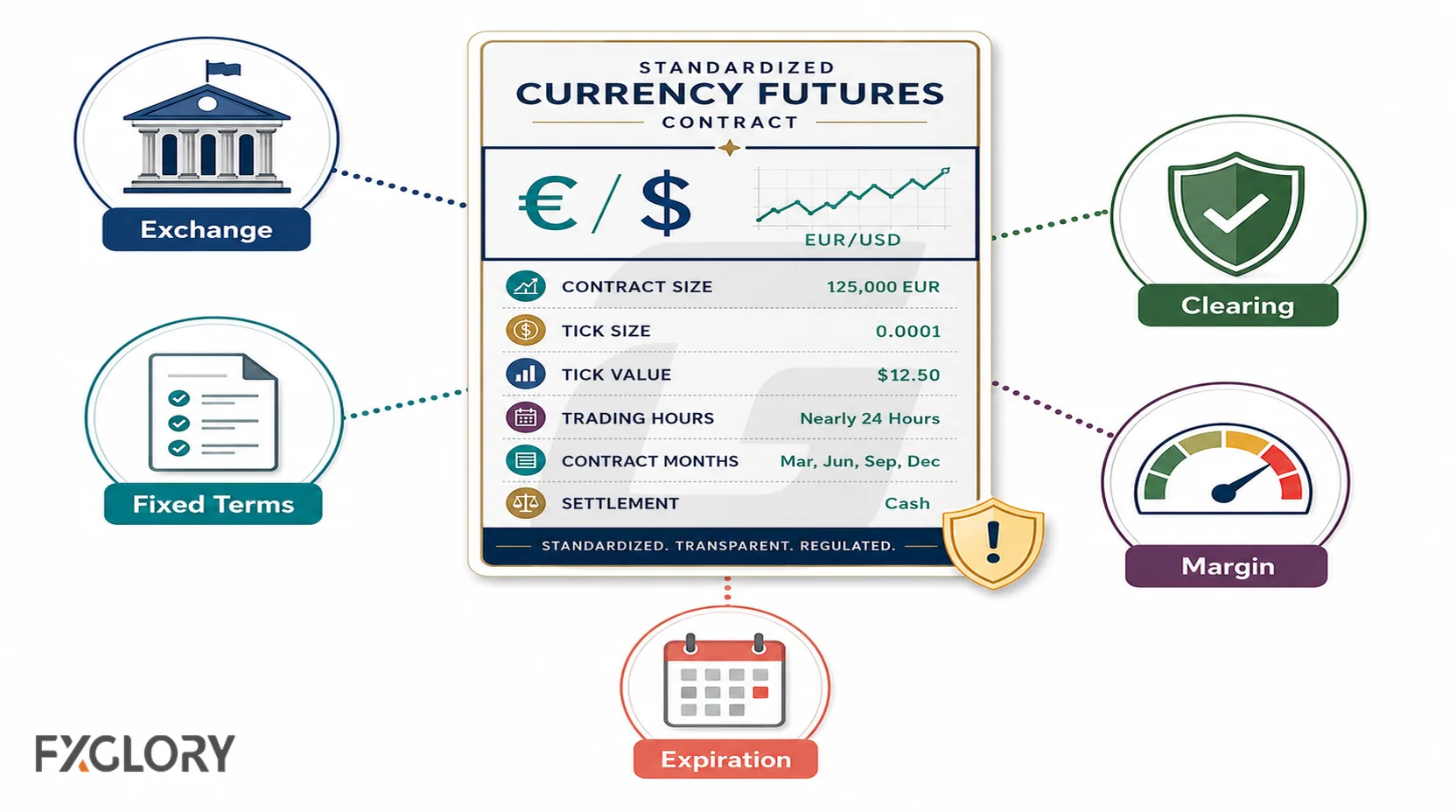
The trader chooses among the contracts that are listed rather than setting an arbitrary contract size or keeping one contract month open indefinitely. That means a directional view on a currency is only one part of the decision; the exact product and expiry month also determine the position being traded.
How Forex Futures Trading Works
Forex futures trading usually follows this workflow:
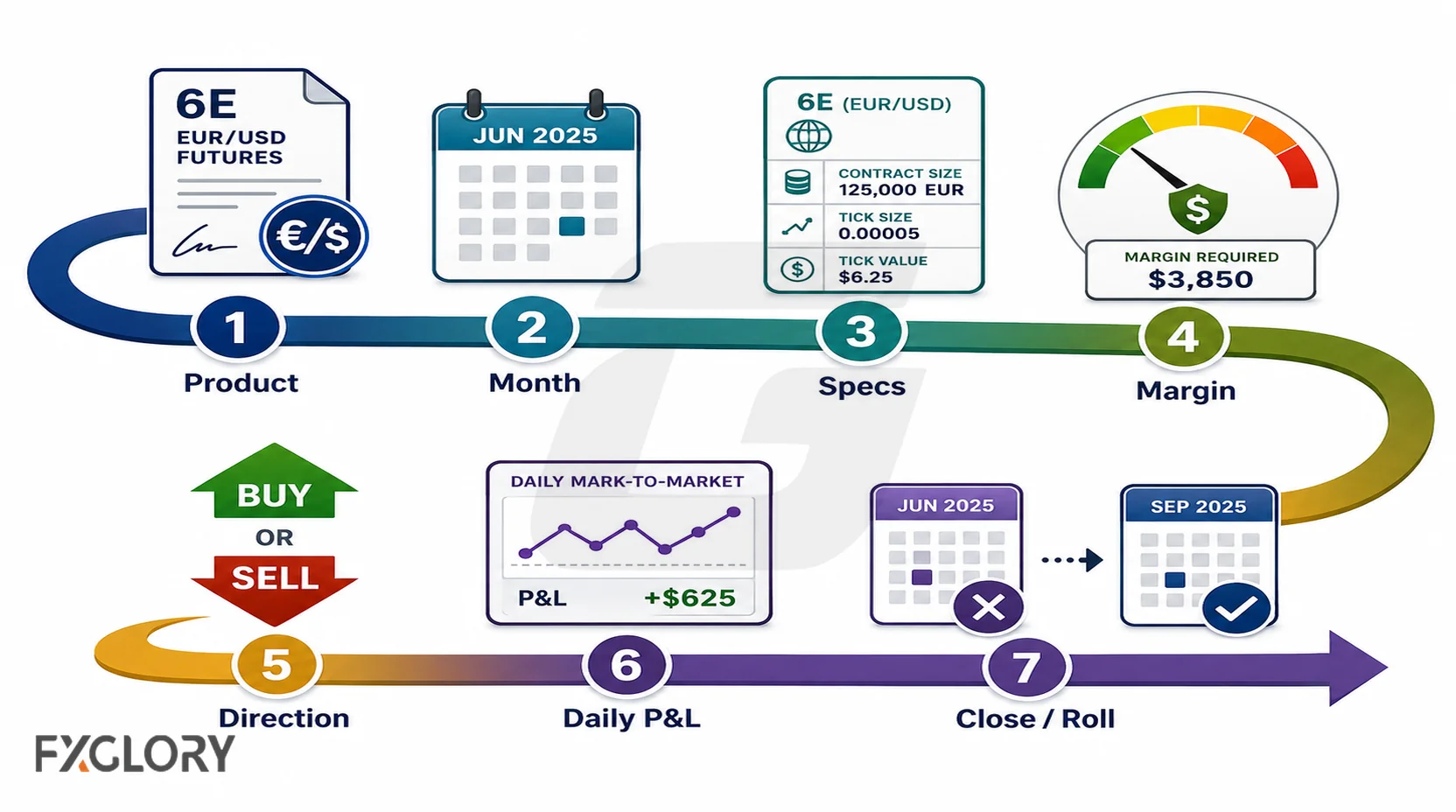
- Choose the currency futures product: For example, a euro, yen, pound, Swiss franc, or Australian dollar futures contract.
- Check the futures symbol: Futures symbols often include a product code plus a contract month and year. A platform may show a root symbol plus month/year code rather than a simple EUR/USD label, so confirm that you are viewing the intended product and month.
- Choose the contract month: Futures contracts expire, so the month matters. Two contracts based on the same currency can have different prices if they expire in different months.
- Check the contract specifications: Review contract size, minimum tick, tick value, trading hours, final trading schedule, and settlement method.
- Check margin requirements: Know the required initial and maintenance margin before entering.
- Choose direction: Buy if you expect the contract price to rise, or sell if you expect it to fall.
- Open the position: The position is entered through a futures broker or futures-approved platform.
- Monitor daily mark-to-market: Futures positions are generally settled to market each trading day, so gains or losses can change account equity before the position is closed.
- Close, roll, or hold toward settlement: Decide in advance whether to exit, move the position to a later month, or remain open toward settlement only when exchange and broker rules are fully understood.
Forex Futures Contract Anatomy
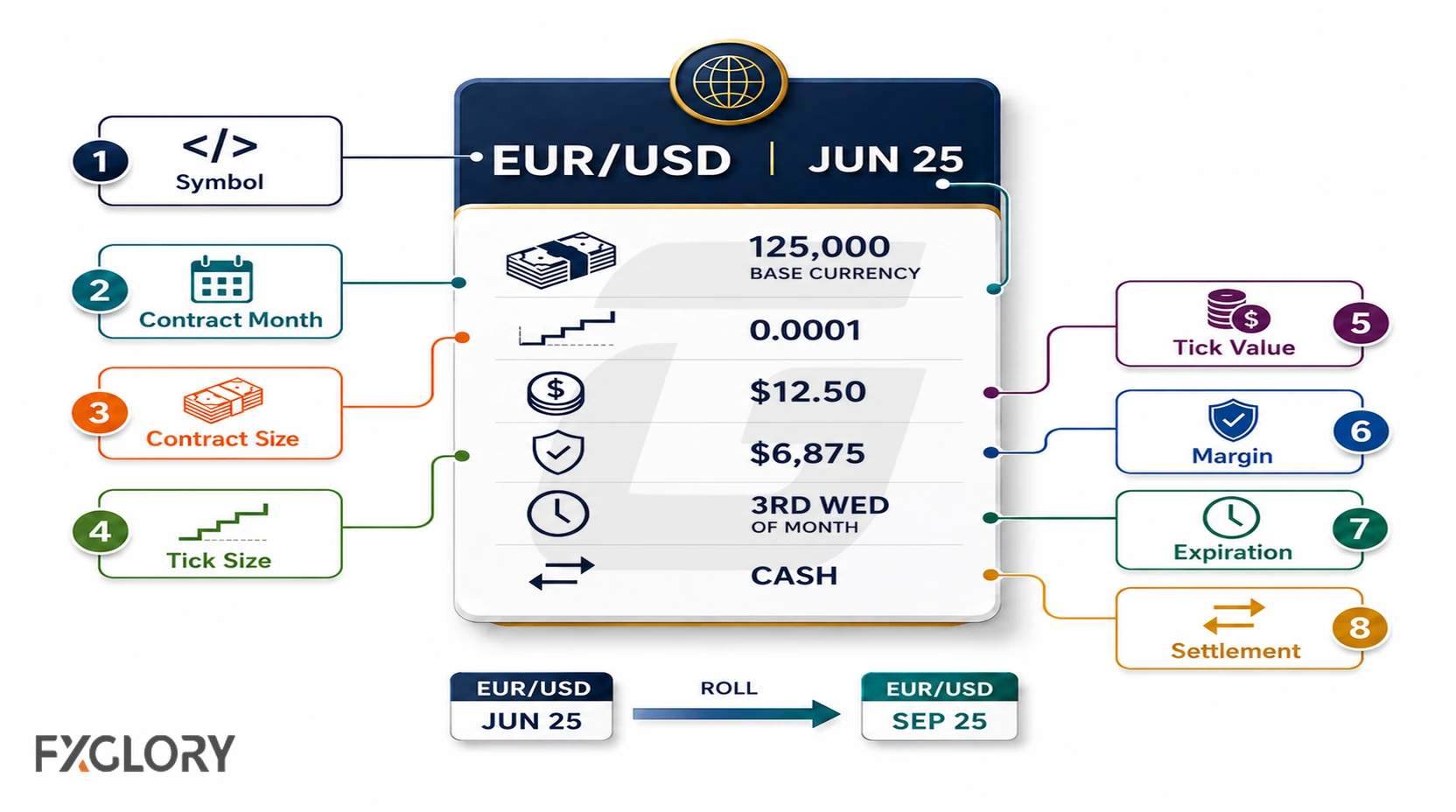
The most important part of forex futures trading is understanding the contract itself. A futures chart may look like a currency chart, but the position is controlled by futures contract specifications.
| Contract Part | Meaning |
|---|---|
| Contract | The exact futures product being traded. |
| Underlying quotation | The currency exchange rate or contract quotation the futures product is based on. |
| Contract symbol | The product code and contract month/year used to identify the futures contract. |
| Contract size | The currency amount represented by one futures contract. |
| Tick size | The smallest allowed price movement. |
| Tick value | The money value of one tick movement. |
| Margin | Performance-bond requirement for opening or maintaining the position; it can change and may include broker-specific requirements. |
| Expiration | The contract month or date when the contract expires. |
| Settlement | How the contract is resolved at or near expiration. |
| Roll | Closing one contract month and opening another later contract month. |
These fields determine what one contract represents, how its price changes translate into money, and what happens as the contract approaches its final trading and settlement dates.
Clearing means the clearinghouse becomes the central counterparty under exchange rules and administers margin and settlement. Central clearing changes the counterparty structure, but it does not remove price risk or prevent trading losses.
Contract Size, Tick Size and Tick Value
Contract size and tick value are central to forex futures. They tell the trader how much exposure one contract creates and how much a minimum price move is worth.
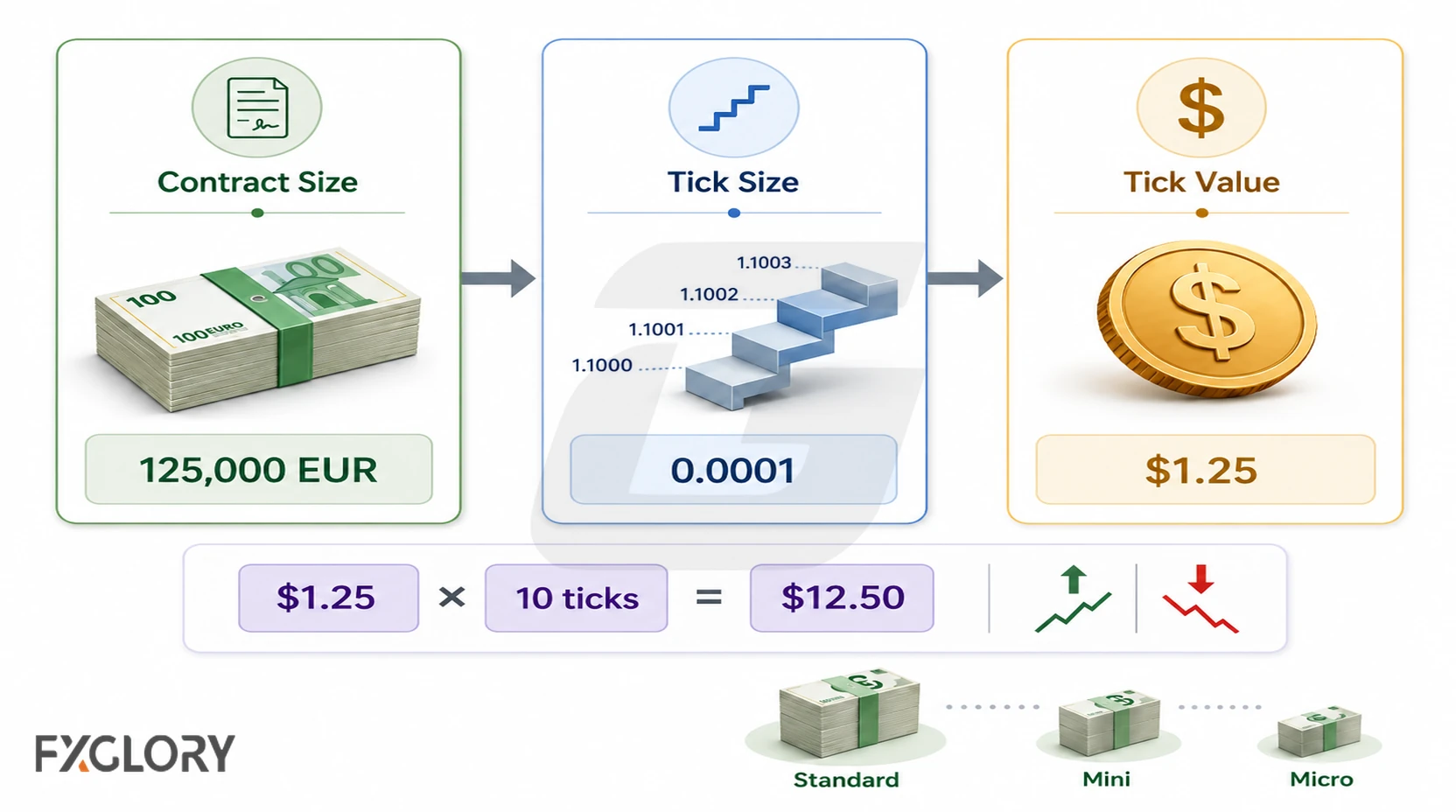
- Contract size: The amount of currency represented by one futures contract.
- Tick size: The minimum price movement allowed by the contract.
- Tick value: The money value of one tick movement.
As of September 2026, CME Micro EUR/USD futures (M6E) use a 12,500 euro contract size and a 0.0001 USD-per-EUR minimum tick, giving a $1.25 tick value per contract. A 10-tick move therefore changes the gross contract value by $12.50 before commissions and exchange or clearing fees; the actual trade result also depends on the entry and exit fills, which can be affected by bid/ask spread and slippage. Contract specifications can change, so verify the current exchange specification before trading.
Standard, mini and micro FX futures
| Contract Type | What It Means | Risk Note |
|---|---|---|
| Standard FX futures | The exchange's full-size contract for that currency product. | One contract can represent substantial notional currency exposure. |
| E-mini / mini FX futures | Reduced-size versions where the exchange lists them. | Contract availability and specifications vary by currency. |
| Micro FX futures | Smaller standardized contracts designed to provide finer exposure increments. | They remain leveraged futures with margin, expiration, mark-to-market, and trading risk. |
Do not confuse a futures contract size with a spot forex lot size. Futures contracts are standardized by the exchange, while spot forex lot sizing depends on the broker or platform.
For related basics, see what is lot size in forex and how to calculate pips in forex.
Example of a Forex Futures Trade
Here is a simplified educational example using a Micro EUR/USD futures contract. This is not a forecast or trading recommendation.
| Trade Detail | Example |
|---|---|
| Contract | Micro EUR/USD futures |
| Direction | Buy / long |
| Tick value | $1.25 per tick for CME Micro EUR/USD futures under the current specification |
| Price movement in favor | 10 ticks |
| Gross favorable movement | 10 × $1.25 = $12.50 before costs |
| If the move is against the trader | -10 × $1.25 = -$12.50 before costs |
| Margin impact | Losses reduce account equity and may trigger margin action if equity falls below requirements. |
| Final result | Based on the actual entry and exit fills and the contract's tick value, less applicable commissions, exchange or clearing fees, and other transaction charges. Spread and slippage affect the fill prices rather than acting as a fixed separate fee. |
If the contract moves 10 ticks in favor and each tick is worth $1.25, the gross movement is $12.50. If the same move goes against the position, the gross movement is -$12.50 before costs.
Gross tick movement is not the same as final account P/L. The actual result depends on entry and exit fills plus applicable commissions and exchange or clearing fees. Bid/ask spread and slippage can change the fills, while daily mark-to-market determines when gains and losses are credited or debited to the account.
Margin, Leverage and Daily Mark-to-Market
Forex futures are leveraged products. A trader does not usually pay the full notional value of the contract upfront. Instead, the trader must meet margin requirements.
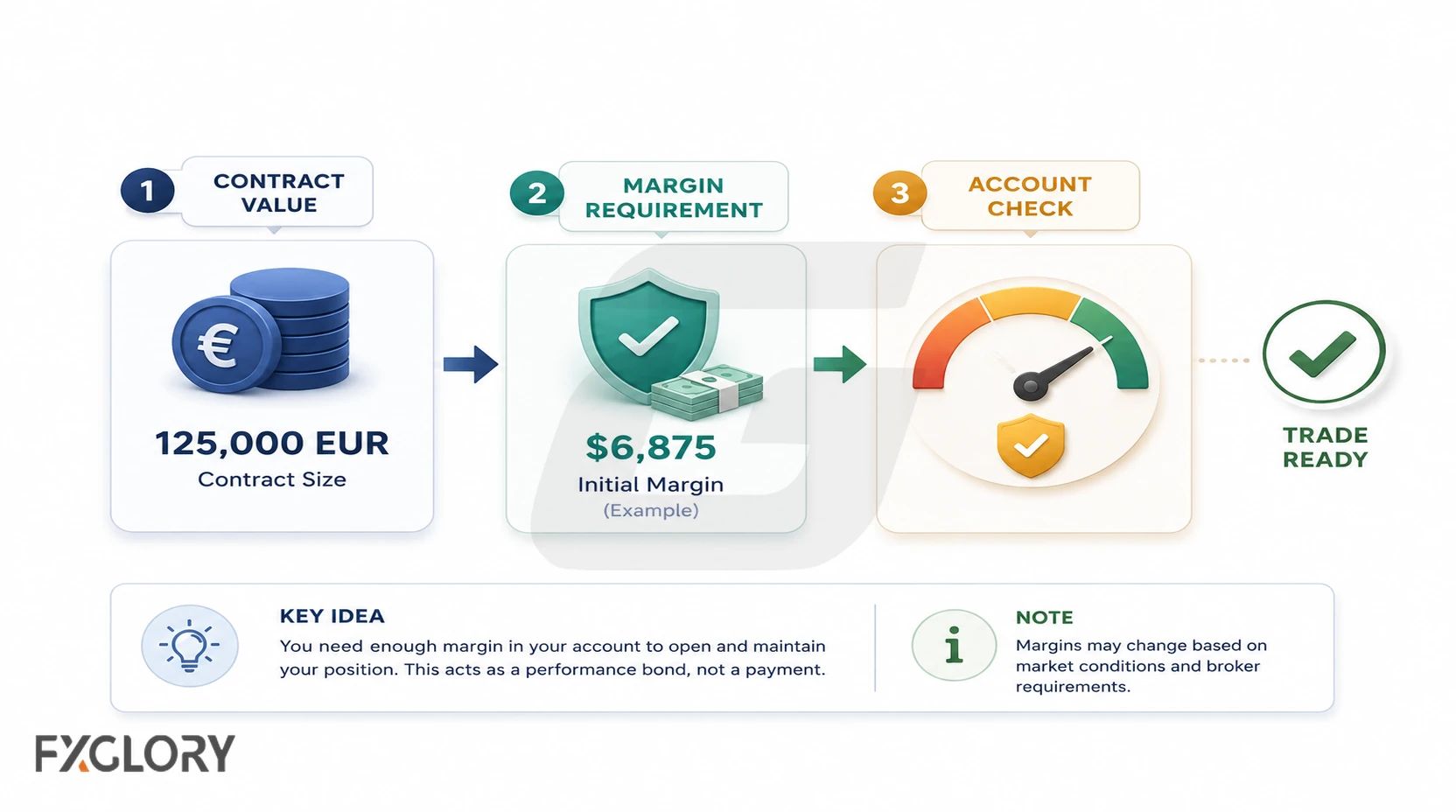
Notional exposure is the value represented by the futures contract. Futures margin is a performance bond rather than a down payment on that full value. Initial and maintenance margin requirements can change, and a broker may impose requirements above the exchange or clearing minimum.
Margin should not be treated as a maximum-loss amount. Adverse price movement can reduce account equity beyond the initial margin posted, and broker liquidation rules do not guarantee that a position will be closed at a particular loss.
Futures positions are generally marked to market daily. Gains and losses are credited or debited using the settlement process, so account equity and funding requirements can change while the position remains open.
| Concept | Why It Matters |
|---|---|
| Initial margin | Amount required to open the futures position. |
| Maintenance margin | Minimum equity level needed to keep the position open. |
| Margin deficiency | If equity falls below required levels, additional funds may be required or the broker may reduce positions according to its rules. |
| Settlement price | The daily futures price often used for mark-to-market calculations. |
| Mark-to-market | Daily settlement process that credits gains and debits losses as the settlement value changes. |
| Leverage | Can magnify gains and losses because the contract exposure is larger than the margin deposit. |
Lower margin does not mean lower risk. A futures contract can lose money quickly, and losses may exceed the initial margin deposit. Traders should understand maintenance margin, liquidation risk, and account funding requirements before opening a futures position.
For more on leverage risk, see best leverage for forex.
Expiration, Settlement and Rolling Contracts
A forex futures contract has an expiration date. It is not designed to remain open forever in the same contract month.
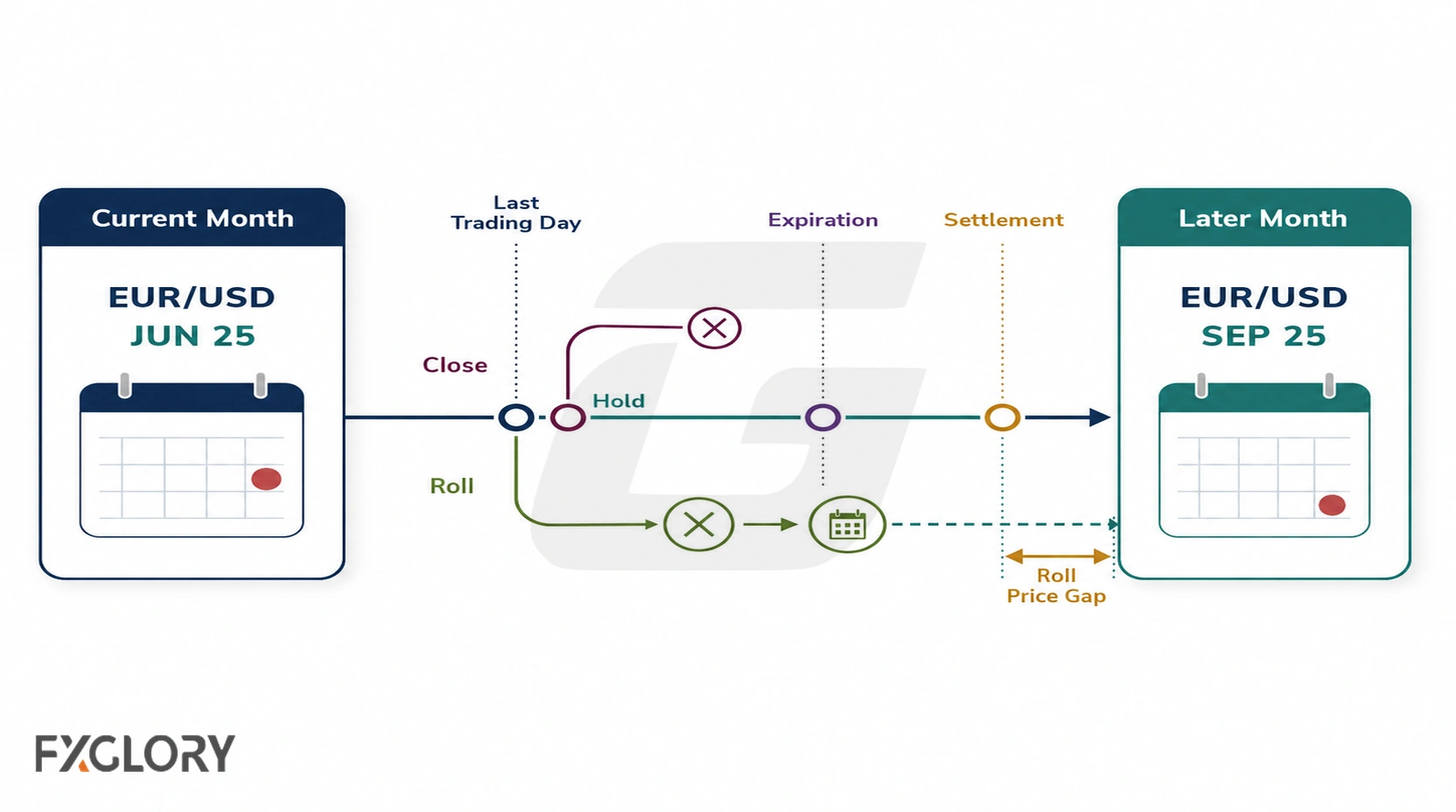
Before trading a forex futures contract, check:
- Expiration date: When the contract expires.
- Settlement method: Whether settlement is physical, financial, or handled according to broker rules.
- Last trading day: When trading stops for that contract month.
- Delivery or settlement policy: Whether the broker allows holding into delivery or settlement.
- Broker close-out or delivery policy: A broker may restrict holding a deliverable contract into its final trading or settlement process.
- Roll plan: Whether the position should be closed or moved to a later contract month before expiration.
Rolling a futures contract means closing a position in a contract month that is approaching expiration and opening a position in a later contract month. Futures rolling is not the same as forex swap or overnight rollover.
Rolling can involve a price difference between contract months, different liquidity, bid/ask spread, commissions, exchange fees, and other transaction costs. Rolling does not guarantee that the position economics stay exactly the same.
For the separate overnight rollover concept in spot forex, see what is swap in forex.
Quick Product Comparison
Spot forex, forex CFDs, and forex futures can all reference currency prices, but their legal and trading structures differ. Forex vs CFD explains the broader market-versus-contract distinction, while forex CFD trading covers CFD mechanics in more detail.
| Product | Core Structure |
|---|---|
| Spot forex | Typically an over-the-counter currency transaction or broker-based spot exposure without a standardized futures expiry. |
| Forex CFD | A broker-issued derivative that references currency-pair price movement without being an exchange-listed currency future. |
| Forex futures | Exchange-listed standardized currency futures contract with expiration, clearing, margin, and settlement rules. |
Do not assume that EUR/USD, GBP/USD, or JPY/USD means the same product everywhere. The same currency idea can appear as spot forex, a forex CFD, or a currency futures contract, with different margin, cost, execution, expiration, and settlement rules.
Why Traders Use Forex Futures
Forex futures may be used for different purposes. The two broad categories are hedging and speculation.
- Hedging: A business, investor, or institution may use forex futures to manage future currency exposure, such as a planned payment or cash flow in another currency.
- Speculation: A trader may use forex futures to trade expected price movement in a currency futures contract.
Some traders value exchange-listed contract rules, centralized clearing, visible contract specifications, and exchange-based market data. These features do not make forex futures risk-free. Hedgers and speculators both still need to understand contract specifications, expiration, margin, liquidity, fees, and risk.
Forex futures availability depends on the broker or platform. Not every forex broker offers exchange-listed futures, and futures usually require futures-trading approval.
Before Trading Forex Futures: Product Checklist
Before trading forex futures, check the product details. Group these checks into five areas: contract identity, contract economics, execution, expiration, and account requirements.
- Confirm the exact futures contract: Do not rely only on the currency name.
- Check the contract symbol: Make sure you are viewing the correct futures product.
- Check the contract month: Futures expire, so the month matters.
- Compare liquidity across contract months: Volume and open interest can differ by expiry, so check the specific month rather than assuming every listed contract is equally liquid.
- Check contract size: Know how much currency exposure one contract represents.
- Check tick size and tick value: Know how much each minimum price move is worth.
- Do not assume tick equals pip: Use the futures contract specification, not spot forex habit.
- Check margin requirement: Understand initial and maintenance margin.
- Check total exposure: Know the full notional exposure behind the margin deposit.
- Check trading hours: Know when the contract trades and when breaks occur.
- Check liquidity, volume, and open interest: Thin markets can increase execution risk.
- Check transaction and access costs: Review commissions, exchange or clearing fees, bid/ask spread, and any broker, platform, or market-data charges that apply to the account.
- Understand order types, stop behavior, and slippage risk: Execution may differ from expected prices.
- Check the final trading and settlement schedule: Know the dates and times that control when trading ends and settlement begins.
- Check settlement and delivery rules: Know whether the contract is cash-settled, physically delivered, or restricted by broker policy.
- Check position limits or broker restrictions: Some contracts or accounts may have limits.
- Decide whether to close, roll, or hold only if permitted and understood: Have a plan before expiration approaches.
- Confirm account approval: Futures usually require futures-trading approval, not only a basic forex or CFD account.
- Read futures risk disclosures: Understand that futures are leveraged and not suitable for all traders.
What to check on a currency pair or futures contract page
A spot pair page can help you understand currency movement, but it is not a substitute for the futures contract quote or specifications. Futures prices and spot prices may be related, but they are not always identical because the futures contract has its own month, quotation, pricing, and settlement rules.
You can use a live pair page such as EUR/USD live price to review currency-pair movement, then confirm futures contract specifications through the exchange, futures broker, platform, or account documents before trading.
A futures contract page or platform specification should identify the product code, contract month, contract size, minimum tick, tick value, trading hours, margin information, final trading schedule, settlement method, and applicable fees. Delivery-related information should also be checked when the contract is physically settled.
Common Mistakes With Forex Futures
Many forex futures mistakes come from treating a futures contract like a simple spot forex trade. Avoid these errors:
- Treating forex future trading like ordinary spot forex trading: Forex futures are standardized futures contracts, not flexible spot trades.
- Trading the wrong contract month: Similar symbols can represent different expiration months with different prices and liquidity.
- Ignoring contract size: One futures contract can represent significant currency exposure.
- Ignoring tick value: Without tick value, the trader may not know how much each price move is worth.
- Assuming a futures tick is the same as a spot forex pip: Tick size and tick value must come from the futures contract specification.
- Thinking margin is the full trade value: Margin is a requirement to hold the position, not the full contract value or a reliable loss limit.
- Forgetting daily mark-to-market: Futures gains and losses may be credited or debited daily based on settlement price.
- Ignoring expiration: Futures contracts expire, so timing matters.
- Ignoring final trading or delivery rules: A physically settled contract can have obligations that differ from simply closing a cash-settled position.
- Confusing futures rolling with forex swap rollover: Rolling a futures contract is different from overnight swap in spot forex.
- Ignoring roll costs: Rolling may involve price differences between contract months, spread, commissions, exchange fees, and liquidity changes.
- Assuming micro means low risk: Micro contracts may be smaller than standard contracts, but they are still leveraged futures products.
- Relying only on a spot EUR/USD chart: Futures contracts have their own quotes, contract months, tick values, and settlement rules.
- Holding near expiration without understanding settlement: Settlement or delivery rules can create serious problems if misunderstood.
- Ignoring liquidity and open interest: Thin contracts may have wider spreads and worse execution.
- Trading without futures account approval: Futures usually require specific account approval and risk disclosures.
- Assuming spot forex, forex CFDs, and forex futures are the same: They can track related currency movement but use different product structures.
Quick Recap: Forex Futures Trading
Currency futures add contract-specific mechanics to a currency view. The trader must identify the exact product and expiry, understand the contract size and tick value, and know how margin, daily mark-to-market, and settlement affect the account.
Spot and futures prices can be related without being identical, and a futures tick should not be substituted for a spot pip unless the contract specification supports that comparison. Margin is a performance bond, not the full notional value and not a maximum-loss amount.
Before entering a position, verify the current exchange specification and broker rules for the exact contract month, including trading hours, liquidity, margin, final trading schedule, settlement method, fees, and any delivery restrictions.