

What Are Forex Candlestick Patterns?
Forex candlestick patterns are formations created by one or more candles on a currency-pair chart. They help traders compare the latest candles with previous price movement and describe what the chart is showing.
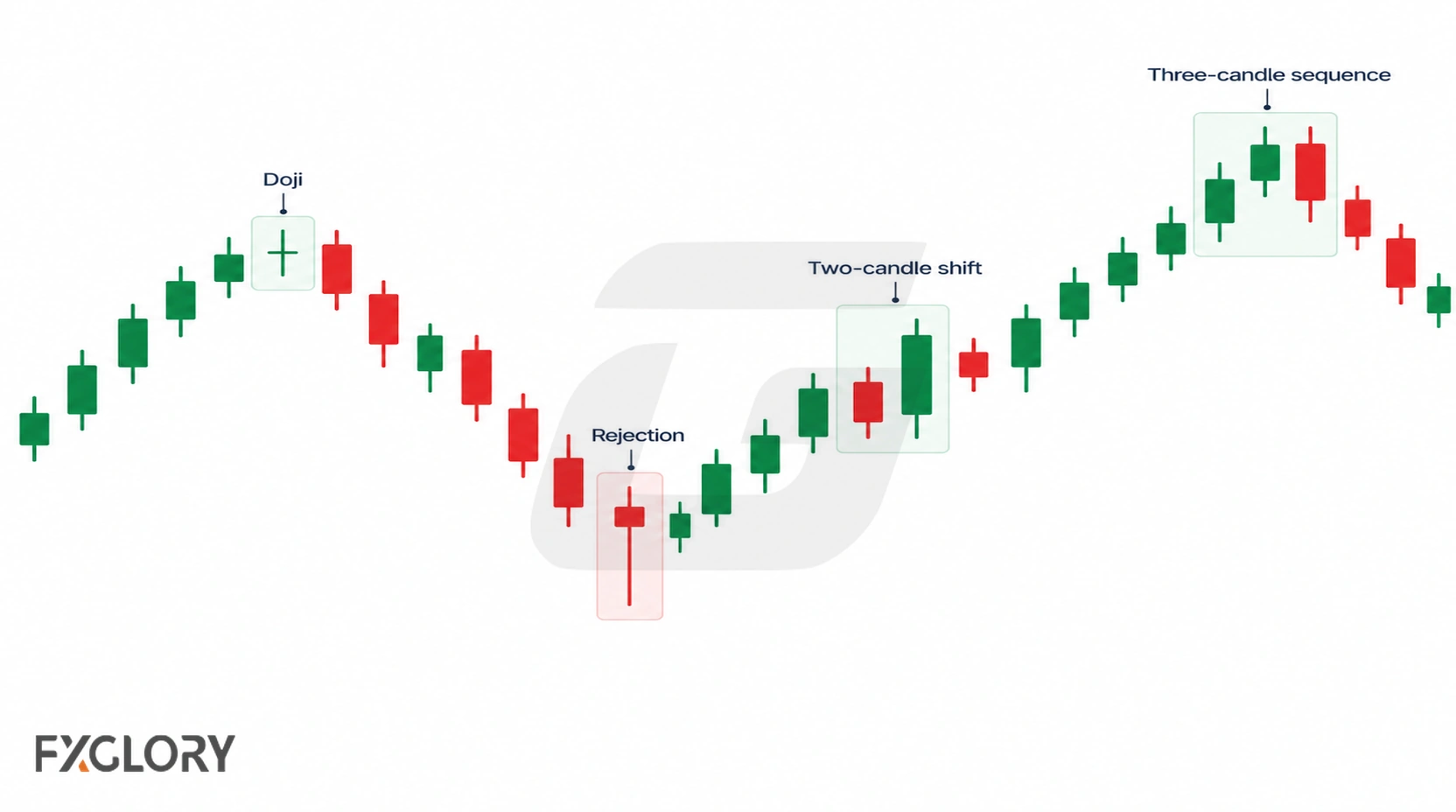
A single candle shows open, high, low, close, body, and wick information. A candlestick pattern looks at how one candle or a group of candles forms a recognizable structure. That structure may show hesitation, rejection, body pressure, continuation, compression, repeated testing, or a possible change in short-term pressure.
This page is a map of common forex candlestick patterns. It groups the patterns by structure and chart role, then links to deeper guides where the formation needs its own explanation.
If you need the basic parts of a candle first, start with the open, close, body, and wick relationship before studying pattern groups.
Pattern names can be useful because they give traders a shared language. However, the name is only the starting point. A pattern near a tested support area may carry a different meaning from the same pattern in the middle of a noisy range. A pattern after a long trend may read differently from a pattern after quiet sideways movement.
How Forex Candlestick Patterns Are Grouped
Candlestick patterns can be grouped in two practical ways. The first method groups them by structure: how many candles are involved. The second method groups them by chart role: what type of behavior the formation may suggest.
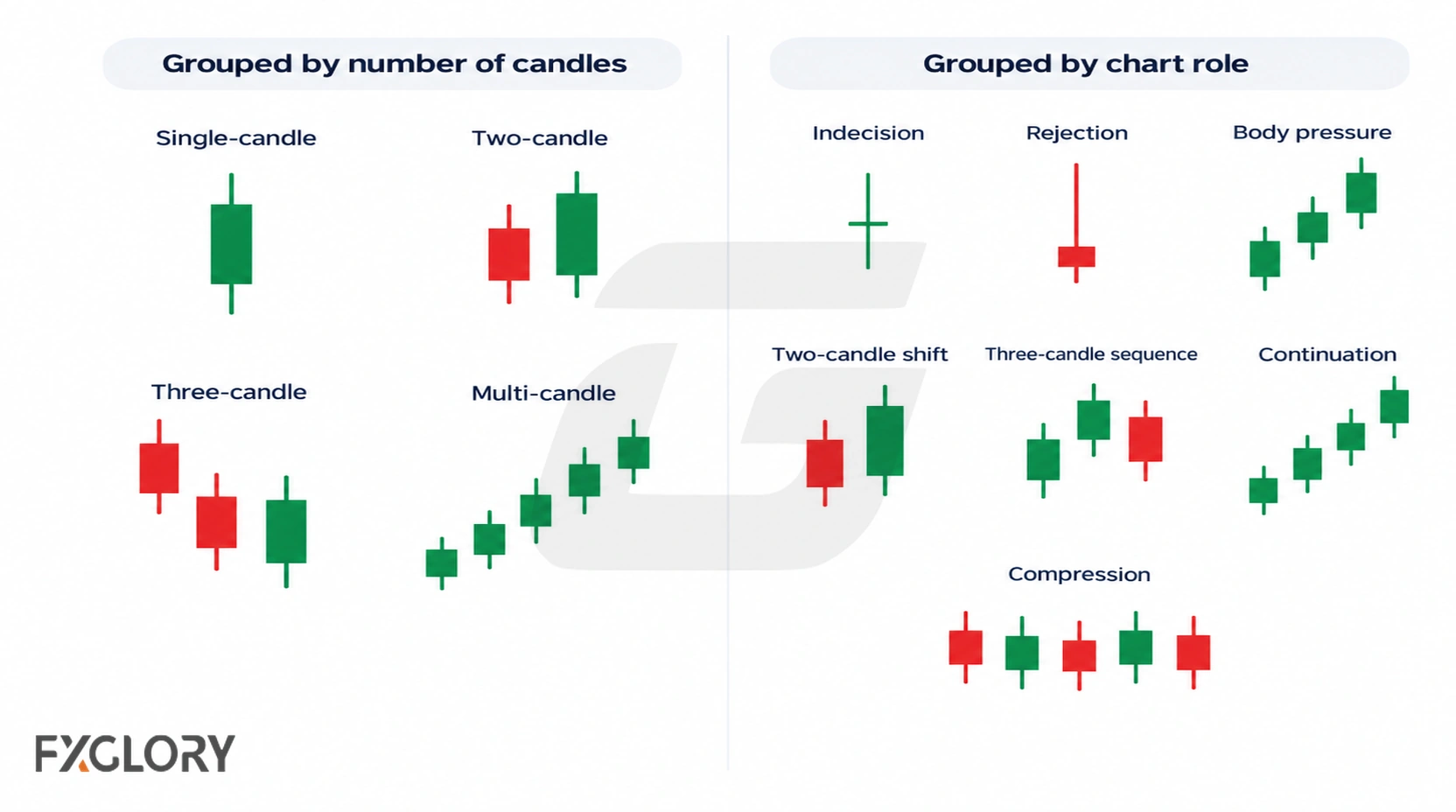
Grouping By Number Of Candles
- Single-candle patterns: Formed by one candle and usually read through body size, wick length, body position, and close location.
- Two-candle patterns: Formed by comparing one candle with the next candle.
- Three-candle patterns: Formed by a short sequence, often with a pause, pressure shift, or sustained directional response.
- Multi-candle patterns: Formed by more than three candles and usually reviewed through continuation, compression, or staged movement.
Grouping By Chart Role
- Indecision patterns: Suggest balance, hesitation, or a temporary pause in direction.
- Doji-family patterns: Focus on open-close balance, then add shadow direction for specific subtypes.
- Rejection patterns: Suggest that price tested one area but did not hold there by the close.
- Body-pressure candles: Show a larger real body and limited wick activity during one candle period.
- Two-candle shifts: Show how the second candle changes the message of the first candle.
- Three-candle sequences: Show a staged response across several candle periods.
- Continuation patterns: May appear during a pause inside an existing move.
- Compression patterns: Show narrowing movement before price chooses a clearer direction.
This grouping method helps traders ask what the formation is trying to describe before deciding whether it matters.
Beginner Pattern Map
Beginners do not need to start by memorizing every candle name. A smaller pattern map can make chart reading easier because each group has a different job.
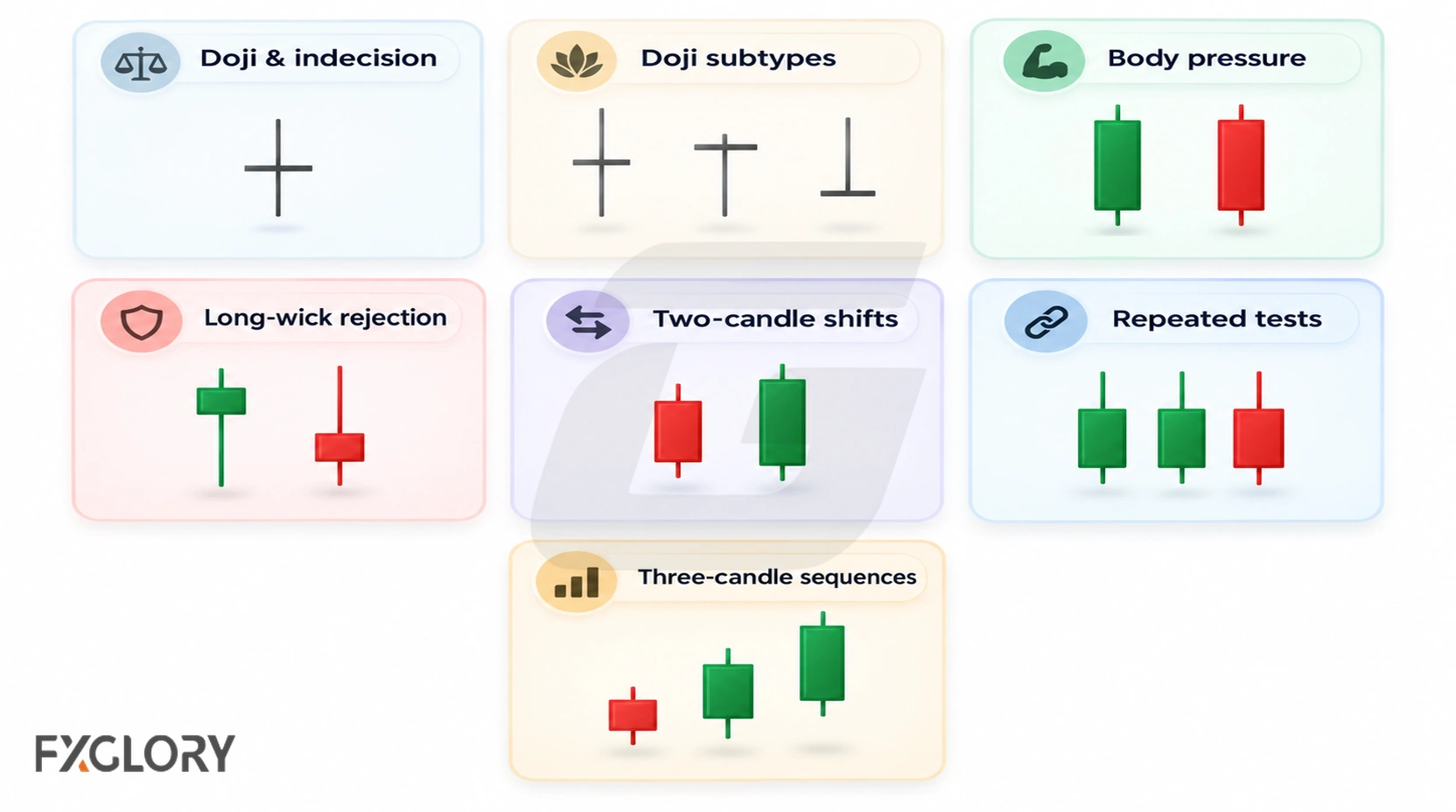
| Starter Group | What To Look For | Why It Matters | Deeper Study |
|---|---|---|---|
| Doji and indecision candles | Small bodies, balanced movement, or closes near the open. | They can show hesitation after movement or inside a range. | Doji candle guide and spinning top guide. |
| Doji subtypes | A doji body plus a dominant upper or lower shadow. | They help separate lower-price rejection from higher-price rejection. | Dragonfly doji and gravestone doji. |
| Body-pressure candles | A long real body with little or no wick. | They show stronger one-direction movement during one candle period. | Marubozu candle guide. |
| Long-wick rejection candles | A candle that tests one side but closes away from the extreme. | They can help traders review whether price rejected an area. | Hammer, inverted hammer, shooting star, and hanging man. |
| Two-candle shifts | A second candle changes, pauses, or compresses the message of the first candle. | They can show that short-term pressure changed between two candle periods. | Engulfing, harami, piercing line, and dark cloud cover. |
| Repeated tests | Nearby candles test similar highs or lows. | They help traders review whether price is repeatedly rejected at a visible area. | Tweezer top and bottom guide. |
| Three-candle sequences | Three candles form a staged pause, response, or sustained movement. | They show behavior over several candle periods rather than one candle. | Morning star, evening star, three white soldiers, and three black crows. |
Forex Candlestick Pattern Library
The table below gives a broad map of common forex candlestick patterns. Each row gives a short routing-level summary and points to a deeper guide where one exists.
| Pattern | Structure Type | Common Chart Role | Basic Idea | Deeper Study |
|---|---|---|---|---|
| Doji | Single candle | Open-close balance | Open and close are the same or very close, showing hesitation or balance. | Doji candle guide |
| Dragonfly doji | Single candle | Lower-shadow doji | Open, high, and close are near the same upper level, with a long lower shadow. | Dragonfly doji guide |
| Gravestone doji | Single candle | Upper-shadow doji | Open, low, and close are near the same lower level, with a long upper shadow. | Gravestone doji guide |
| Spinning top | Single candle | Indecision | Small body with upper and lower shadows, often showing two-sided movement. | Spinning top guide |
| Marubozu | Single candle | Body pressure | Large body with little or no wick, showing one-direction pressure during one candle period. | Marubozu candle guide |
| Hammer | Single candle | Lower-wick rejection after selling pressure | Small body near the top with a long lower wick, usually reviewed after selling pressure. | Hammer candle guide |
| Inverted hammer | Single candle | Upper-wick test after selling pressure | Small body near the bottom with a long upper wick, usually reviewed after a decline or lower-price test. | Inverted hammer guide |
| Shooting star | Single candle | Upper-wick rejection after buying pressure | Small body near the bottom with a long upper wick, usually reviewed after buying pressure. | Shooting star guide |
| Hanging man | Single candle | Lower-wick test after buying pressure | Similar shape to a hammer, but usually reviewed after an upward move instead of after selling pressure. | Hanging man guide |
| Pin bar | Single candle | Long-wick rejection | Long wick, smaller body, and close near one end of the candle range. | Pin bar guide |
| Engulfing candle | Two candles | Body takeover | Second candle body covers the previous candle body, showing a two-candle pressure shift. | Engulfing candle guide |
| Harami | Two candles | Contraction after a larger candle | The second candle's real body is contained within the first candle's real body; its shadows do not need to be fully contained. | Harami guide |
| Piercing line | Two candles | Bullish pressure shift | After selling pressure, a bullish second candle recovers into the prior bearish candle's body. | Piercing line guide |
| Dark cloud cover | Two candles | Bearish pressure shift | After buying pressure, a bearish second candle moves into the prior bullish candle's body. | Dark cloud cover guide |
| Tweezer bottom | Two or more candles | Repeated lower-price test | Price tests a similar low more than once and fails to hold below it. | Tweezer top and bottom guide |
| Tweezer top | Two or more candles | Repeated higher-price test | Price tests a similar high more than once and fails to hold above it. | Tweezer top and bottom guide |
| Morning star | Three candles | Bullish pause-and-response sequence | A bearish candle, a smaller middle candle, and a bullish third candle create a staged pressure shift after selling pressure. | Morning star guide |
| Evening star | Three candles | Bearish pause-and-response sequence | A bullish candle, a smaller middle candle, and a bearish third candle create a staged pressure shift after buying pressure. | Evening star guide |
| Three white soldiers | Three candles | Sustained bullish candles | Three bullish candles in sequence can show sustained buyer response when the chart context supports it. | Three white soldiers guide |
| Three black crows | Three candles | Sustained bearish candles | Three bearish candles in sequence can show sustained seller response when the chart context supports it. | Three black crows guide |
| Inside bar | Two candles | Compression or pause | A smaller candle forms inside the previous candle's range, showing narrower movement after a wider candle. | Inside bar pattern guide |
| Outside bar | Two candles | Range expansion | A candle forms a wider high-to-low range than the previous candle, showing expansion after a smaller range. | |
| Rising three methods | Multi-candle | Continuation pause | A larger bullish candle is followed by smaller corrective candles and then another bullish candle, if the sequence is clean. | |
| Falling three methods | Multi-candle | Continuation pause | A larger bearish candle is followed by smaller corrective candles and then another bearish candle, if the sequence is clean. |
Some less common candlestick names, such as abandoned baby, kicker, and belt hold, also appear in candlestick discussions. In forex, these are usually better treated carefully because gap-based logic can depend on the chart timeframe, session, and liquidity conditions.
Single-Candle Forex Patterns
Single-candle patterns use one candle to describe a short piece of price behavior. These formations usually depend on body size, wick length, body location, and where the candle closes inside its full range.
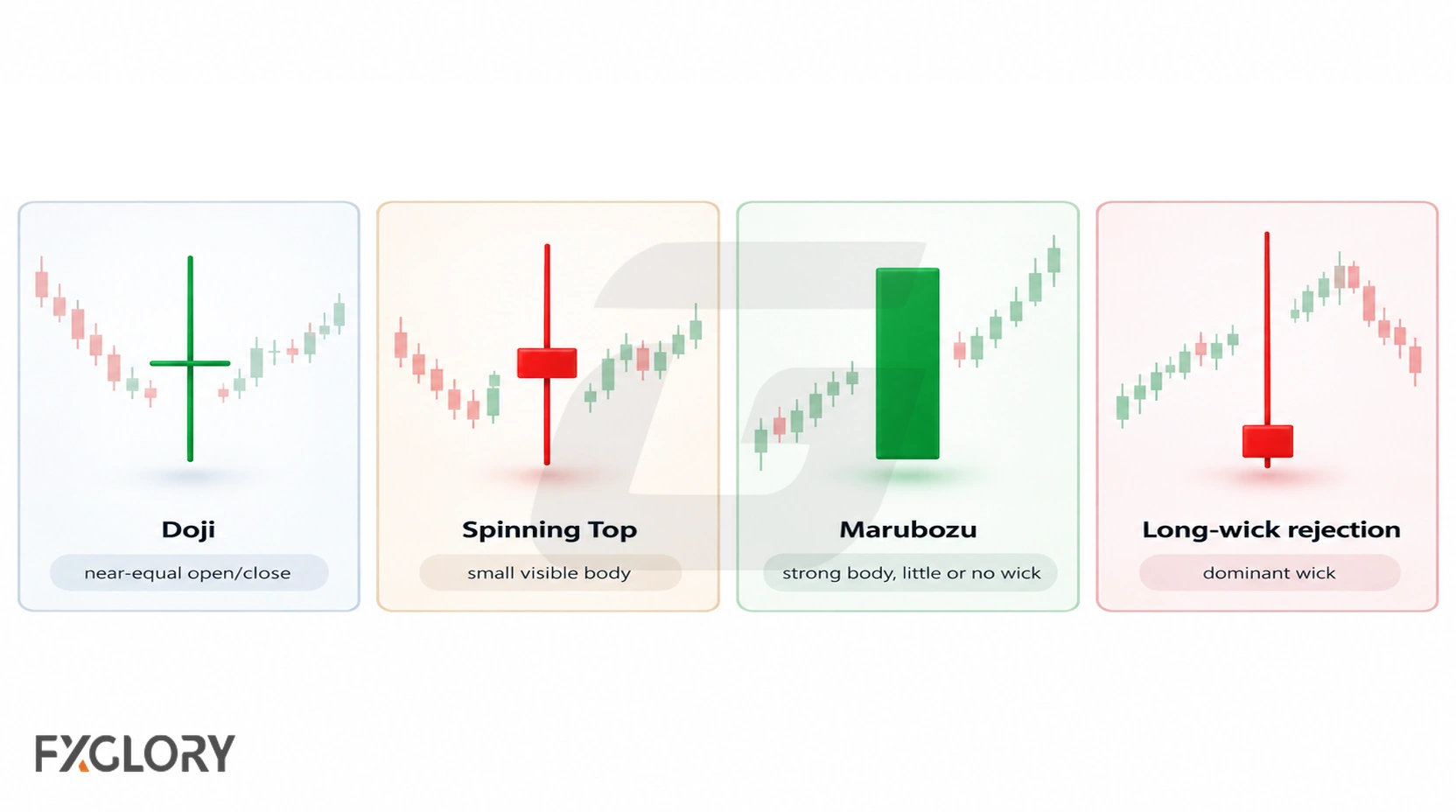
A small-bodied candle may show hesitation because price opened and closed near the same area. A long-wick candle may show that price tested one side of the range but did not hold there by the close. A large-body candle may show stronger movement from open to close.
The main single-candle groups in this cluster are doji-family candles, spinning top candles, full-body candles, and long-wick rejection candles. Each group has a different structure and should not be treated as the same pattern.
| Single-Candle Feature | Example Patterns | What It May Describe | Reading Caution |
|---|---|---|---|
| Open-close balance | Doji, dragonfly doji, gravestone doji | Open and close sit close together, with subtype meaning based on shadow direction. | Doji-family candles need location and follow-up movement. |
| Small body with two-sided shadows | Spinning top | Two-sided movement and hesitation. | Can appear often in noisy ranges. |
| Long lower wick | Hammer, hanging man, dragonfly doji | Price tested lower levels and closed above the low. | Pattern name depends on body type and prior movement. |
| Long upper wick | Shooting star, inverted hammer, gravestone doji | Price tested higher levels and closed below the high. | Pattern name depends on body type and prior movement. |
| Large body | Marubozu | Strong movement from open to close. | Large bodies can also appear during unstable volatility. |
Doji And Indecision Patterns
Doji and spinning top patterns are often grouped near each other because they both involve smaller bodies. The difference is that doji candles focus on the open and close being nearly the same, while spinning tops focus on a small body with upper and lower shadows.
Doji Candle
A doji candle has an open and close that are the same or nearly the same. It can show hesitation, balance, or a pause, but it does not explain the whole chart by itself. Use the general doji candle guide for the broader doji family.
Dragonfly Doji
A dragonfly doji is a doji subtype with a long lower shadow and open, high, and close near the same upper level. It is best kept separate from hammer because dragonfly doji requires a doji-like body. Use the long lower-shadow doji guide for the full structure.
Gravestone Doji
A gravestone doji is a doji subtype with a long upper shadow and open, low, and close near the same lower level. It is best kept separate from shooting star because gravestone doji requires a doji-like body. Use the long upper-shadow doji guide for the full structure.
Spinning Top
A spinning top has a small body with upper and lower shadows. It can show two-sided movement and uncertainty, but it is not the same as a doji because the open and close do not need to be nearly equal. Use the two-sided small-body candle guide for the full reading.
Wick-Rejection Patterns
Wick-rejection patterns focus on candles where price tests one side of the range and then closes away from that extreme. The direction of the wick matters, but the pattern name also depends on prior movement and body structure.
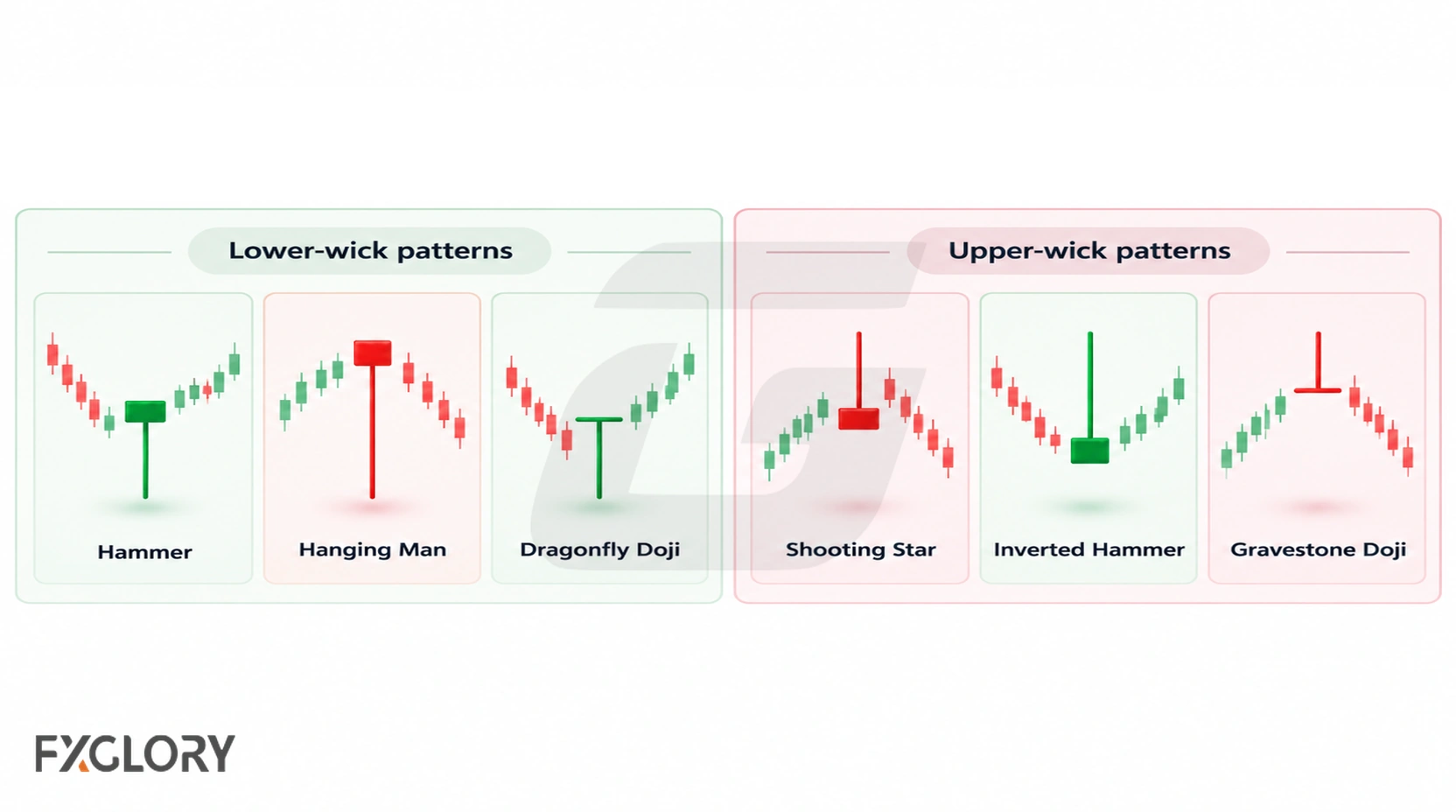
Lower-Wick Patterns
Hammer, hanging man, and dragonfly doji can all show long lower shadows, but they should not be merged into one idea. Hammer is usually reviewed after selling pressure. Hanging man is usually reviewed after buying pressure. Dragonfly doji is a doji subtype with open and close nearly equal near the high.
For detailed study, compare the hammer candle after selling pressure, the hanging man after buying pressure, and the dragonfly doji lower-shadow structure.
Upper-Wick Patterns
Shooting star, inverted hammer, and gravestone doji can all show long upper shadows, but they are not the same pattern. Shooting star is usually reviewed after buying pressure. Inverted hammer is usually reviewed after selling pressure. Gravestone doji is a doji subtype with open and close nearly equal near the low.
For detailed study, compare the shooting star after buying pressure, the inverted hammer after selling pressure, and the gravestone doji upper-shadow structure.
Pin Bar
A pin bar is a broader long-wick candle idea. It focuses on a dominant wick and a close away from the tested extreme. Because pin bar is broader, it should not replace the more specific hammer, shooting star, dragonfly doji, or gravestone doji labels. Use the pin bar guide when studying broader long-wick rejection candles.
Two-Candle Forex Patterns
Two-candle patterns compare a first candle with a second candle. The second candle matters because it can confirm hesitation, reject the previous candle's direction, show contraction, or show that short-term pressure has changed.
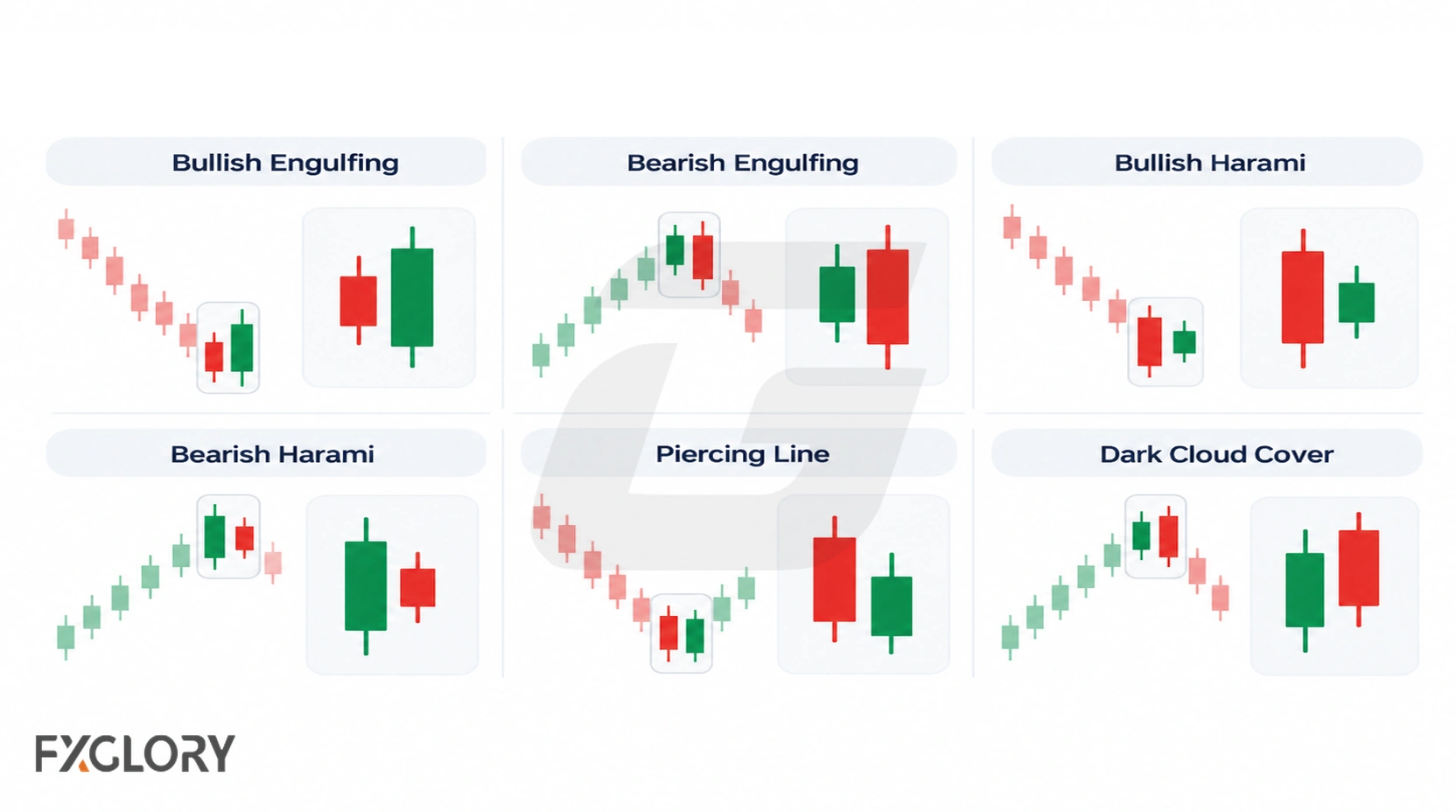
These patterns are often easier to evaluate than single-candle patterns because they include a small before-and-after sequence. The first candle provides the initial condition. The second candle shows whether price continued, paused, rejected, compressed, expanded, or shifted direction.
Engulfing Pattern
An engulfing pattern compares the body of the first candle with the body of the second candle. In a cleaner engulfing formation, the second candle's body covers the previous candle's body. This can show a visible pressure shift between two candle periods. Use the two-candle body-takeover guide for deeper study.
Harami Pattern
A harami pattern is almost the opposite idea of an engulfing formation. Instead of the second candle covering the first, the second candle is smaller and forms inside the prior candle's body or range. This can show contraction or hesitation after a larger candle. Use the inside-body harami guide for the full structure.
Piercing Line And Dark Cloud Cover
The piercing line and dark cloud cover are two-candle pressure-shift formations. A piercing line is usually reviewed after selling pressure when the second candle recovers into the prior bearish body. Dark cloud cover is usually reviewed after buying pressure when the second candle moves down into the prior bullish body.
For the full two-candle comparisons, use the piercing line recovery guide and the dark cloud cover pushback guide.
Tweezer Tops And Tweezer Bottoms
Tweezers focus on repeated tests of a similar high or low. A tweezer top shows price testing a similar upper area more than once. A tweezer bottom shows price testing a similar lower area more than once. These patterns are easier to review near visible support or resistance. Use the matching high and matching low guide for the full comparison.
Inside Bar And Outside Bar
An inside bar shows compression because its range sits inside the previous candle's range. An outside bar shows expansion because its high-to-low range extends beyond the previous candle's range. These patterns should be read with the surrounding trend, range, and volatility conditions.
- First candle: Shows the earlier pressure, range, or hesitation.
- Second candle: Shows whether that pressure continued, weakened, contracted, expanded, or changed.
- Chart location: Helps decide whether the two-candle structure deserves attention.
- Later reaction: Helps review whether the formation is still meaningful.
Three-Candle Forex Patterns
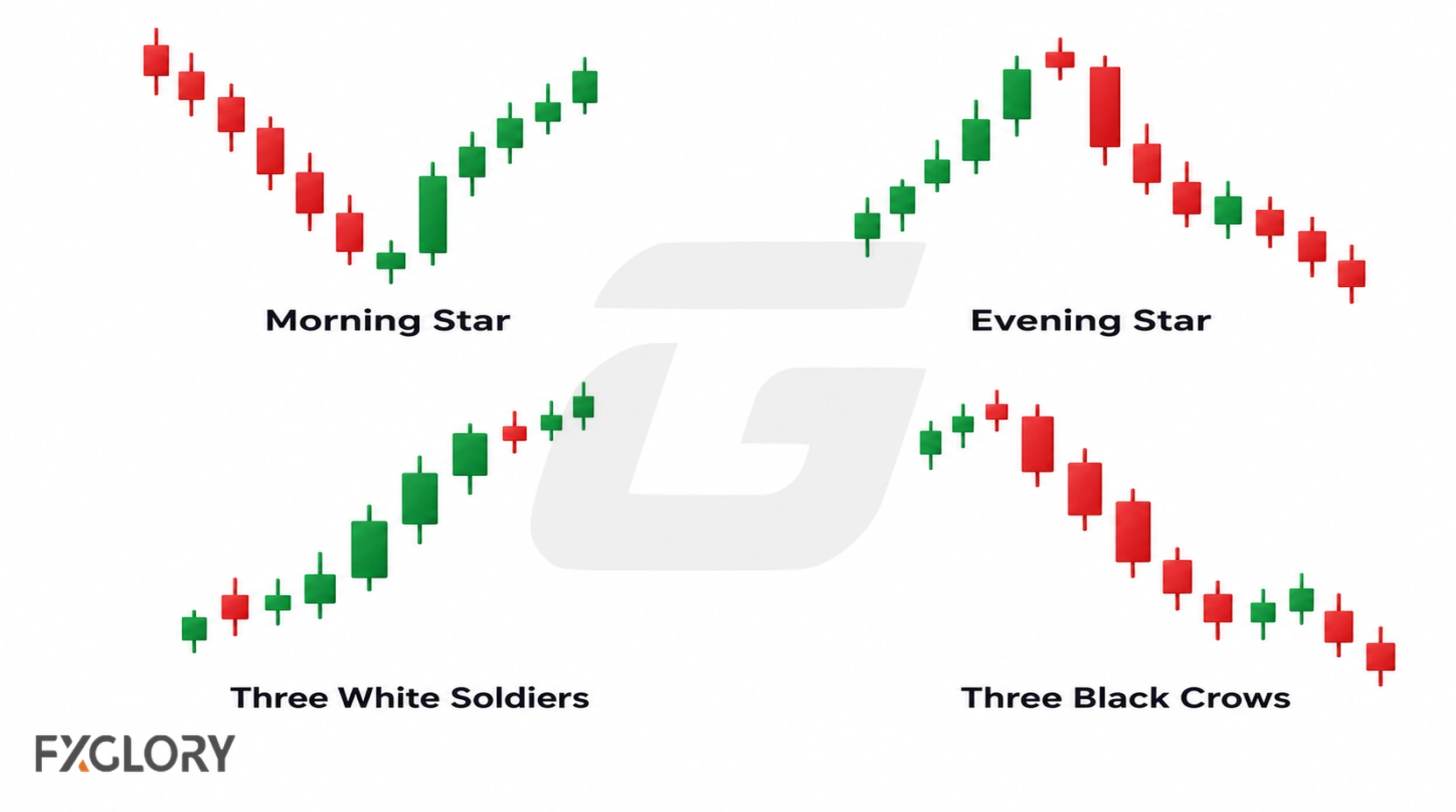
Three-candle patterns show behavior across several candle periods. Some use a middle pause. Others use three candles moving in the same direction. These formations should be read as sequences, not as isolated candles.
Morning Star And Evening Star
Morning star and evening star formations use three candles. A morning star is usually reviewed after selling pressure and shows a staged shift from a bearish candle, to a smaller middle candle, to a bullish third candle. An evening star is usually reviewed after buying pressure and shows the opposite sequence.
Use the morning star sequence guide and the evening star sequence guide for the full candle-by-candle structure.
Three White Soldiers And Three Black Crows
Three white soldiers describes a sequence of three bullish candles. Three black crows describes a sequence of three bearish candles. These formations can show sustained pressure, but they can also appear late in an extended move, so chart location and volatility matter.
Use the three white soldiers guide and the three black crows guide for the full sequence comparison.
Continuation And Range Patterns
Some candlestick formations are reviewed as pauses, compression structures, or continuation-style sequences. These patterns should be handled carefully because overlapping candles can make them easy to force onto unclear price action.
Inside Bar
An inside bar forms when a candle's range sits inside the previous candle's range. It can show compression or a temporary pause. It becomes easier to review near a clear range boundary, during a controlled pullback, or after a wide candle that clearly defines the larger range. For the full definition and mother-bar structure, use the inside bar pattern guide.
Outside Bar
An outside bar forms when a candle's range extends beyond the previous candle's high and low. It can show range expansion, but it still needs context because expansion can happen during volatile or unstable conditions.
Rising And Falling Three Methods
Rising three methods and falling three methods are continuation-style formations. They usually include a larger directional candle, a smaller corrective pause, and a later candle that returns to the broader direction. These patterns need clean structure and should not be forced onto random overlapping candles.
Continuation and range patterns are useful for describing pauses and range behavior, but they should not be treated as automatic directional answers.
Forex Candlestick Pattern Reading Table
The table below groups common candlestick pattern ideas by the behavior they may describe. It is not a trading checklist. It is a way to organize chart observations before moving into more detailed study.
| Pattern Group | Common Structure | Example Patterns | Possible Chart Message | What To Check Next |
|---|---|---|---|---|
| Open-close balance | Open and close are the same or nearly the same. | Doji, dragonfly doji, gravestone doji. | Price may be pausing, balancing, or rejecting one side depending on shadows. | Check body size, shadow direction, and chart location. |
| Indecision | Small body, close near the open, or balanced wicks. | Doji, spinning top, small middle candle in star formations. | Price may be pausing or uncertain. | Check whether it appears after a strong move or inside a range. |
| Wick rejection | Long upper wick or long lower wick. | Hammer, shooting star, inverted hammer, hanging man, pin bar. | Price tested one side but did not close there. | Check nearby support, resistance, prior movement, and the next candle. |
| Body pressure | Large body with small or limited wicks. | Marubozu, three white soldiers, three black crows. | Price held more of one direction into the close. | Check whether the move is fresh, extended, or news-driven. |
| Two-candle shift | Second candle changes the message of the first candle. | Engulfing, piercing line, dark cloud cover, outside bar. | Pressure may have shifted during the next period. | Check whether the second candle closes in a meaningful area. |
| Compression | Narrowing candles or smaller ranges. | Harami, inside bar, small-body sequences. | Price may be pausing before clearer movement. | Check range boundaries, volatility, and nearby levels. |
| Repeated test | Similar highs or similar lows across nearby candles. | Tweezer top, tweezer bottom. | Price retested an area and did not hold beyond it. | Check whether the repeated level is visible on the broader chart. |
| Three-candle sequence | Three candles form a staged or sustained structure. | Morning star, evening star, three white soldiers, three black crows. | Pressure may be shifting or continuing across several candles. | Check the sequence quality and whether the move is already extended. |
| Continuation pause | Pause, small pullback, or controlled candles inside a trend. | Inside bar, rising three methods, falling three methods. | The existing move may be pausing rather than reversing. | Check whether the trend structure remains intact. |
Forex Context: When Candlestick Patterns Matter More
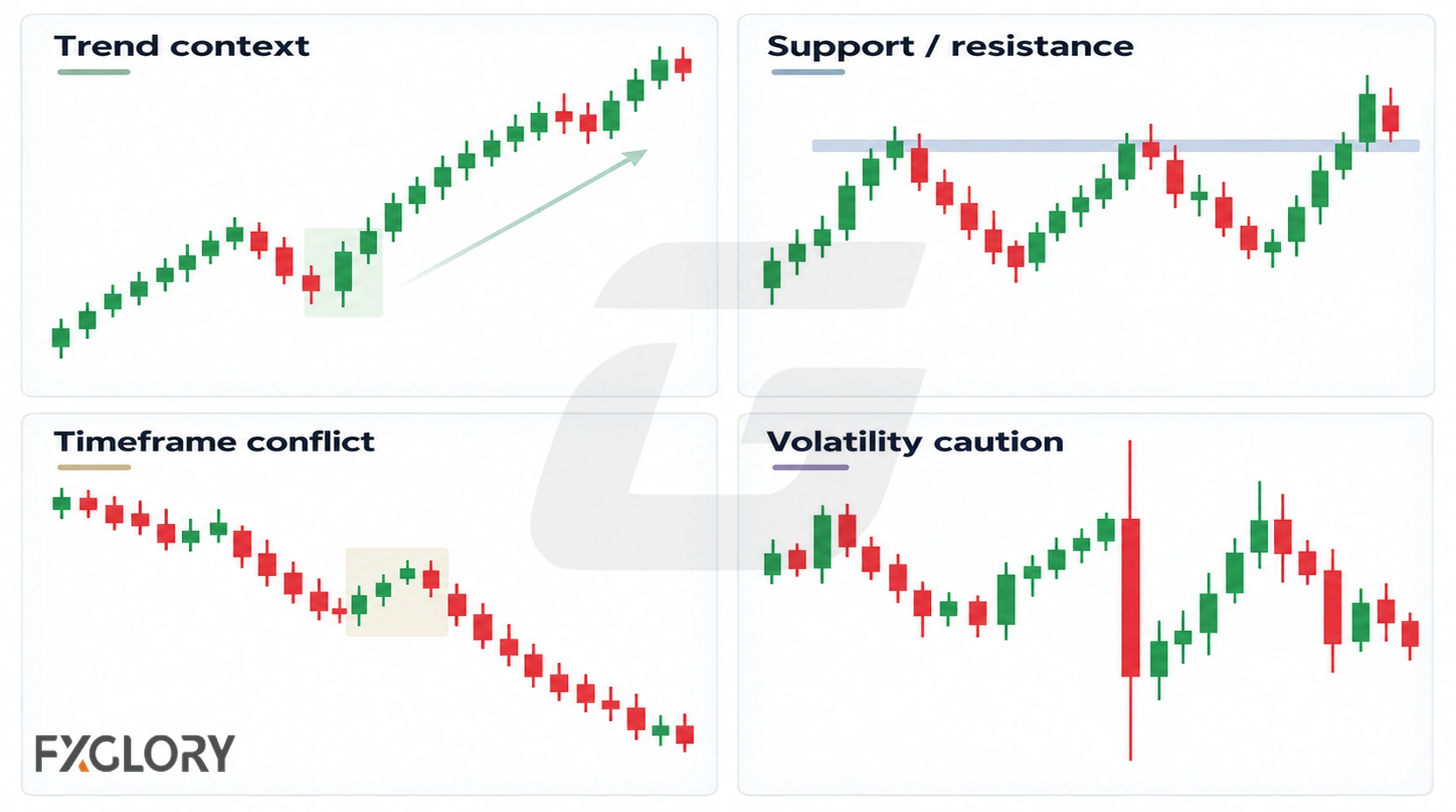
A candlestick pattern becomes easier to read when it appears in a clear chart environment. The same formation can have different meanings in a trend, range, breakout, or news-driven market. Context decides whether the pattern is useful, weak, or better ignored.
Trend Context
In a trending market, candlestick patterns may show continuation, pullback, hesitation, or possible exhaustion. A pattern that aligns with the trend may be easier to read than one that argues against it. A countertrend pattern usually needs more caution because the broader market direction may still dominate.
Support And Resistance
Patterns near tested support or resistance can be more informative than patterns in the middle of random movement. A rejection-style candle near a previous high or low may show a clearer chart reaction than the same candle inside a messy range.
Timeframe Context
A pattern on a short timeframe can look important while being small within a higher-timeframe move. A pattern on a higher timeframe may carry broader chart information but may also take longer to form. Traders should know which timeframe they are reading before comparing patterns.
Volatility Context
High volatility can make patterns look dramatic. Low volatility can make them look compressed. A large candle during news conditions may not be the same as a large candle during normal market flow. A small candle during quiet trading may not carry the same meaning as a small candle after a strong trend.
Spread And Liquidity Conditions
Forex conditions can change around rollover, market opens, major announcements, and low-liquidity periods. Patterns that appear during unstable conditions may be harder to evaluate because spreads, fills, and price movement can change quickly.
For chart observation, a trader can compare candle behavior across a live currency pair such as EUR/GBP price movement and a more volatile pair such as GBP/USD chart movement. The purpose is to observe how formations change across markets and conditions, not to treat any single pattern as a signal.
- A pattern inside a messy range can be less useful than a pattern near a clear level.
- A short-timeframe pattern can conflict with a higher-timeframe trend.
- A candle formed during fast news movement can be difficult to interpret in real time.
- A pattern without clear risk conditions should not be treated as a complete plan.
Forex Candlestick Pattern Reading Checklist
A checklist helps separate pattern recognition from decision-making. The goal is to describe what the chart shows before deciding whether the information is useful.
- Start with the candle basics: Read the open, high, low, close, body, and wicks before naming the pattern.
- Classify the formation: Decide whether it is a single-candle, two-candle, three-candle, or broader multi-candle pattern.
- Identify the chart role: Ask whether it suggests hesitation, rejection, body pressure, compression, repeated testing, continuation, or possible pressure shift.
- Check the location: Review support, resistance, trend structure, range boundaries, or recent swing points.
- Compare the timeframe: Make sure the pattern does not conflict with the timeframe controlling the plan.
- Review market conditions: Consider volatility, spread, liquidity, rollover, and scheduled news events.
- Wait for completed candles: A candle can change shape before the timeframe closes.
- Watch follow-up price action: Review whether price respects the pattern area or immediately weakens the idea.
- Define the risk boundary: Know where the pattern reading would no longer make sense.
Some traders also combine candlestick analysis with technical indicators. For example, RSI can add momentum context, MACD can add trend-momentum context, ATR can add volatility context, and Bollinger Bands can help review range and expansion conditions. These tools can support pattern reading, but they do not remove trading risk.
When To Skip Forex Candlestick Patterns
Some chart conditions make candlestick patterns harder to read. Skipping unclear formations can be as important as recognizing clean ones.
- The chart is messy: Price is moving sideways with overlapping candles and no clear level.
- The candle has not closed: The pattern can change before the timeframe finishes.
- The structure is being forced: If the candle body, wick, or sequence does not match the pattern clearly, the label may not help.
- Spread or volatility is abnormal: The shape may reflect unstable conditions more than useful structure.
- News risk is near: Scheduled events can quickly overpower a candle formation.
- The pattern conflicts with the main timeframe: A small pattern may not matter if the broader chart points the other way.
- The risk boundary is unclear: If there is no clear area where the reading becomes weak, the pattern is not enough.
Common Mistakes With Forex Candlestick Patterns
Candlestick patterns are easy to recognize after practice, but they are also easy to misuse. The most common problem is treating a pattern name as a complete trading decision.
- Memorizing names without reading structure: A pattern name should come after the candle structure is clear. If the body, wick, close location, and surrounding candles are not understood, the name adds little value.
- Ignoring where the pattern appears: A formation near support, resistance, or a trend boundary is different from the same formation in the middle of unclear price action. Location often decides whether the pattern deserves attention.
- Forcing patterns onto random candles: Not every candle sequence is a meaningful pattern. If the formation is unclear, compressed by noise, or hard to define, it may be better to skip it.
- Mixing similar patterns together: Hammer, hanging man, dragonfly doji, shooting star, inverted hammer, and gravestone doji can look similar, but their body structure and prior context are different.
- Reading unfinished candles too early: A candle can change shape before it closes. A pattern that looks clear while forming may disappear by the end of the candle period. The close is part of the pattern.
- Ignoring spread, news, and liquidity: Large candles and long wicks may appear during unstable conditions. These formations can look useful on the chart but may be difficult to act on when spreads widen or price moves quickly.
- Turning every pattern into a trade: A pattern can be an observation, not an instruction. A trading decision needs separate rules for risk, position size, market conditions, and when to stand aside.
- Replacing risk planning with pattern confidence: A candlestick pattern should not replace a complete risk plan, and leverage can magnify losses when exposure is oversized.
What To Study After Candlestick Pattern Groups
After learning how candlestick patterns are grouped, the next step is to study specific formations one at a time. Start with patterns that describe hesitation and rejection, then move into body-pressure candles, two-candle shifts, and three-candle sequences.
You can continue with the doji candle guide, the dragonfly doji guide, the gravestone doji guide, the spinning top guide, the marubozu candle guide, the hammer candle guide, the shooting star guide, or the engulfing candle guide. For a broader view of turning-point formations, continue to reversal candles in forex.
For a strategy-level framework that connects candlestick patterns with market context, entry rules, stop placement, targets, false-signal rules, spread checks, and account risk, continue to the Forex Candlestick Strategy guide.