
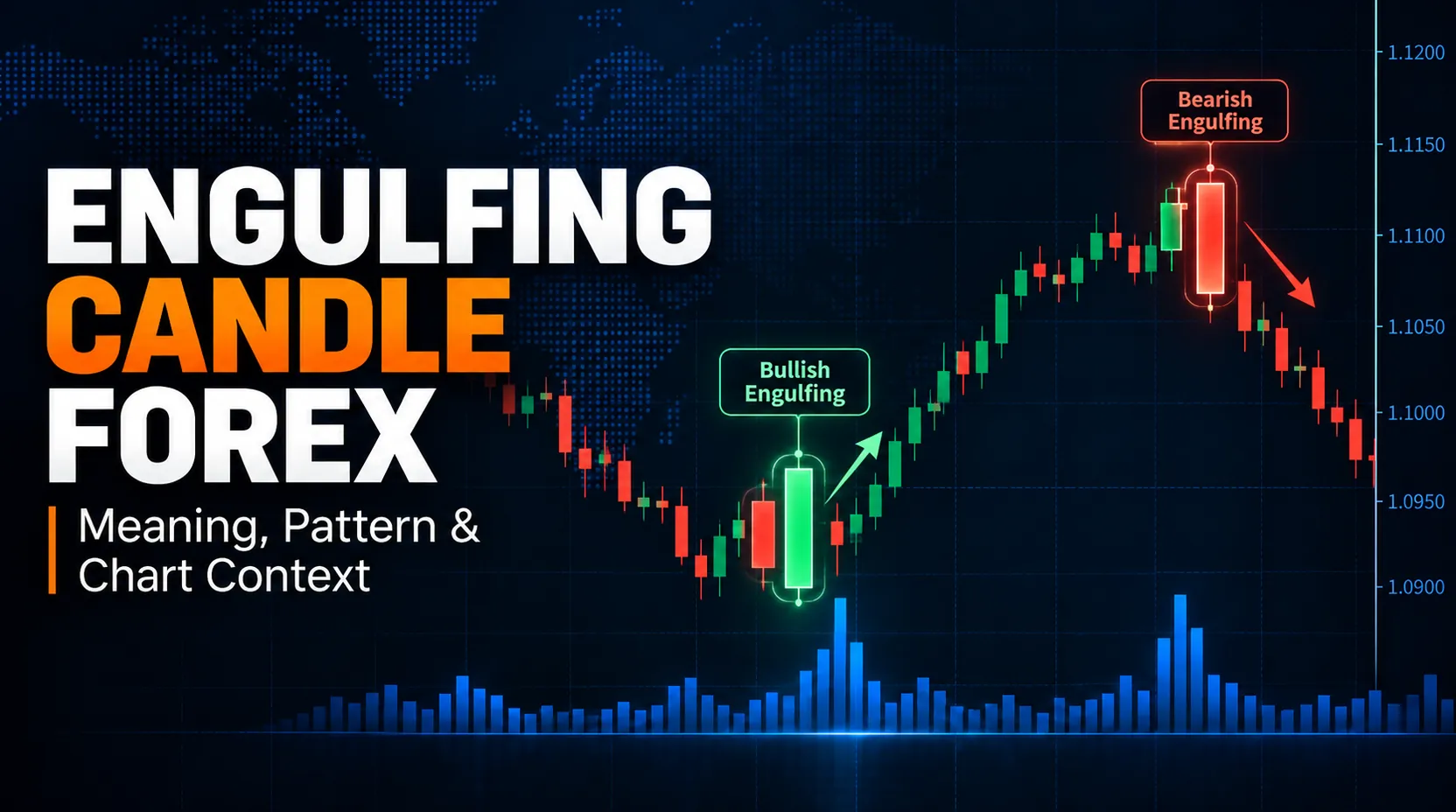
What Is A Forex Engulfing Candle?
A forex engulfing candle is part of a two-candle formation. The first candle gives the initial context, and the second candle has a body that covers the body of the first candle.
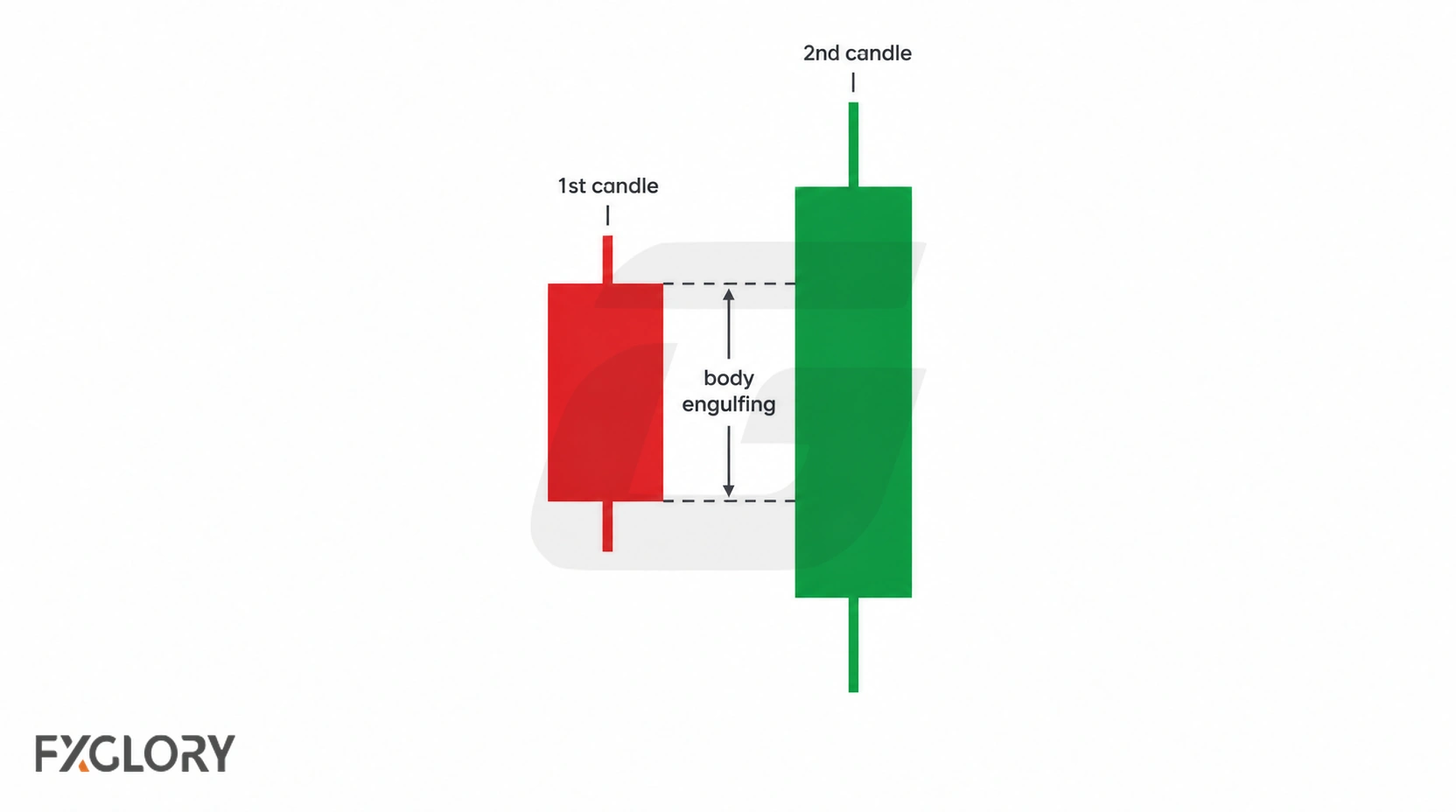
The engulfing idea is about a visible pressure shift between two candle periods. If the first candle shows one side of pressure and the second candle closes strongly in the opposite direction, the second candle can change the message of the first candle.
A forex engulfing candle does not prove that price will continue in the second candle's direction. It is a two-candle chart clue. The useful question is whether the prior move, candle bodies, chart location, timeframe, and later price reaction make the formation worth reviewing.
If you need to understand the basic candle components first, review how the body, wick, open, and close relate to each other.
Engulfing Candle vs Engulfing Strategy
An engulfing candle is a two-candle formation in which the second candle's real body covers the first candle's real body. Identifying the pattern involves comparing the two candle bodies, distinguishing bullish and bearish formations, and evaluating chart context.
An engulfing candle strategy goes further by incorporating the pattern into a trading plan with confirmation rules, entry timing, stop placement, profit targets, invalidation conditions, transaction costs, and risk limits. For these practical trading considerations, see the Forex Engulfing Candle Strategy guide.
Pattern vs strategy: Identifying an engulfing formation is separate from deciding whether to trade it. A trading strategy also requires entry and exit rules, invalidation conditions, stop placement, position sizing, and transaction-cost considerations.
Engulfing Candlestick Anatomy In Forex
An engulfing candlestick in forex has two candles. The first candle is the candle being overtaken. The second candle is the candle doing the engulfing. The body relationship matters more than the name of the pattern.
The candle bodies are the core of the engulfing structure. Wicks can add useful context, but they should not replace the body comparison. A candle with long wicks but weak body coverage may look dramatic without forming a clean engulfing pattern.
| Engulfing Part | What It Shows | Reading Caution |
|---|---|---|
| First candle | The earlier pressure, pause, or movement. | A very tiny first candle can make engulfing easier but less meaningful. |
| Second candle | The later candle that covers the first candle's body. | A large second candle may reflect volatility, not useful structure. |
| Body coverage | The second body extends beyond the previous body. | The clearer the body coverage, the easier the pattern is to review. |
| Candle close | Where the second candle finishes. | The close should support the pressure-shift reading. |
| Wicks | The full high-low exploration of each candle. | Wicks can support the reading, but the body-to-body relationship remains the core feature. |
A clean engulfing candle forex formation usually has a first candle that shows earlier pressure and a second candle that clearly changes that message. If the second candle barely covers the first body, or if the chart is already messy, the formation may be weak.
Body Engulfing vs Full-Range Engulfing
There are two common ways to review engulfing formations. The first focuses on body engulfing. The second uses a stricter full-range view.
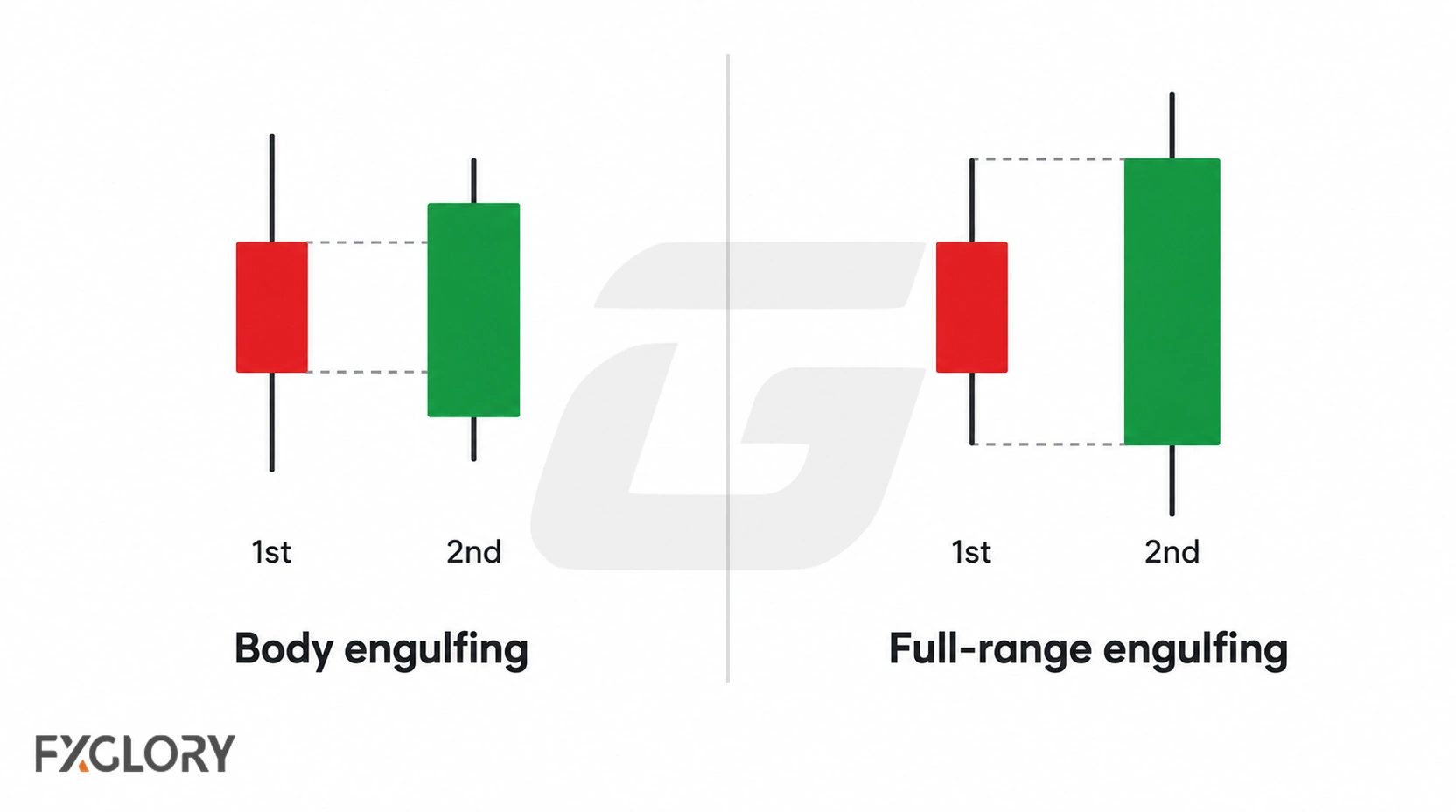
Body engulfing means the second candle's body covers the previous candle's body. This is the common engulfing structure and is usually the main focus when traders describe an engulfing candlestick pattern.
Full-range engulfing applies an additional condition: the second candle's high exceeds the first candle's high, and its low falls below the first candle's low, while its real body also engulfs the first candle's real body. This creates a wider high-low range alongside the standard body-engulfing structure. Full-range coverage does not, by itself, establish a reversal or predict subsequent price direction.
In forex chart reading, traders usually focus on whether the second candle's body clearly covers the previous body and where the second candle closes. A stock-style session gap is not required for every forex engulfing review because the formation is usually judged candle-by-candle on the selected chart timeframe.
| Engulfing Type | What It Requires | Reading Note |
|---|---|---|
| Body engulfing | The second candle's body covers the previous candle's body. | This is the main engulfing structure. |
| Full-range engulfing | The second real body engulfs the first real body, and the second candle's high-low range contains the first candle's range. | This is stricter and may be visually stronger, but still needs context. |
| Weak overlap | The second body barely covers or only partially overlaps the first body. | This may not be a clean engulfing formation. |
Bullish And Bearish Engulfing Candles In Forex
Engulfing formations are usually grouped as bullish or bearish. The label depends on the direction of the second candle and the movement that came before the pattern.
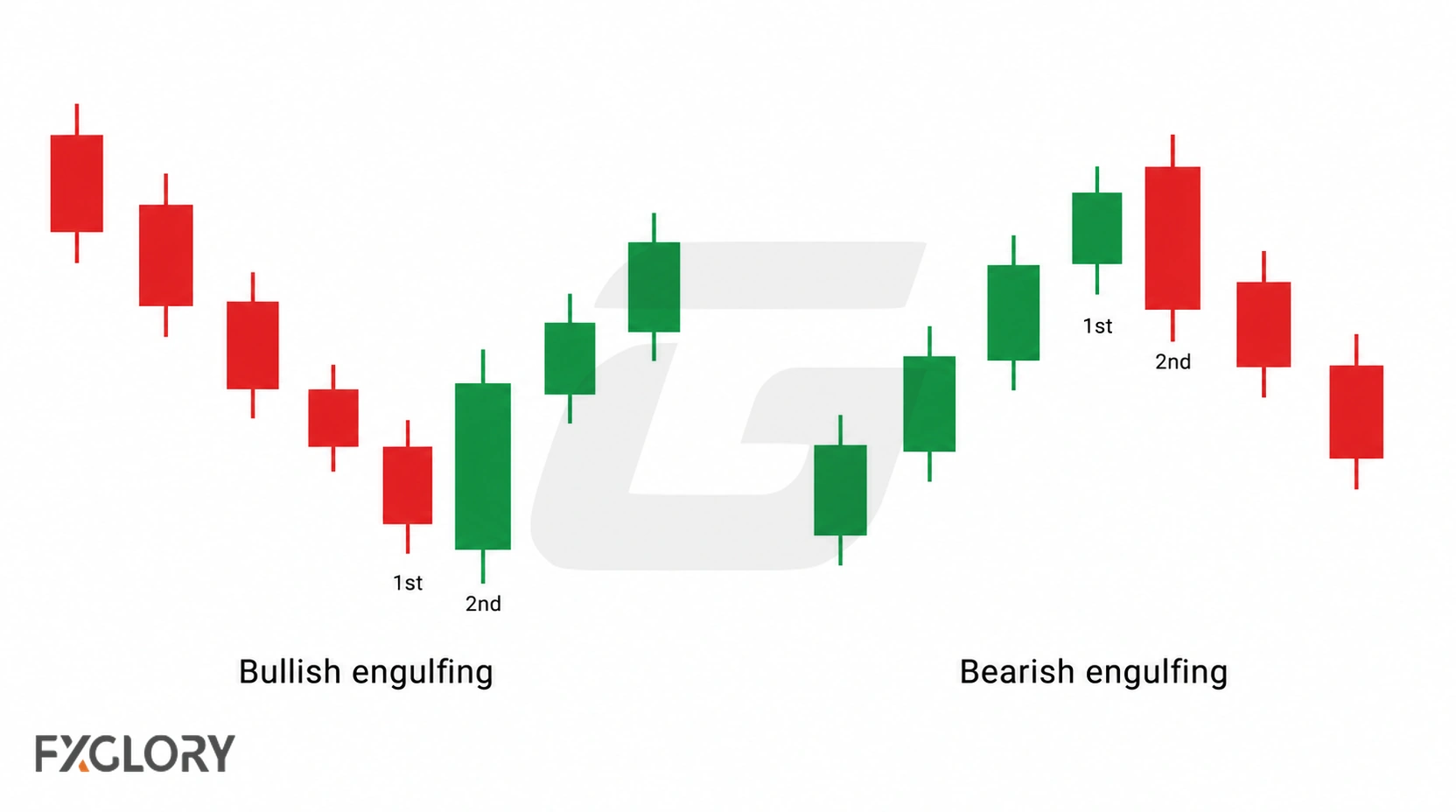
A bullish engulfing candle usually appears after selling pressure. A smaller bearish candle is followed by a bullish candle whose body covers the previous body. This can show that the second candle changed the visible pressure after price had been moving lower or testing lower levels.
A bearish engulfing candle usually appears after buying pressure. A smaller bullish candle is followed by a bearish candle whose body covers the previous body. This can show that the second candle changed the visible pressure after price had been moving higher or testing higher levels.
| Engulfing Type | Common Structure | Usually Reviewed Near | Basic Review Question |
|---|---|---|---|
| Bullish engulfing | Bearish first candle followed by a bullish body that covers it. | Support, swing low, range low, or failed downside break. | Did the second candle change the pressure after lower-price testing? |
| Bearish engulfing | Bullish first candle followed by a bearish body that covers it. | Resistance, swing high, range high, or failed upside break. | Did the second candle change the pressure after higher-price testing? |
| Unclear engulfing | Second body only slightly covers the first or appears in noise. | Messy range, random movement, or unstable conditions. | Is the two-candle structure clear enough to review? |
Why The First Candle Matters
The first candle is not just a candle to be covered. It gives the second candle something to change. Without that first candle's message, the engulfing formation loses much of its meaning.
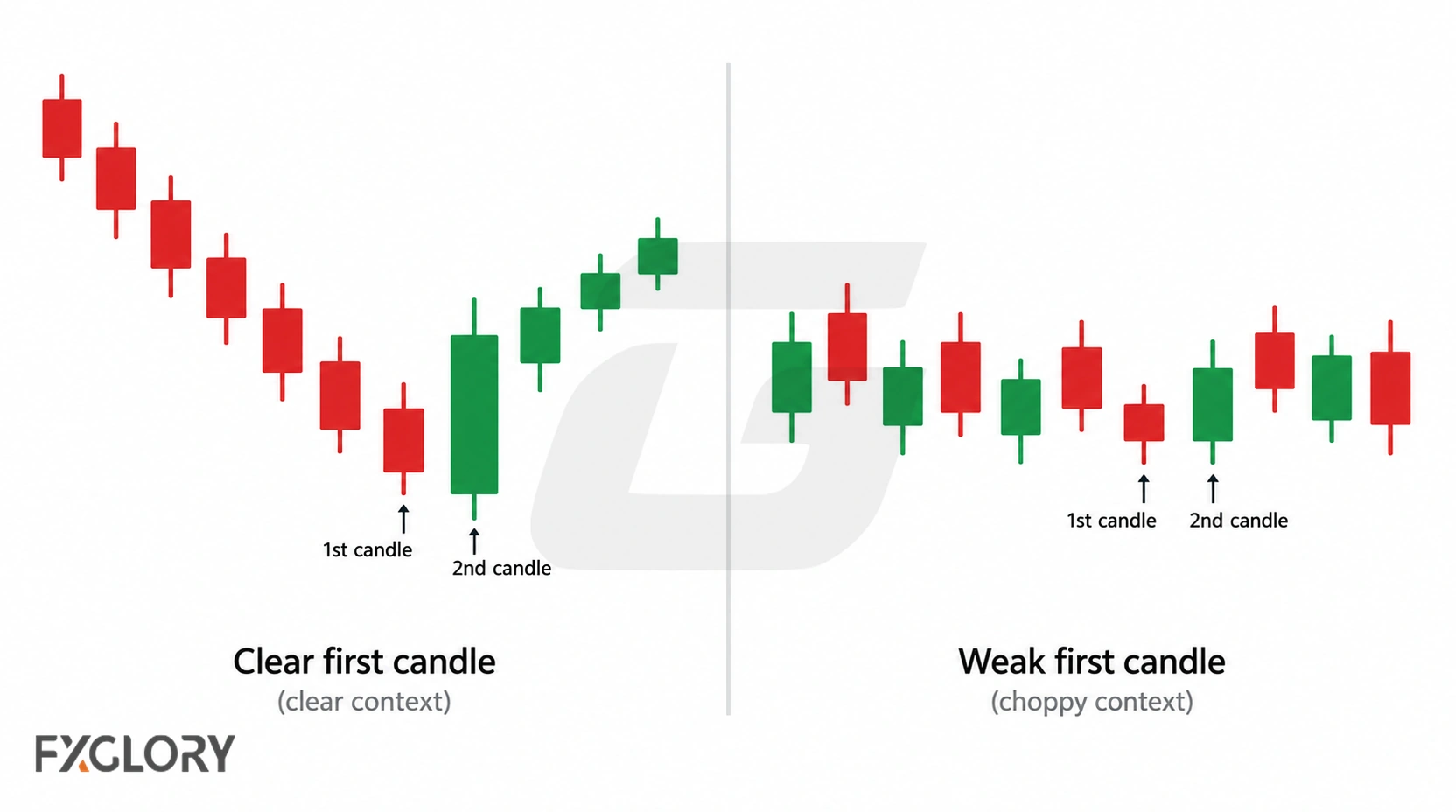
For example, if the first candle shows selling pressure and the second candle closes with a strong bullish body that covers it, the two-candle sequence may show that the latest candle changed the visible pressure. If the first candle is extremely small, random, or formed inside messy price action, the second candle may not be changing anything important.
The same idea applies in reverse. A bearish engulfing structure is easier to review when the first candle appears after buying pressure or near a higher-price test. If the prior chart was already unclear, the engulfing label may add little value.
- Useful first candle: Shows a clear earlier move, test, or pressure point.
- Weak first candle: Is too small, random, or buried inside overlapping candles.
- Useful second candle: Clearly covers the first body and closes in a meaningful area.
- Weak second candle: Barely covers the first body or forms during unstable conditions.
Engulfing Candle vs Similar Forex Candles
Engulfing formations can overlap with broader candlestick-pattern discussion, but they are different from single-candle wick formations. The main difference is that engulfing requires two candles.
| Candle Or Pattern | Main Structure | Usually Reviewed For | Main Difference |
|---|---|---|---|
| Engulfing candle | Second candle body covers the previous candle body. | Two-candle pressure shift. | Uses two candles instead of one. |
| Pin bar | Long wick, smaller body, close near one end. | Failed price test or wick rejection. | Focuses on one candle's wick. |
| Hammer | Small body near top with long lower wick. | Lower-wick rejection after selling pressure. | Single-candle lower-wick structure. |
| Shooting star | Small body near bottom with long upper wick. | Upper-wick rejection after buying pressure. | Single-candle upper-wick structure. |
| Doji | Open and close are equal or almost equal. | Open-close balance. | Focuses on tiny body and hesitation. |
For deeper comparison, use the separate guides for long-wick rejection candles, lower-wick hammer structure, upper-wick shooting star structure, and open-close balance candles.
Forex Engulfing Candle Strength Filter
A forex engulfing pattern does not have the same value in every chart condition. The table below helps separate clearer engulfing readings from weaker ones.
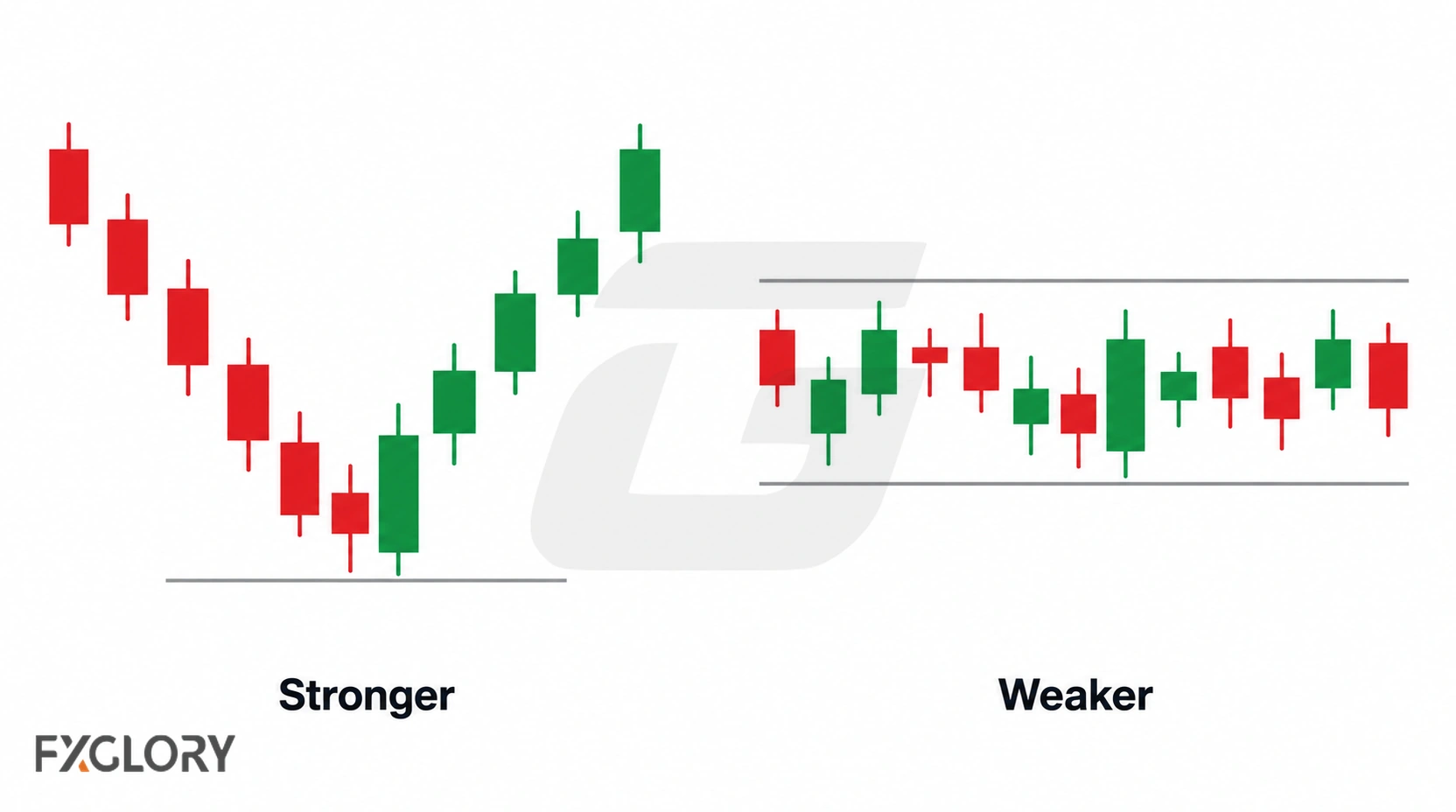
| Engulfing Factor | Stronger Reading | Weaker Reading |
|---|---|---|
| Prior movement | The pattern appears after a clear rise, decline, pullback, or level test. | The pattern appears when price was already random or unclear. |
| Body coverage | The second body clearly covers the first body. | The second body barely covers the first or only partially overlaps it. |
| Second candle close | The second candle closes clearly beyond the first candle's body area. | The second candle closes near the middle of the formation. |
| Chart location | The formation appears near support, resistance, a swing point, range edge, or failed break. | The formation appears in the middle of random movement. |
| First candle quality | The first candle shows an earlier move or pressure point worth comparing. | The first candle is tiny, random, or buried inside noise. |
| Market conditions | Spread and volatility conditions are stable enough for chart review. | The formation appears during abnormal news movement, rollover, or thin liquidity. |
| Later price reaction | Later candles keep the engulfing area relevant. | Later candles immediately make the two-candle formation irrelevant. |
Where Engulfing Candles Matter More In Forex
An engulfing candle becomes easier to review when it appears near a chart area where a pressure shift matters. Without a useful location, the two-candle structure may only be normal price movement.
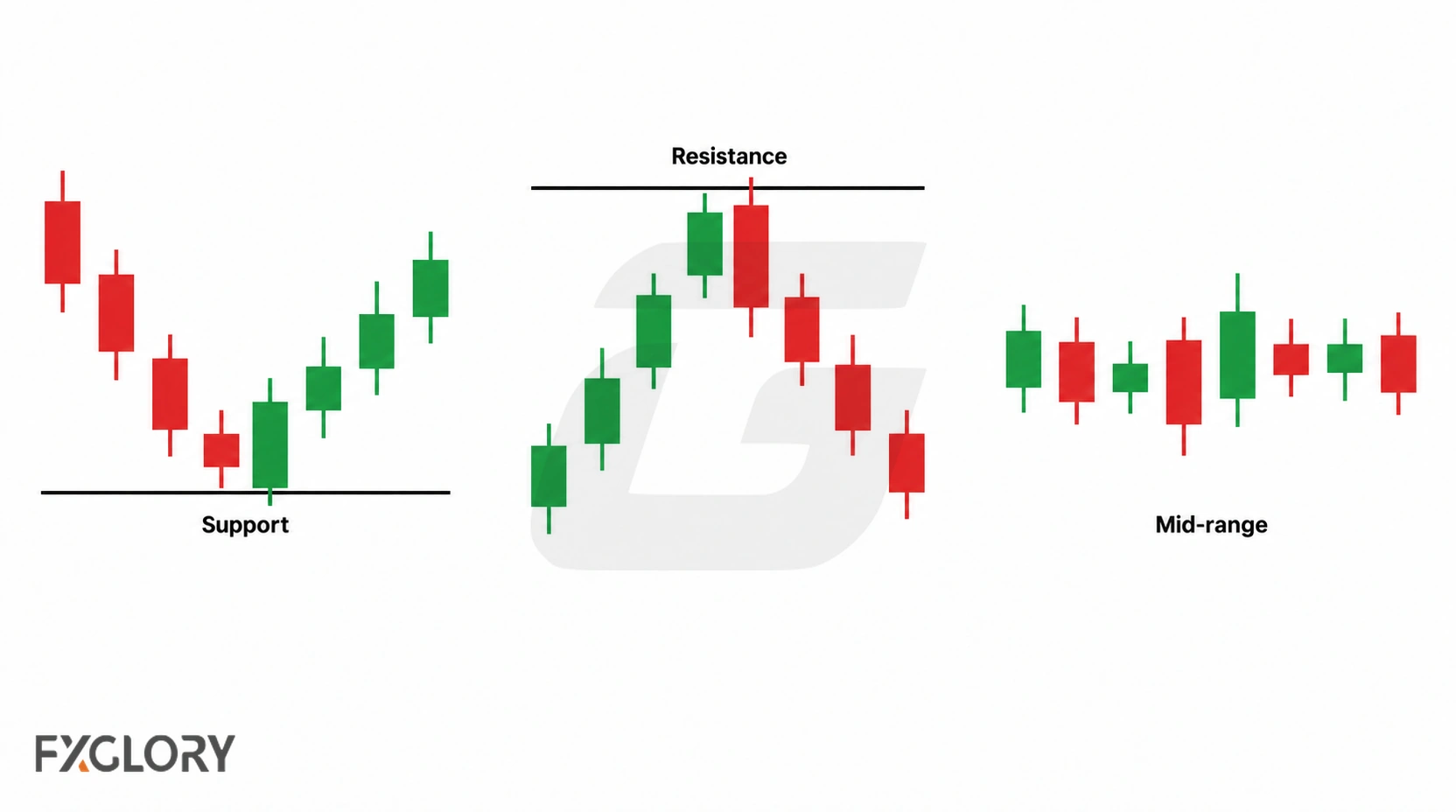
Near Support
A bullish engulfing formation near support can show that the second candle changed the visible pressure after a lower-price test. The support area gives the formation a clearer place on the chart.
Near Resistance
A bearish engulfing formation near resistance can show that the second candle changed the visible pressure after a higher-price test. The resistance area gives the formation a clearer place on the chart.
Near Swing Highs Or Swing Lows
Swing points help compare the engulfing formation with previous turning areas. A two-candle pressure shift near a swing high or swing low is easier to review than the same formation in the middle of a range.
At Range Edges
Engulfing formations near the top or bottom of a range can show how price behaved around the range boundary. Engulfing formations in the middle of a range usually carry weaker information.
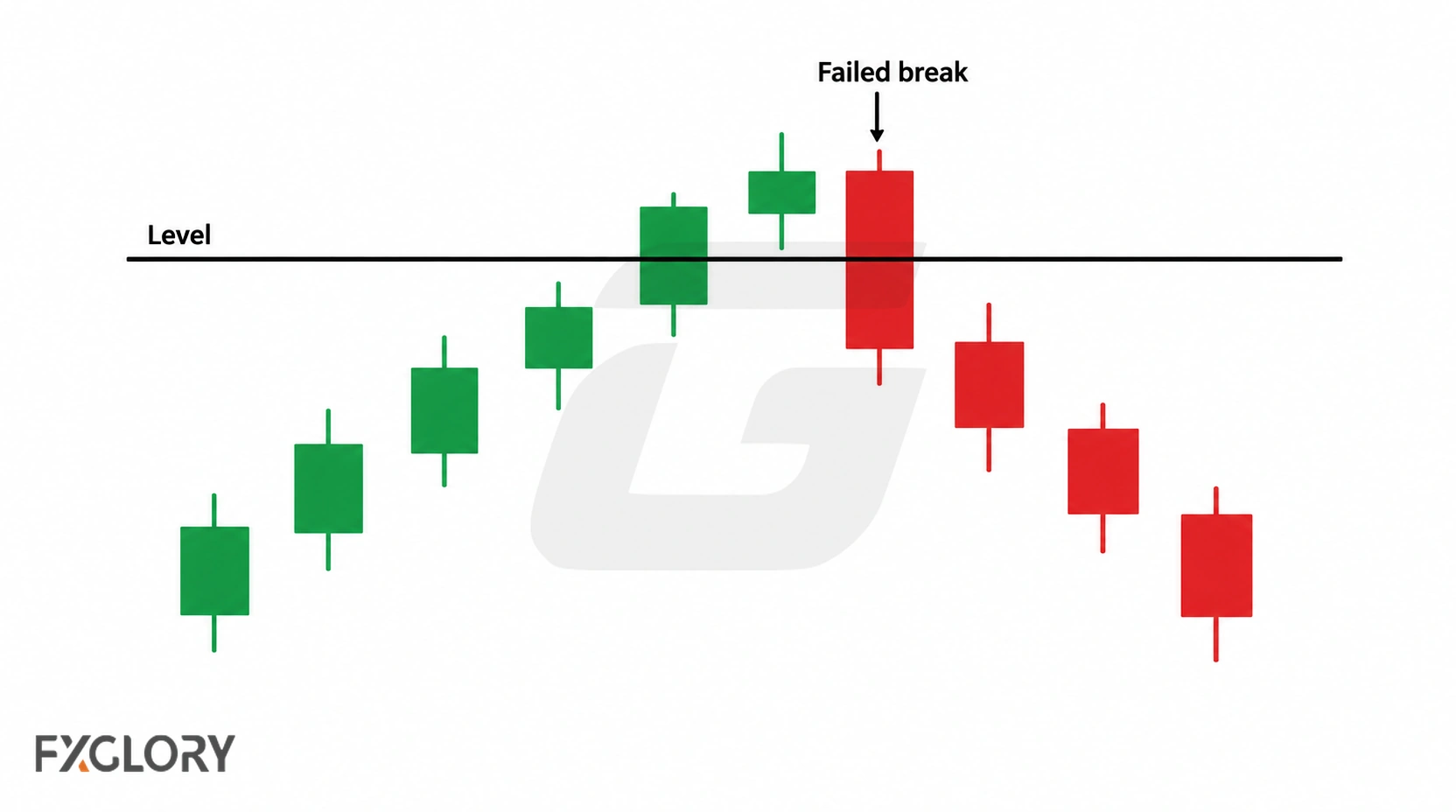
After A Failed Break
An engulfing formation can appear when price moves beyond a level and then the next candle closes back away from the tested area. This can make the two-candle shift easier to review, especially when the level was already visible.
For observation, a trader can compare engulfing-style two-candle shifts on live market pages such as GBP/USD around visible swing areas or gold during wider candle ranges. These pages are useful for chart review, not as standalone trading signals.
- Check whether the formation appears after a clear move or level test.
- Review whether it forms near support, resistance, a swing point, a range edge, or a failed break.
- Compare the second candle's body with the first candle's body.
- Watch whether later candles keep the engulfing area relevant.
Forex Engulfing Candle Reading Table
The table below shows how the same engulfing structure can change depending on chart location.
| Engulfing Location | Possible Reading | What To Check Next |
|---|---|---|
| After a decline | A bullish second candle may show pressure shifting during that candle. | Check support, body coverage, and later candles. |
| After a rise | A bearish second candle may show pressure shifting during that candle. | Check resistance, body coverage, and later candles. |
| Near support | The second candle changed pressure near a lower-price area. | Check whether price stays above the tested area. |
| Near resistance | The second candle changed pressure near a higher-price area. | Check whether price stays below the tested area. |
| Near a swing low | The formation appeared near a previous lower turning area. | Compare the current low with the earlier swing low. |
| Near a swing high | The formation appeared near a previous upper turning area. | Compare the current high with the earlier swing high. |
| Middle of a range | The formation may only reflect normal range movement. | Check whether a meaningful level is nearby. |
| During news volatility | The second candle may reflect unstable movement. | Review spread, candle range, and execution conditions. |
How To Read An Engulfing Candle In Forex
A simple workflow helps keep engulfing candle reading disciplined. The goal is to describe the two-candle structure before giving it more meaning than it deserves.
- Check the timeframe: Decide whether the formation reflects a short-term reaction or a broader candle period.
- Review the prior move: Look for selling pressure, buying pressure, a pullback, or a level test before the two candles.
- Read the first candle: Decide what the first candle shows and whether it is meaningful enough to compare.
- Read the second candle: Check whether the second body clearly covers the first body.
- Check the close: Review whether the second candle closes in a place that supports the pressure-shift reading.
- Review the chart location: Look for support, resistance, swing points, range edges, or failed break areas.
- Review market conditions: Consider volatility, spread, liquidity, and scheduled news events.
- Watch the next reaction: Review whether later candles keep the engulfing area relevant or cancel the reading.
- Define the weak point: Know where the engulfing reading would no longer make sense.
Some traders compare engulfing candles with technical indicators for additional context. For example, RSI can add momentum context, ATR can add volatility context, and Bollinger Bands can help review range and expansion conditions. These tools can support engulfing candle review, but they do not remove trading risk.
False Engulfing Candles In Forex
Not every overlapping two-candle formation qualifies as an engulfing pattern, and not every valid engulfing pattern provides a useful directional clue. If the second candle's real body does not fully cover the first candle's real body, the formation does not satisfy the standard body-engulfing definition. A correctly formed engulfing pattern may still have limited interpretive value when the first candle is unusually small, the chart is directionless, or market conditions are unstable. An unsuccessful subsequent price reaction does not invalidate the original candle structure.
Weak First Candle
If the first candle is tiny, random, or buried inside overlapping price action, the second candle may not be changing anything meaningful. The formation may look clean but still carry little chart value.
Weak Body Coverage
If the second candle barely covers the first candle's body, the formation may not show a clear pressure shift. It may be closer to normal candle overlap than a clean engulfing pattern.
Middle Of A Messy Range
Sideways ranges often create many overlapping candle bodies. An engulfing shape in the middle of a range may only reflect normal back-and-forth movement.
Unfinished Candle
A candle can look like it is engulfing the previous candle before it closes and then finish differently. The completed second candle matters.
News Or Low-Liquidity Conditions
Major news, rollover, market opens, and thin liquidity can create large second candles that look meaningful after the fact. In real time, spread and execution conditions may be unstable.
Engulfing classification: First verify that the completed second candle's real body engulfs the first candle's real body. Then assess prior movement, chart location, market conditions, and subsequent price behavior. Weak context or unsuccessful follow-through does not retroactively invalidate a structurally correct formation.
Common Mistakes With Engulfing Candles In Forex
Engulfing candles are easy to notice because the second candle is larger than the first, but they are also easy to overuse. Most mistakes come from treating candle size as more important than the chart around it.
- Calling every large second candle engulfing: The second candle should clearly cover the previous candle's body.
- Ignoring the first candle: An engulfing pattern needs a first candle that gives the second candle something meaningful to change.
- Ignoring chart location: An engulfing formation near support, resistance, or a failed break is easier to review than one in random movement.
- Reading an unfinished second candle: A candle that looks engulfing before the close may finish with a different body.
- Focusing only on candle color: The relationship between the two candle bodies matters more than color alone.
- Overlooking spread, liquidity, and news risk: Large second candles may appear during unstable conditions that are difficult to act on in real time.
- Replacing risk planning with engulfing confidence: An engulfing candle should not replace position sizing, risk limits, or a clear area where the reading becomes weak.
- Confusing body engulfing with full-range engulfing: Body coverage and full high-low coverage are different levels of strictness.
What To Study After Engulfing Candles
After reviewing engulfing structure, you can compare it with the pin bar guide for long-wick rejection, return to the hammer candle guide or shooting star guide for single-candle wick structures, or return to forex candlestick pattern categories and reversal candle review for broader grouping.
To move from pattern recognition into trade-planning rules, continue with the Forex Engulfing Candle Strategy guide.