
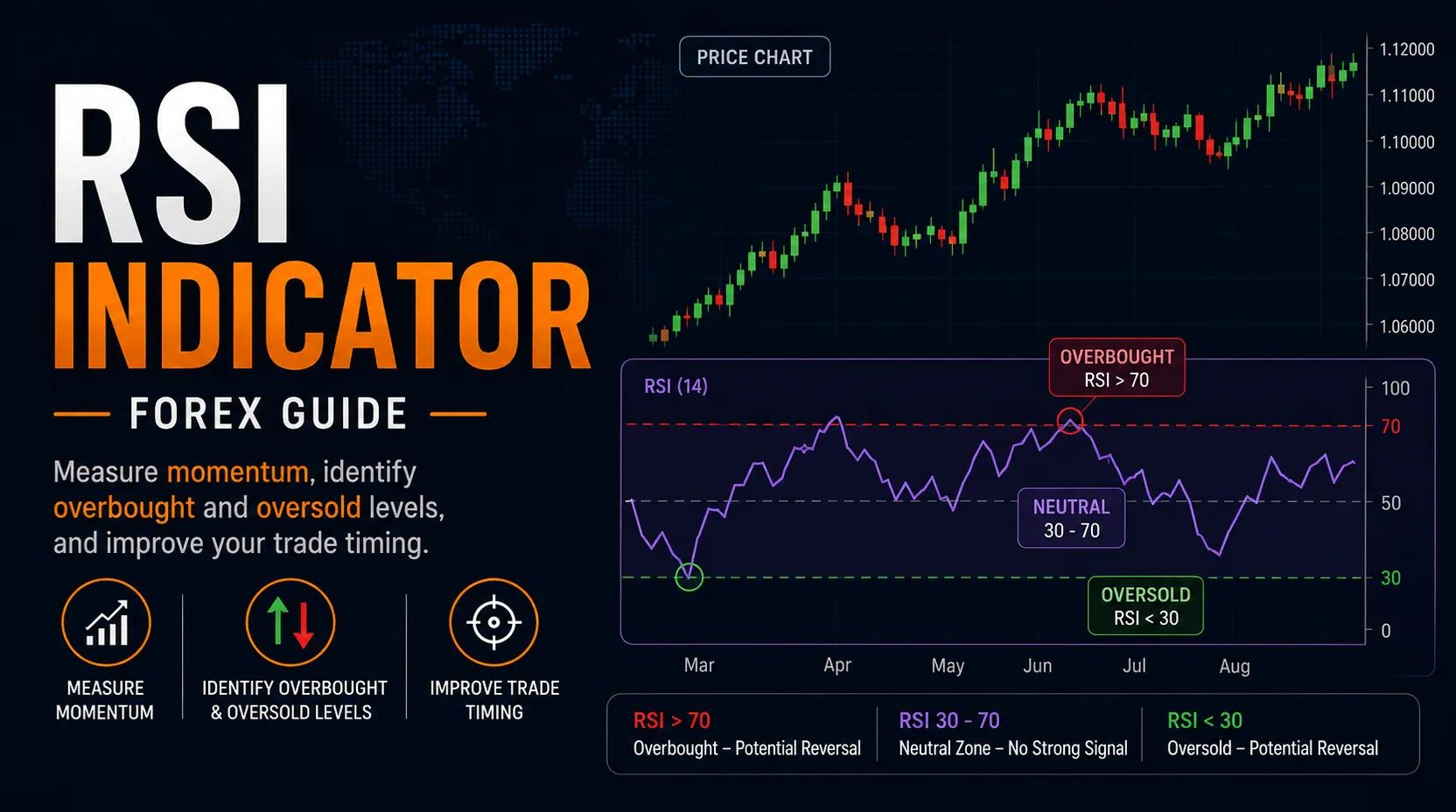
What Is RSI in Forex?
RSI stands for Relative Strength Index. In forex trading, the RSI indicator is used to review momentum pressure by comparing recent upward and downward price movement on a 0 to 100 scale.
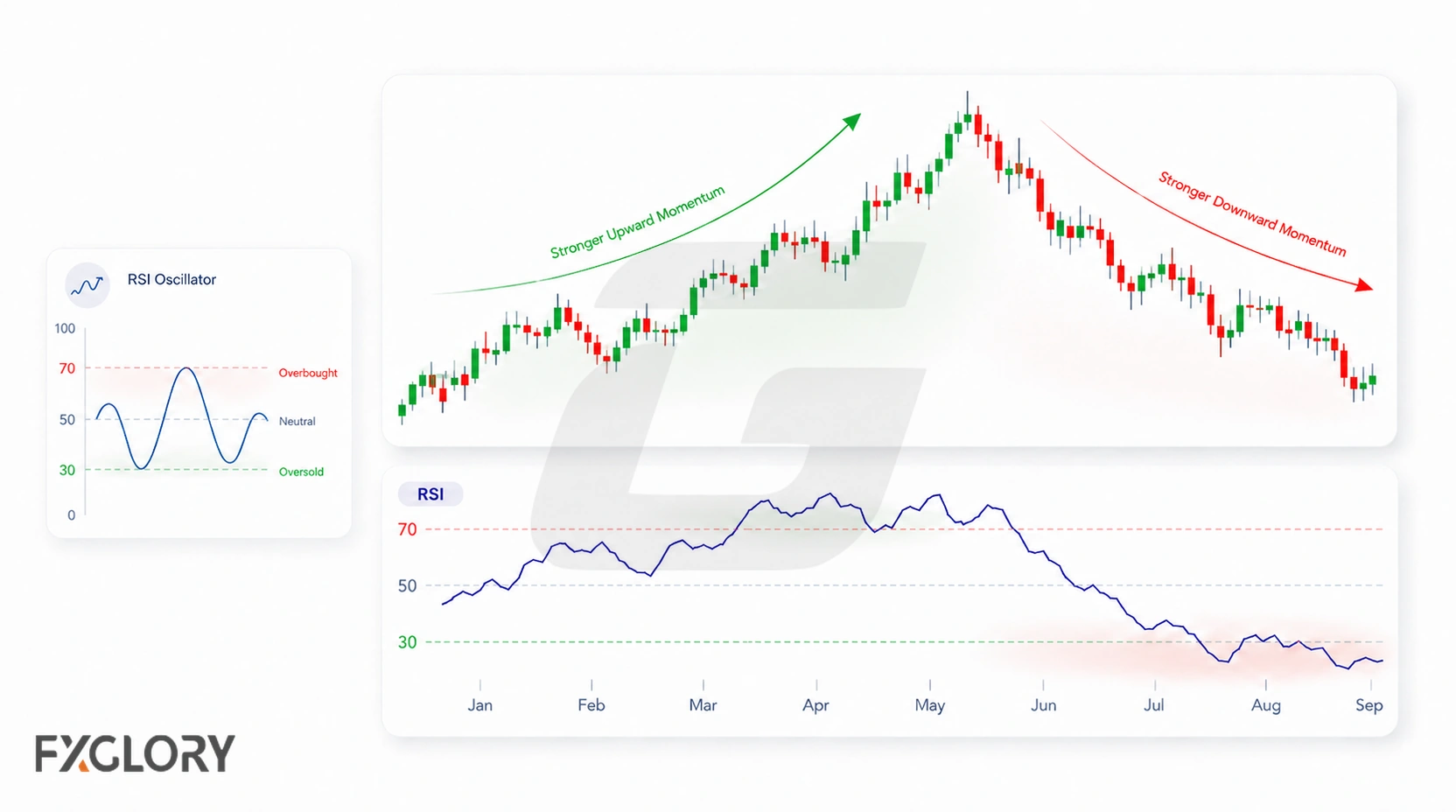
The forex RSI indicator can show when movement looks stretched, when momentum is shifting, or when price and momentum are not confirming each other. It should not be treated as a buy or sell signal by itself.
For the broader early-warning category, review forex leading indicators and false-signal filters.
How the Relative Strength Index Works
RSI is an oscillator. It moves between 0 and 100 and is usually displayed below the price chart. The reading changes as recent price gains and losses change across the selected lookback period.
A higher RSI reading means recent upward movement has been stronger compared with recent downward movement. A lower RSI reading means recent downward movement has been stronger compared with recent upward movement.
- RSI near the upper zone: Price movement may be stretched to the upside, but this does not confirm a reversal.
- RSI near the lower zone: Price movement may be stretched to the downside, but this does not confirm a bounce.
- RSI around the middle: Momentum may be more balanced or unclear.
- RSI moving sharply: Momentum pressure may be changing quickly, but fast movement can also create false warnings.
RSI Formula in Plain English
RSI compares average recent gains with average recent losses across the selected period, then converts that relationship into a 0 to 100 oscillator reading.
A higher reading means recent gains have outweighed recent losses more strongly. A lower reading means recent losses have outweighed recent gains more strongly.
RSI 70 and 30 Levels in Forex
The 70 and 30 levels are common RSI reference zones. A reading above 70 is often called overbought. A reading below 30 is often called oversold.
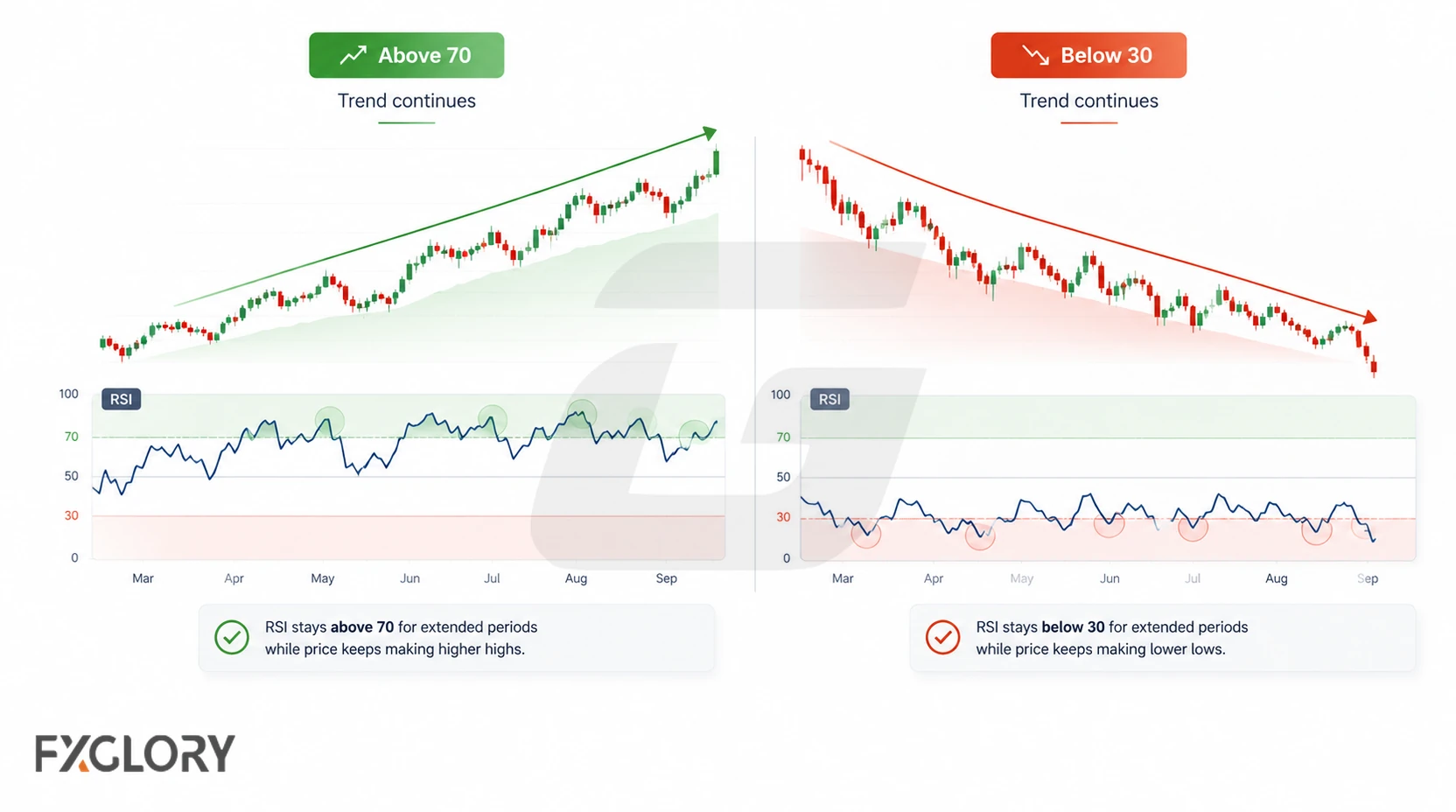
Those words can be misleading. Overbought does not mean price must fall, and oversold does not mean price must rise. In strong trends, RSI can stay stretched for a long time.
- RSI above 70: Review whether upward momentum is stretched, but check trend context before expecting weakness.
- RSI below 30: Review whether downward momentum is stretched, but check structure before expecting recovery.
- RSI between 30 and 70: Momentum may be less extreme, but price can still move strongly.
- RSI near a level: The reading matters more when price is near support, resistance, a range edge, or a pullback zone.
RSI 50 Line: Momentum Balance
The RSI 50 line is often used as a rough momentum-balance reference. Readings above 50 can suggest stronger upward pressure, while readings below 50 can suggest stronger downward pressure.
A move through 50 should not be treated as a complete signal. It is more useful when checked beside trend direction, market structure, support and resistance, and volatility.
- Above 50: Upward momentum may be stronger, but price still needs context.
- Below 50: Downward momentum may be stronger, but price still needs context.
- Repeated 50-line crosses: The chart may be choppy or unclear.
- 50-line rejection: RSI may show momentum pressure, but price structure must confirm whether the rejection matters.
For trend-side context, use the trend-filter guide.
RSI in Ranging Markets vs Trending Markets
RSI behavior changes with market condition. A reading that looks useful in a range can become misleading during a strong trend.
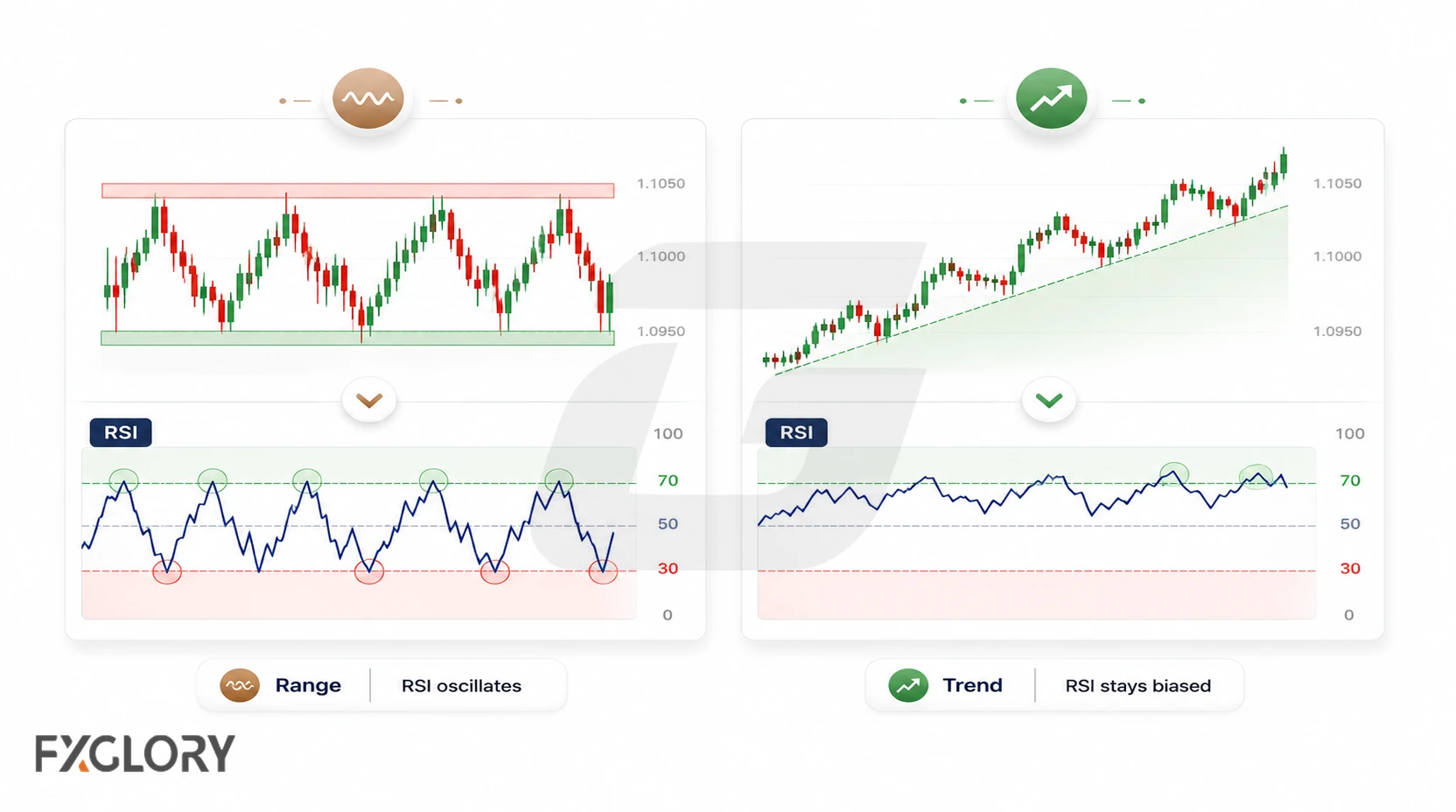
- Ranging market: RSI 70 and 30 levels can be easier to review near range boundaries, especially when price is also near support or resistance.
- Uptrend: RSI may hold above deeper oversold zones and spend more time in the upper half of the scale.
- Downtrend: RSI may fail below classic overbought zones and spend more time in the lower half of the scale.
- Strong one-way movement: RSI can stay overbought or oversold while price continues in the same direction.
- High-volatility market: RSI can swing quickly and create early warnings that fail before confirmation appears.
When RSI is stretched but price structure still supports the trend, review forex trend structure before treating the RSI reading as a reversal warning.
RSI Divergence in Forex
RSI divergence appears when price and RSI stop confirming each other. This can warn that momentum behind a move is changing, but it is not a reversal signal by itself.
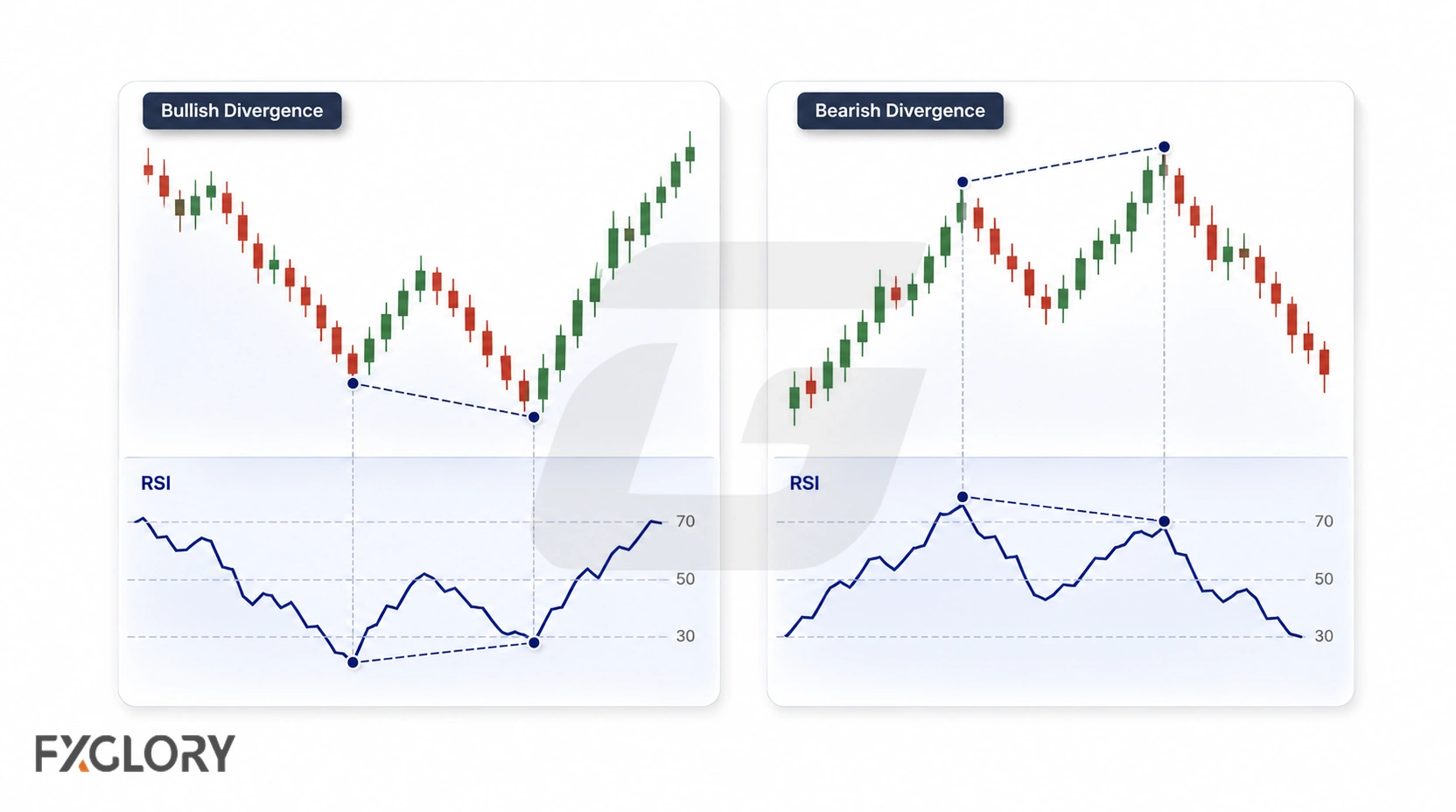
- Bullish RSI divergence: Price makes a lower low while RSI makes a higher low. This can warn that downside momentum is weakening.
- Bearish RSI divergence: Price makes a higher high while RSI makes a lower high. This can warn that upside momentum is weakening.
- Hidden divergence: Some traders use it to review possible trend continuation, but it needs clear structure and should not be forced onto every chart.
- Weak divergence: Divergence away from support, resistance, or structure can be easier to misuse.
For the full topic, use the price-and-momentum divergence guide.
RSI Settings in Forex
The 14-period RSI is a common default setting. This does not make it the best setting for every pair, timeframe, or market condition.
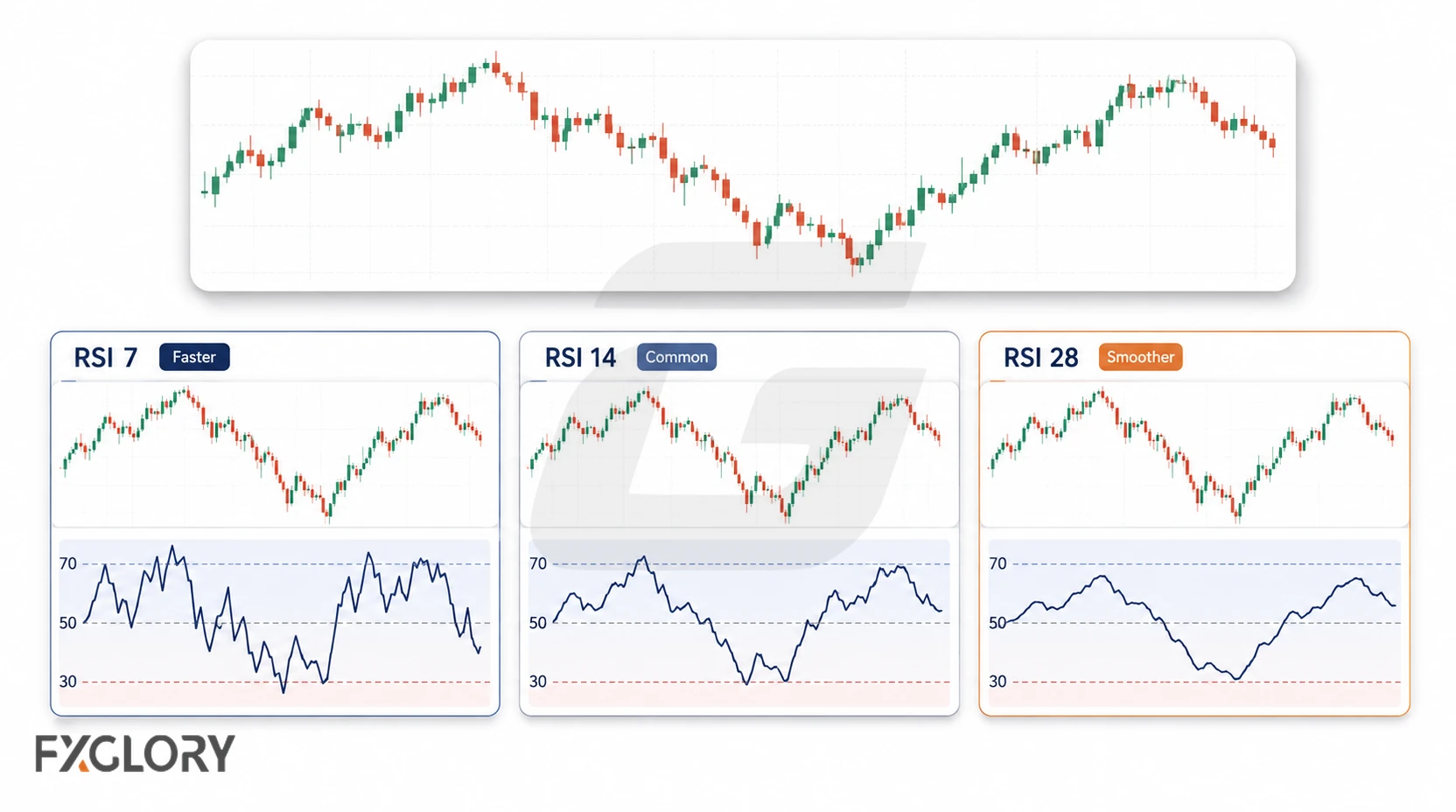
Shorter RSI settings react faster, but they can create more noise. Longer settings smooth the reading, but they can react later. Some traders also adjust the overbought and oversold zones, such as using wider 80/20 levels in stronger conditions, but wider zones can also delay warnings.
The same RSI setting can behave differently on a 5-minute chart, 1-hour chart, or daily chart because the lookback reads a different slice of price movement.
- Shorter setting: Faster reaction, more false warnings.
- Longer setting: Smoother reading, slower reaction.
- 70/30 levels: Common reference zones, not universal reversal levels.
- 80/20 levels: Wider reference zones that may reduce some signals but can react later.
- Changing settings too often: Can create curve fitting if the trader adjusts the tool to make past examples look better.
RSI with Confirmation Checks
An RSI warning becomes more useful when it is connected to price context. Confirmation does not remove risk, but it can reduce the chance of treating every RSI reading as a trade idea.
- Price location: Is RSI stretched while price is near support, resistance, a range edge, or a retracement zone?
- Market structure: Has price shown a break, retest, failed continuation, higher low, lower high, or another structure change?
- Trend context: Is the RSI warning with the broader trend, against it, or inside chop?
- Volatility context: Is the market calm enough to define invalidation, or moving too quickly to manage clearly?
- Momentum comparison: Does RSI agree or disagree with price movement?
- Risk rule: Can the trader explain where the idea is wrong before considering an entry?
For confirmation beyond RSI, review support and resistance zones, market structure context, and price action in forex.
RSI vs Stochastic and MACD
RSI, Stochastic, and MACD can all support momentum review, but they do not ask the same question.
- RSI: Reviews momentum pressure by comparing recent gains and losses.
- Stochastic: Reviews where price closes within a recent range, which can be useful around range edges or pullbacks.
- MACD: Reviews the relationship between moving averages and momentum shifts.
- Stacking risk: Adding all three without separate jobs can make the chart look confirmed while only repeating similar momentum information.
For oscillator comparison, use the Stochastic range-pressure guide. For moving-average momentum context, use the MACD momentum guide.
Live Market Examples: Matching RSI to Chart Questions
The first step is to identify the RSI question, not to treat every 70 or 30 reading as a signal.
- EUR/CHF live chart: If the question is whether RSI is reacting near a quiet range boundary, support and resistance context can frame the review.
- EUR/GBP live chart: If the question is whether a range-bound oscillator warning has enough price location, RSI belongs beside range structure.
- GBP/USD live chart: If the question is whether momentum is shifting after a move, RSI, the 50 line, and market structure can support confirmation.
- Gold live chart: If the question is whether RSI is stretched during a strong move, volatility and trend context should be checked before trusting a counter-move warning.
- BTC/USD live chart: If the question is whether fast movement is creating unstable RSI readings, spread, volatility, and execution conditions should be reviewed before acting.
RSI False-Signal Filters
Use these filters when the RSI indicator looks active but the chart condition does not support the warning.
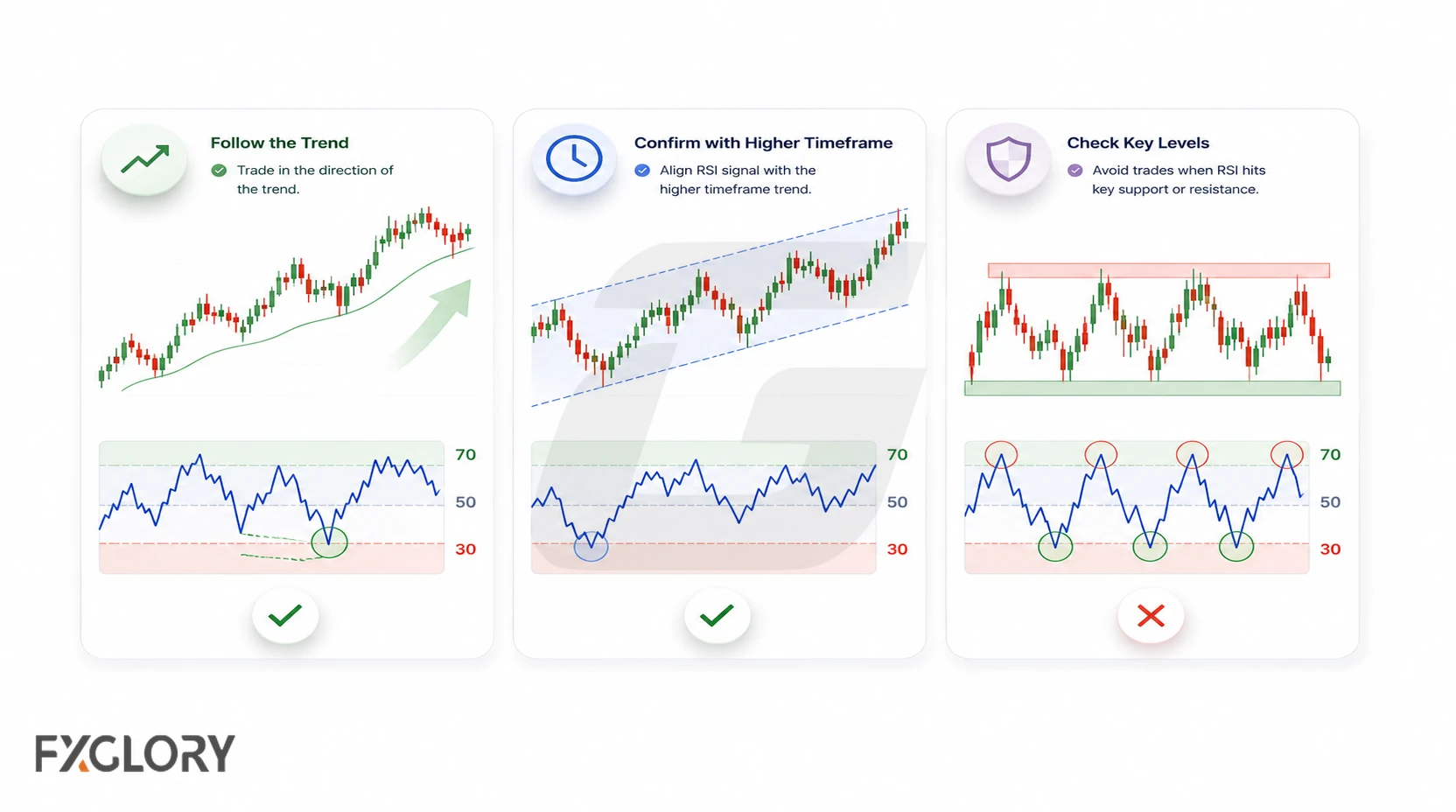
- Strong-trend filter: Reduce trust when RSI stays above 70 or below 30 while price continues in the same direction.
- No-level filter: Reduce trust when RSI is stretched but price is not near support, resistance, a range edge, or a reaction area.
- Repeated-signal filter: Reduce trust when RSI keeps printing similar warnings without price confirmation.
- Centerline-noise filter: Reduce trust when RSI crosses 50 repeatedly while price is choppy.
- Divergence-without-structure filter: Reduce trust when RSI divergence appears but price does not react or change structure.
- Settings-overfit filter: Reduce trust when RSI settings are changed only to make past examples look better.
- News and volatility filter: Reduce trust when fast movement, news risk, abnormal spreads, or thin liquidity dominate the chart.
- No-invalidation filter: Skip the setup when the trader cannot explain where the RSI-based idea is wrong.
How to Test the RSI Indicator in Forex
RSI should be tested inside one market condition at a time. Testing it across random charts without separating ranges, trends, pullbacks, volatility, and news conditions can create misleading results.
- Choose the RSI job: Overbought/oversold warning, 50-line review, divergence, pullback check, or range reaction.
- Choose the market condition: Range, trend, pullback, high volatility, quiet movement, or unclear structure.
- Choose the setting: Record whether the RSI uses the common 14-period setting or another lookback.
- Name the confirmation layer: Support/resistance, structure, trend context, divergence, volatility, or invalidation.
- Define the trigger: Write the exact event that would confirm the RSI warning.
- Define invalidation: Write the price behavior that would make the idea wrong.
- Record signal timing: Note whether the RSI warning came early, too early, late, or repeatedly.
- Check spread and slippage context: Record whether trading costs or execution conditions could affect the setup.
- Check news-event risk: Mark whether high-impact news or abnormal volatility was nearby.
- Record the failure type: False signal, stretched trend, no-level warning, 50-line noise, no confirmation, unclear structure, poor risk distance, or curve fitting.
RSI is useful only if it makes the momentum-pressure question clearer. If it encourages prediction, hides price structure, or cannot be tied to invalidation, it should not stay on the chart.
A Practical Way to Use Forex RSI
Start with the market condition. Choose one RSI job. Check price location, trend context, volatility, confirmation, and invalidation. If the RSI reading does not make the momentum question clearer, ignore it.
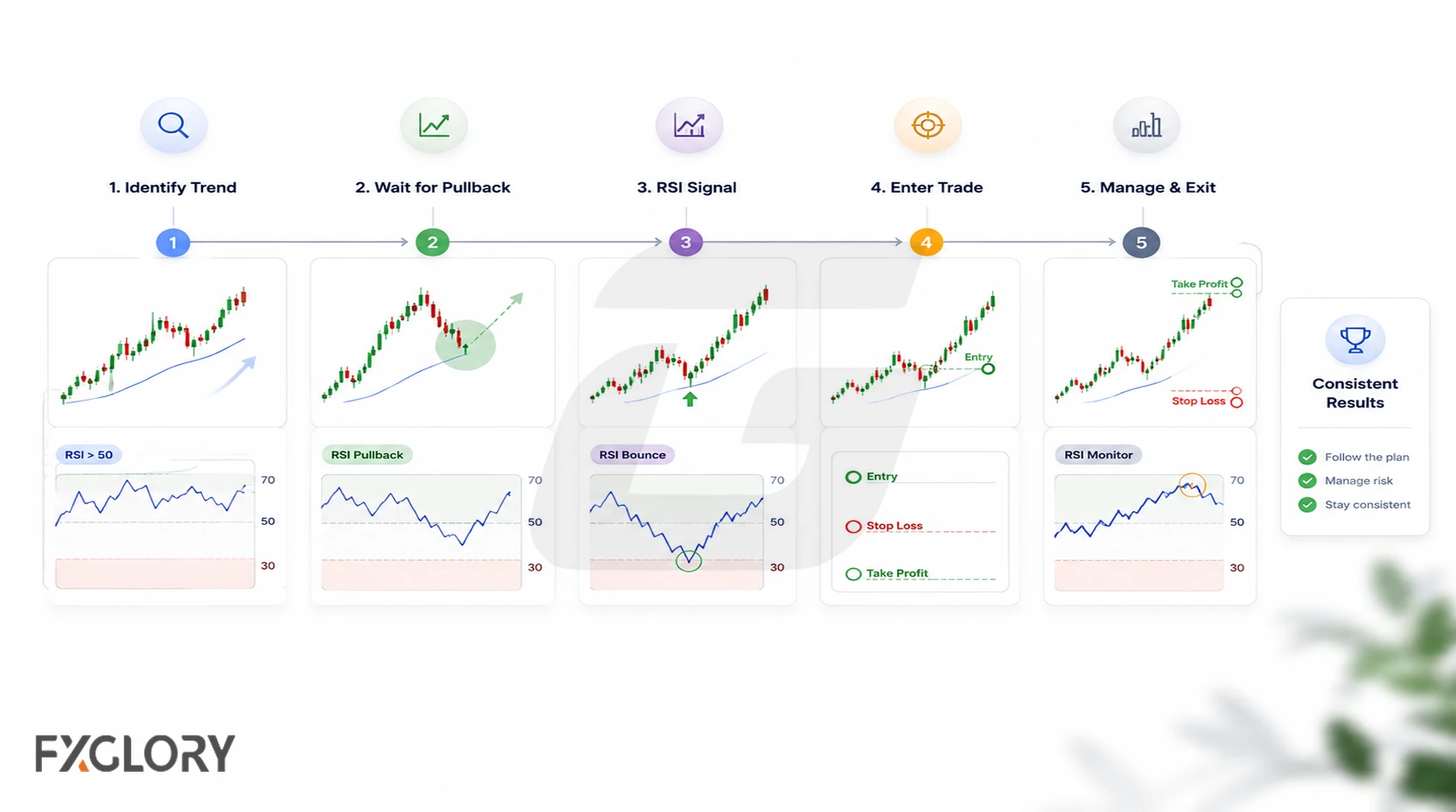
RSI does not need to predict the next move. It only needs to support one part of a clear process: momentum pressure, stretched movement, divergence, range reaction, or confirmation review.
For a broader comparison across momentum and early-warning tools, use the forex leading indicators guide. For a wider indicator selector, use the best indicators for forex guide.