
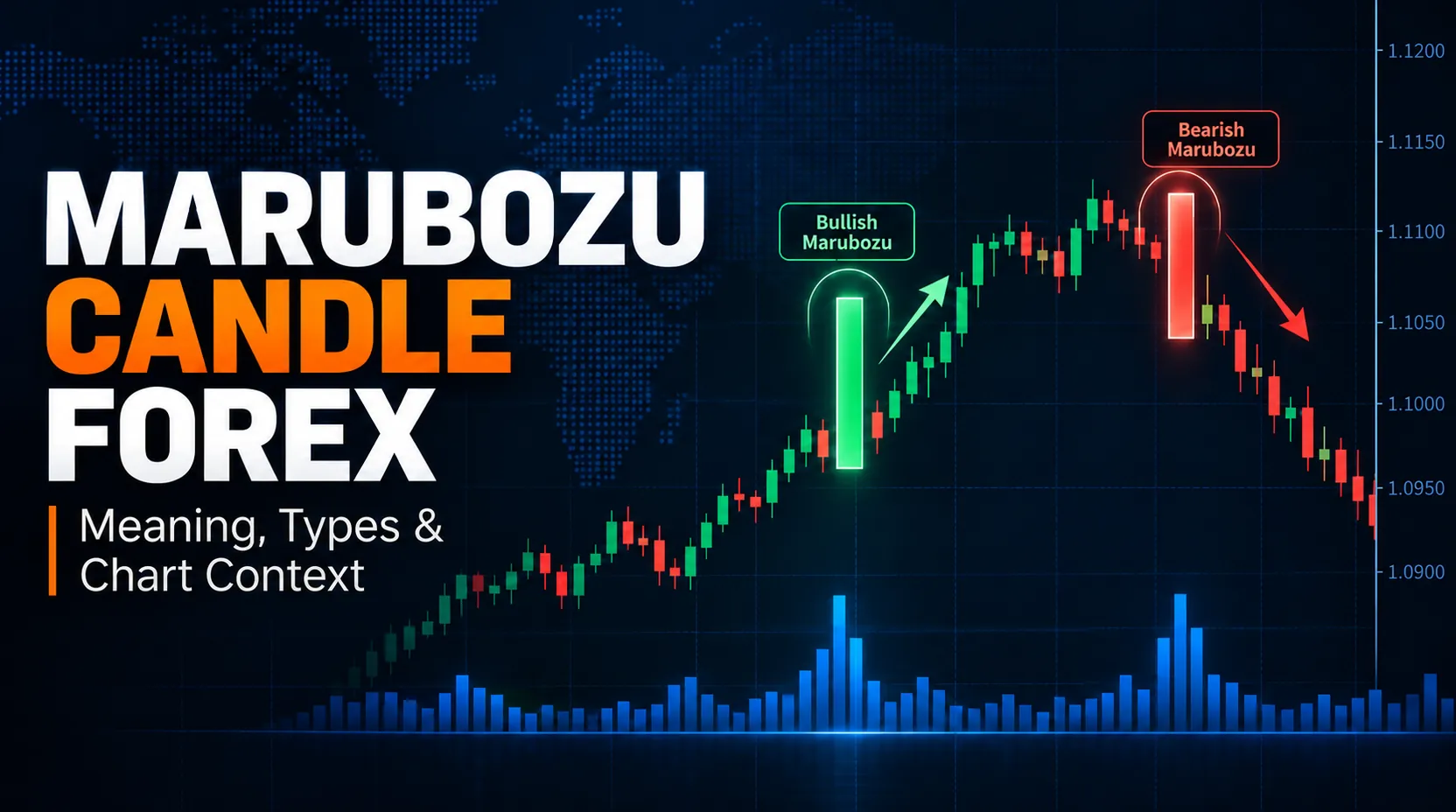
What Is a Marubozu Candle?
A marubozu candle is a single candlestick with a long real body and little or no wick. In forex charts, it shows that price moved strongly in one direction during that candle period, with limited rejection at the candle extremes.
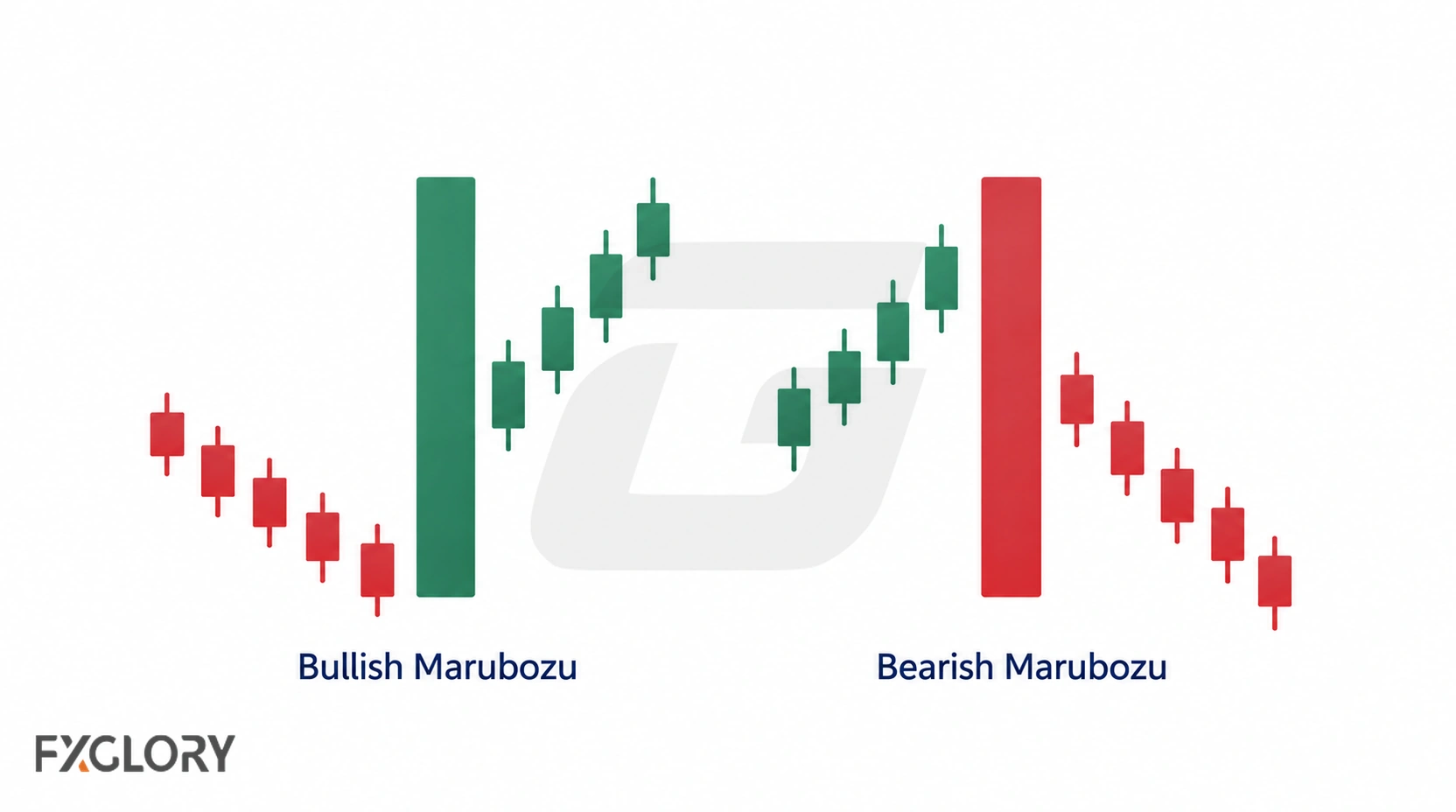
The word is commonly linked to a shaved or bald candle appearance because the upper and lower shadows are missing or extremely small. That shaved look is what separates a marubozu from candles where wicks show more two-sided movement.
A strict marubozu has no upper or lower shadow. In modern chart reading, a near-marubozu may still be reviewed when the shadows are extremely small compared with the body.
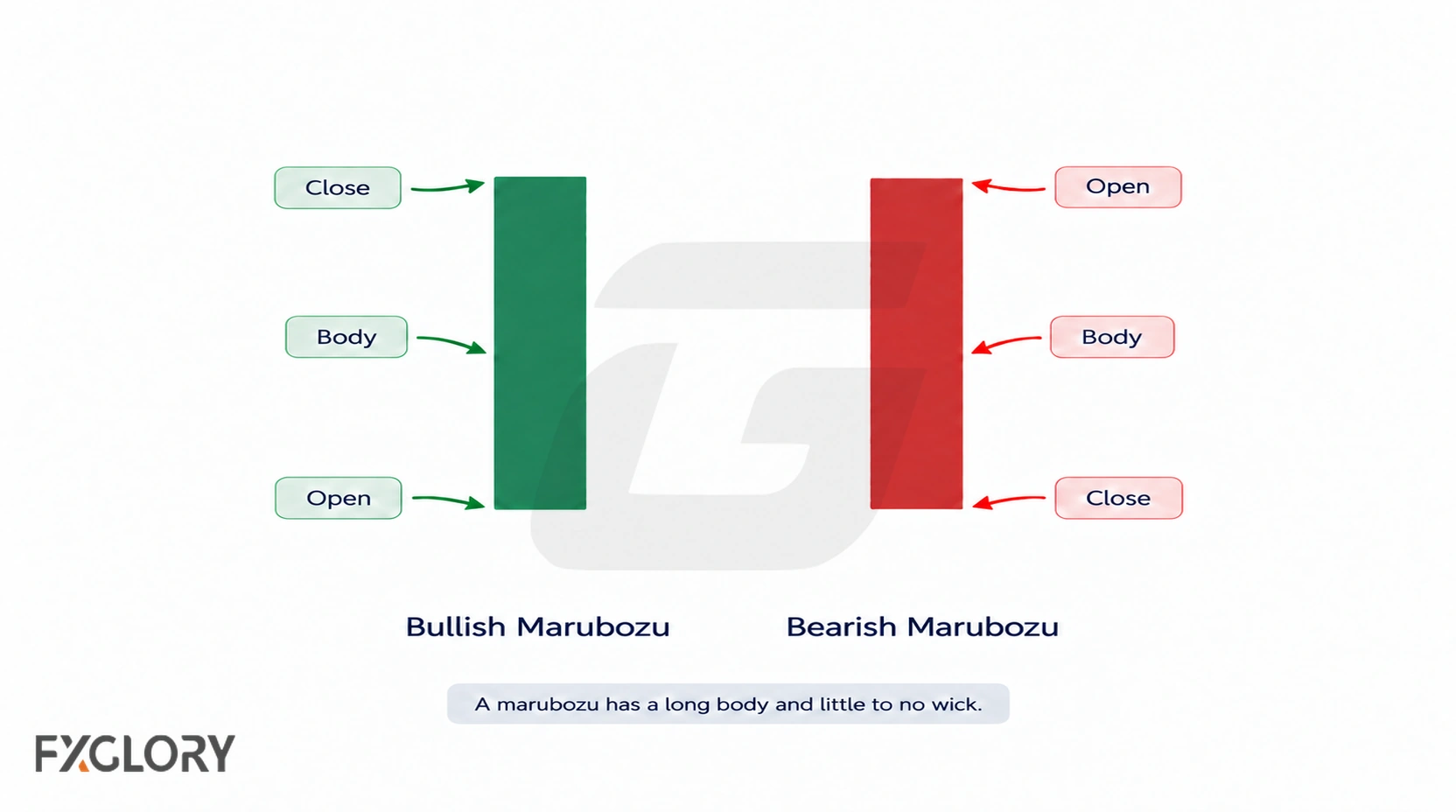
A bullish marubozu opens near the low of the candle and closes near the high. A bearish marubozu opens near the high of the candle and closes near the low. In both cases, the body dominates the candle.
A marubozu candle does not confirm that price will continue in the same direction or reverse from a level. It is a one-candle chart clue about strong directional pressure during one completed candle. The useful question is whether the candle body, wick size, chart location, market conditions, and follow-up movement make the candle worth reviewing.
If you need the candle parts first, review the real-body, shadow, open, and close relationship. A marubozu uses those same parts, but its message depends on how much of the candle is body and how little is wick.
Marubozu Candle Anatomy
The anatomy of a marubozu candle is simple, but the details matter. The body should dominate the candle. The shadows should be missing or very small. The candle should also be reviewed only after it has closed.
A candle should not be called marubozu while it is still forming because a late wick can change the structure before the close.
| Marubozu Part | Common Structure | What It Shows | Reading Caution |
|---|---|---|---|
| Real body | Long body compared with the candle's full range. | Price moved strongly from open to close. | A small body is not a marubozu. |
| Upper shadow | None or extremely small. | There was little movement above the body. | A large upper shadow weakens or disqualifies the reading. |
| Lower shadow | None or extremely small. | There was little movement below the body. | A large lower shadow weakens or disqualifies the reading. |
| Open and close | Open and close sit near opposite extremes of the candle. | One side controlled most of the candle period. | An unfinished candle can change before the close. |
| Chart location | Support, resistance, a range boundary, or a recent pressure area. | The candle has a clearer place on the chart. | A strong body in random movement may still be noise. |
A marubozu candle is not defined by color alone. The defining feature is body dominance. A bullish candle with large shadows is not a clean bullish marubozu, and a bearish candle with large shadows is not a clean bearish marubozu.
Bullish Marubozu vs Bearish Marubozu
Marubozu candles can be bullish or bearish. The difference comes from where the candle opens and closes.
Bullish Marubozu
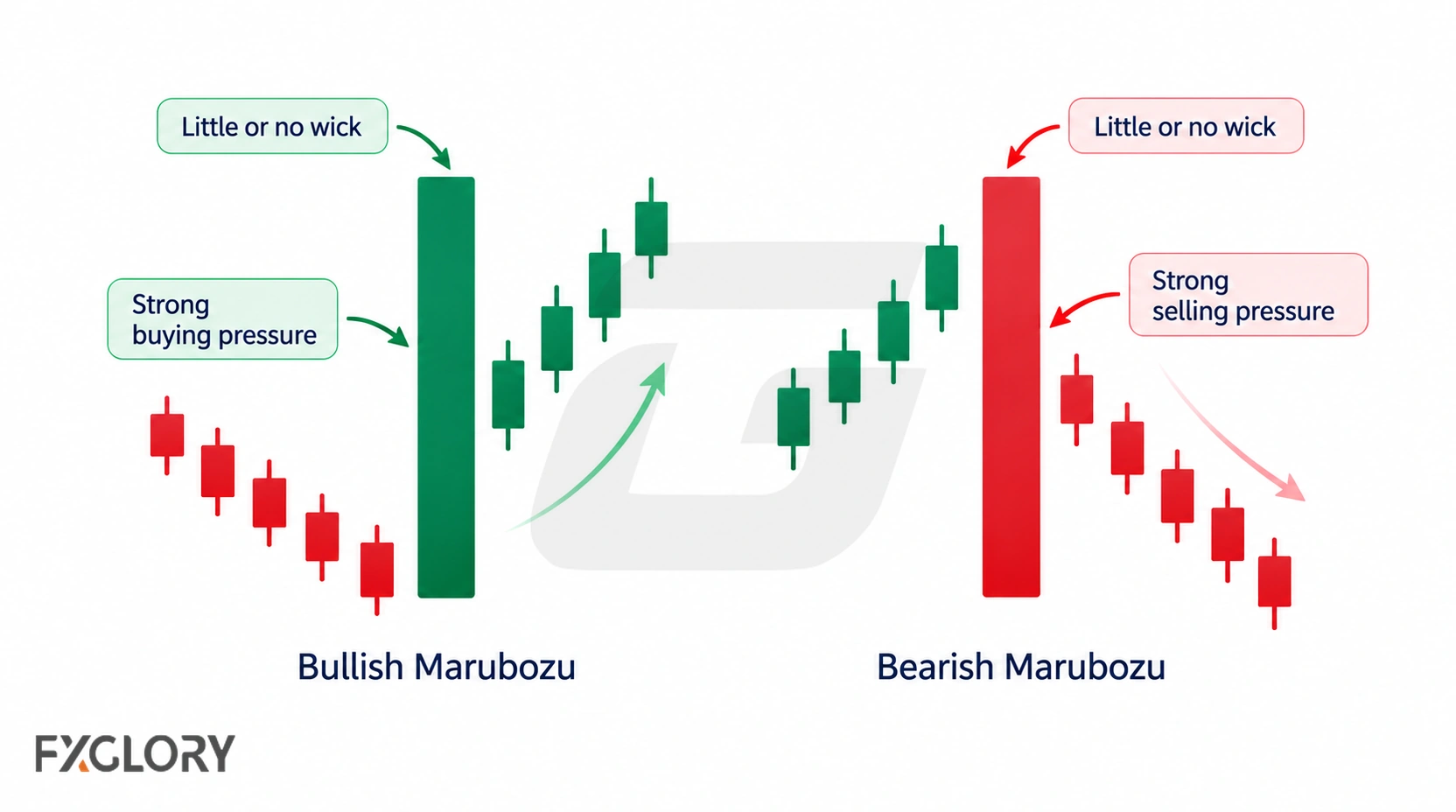
A bullish marubozu opens near the low and closes near the high. It shows that buyers controlled most of that candle period. The stronger version has a long body and little or no wick at either end.
A bullish marubozu can appear during an existing upward move, after selling pressure, near support, or after price moves through a chart area. The candle itself only shows strong buyer pressure during that completed candle period.
Bearish Marubozu
A bearish marubozu opens near the high and closes near the low. It shows that sellers controlled most of that candle period. The stronger version has a long body and little or no wick at either end.
A bearish marubozu can appear during an existing downward move, after buying pressure, near resistance, or after price moves through a chart area. The candle itself only shows strong seller pressure during that completed candle period.
| Type | Open Area | Close Area | Main Reading | Caution |
|---|---|---|---|---|
| Bullish marubozu | Near the candle low. | Near the candle high. | Strong buyer pressure during one candle period. | Does not guarantee continuation or reversal. |
| Bearish marubozu | Near the candle high. | Near the candle low. | Strong seller pressure during one candle period. | Does not guarantee continuation or reversal. |
True Marubozu vs Near-Marubozu
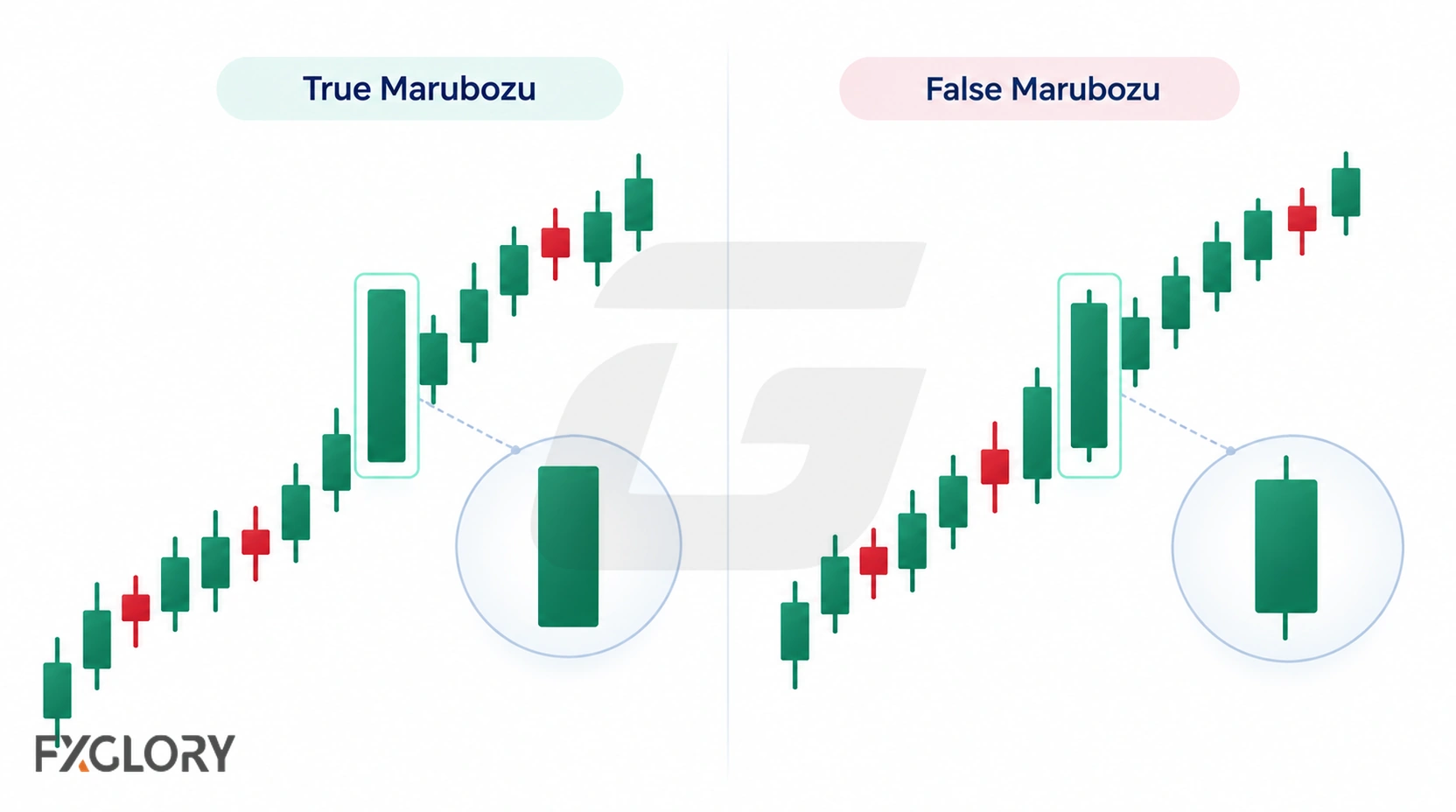
A true marubozu has no upper shadow and no lower shadow. The candle opens at one extreme and closes at the other extreme.
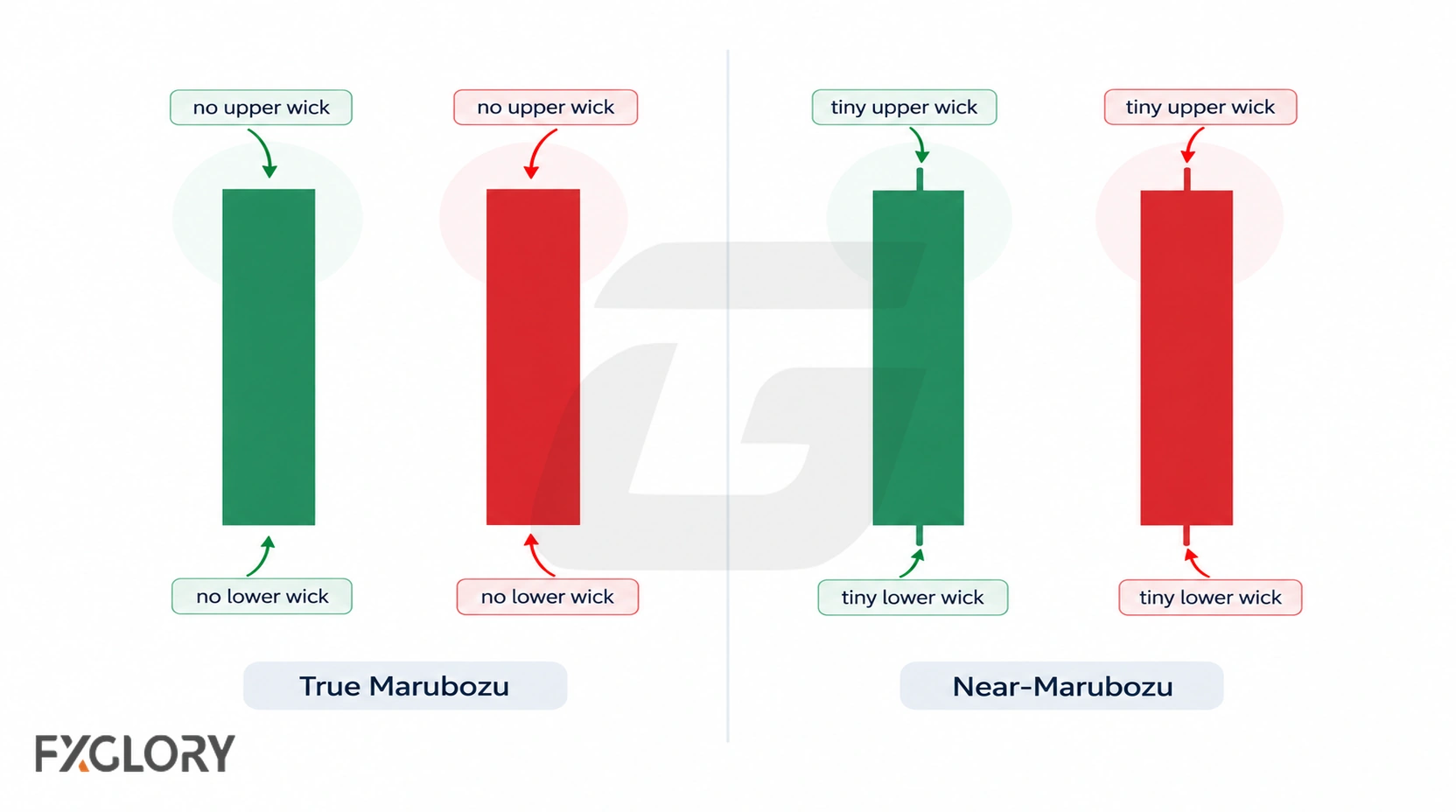
Forex charts do not always show perfectly shaved candles. Platform feeds, spread, volatility, and timeframe selection can create tiny shadows. Because of that, many chart readers also review near-marubozu candles, where the shadows are extremely small compared with the body.
The key is proportion. A candle with a long body and tiny shadows may still show body dominance. A candle with visible or large shadows should not be forced into the marubozu label.
If the shadows are easy to notice without close inspection, the candle is usually better treated as a long-body candle, not a clean marubozu.
| Structure | What It Looks Like | Possible Reading | Reading Caution |
|---|---|---|---|
| True marubozu | No upper or lower shadow. | The cleanest full-body structure. | Still needs chart context. |
| Near-marubozu | Very small shadows compared with the body. | Body still dominates the candle. | Only acceptable when shadows are minor. |
| Not marubozu | Visible or large shadows at one or both ends. | The candle no longer shows clean full-body control. | May belong to another candle type. |
Full, Opening, And Closing Marubozu Types
Some explanations divide marubozu candles into full, opening, and closing versions. This can help describe where the small wick appears when the candle is not perfectly shaved.
| Marubozu Type | Bullish Version | Bearish Version | What To Watch |
|---|---|---|---|
| Full marubozu | Opens at or near the low and closes at or near the high, with no or almost no wick. | Opens at or near the high and closes at or near the low, with no or almost no wick. | Cleanest body-dominant version. |
| Opening marubozu | Little or no lower shadow near the open, with a small upper shadow possible. | Little or no upper shadow near the open, with a small lower shadow possible. | The candle starts with strong pressure but may leave a small closing-side shadow. |
| Closing marubozu | Small lower shadow possible, then a close at or near the high. | Small upper shadow possible, then a close at or near the low. | The candle finishes strongly near the closing-side extreme. |
These subtype names are useful for describing candle shape, but they should not replace the main reading: the candle is useful only when the body dominates and the shadows are small enough to support a full-body pressure interpretation.
Why Wick Size Matters
Wick size is central to the marubozu reading. A marubozu is supposed to show that price moved in one direction with little rejection from the opposite side. Large shadows change that message.
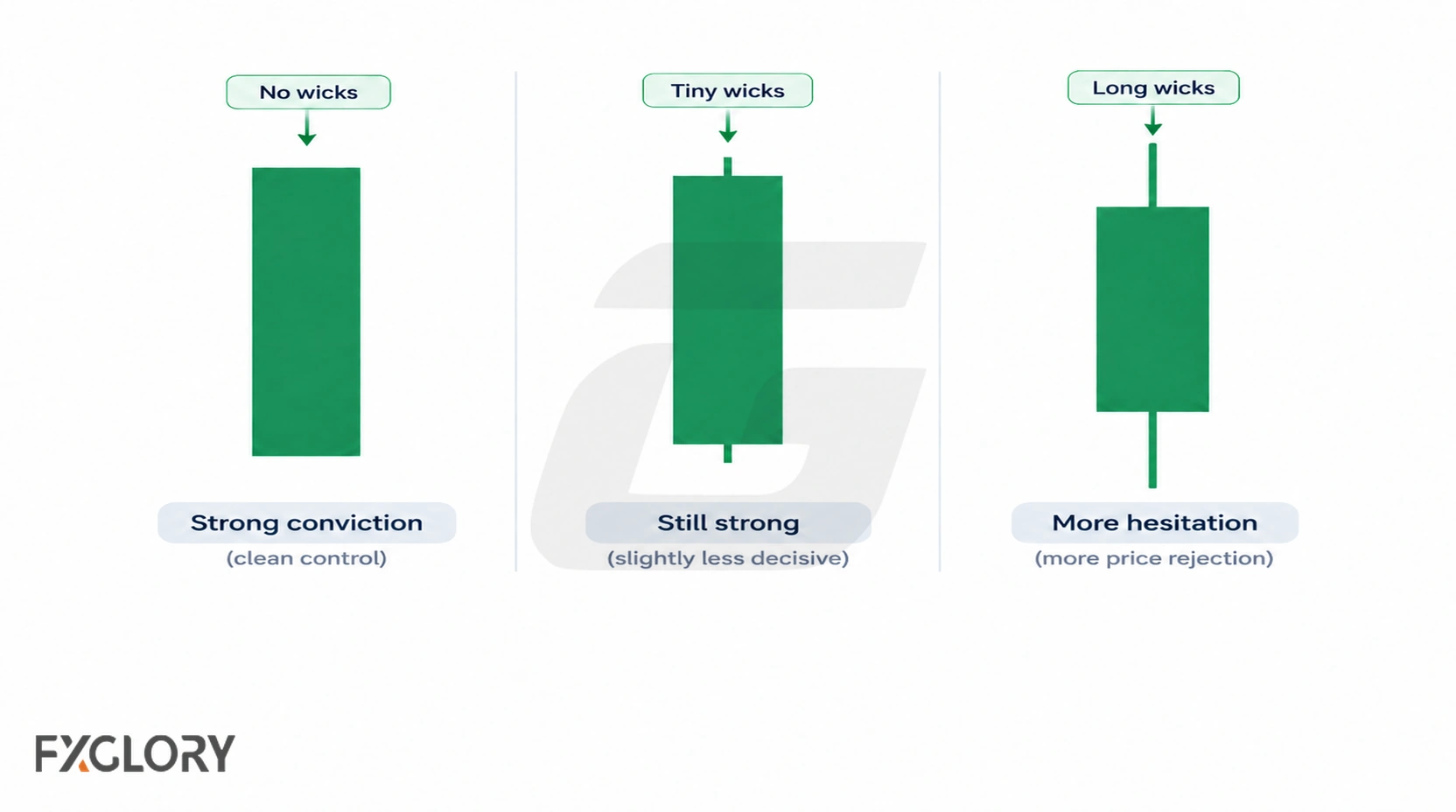
For a bullish marubozu, a large upper shadow shows that price moved higher but was pushed back before the candle closed. A large lower shadow shows that price moved below the open before buyers regained control. Either shadow makes the candle less clean.
For a bearish marubozu, a large lower shadow shows that price moved lower but was pushed back before the candle closed. A large upper shadow shows that price moved above the open before sellers regained control. Either shadow weakens the full-body reading.
| Wick Condition | Possible Reading | Reading Caution |
|---|---|---|
| No wick | Cleanest marubozu structure. | Still not a complete trading reason. |
| Tiny wick | May still be near-marubozu if the body dominates. | The wick should be minor compared with the body. |
| Moderate wick | Directional pressure is less clean. | The candle may be another long-body candle, not marubozu. |
| Large wick | Opposite-side rejection became visible. | Usually weakens or disqualifies the marubozu label. |
Body Size Relative To Recent Candles
A marubozu body should be meaningful relative to recent candles. A candle can have small shadows but still be too small to show strong full-body pressure.
Body size should be compared with the candles around it. A long body in a quiet market can stand out clearly. A similar body during extreme volatility may be less useful because many candles are large and unstable.
The best reading comes from proportion and context together: long body, very small shadows, completed candle, and a chart location where the pressure matters.
| Body Context | Possible Reading | Reading Caution |
|---|---|---|
| Large body compared with recent candles | The candle stands out as strong directional pressure. | Check whether it formed during news or unstable spread conditions. |
| Average body with tiny shadows | The candle may be body-dominant but not especially forceful. | May be a weaker marubozu reading. |
| Small body with tiny shadows | The candle lacks strong full-body pressure. | May not deserve the marubozu label. |
| Large body in extreme volatility | The candle may reflect unstable movement. | Review news, spread, liquidity, and candle range conditions. |
Continuation And Reversal Context
A marubozu candle can appear in different chart contexts. Sometimes it appears in the direction of an existing move. Sometimes it appears after price has tested a support or resistance area. The candle itself does not decide the whole chart.
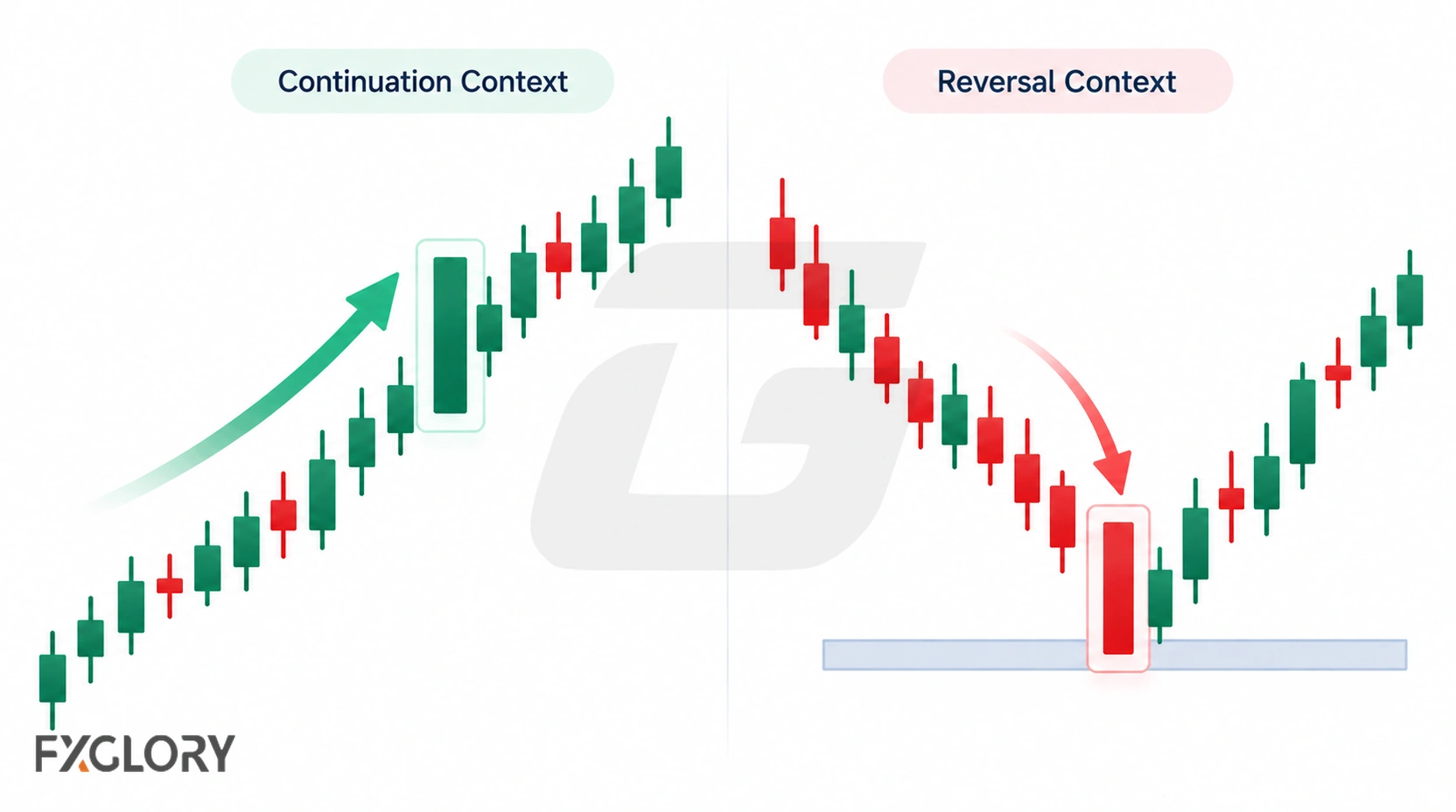
In a continuation context, a bullish marubozu may show strong buyer pressure during an existing upward move, while a bearish marubozu may show strong seller pressure during an existing downward move.
In a pressure-shift context, a bullish marubozu may appear after selling pressure or near support, while a bearish marubozu may appear after buying pressure or near resistance. In that setting, the candle may show that one side took control during that candle period, but it still needs follow-up movement and chart context.
The safest way to read a marubozu is to describe what happened during the candle first, then review where it happened on the chart.
Where Marubozu Candles Matter More
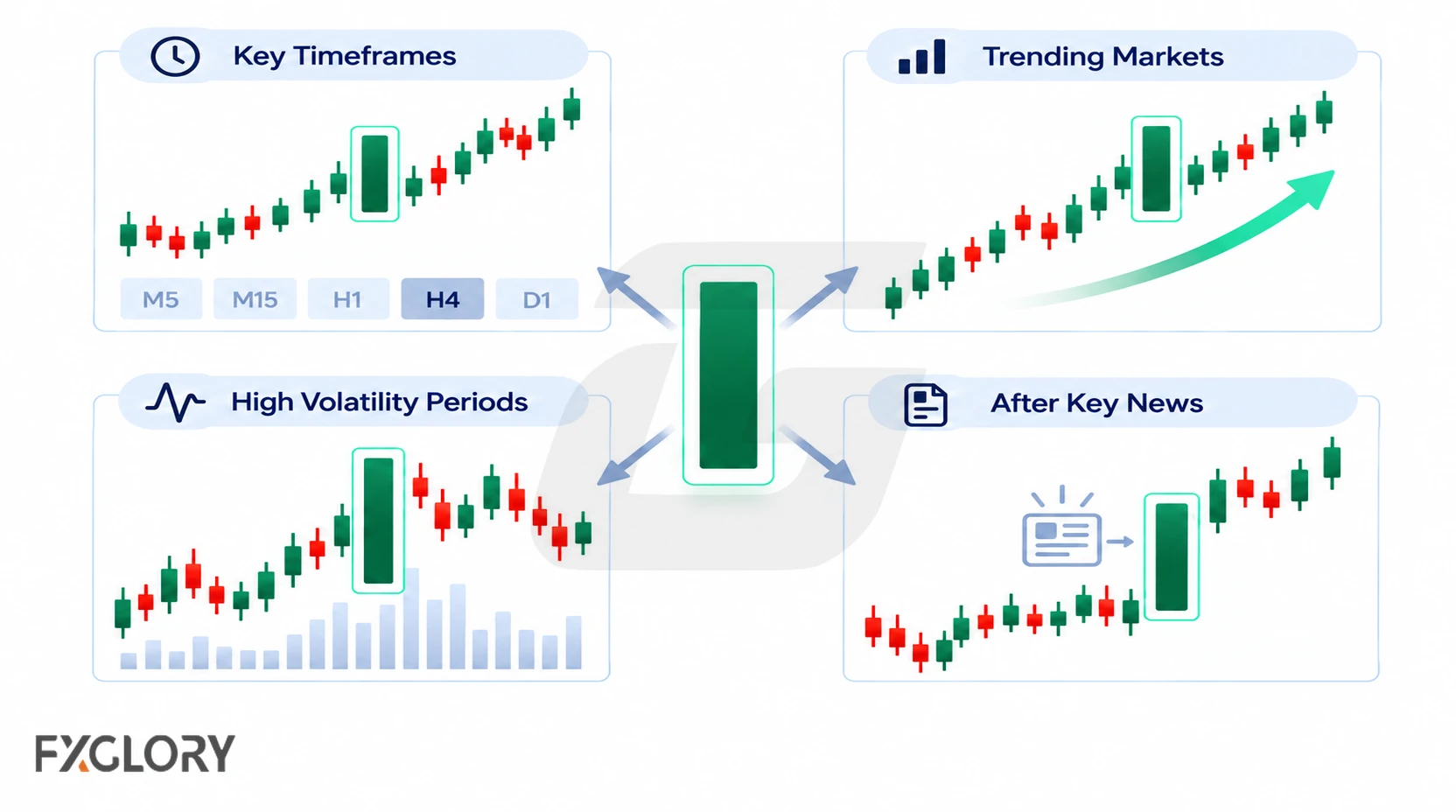
A marubozu candle becomes easier to review when it appears in a place where full-body pressure matters. Without a useful chart location, even a strong-looking candle may be ordinary movement.
Near Support
A bullish marubozu near support can show that buyers controlled a candle period around a lower-price area. This does not confirm a reversal, but the location can make the candle easier to review.
Near Resistance
A bearish marubozu near resistance can show that sellers controlled a candle period around a higher-price area. This does not confirm a reversal, but the location can make the candle easier to review.
At Range Boundaries
A marubozu near a range high or range low can show strong pressure around a boundary that already matters on the chart. In the middle of a range, the same candle may be less useful.
After Quiet Movement
A marubozu after quiet candles can stand out because the body is noticeably larger than recent candles. The shift from small candles to a full-body candle may make the pressure easier to see.
During Existing Directional Movement
A marubozu in the direction of an existing move can show that pressure continued during that candle period. The chart still needs review for nearby support, resistance, overextension, and market conditions.
During News Or Abnormal Volatility
A large marubozu-like candle during news, rollover, a market open, or thin liquidity can be difficult to interpret. The candle may show a strong body after the fact, while real-time spread and execution conditions were unstable.
For observation, a trader can compare marubozu-like candles on live market pages such as GBP/USD during directional candle periods or gold during wider candle ranges. These pages are useful for chart review, not as standalone trading reasons.
Marubozu vs Doji And Spinning Top
Marubozu, doji, and spinning top candles are often compared because they show very different relationships between body and wick.
| Candle | Main Structure | Main Reading Difference |
|---|---|---|
| Marubozu | Long body with little or no wick. | Shows strong directional pressure during one candle period. |
| Doji | Open and close are very close together. | Shows balance or indecision during the candle period. |
| Spinning top | Small body with upper and lower shadows. | Shows more two-sided movement and uncertainty. |
For the opposite body message, compare marubozu with the small-body balance candle and the two-sided spinning-top structure.
Marubozu vs Engulfing, Soldiers, And Crows
A marubozu should also be separated from multi-candle patterns. Marubozu is one candle. Engulfing needs two candles. Three white soldiers and three black crows need three candles.
| Pattern | Candle Count | Main Focus | Main Difference From Marubozu |
|---|---|---|---|
| Marubozu | One candle. | Full-body pressure with little or no wick. | The single candle is the structure. |
| Engulfing candle | Two candles. | Second candle body covers the previous body. | Engulfing is about two-candle body takeover. |
| Three white soldiers | Three candles. | Three consecutive bullish candles with higher closes. | Shows buyer response across three candles. |
| Three black crows | Three candles. | Three consecutive bearish candles with lower closes. | Shows seller response across three candles. |
For multi-candle comparisons, review the two-candle body takeover guide, the three-candle bullish pressure sequence, and the three-candle bearish pressure sequence.
Marubozu vs Wick-Dominant Candles
Marubozu candles are body-dominant. Hammer, inverted hammer, shooting star, and hanging man candles are wick-dominant. That difference matters because the candle message changes.
| Candle | Main Structure | Main Difference From Marubozu |
|---|---|---|
| Marubozu | Long body with little or no wick. | Body dominance is the main feature. |
| Hammer | Small body with long lower wick after selling pressure. | Lower-wick rejection is the main feature. |
| Inverted hammer | Small body with long upper wick after selling pressure. | Upper-wick test is the main feature. |
| Shooting star | Small body with long upper wick after buying pressure. | Upper-wick rejection is the main feature. |
| Hanging man | Small body with long lower wick after buying pressure. | Lower-wick warning structure is the main feature. |
For wick-dominant candles, compare the single-candle lower-wick structure, the upper-wick structure after selling pressure, the upper-wick structure after buying pressure, and the lower-wick structure after buying pressure.
Marubozu Candle Strength Filter: Stronger vs Weaker Readings
A marubozu candle does not have the same value in every chart condition. The table below helps separate clearer full-body pressure readings from weaker ones.
| Marubozu Factor | Clearer Reading | Weaker Reading |
|---|---|---|
| Body dominance | The body covers almost the entire candle. | The body is small or does not dominate the range. |
| Wick size | No wick or only tiny shadows. | Visible or large shadows weaken the structure. |
| Body size | The body is meaningful compared with recent candles. | The candle is small compared with recent movement. |
| Close location | Bullish closes near high; bearish closes near low. | The candle closes away from the pressure-side extreme. |
| Chart location | The candle forms near support, resistance, a range boundary, or a recent pressure area. | The candle forms in the middle of random movement. |
| Market conditions | Spread and volatility conditions are stable enough for chart review. | The candle forms during abnormal news movement, rollover, or thin liquidity. |
| Completed candle | The candle has fully closed. | The candle is still forming and can change shape. |
| Follow-up movement | Later price movement keeps the candle area relevant. | Price immediately makes the candle area irrelevant. |
Marubozu Candle Forex Reading Table
The table below shows how the same full-body candle can change depending on chart location and candle quality.
| Marubozu Situation | Possible Reading | What To Check Next |
|---|---|---|
| Bullish marubozu after selling pressure | Buyers controlled one candle period after prior weakness. | Check support, recent lows, and follow-up movement. |
| Bearish marubozu after buying pressure | Sellers controlled one candle period after prior strength. | Check resistance, recent highs, and follow-up movement. |
| Marubozu in the direction of an existing move | Directional pressure continued during that candle. | Check overextension and nearby levels. |
| Marubozu near a range boundary | The candle formed at a chart area already being tested. | Check whether the boundary remains relevant. |
| Large body with tiny shadows | Body dominance is easier to read. | Check whether the candle formed during stable conditions. |
| Large body during news volatility | The candle may reflect unstable movement. | Review spread, candle range, and liquidity conditions. |
| Unfinished marubozu-like candle | The structure is not confirmed as a candle shape yet. | Wait for the candle to close before labeling it. |
How To Read A Marubozu Candle In Forex
A simple workflow helps keep marubozu reading disciplined. The goal is to describe the full-body candle before giving it more meaning than it deserves.
- Check the candle close: Review the candle only after it has completed.
- Read the body: Check whether the real body dominates the full candle range.
- Check the wicks: Confirm that shadows are missing or very small compared with the body.
- Identify direction: Decide whether the candle is bullish or bearish based on its open and close.
- Compare recent candles: Check whether the body is meaningful compared with nearby candles.
- Check chart location: Review support, resistance, range boundaries, recent highs, recent lows, or existing directional movement.
- Separate it from other candles: Check whether the structure is really marubozu or closer to doji, spinning top, engulfing, hammer, shooting star, hanging man, soldiers, or crows.
- Review market conditions: Consider volatility, spread, liquidity, rollover, and scheduled news events.
- Watch follow-up movement: Review whether price keeps the candle area relevant or cancels the reading.
Some traders compare marubozu candles with technical indicators for additional context. For example, RSI can add momentum context, MACD can add trend-momentum context, ATR can add volatility context, and Bollinger Bands can help review range and expansion conditions. These tools can support candle review, but they do not remove trading risk.
Some traders also review activity or volume-style tools around a large full-body candle, but spot forex volume is usually broker/platform-specific and should not be treated as a complete confirmation by itself.
False Marubozu Candles In Forex
A false marubozu candle looks like a full-body pressure candle but does not provide a useful chart clue. This can happen because the candle is unfinished, the shadows are too large, the body is not meaningful, the chart location is weak, or market conditions make the candle hard to interpret.
Unfinished Candle
A candle can look like a marubozu before it closes and then finish with a large shadow or smaller body. A marubozu should be reviewed after the candle has closed.
Visible Or Large Shadows
If the candle has visible or large shadows, the full-body pressure reading becomes weaker. Large shadows show that the opposite side affected the candle period.
Small Body
A candle with a small body and tiny shadows is not automatically marubozu. The body should be meaningful relative to recent candles.
Choppy Market Conditions
In messy or high-volatility conditions, a strong body may reflect unstable movement rather than clean directional control. Choppy charts can create large candles that look important after the fact.
Lower-Timeframe Noise
Lower timeframes do not automatically invalidate a marubozu candle, but they can create more frequent lookalikes. The candle needs stronger chart context when movement is short-term and noisy.
News Or Low-Liquidity Conditions
Major news, rollover, market opens, and thin liquidity can create marubozu-like candles that are difficult to interpret in real time. Spread and execution conditions may be unstable even when the final candle looks clean.
Random Middle-Range Candle
A marubozu-like candle in the middle of a messy range may be less useful than one near support, resistance, a range boundary, or another visible chart area.
- Wait for the close: An unfinished candle can develop a larger wick or smaller body before the period ends.
- Compare proportions: The body should dominate the range, and any shadows should be minor.
- Compare recent candles: A body that is small for current conditions may not represent unusually strong pressure.
- Check market conditions: News, rollover, thin liquidity, or abnormal volatility can make a dramatic candle harder to interpret.
- Check the actual candle type: If the wicks or multi-candle structure dominate the setup, another candlestick label may be more accurate.
Common Mistakes With Marubozu Candles In Forex
Marubozu candles are easy to recognize after they close, but they are also easy to overread. Most mistakes come from treating one strong candle as a complete directional answer.
- Assuming continuation: Strong pressure during one candle does not establish that the next candle will move the same way.
- Assuming reversal: A marubozu near support or resistance is not enough to confirm a turning point.
- Confusing one-candle and multi-candle structures: Engulfing, three white soldiers, and three black crows use different pattern logic.
- Confusing body-dominant and wick-dominant candles: Hammer, shooting star, and similar candles derive their meaning from the wick rather than a nearly full body.
- Replacing risk planning with candle confidence: A strong-looking candle does not define position size, invalidation, or acceptable loss.
What to Compare With a Marubozu Candle
Comparing marubozu with small-body, wick-dominant, and multi-candle patterns helps clarify which part of a candlestick structure carries the main information.
You can compare marubozu with the small-body doji structure, the two-sided spinning top candle, the two-candle engulfing structure, the three-candle bullish sequence, or the three-candle bearish sequence. For wick-dominant single candles, review the hammer candle guide and the shooting star guide. For a wider map of candle formations, return to forex candlestick pattern groups.