

What Is A Doji In Forex?
A doji in forex is a candlestick whose opening and closing prices are equal or very close. It can resemble a cross, a plus sign, or a candle with a barely visible body, depending on its wicks.
That shape records little net change between the opening and closing prices during the selected timeframe. It does not prove that buying and selling volumes were equal, and it does not reveal the order of price movements inside the candle.
A doji can appear after a rise, after a decline, or during sideways movement. Identifying the candle is different from interpreting its surroundings or deciding whether a trade is justified.
If you need the basic parts of a candle first, review the body, wick, open, and close relationship.
Doji Candle Anatomy
The real body is the absolute difference between the opening and closing prices. The upper wick extends from the higher of those prices to the candle’s high; the lower wick extends from the lower of those prices to the candle’s low.
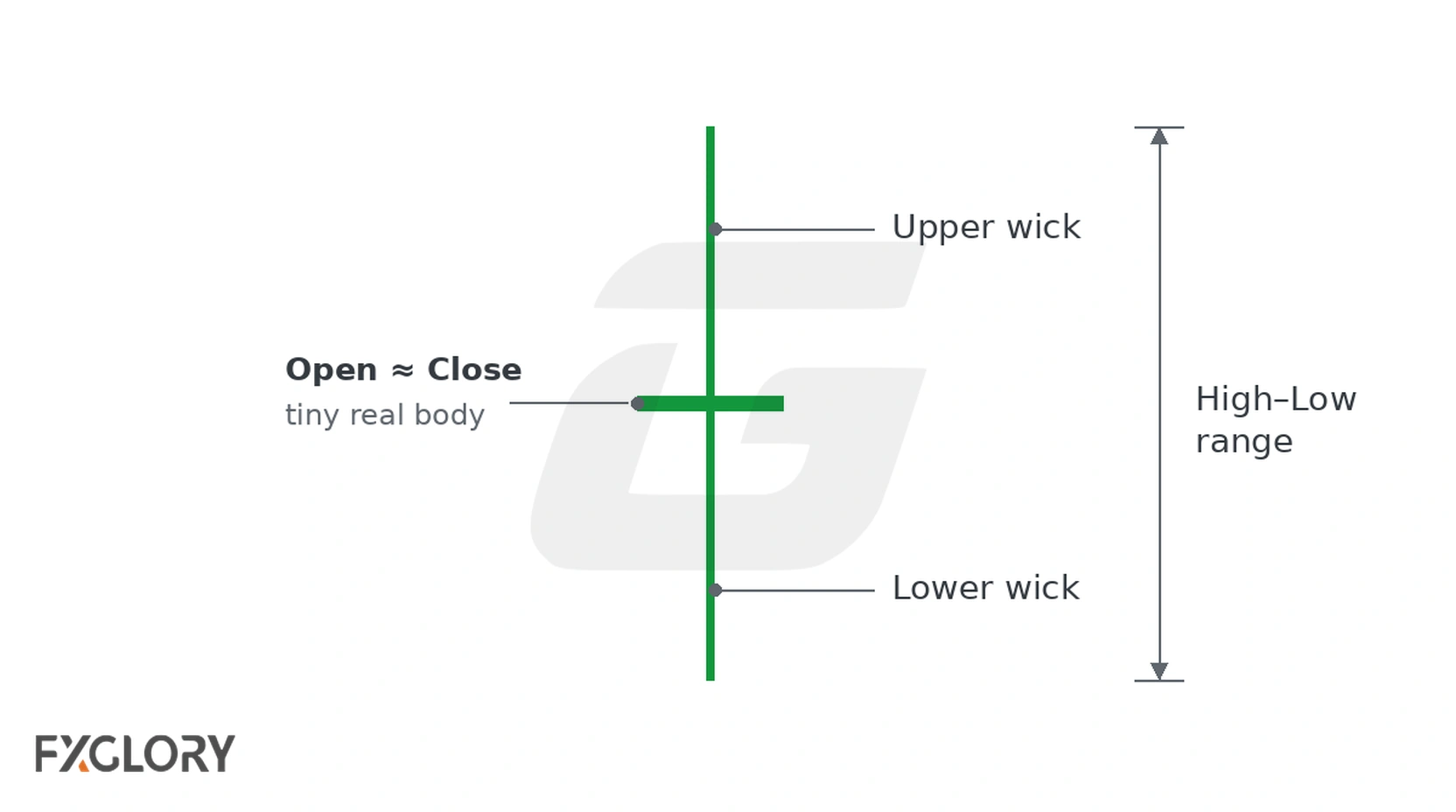
OHLC data identifies these four prices, not the sequence of events between them. For example, an upper wick can coexist with a bullish close (close above open), and a lower wick can coexist with a bearish close (close below open).
| Doji Part | What It Shows | Reading Caution |
|---|---|---|
| Tiny or missing body | Open and close differ very little or not at all. | Defines the candle shape, not the next direction. |
| Upper wick | Distance from the higher of open or close to the high. | Does not show when the high occurred or who initiated the move. |
| Lower wick | Distance from the lower of open or close to the low. | Does not show when the low occurred or who initiated the move. |
| Full candle range | High minus low. | Compare with preceding candle ranges; a long wick relative to the body does not by itself establish unusually high volatility. |
| Close location | Where the close lies between the low and high, when that range is nonzero. | With a strict four-price doji, high equals low, so there is no nonzero range to measure. |
Hypothetical EUR/USD example: Suppose a completed candle opens at 1.1000, reaches 1.1012, trades as low as 1.0988, and closes at 1.1001. Assuming one pip equals 0.0001, its body is 1 pip, upper wick 11 pips, lower wick 12 pips, and full range 24 pips. The OHLC values cannot tell whether the high or low occurred first.
Doji vs Spinning Top In Forex
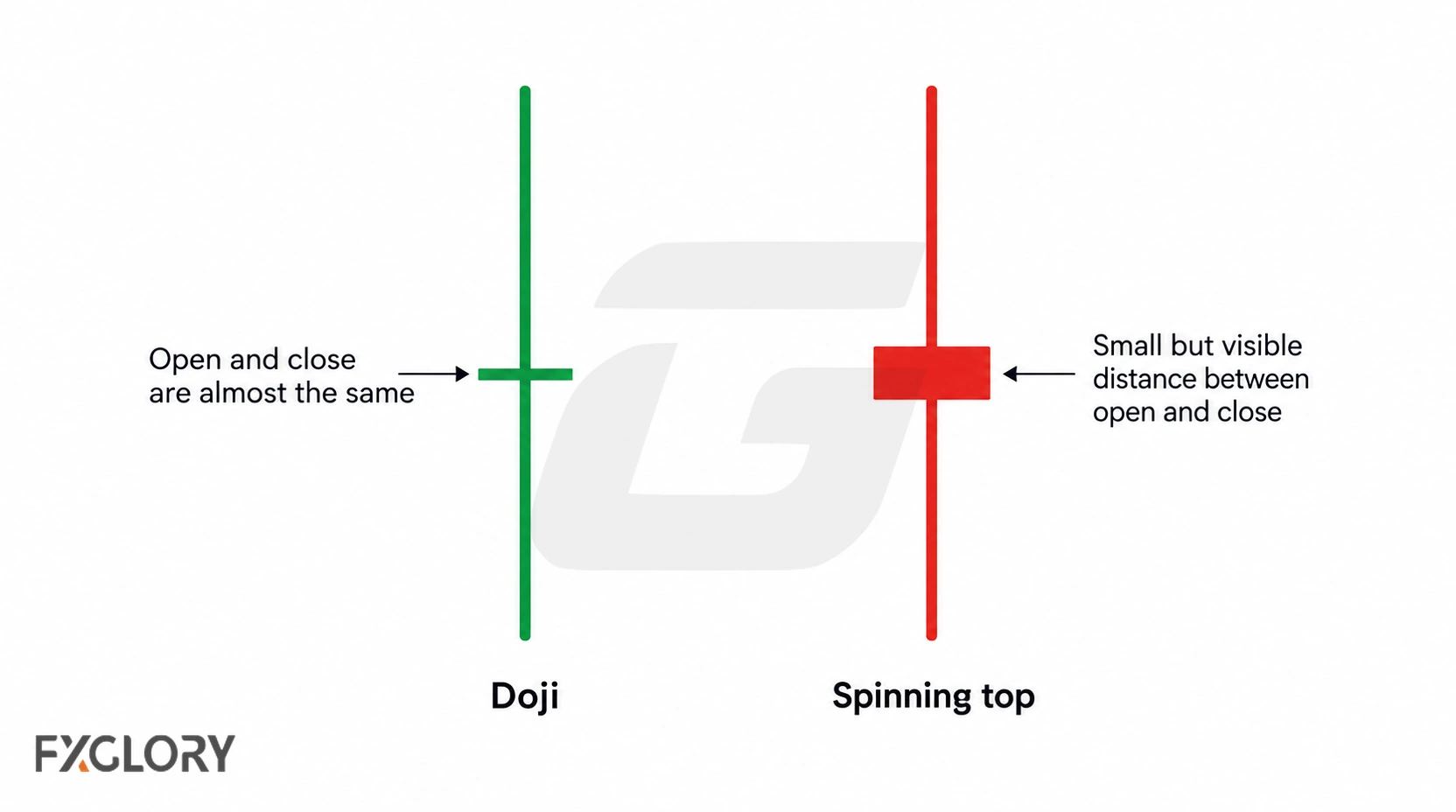
Both formations have relatively small real bodies. A doji closes at or very near its open; a spinning top typically has a small but more visible difference between its opening and closing prices.
| Candle | Body | What OHLC Shows | Main Caution |
|---|---|---|---|
| Doji | Open and close are equal or almost equal. | Little net open-to-close change. | Does not predict the next price move. |
| Spinning top | Small body, usually more visible than a doji’s. | A small directional difference between open and close. | Classification can overlap near the boundary between labels. |
No single numerical body-size cutoff is universal across all charting conventions. When a candle sits near the boundary, describe its actual body and wick proportions rather than forcing a label.
Types Of Doji Candles In Forex
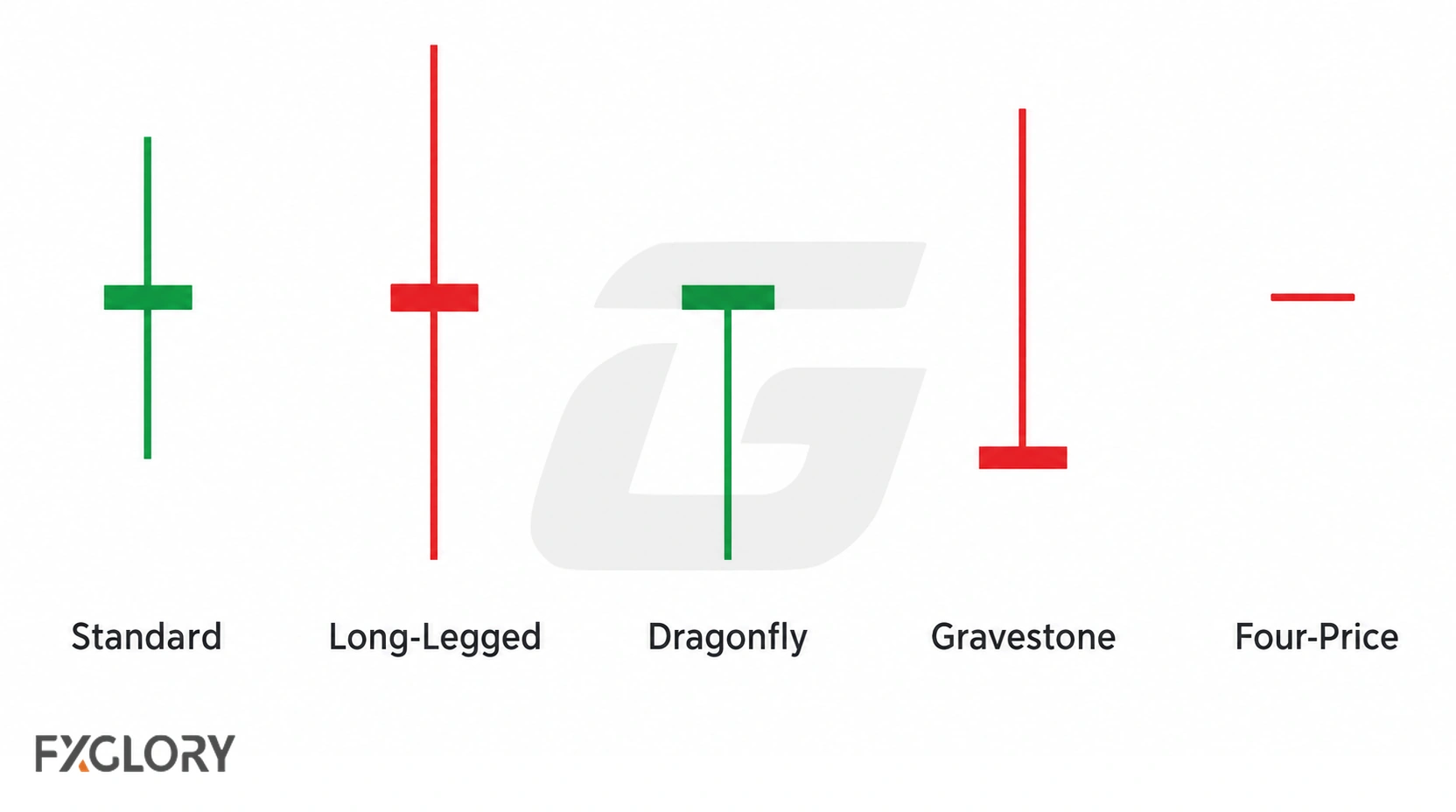
Doji types describe the relative positions of the open, high, low, and close. Their names identify candle structures rather than the intraperiod order of trades or a forecast.
Standard Doji
A standard doji has a negligible body and upper and lower wicks. Its recorded high and low lie on opposite sides of the opening/closing area.
Long-Legged Doji
A long-legged doji has comparatively long upper and lower wicks around a tiny body. Its high and low show movement on both sides of the opening area, but its full range is not necessarily unusually large relative to recent candles. For a more detailed breakdown, see the long-legged doji structure guide.
Dragonfly Doji
A dragonfly doji has a long lower wick and little or no upper wick. Its opening and closing prices lie near the candle’s high, with the recorded low well below them. See the specialist Dragonfly Doji guide in Related Content for more detail.
Gravestone Doji
A gravestone doji has a long upper wick and little or no lower wick. Its opening and closing prices lie near the candle’s low, with the recorded high well above them. See the specialist Gravestone Doji guide in Related Content for more detail.
Four-Price Doji
A strict four-price doji has identical opening, high, low, and closing prices, creating zero recorded range. Some traders also describe very narrow near-equal OHLC candles as four-price-like; these are not the strict zero-range form. If high equals low, a body-to-range ratio is undefined because the denominator is zero.
| Doji Type | Main Structure | What OHLC Shows | What To Check |
|---|---|---|---|
| Standard doji | Tiny body, with upper and lower wicks. | High and low around a near-equal open and close. | Wick lengths, prior candles, and marked levels. |
| Long-legged doji | Tiny body with comparatively long upper and lower wicks. | High well above and low well below the body. | Full range relative to recent candles. |
| Dragonfly doji | Tiny body near the high and a long lower wick. | Low substantially below the opening/closing area. | Previously tested support and later closes. |
| Gravestone doji | Tiny body near the low and a long upper wick. | High substantially above the opening/closing area. | Previously tested resistance and later closes. |
| Four-price doji | Open = high = low = close in the strict form. | Zero recorded high-low range. | Price-feed precision, session, spread, and liquidity. |
Doji Candle Context In Forex
Once the candle’s structure is identified, compare it with earlier price movement and levels marked before it formed. These features provide reference points for observing later price action; they do not change whether the candle qualifies as a doji.
Doji After An Upward Move
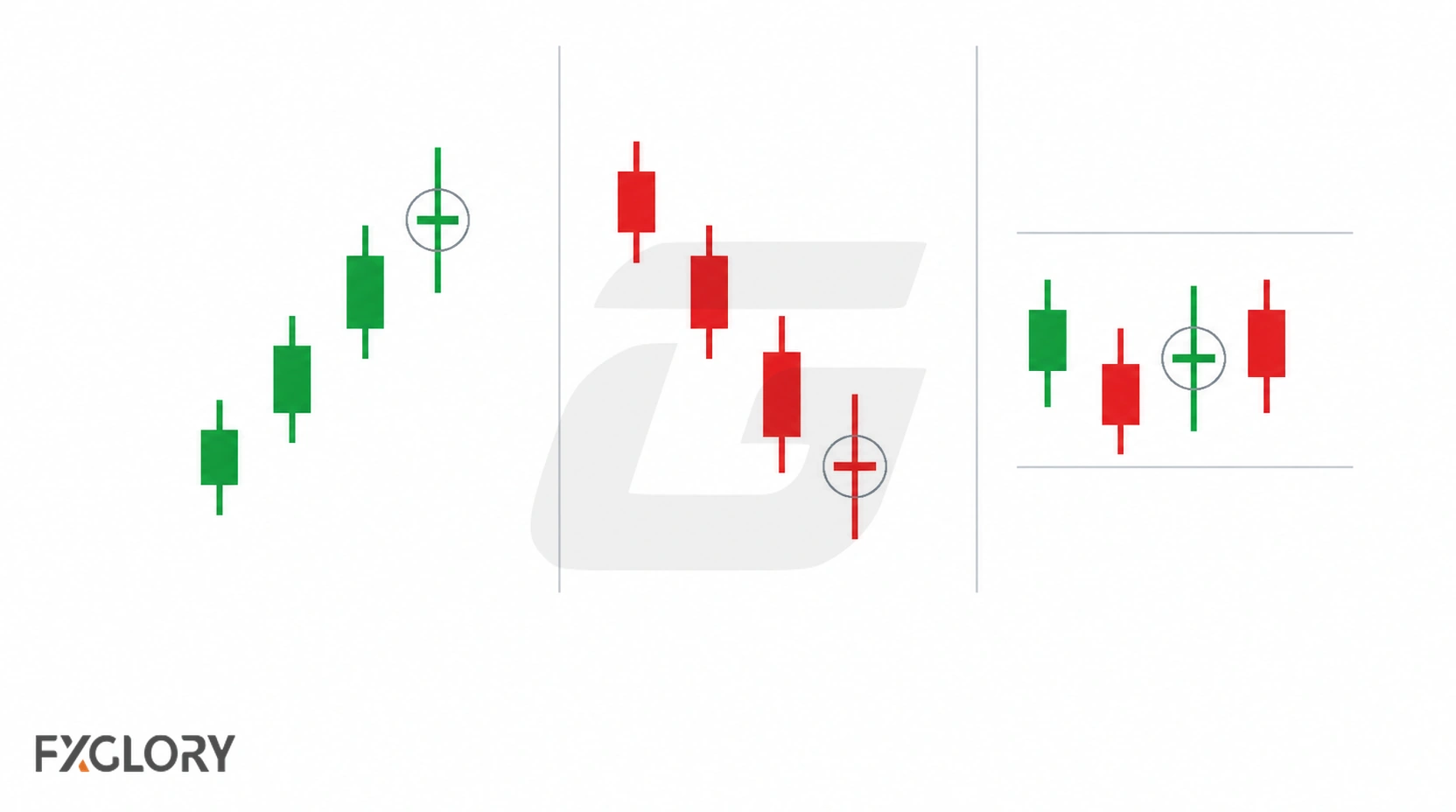
After a sequence of higher swing highs and lows, a doji records a small open-close change in that particular candle; it does not prove that buying pressure weakened. Compare its range with the latest swing high or an earlier resistance area, then examine completed candles that follow.
Doji After A Downward Move
After a sequence of lower swing highs and lows, a doji likewise shows little net change during one interval; it does not establish that selling pressure weakened. Compare its range with the last swing low or previously observed support, then note whether later closes cross those levels.
Doji Inside A Range
Where several candles overlap between identifiable horizontal boundaries, a doji near an established edge provides a specific nearby price level to monitor. A doji near the middle offers less information about how price might behave at either boundary, but both remain valid doji shapes.
Doji Near Support Or Resistance
Mark a support or resistance area using earlier price tests, before inspecting the doji. Record whether its range overlaps the area and whether subsequent completed candles close across or away from it. The level supplies an observable reference, not a guaranteed reversal.
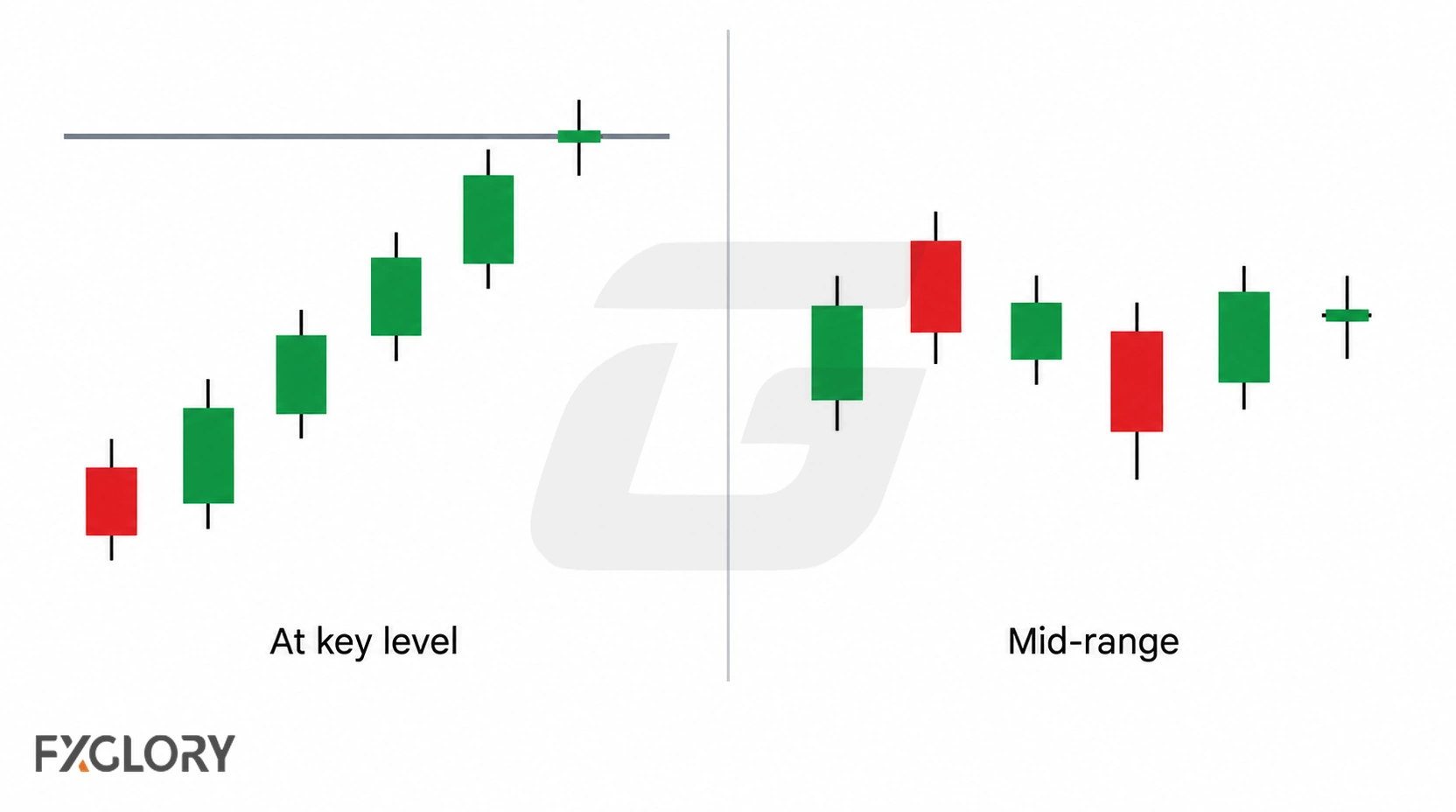
Doji On Short vs Longer Timeframes
A one-minute and a daily doji summarize different amounts of time. Neither is inherently an invalid pattern: select a timeframe suited to the question being studied and compare spreads and execution conditions separately if considering a trade.
For observation, compare recorded bodies and candle ranges for EUR/GBP during quieter price movement and GBP/USD during wider candle ranges across the same timeframes and sessions. Do not assume either pair is consistently quieter or more active. For broader comparisons, see other turning-point candle clues and candlestick pattern groups.
Doji Context Checklist
This checklist records observable conditions surrounding a doji. It is not a validated strength score, and none of these contextual factors is required for the candle to qualify structurally as a doji.
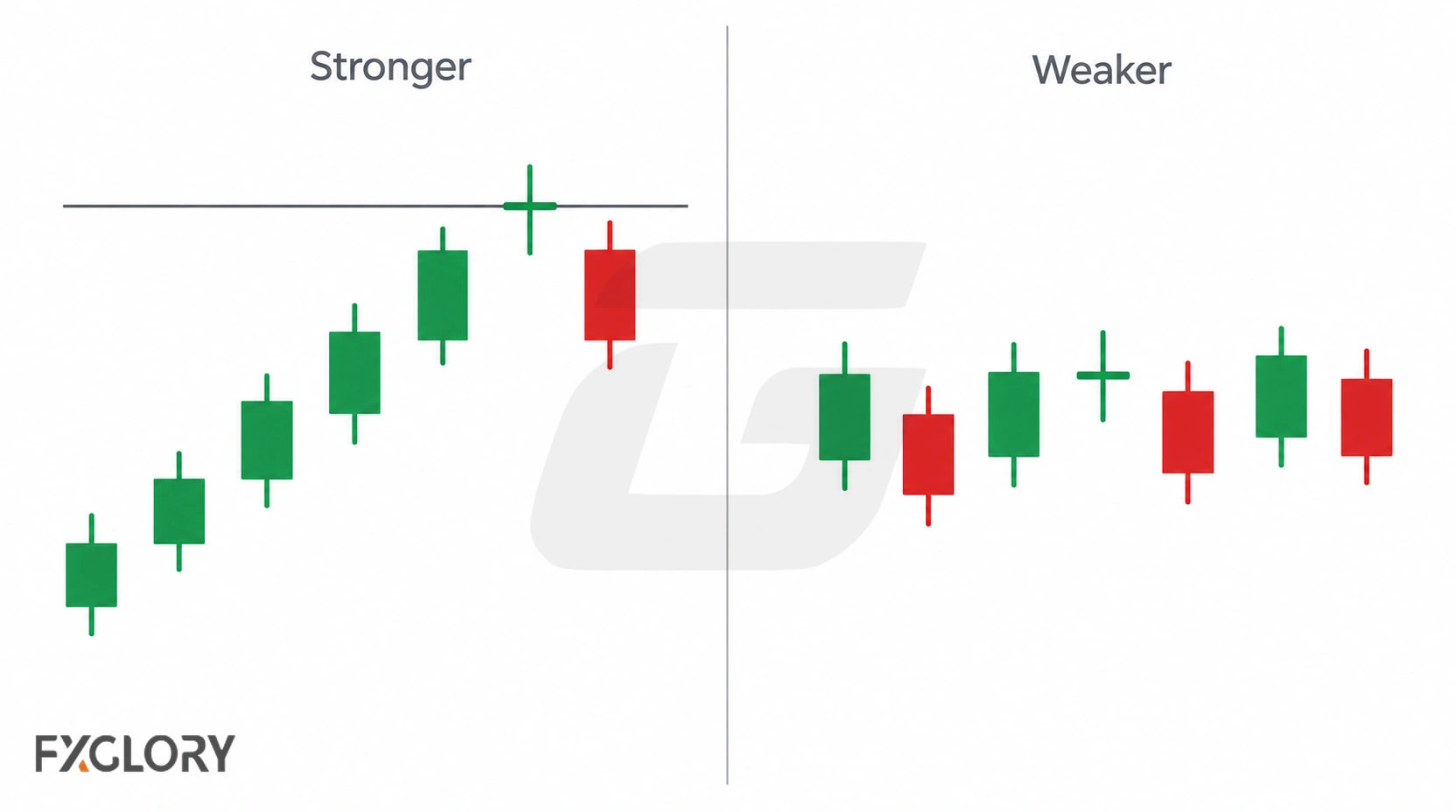
| Factor | What To Observe | Why It Matters For Review |
|---|---|---|
| Prior move | Were recent swing highs and lows rising, falling, or overlapping? | Identifies what price behavior preceded the candle without requiring a trend. |
| Chart location | Does the candle overlap previously marked support, resistance, a swing point, or a range boundary? | Provides a price level against which later closes can be compared. |
| Wick structure | Measure the upper and lower wicks and full high-low range. | Separates relative candle shape from the size of the move compared with recent bars. |
| Timeframe | Has the candle closed on the timeframe being analyzed? | The final open-close relationship is only established when that bar completes. |
| Market conditions | Compare the spread with candle range; note the session, thin liquidity, and scheduled news. | Execution costs or rapid price changes may matter for a trade without changing the recorded candle shape. |
| Follow-up price action | Specify a later completed-candle condition, such as a close beyond the doji high or low, if the analysis requires confirmation. | Makes a subsequent observation testable; it is separate from doji identification and does not by itself prove a reversal. |
Doji Forex Reading Table
These scenarios illustrate distinct next observations a reader can make after identifying the same basic candle structure.
| Doji Location | What Is Observable | What To Check Next |
|---|---|---|
| After a strong rise | The doji closes near its own open after several rising candles. | Compare later closes with the most recent swing high and the doji range. |
| After a strong decline | The doji closes near its own open after several falling candles. | Compare later closes with the most recent swing low and the doji range. |
| Near resistance | Its range touches or overlaps an area identified from earlier highs. | Does a later completed candle close above that area or move back below it? |
| Near support | Its range touches or overlaps an area identified from earlier lows. | Does a later completed candle close below that area or move back above it? |
| Middle of a range | Its range lies between previously observed upper and lower boundaries. | How far are the boundaries, and does subsequent price action approach either one? |
| During news volatility | Open and close may be nearly equal despite a large recorded range. | Compare the range with nearby bars and examine spreads and execution conditions. |
| During quiet trading | The high-low range may also be very small. | Compare that range with normal spread and recent candles; the candle still qualifies if its OHLC structure fits. |
How To Read A Doji Candle In Forex
Start with a completed candle and its measurable features. Interpret surrounding price action only after confirming the candle’s structure.
- Check the timeframe and close: Wait for the chosen candle interval to finish; its final body can differ from its intrabar appearance.
- Compare open and close: Verify that the real body is negligible, allowing for the strict zero-range four-price form.
- Measure wicks and range: Calculate the upper and lower wick lengths, and compare high minus low with recent candles.
- Describe the prior move: Identify rising swings, falling swings, or overlapping candles without assuming any required trend.
- Mark chart levels: Use highs, lows, and range boundaries that were established before the doji.
- Specify any follow-up condition: For example, observe whether a later completed candle closes above the doji high or below its low. That is one possible condition, not universal confirmation of a reversal.
- Review market conditions: Check spreads, session liquidity, and news if considering whether price movement could be traded.
- Keep the trade plan separate: Any proposed trade still needs entry criteria, invalidation, risk limits, position sizing, and transaction-cost assumptions.
Optional indicator comparison: In the hypothetical anatomy example, the candle’s range is 24 pips. If the same timeframe’s ATR indicator read 12 pips, that candle’s range would be twice the ATR reading, despite its 1-pip body. RSI can add momentum context from preceding closes; Bollinger Bands can help review range and expansion conditions by placing price relative to their bands. None identifies which side initiated the wick movements or establishes an entry on its own.
Common Mistakes With Doji Candles In Forex
The recurring error is treating a descriptive candle shape as proof of a particular market mechanism or as a ready-to-execute trade.
- Calling every doji a reversal: A tiny open-close difference does not establish what later prices will do.
- Inferring an intrabar sequence: A wick identifies the high or low relative to the body, not whether the high came before the low.
- Misreading different doji types: Dragonfly, gravestone, and long-legged candles have different OHLC proportions even though their open and close are near each other.
- Reading an unfinished candle: A candle can resemble a doji midway through a period and finish with a larger body.
- Rejecting a small-range doji as invalid: A very narrow range may offer little additional context, but it does not change the candle’s open-close relationship.
- Assuming the next candle confirms everything: Define the specific completed-candle condition being checked; a break, a retest, and further follow-through are different observations.
- Confusing structural reading with risk planning: A valid doji does not determine an entry, stop, position size, or acceptable loss. Those are separate trading decisions.
What To Study After Doji Candles
After learning how to read doji candles, the next step is to compare them with other candle formations that use wick structure or multi-candle pressure shifts.
You can continue with the hammer candle guide, the shooting star guide, the pin bar guide, or the engulfing candle guide. For broader grouping, return to forex candlestick pattern categories or reversal candle review.