
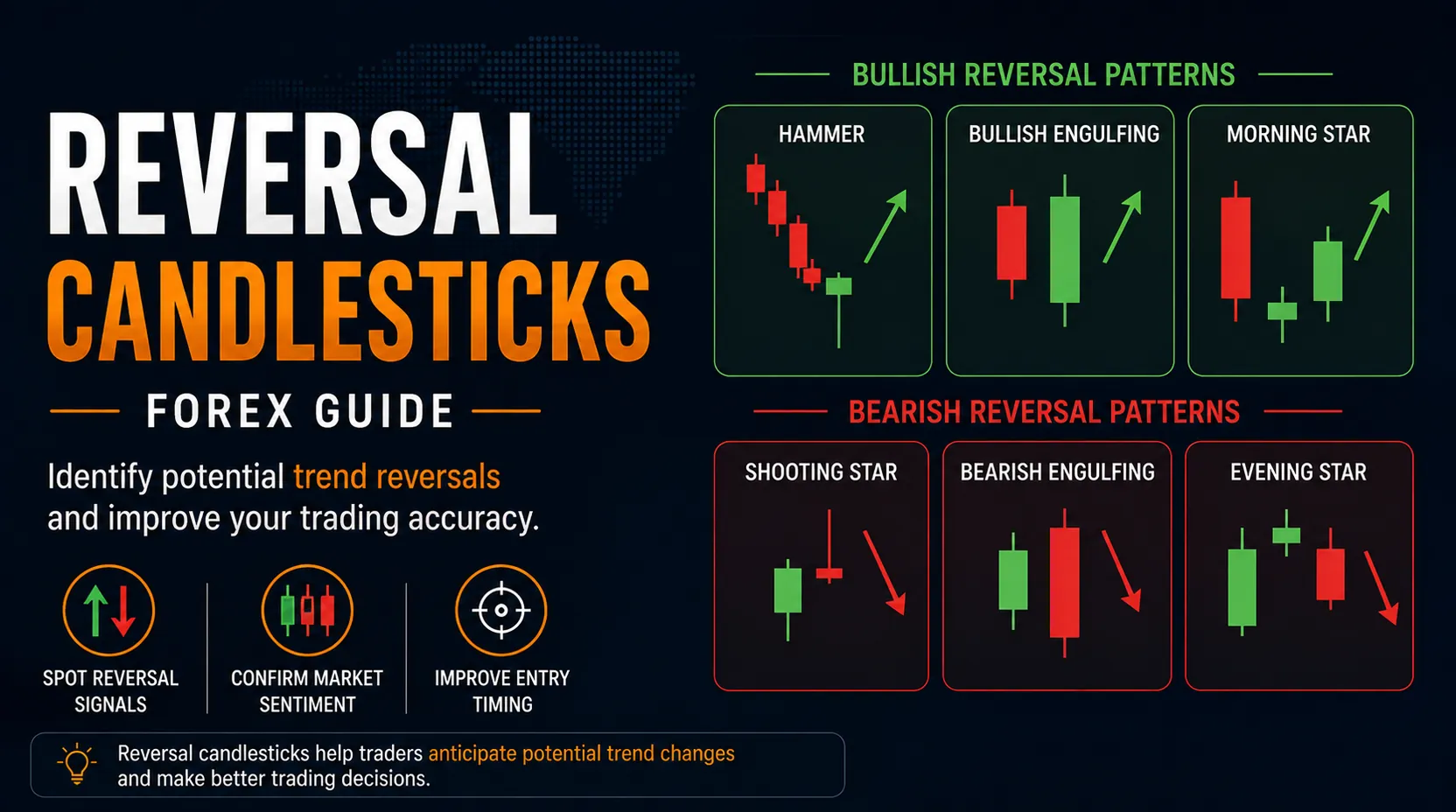
What Are Forex Reversal Candles?
Forex reversal candles are candlestick formations traders review when price may be losing momentum after an existing move. They are usually studied after a rise, after a decline, near a chart level, or around an area where the previous direction may be weakening.
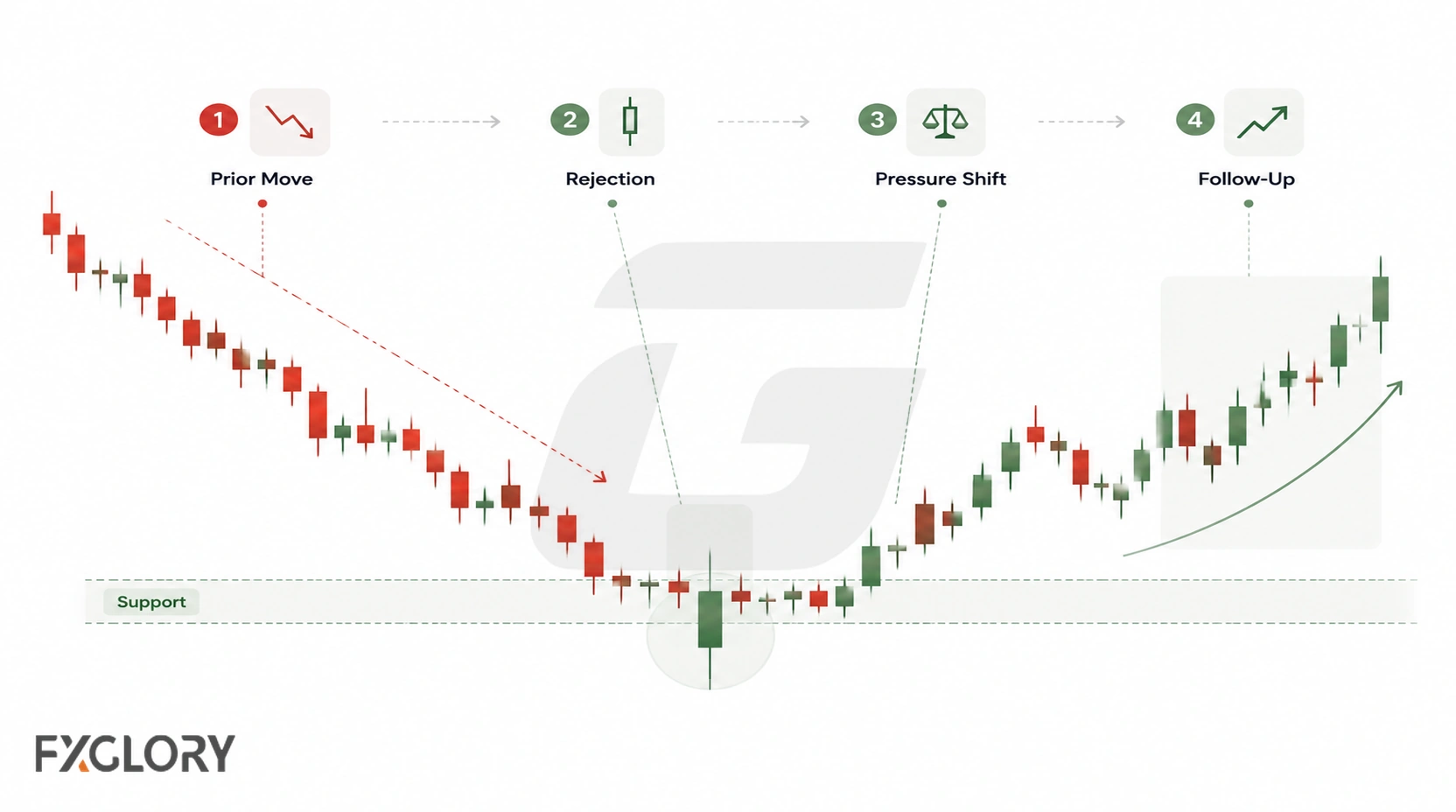
A reversal candle does not prove that the market has changed direction. It is better understood as a turning-point clue. The candle may show rejection, hesitation, exhaustion, compression, repeated testing, or a short-term pressure shift, but the surrounding chart decides whether that clue deserves attention.
Before studying reversal candles, it helps to understand the basic body, wick, open, and close relationship. Reversal formations are built from those same candle parts, but they are read after asking a bigger question: what was price doing before this candle appeared?
This page is a reversal-focused map. It groups candles that traders often review near possible turning areas and routes each structure to the deeper guide when the pattern needs its own explanation. For the full pattern library, use the forex candlestick pattern groups.
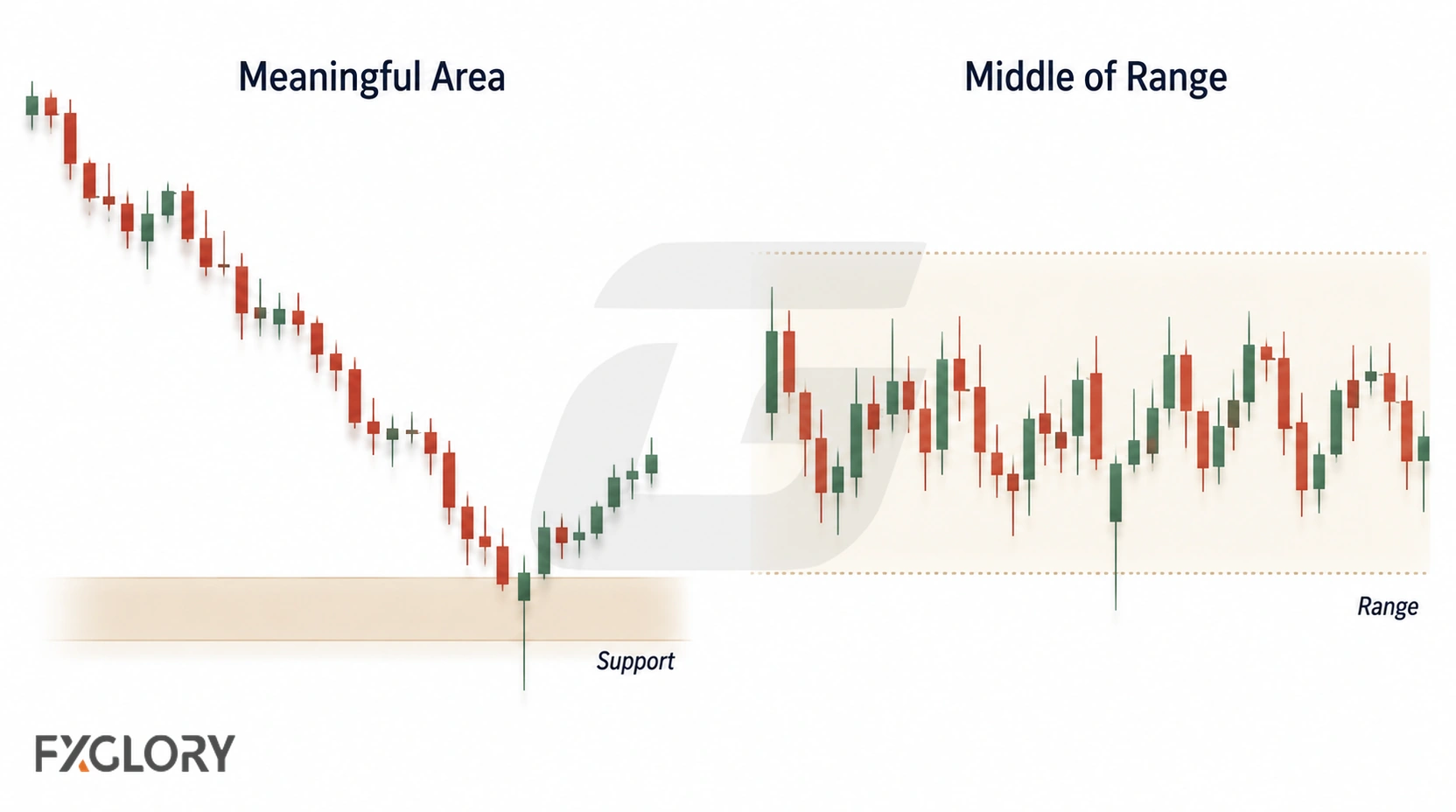
Reversal candlestick patterns in forex should be reviewed with the prior move, chart location, candle close, timeframe, market condition, and next reaction. A candle that looks important after a long decline may be less meaningful in the middle of a sideways range.
Reversal Candle vs Pullback, Correction, And Consolidation
One of the hardest parts of reading reversal candles is separating a possible reversal from a normal pause. Not every candle against the current move means the direction is changing.
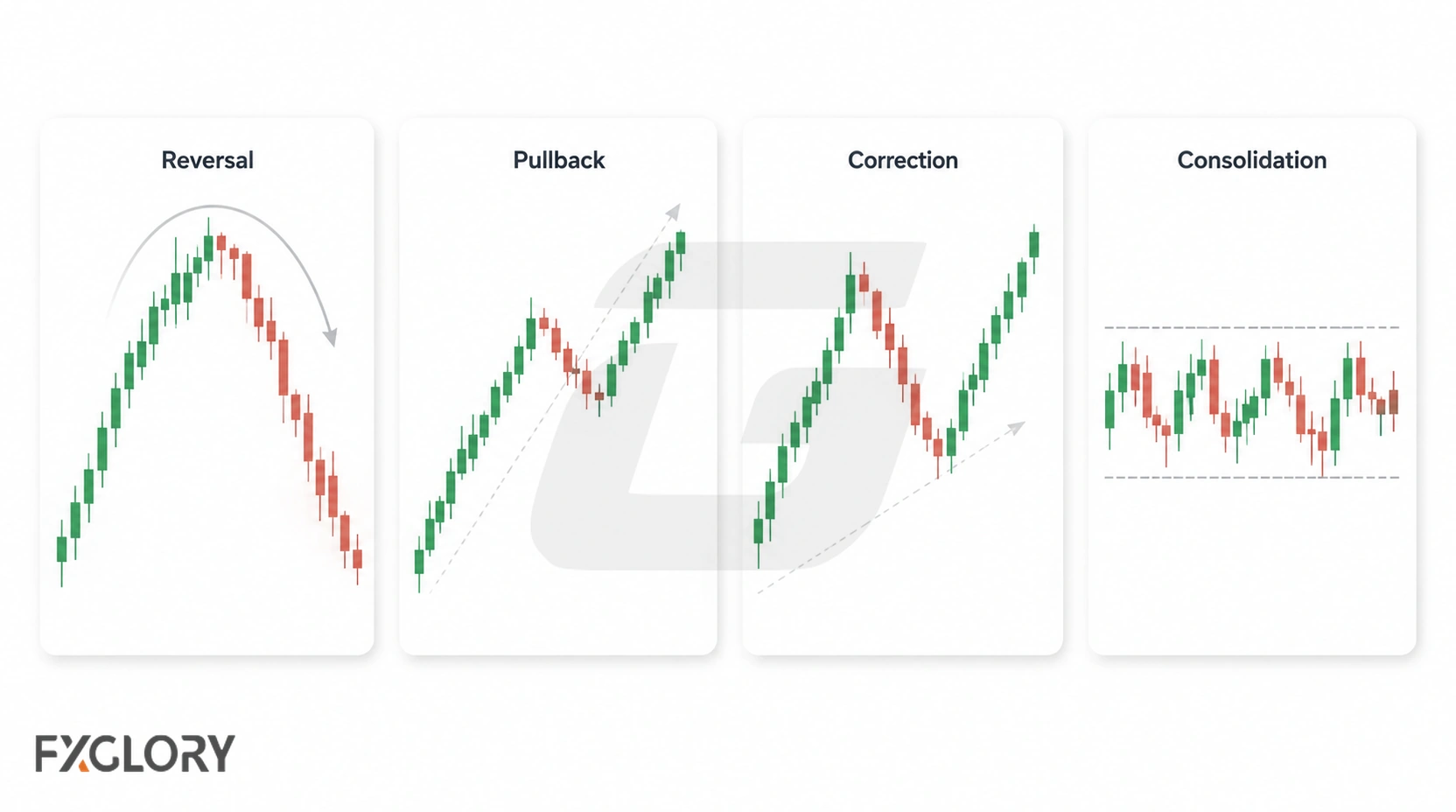
A reversal suggests that the broader direction may be shifting. A pullback is a temporary move against the current direction. A correction is a deeper counter-move that may still remain inside the broader trend. Consolidation is sideways movement where price has not chosen a clear direction.
| Market Behavior | What It Means | Why One Candle Is Not Enough |
|---|---|---|
| Reversal | The previous direction may be changing. | Price needs to show more than one moment of rejection, hesitation, or pressure shift. |
| Pullback | Price moves against the current direction temporarily. | A counter-candle may only be part of a normal pause. |
| Correction | Price moves more deeply against the prior move. | The broader trend may still remain intact. |
| Consolidation | Price moves sideways with no clear direction. | Many candle shapes can appear without strong meaning. |
A reversal candle becomes more useful when it appears after an extended move and near a chart area that already matters. Without that context, the candle may only show a pause, a pullback, or temporary volatility.
Bullish And Bearish Reversal Candles In Forex
Reversal candles are often described as bullish or bearish, but those words depend on what happened before the candle appeared.
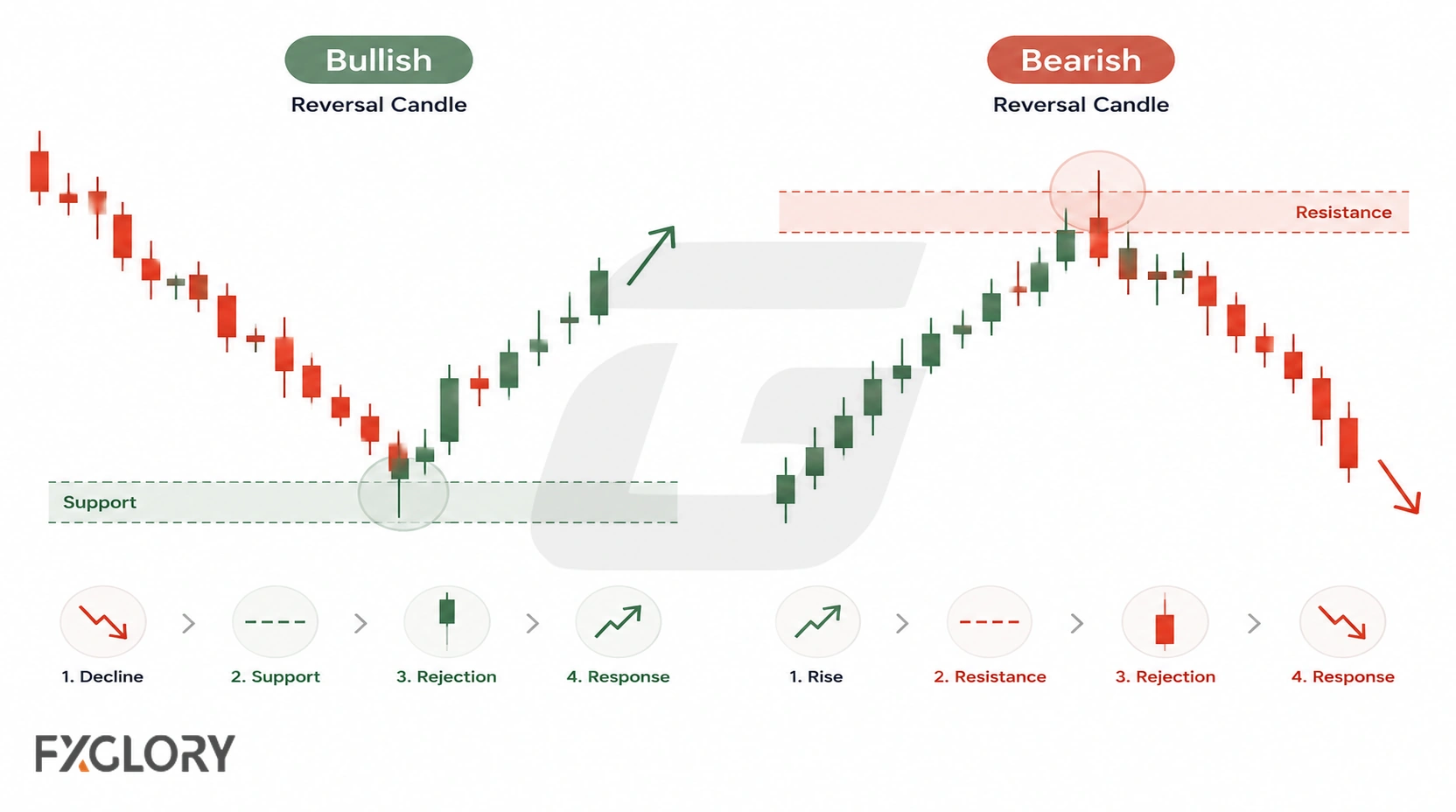
A bullish reversal candle is usually reviewed after selling pressure. It may suggest that sellers failed to hold lower prices or that buyers started to respond. A bearish reversal candle is usually reviewed after buying pressure. It may suggest that buyers failed to hold higher prices or that sellers started to respond.
The same candle structure can be less useful if it appears in the wrong location. A candle with a long lower wick may deserve attention after a decline into support, but it may say much less if it appears in the middle of an unclear range. A candle with a long upper wick may deserve attention after a rise into resistance, but it may not matter much inside choppy movement.
| Reversal Side | Usually Reviewed After | Common Chart Area | Basic Review Question |
|---|---|---|---|
| Bullish reversal candle | Selling pressure or a downward move. | Support, range low, swing low, or failed downside break. | Did price fail to hold lower levels? |
| Bearish reversal candle | Buying pressure or an upward move. | Resistance, range high, swing high, or failed upside break. | Did price fail to hold higher levels? |
| Neutral hesitation clue | Movement that starts to pause. | Any area where the prior move is slowing. | Is price pausing, or is direction actually changing? |
Expanded Forex Reversal Candle Map
The table below gives a controlled overview of common reversal-candle ideas. Use it as a map for further study, not as a shortcut for trade decisions.
| Formation | Usually Reviewed After | Basic Reversal Clue | Full Guide |
|---|---|---|---|
| Doji | A move that begins to pause. | Open and close are close together, showing balance or hesitation. | Study doji candles |
| Dragonfly doji | Selling pressure or a lower-price test. | Lower shadow shows price tested lower levels and recovered by the close. | Review dragonfly doji |
| Gravestone doji | Buying pressure or a higher-price test. | Upper shadow shows price tested higher levels and returned by the close. | Review gravestone doji |
| Spinning top | A move that starts to lose clarity. | Small body and two-sided shadows can show hesitation. | Review spinning top candles |
| Hammer | Selling pressure or a decline. | Long lower wick shows price tested lower levels but did not close there. | Review hammer candles |
| Inverted hammer | Selling pressure or a lower-price test. | Long upper wick shows a higher-price test after selling pressure. | Review inverted hammer candles |
| Shooting star | Buying pressure or a rise. | Long upper wick shows price tested higher levels but did not close there. | Review shooting star candles |
| Hanging man | Buying pressure or a rise. | Long lower wick after buying pressure can show a lower-price test during the candle. | Review hanging man candles |
| Engulfing candle | An existing move or pressure imbalance. | The second candle body overtakes the previous candle body. | Review engulfing candles |
| Harami | A large candle after a move. | A smaller inside candle can show contraction or hesitation after stronger movement. | Review harami candles |
| Piercing line | Selling pressure. | A bullish second candle recovers into the prior bearish candle body. | Review piercing line candles |
| Dark cloud cover | Buying pressure. | A bearish second candle moves into the prior bullish candle body. | Review dark cloud cover |
| Tweezer bottom | Selling pressure or a lower range test. | Nearby candles test similar lows and fail to hold below them. | Review tweezer top and bottom |
| Tweezer top | Buying pressure or a higher range test. | Nearby candles test similar highs and fail to hold above them. | Review tweezer top and bottom |
| Morning star | Selling pressure. | Three-candle sequence moves from bearish pressure, to pause, to bullish response. | Review morning star candles |
| Evening star | Buying pressure. | Three-candle sequence moves from bullish pressure, to pause, to bearish response. | Review evening star candles |
| Three white soldiers | Selling pressure, a range low, or a lower-price response area. | Three bullish candles can show sustained buyer response if the sequence is clean. | Review three white soldiers |
| Three black crows | Buying pressure, a range high, or a higher-price response area. | Three bearish candles can show sustained seller response if the sequence is clean. | Review three black crows |
Bullish Reversal-Focused Candles
Bullish reversal-focused candles are usually reviewed after selling pressure, a decline, a lower-price test, or a failed downside break. They do not confirm that a new upward trend has started. They only help traders review whether lower prices were rejected, selling pressure slowed, or buyers responded.
| Formation | Main Structure | Common Review Area | Deeper Guide |
|---|---|---|---|
| Hammer | Small body near the high with a long lower wick. | After selling pressure, near support, or near a swing low. | Hammer candle structure |
| Inverted hammer | Small body with a long upper wick after selling pressure. | After a decline or lower-price test. | Inverted hammer structure |
| Dragonfly doji | Doji body near the high with a long lower shadow. | After selling pressure, near support, or near a range low. | Dragonfly doji structure |
| Piercing line | Two-candle recovery into the prior bearish body. | After selling pressure. | Piercing line structure |
| Tweezer bottom | Nearby candles test similar lows. | Near support, range lows, or repeated lower-price tests. | Tweezer bottom comparison |
| Morning star | Three-candle bearish-pressure, pause, bullish-response sequence. | After selling pressure or near a lower-price response area. | Morning star sequence |
| Three white soldiers | Three consecutive bullish candles. | After selling pressure, near a base, or after a lower-price response. | Three white soldiers sequence |
Bearish Reversal-Focused Candles
Bearish reversal-focused candles are usually reviewed after buying pressure, a rise, a higher-price test, or a failed upside break. They do not confirm that a new downward trend has started. They only help traders review whether higher prices were rejected, buying pressure slowed, or sellers responded.
| Formation | Main Structure | Common Review Area | Deeper Guide |
|---|---|---|---|
| Shooting star | Small body near the low with a long upper wick. | After buying pressure, near resistance, or near a swing high. | Shooting star structure |
| Hanging man | Small body with a long lower wick after buying pressure. | After a rise or higher-price advance. | Hanging man structure |
| Gravestone doji | Doji body near the low with a long upper shadow. | After buying pressure, near resistance, or near a range high. | Gravestone doji structure |
| Dark cloud cover | Two-candle pushback into the prior bullish body. | After buying pressure. | Dark cloud cover structure |
| Tweezer top | Nearby candles test similar highs. | Near resistance, range highs, or repeated higher-price tests. | Tweezer top comparison |
| Evening star | Three-candle bullish-pressure, pause, bearish-response sequence. | After buying pressure or near a higher-price response area. | Evening star sequence |
| Three black crows | Three consecutive bearish candles. | After buying pressure, near a top, or after a higher-price rejection area. | Three black crows sequence |
Context-Dependent Reversal Clues
Some candle formations can appear near possible turning areas, but they are not automatically bullish or bearish. Their meaning depends heavily on prior movement, chart location, body structure, wick direction, and follow-up candles.
| Formation | Why It Is Context-Dependent | Best Use On This Page | Deeper Guide |
|---|---|---|---|
| Doji | It shows open-close balance, not a fixed reversal direction. | Review hesitation after a move or near a level. | Doji candle guide |
| Spinning top | It shows a small body with two-sided movement, not a fixed outcome. | Review uncertainty or balance after a stronger move. | Spinning top guide |
| Engulfing | It can be bullish or bearish depending on direction and prior move. | Review two-candle body takeover after pressure. | Engulfing candle guide |
| Harami | It shows contraction after a larger candle and can appear in many contexts. | Review pause or compression after movement. | Harami guide |
| Marubozu | It shows full-body pressure, which may continue a move or appear near a pressure shift. | Review strong one-candle body pressure, not a reversal by itself. | Marubozu candle guide |
| Pin bar | It is a broad long-wick rejection concept and needs direction, location, and prior movement. | Review failed price acceptance at a visible area. | Pin bar guide |
These context-dependent formations can support reversal review, but they should not replace the more specific child pages. Use the deeper guides when the structure itself needs a precise definition.
Types Of Forex Reversal Candle Structures
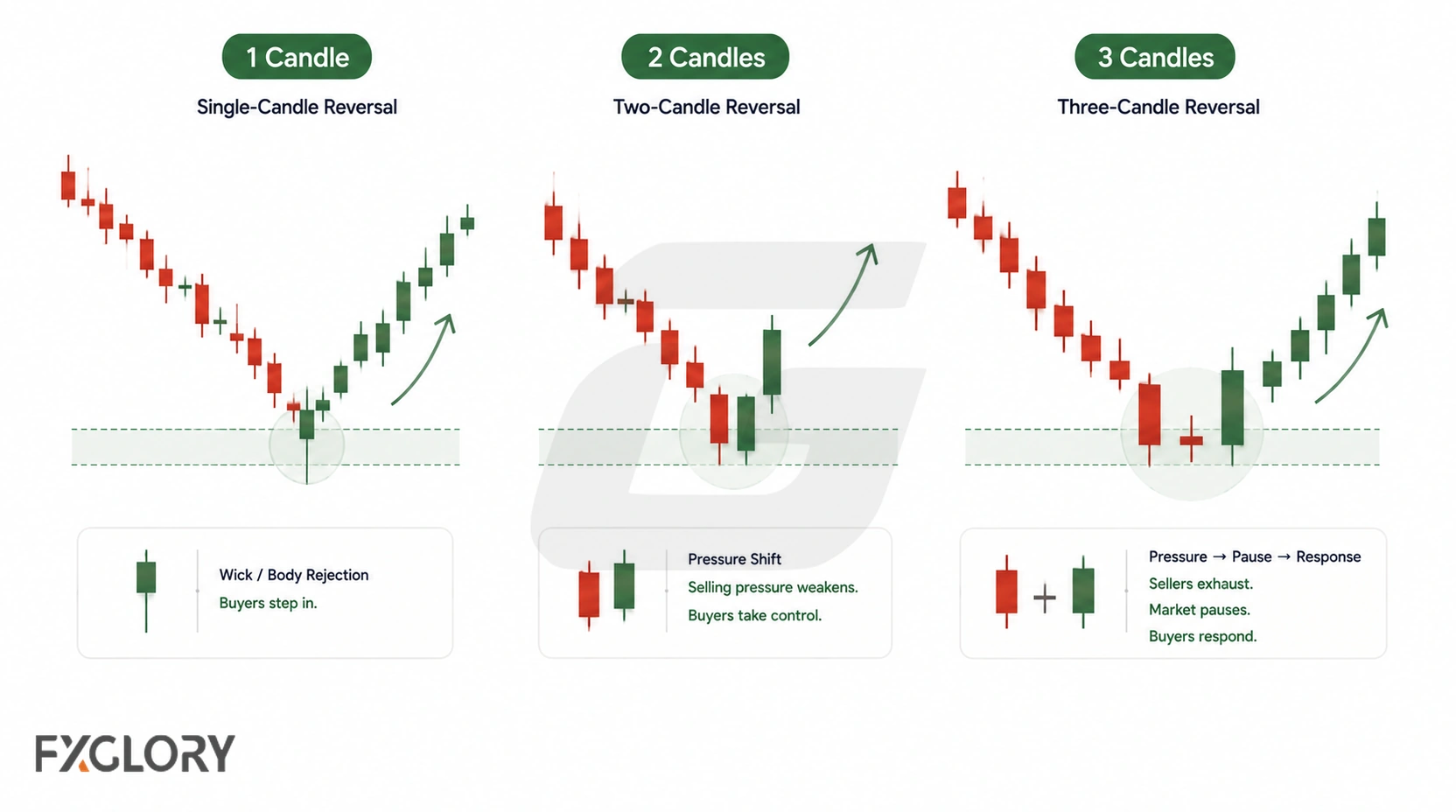
Reversal candles can be grouped by structure. Some use one candle, some compare two candles, and some require several candles to form a broader turning-point sequence. The structure helps describe the formation, but the surrounding market still matters.
Single-Candle Reversal Structures
Single-candle reversal structures usually rely on the relationship between the body, wick, and close location. They can show hesitation, rejection, or a failure to hold one side of the candle range. Because they use only one candle, they can be easy to spot and easy to overread.
Single-candle structures on this page include doji, dragonfly doji, gravestone doji, spinning top, hammer, inverted hammer, shooting star, hanging man, marubozu, and pin bar. Each one has a different body-and-wick structure, so they should not be merged into one reversal idea.
Two-Candle Reversal Structures
Two-candle reversal structures compare the first candle with the second candle. The second candle may show that pressure from the first candle weakened, failed, compressed, or changed. These formations can be easier to review than one-candle structures because they include a small before-and-after sequence.
Two-candle structures on this page include engulfing, harami, piercing line, dark cloud cover, and tweezer top or bottom formations. They still need a meaningful prior move, useful chart location, and follow-up movement.
Three-Candle Reversal Structures
Three-candle reversal structures use a short sequence. Morning star and evening star use a first pressure candle, a smaller pause candle, and a response candle. Three white soldiers and three black crows use three candles in the same direction to show sustained pressure.
Three-candle structures can offer more information than a single candle, but they can also appear late in a move. The sequence should be clean, and the chart should not be ignored just because three candles have formed.
Forex Reversal Candle Reference Table
The table below groups reversal-candle ideas by what they may describe. It is a reading aid, not a trading instruction.
| Reversal Candle Group | Typical Chart Position | What It May Suggest | What To Check Next |
|---|---|---|---|
| Small-body hesitation candle | After a move or near a tested area. | The previous side may be losing control or pausing. | Check whether later candles confirm hesitation or reject the area. |
| Long lower-wick candle | After selling pressure or near support. | Price tested lower levels but did not close there. | Check whether support holds and whether later candles stay above the rejection area. |
| Long upper-wick candle | After buying pressure or near resistance. | Price tested higher levels but did not close there. | Check whether resistance holds and whether later candles stay below the rejection area. |
| Full-body pressure candle | After a pause, near a level, or inside a directional move. | One side controlled most of the candle period. | Check whether the candle is fresh pressure, late pressure, or news-driven movement. |
| Two-candle pressure shift | After an existing move or near a level. | The second candle changed the message of the first candle. | Check whether the second close appears in a meaningful chart area. |
| Two-candle compression | After a larger candle or extended move. | Price may be pausing before the next clearer movement. | Check whether the smaller candle forms in a useful location. |
| Repeated level test | Around support, resistance, range highs, or range lows. | Price retested an area and failed to hold beyond it. | Check whether the repeated level is visible on the broader chart. |
| Three-candle turning attempt | After extended movement or near a tested area. | Momentum may be shifting over several candles. | Check whether the sequence has clean structure and follow-up reaction. |
| Failed breakout candle | Around a range edge, high, low, support, or resistance. | Price moved beyond an area but did not hold there. | Check whether price returns inside the prior range or retests the broken area. |
Where Forex Reversal Candles Matter More
A reversal candle becomes easier to evaluate when it appears in a location that already matters on the chart. Without a meaningful location, many reversal candles are only random shapes inside normal price movement.
After An Extended Move
Reversal candles are usually more relevant after price has already moved in one direction. If there was no clear move before the candle, there may be nothing meaningful to reverse.
Near Support Or Resistance
A reversal candle near a tested support or resistance area can show how price behaved around a level that traders may already be watching. The level does not guarantee a turn, but it gives the candle a clearer place on the chart.
Near Swing Highs Or Swing Lows
Swing highs and swing lows can help traders compare the latest candle with previous turning areas. A rejection candle near a previous swing can be easier to read than the same candle in the middle of a range.
At Range Edges
In a range, reversal candles near the top or bottom of the range can be more informative than candles in the center. The middle of a range often creates mixed candle shapes with weaker meaning.
After A Failed Break
A candle that breaks beyond a level and then closes back away from it may show that price failed to hold the breakout area. This can be useful to review, but it still needs later price action and risk awareness.
After A Momentum Slowdown
Some reversal readings become easier when the prior move already shows smaller bodies, weaker closes, overlapping candles, or repeated failed attempts to continue. The reversal candle is then part of a broader slowdown rather than a sudden standalone clue.
For observation, a trader can compare candle behavior on live market pages such as GBP/USD around visible swings or gold around larger candle ranges. These pages are useful for chart review, not as standalone trading signals.
- Ask whether there was a clear move before the candle.
- Check whether the candle formed near support, resistance, a range edge, or a swing point.
- Compare the candle close with the level being tested.
- Review whether later price action respects or cancels the candle area.
How To Read Forex Reversal Candles
A reversal-candle workflow helps prevent rushed conclusions. The goal is to review the candle as part of a chart sequence, not as a standalone instruction.
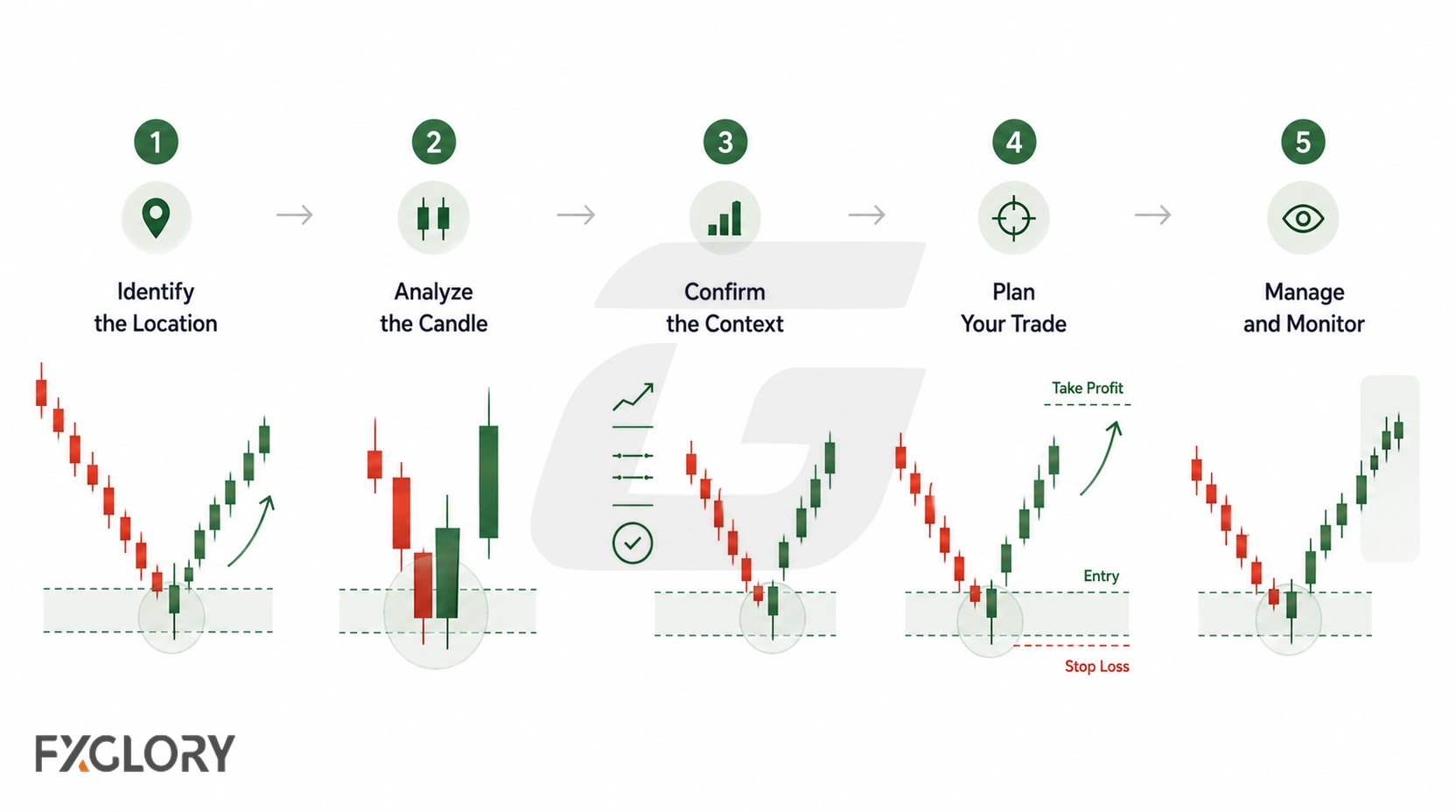
- Start with the prior move: Decide whether price was rising, falling, ranging, or moving without clear structure.
- Check the candle location: Look for support, resistance, range edges, swing highs, swing lows, or a failed break area.
- Read the candle structure: Compare body size, wick length, close location, and full candle range.
- Classify the clue: Decide whether the candle shows hesitation, rejection, a pressure shift, compression, repeated testing, or only noise.
- Compare the timeframe: Review whether the candle matters on the timeframe controlling the chart plan.
- Review market conditions: Consider volatility, spread, liquidity, rollover, and scheduled news events.
- Watch the follow-up: See whether later candles respect the reversal area or move back against the idea.
- Define the weak point: Know where the reversal reading would no longer make sense.
Some traders review reversal candles alongside other technical tools. For example, RSI can add momentum context, ATR can add volatility context, and Bollinger Bands can help review range and expansion conditions. These tools can support reversal review, but they do not remove trading risk.
False Reversal Candles In Forex
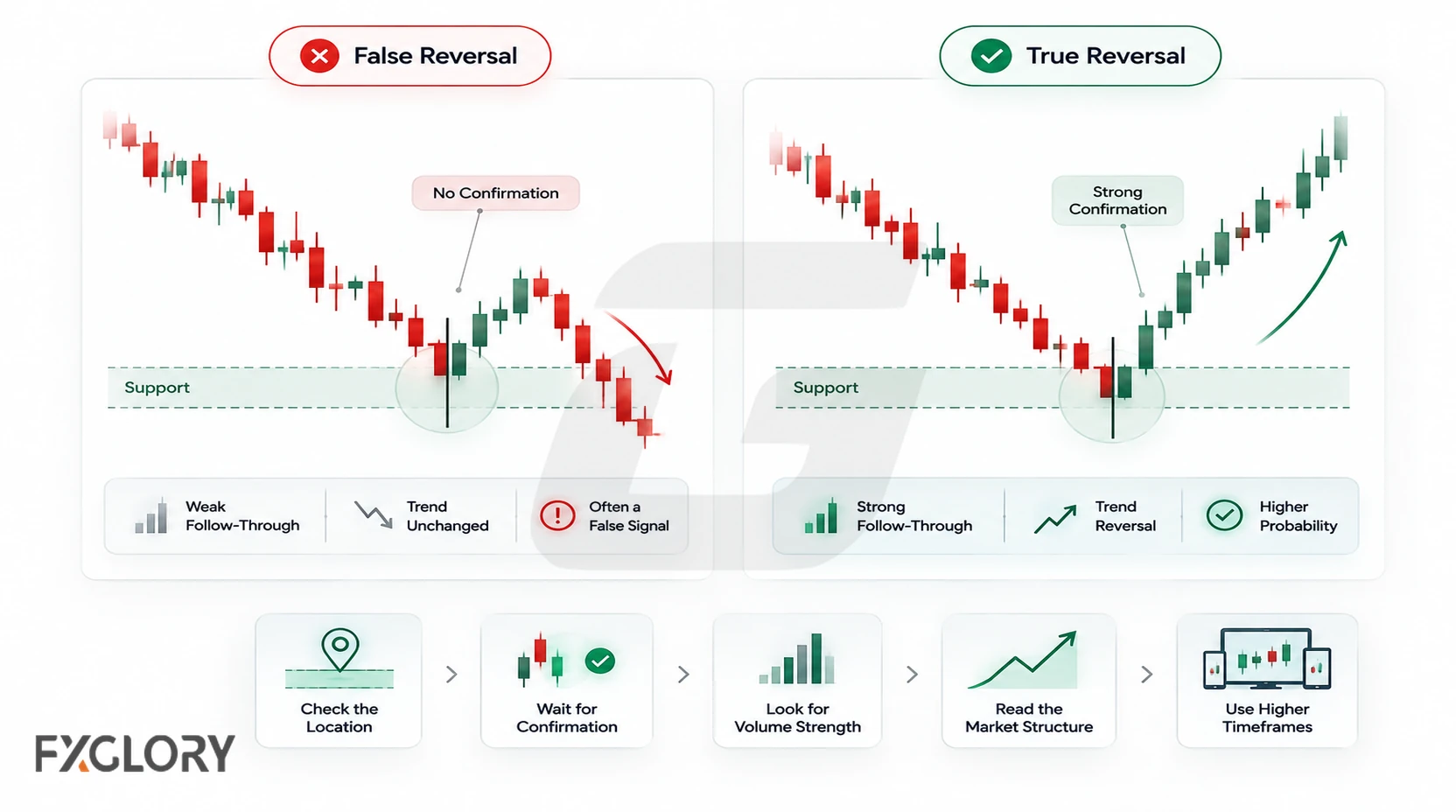
A false reversal candle appears to suggest a turning point, but price later continues in the previous direction or becomes unclear. False reversal readings are common because one candle can be shaped by temporary volatility, low liquidity, or a brief reaction at a level.
News-Driven Candles
Major economic events can create sharp candle ranges, long wicks, and fast direction changes. These candles may look clear after the fact, but they can be difficult to interpret in real time when spreads and execution conditions are changing quickly.
Low-Liquidity Candles
During quieter periods, market opens, or rollover conditions, candles may form unusual wicks or small bodies. These shapes may reflect thin trading conditions rather than a useful reversal clue.
Messy Range Candles
Sideways ranges often produce many candles that look like reversals. If price is overlapping, chopping, and repeatedly crossing the same area, the candle structure may not provide a clear reading.
Countertrend Candles Without Structure Change
A candle against the trend may only be a pullback. If the broader structure remains intact, calling the candle a reversal may be too early.
Late Candles After Exhaustion
A candle sequence can look strong after a move is already extended. For example, three bullish candles after a long rise or three bearish candles after a long decline may show late pressure rather than a fresh reversal clue.
Unfinished Candles
A candle can look like a reversal before the timeframe closes and then finish with a different body, wick, or close location. Reversal candles should be reviewed after the candle has completed.
- Skip the candle when it forms in the middle of unclear price action.
- Be careful around news when candle size and spread conditions can change quickly.
- Do not read unfinished candles as completed reversal formations.
- Compare the timeframe before assuming a short-term candle changes the broader direction.
- Avoid forced labels when the formation is hard to explain clearly.
- Watch for late pressure when a sequence appears after an already extended move.
Common Mistakes With Forex Reversal Candles
Reversal candles can be helpful for chart review, but they are easy to misuse when the trader focuses on the candle shape and ignores the surrounding market.
- Calling every counter-candle a reversal: A candle against the current move may only be a pullback, correction, or short pause.
- Ignoring the prior move: A reversal candle needs something to reverse. If there was no clear move before it, the reading may be weak.
- Reading the candle away from a level: Reversal candles usually need a meaningful chart area, such as support, resistance, a swing point, or a range edge.
- Using the pattern name too early: The candle name matters less than body size, wick length, close location, and the chart environment.
- Reading before the candle closes: A candle can change shape before the timeframe finishes, so the completed close matters.
- Confusing similar structures: Dragonfly doji and hammer, gravestone doji and shooting star, inverted hammer and shooting star, and hammer and hanging man need different context checks.
- Treating hesitation as reversal: Doji, spinning top, and harami can show pause or compression without proving a turn.
- Treating body pressure as reversal: Marubozu, three white soldiers, and three black crows can show strong pressure, but strong pressure can also appear late or during continuation.
- Ignoring spread, liquidity, and news risk: Large reversal-looking candles can form during unstable conditions that are difficult to act on in real time.
- Replacing risk planning with reversal confidence: A reversal candle should not replace position sizing, risk limits, and a clear area where the reading becomes weak.
What To Study After Forex Reversal Candles
After learning how reversal candles are reviewed, the next step is to study individual formations separately. Each candle has its own structure, chart context, and common mistake filters.
For bullish reversal-focused structures, continue with the hammer candle guide, the inverted hammer guide, the dragonfly doji guide, the piercing line guide, the tweezer bottom guide, the morning star guide, or the three white soldiers guide.
For bearish reversal-focused structures, continue with the shooting star guide, the hanging man guide, the gravestone doji guide, the dark cloud cover guide, the tweezer top guide, the evening star guide, or the three black crows guide.
For broader context-dependent formations, review the doji candle guide, the spinning top guide, the engulfing candle guide, the harami guide, the marubozu candle guide, or the pin bar guide. For the full candle library, return to forex candlestick pattern categories.