
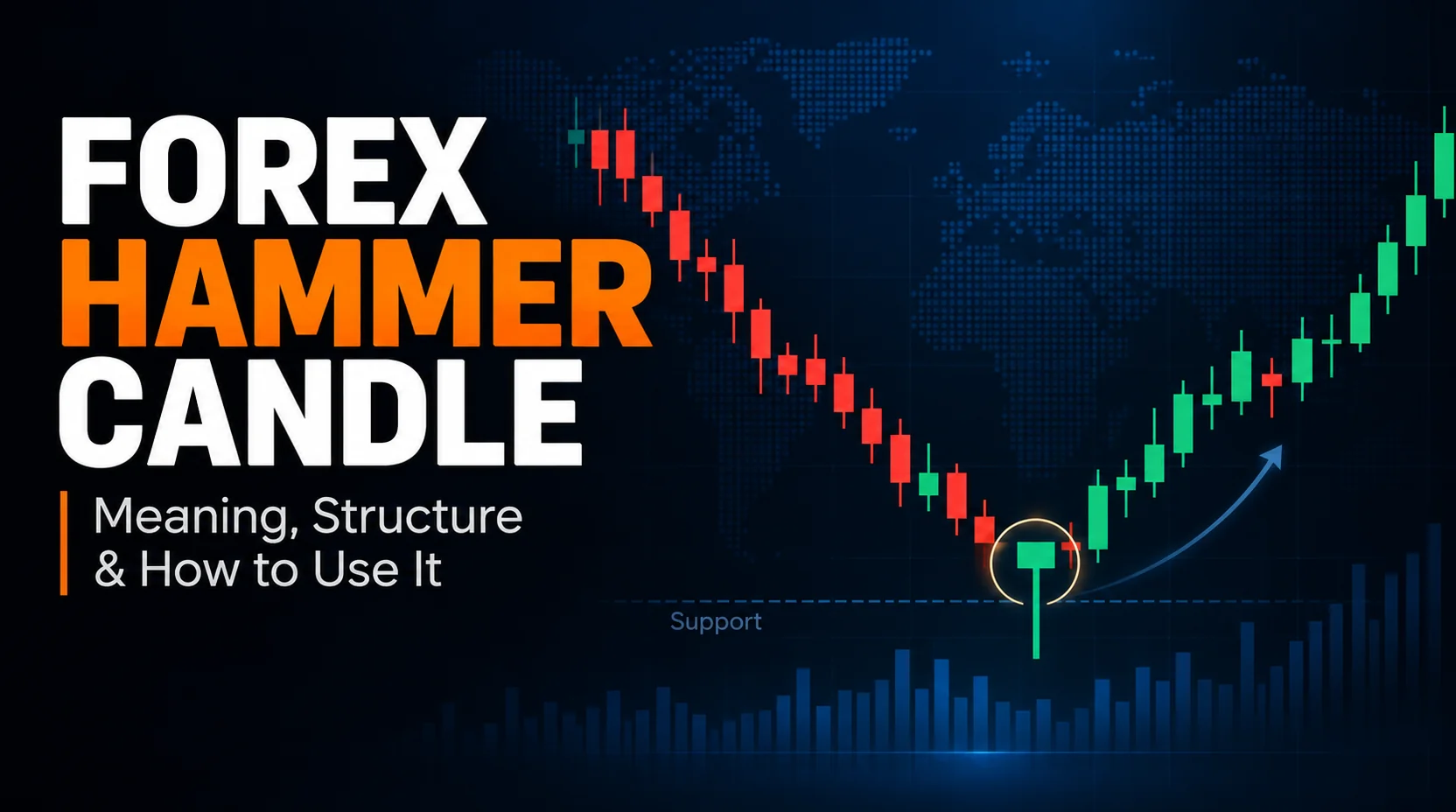
What Is A Forex Hammer Candle?
A forex hammer candlestick is a candle with a small body near the top of the candle range and a long lower wick. The candle shows that price moved lower during the selected timeframe but closed away from the low.
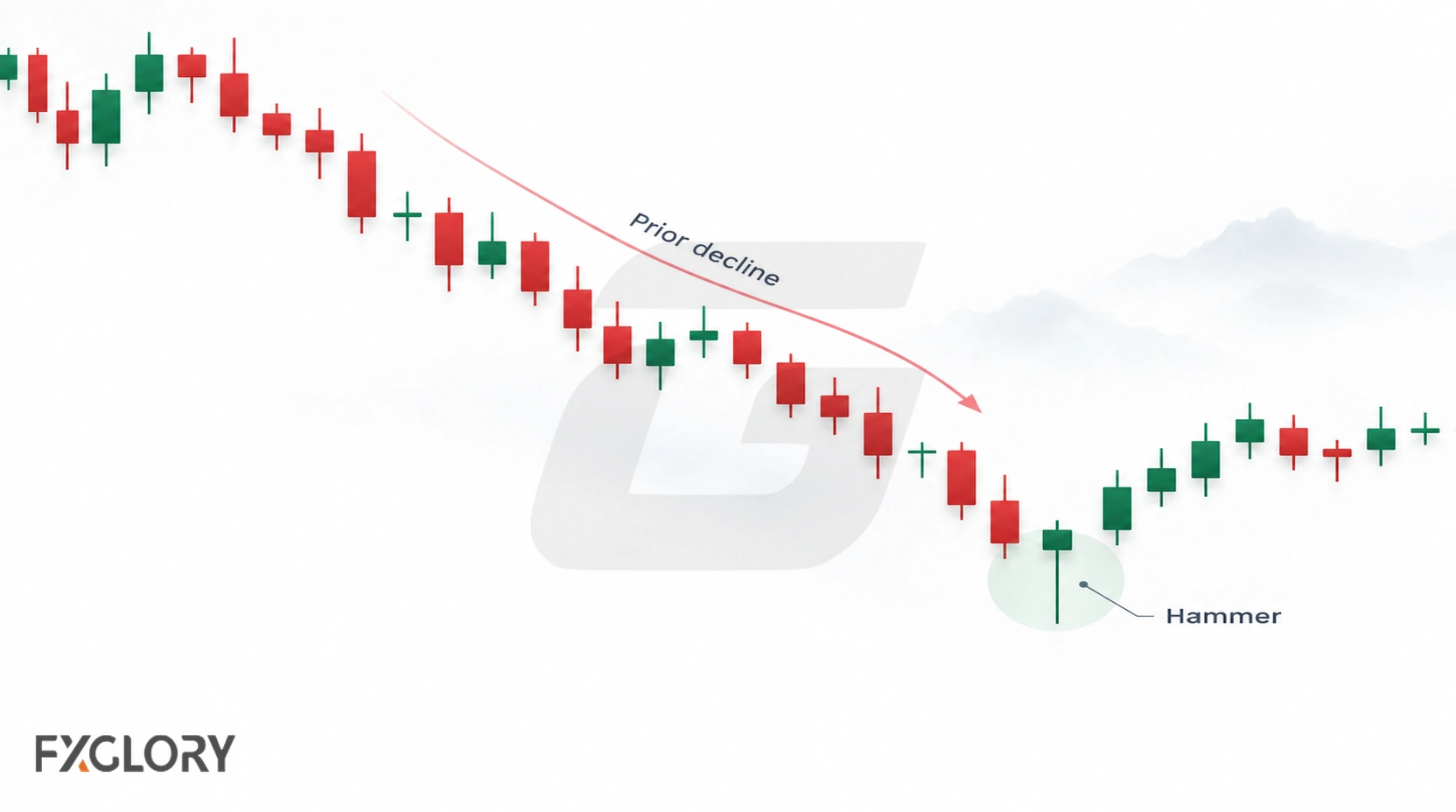
The hammer shape is usually reviewed after selling pressure. The long lower wick shows that price traded below the candle body but recovered before the close. Traders may interpret this as rejection of lower prices, particularly when the candle forms near support, a swing low, a range low, or a failed downside break.
A hammer candle does not prove that price will rise. It is a lower-wick rejection clue. The useful question is whether the prior move, chart location, candle close, and later reaction make the candle worth reviewing.
If you need the basic candle parts first, review the body, wick, open, and close relationship. A hammer uses those same candle parts, but its message depends mainly on the small body near the top and the long lower wick.
Forex Hammer Candle Anatomy
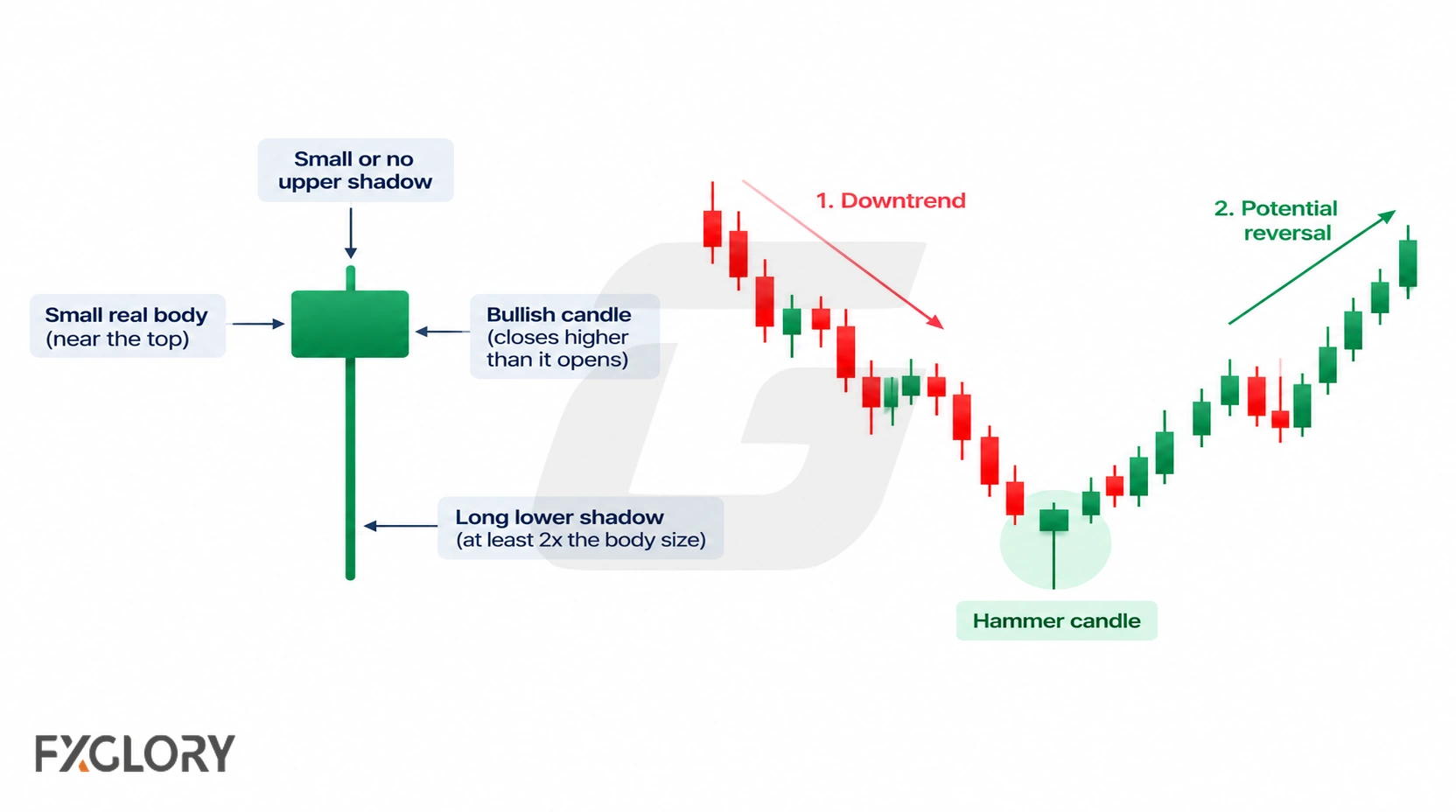
The anatomy of a hammer candle has three main parts: a small body, a long lower wick, and little or no upper wick. The body can be bullish or bearish, but the shape and location are usually more important than the candle color.
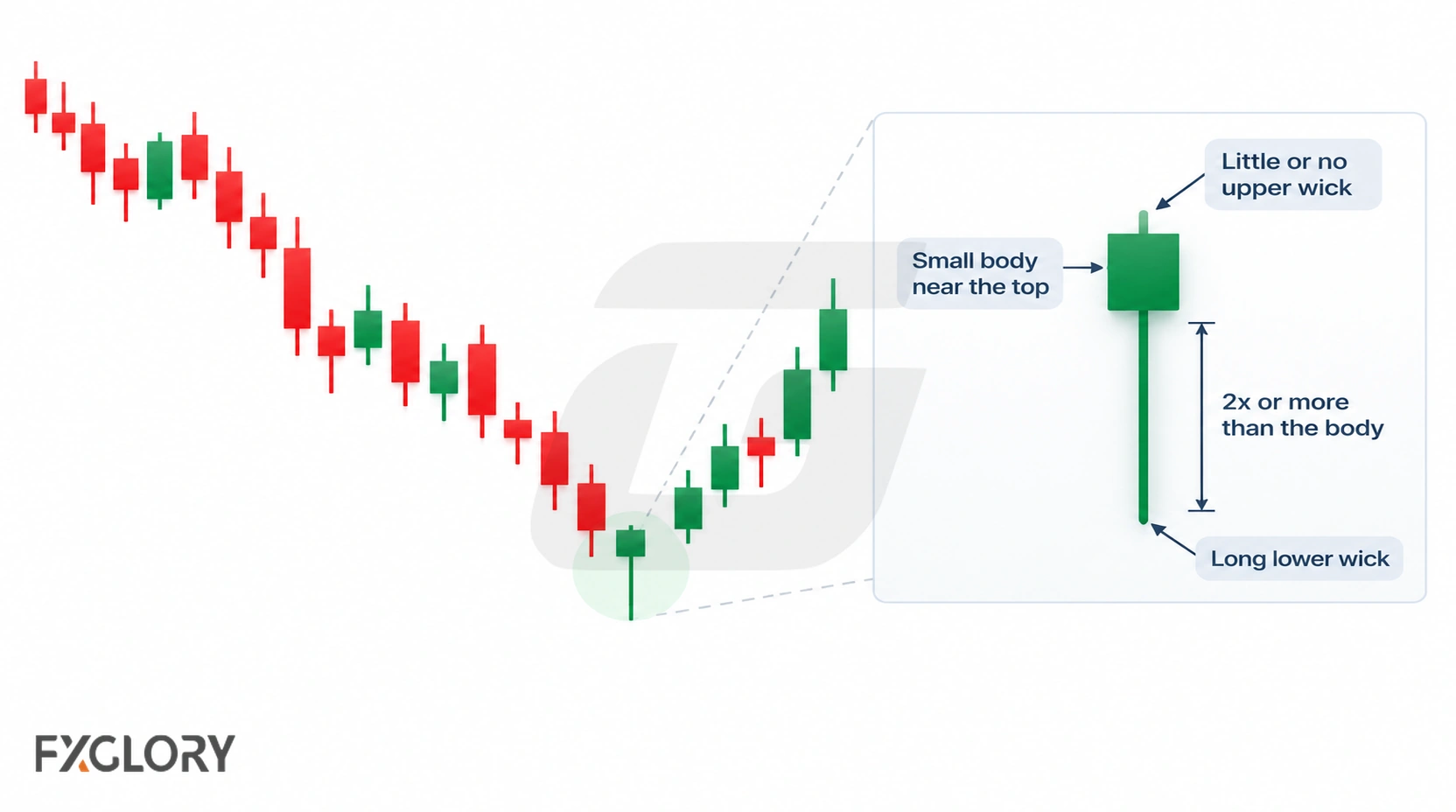
A clean forex hammer pattern is built around lower-wick rejection. Price explores lower levels during the candle, then finishes closer to the upper part of the range. That structure is what separates a hammer from a random small-bodied candle.
| Hammer Part | What It Shows | Reading Caution |
|---|---|---|
| Small body near the top | The candle closed near the upper part of its range. | A small body alone does not make a hammer. |
| Long lower wick | Price traded lower but did not close near the low. | The wick should be clear compared with the body. |
| Little or no upper wick | Price did not spend much range above the body. | A large upper wick can weaken the hammer shape. |
| Full candle range | The distance between the high and low. | A very wide candle may reflect news or abnormal volatility. |
| Close location | Where price finished inside the candle range. | A close near the top usually supports the hammer shape more clearly. |
Many traders look for the lower wick to be clearly longer than the body. A common visual rule is that the lower wick should be much longer than the body, often around twice the body length or more. This is a guide for recognizing the shape, not a guarantee that the candle is useful.
Why Prior Selling Pressure Matters
A hammer candle needs something to push back against. That is why prior selling pressure matters. If there was no clear downward move, no pullback, or no test of lower prices before the hammer appeared, the candle may not carry much information.
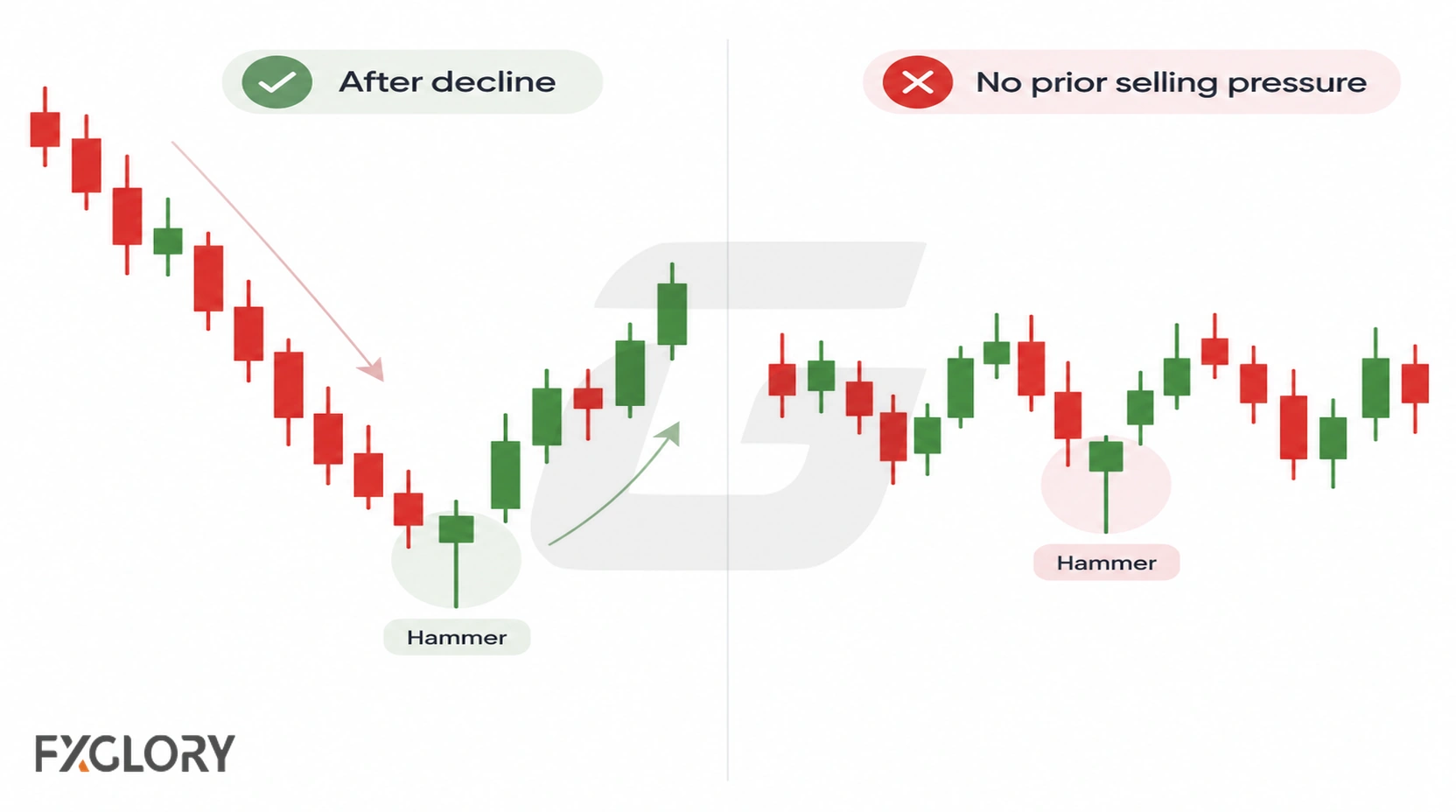
After a decline, a hammer may show that price tested lower levels and then recovered before the candle closed. Near support, that recovery can be easier to review because the candle appears around a chart area that already matters. In the middle of unclear sideways movement, the same candle may only be noise.
The hammer should also be compared with the candles before it. Was price making lower lows? Was the decline stretched? Did the candle appear near a previous swing low? Did the lower wick reject a level that was already visible? These questions help separate a cleaner hammer from a random long-wick candle.
- Clearer hammer context: Prior selling pressure, a meaningful chart area, a long lower wick, and a close away from the low.
- Weaker hammer context: No prior decline, no useful level, overlapping candles, or a shape that only appears during random range movement.
Hammer vs Similar Forex Candles
Hammer candles can look similar to other candlestick formations. Comparing them carefully helps avoid forcing the wrong label onto the chart.
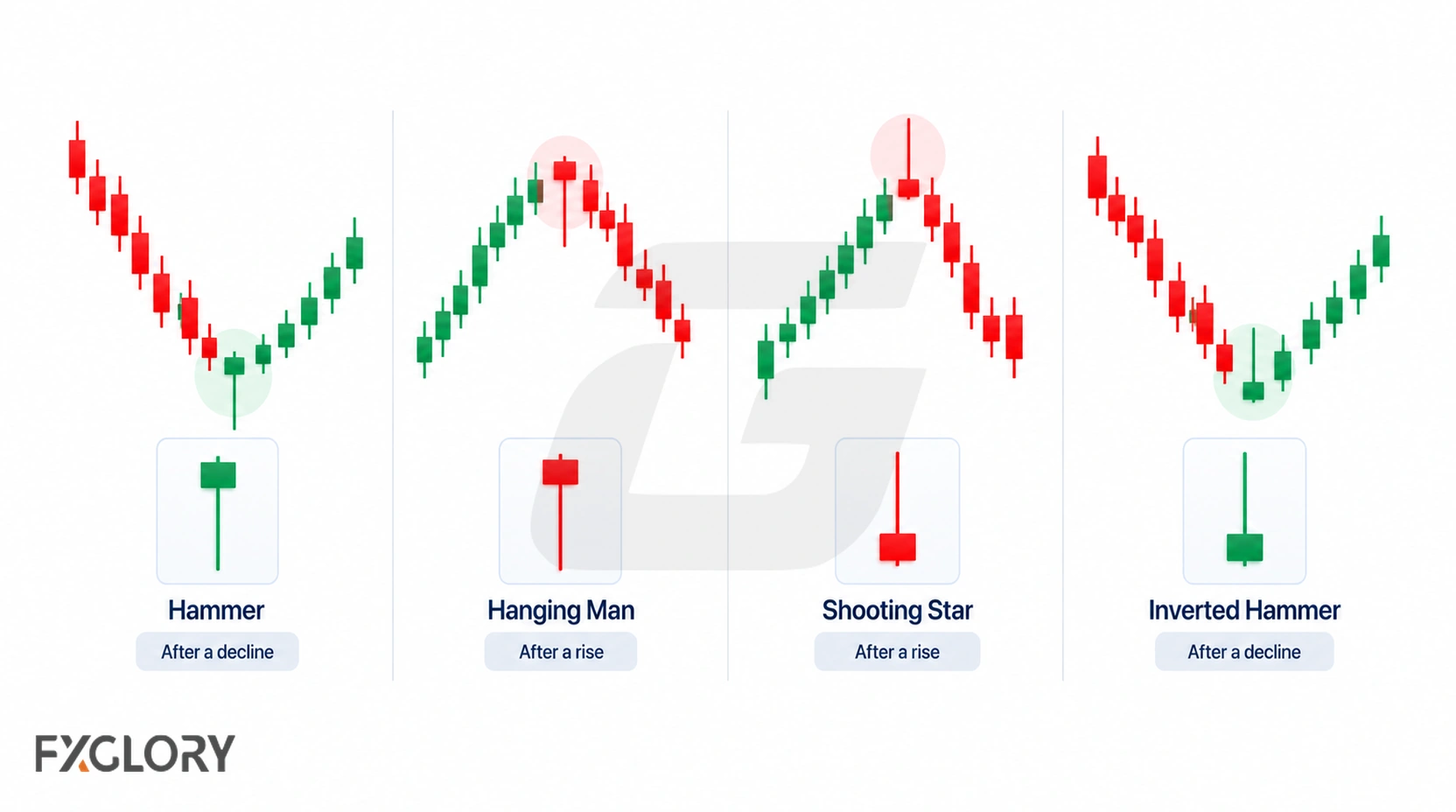
| Candle | Main Shape | Usually Reviewed After | Main Difference |
|---|---|---|---|
| Hammer | Small body near the top with a long lower wick. | Selling pressure or a decline. | Focuses on lower-wick rejection after price traded lower. |
| Doji | Open and close are equal or almost equal. | Any area where price pauses. | Focuses on open-close balance, not necessarily lower-wick rejection. |
| Pin bar | Long wick with a smaller body. | A level test or failed move. | Broader long-wick rejection idea; a hammer can overlap with bullish pin-bar reading. |
| Shooting star | Small body near the bottom with a long upper wick. | Buying pressure or a rise. | Opposite wick position compared with a hammer. |
| Hanging man | Small body near the top with a long lower wick. | Buying pressure or an upward move. | Same basic shape as a hammer, but different prior context. |
| Inverted hammer | Small body near the bottom with a long upper wick. | Selling pressure or a decline. | Different wick position from a hammer and needs separate review. |
For deeper comparison, use the separate guides for open-close balance candles, long-wick rejection candles, and the upper-wick counterpart after buying pressure.
Forex Hammer Candle Strength Filter
A hammer candle does not have the same value in every chart condition. The table below helps separate clearer hammer readings from weaker ones.
| Hammer Factor | Stronger Reading | Weaker Reading |
|---|---|---|
| Prior move | The candle appears after selling pressure, a pullback, or a decline. | The candle appears with no clear prior selling pressure. |
| Chart location | The candle forms near support, a swing low, a range low, or a failed downside break. | The candle forms in the middle of random price movement. |
| Lower wick | The lower wick is clearly longer than the body. | The lower wick is short, unclear, or only slightly larger than the body. |
| Body position | The body is near the top of the candle range. | The body sits too close to the middle of the candle range. |
| Upper wick | The upper wick is small or absent. | The upper wick is large enough to confuse the structure. |
| Market conditions | Spread and volatility conditions are stable enough for chart review. | The candle forms during abnormal news movement, rollover, or thin liquidity. |
| Later price reaction | Later candles respect the lower-wick area or clarify the reaction. | Later candles immediately break below the hammer area and weaken the clue. |
Where Forex Hammer Candles Matter More
A hammer candle becomes easier to evaluate when it appears in a place where a lower-price test already matters. Without a useful chart location, the hammer shape may only be a random long wick.
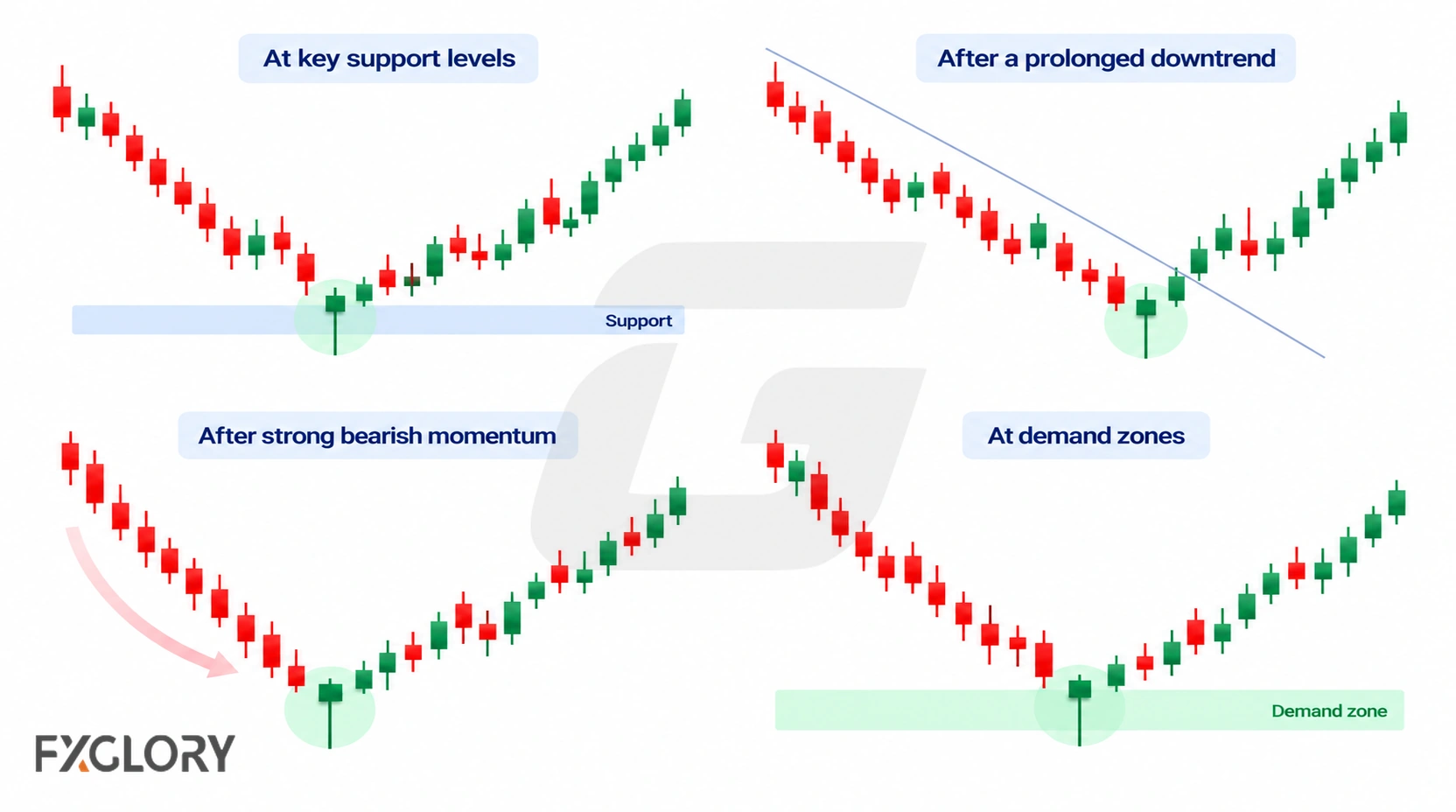
Near Support
A hammer near support can show how price behaved when it tested lower levels around an area traders may already be watching. Support does not guarantee a turn, but it gives the candle a clearer chart location.
Near A Swing Low
A swing low gives the hammer a reference point. If price tests a previous low and leaves a long lower wick, the candle becomes easier to review than the same shape in the middle of a range.
At A Range Low
Inside a range, a hammer near the lower boundary can be more informative than a hammer in the center of the range. The range low gives context to the lower wick.
After A Failed Downside Break
A hammer can appear when price briefly moves below a level and then closes back above the lower area. This can show that the downside break did not hold during that candle, but later price action still matters.
After A Pullback In A Broader Uptrend
Sometimes a hammer forms during a pullback inside a broader upward move. In that case, the candle should be reviewed as part of the larger structure, not as a standalone reason to act.
For observation, a trader can compare hammer-like lower wicks on live market pages such as GBP/USD around visible swing lows or gold during wider candle ranges. These pages are useful for chart review, not as standalone trading signals.
- Check whether there was selling pressure before the hammer.
- Review whether the candle formed near support, a swing low, a range low, or a failed break.
- Compare the lower wick with the candle body.
- Watch whether later candles respect or weaken the hammer area.
Forex Hammer Candle Reading Table
The table below shows how the same hammer shape can change depending on chart location.
| Hammer Location | Possible Reading | What To Check Next |
|---|---|---|
| After a decline | Selling pressure may be weakening during that candle. | Check the next candles and nearby support. |
| Near support | Price tested lower levels near a known area. | Check whether price holds above the lower-wick area. |
| Near a swing low | The candle reacted near a previous turning area. | Compare the current low with the earlier swing low. |
| At a range low | Price tested the lower part of a range. | Check whether the range boundary remains respected. |
| Middle of a range | The candle may only be normal range noise. | Check whether a meaningful level is nearby. |
| During news volatility | The long wick may reflect unstable movement. | Review spread, candle range, and execution conditions. |
| Without prior selling pressure | The hammer label may be weak. | Check whether there is anything meaningful to reject. |
How To Read A Hammer Candle In Forex
A simple workflow helps keep hammer reading disciplined. The goal is to decide what the candle shows before giving the shape more meaning than it deserves.
- Check the timeframe: Decide whether the hammer reflects a short-term reaction or a broader candle period.
- Review the prior move: Look for selling pressure, a pullback, a decline, or a test of lower levels.
- Read the candle body: Confirm that the body is small and placed near the upper part of the range.
- Compare the wicks: Check whether the lower wick clearly dominates the candle.
- Check the location: Look for support, swing lows, range lows, failed breaks, or other meaningful chart areas.
- Watch the next reaction: Review whether later candles respect the lower-wick area or make the hammer irrelevant.
- Review conditions: Consider volatility, spread, liquidity, and scheduled news events.
- Define the weak point: Know where the hammer reading would no longer make sense.
Some traders compare hammer candles with technical indicators for additional context. For example, RSI can add momentum context, ATR can add volatility context, and Bollinger Bands can help review range and expansion conditions. These tools can support hammer review, but they do not remove trading risk.
False Hammer Candles In Forex
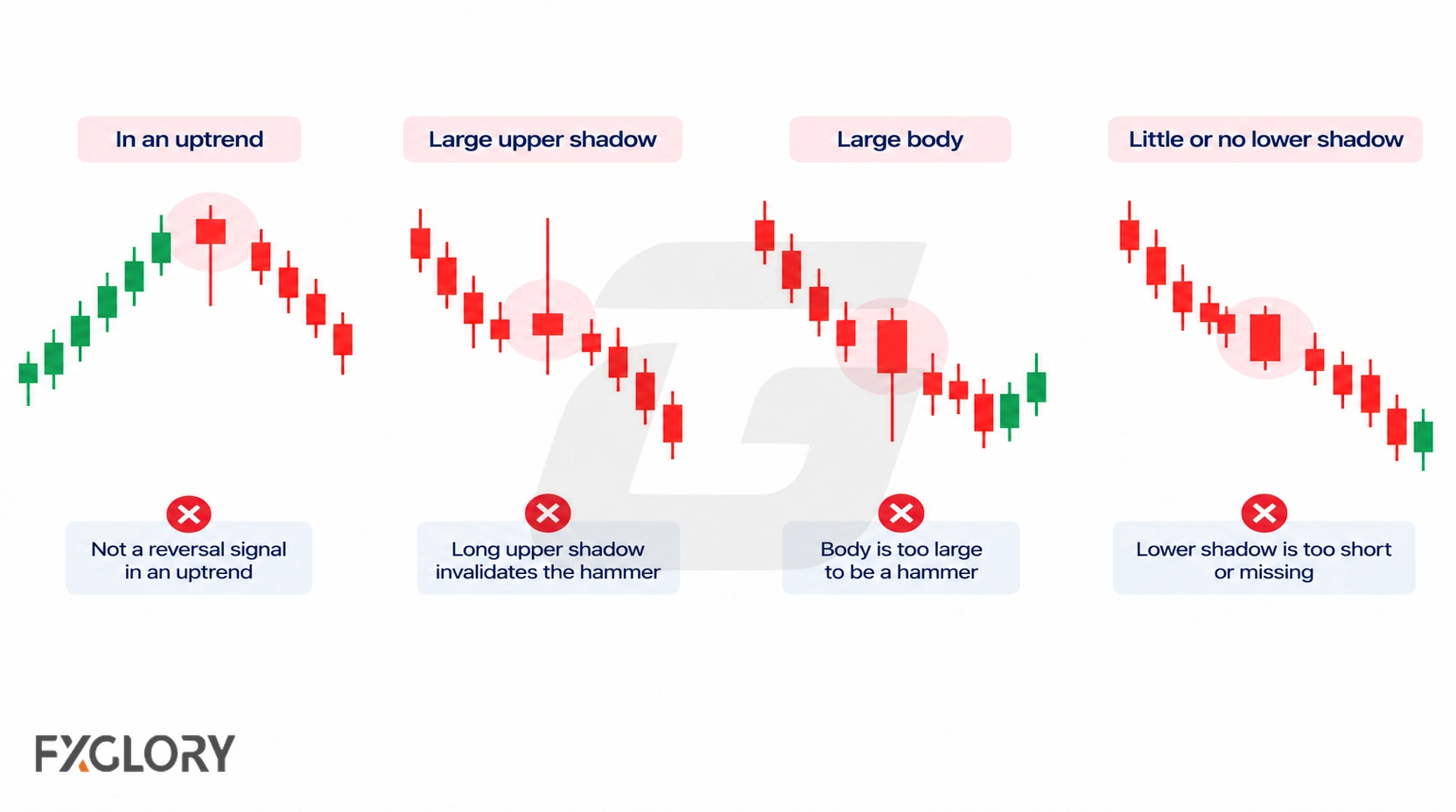
Not every hammer-looking candle meets the structural requirements of a hammer, and not every valid hammer provides a useful bullish reversal clue. A candle with an oversized body, weak lower wick, or prominent upper wick may be a structural lookalike rather than a clean hammer. A correctly formed hammer can also appear without meaningful prior selling pressure, near no important chart level, or during unstable market conditions. These situations weaken its interpretation without necessarily invalidating its candle structure. Even a valid hammer followed by further declines remains structurally valid; the anticipated bullish reaction simply did not develop.
No Prior Selling Pressure
A hammer shape that appears without a decline, pullback, or lower-price test may have little value. The candle needs something to reject.
Middle Of A Messy Range
Sideways ranges often create long wicks in both directions. A hammer in the middle of a range may only reflect normal back-and-forth movement.
Weak Lower Wick
If the lower wick is not clearly longer than the body, the candle may not show strong lower-price rejection. The shape may be closer to a small candle or spinning-top style candle.
Large Upper Wick
A large upper wick can make the candle less clean because price also failed to hold the upper area. This can make the hammer reading less direct.
News Or Low-Liquidity Conditions
Major news, rollover, market opens, and thin liquidity can create long wicks that look meaningful after the fact. In real time, spread and execution conditions may be unstable.
Hammer classification: First determine whether the completed candle has a valid hammer-like structure. Then assess whether prior selling pressure, chart location, market conditions, and subsequent price movement support a useful bullish interpretation. Weak context or unsuccessful follow-through does not retroactively change the candle's shape.
Common Mistakes With Hammer Candles In Forex
Hammer candles are easy to recognize visually, but they are also easy to overuse. Most mistakes come from treating the shape as more important than the market around it.
- Calling every long lower wick a hammer: A hammer needs a small body near the top, a clear lower wick, and useful chart context.
- Ignoring the prior decline: A hammer shape without prior selling pressure is usually weaker.
- Reading the candle away from support: A hammer near a meaningful area is easier to review than one in random movement.
- Reading an unfinished candle: A candle that looks like a hammer before the close may finish with a different body or wick shape.
- Ignoring the upper wick: A large upper wick can make the hammer structure less clean.
- Overlooking spread, liquidity, and news risk: Long lower wicks may appear during unstable conditions that are difficult to act on in real time.
- Replacing risk planning with hammer confidence: A hammer should not replace position sizing, risk limits, or a clear area where the reading becomes weak.
- Confusing hammer with hanging man: The shape can be similar, but the prior chart context is different.
What To Study After Hammer Candles
After learning how to read hammer candles, the next step is to compare them with other candles that use wick structure, hesitation, or multi-candle pressure shifts.
You can continue with the shooting star guide, the pin bar guide, or the engulfing candle guide. For broader grouping, return to forex candlestick pattern categories or reversal candle review.