What Is The Three Black Crows Pattern In Forex?
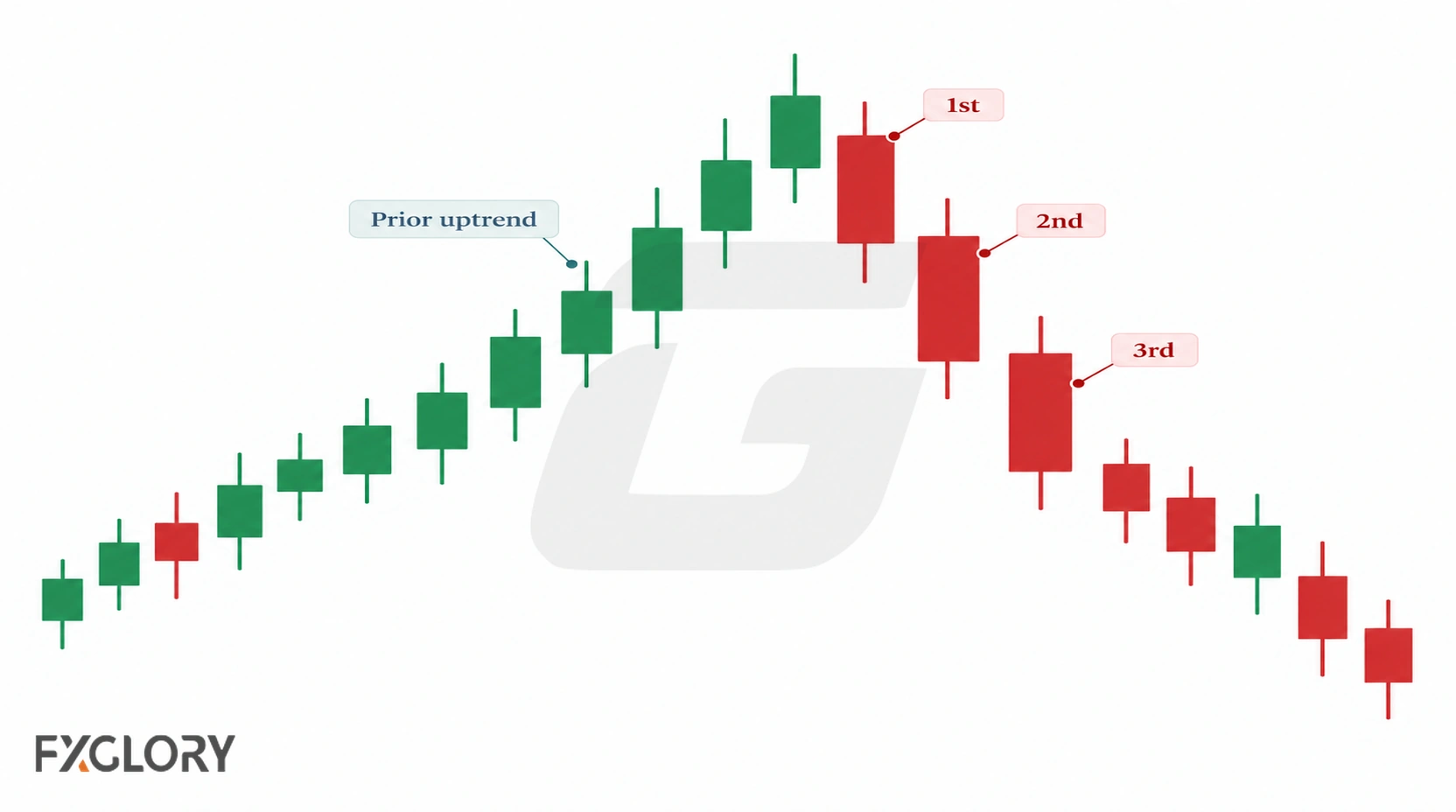
The three black crows forex pattern is a three-candle formation made of three consecutive bearish candles. It is usually reviewed after buying pressure, a rise, a higher-price test, or a quiet pause following bullish movement.
The traditional name uses black candles, but many platforms show bearish candles as red. The color setting does not change the structure. The main idea is three consecutive bearish real bodies that show sustained seller response across multiple candle periods.
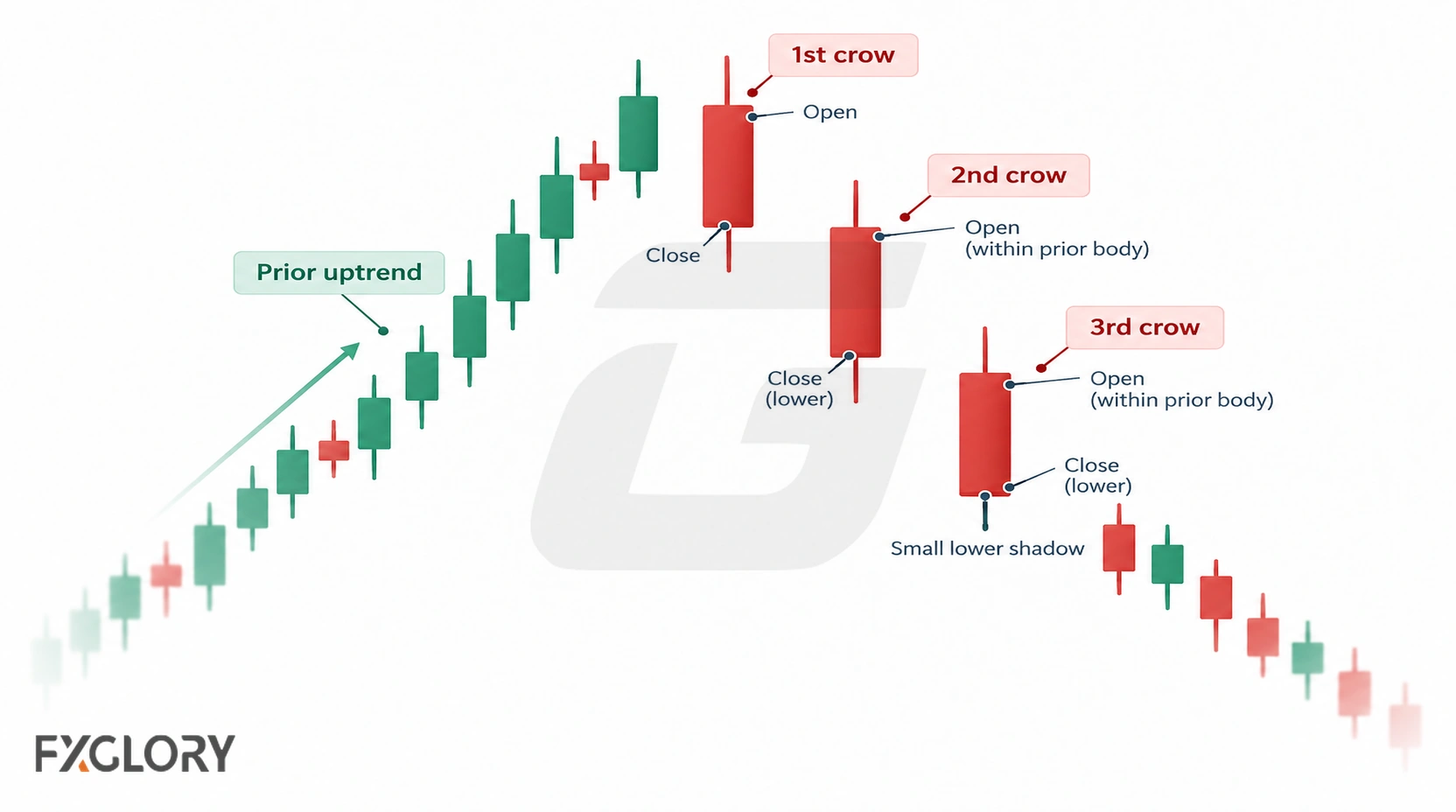
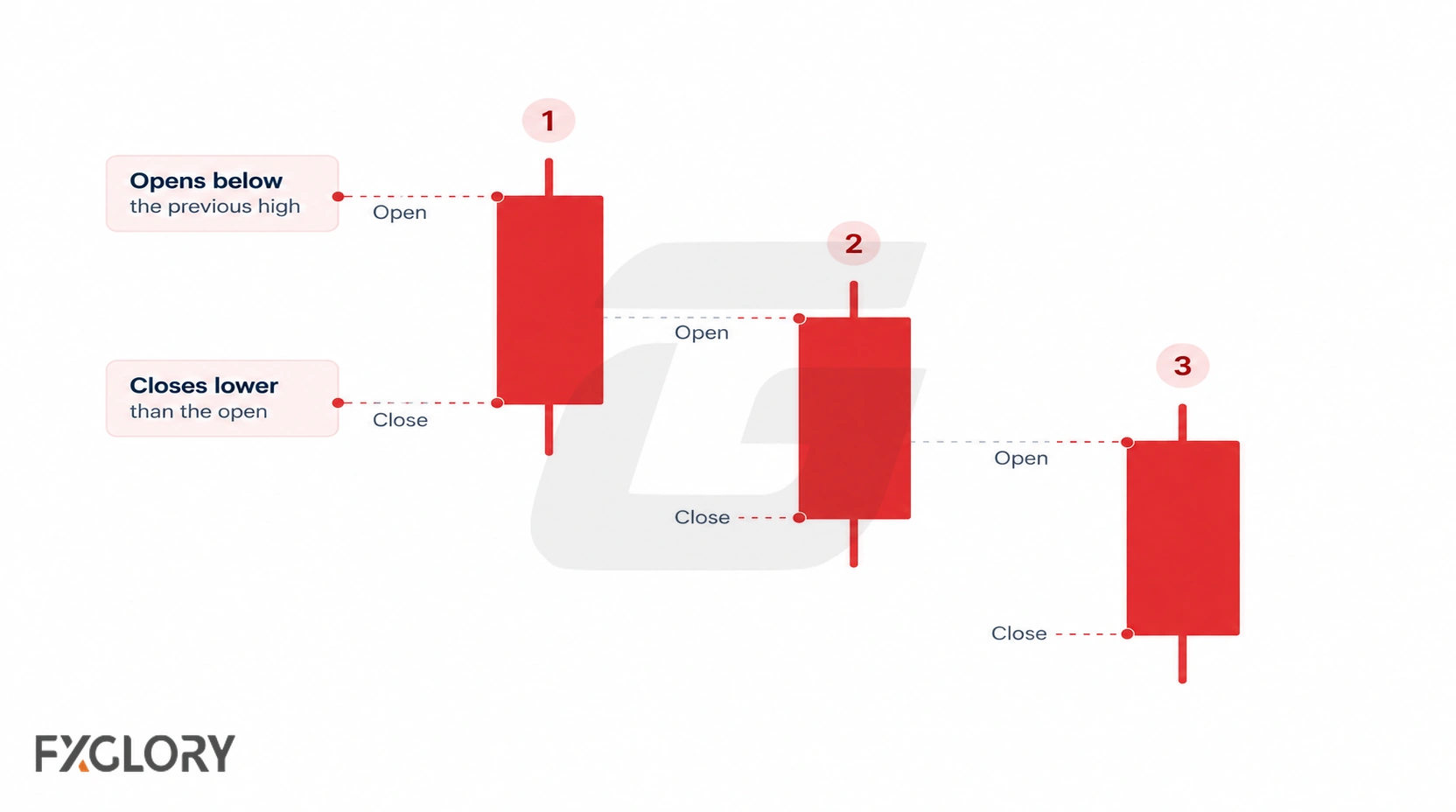
A cleaner three black crows pattern usually has each candle closing lower than the previous one. The candles often open within or near the previous candle's real body and close near their own lows, with small or controlled lower shadows.
Three black crows does not confirm that price will keep falling. It is a three-candle chart clue about seller response after buying pressure. The useful question is whether the prior movement, candle quality, chart location, market conditions, and follow-up movement make the sequence worth reviewing.
If you need the basic candle parts first, review the real-body and wick relationship. Three black crows uses those same candle parts, but its message depends on how three bearish candles develop together.
Three Black Crows Pattern Anatomy
The anatomy of three black crows has three bearish candles in a row. Each candle should add to the sequence rather than simply appear as a random bearish candle. The pattern is cleaner when the candles show steady downside progress instead of messy overlap.
| Three Black Crows Part | Common Structure | What It Shows | Reading Caution |
|---|---|---|---|
| First crow | Bearish candle after buying pressure or near a higher-price area. | Sellers responded after prior strength. | If there was no prior buying pressure, the sequence may be less meaningful. |
| Second crow | Another bearish candle that closes lower than the first. | Seller response continued into the next candle period. | If the body shrinks sharply, pressure may be less clear. |
| Third crow | Third bearish candle that closes lower again. | The sequence shows sustained selling across three candles. | A weak third candle can make the pattern look tired. |
| Opens | Each later candle often opens within or near the previous real body. | The sequence progresses without a messy break in structure. | Large gaps or unstable opens can make the reading harder. |
| Closes | Each candle closes lower, often near its own low. | Sellers remained active through each candle period. | Long lower shadows can show that lower prices were rejected. |
| Pattern location | Usually after a rise, near resistance, or after a higher-price test. | The sequence has a clearer place on the chart. | A sequence in random movement may be ordinary noise. |
A clean three black crows sequence is not just three candles with the same bearish color. The candles should show readable structure: lower closes, meaningful bodies, controlled lower shadows, and a chart location where seller response after buying pressure makes sense.
Why Prior Buying Pressure Matters
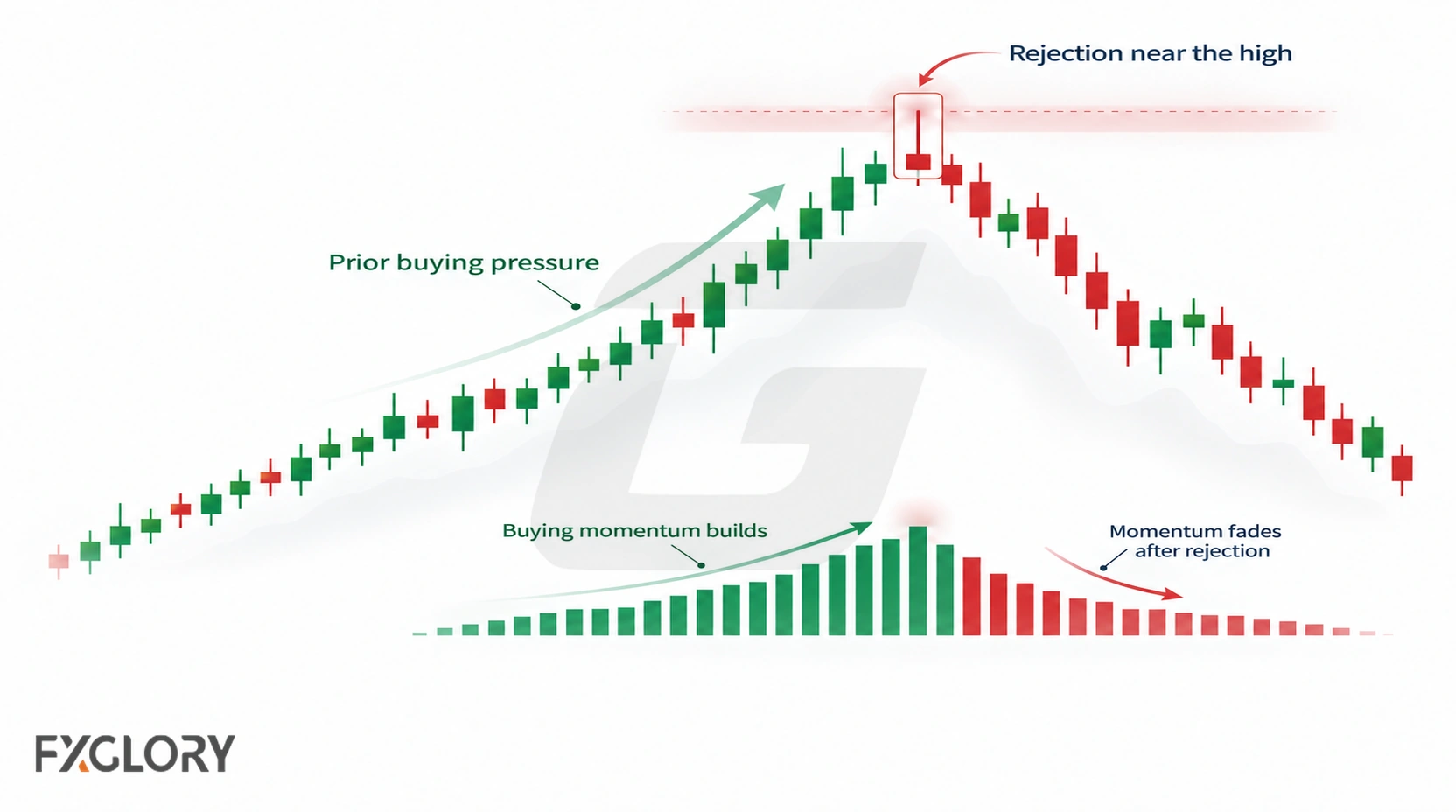
Three black crows needs something to respond to. That is why prior buying pressure matters. A sequence after a rise, a higher-price test, or a stalled bullish move is easier to review than three bearish candles in the middle of random movement.
After buying pressure, the first bearish candle shows that sellers responded. The second candle shows that the response continued. The third candle shows that the move was sustained across three candle periods.
This does not prove that buyers have disappeared or that a full reversal has started. It only shows that the chart changed from prior strength into a three-candle seller response. The pattern is easier to review near resistance, a swing high, a range high, or after price stops making clean upside progress.
A similar three-candle bearish sequence can also appear inside an existing downward move. In that case, it may describe continued seller pressure rather than a reversal from buying pressure. The surrounding chart context decides how the sequence should be reviewed.
- Clearer context: Prior buying pressure, a meaningful higher-price area, three consecutive bearish candles, lower closes, and controlled lower shadows.
- Weaker context: No prior buying pressure, random sideways movement, shrinking candles, long lower shadows, or no useful chart location.
Candle Opens, Closes, And Lower Shadows
The way each candle opens and closes matters. A cleaner three black crows pattern usually has each later candle opening within or near the real body of the previous candle. This creates a downward stair-step structure instead of a scattered set of bearish candles.
Some stricter descriptions also expect each later candle to open lower than the previous candle's open, or around the middle area of the previous candle's body. In forex chart review, that can be treated as a cleaner version rather than a guarantee.
A cleaner sequence also shows downward progression from candle to candle, where each candle does not reset the structure deeply above the prior body.
Each candle should also close lower than the previous candle. The close is important because it shows whether the bearish candle period finished with downside progress or recovered before the candle completed.
Some stricter descriptions expect each candle to close beyond the previous candle's low. In forex chart review, this can be treated as a cleaner version rather than a guarantee of meaning.
Lower shadows also matter. Small or controlled lower shadows can make the sequence easier to read because the candles closed near their lows. Long lower shadows can show that price moved lower but was pushed back before the candle closed, weakening the structure.
| Candle Feature | Cleaner Reading | Weaker Reading |
|---|---|---|
| Opening area | Each later candle opens within or near the previous real body. | Large unstable gaps or disconnected opens make the structure harder to read. |
| Lower-opening progression | Later candles open lower than the previous open or around the middle area of the previous body. | Openings reset too high or disconnect the sequence. |
| Downward progression | Each candle continues the sequence without resetting deeply into the prior structure. | Deep resets or disconnected candles make the sequence less clean. |
| Closing behavior | Each candle closes lower than the previous candle. | Lower closes are missing or unclear. |
| Stricter close quality | Each candle closes beyond the previous low. | The candle closes lower than the prior close but does not clearly extend the sequence. |
| Close location | Candles close near their own lows. | Candles leave long lower shadows. |
| Real bodies | Bodies are meaningful and not sharply shrinking. | Bodies become much smaller or lose clarity. |
| Lower shadows | Short or controlled lower shadows. | Long lower shadows suggest lower-price rejection. |
These details help separate a cleaner three-candle seller response from a messy set of bearish candles that only looks convincing after the fact.
Why Three Black Crows Is Not Just Any Three Bearish Candles
Three random bearish candles are not automatically three black crows. The pattern needs structure. The candles should appear in a useful chart context, close progressively lower, and show enough body strength to make the three-candle sequence readable.
If the candles are small, scattered, heavily overlapped, or surrounded by sideways noise, the pattern may not show sustained seller response. If the candles appear after a sharp move has already stretched far downward, the sequence may be harder to interpret because the chart may already be extended.
The phrase three black crows should be reserved for a cleaner three-candle sequence, not used for every group of three bearish candles.
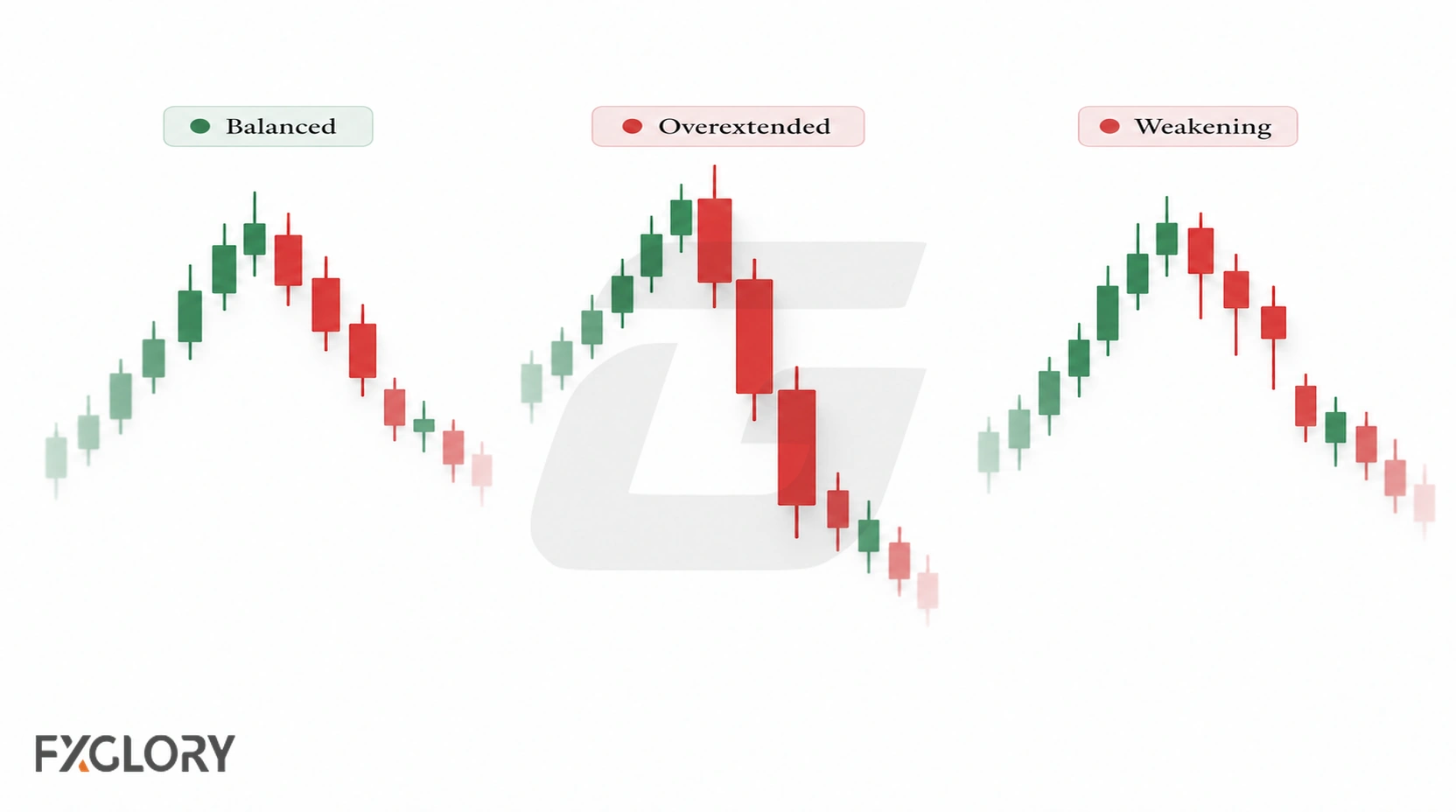
Overextended Or Weakening Three-Candle Sequences
A three black crows sequence can look strong but still deserve caution. Very large candles after an already sharp decline may create a stretched chart area. A stretched chart does not automatically cancel the sequence, but it can make the next reading less clean.
Weakening candles also matter. If the second and third candles become much smaller, or if lower shadows grow longer, the sequence may show that seller pressure is becoming less clear. This can make the formation look closer to a tired decline than a clean three black crows structure.
A smaller third candle is especially important to review because the sequence may be losing clarity by the time the third candle closes. The useful point is simple: three black crows should show steady seller response. Shrinking bodies, long lower shadows, or heavy support nearby can make the reading weaker.
| Sequence Issue | Why It Weakens The Reading | What To Review |
|---|---|---|
| Very stretched candles | The sequence may already be extended. | Review nearby support and volatility conditions. |
| Shrinking bodies | Seller pressure may be losing clarity. | Compare each candle body with the previous one. |
| Weak third candle | The sequence may be tiring by the third candle. | Check whether the third candle still closes with clear downside progress. |
| Long lower shadows | Lower prices may be rejected before each close. | Check whether the candles still close near their lows. |
| Support nearby | The sequence may be running into a lower-price area. | Review whether that level already mattered on the chart. |
| News volatility | The candles may reflect unstable movement. | Review spread, liquidity, and candle range conditions. |
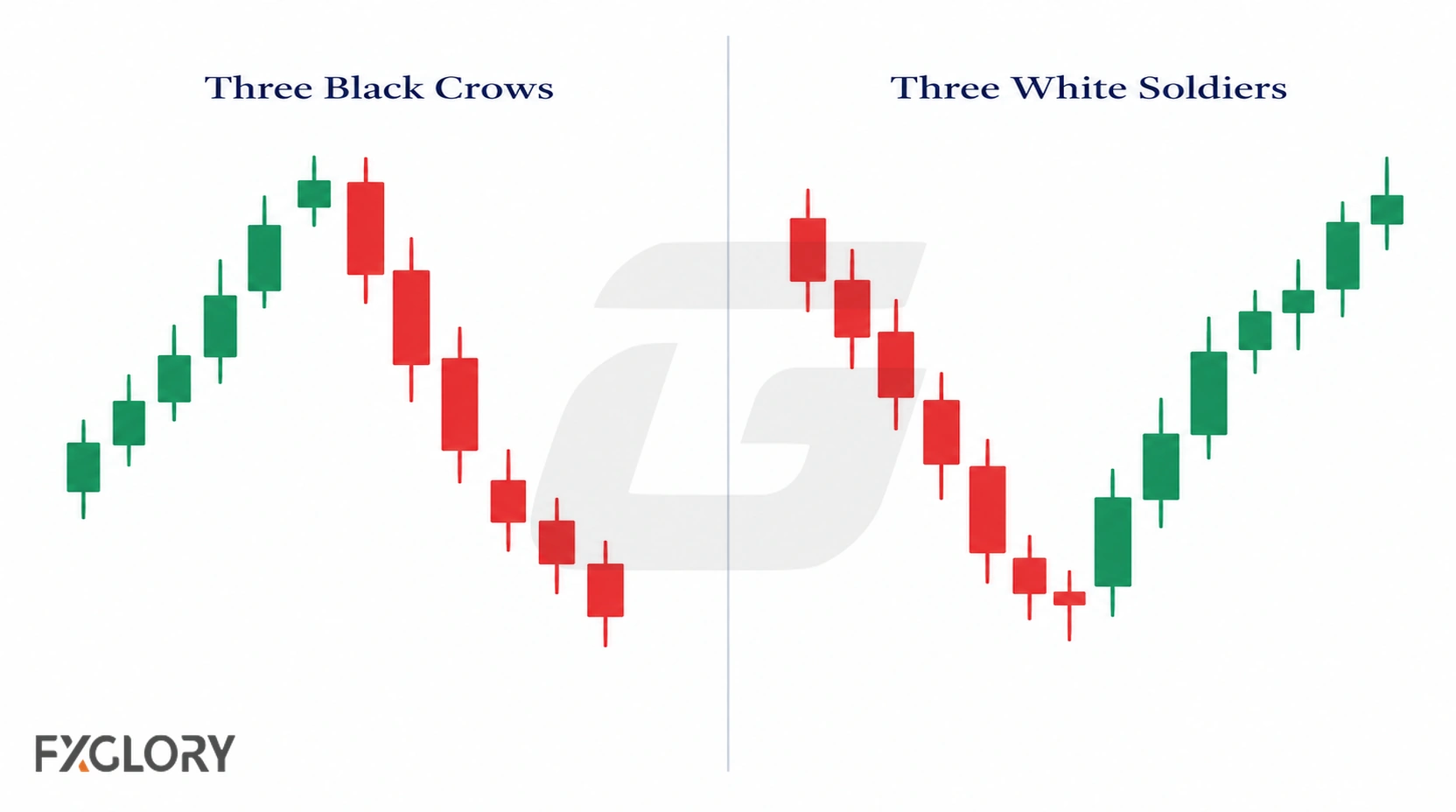
Three Black Crows vs Three White Soldiers
Three black crows and three white soldiers are opposite three-candle formations. Both use three consecutive candles, but they point to different pressure sequences.
| Pattern | Usually Reviewed After | Three-Candle Structure | Main Reading Difference |
|---|---|---|---|
| Three black crows | Buying pressure, rise, or higher-price test. | Three consecutive bearish candles with lower closes. | Shows sustained seller response across three candles. |
| Three white soldiers | Selling pressure, decline, or lower-price test. | Three consecutive bullish candles with higher closes. | Shows sustained buyer response across three candles. |
For the opposite three-candle sequence, use the three white soldiers guide. The candle count is similar, but the direction and prior context are reversed.
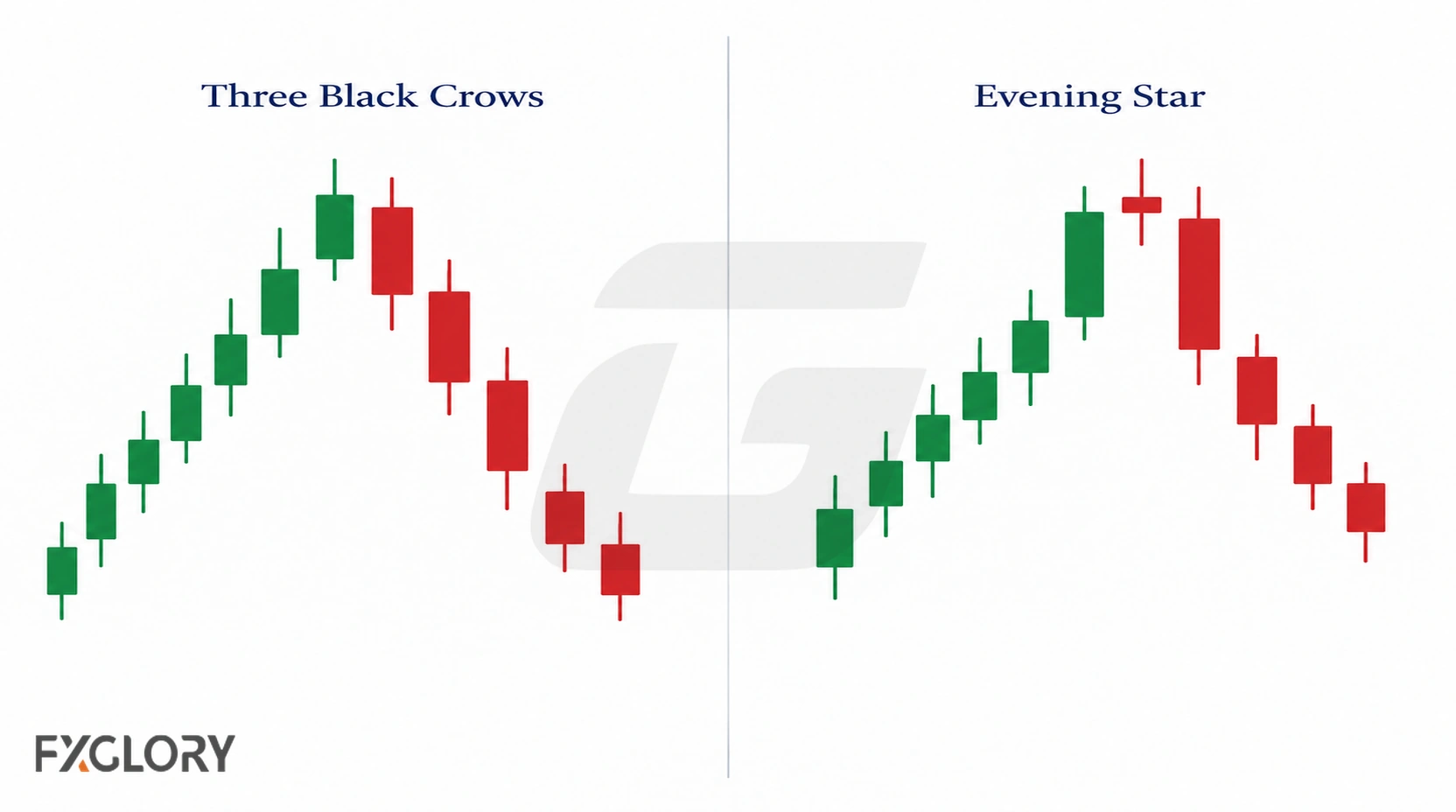
Three Black Crows vs Evening Star
Three black crows and evening star are both three-candle formations that can be reviewed after buying pressure, but they are not the same pattern.
Evening star includes a pause. It usually has a bullish first candle, a small or indecisive middle candle, and a bearish third candle. Three black crows does not use a small middle pause as its defining feature. It uses three consecutive bearish candles.
| Pattern | Candle Count | Main Structure | Main Difference |
|---|---|---|---|
| Three black crows | Three candles. | Three consecutive bearish candles with lower closes. | Focuses on sustained seller response. |
| Evening star | Three candles. | Bullish candle, small middle candle, bearish third candle. | Focuses on a pause followed by seller response. |
For the three-candle pattern with a middle pause, use the evening star sequence guide. That comparison keeps three black crows focused on consecutive bearish candles.
Three Black Crows vs Similar Forex Patterns
Three black crows can overlap visually with several bearish candlestick ideas. Comparing them helps avoid forcing the wrong label onto the chart.
| Pattern Or Candle | Main Structure | Main Difference From Three Black Crows |
|---|---|---|
| Three black crows | Three consecutive bearish candles with lower closes. | Focuses on sustained seller response across three candles. |
| Evening star | Bullish candle, small middle candle, bearish third candle. | Evening star includes a middle pause; three black crows does not. |
| Dark cloud cover | Bullish first candle, bearish second candle closing into the first body. | Dark cloud cover uses two candles and partial bearish body pushback. |
| Bearish engulfing | Second bearish body covers the previous bullish body. | Engulfing uses two candles and full body takeover. |
| Shooting star | Single candle with small body and long upper wick after buying pressure. | Shooting star is one candle; three black crows uses three bearish candles. |
| Hanging man | Single candle with small body and long lower wick after buying pressure. | Hanging man is one candle; three black crows is a three-candle sequence. |
| Tweezer top | Two or more nearby candles with matching or near-matching highs. | Tweezer top focuses on repeated highs, not three lower bearish closes. |
| Falling three methods | Bearish continuation structure with a pause inside an existing downward move. | Falling three methods is a continuation-style structure with a middle pullback, not three consecutive bearish candles. |
For two-candle comparisons, review the partial bearish pushback pattern and the full-body takeover structure. For upper-level and single-candle comparisons, use the matching-high rejection guide and the single-candle upper-wick guide.
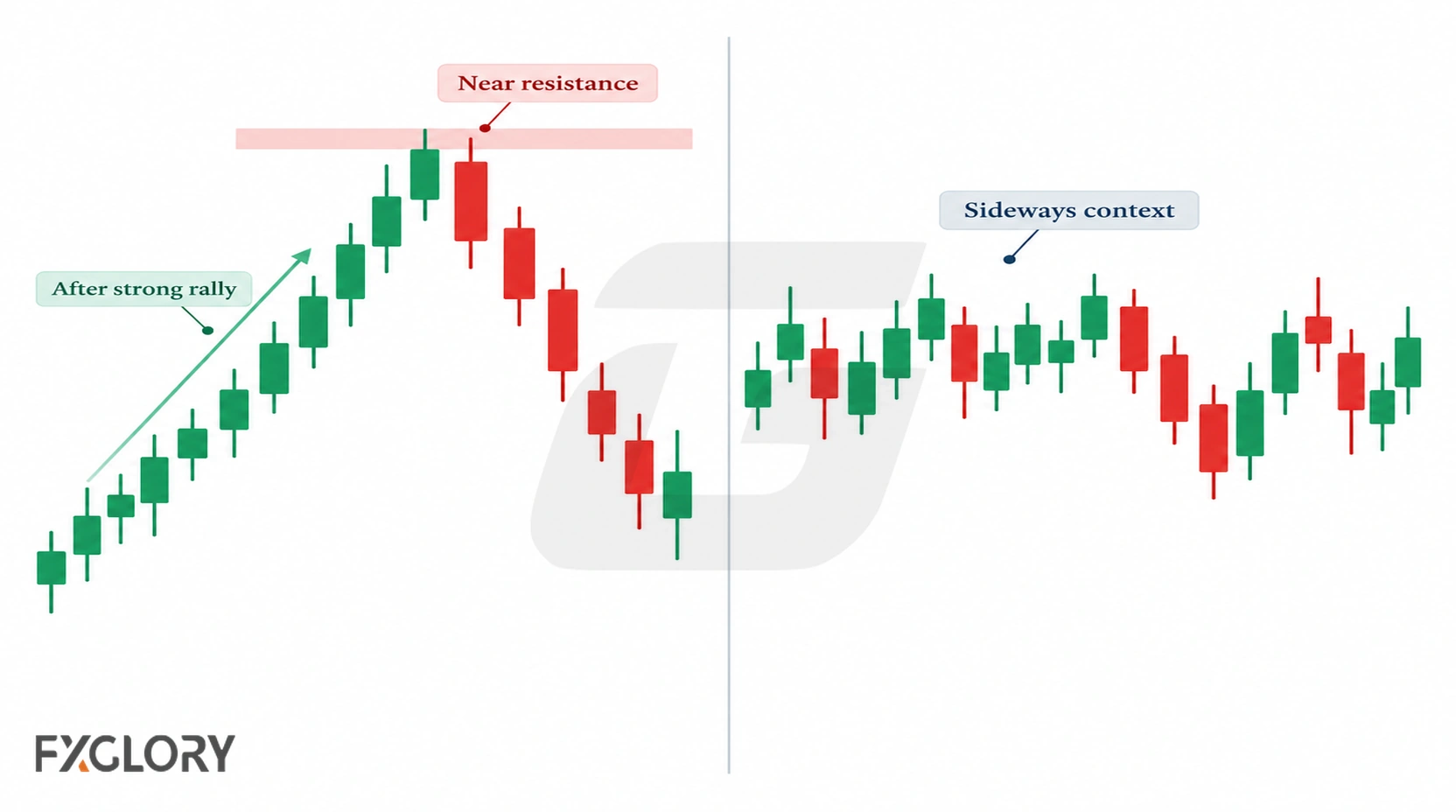
Where Three Black Crows Matter More
Three black crows becomes easier to review when it appears in a place where sustained seller response matters. Without a useful chart location, the sequence may only be ordinary bearish movement.
The candle sequence should not be read above the surrounding chart structure; support, resistance, range position, and recent price behavior decide whether the three candles are worth reviewing.
The sequence is easier to review after a mature advance or near a high-level area than after random bearish candles in the middle of a chart.
After A Rise
After a rise, three black crows can show that sellers responded across three candle periods. This does not confirm a full reversal, but it can show that prior buying pressure lost clarity during the sequence.
Near Resistance
Three black crows near resistance can be easier to review because the sequence appears around a higher-price area that already matters on the chart. The resistance area gives the three-candle response a clearer location.
Near A Swing High
A swing high gives the sequence a reference point. If price has recently tested a higher area and then forms three black crows, the seller response can be compared with that prior high.
At A Range High
Inside a range, three black crows near the upper boundary can be more meaningful than a similar sequence in the middle of the range. The range high gives context to the prior buying pressure and the three bearish candles.
After Quiet Consolidation
Three black crows can appear after a quieter pause following buying pressure. In that setting, the sequence may show that seller response expanded after the market had stopped moving higher clearly.
Near A Support Area
If the sequence moves into a nearby support area, the candles may still show seller response, but the chart needs extra review. Support can make a strong-looking sequence less clean if lower prices are rejected shortly afterward.
If the sequence reaches support and price stops moving lower, the pattern may become a sideways or failed reading rather than a clean seller-response sequence.
For observation, a trader can compare three-black-crows-like structures on live market pages such as GBP/USD around higher-price tests or gold during wider candle ranges. These pages are useful for chart review, not as standalone trading reasons.
Three Black Crows Strength Filter: Stronger vs Weaker Readings
Three black crows does not have the same value in every chart condition. The table below helps separate clearer three-candle seller response readings from weaker ones.
| Three Black Crows Factor | Clearer Reading | Weaker Reading |
|---|---|---|
| Prior movement | The sequence appears after buying pressure, a rise, or a higher-price test. | The sequence appears without clear prior buying context. |
| Candle count | Three consecutive bearish candles. | Only one or two bearish candles, or a broken sequence. |
| Closing behavior | Each candle closes lower than the previous candle. | Lower closes are missing or unclear. |
| Opening behavior | Each later candle opens within or near the previous real body. | Large unstable gaps or disconnected candles make the sequence messy. |
| Downward progression | Each candle continues the sequence without a deep reset. | Deep resets make the structure harder to read. |
| Lower shadows | Short or controlled lower shadows. | Long lower shadows show repeated lower-price rejection. |
| Body quality | Meaningful bodies that do not shrink sharply. | Bodies become very small or show weakening pressure. |
| Chart location | The pattern forms near resistance, a swing high, a range high, or after a higher-price test. | The pattern forms in the middle of random movement. |
| Market conditions | Spread and volatility conditions are stable enough for chart review. | The pattern forms during abnormal news movement, rollover, or thin liquidity. |
| Follow-up movement | Later price movement keeps the sequence relevant. | Price immediately makes the sequence irrelevant. |
Three Black Crows Forex Reading Table
The table below shows how the same three-candle structure can change depending on chart location and candle quality.
| Three Black Crows Situation | Possible Reading | What To Check Next |
|---|---|---|
| After a rise | Sellers responded across three candle periods. | Check whether follow-up movement keeps the sequence relevant. |
| Near resistance | The sequence formed around a higher-price area already visible on the chart. | Check whether resistance remains relevant. |
| Near a swing high | The pattern appeared near a previous upper turning area. | Compare the sequence with the earlier swing high. |
| After quiet consolidation | Seller response expanded after a pause. | Check whether the sequence is clean or only a short burst. |
| Into support | The sequence may be running into a lower-price area. | Check whether support weakens the reading. |
| Shrinking bodies | Seller pressure may be losing clarity. | Check whether the sequence is closer to a weakening decline. |
| Long lower shadows | Lower prices were rejected during the candles. | Check whether candles still closed near their lows. |
| During news volatility | The sequence may reflect unstable movement. | Review spread, candle range, and execution conditions. |
How To Read Three Black Crows In Forex
A simple workflow helps keep three black crows reading disciplined. The goal is to describe the three-candle sequence before giving it more meaning than it deserves.
- Check the timeframe: Decide whether the three-candle sequence reflects a useful chart period or short-term noise.
- Review the prior move: Look for buying pressure, a rise, a recent high, or a higher-price test before the sequence.
- Count the candles: Confirm that there are three consecutive bearish candles.
- Check the closes: Review whether each candle closes lower than the previous candle.
- Check the opens: Review whether each later candle opens within or near the previous candle's real body.
- Check stricter opening quality: Review whether later candles open lower than the previous open or around the middle area of the previous body.
- Check downward progression: Review whether each candle continues the structure without resetting deeply above the prior body.
- Review lower shadows: Check whether the candles close near their lows or leave long lower shadows.
- Review body quality: Check whether the bodies remain meaningful instead of shrinking sharply.
- Check chart location: Look for resistance, swing highs, range highs, stalled buying pressure, or nearby support.
- Separate it from other patterns: Check whether the structure is really three black crows or an evening star, dark cloud cover, engulfing candle, shooting star, hanging man, or tweezer top.
- Review market conditions: Consider volatility, spread, liquidity, rollover, and scheduled news events.
- Watch follow-up movement: Review whether price keeps the three-candle sequence relevant or cancels the reading.
Some traders compare three black crows with technical indicators for additional context. For example, RSI can add momentum context, MACD can add trend-momentum context, ATR can add volatility context, and Bollinger Bands can help review range and expansion conditions. These tools can support candle review, but they do not remove trading risk.
If a three-candle decline appears stretched, near support, or during thin-liquidity or unclear activity conditions, the sequence may need extra caution even if the candle structure looks clean.
Some traders also review activity or volume-style tools around the sequence, but spot forex volume is usually broker/platform-specific and should not be treated as a complete confirmation by itself.
False Three Black Crows In Forex
A false three black crows pattern looks like a clean three-candle bearish sequence but does not provide a useful chart clue. This can happen because prior buying pressure is missing, candle quality is poor, the chart location is weak, or market conditions make the candles hard to interpret.
No Prior Buying Pressure
If there was no rise, recent high, or higher-price test before the sequence, the three black crows reading becomes weaker. The candles may only show ordinary bearish movement.
Only Random Bearish Candles
Three bearish candles are not enough by themselves. If the candles do not close progressively lower or do not form a readable sequence, the pattern may be forced.
Shrinking Candle Bodies
If each candle becomes much smaller than the previous one, seller pressure may be losing clarity. A clean sequence should not look increasingly tired.
Weak Third Candle
If the third candle is clearly weaker than the first two, the sequence may not show sustained seller response. The third candle matters because it completes the pattern.
Long Lower Shadows
Long lower shadows can show that lower prices were rejected before the candles closed. This can weaken the idea of sustained seller response.
Overextended Move
If the sequence appears after price has already moved sharply downward, the chart may be stretched. A strong-looking sequence can still need caution when it forms into support or after a fast move.
Support Stops The Move
If price reaches support and stops moving lower after the sequence, the pattern may become a sideways or failed reading rather than a clean seller-response sequence.
Middle Of A Range
Sideways ranges can create groups of bearish candles that look meaningful after the fact. A sequence in the middle of a messy range is usually weaker than one near resistance or after a higher-price test.
Lower-Timeframe Noise
Lower timeframes do not automatically invalidate the pattern, but they can create more frequent lookalikes. The sequence needs stronger chart context when candles are short-term and noisy.
Unfinished Candles
A third candle can look strong before it closes and then finish differently. Three black crows should be reviewed after all three candles have closed.
News Or Low-Liquidity Conditions
Major news, rollover, market opens, and thin liquidity can create three-candle sequences that look clean after the fact. In real time, spread and execution conditions may be unstable.
- Skip the pattern when there is no prior buying pressure or higher-price test.
- Be careful inside messy ranges where random three-candle sequences can appear.
- Do not read unfinished candles as completed three black crows formations.
- Check candle quality before treating three bearish candles as a clean sequence.
- Review lower shadows before assuming the candles closed with sustained weakness.
- Check the third candle before treating the sequence as complete and readable.
- Check support areas before treating the sequence as a clean seller-response reading.
- Check for overextension when the sequence appears after a fast downward move.
- Review spread and volatility before giving meaning to a dramatic three-candle sequence.
Common Mistakes With Three Black Crows In Forex
Three black crows is easy to label after three bearish candles are visible, but it is also easy to overread. Most mistakes come from treating three bearish candles as a complete directional answer.
- Calling any three bearish candles three black crows: The candles should form a readable sequence with lower closes and useful context.
- Ignoring prior buying pressure: Without a rise, recent high, or higher-price test, the reversal-focused reading becomes weaker.
- Ignoring candle opens: A cleaner sequence usually has each later candle opening within or near the previous real body.
- Ignoring lower-opening quality: A cleaner version often has later candles opening lower than the previous open or around the middle area of the previous body.
- Ignoring downward progression: A cleaner sequence should not keep resetting deeply into the previous candle's structure.
- Ignoring lower shadows: Long lower shadows can weaken the reading because they show rejection before the candle closes.
- Ignoring shrinking bodies: Candles that become much smaller can show that seller response is losing clarity.
- Ignoring the third candle: A weak third candle can make the sequence look tired instead of sustained.
- Ignoring support: A strong-looking sequence can become less clean when it reaches support and stops moving lower.
- Ignoring overextension: A strong-looking sequence after a fast downward move may already be stretched or near support.
- Confusing it with evening star: Evening star has a small or indecisive middle candle. Three black crows uses three consecutive bearish candles.
- Confusing it with dark cloud cover: Dark cloud cover uses two candles and partial bearish body pushback.
- Confusing it with bearish engulfing: Bearish engulfing uses two candles and full body takeover.
- Confusing it with shooting star or hanging man: Shooting star and hanging man are single-candle wick structures, not three-candle sequences.
- Confusing it with tweezer top: Tweezer top focuses on matching highs, not three lower bearish closes.
- Reading unfinished candles: Three black crows should be reviewed after all three candles have closed.
- Overlooking spread, liquidity, and news risk: Large candles can appear during unstable conditions that are difficult to interpret in real time.
- Replacing risk planning with pattern confidence: Three black crows should not replace position sizing, risk limits, or a clear area where the reading becomes weak.
What To Study After Three Black Crows
After learning how to read three black crows, the next step is to compare it with opposite, shorter, and single-candle bearish structures.
You can compare three black crows with the opposite three white soldiers sequence, the evening star sequence with a middle pause, the two-candle dark cloud cover pushback, or the engulfing body-takeover structure. For single-candle comparisons after buying pressure, review the shooting star guide and the hanging man guide. For a wider map of candle formations, return to forex candlestick pattern groups.
Frequently Asked Questions
What is the three black crows pattern in forex?
The three black crows pattern in forex is a three-candle formation made of three consecutive bearish candles. It is usually reviewed after buying pressure, a rise, or a higher-price test.
What does three black crows mean in forex?
Three black crows can show sustained seller response across three candle periods after buying pressure. Its meaning depends on prior movement, candle quality, chart location, market conditions, and follow-up movement.
Is three black crows bearish?
Three black crows is often reviewed as a bearish reversal-focused formation after a rise, but it is not automatically bearish. It needs useful chart context, completed candles, and later price movement that keeps the sequence relevant.
What are the three candles in three black crows?
The pattern uses three consecutive bearish candles. A cleaner version has each candle closing lower than the previous candle, opening within or near the previous candle's real body, and closing near its own low with limited lower shadow.
Can three black crows appear inside an existing downtrend?
Yes, a similar three-candle bearish sequence can appear inside an existing downward move. In that case, it may describe continued seller pressure rather than a reversal from buying pressure. The surrounding chart context decides how the sequence should be reviewed.
What is the difference between three black crows and evening star?
Three black crows uses three consecutive bearish candles. Evening star uses a bullish first candle, a small or indecisive middle candle, and a bearish third candle. Evening star includes a pause; three black crows focuses on sustained bearish candles.
What is the opposite of three black crows?
Three white soldiers is commonly reviewed as the opposite pattern. Three black crows has three consecutive bearish candles, while three white soldiers has three consecutive bullish candles.
When should three black crows be ignored?
Three black crows is often better ignored when there is no prior buying pressure or useful chart location, the candles are shrinking sharply, lower shadows are long, the sequence is already overextended, the candles are unfinished, or market conditions are unstable.
Related Contents
Practice Comparing Three-Candle Sequences Across Market Conditions
Use a free FXGlory demo account to observe three black crows formations across pairs, timeframes, chart locations, and volatility conditions before trading with real funds.
Open a Free Demo Account