
What Is A Forex Candlestick Strategy?
A forex candlestick strategy is a trade-planning method that uses completed candle information inside a wider decision process. The candle may show rejection, compression, expansion, hesitation, or pressure shift, but the candle does not create a complete trade by itself.
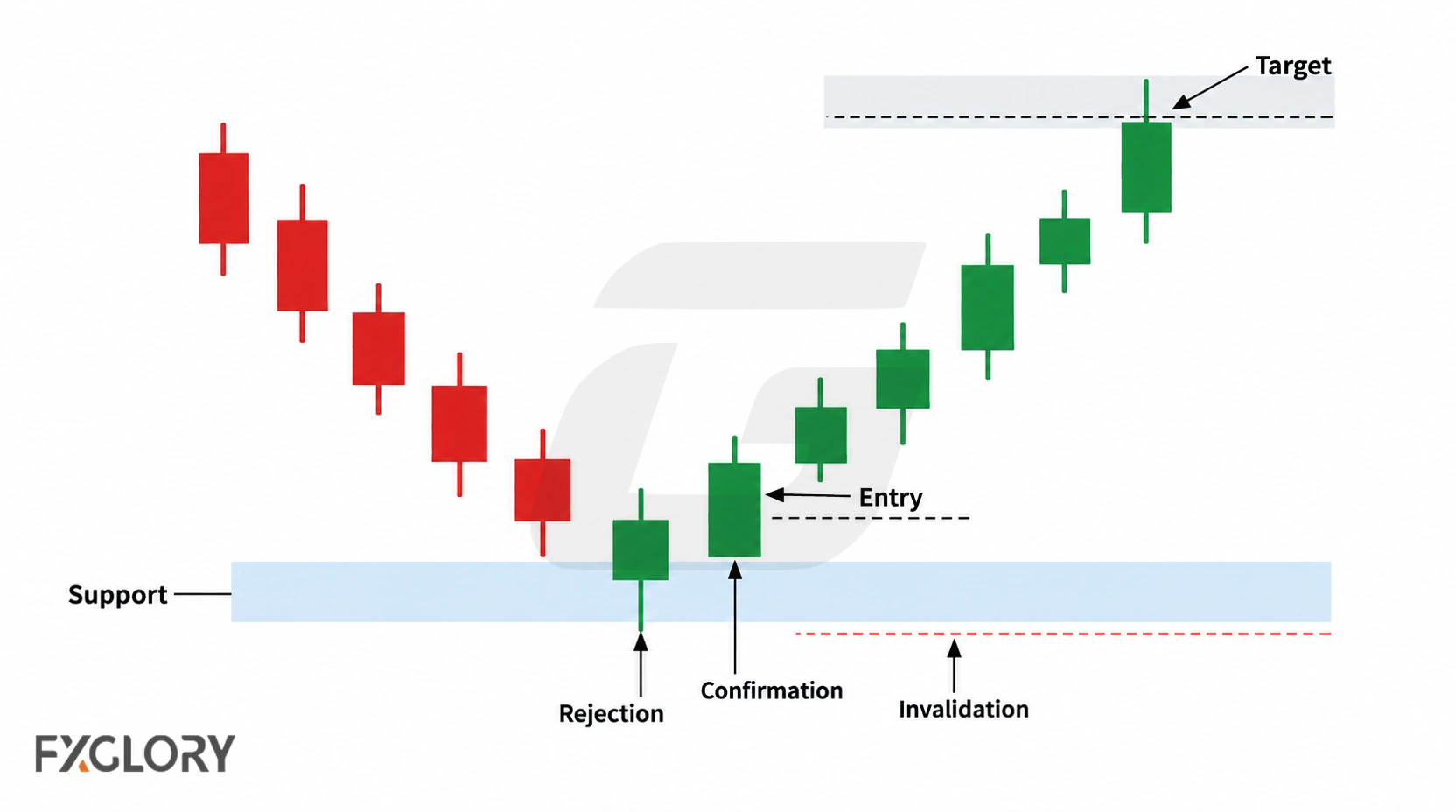
A usable candlestick strategy needs market condition, chart location, candle quality, entry trigger, invalidation, stop placement, target logic, spread review, position sizing, and a rule for when the setup is canceled.
This page focuses on how candlesticks can be used inside a trading framework. It does not replace the candlestick pattern library. For definitions of individual candle formations, use the forex candlestick patterns guide before applying the strategy framework.
Candlestick Pattern vs Candlestick Strategy
A candlestick pattern describes candle shape or candle relationship. A candlestick strategy explains how that pattern is used with context, entry rules, stop placement, target planning, and risk control.
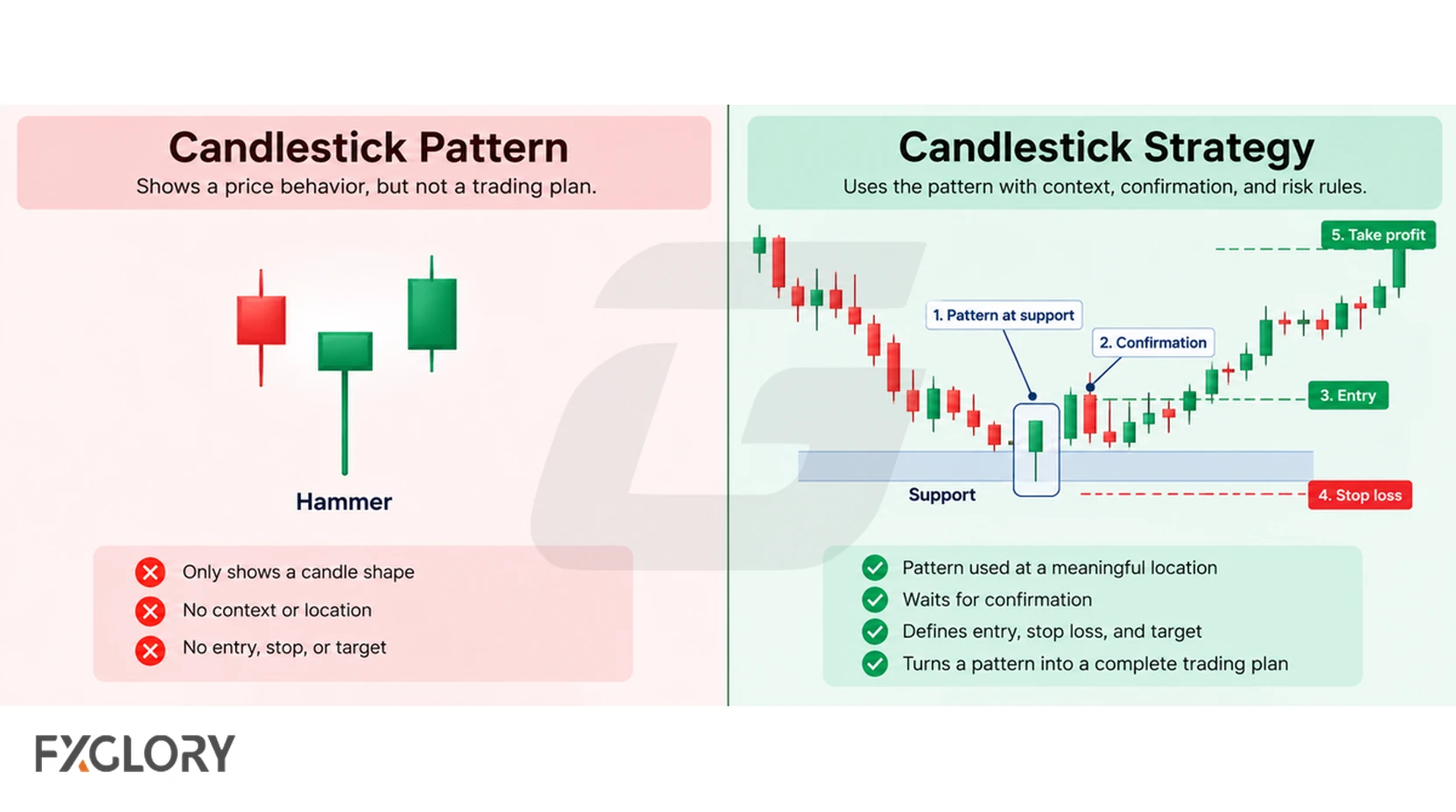
Confusing those two ideas creates weak trades. A hammer, engulfing candle, inside bar, doji, or pin bar may be easy to name, but the name does not decide whether the trade has location, invalidation, or target room.
| Item | What It Means | Why It Is Not Enough Alone |
|---|---|---|
| Candlestick pattern | A candle or candle sequence has a recognizable structure | The pattern does not define context, stop, target, or risk |
| Candlestick meaning | The candle may show rejection, compression, expansion, or hesitation | The meaning changes with location and market condition |
| Candlestick strategy | The trader has context, trigger, invalidation, stop, target, and risk rules | The plan can still be invalid if spread, volatility, or structure changes |
The Forex Candlestick Decision Sequence
A forex candlestick strategy should follow the same order each time. If the trader starts with a candle shape and searches for reasons afterward, the setup cannot be reviewed cleanly.
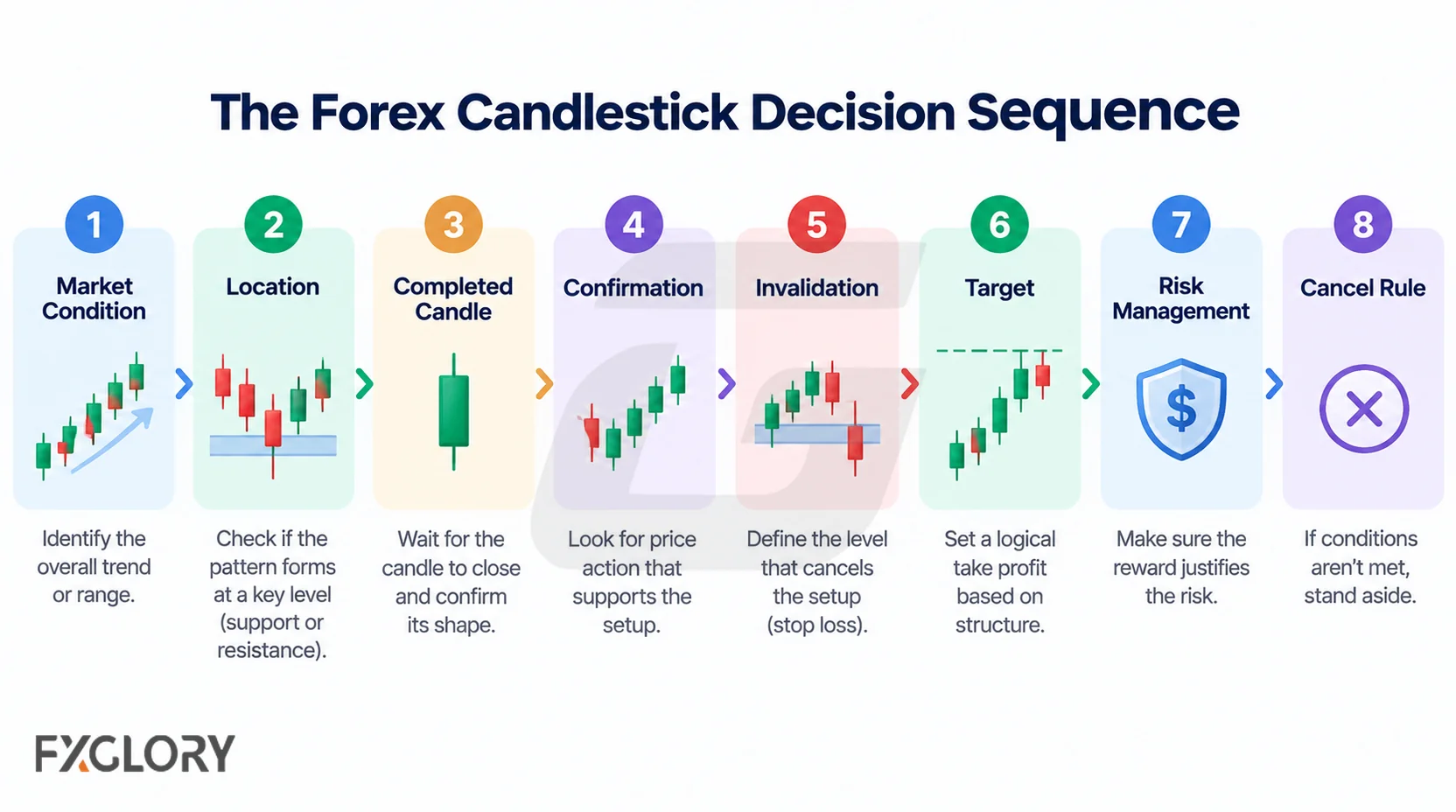
| Step | Decision | Continue Only If |
|---|---|---|
| 1. Market condition | The market is trending, ranging, pulling back, breaking out, reversing, or unclear | The condition supports the candle idea |
| 2. Location | The candle forms near support, resistance, trend structure, range edge, breakout area, or pullback zone | The candle has a reason beyond its shape |
| 3. Candle type | The candle shows rejection, compression, expansion, hesitation, or a pressure shift | The candle is completed and clearly defined |
| 4. Confirmation | The rule may require close, break, retest, rejection, or follow-through | The entry is not early, late, or forced |
| 5. Invalidation | The trader knows where the candle idea is wrong | The stop is not guessed after entry |
| 6. Target | The target uses next structure, support/resistance, swing point, range, measured move, trail, or time rule | The target still makes sense after spread |
| 7. Risk | Position size, margin, and account limits fit the trade | The trade does not break daily or account-level risk rules |
| 8. Cancel rule | The setup has a written failure condition | The trade is not held after the candle reason disappears |
Timeframes, Candle Close, And Session Alignment
A candlestick strategy should define which candle close matters before the setup forms. A candle on the daily chart, 4-hour chart, 1-hour chart, and very low timeframe can show different structure, spread sensitivity, and stop distance.
The candle should be reviewed after it closes unless the strategy has a written early-entry rule. A forming candle can change its body, wick, high, low, and final meaning before the period ends.
| Timeframe Or Timing Issue | Why It Matters | Better Rule |
|---|---|---|
| Higher timeframe candle | May show cleaner context but wider stop distance | Use it for structure only if risk still fits |
| Trading timeframe candle | Defines the setup candle used for entry planning | Write which candle close confirms the setup |
| Lower timeframe candle | May help refine entry, but can create noise | Do not let lower-timeframe noise override the larger setup |
| Unfinished candle | Shape can change before close | Judge candle structure after close unless the plan says otherwise |
| Session change | Liquidity, spread, and movement speed can change | Check session context before accepting the setup |
| News window | Fast movement can distort candle shape and execution | Use the event-risk rule or stand aside |
Context Comes Before The Candle Name
The same candle can mean different things in different conditions. A rejection candle at a clean support zone is not the same as a rejection candle in the middle of noisy movement. An engulfing candle after a pullback is not the same as an engulfing candle directly into resistance.
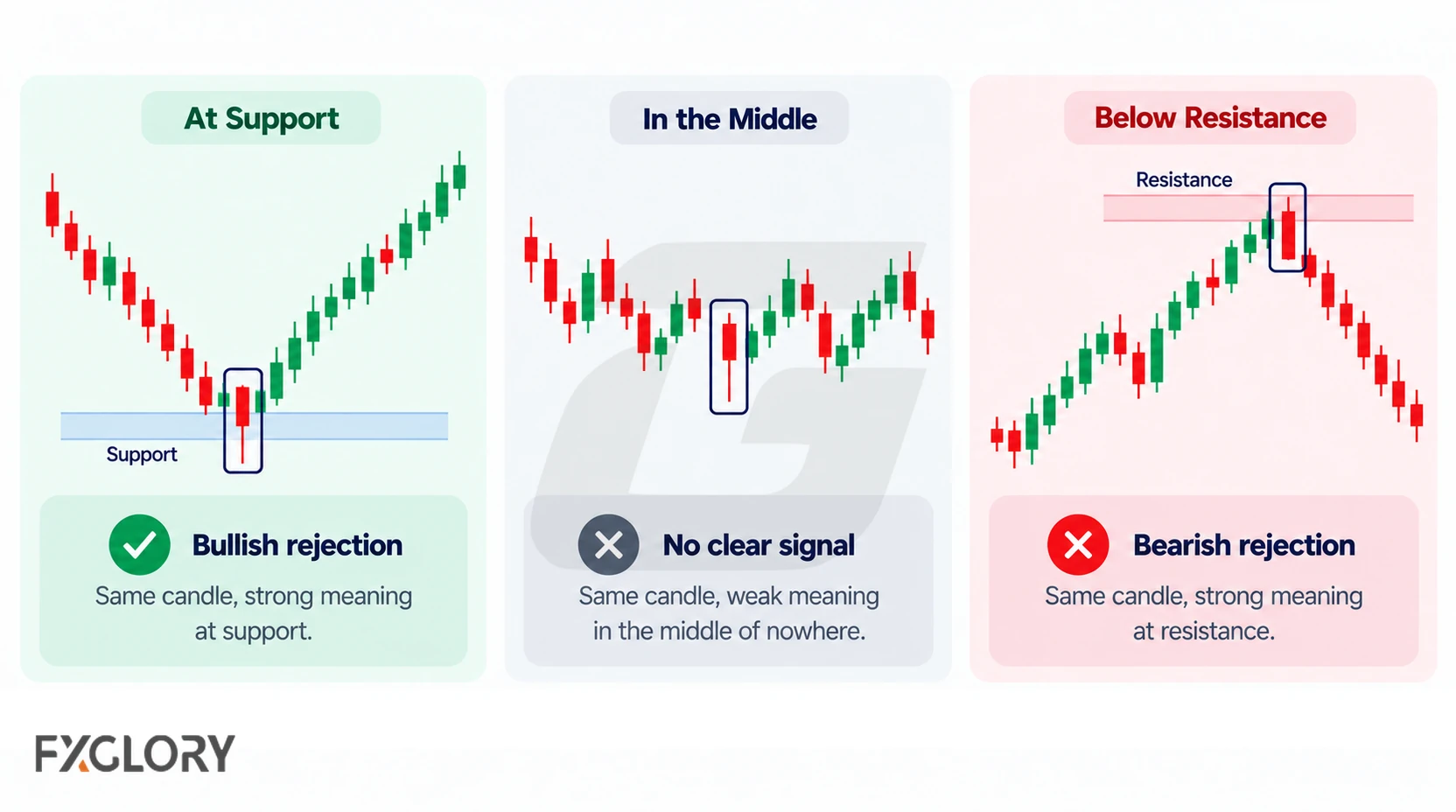
Context decides whether the candle deserves attention. Candle names can help organize the chart, but they should not replace market structure.
| Context | How Candles Can Help | Weak Use |
|---|---|---|
| Trend | Candles may show pullback pause, rejection, or continuation attempt | Trader fades every candle against the trend |
| Range | Candles may help review reactions near range edges | Trader enters from candles in the middle of the range |
| Support or resistance | Candles may show rejection, compression, or failed movement near a level | Trader uses the candle without level quality |
| Pullback | Candles may help review whether correction is slowing or failing | Trader enters before the pullback has a clear invalidation point |
| Breakout | Candles may show expansion, close beyond a level, or false break | Trader chases a candle directly into the next obstacle |
| Unclear chop | Candles may be too noisy to carry a decision | Trader forces pattern names onto overlapping candles |
For the broader price-action framework behind candles, swings, failed moves, and raw price behavior, use the guide to price action in forex.
Candlestick Location: Where The Pattern Forms
A candlestick pattern is more useful when it forms at a meaningful location. Location gives the candle a reason to matter. Without location, the candle may only be ordinary movement.
| Candle Location | Possible Use | Risk To Review |
|---|---|---|
| At support | Review whether a bullish reaction, rejection, or compression appears near a lower zone | Support may fail or produce a false break |
| At resistance | Review whether a bearish reaction, rejection, or compression appears near a higher zone | Resistance may break or become support |
| At a range edge | Review whether the edge is still respected | Range may break or midpoint target room may be poor |
| At a pullback zone | Review whether correction is slowing near trend structure | Pullback may become a reversal |
| After a breakout | Review retest candles, failed-break candles, or continuation candles | Breakout may already be extended |
| Middle of movement | Usually lower-quality unless a written strategy explains why | Stop and target may be unclear |
For level quality, role reversal, false breaks, wicks, and spread-aware level rules, use the forex support and resistance strategy guide.
Candlestick Behavior Groups Used In Strategies
Different candlestick groups describe different market behaviors. A strategy should know what type of behavior it is trying to use before it defines an entry.
| Candlestick Behavior Group | What It May Show | Useful Strategy Role | Weak Use |
|---|---|---|---|
| Rejection candles | Price tests an area and closes away from the extreme | Review reaction near support, resistance, or pullback zones | Every wick is treated as a trade |
| Engulfing candles | Second candle body overtakes or strongly responds to the prior candle | Review possible pressure shift after context is clear | Engulfing candle is used without target room |
| Inside bars | Price compresses inside a mother bar range | Review compression, breakout, or false-break context | Every inside bar becomes a breakout trade |
| Outside bars | Price expands beyond the prior candle range | Review volatility expansion or two-sided range test | Expansion is chased into the next obstacle |
| Doji and spinning tops | Open-close balance or two-sided hesitation | Review uncertainty near a meaningful area | Indecision is treated as direction |
| Multi-candle sequences | Several candles show contraction, expansion, reversal-review, or continuation-review structure | Review whether the sequence fits the market condition | Sequence name replaces stop and risk rules |
For individual pattern definitions and comparisons, use the candlestick pattern library. For a specific compression-based example, use the forex inside bar strategy guide.
Candlestick Entry Methods
A candlestick entry method should be written before the candle forms. The trader should not change from one entry type to another after price starts moving.
| Entry Method | Possible Use | Main Risk |
|---|---|---|
| Close confirmation | Trader waits for the candle to close before judging the setup | Entry may be later and closer to the next obstacle |
| Break of candle high or low | Trader reviews entry after price moves beyond the completed candle range | Break can fail quickly if context is weak |
| Retest entry | Trader waits for price to return to a broken candle area or level | Retest may not happen or may fail |
| Next-candle confirmation | Trader waits for follow-through after the signal candle | Confirmation can reduce target room |
| No-entry rule | Trader skips if the candle does not trigger the written rule | Impatience can create early entries |
For a fuller execution framework, use the forex entry and exit strategy guide.
Stop Placement Around Candlestick Structure
Stop placement should come from invalidation, not fear or convenience. A tighter stop is not automatically better. A wider stop is not automatically safer. The stop should sit where the candle idea no longer makes sense.
| Stop Method | Possible Rule | Weak Version |
|---|---|---|
| Beyond candle wick | Stop is placed beyond the rejected high or low | Stop is too close to normal wick noise |
| Beyond full candle range | Stop is placed beyond the full signal candle | Stop distance is too large for the account |
| Beyond support or resistance | Stop is placed where the level and candle idea fail together | Level quality is ignored |
| Beyond swing high or low | Stop uses structure instead of candle shape alone | Structure is chosen after entry |
| Volatility-adjusted stop | ATR or recent candle size helps review normal movement | Volatility is used to justify oversized risk |
Position size should be chosen only after stop distance is known. For account-level rules, use the forex risk-management strategy page.
Targets And Exit Rules
A candle-based trade should define the target and exit rule before entry. If the trader decides the exit only after the trade is open, the candle strategy becomes reactive.
| Exit Method | Possible Rule | Weak Version |
|---|---|---|
| Next support or resistance | Target is planned near the next meaningful zone | Target ignores nearby obstacles |
| Swing high or swing low | Target uses recent market structure | Target is chosen without checking current context |
| Measured candle range | Target references the size of the signal candle or setup range | Measured move is forced when structure is too close |
| R-multiple target | Target is based on planned risk only if structure allows it | Fixed R target ignores support, resistance, and spread |
| Trailing exit | Trade is managed by structure, ATR, moving average, or written trailing rule | Trail is changed emotionally after each pullback |
| Time exit | Trade is reviewed or closed if price does not respond within the planned window | A stalled candle setup becomes an unplanned hold |
| Invalidation exit | Exit when the candle reason disappears | Trader holds because the candle looked strong earlier |
Candlestick Strategy In Trends
In a trend, candlesticks can help review pullbacks, pauses, failed countertrend moves, and continuation attempts. The candle should support the trend context rather than replace it.
| Trend Situation | Useful Candle Role | Weak Use |
|---|---|---|
| Uptrend pullback | Bullish rejection, compression, or continuation candle may help review pullback behavior | Trader buys after trend structure has already failed |
| Downtrend pullback | Bearish rejection, compression, or continuation candle may help review rally failure | Trader sells after downtrend structure is no longer valid |
| Strong trend expansion | Large candles may show momentum, but also late-entry risk | Trader chases a large candle directly into resistance/support |
| Weak or choppy trend | Candles may be too overlapping to carry a clean decision | Every candle is labeled as continuation or reversal |
For directional structure, use the forex trend trading strategy guide. For correction behavior, use the forex pullback strategy guide.
Candlestick Strategy In Ranges
In a range, candlesticks are usually more useful near the range edges than in the middle. A rejection candle near resistance or support may be easier to review than a small candle in the center of sideways movement.
| Range Area | Useful Candle Role | Weak Use |
|---|---|---|
| Support edge | Review whether bullish reaction or failed breakdown appears | Trader buys every candle near support without checking range quality |
| Resistance edge | Review whether bearish reaction or failed breakout appears | Trader sells every candle near resistance without checking breakout risk |
| Middle of range | Usually weaker because target and invalidation are less clear | Trader enters because a candle name appears |
| Range break | Candles may help review whether the range is ending or producing a false break | Trader keeps using range rules after the edge fails |
For full range-edge and midpoint rules, use the forex range trading strategy guide.
Candlestick Breakouts And False Signals
Candlesticks can appear around breakout areas, but a breakout candle is not automatically a valid breakout. Price can close beyond a level and still return back through it later. Wicks, spreads, session changes, and news can also distort the first move.
| Candle Behavior | Possible Meaning | Response |
|---|---|---|
| Large candle through a level | Price may be expanding beyond prior structure | Continue only if target room and risk still fit |
| Close beyond a level | Breakout may be cleaner than a wick-only break | Still review retest, spread, and nearby obstacles |
| Wick beyond a level | Possible test, trap, or temporary pierce | Do not treat every wick as confirmed direction |
| Break and return | Possible false signal or failed breakout | Cancel the breakout idea unless a false-break rule exists |
| Repeated failed candles | Market may be choppy or undecided | Stand aside until structure improves |
For full breakout, fakeout, and retest rules, use the forex breakout strategy guide.
Forex-Specific Spread, Wick, Session, And News Rules
Forex candlestick strategies need extra caution because candle shape can be affected by spread, liquidity, session changes, rollover, news events, and broker-feed differences. A candle that looks clean after the fact may not have been easy to trade in real time.
| Forex-Specific Issue | Why It Matters | Better Rule |
|---|---|---|
| Spread near entry | Small candle setups can lose target room after cost | Check spread before accepting small targets |
| Long wick | Wicks can show rejection, but also noise or temporary liquidity tests | Use location and invalidation instead of wick shape alone |
| Session change | Liquidity and speed can change around market sessions | Do not assume a candle formed in quiet conditions behaves the same later |
| News event | Fast movement can distort candle shape, spread, and slippage risk | Use the event-risk rule or stand aside |
| Broker-feed difference | Minor high, low, open, or close differences can change candle appearance | Do not force borderline patterns |
| Volatility expansion | Large candles can make stop distance too wide | Calculate position size only after stop distance is clear |
Short-term candle setups can be sensitive to cost. Check the spread conditions that affect trade planning before accepting a small candle-based target. When stop distance, position size, leverage exposure, and margin need to be reviewed together, use the margin calculator before the order is placed.
Why Forex Candlestick Strategies Fail
Candlestick strategies often fail when traders treat candle names as complete trading reasons. A candle may describe price behavior, but it does not decide whether the trade is valid.
| Failure Reason | What Happens | Better Rule |
|---|---|---|
| Pattern memorization | Trader names the candle but ignores context | Start with market condition and location |
| Entering before close | The candle changes shape before completion | Judge candles after close unless the strategy has a written early-entry rule |
| No location | Pattern appears in random movement | Require support, resistance, trend, range, pullback, or breakout context |
| Messy price action | Overlapping candles create many weak patterns | Skip when structure is unclear |
| Stop has no invalidation | Trader does not know where the candle idea is wrong | Do not enter without invalidation |
| Target too close | Nearby structure or spread weakens the setup | Skip if target room is poor after cost |
| Overleveraging | A normal failed candle setup becomes an account-level problem | Size after stop distance and margin review |
| Recovery re-entry | Trader re-enters after a failed candle to recover a loss | Stop trading when the risk rule is reached |
Risk Rules And No-Trade Conditions
Candlestick setups can look convincing because candle shapes are visual. That does not make them safe. A candle-based setup should be rejected when the pattern, context, stop, target, market condition, or account risk does not support the trade.
| No-Trade Condition | Why It Matters | Action |
|---|---|---|
| Candle has not closed | The final shape may change | Wait for completion unless the strategy says otherwise |
| Market condition is unclear | The candle may have no useful context | Skip until structure is clearer |
| No meaningful location | The pattern has no chart reason | Skip |
| Pattern appears in messy chop | Many candle names can appear inside noise | Do not trade the pattern |
| Target is too close | Nearby levels or spread reduce usefulness | Skip if reward is weak after cost |
| Stop is unclear | The trader cannot define where the idea is wrong | Do not enter |
| News risk is too close | Spread, speed, and volatility can change quickly | Use event rule or stand aside |
| Daily stop reached | More attempts can become recovery trades | Stop trading for the session |
| Recovery motive appears | The trade exists because the trader wants to recover a prior loss | Step away and review the plan |
Testing And Review Before Live Trading
A forex candlestick strategy should be reviewed on historical examples or demo conditions before it is used with real funds. The purpose is not to find perfect candle patterns. The purpose is to check whether the same context rules, candle rules, entry triggers, stop rules, target rules, and no-trade rules can be followed repeatedly.
Record both taken and skipped setups. Skipped setups matter because many candlestick mistakes come from weak location, unfinished candles, nearby obstacles, spread damage, oversized stops, news risk, and trades taken after the candle reason already failed.
- Record the market condition before the candle setup forms.
- Record the timeframe used for context and the timeframe used for entry.
- Record the candle type and whether it was completed before review.
- Record whether the setup formed near support, resistance, pullback context, range context, breakout context, or random movement.
- Record the planned entry trigger before entry.
- Record whether the stop and target were known before entry.
- Record whether spread, volatility, news risk, margin, and position size were checked before entry.
- Record whether the trade exited by target, trail, time rule, false-signal rule, or invalidation.
- Compare trades that followed the plan with trades that broke it.
Forex Candlestick Strategy Checklist
Before a candlestick setup becomes a trade, each item below should already be clear.
- Define whether the market is trending, ranging, pulling back, breaking out, reversing, or unclear.
- Confirm that the candle has closed before judging its final structure.
- Identify what the candle shows: rejection, compression, expansion, hesitation, or pressure shift.
- Check whether the candle forms at a useful location, such as support, resistance, trend structure, pullback, range edge, or breakout area.
- Reject the setup if the candle forms in messy chop or random movement.
- Reject the setup if price points directly into the next obstacle.
- Write the entry trigger before entry.
- Define the invalidation point before entry.
- Choose position size only after stop distance is known.
- Set the target by next structure, support/resistance, swing point, measured candle range, R-multiple, trail, time rule, or invalidation.
- Write the cancel rule before entry.
- Check spread, volatility, event risk, margin, and correlated exposure before entry.
- Stop trading when the daily loss, drawdown, or trade-count rule is reached.
- Review whether the trade followed the plan, not only whether it made or lost money.