
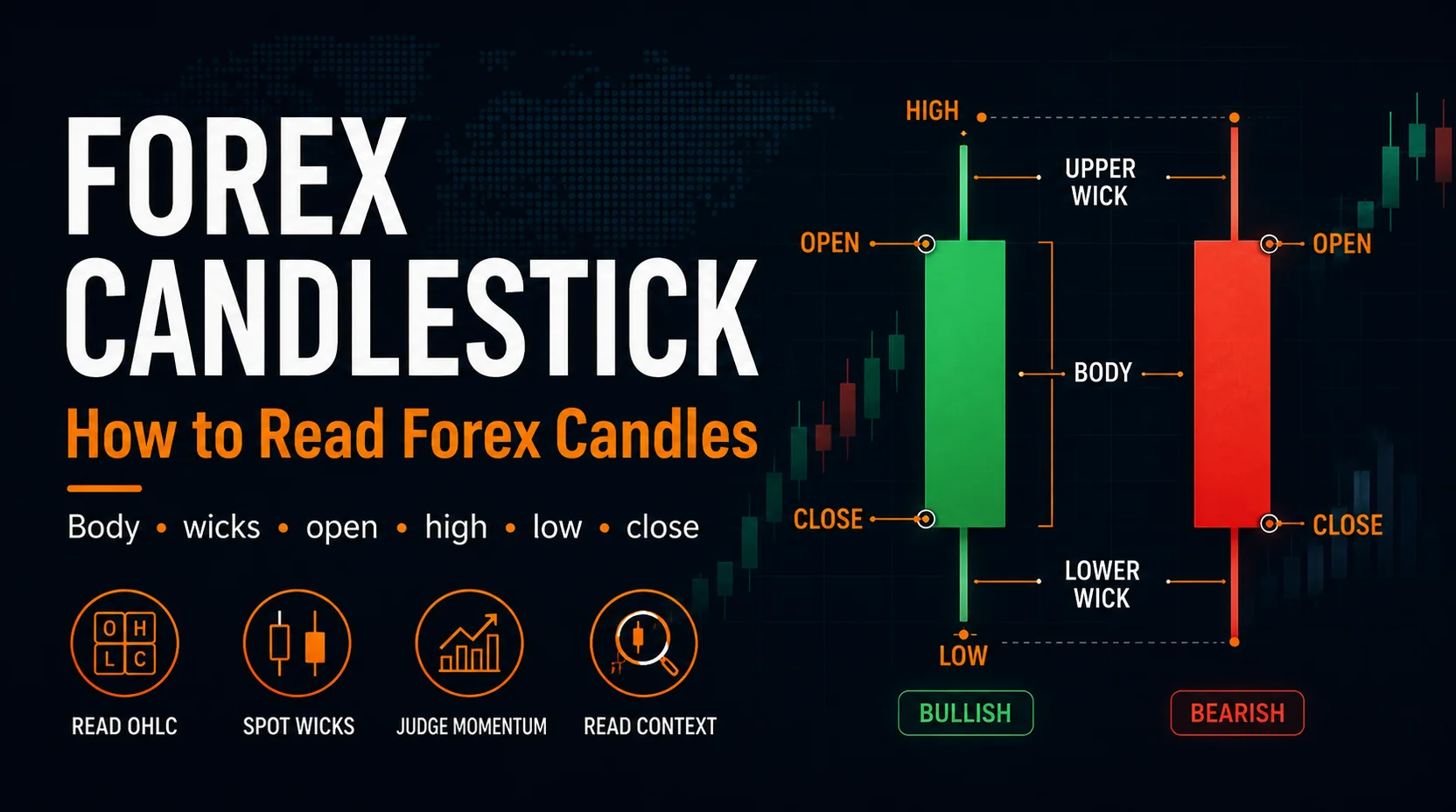
What Is A Forex Candlestick?
A forex candlestick is a chart candle that summarizes price movement for a currency pair during one selected timeframe. A single candle can represent one minute, five minutes, one hour, one day, or another chart period supported by the platform.
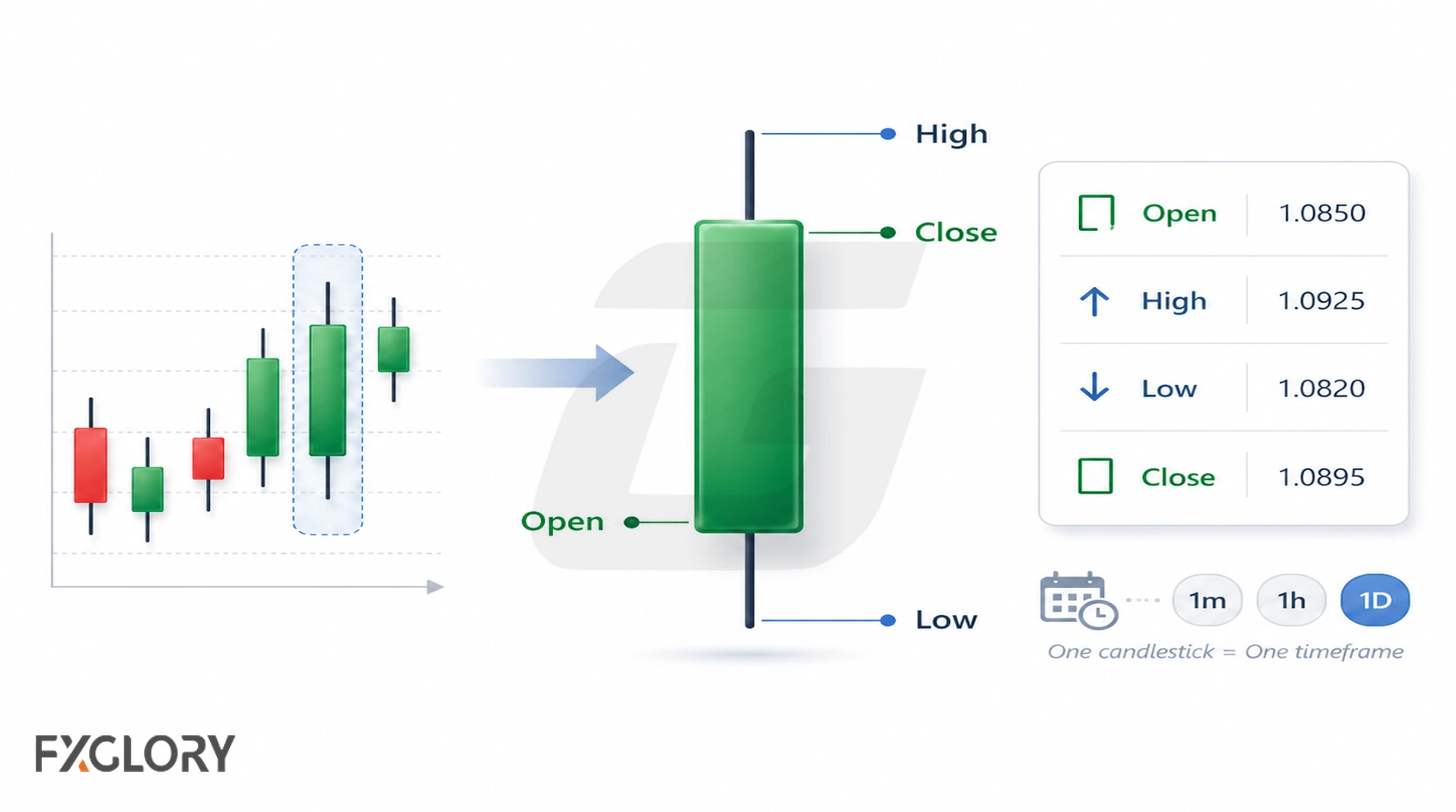
Each forex candle shows four prices: the open, high, low, and close. These are often shortened to OHLC. The open is where the candle began. The high is the highest price reached during that candle. The low is the lowest price reached during that candle. The close is where the candle finished.
Forex candlesticks are widely used because they show more detail than a simple line chart. A line chart usually connects closing prices. A candlestick chart shows the relationship between the open and close, plus the full range that price explored before the candle ended.
This helps traders review short-term pressure, pauses, rejections, breakouts, and indecision. Still, a candle is only one piece of chart information. Its meaning depends on where it appears, what happened before it, and how price behaves afterward.
Forex Candle Anatomy: Body, Wicks, Open, High, Low, And Close
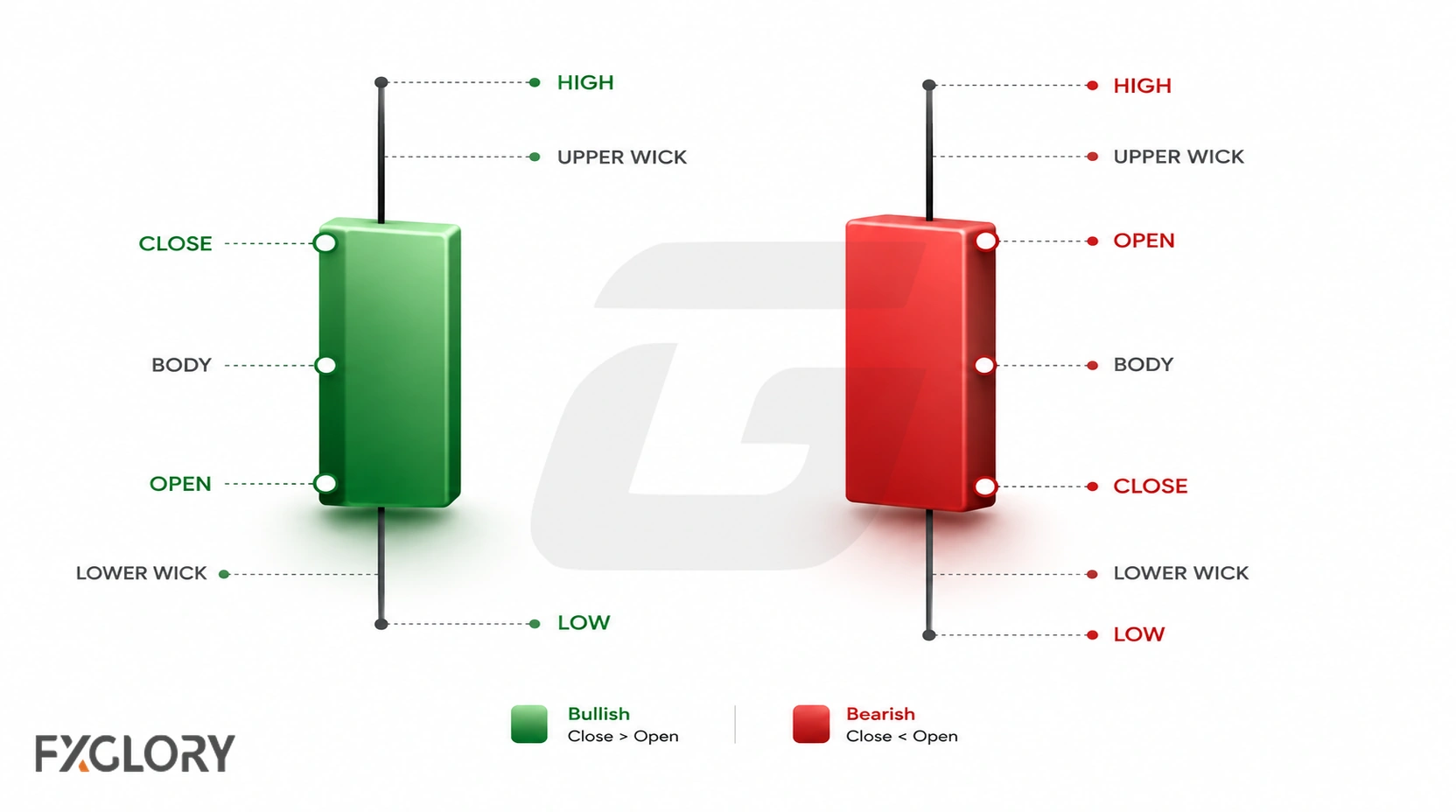
A candle has two main parts: the body and the wicks. The body is the thick section of the candle. It shows the distance between the open and close. The wicks, sometimes called shadows, are the thin lines above and below the body. They show how far price moved beyond the body before the candle closed.
The Candle Body
The body shows the relationship between the opening price and the closing price. A large body means price closed far away from where it opened. A small body means that the closing price was close to the opening price.
- Large body: Price moved clearly from open to close during that candle.
- Small body: Price opened and closed near the same area, which may show hesitation or balance.
- Close near the high: The candle finished near the upper end of its range.
- Close near the low: The candle finished near the lower end of its range.
The Upper Wick
The upper wick shows how far price moved above the candle body. A long upper wick means price traded higher during the candle but could not close near that high. Depending on location, this may show rejection, profit taking, a failed breakout attempt, or short-term selling pressure.
The Lower Wick
The lower wick shows how far price moved below the candle body. A long lower wick means price traded lower during the candle but did not close near that low. Depending on location, this may show rejection of lower prices, buying pressure, short covering, or volatility around a key area.
The Open And Close
The open and close decide whether the candle is bullish or bearish. If the close is above the open, the candle is bullish. If the close is below the open, the candle is bearish. Chart colors can vary, so the position of the open and close matters more than the candle color itself.
Bullish And Bearish Candlesticks In Forex
A bullish forex candle closes above its open. This means the pair finished the candle higher than where it began. A bearish forex candle closes below its open. This means the pair finished the candle lower than where it began.
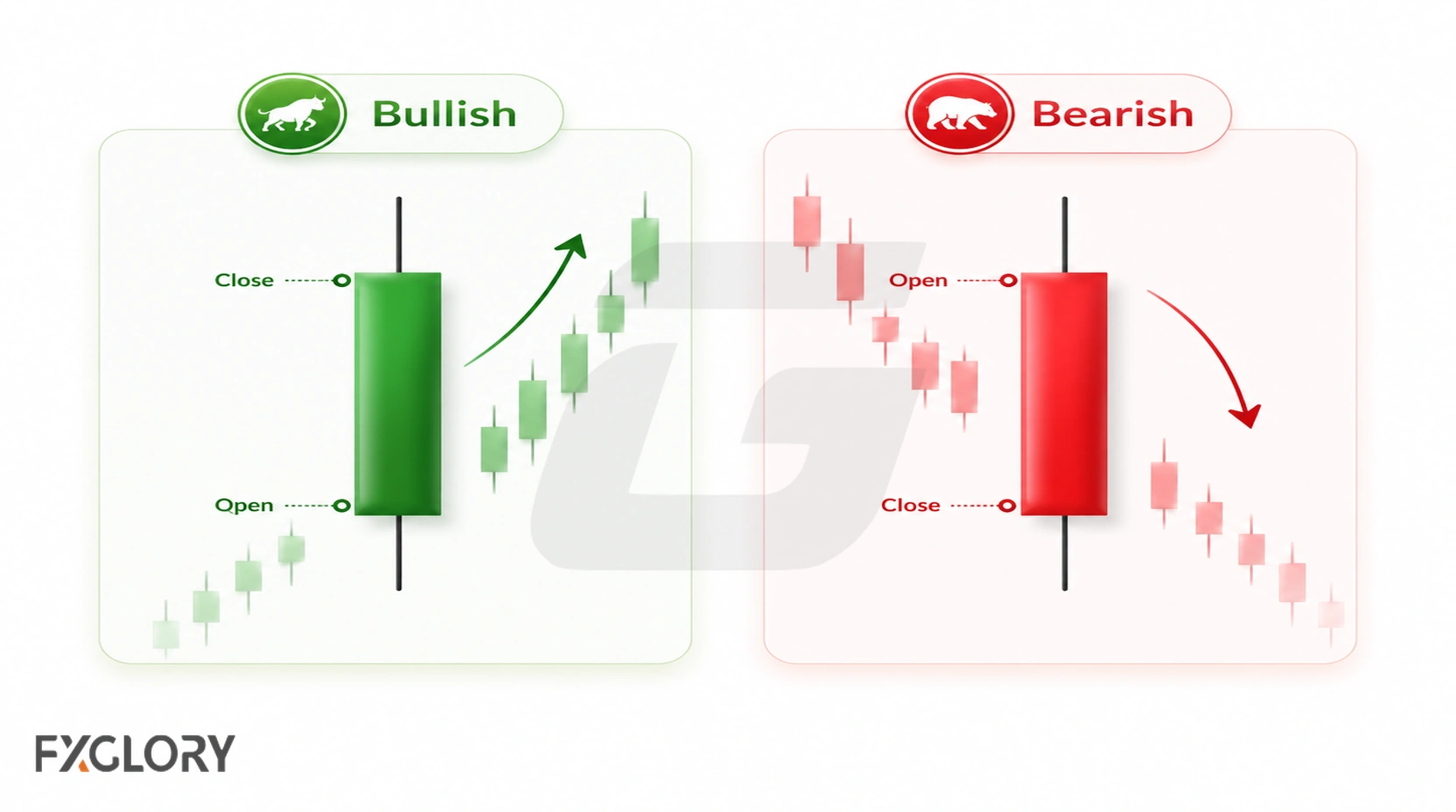
For example, on a GBP/USD chart, a bullish candle means GBP gained against USD during that candle's period. A bearish candle means GBP weakened against USD during that candle's period. The same reading logic applies to any currency pair, but the quote direction matters because every forex pair compares one currency against another.
A candle can be bullish without being strong. A candle can also be bearish without being important. Strength depends on the candle's size, close location, surrounding candles, volatility, and chart area.
- Stronger bullish appearance: A larger body that closes near the high of the candle.
- Weaker bullish appearance: A small body, a long upper wick, or a candle that appears after an extended rise.
- Stronger bearish appearance: A larger body that closes near the low of the candle.
- Weaker bearish appearance: A small body, a long lower wick, or a candle that appears near a support area.
Worked Example: Reading One Forex Candle With OHLC
Imagine a one-hour EUR/USD candle with these prices:
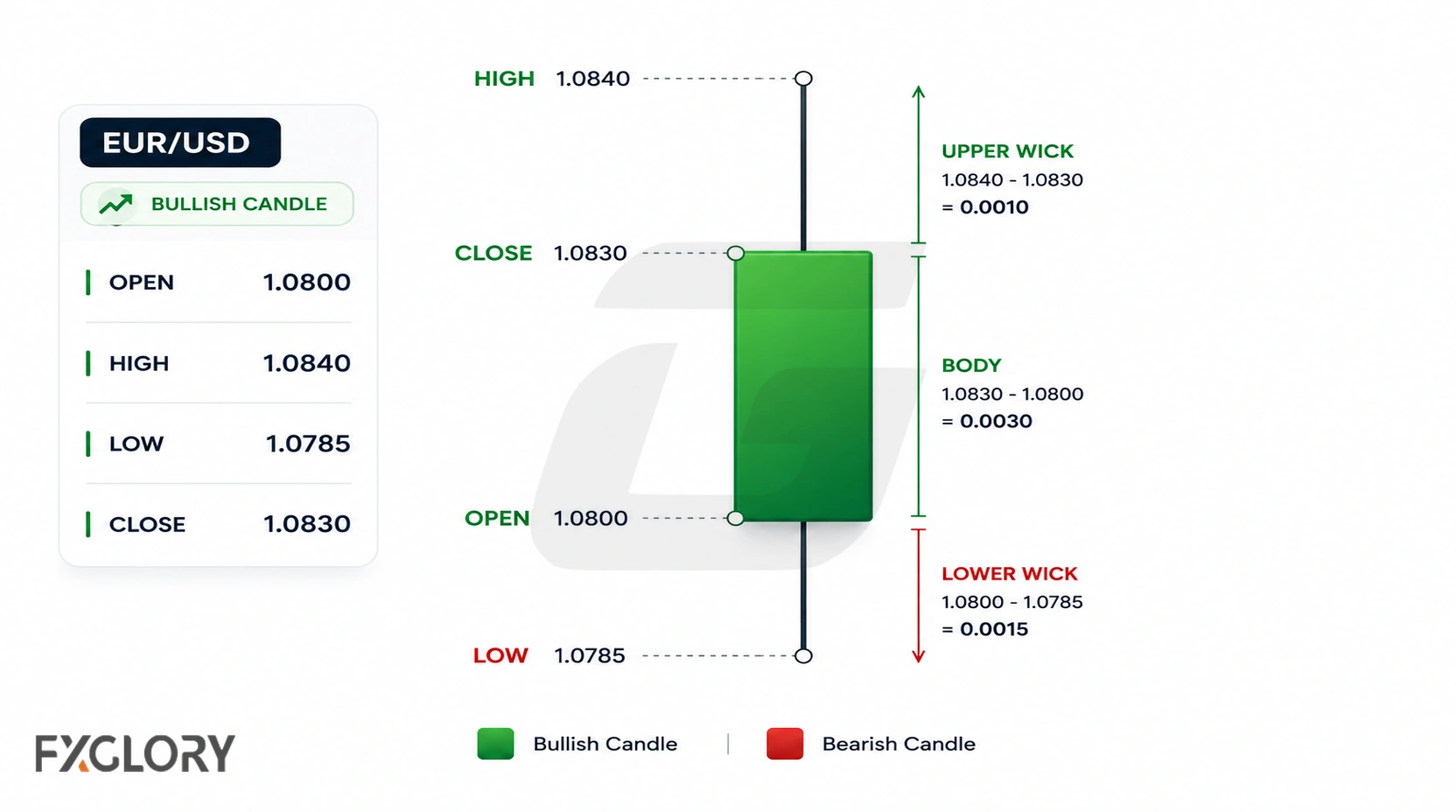
- Open: 1.0800
- High: 1.0840
- Low: 1.0785
- Close: 1.0830
This candle opened at 1.0800 and closed at 1.0830, so it is bullish because the close is above the open. The high was 1.0840, which means price reached 10 pips above the close before pulling back slightly. The low was 1.0785, which means price also traded 15 pips below the open before recovering.
The body runs from 1.0800 to 1.0830. The full range runs from 1.0785 to 1.0840. A trader reading this candle would not only say it was bullish. They would also notice that price moved below the open first, recovered, reached a higher level, and closed closer to the high than the low.
How To Read Candlesticks In Forex
A consistent candlestick-reading process starts with the timeframe and candle structure, then adds surrounding price action and chart context.
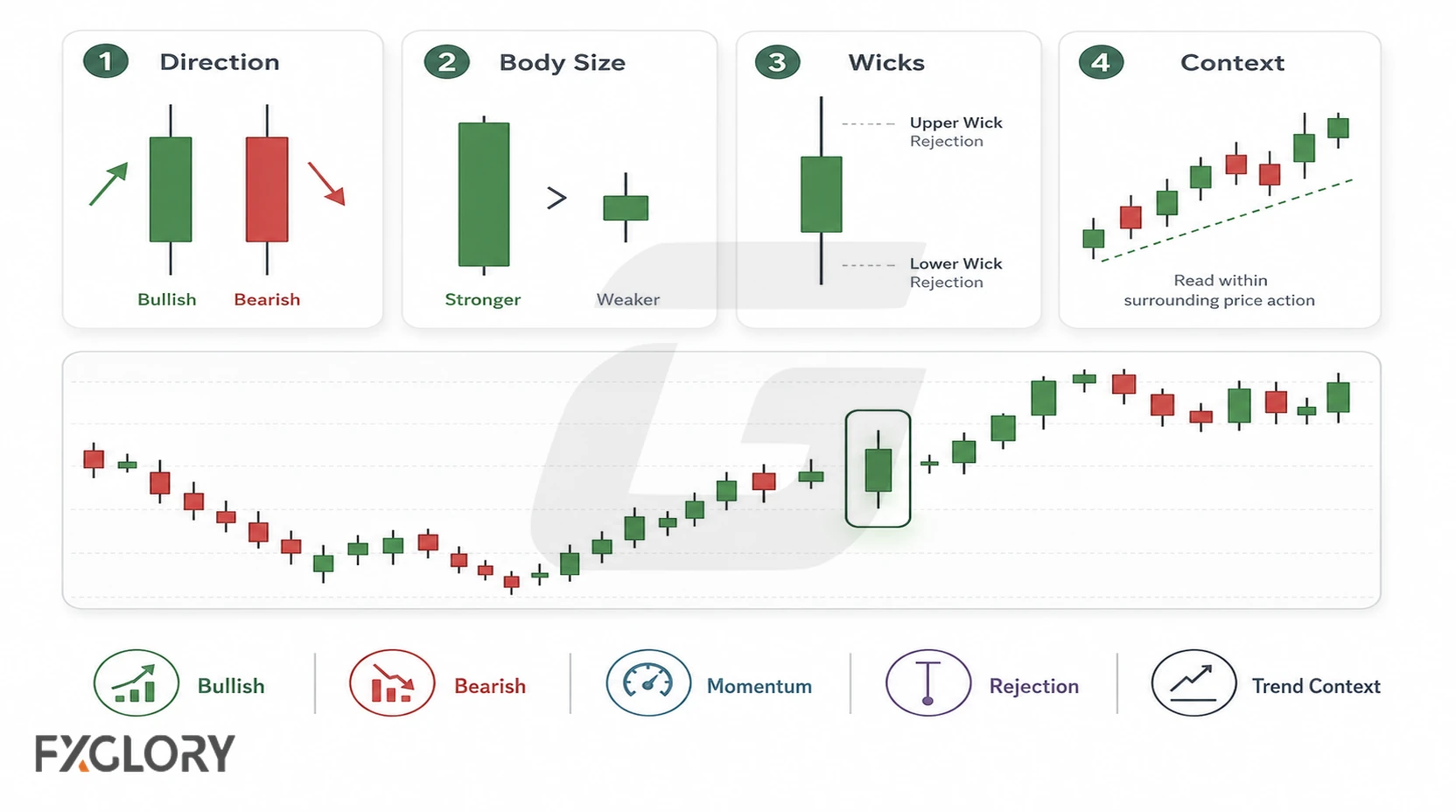
1. Check The Timeframe First
A candle's meaning depends on the timeframe. A long wick on a one-minute chart may reflect a brief burst of volatility. A long wick on a daily chart may reflect a larger rejection across an entire trading day. The same candle shape can carry different importance on different timeframes.
Shorter timeframes create completed candles more frequently and often show more short-term noise. Longer-timeframe candles take longer to complete, even though a live candle can still change with each incoming price update. A trader reading candlesticks should know whether the candle represents a short-term fluctuation or a broader market period.
2. Identify The Open, High, Low, And Close
Before naming any candle, identify the four prices. Where did the candle start? How high did it reach? How low did it reach? Where did it close? This gives the candle its basic message.
3. Compare The Body With The Wicks
The body and wicks show whether price held its move or pulled back before the close. A large body with small wicks may show directional control during that candle. A small body with long wicks may show uncertainty, rejection, or two-sided volatility.
4. Read The Candle In Its Chart Location
Location is critical. A long lower wick in the middle of a choppy range may not matter much. A long lower wick at a previously tested support area may deserve closer attention. A strong candle after a long move may mean something different from the same candle after a quiet consolidation.
5. Watch What Price Does Next
The next candle, a nearby level, or a retest can change how the first candle is interpreted. A candle that looks strong alone may become less useful if price immediately returns into the previous range. A candle that looks small may become more important if it appears before a clean break from compression.
Quick Reference: What Bodies And Wicks Can Suggest
Candle bodies and wicks help describe what happened during a chart period. They do not explain every reason behind the move, and they do not guarantee the next candle. Their value is in making visible price behavior easier to organize.
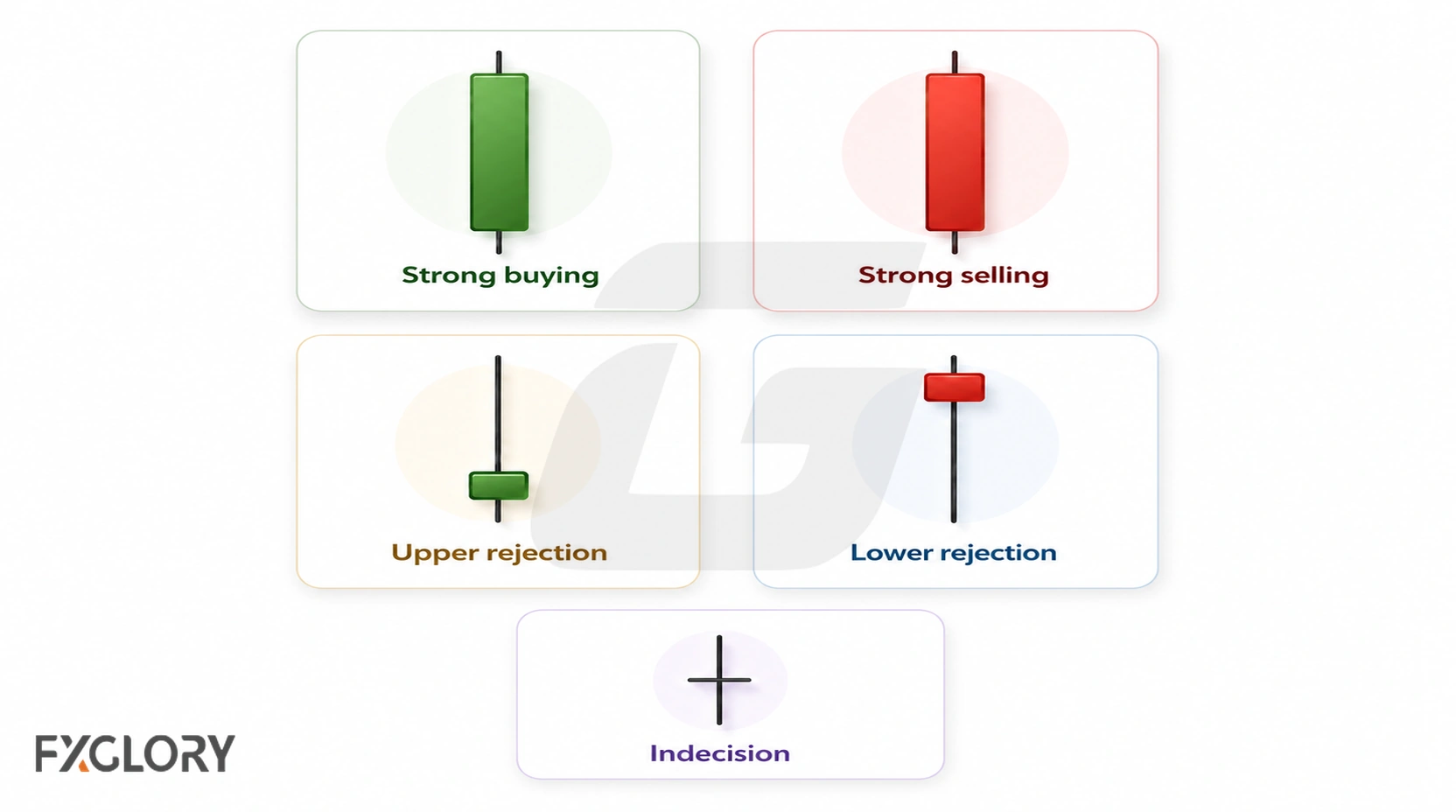
| Candle Feature | What It Shows | Reading Caution |
|---|---|---|
| Large body | Price closed far from where it opened. | Can show pressure, but may also appear late in an extended move or during unstable volatility. |
| Small body | Price opened and closed near the same area. | May show hesitation, but needs chart context. |
| Long upper wick | Price traded higher but did not close near the high. | Can suggest rejection, but may only be temporary volatility. |
| Long lower wick | Price traded lower but did not close near the low. | Can suggest rejection of lower prices, but trend context matters. |
| Close near the high | Buyers held more of the candle's range into the close. | Still needs comparison with nearby resistance and prior candles. |
| Close near the low | Sellers held more of the candle's range into the close. | Still needs comparison with nearby support and prior candles. |
| Very wide range | The candle covered a large high-to-low distance. | Check news, spread, liquidity, and volatility conditions. |
| Very narrow range | Price moved within a small high-to-low distance. | May show quiet trading or compression, not necessarily direction. |
From Single Candles To Forex Candlestick Patterns
A candlestick pattern is a recognizable structure formed by one or more candles. Pattern names can help traders organize chart observations, but the candle's location and surrounding price action remain more important than the label.
Candle anatomy provides the foundation for recognizing more complex formations. The forex candlestick patterns guide groups common one-, two-, and three-candle structures, while the forex reversal candles guide focuses on formations commonly examined near possible turning areas.
Forex Candlestick Cluster Map
The table below shows where to continue after learning candle anatomy. Use it as a guide map, not as a shortcut for trading decisions.
| Study Area | Main Idea | Best Next Page | Why It Comes Next |
|---|---|---|---|
| Pattern groups | Single-candle, two-candle, three-candle, and multi-candle formations. | Forex candlestick patterns | Use this after candle anatomy to understand how formations are grouped. |
| Reversal-focused candles | Candles often reviewed after an existing move or near possible turning areas. | Forex reversal candles | Use this to compare reversal-focused structures without relying on one candle alone. |
| Doji and balance | Open and close sit close together, showing pause or balance. | Doji candle forex | Use this before studying doji subtypes. |
| Long lower-shadow doji | Doji body near the high with a long lower shadow. | Dragonfly doji forex | Use this to separate lower-shadow doji structure from hammer candles. |
| Long upper-shadow doji | Doji body near the low with a long upper shadow. | Gravestone doji forex | Use this to separate upper-shadow doji structure from shooting star candles. |
| Small-body two-sided candle | Small body with upper and lower shadows. | Spinning top forex | Use this to study two-sided candle movement without forcing a doji label. |
| Full-body pressure candle | Large body with little or no wick. | Marubozu candle forex | Use this to study body dominance and one-candle directional pressure. |
| Lower-wick candle after selling pressure | Small body near the high with a long lower wick. | Forex hammer candle | Use this to study lower-price rejection after selling pressure. |
| Upper-wick candle after selling pressure | Small body with a long upper wick after a decline or lower-price test. | Inverted hammer forex | Use this to study an upper-wick test after selling pressure. |
| Upper-wick candle after buying pressure | Small body near the low with a long upper wick. | Shooting star forex | Use this to study higher-price rejection after buying pressure. |
| Lower-wick candle after buying pressure | Small body with a long lower wick after an upward move. | Hanging man forex | Use this to compare hammer-like shape in a different prior context. |
| Broad long-wick rejection | Long wick, smaller body, and close away from the tested extreme. | Pin bar in forex | Use this for the broader long-wick concept after learning specific candle names. |
| Two-candle body takeover | Second candle body covers the previous candle body. | Forex engulfing candle | Use this when moving from one-candle reading to two-candle pressure shifts. |
| Two-candle contraction | Smaller second candle forms inside a larger first candle. | Harami forex | Use this to study compression after a larger candle. |
| Two-candle bullish recovery | Second candle recovers into the prior bearish candle body. | Piercing line forex | Use this to study a two-candle recovery structure after selling pressure. |
| Two-candle bearish pushback | Second candle moves into the prior bullish candle body. | Dark cloud cover forex | Use this to study a two-candle pushback structure after buying pressure. |
| Repeated high or low tests | Nearby candles test similar highs or lows. | Tweezer top and bottom forex | Use this to study repeated rejection around similar price areas. |
| Three-candle bullish sequence | Bearish candle, smaller middle candle, and bullish response candle. | Morning star forex | Use this to study a staged response after selling pressure. |
| Three-candle bearish sequence | Bullish candle, smaller middle candle, and bearish response candle. | Evening star forex | Use this to study a staged response after buying pressure. |
| Three bullish candles | Three consecutive bullish candles with sustained buyer response. | Three white soldiers forex | Use this to study sustained bullish candle sequences. |
| Three bearish candles | Three consecutive bearish candles with sustained seller response. | Three black crows forex | Use this to study sustained bearish candle sequences. |
Popular Forex Candlestick Guides By Structure
Once you can identify the open, high, low, close, body, and wicks, the next topic depends on the structure you see on the chart.
- Pattern overview: The forex candlestick patterns guide groups common formations by candle count and structure.
- Possible turning structures: The forex reversal candles guide compares candles often examined after an existing move or near a tested level.
- Balance and indecision: The doji and spinning top guides explain small-body structures where price finishes near its opening area.
- Long-wick structures: The hammer, shooting star, and pin bar guides focus on candles where the wick carries much of the visual information.
- Multi-candle formations: The engulfing, morning star, and evening star guides show how meaning can depend on the relationship between consecutive candles.
Forex Context: Why Candle Location Matters
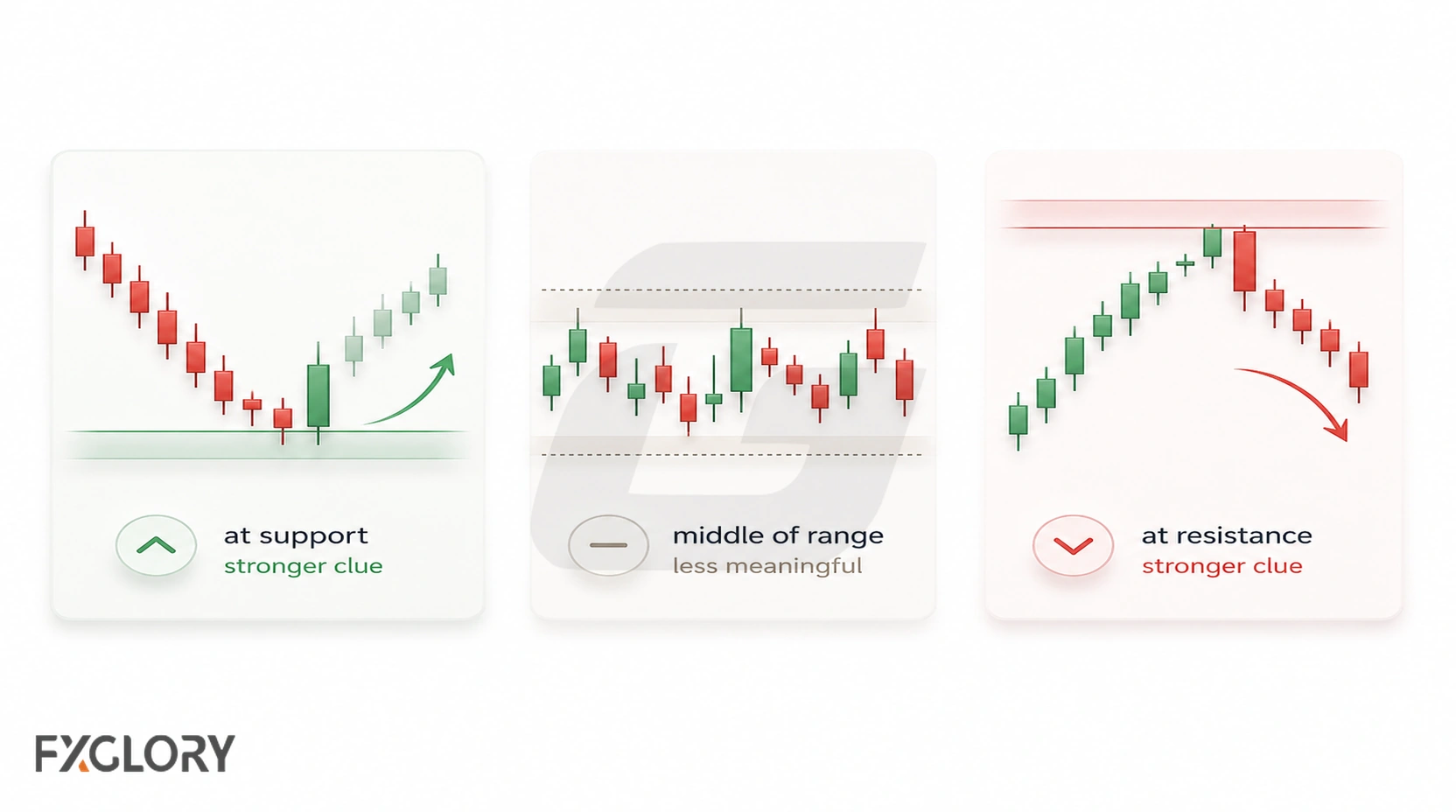
Forex candlesticks should be read with the chart environment around them. The same candle can suggest different things in a trend, range, breakout, or news-driven market. Context helps decide whether the candle is useful, unclear, or better ignored.
Trend Context
In an uptrend, bullish candles may support continuation, while bearish candles may show a pullback. In a downtrend, bearish candles may support continuation, while bullish candles may show a pause or correction. A candle that moves against the prevailing trend may represent a pullback, pause, or early shift, so its meaning depends on the surrounding structure rather than direction alone.
Support And Resistance
Candles near previously tested support or resistance can be easier to interpret because their reaction can be compared with a defined chart area. A rejection wick near a previous low or high may be more useful than a similar wick in the middle of a range. The level and candle should be reviewed together.
Volatility Conditions
Volatility changes candle size. During active sessions or news events, candles may become much larger. During quiet periods, candles may shrink. A large candle is not automatically useful if it forms during unstable spreads or fast news movement.
Spread And Liquidity
Forex prices can move differently during low-liquidity periods, market opens, rollovers, or major announcements. Candlestick patterns that appear during these conditions may be harder to interpret because execution conditions can change quickly.
Timeframe Alignment
A candle on a short timeframe may look important until it is compared with a higher timeframe. For example, a short-term bullish candle may only be a small pullback inside a larger downtrend. Reading multiple timeframes can help, but only when the trader defines which timeframe controls the review.
For chart practice, a trader may observe candle behavior on a live pair page such as GBP/USD chart movement or compare how candle ranges change on a different market such as gold price movement. These pages are useful for observation, not as standalone trading signals.
- Do not treat a candle near a random area the same as a candle near a tested level.
- Do not ignore spread and news-event conditions when reading fast candles.
- Do not assume that a short-timeframe candle controls the broader chart direction.
- Do not turn a candle shape into a decision without a clear risk plan.
A Practical Workflow For Reading Forex Candlestick Charts
A clear workflow keeps candlestick reading disciplined. Instead of asking whether a candle is good or bad, the trader can ask a series of structured questions.
- Start with the pair: Know which two currencies are being compared and which side of the quote is strengthening or weakening.
- Choose the main timeframe: Decide whether the candle is being read for short-term observation, intraday review, or broader chart review.
- Mark the obvious areas: Identify nearby support, resistance, range boundaries, swing highs, swing lows, or trend structure.
- Read the candle structure: Compare the body, upper wick, lower wick, full range, open, and close.
- Compare with previous candles: Ask whether the candle continues, rejects, pauses, or changes the recent rhythm.
- Check the next reaction: Review whether later price movement supports or weakens the candle reading.
- Review risk conditions: Consider spread, volatility, leverage, news risk, and whether the chart reading has a clear risk boundary.
This workflow can also be combined with other technical analysis tools. For example, a trader may use candle structure alongside momentum context from RSI, volatility context from ATR, or range and expansion context from Bollinger Bands. These tools can support the reading process, but they do not remove the need for risk planning.
Common Mistakes When Reading Forex Candles
Candlestick charts are easy to look at, but they can be difficult to read consistently. Many mistakes come from giving one candle more meaning than it deserves.
- Reading the candle without the trend: A bullish candle inside a strong downtrend may only be a pullback. A bearish candle inside a strong uptrend may only be a pause. Trend context helps avoid reading every candle as a reversal.
- Ignoring the close: A candle may look strong while it is forming, then close very differently. The close is important because it shows where price finished the selected period.
- Using pattern names without context: Knowing a pattern name is not the same as understanding the chart. A pattern still needs market condition, risk size, and a reason to stand aside when the chart is unclear.
- Forgetting about news and volatility: Major economic events can create large candles, long wicks, and fast reversals. These candles may look clean after the fact, but spreads and execution conditions can change quickly in real time.
- Overloading the chart: Too many indicators, candles, lines, and timeframes can create conflicting information. Candlestick reading works better when each tool has a clear purpose.
- Confusing similar candle structures: Hammer, hanging man, dragonfly doji, shooting star, inverted hammer, and gravestone doji can look similar, but their body structure and prior context are different.
- Confusing observation with action: A candle can show pressure, rejection, or hesitation. That does not automatically create a decision. Risk control and chart context still matter.
- Replacing risk planning with candle confidence: A single candle should not replace a complete risk plan, and leverage can magnify losses when exposure is oversized.