
What Is the Three White Soldiers Pattern in Forex?
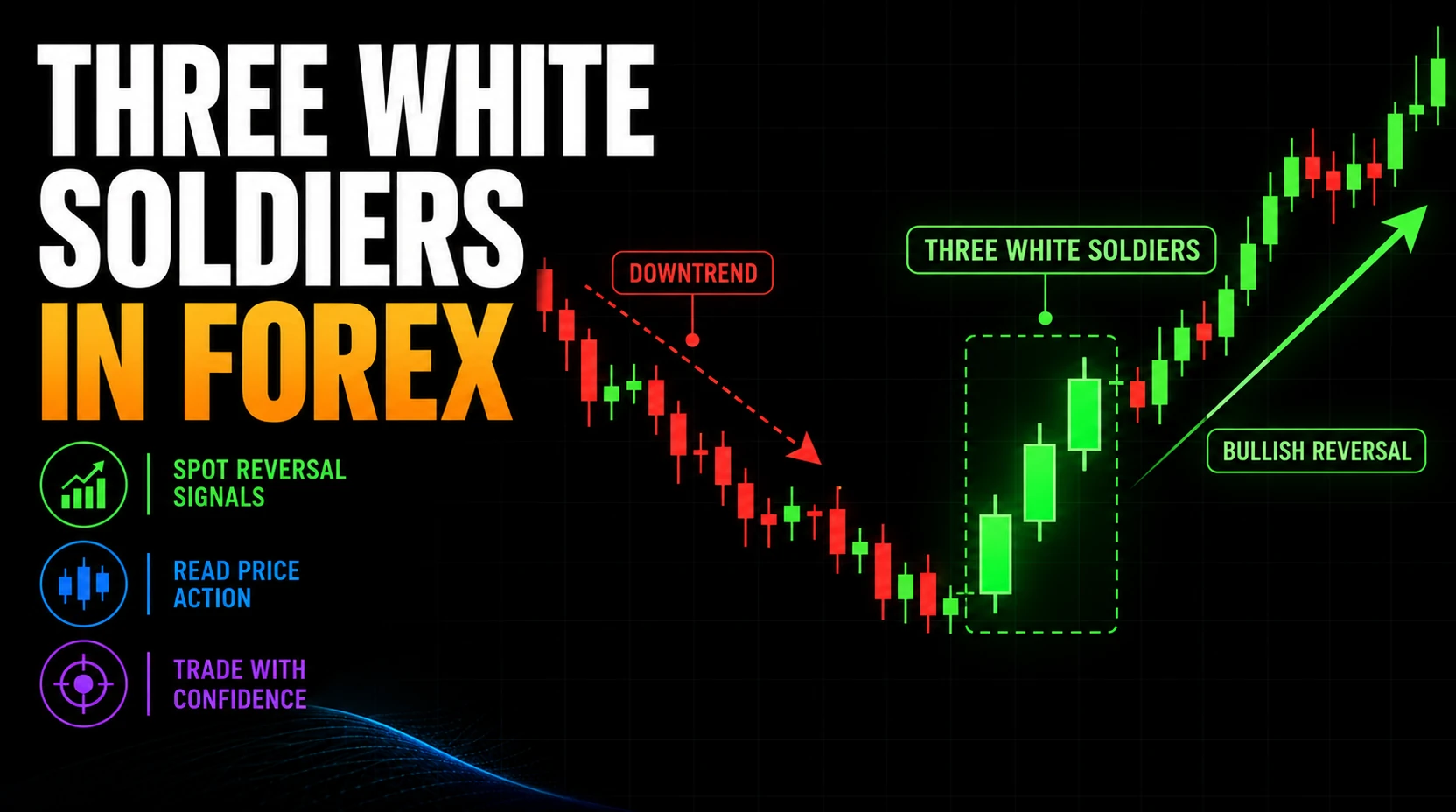
Three White Soldiers is a bullish three-candle candlestick formation traditionally studied after a decline or sustained selling pressure. Three consecutive completed candles have bullish real bodies and progressively higher closes. The formation describes a change in short-term price behavior; it does not establish that a broader downtrend has reversed.
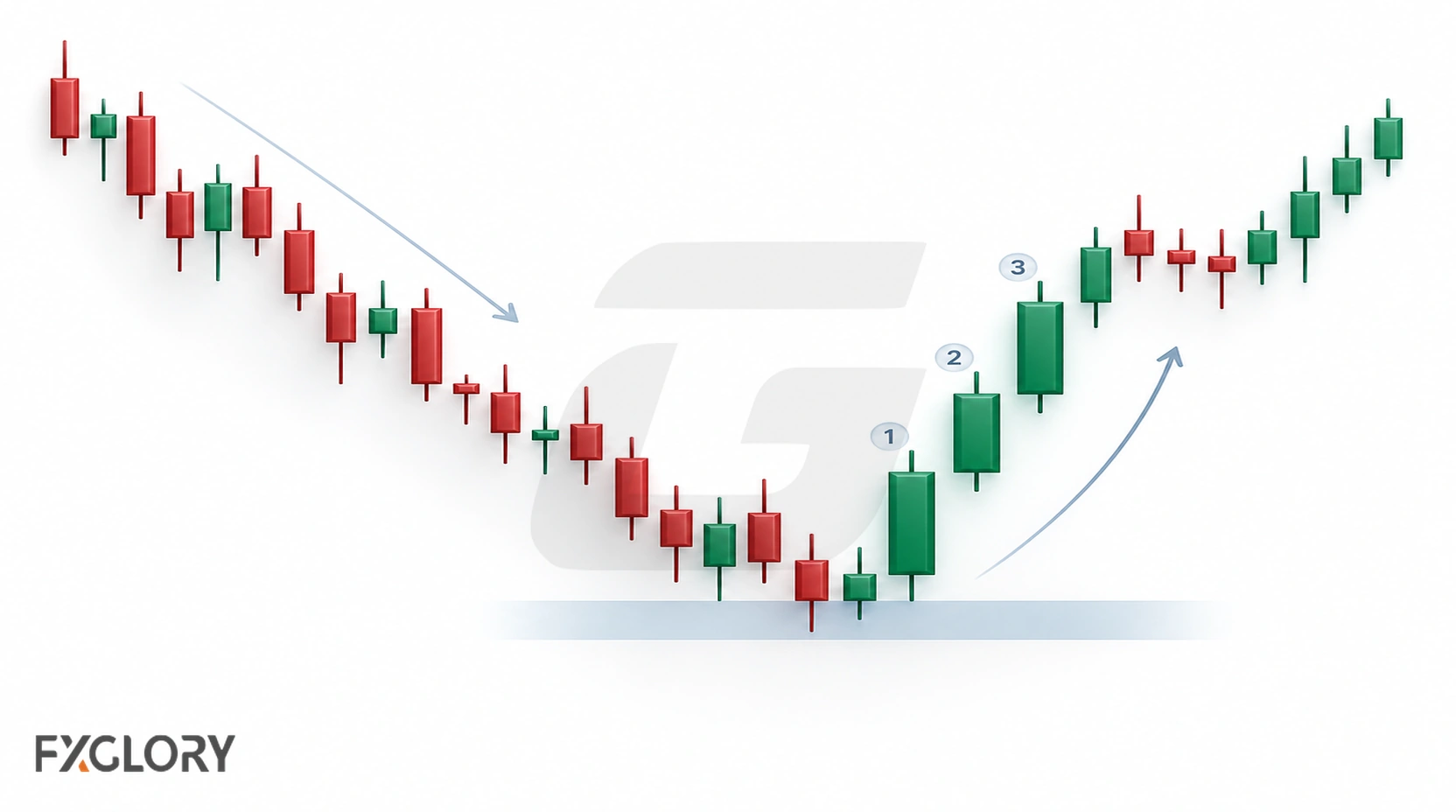
The traditional “white” candles are usually displayed as green on modern charts. Unlike an arbitrary run of up candles, the conventional pattern also emphasizes substantial real bodies, openings within the previous real body, and relatively short upper shadows. The next sections explain how to judge those details.
For definitions of the open, close, real body, and shadows, see the candlestick anatomy guide.
Three White Soldiers Anatomy
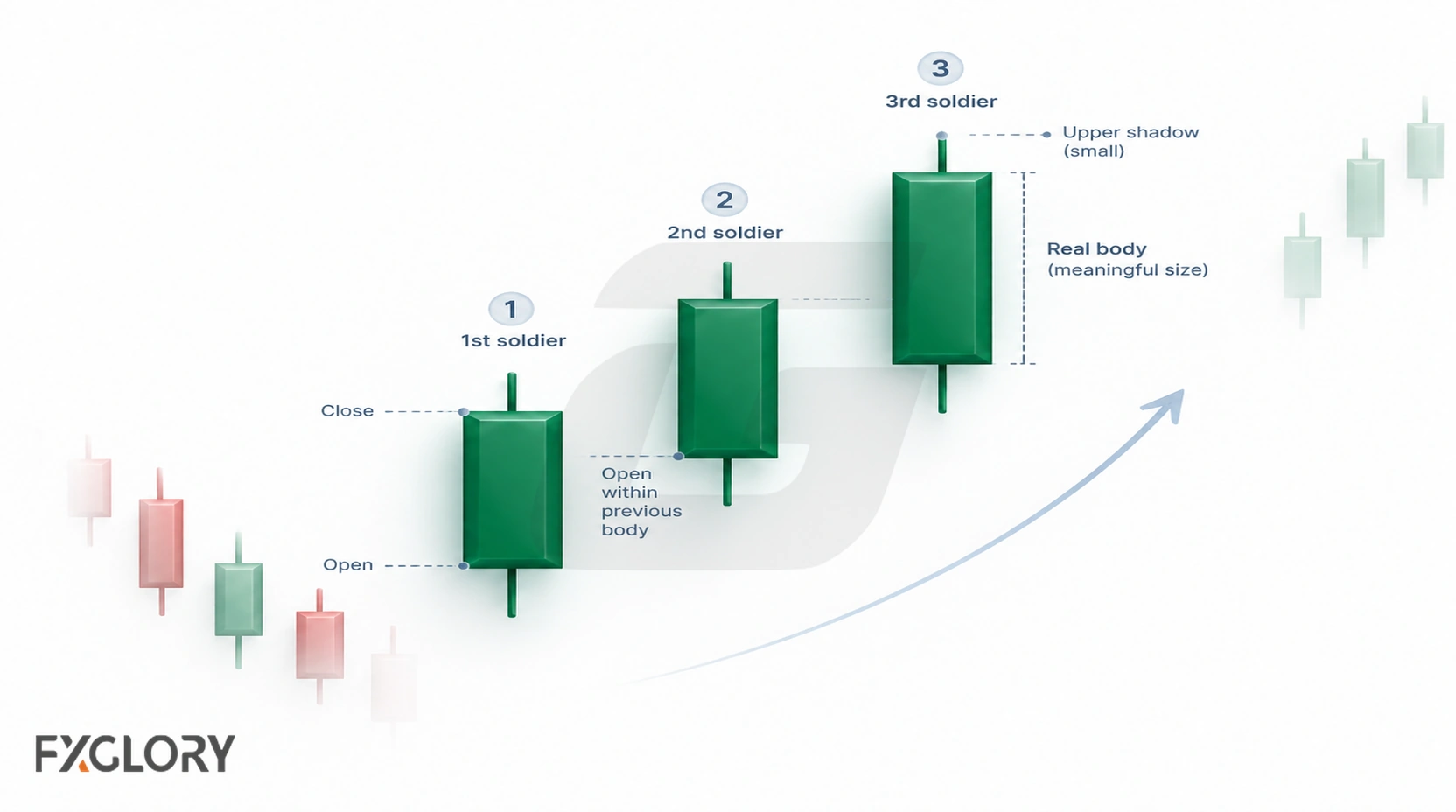
Read the three candles in sequence after they have all closed. A green intrabar third candle does not complete the formation until its closing price is known.
| Candle | Observable condition | Interpretation |
|---|---|---|
| First soldier | A bullish real body appears after prior weakness. | Buyers make an initial advance. |
| Second soldier | Opens within the first real body and closes above the first close. | Upward movement extends into a second period. |
| Third soldier | Opens within the second real body and closes above the second close. | The three-candle formation completes. |
Many classical descriptions also expect each close to exceed the preceding candle’s high, each close to finish near its own high, and upper shadows to remain short. These are stricter quality criteria: the distinction between the necessary price sequence and an especially clean textbook example should be made explicit.
Why Prior Selling Pressure Matters
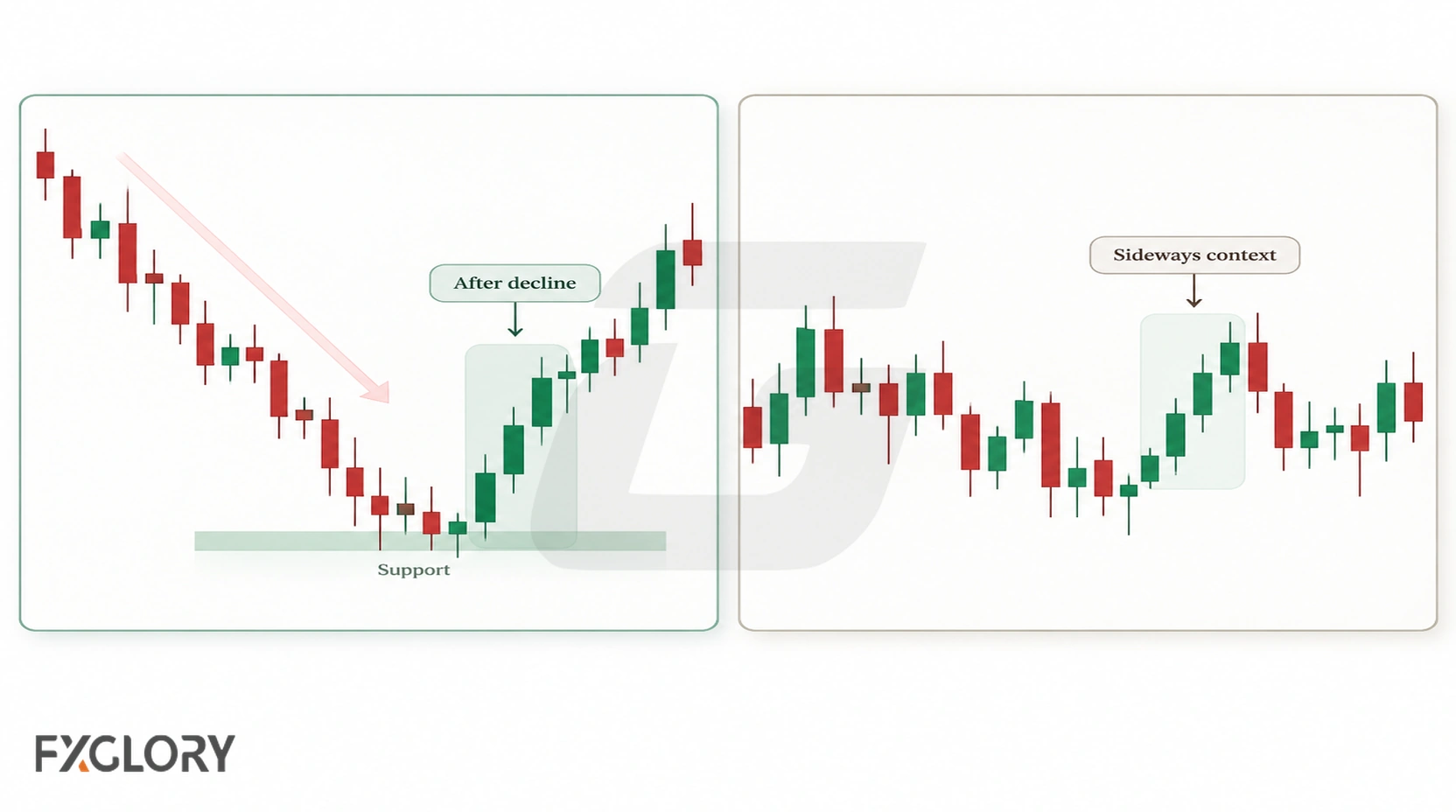
The classic Three White Soldiers is interpreted as a potential bullish reversal after a falling market, a recent swing low, or a pause following selling pressure. In that context the candles show a shift away from the earlier downward move.
Three ascending bullish candles inside an established uptrend may instead show bullish continuation. They resemble the soldier sequence, but lack the preceding decline that gives the classical reversal pattern its name and interpretation.
If the candles emerge in an unstructured sideways range, their directional meaning is less distinctive. Neither a classic reversal formation nor a continuation-like sequence proves what the next candle will do.
Opening, Closing, and Upper-Shadow Rules
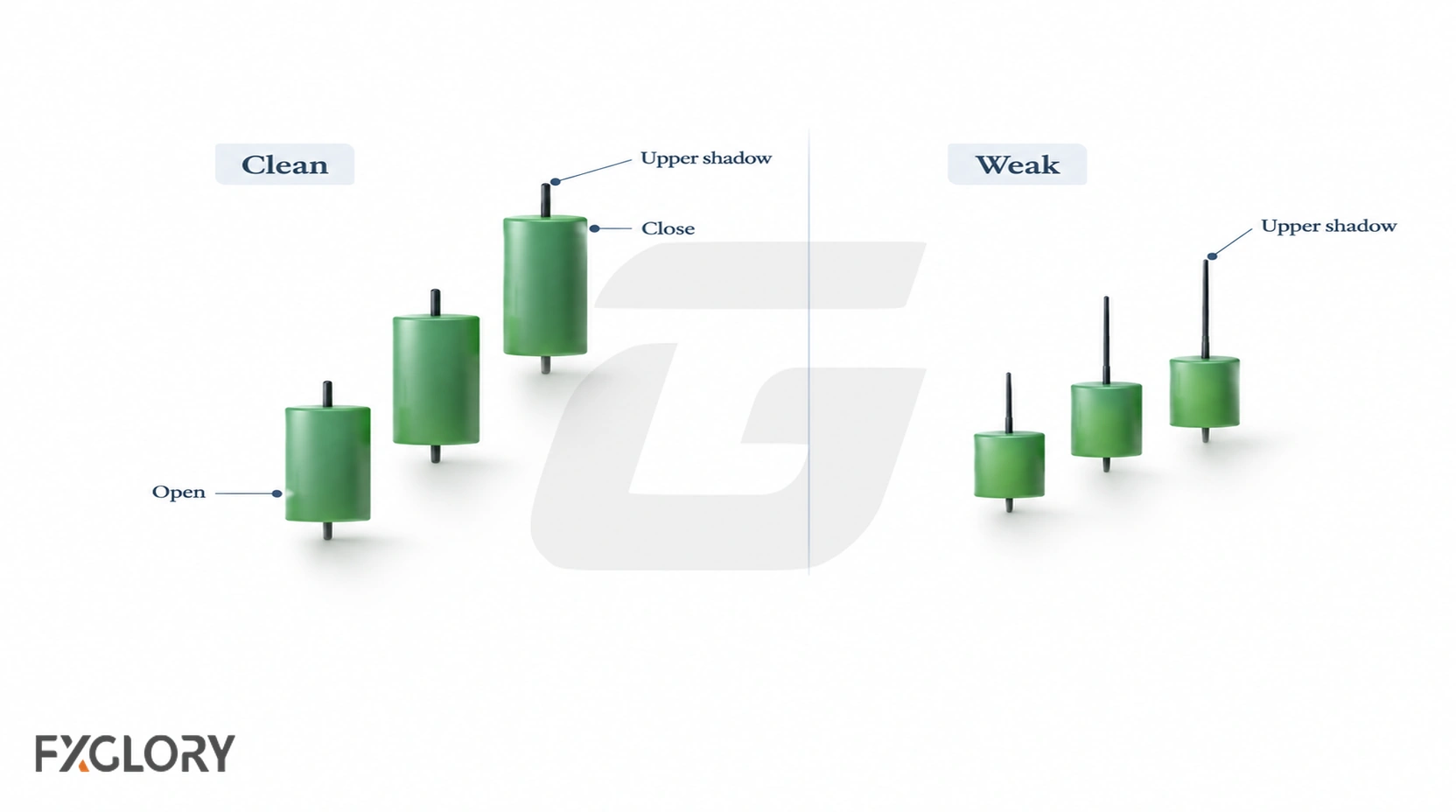
For a textbook formation, the second and third candles commonly open within the real body of the preceding candle and close above the previous close, preferably above its high. For example, opening below the previous body’s lower edge does not meet a strict within-body opening rule, even if that candle later finishes bullish. Forex gaps and broker feed differences can affect the appearance of openings.
The real body is the distance between opening and closing prices. Strong, comparable bullish bodies and closes near candle highs fit the conventional pattern better than progressively tiny bodies or pronounced upper shadows. Short upper shadows suggest less retreat from intrabar highs; long ones show prices traded higher before falling back into the close.
| Feature | Textbook reading | Qualification |
|---|---|---|
| Opens | Second and third opens within the preceding real body | Openings outside it depart from a strict interpretation |
| Closes | Three bullish bodies with progressively higher closes | Closes beyond preceding highs make the advance more emphatic |
| Body size | Substantial bodies without sharp successive contraction | Compare bodies within the same instrument and timeframe |
| Upper shadows | Relatively short, with closes near highs | Large shadows show intrabar rejection |
No universal pip count or body-size threshold applies across all currency pairs and timeframes. The chart should make the relationships observable without relying on subjective labels such as “deep reset” or “tired candles.”
Overextension and Weakening Signs
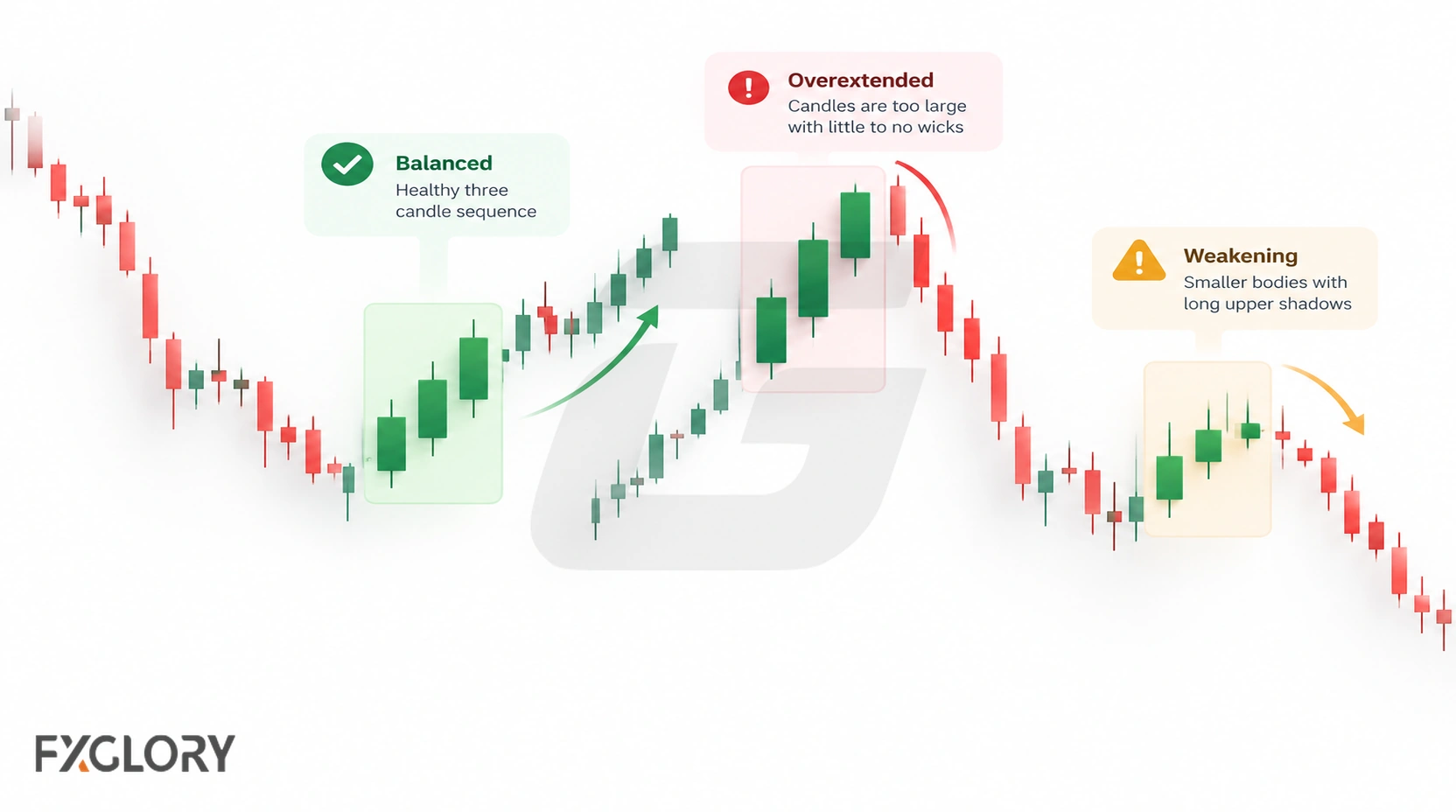
A formation with unusually large real bodies can travel a considerable distance before a trader recognizes it. If the third close approaches established resistance, the potential entry distance and nearby selling pressure differ from those of an earlier-stage reversal. Large candles are not automatically invalid, but they can change the risk/reward of a later trade.
| Sequence Issue | Why It Weakens The Reading | What To Review |
|---|---|---|
| Very stretched candles | The sequence may already be extended. | Review nearby resistance and volatility conditions. |
| Shrinking bodies | Buyer pressure may be losing clarity. | Compare each candle body with the previous one. |
| Long upper shadows | Higher prices may be rejected before each close. | Check whether the candles still close near their highs. |
| Resistance nearby | The sequence may be running into a higher-price area. | Review whether that level already mattered on the chart. |
| News volatility | The candles may reflect unstable movement. | Review spread, liquidity, and candle range conditions. |
Shrinking second or third real bodies and expanding upper shadows are often discussed as possible stalling or advance-block behavior. Those characteristics weaken the interpretation of persistent buying rather than retroactively changing the candle closes. Do not infer a quantified reversal probability without supporting research.
Three White Soldiers vs Three Black Crows
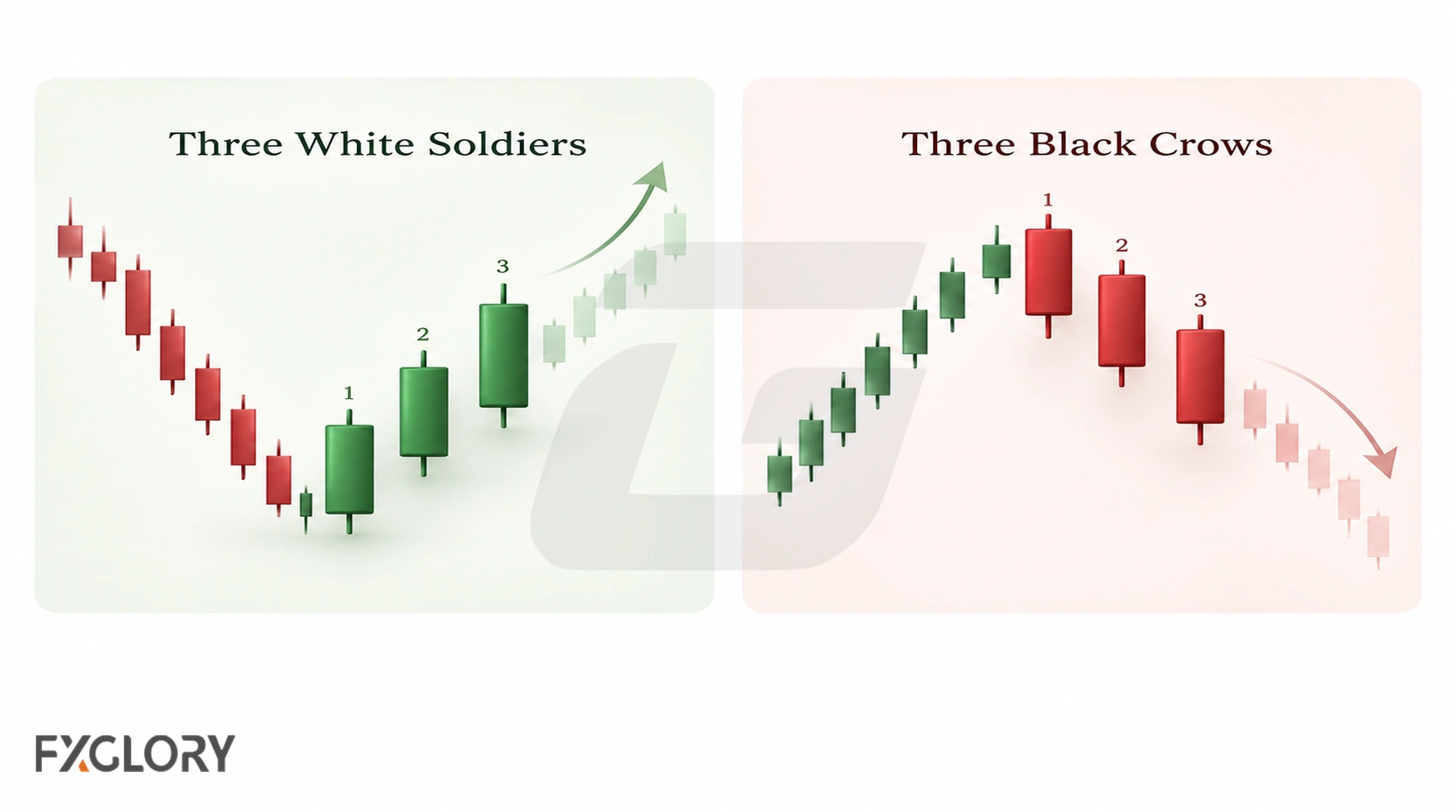
Three Black Crows is the bearish counterpart: three consecutive bearish real bodies that step lower after an advance. Both patterns require candle-to-candle assessment rather than merely counting matching colors.
| Pattern | Usually Reviewed After | Three-Candle Structure | Main Reading Difference |
|---|---|---|---|
| Three white soldiers | Selling pressure, decline, or lower-price test. | Three consecutive bullish candles with higher closes. | Shows sustained buyer response across three candles. |
| Three black crows | Buying pressure, rise, or higher-price test. | Three consecutive bearish candles with lower closes. | Shows sustained seller response across three candles. |
See the Three Black Crows guide for the bearish formation’s distinct requirements.
Three White Soldiers vs Morning Star
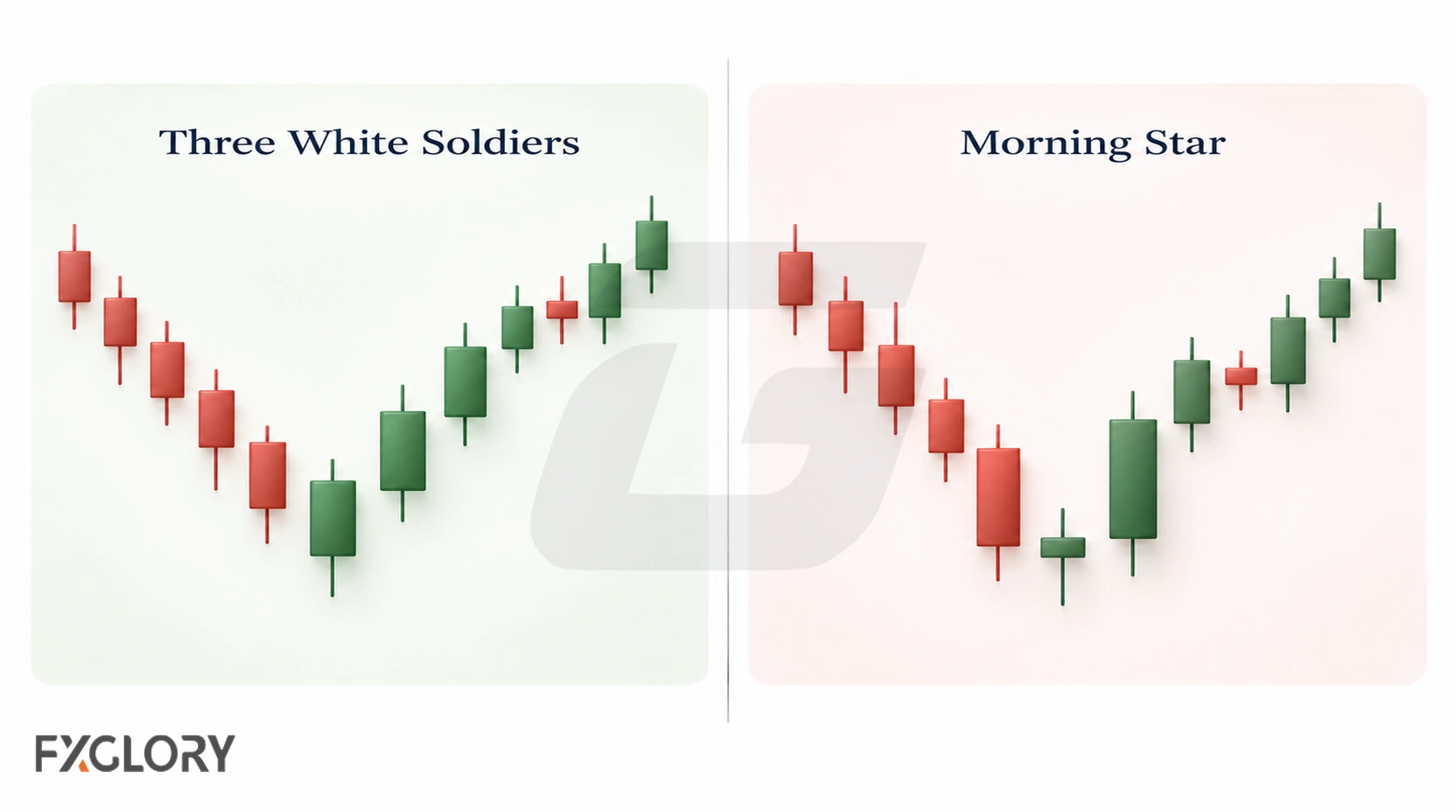
A Morning Star combines a bearish first candle, a relatively small middle candle, and a bullish third candle. It describes a pause and recovery; Three White Soldiers describes three advancing bullish periods without that defining small middle candle.
| Pattern | Candle Count | Main Structure | Main Difference |
|---|---|---|---|
| Three white soldiers | Three candles. | Three consecutive bullish candles with higher closes. | Focuses on sustained buyer response. |
| Morning star | Three candles. | Bearish candle, small middle candle, bullish third candle. | Focuses on a pause followed by buyer response. |
The Morning Star guide covers that separate structure in detail.
Other Similar Forex Candlestick Patterns
The following patterns can signal a possible bullish response but use different candle counts or body relationships.
| Pattern | Distinguishing feature |
|---|---|
| Piercing pattern | Two candles; second bullish close recovers into the first bearish real body |
| Bullish engulfing | Two candles; bullish second real body engulfs the first bearish real body |
| Hammer or inverted hammer | One-candle wick-and-body formations following weakness |
| Tweezer bottom | Repeated near-matching lows rather than a required sequence of three higher bullish closes |
| Rising three methods | Continuation structure with an intervening pullback rather than three uninterrupted bullish candles |
For detailed distinctions, see the inverted hammer, piercing pattern, engulfing candle, hammer, and tweezer bottom guides.
Chart Locations and Forex Conditions
Location affects the interpretation of the same three candles. After a decline near an established swing low or support area, the sequence may describe a potential reversal. At a range low, it may instead signal a bounce within the range. Near overhead resistance, a completed pattern may have less room for a further advance.
A quiet consolidation after selling pressure can also provide context, but the candles still need the characteristic structure. In the middle of an established uptrend, describe a three-candle bullish advance as continuation-like rather than automatically calling it a new reversal.
Session liquidity, scheduled news, spreads, and slippage are especially relevant if someone intends to trade the formation. Unusually wide spreads or rapid news candles can make apparent chart strength difficult to execute at expected prices. Spot forex volume is fragmented; platform tick volume is not a complete market-wide volume measure.
For chart observation, compare GBP/USD price action or gold price action without treating any individual chart as an endorsed setup.
Pattern Quality and Follow-Through
A completed textbook sequence, its chart quality, and a later trading signal are different assessments. The table separates them.
| Assessment | What to inspect | What it does not establish |
|---|---|---|
| Identification | Three completed bullish bodies, higher successive closes, and conventional opening relationships | That a new uptrend has begun |
| Quality | Body size, upper shadows, preceding decline, nearby support or resistance | A guaranteed outcome or universal success rate |
| Follow-through | Later completed candles hold above or advance beyond the sequence, according to a stated rule | That an entry is profitable after spread or slippage |
| Trade planning | Entry condition, invalidation, stop distance, position size, costs, and account-risk limit | Whether the three-candle structure existed |
For instance, a trader might define follow-through as the next completed candle closing above the third soldier’s high. That is one illustrative rule, not a mandatory definition of Three White Soldiers. A later drop below the sequence can defeat a bullish trade thesis even though the historical three-candle pattern remains identifiable.
Hypothetical Three-Candle Forex Example
Suppose EUR/USD has declined and then prints these three completed candles. These prices are invented solely to demonstrate candle relationships, not taken from a historical chart.
| Candle | Open | High | Low | Close |
|---|---|---|---|---|
| 1 | 1.1000 | 1.1022 | 1.0995 | 1.1020 |
| 2 | 1.1014 | 1.1037 | 1.1012 | 1.1035 |
| 3 | 1.1028 | 1.1050 | 1.1026 | 1.1048 |
All three candles close above their opens. Candle 2 opens within candle 1’s real body (1.1000–1.1020), while candle 3 opens within candle 2’s body (1.1014–1.1035). Successive closes rise from 1.1020 to 1.1035 to 1.1048; each close also exceeds the preceding high. The upper shadows are two pips each, giving a relatively clear illustrative sequence.
At the third close the three-candle structure is complete. Whether later EUR/USD price action confirms a reversal—and whether any hypothetical trade is sensible—are separate questions.
How to Identify and Assess the Pattern
- Locate the sequence: Identify the preceding decline, swing low, or consolidation after weakness.
- Inspect closed candles: Find three successive bullish real bodies with advancing closes and assess opening positions relative to previous bodies.
- Judge quality: Compare real-body sizes, upper shadows, and nearby support or resistance without imposing universal thresholds.
- Classify the setting: Distinguish reversal context from an uptrend continuation-like run of bullish candles.
- Observe what happens next: Evaluate any later follow-through using an explicit, separate rule.
- Plan independently: If considering a trade, account for spread, slippage, stop placement, position size, and risk limits.
Indicators can supplement, rather than define, this candlestick structure: RSI and MACD provide momentum context, while ATR and Bollinger Bands describe different aspects of volatility and range behavior. None confirms the pattern by itself.
False and Weak Three-White-Soldiers Readings
The most important distinction is between a sequence that does not meet the structural rules and one that is structurally recognizable but provides weak reversal evidence.
- Not a completed formation: Only one or two candles have closed, the third is unfinished, or the successive closes fail to rise.
- Not the classic reversal context: Three rising bullish candles appear in a mature uptrend without preceding weakness; this may be a continuation-like advance.
- Weaker candle quality: Markedly shrinking real bodies, expanding upper shadows, or openings far outside previous bodies depart from the textbook picture.
- Limited chart significance: The sequence forms in the middle of a choppy range or immediately below established resistance.
- Execution risk: A news spike, rollover spread, or thin-liquidity period creates a visually large sequence but does not ensure an executable trade.
A later selloff does not erase a correctly identified completed pattern; it means the expected bullish follow-through did not materialize. Likewise, having no predefined trade stop does not make a completed candle pattern structurally incomplete.
What to Study After Three White Soldiers
To develop pattern recognition further, compare the opposite Three Black Crows sequence and the Morning Star’s pause-and-recovery structure. For wider context, see forex candlestick pattern groups.