
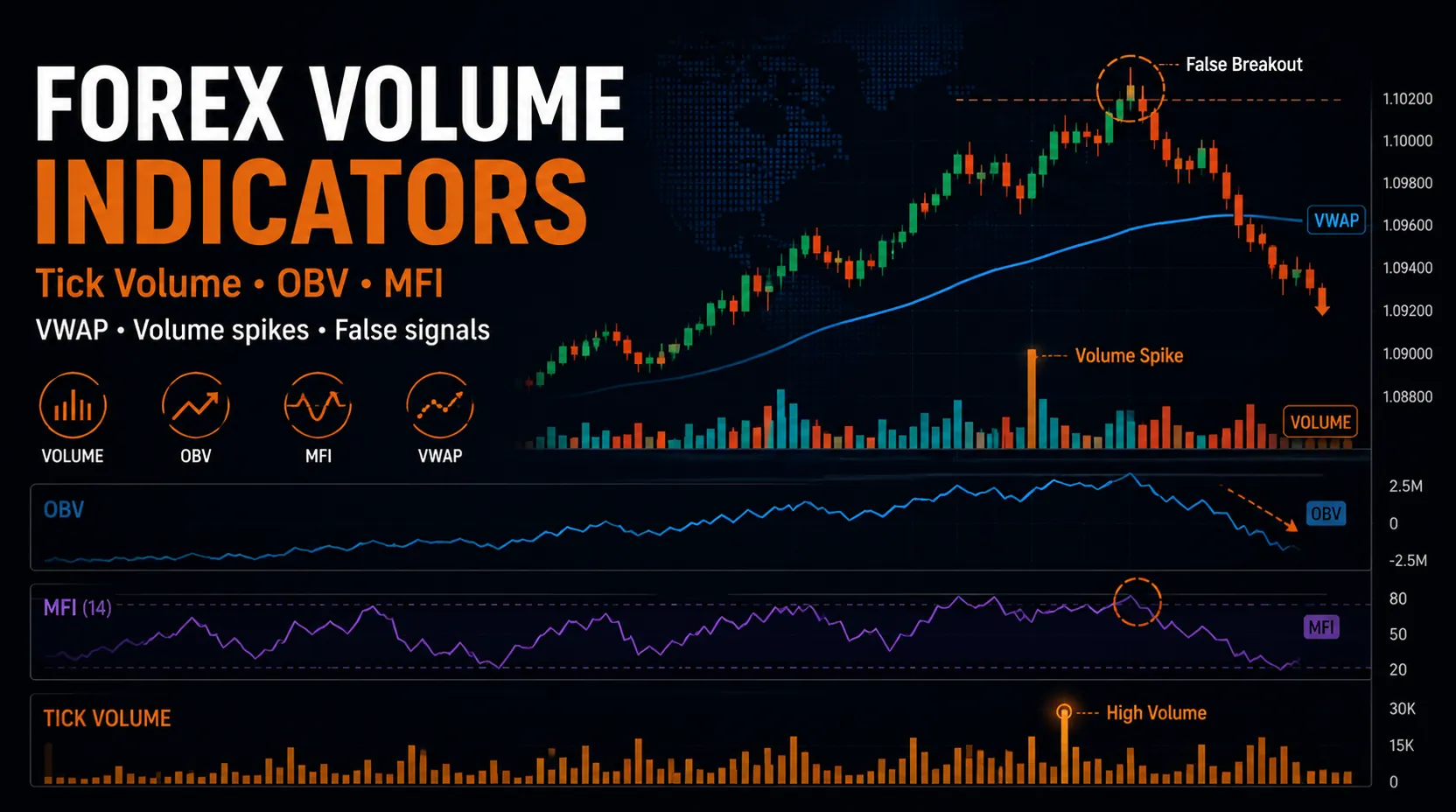
What Are Forex Volume Indicators?
Forex volume indicators are tools used to review market activity, participation, and price-volume context. They can help show whether activity is increasing, decreasing, spiking, or failing to confirm price movement.
Forex volume needs extra caution because spot forex is decentralized. Most retail platforms do not show total global forex volume. They usually show tick volume, broker-specific volume, platform-specific activity, or another proxy for participation.
This distinction matters. A volume reading can help organize an activity question, but it does not confirm direction, trend quality, breakout success, reversal, or trade timing by itself.
For the strict activity-count distinction behind many volume readings, start with the tick-volume mechanics guide.
Why Forex Volume Is Different
In centralized markets, volume can often refer to exchange-traded contracts or shares. In spot forex, there is no single centralized exchange that reports all global trading volume in one complete feed.
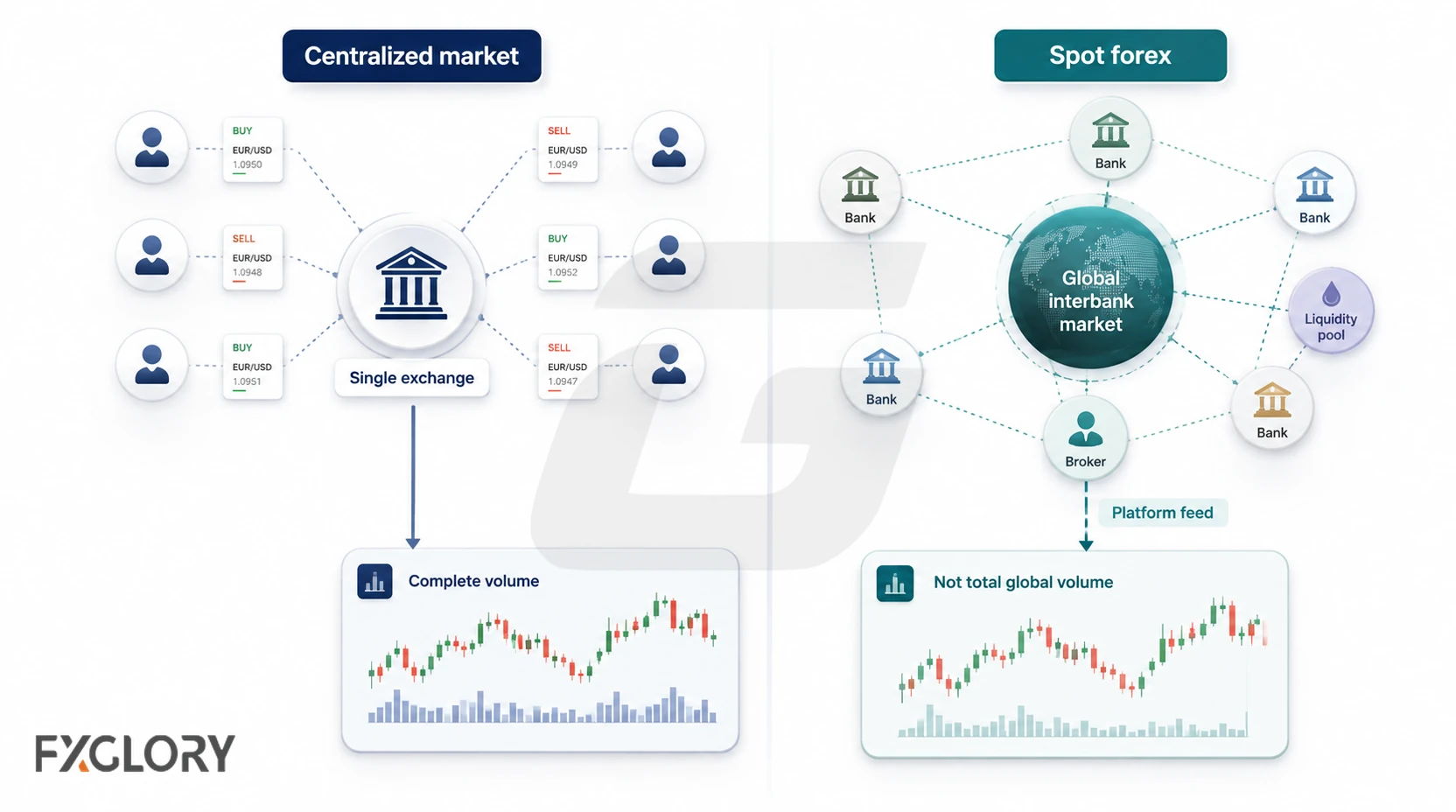
That means many forex volume indicators are based on available platform data, broker data, tick activity, or approximations. This does not make them useless, but it changes how they should be read.
- Forex is decentralized: One platform does not see the whole global spot forex market.
- Tick volume is common: Many platforms count price changes rather than total traded money.
- Broker data can differ: Activity readings may vary between platforms and liquidity sources.
- Volume is context: It can support a chart review, but it should not replace price structure or risk control.
Tick Volume vs Real Volume in Forex
Tick volume counts how often price changes during a selected period. A higher tick-volume reading can show more price updates or activity, while a lower reading can show quieter activity.
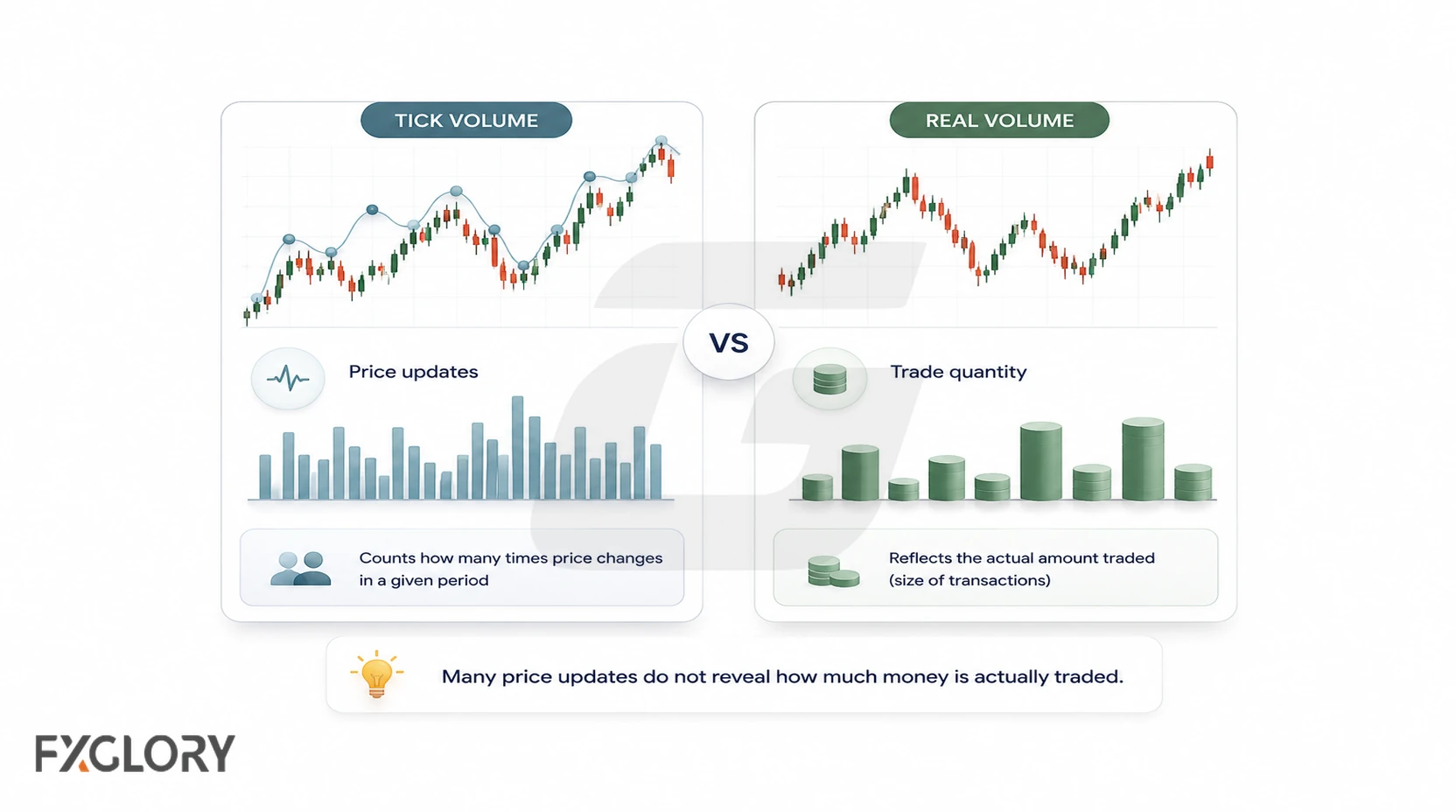
Tick volume is not the same as real centralized traded volume. It does not show the total amount of money traded across the entire forex market. It also does not show whether many small trades or fewer larger trades created the activity.
For the full tick-volume workflow, use the forex tick volume indicator guide.
| Volume type | What it shows | Main limitation |
|---|---|---|
| Tick volume | How often price changes during the selected period | Does not show total traded money or full global forex volume |
| Broker/platform volume | Activity visible through one broker, platform, or liquidity setup | May differ from other platforms and data sources |
| Futures or exchange volume | Exchange-traded contract volume for a related market | May not match spot forex activity exactly |
| Market depth | Available liquidity at visible price levels on a platform | Does not necessarily show all hidden or external liquidity |
| VWAP or profile data | Volume-weighted or distribution-style context from available data | Data source matters, especially in spot forex |
Market depth and order-flow tools are separate from basic volume indicators and should not be treated as the same data source.
Forex Volume Data Types
Before reading any forex volume indicator, identify the data source. A volume tool is only as clear as the data it uses.
The same indicator name can behave differently when it is built from tick volume, platform volume, futures volume, or a custom data feed. This is especially important with custom indicators, dashboards, and imported scripts.
- Tick-based data: Useful for activity review, but not centralized transaction size.
- Broker-specific data: Useful inside that platform, but not a full market-wide reading.
- Exchange-related data: Useful as a reference when relevant, but not the same as spot forex volume.
- Custom indicator data: Must be checked before trusting labels, colors, alerts, or dashboards.
Best Forex Volume Indicator? Match the Tool to the Job
There is no single best forex volume indicator for every trader, pair, timeframe, or market condition. The better question is: what volume job needs to be reviewed?
| Indicator | What it reviews | Best used for | Main caution |
|---|---|---|---|
| Tick Volume | Price-update activity | Activity expansion or quiet participation | Not total traded money or global volume |
| OBV | Cumulative volume pressure linked to closing direction | Pressure and divergence review | Depends on available volume data in spot forex |
| MFI | Price-volume oscillator behavior | Pressure and exhaustion review | Can whipsaw like other oscillators |
| Accumulation/Distribution | Close-location and volume-flow context | Price-volume confirmation review | Can misread noisy candles or weak data |
| Chaikin tools | Money-flow pressure and momentum | Pressure-shift review | Needs clean data and confirmation |
| VWAP | Average price weighted by available volume data | Price-location context versus volume-weighted average | Stronger when volume data source is reliable |
| Volume Profile | Activity distribution by price area | Participation-zone review | Data source and calculation method matter |
On-Balance Volume, or OBV, in Forex
On-Balance Volume, or OBV, is used to review cumulative volume pressure. It adds or subtracts volume based on whether price closes higher or lower than the previous period.
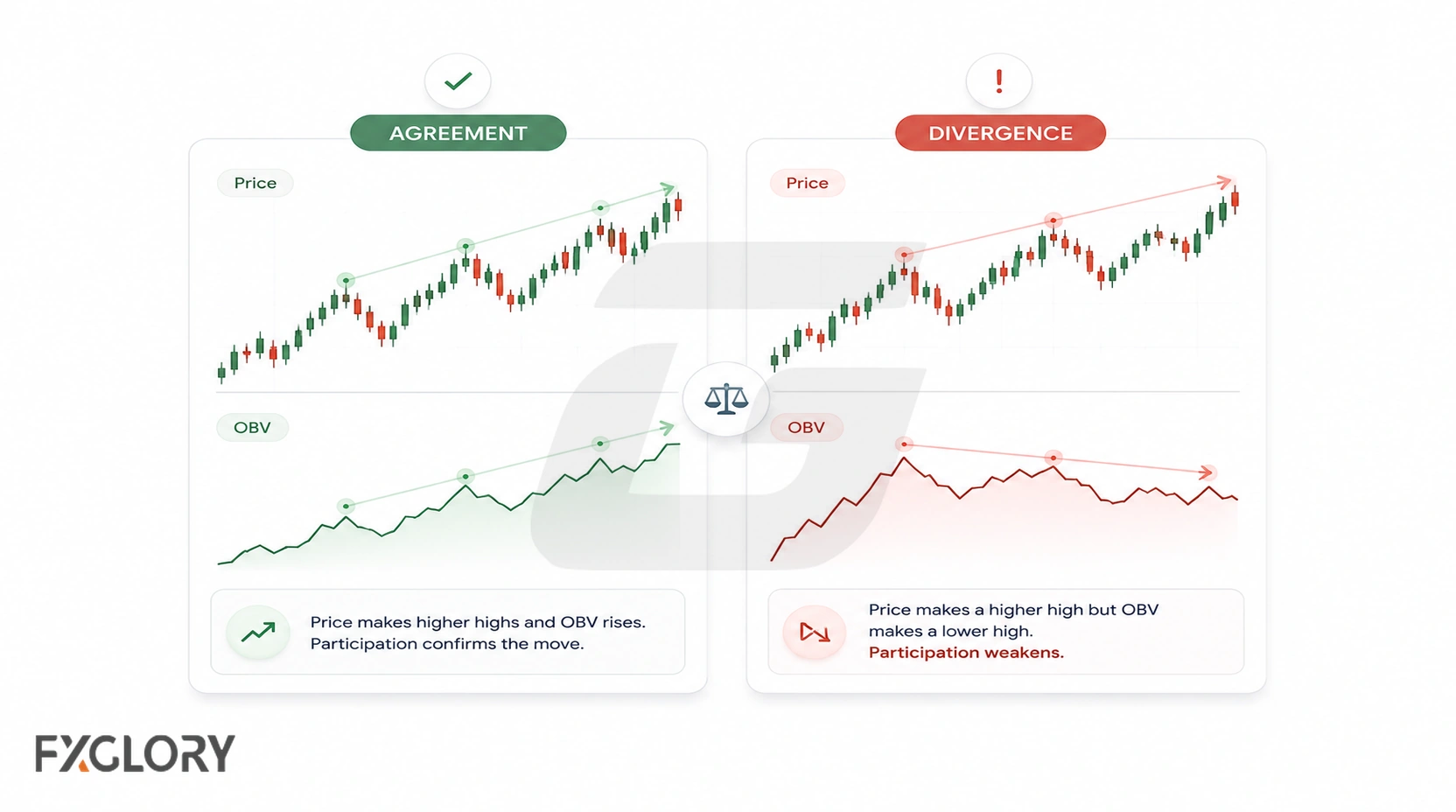
In forex, OBV should be read carefully because the underlying volume may be tick volume or platform-specific activity. OBV can help review whether activity is broadly supporting or failing to support price movement, but it is not a complete signal by itself.
For the full cumulative-pressure workflow, use the OBV forex guide.
- Rising OBV: Available volume pressure may be building with upward closes, but price structure still matters.
- Falling OBV: Available volume pressure may be building with downward closes, but direction still needs confirmation.
- OBV divergence: OBV may stop confirming price movement, but divergence still needs structure and invalidation.
- OBV limitation: In spot forex, OBV quality depends on the volume data source.
MFI, A/D, Chaikin, VWAP, and Volume Profile in Forex
Other forex volume indicators use price and volume in different ways. Some act like oscillators, some review cumulative flow, and some compare price with volume-weighted or volume-distribution context.
| Tool | Main idea | Forex caution |
|---|---|---|
| Money Flow Index, or MFI | Combines price and volume into an oscillator-style reading | Can whipsaw and should not be treated as a standalone overbought or oversold signal |
| Accumulation/Distribution, or A/D | Reviews where price closes inside the range with volume context | Noisy candles can distort the reading |
| Chaikin Money Flow | Reviews buying/selling pressure over a selected period | Needs clean data and price confirmation |
| Chaikin Oscillator | Reviews momentum changes in accumulation/distribution behavior | Can create false shifts during chop |
| VWAP | Reviews average price weighted by available volume data | Spot forex volume source matters, so VWAP should be caveated |
| Volume Profile | Shows available activity by price area | Profile output depends on the platform and data source |
VWAP reviews a volume-weighted average price from available data, while Volume Profile reviews available activity by price area.
These tools can help describe activity, pressure, or price-location context. They should not replace support and resistance, market structure, spread checks, or risk control.
Forex Volume Spikes
A volume spike appears when activity rises sharply compared with nearby readings. In forex, a spike may come from increased participation, news, session overlap, liquidity changes, or platform-specific activity.
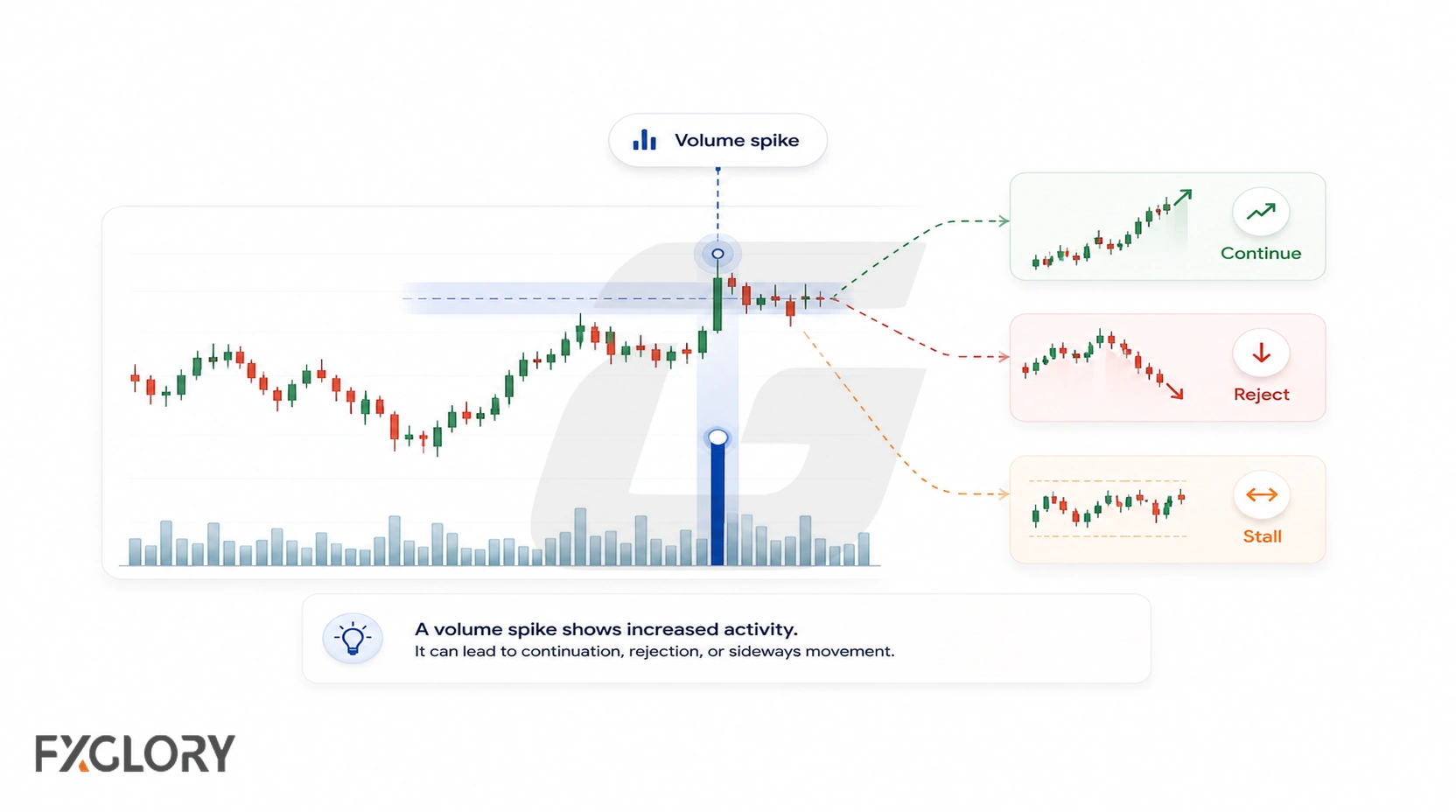
A spike does not automatically confirm a breakout, reversal, or continuation. It only shows that activity changed. The quality of the price reaction still matters.
- News spike: Activity may jump because of event risk rather than clean participation.
- Session spike: Activity may change around market opens, overlaps, or thin-session transitions.
- Breakout spike: Activity may support a breakout attempt, but follow-through and structure still matter.
- Exhaustion spike: A spike after a long move can warn of stress, but it does not confirm reversal.
- Platform spike: A reading may reflect the platform feed rather than full market-wide activity.
Volume Divergence in Forex
Volume divergence appears when price movement and volume activity stop confirming each other. Price may push to a new high while volume activity weakens, or price may push to a new low while activity does not expand.
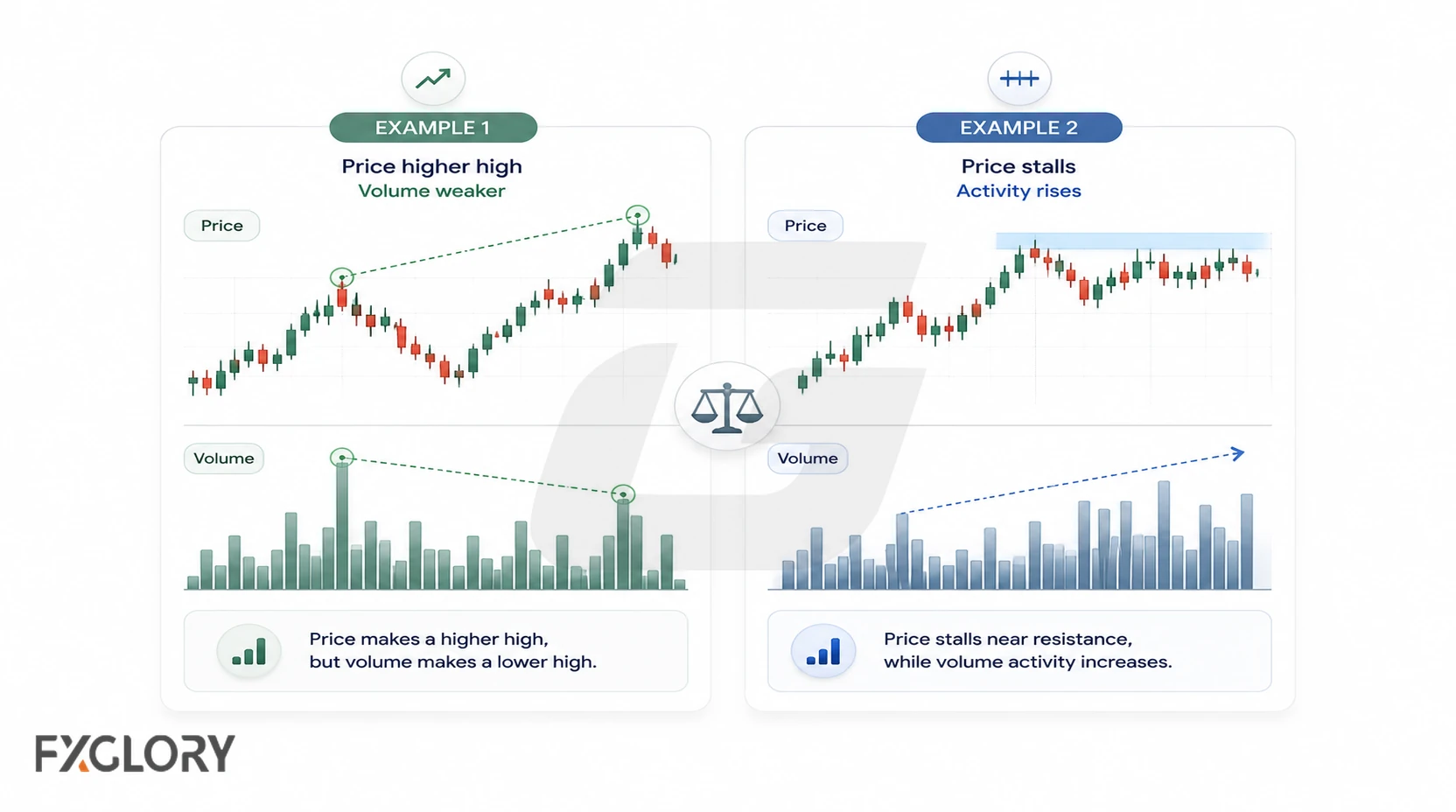
Volume divergence can warn that participation is changing, but it does not confirm reversal or continuation by itself. It needs price location, structure reaction, volatility context, and invalidation.
- Price rising while volume weakens: Participation may not be confirming the move, but price can still continue.
- Price falling while volume weakens: Downside participation may be changing, but price can still continue lower.
- Volume rising while price stalls: Activity may be increasing near a decision area, but direction still needs confirmation.
- Volume divergence inside chop: The reading may be noisy and easy to overinterpret.
For the full price-and-indicator disagreement framework, review the divergence guide for forex charts.
Volume vs ATR, ADX, Bollinger Bands, and Order Flow
Volume indicators are often compared with volatility tools, trend-strength tools, and order-flow concepts. These topics can overlap, but they do not answer the same chart question.
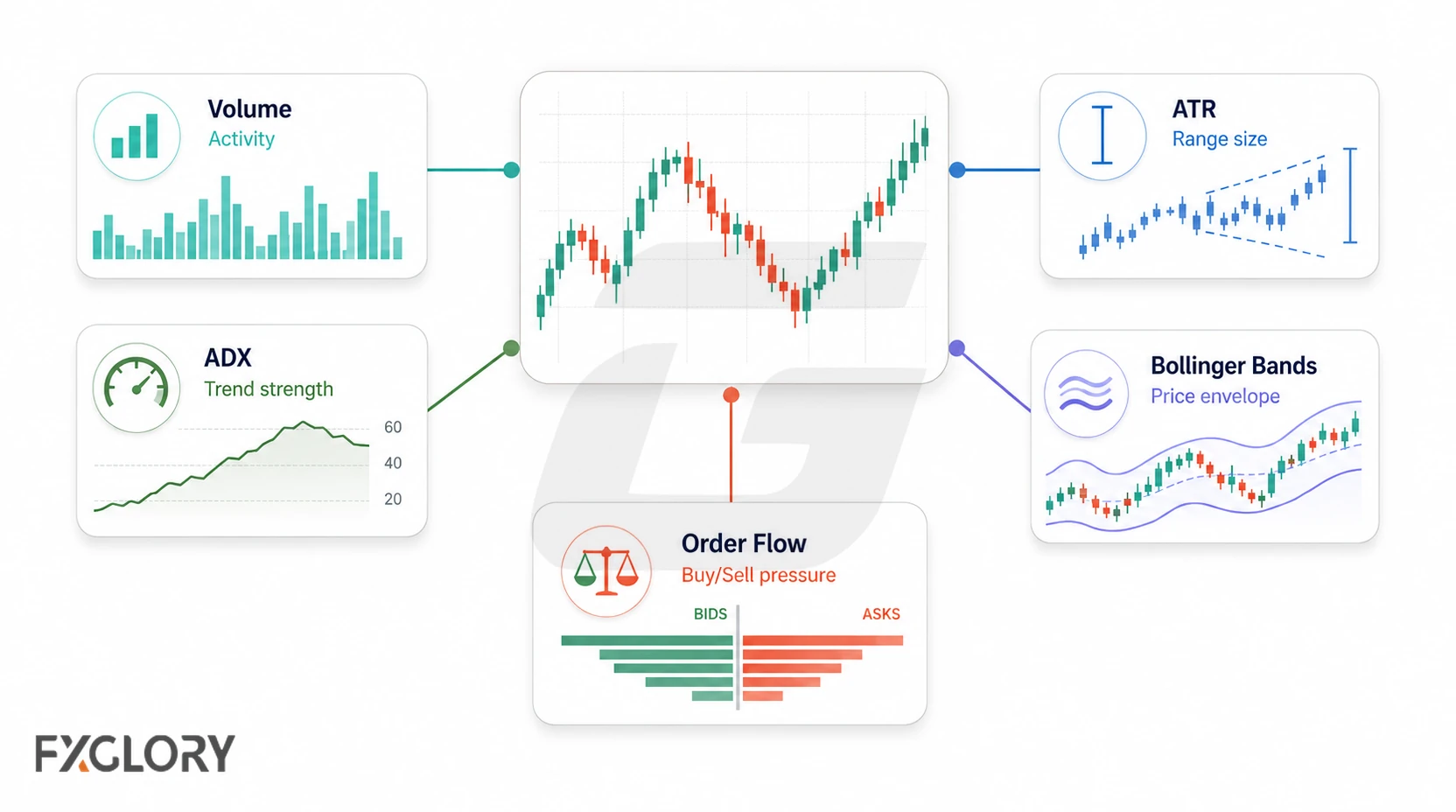
| Tool or topic | Main job | What volume adds |
|---|---|---|
| Forex volume indicators | Activity, participation, and price-volume review | Shows whether available activity is expanding, fading, spiking, or diverging |
| ATR | Volatility and average range-size review | Separates activity changes from movement-size changes |
| ADX | Trend-strength review | Helps compare participation with weak or strong trend conditions |
| Bollinger Bands | Volatility bands and price-location review | Helps compare activity with band expansion, squeeze, or band walk |
| Order flow | Execution-flow and bid/ask pressure concepts | Volume indicators can support activity context but do not replace order-flow data |
For related context, use the ATR range-size guide, the ADX trend-strength guide, and the Bollinger Bands volatility-band guide.
How to Use Forex Volume Indicators Without Treating Them as Signals
Start with the data source, then compare volume activity with price structure, market condition, and trading conditions. The goal is to decide whether volume clarifies the chart question, not to turn a spike or colored bar into a trade command.
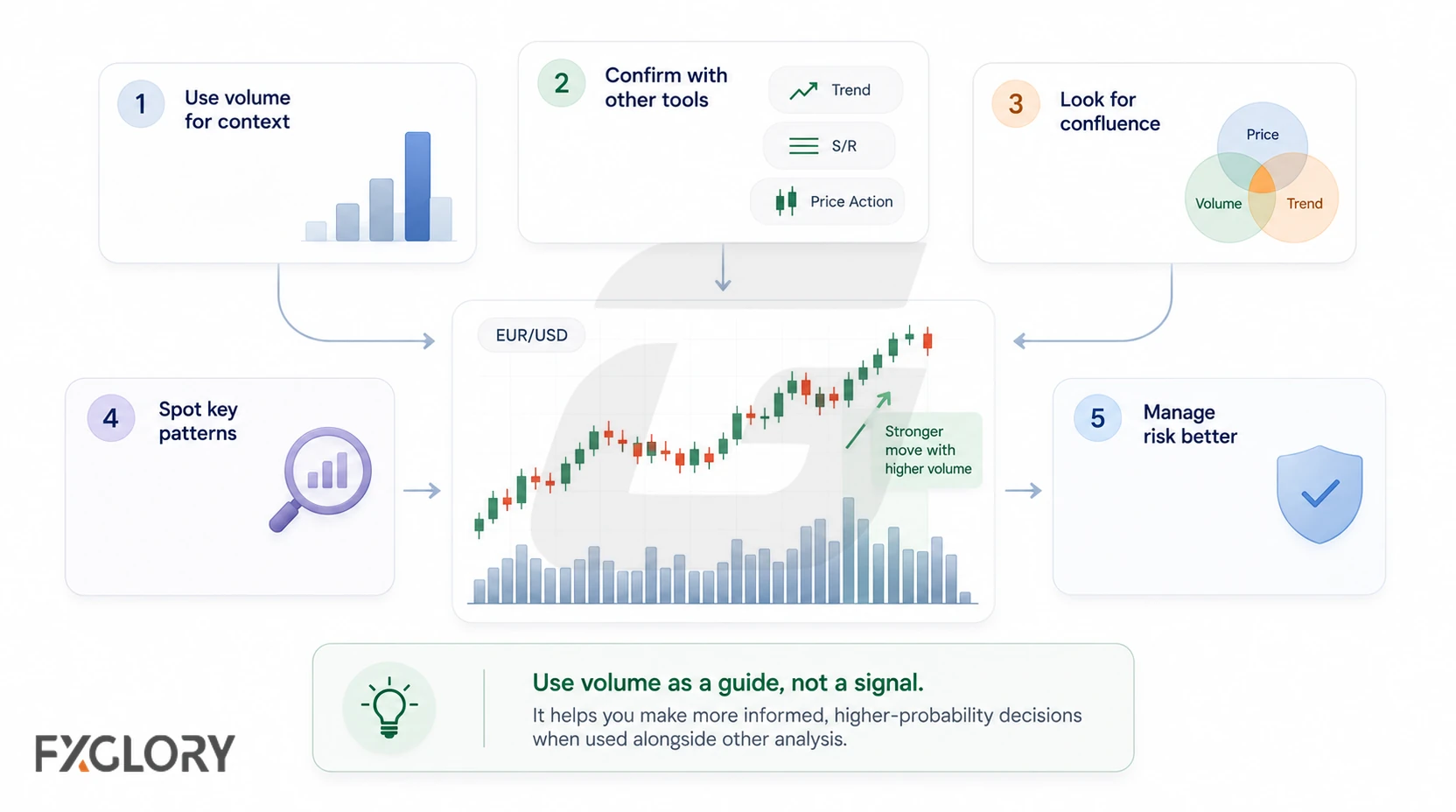
- Identify the data source: Tick volume, broker/platform data, exchange-related data, market depth, or custom feed.
- Compare with recent history: Is the current activity normal, quiet, elevated, or abnormal for that market and timeframe?
- Check price location: Is volume changing near support, resistance, a range edge, breakout area, or retracement zone?
- Review price-volume agreement: Does activity support price movement, conflict with it, or create a divergence question?
- Check session and spread: Is the reading affected by market open, session overlap, thin liquidity, or spread changes?
- Check news risk: Is the volume spike connected to event-driven movement?
- Define invalidation: Know where the volume-based idea is wrong before using it in a plan.
Forex Volume Indicators with Confirmation Checks
A volume reading becomes more useful when it is connected to price context. Confirmation does not remove risk, but it can reduce the chance of treating every spike, divergence, or indicator color change as a trade idea.
- Price location: Is the volume change near support, resistance, a range edge, or a retracement zone?
- Market structure: Has price shown breakout, failed breakout, continuation, rejection, compression, or unclear chop?
- Trend context: Is the volume change supporting a visible trend, fighting it, or appearing inside a range?
- Volatility context: Is the volume spike connected to a normal range expansion or abnormal volatility?
- Session context: Is the activity change linked to session open, overlap, rollover, or thin liquidity?
- Risk rule: Can the trader explain where the idea is wrong before using it in a plan?
For confirmation beyond volume, review support and resistance zones, market structure context, and price action in forex.
Market Context Examples: Matching Volume to Instruments
Use the market page for instrument context, then compare volume-indicator behavior inside the charting setup where the relevant volume or tick-volume feed is available.
| Market page | Volume question | Context to check |
|---|---|---|
| EUR/CHF market page | What would low tick activity imply if your charting setup shows a quiet range? | Range boundaries, spread sensitivity, and support/resistance |
| EUR/GBP market page | What would a volume spike mean near a range boundary in your charting setup? | Price location, market structure, and failed-breakout risk |
| GBP/USD market page | What would expanding tick activity add to a directional-movement review? | Trend context, structure reaction, and follow-through |
| Gold market page | What would rising activity mean around event-sensitive volatility? | News risk, range expansion, and support/resistance distance |
| BTC/USD market page | What would platform-volume sensitivity change during a volatility spike? | Data source, spread, execution conditions, and structure clarity |
Custom Forex Volume Indicator Caution
Some traders use custom volume dashboards, colored volume bars, relative volume scripts, MT4 volume indicators, VWAP tools, Volume Profile tools, or alert-based volume indicators. These tools can make scanning easier, but the logic should be understandable before it is used.
A custom volume indicator can look clean in old examples and still fail when market condition, session, spread, or data source changes. A label, alert, or dashboard should not hide what the tool is actually measuring.
- Data-source check: Does the tool use tick volume, broker data, futures data, imported data, or a custom approximation?
- Alert-timing check: Does the alert appear after candle close, or does it change while the candle is forming?
- Repaint check: Does the indicator change past signals after new data appears?
- Threshold check: Are colors or spike labels based on fixed levels that may not fit all sessions?
- Overfitting check: Does the tool need constant settings changes to look useful?
Forex Volume Indicator False-Signal Filters
Use these filters when a forex volume indicator looks active but the chart condition does not support the reading.
| Filter | Problem it catches | What to check |
|---|---|---|
| Tick-volume-overread filter | Tick activity treated as total global market volume | Data source, platform context, and recent activity history |
| Broker-data filter | One platform's volume treated as full market-wide volume | Broker feed, liquidity setup, and comparison limits |
| Volume-without-structure filter | Volume spike appears away from meaningful price context | Support/resistance, structure, and invalidation |
| News-spike filter | Activity jumps because of event risk rather than normal participation | News calendar, spread behavior, and liquidity conditions |
| Session-liquidity filter | Volume changes around opens, overlaps, rollover, or thin sessions | Session timing, spread, and volatility regime |
| Low-timeframe-noise filter | Volume changes repeat on noisy lower timeframes | Broader structure and timeframe alignment |
| Divergence-overread filter | Price-volume disagreement treated as reversal confirmation | Price reaction, structure change, and follow-through |
| VWAP-data filter | VWAP treated as complete market-wide average price | Volume source and platform calculation |
| Custom-indicator filter | Dashboard labels or colors hide the real logic | Calculation, repaint behavior, and alert timing |
| No-invalidation filter | No clear place where the idea is wrong | Risk distance and invalidation rule |
How to Test Forex Volume Indicators
Forex volume indicators should be tested inside one market condition and data source at a time. Testing them across random charts without separating sessions, news, ranges, trends, volatility spikes, and platform data can create misleading results.
- Choose the volume job: Tick-activity review, OBV pressure review, MFI oscillator review, A/D flow review, VWAP context, Volume Profile context, spike review, or divergence review.
- Identify the data source: Tick volume, broker/platform data, futures-related data, market depth, imported data, or custom approximation.
- Choose the market condition: Quiet range, active range, trend, breakout attempt, high volatility, news movement, or unclear structure.
- Match the timeframe: Record whether the volume reading is reviewed on the same timeframe as the chart question.
- Compare with recent history: Mark whether activity is normal, quiet, elevated, abnormal, or platform-specific.
- Name the confirmation layer: Support/resistance, structure, trend context, volatility regime, session, spread, news risk, or invalidation.
- Define the trigger: Write the exact price behavior that would confirm the volume reading.
- Define invalidation: Write the price behavior that would make the idea wrong.
- Check spread and slippage context: Record whether trading costs or execution conditions could affect the setup.
- Record the failure type: Tick-volume overread, broker-data confusion, volume without structure, news spike, session distortion, low-timeframe noise, divergence overread, VWAP data issue, custom-tool problem, or no invalidation.
Forex volume indicators are useful only if they make the activity and participation question clearer. If they encourage prediction, hide price structure, or ignore the data source, they should not stay in the plan.
A Practical Way to Use Forex Volume Indicators
Start with the data source. Compare activity with recent history. Check price location, market structure, volatility, session, spread, news risk, confirmation, and invalidation. If the volume reading does not make the chart question clearer, ignore it.
Forex volume indicators do not need to predict the next move. They only need to support one part of a clear process: activity review, participation context, pressure check, divergence review, volume-spike filter, or confirmation review.
For the completed volume-tool workflows, use the tick-volume mechanics guide, the OBV cumulative-pressure guide, the MFI oscillator guide, the A/D close-location guide, and the VWAP price-location guide. For price-location confirmation, use the support and resistance guide.