
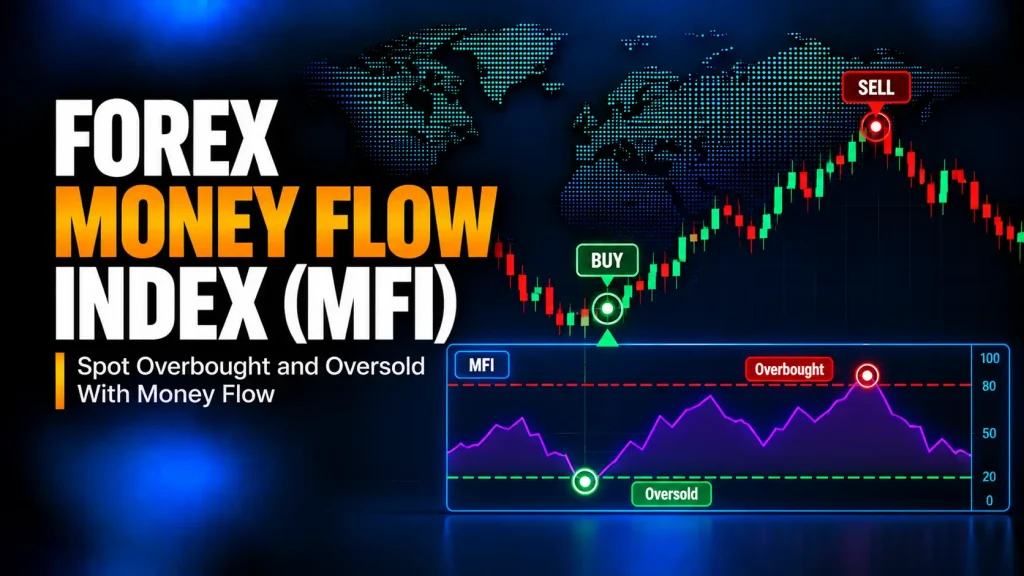
What Is Money Flow Index in Forex?
Money Flow Index (MFI) is a bounded 0–100 oscillator that combines changes in typical price with available volume data over a lookback period. It describes calculated positive and negative money flow; it does not measure net aggressive buying or selling orders.
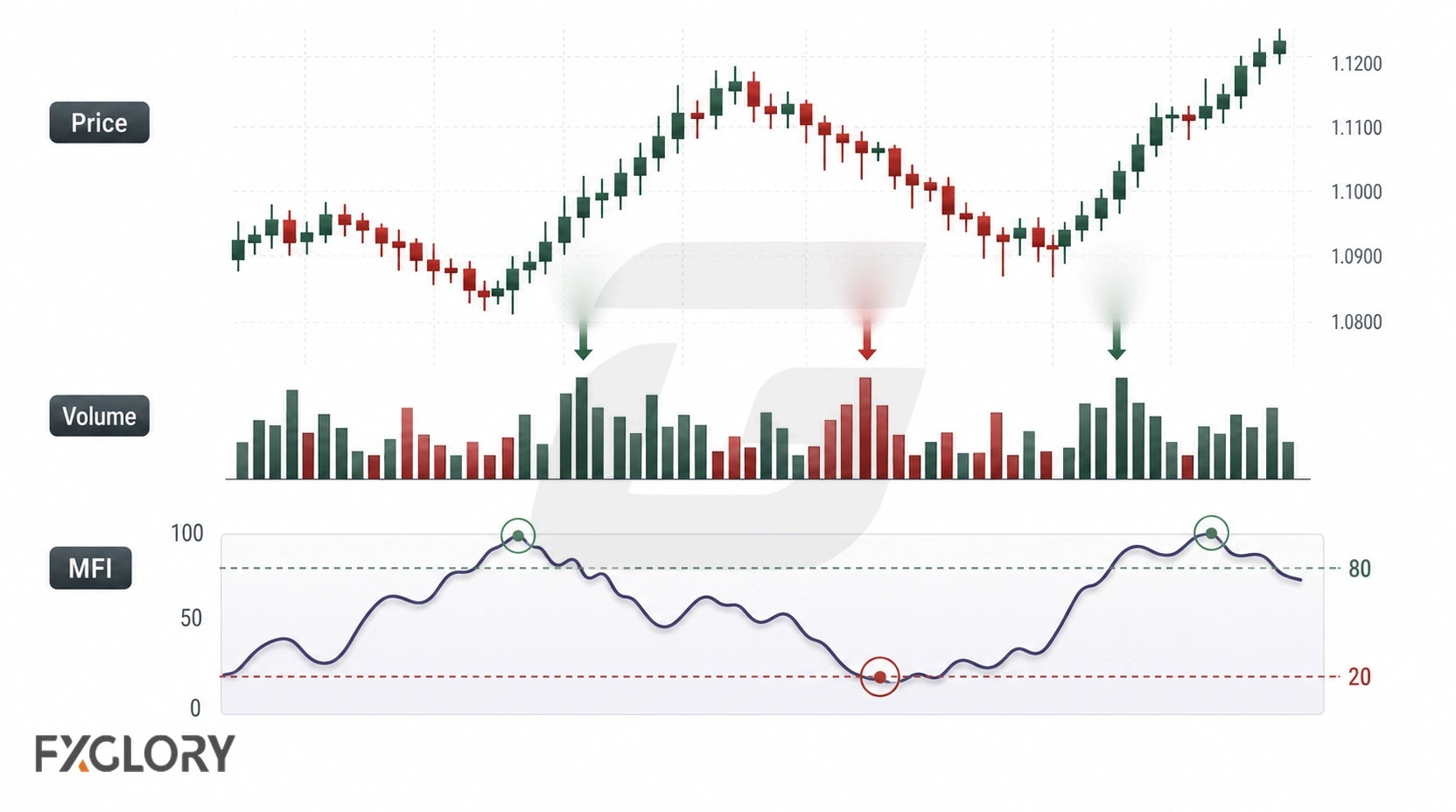
MFI is often called a volume-weighted RSI because it uses both price and volume-style data. That does not make it better than RSI. It means MFI answers a different chart question: is price movement being supported by available price-volume pressure?
In forex, that question needs extra caution. Spot forex does not have one centralized total-volume feed, so MFI readings often depend on tick volume or platform-specific activity.
For the chart context behind MFI, review market structure context.
How the Money Flow Index Works
MFI compares positive and negative money flow over a selected lookback period, commonly 14 periods. It then converts that comparison into a 0–100 oscillator.
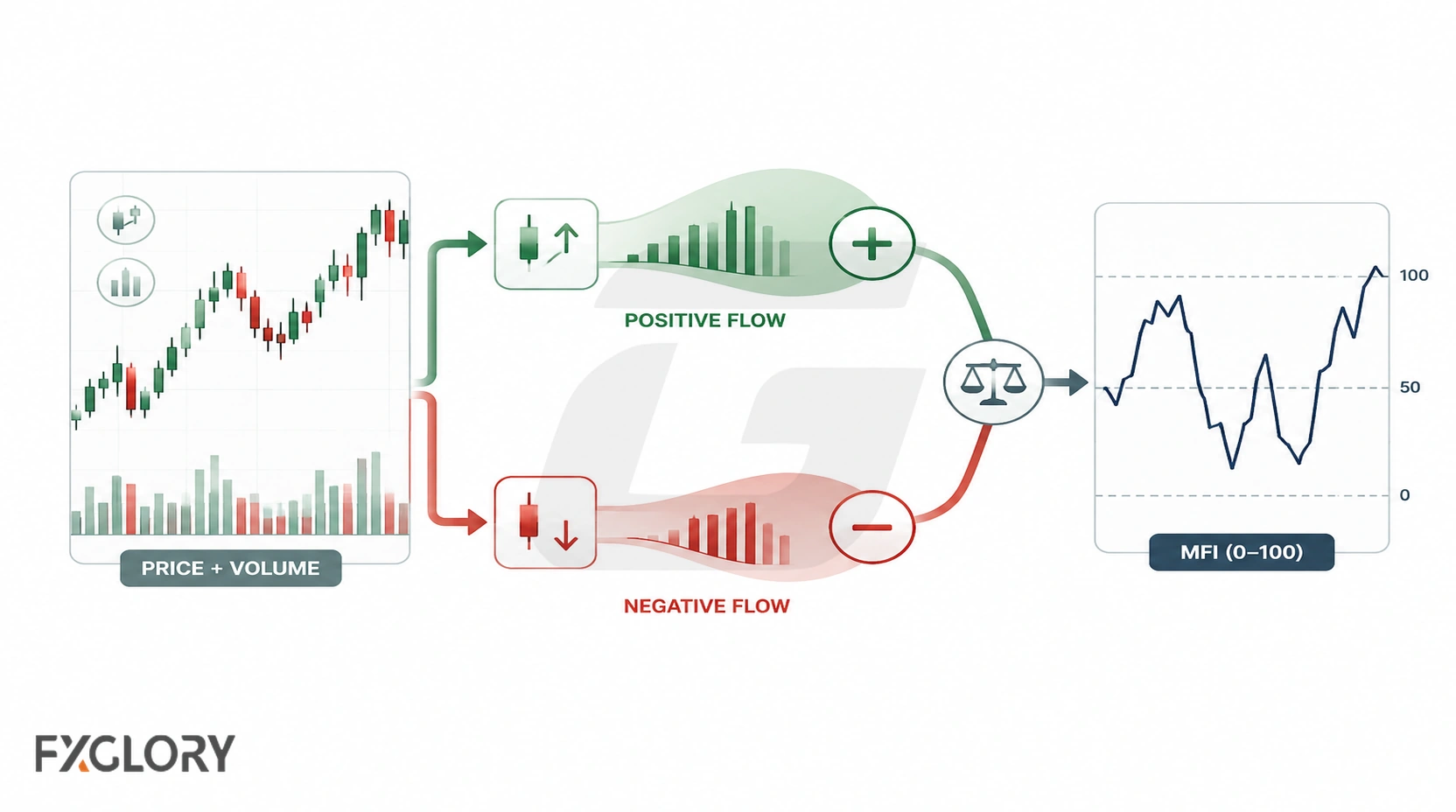
When MFI rises, available price-volume pressure may be increasing. When MFI falls, available price-volume pressure may be weakening. But the reading still needs price structure, trend context, and data-source awareness before it becomes useful.
- Rising MFI: Price-volume pressure may be increasing, but direction still needs price confirmation.
- Falling MFI: Price-volume pressure may be weakening, but this does not confirm reversal.
- High MFI: Pressure may be extended, but strong trends can keep MFI high.
- Low MFI: Pressure may be depressed, but weak markets can keep MFI low.
- Choppy MFI: The market may be noisy, range-bound, or affected by unstable volume data.
Why MFI Needs Extra Caution in Forex
MFI uses volume in its calculation. In spot forex, that volume is usually not total global forex volume. It may be tick volume, broker-specific volume, platform activity, or another available proxy.
For what tick volume measures and why feeds can differ, see the tick volume guide.
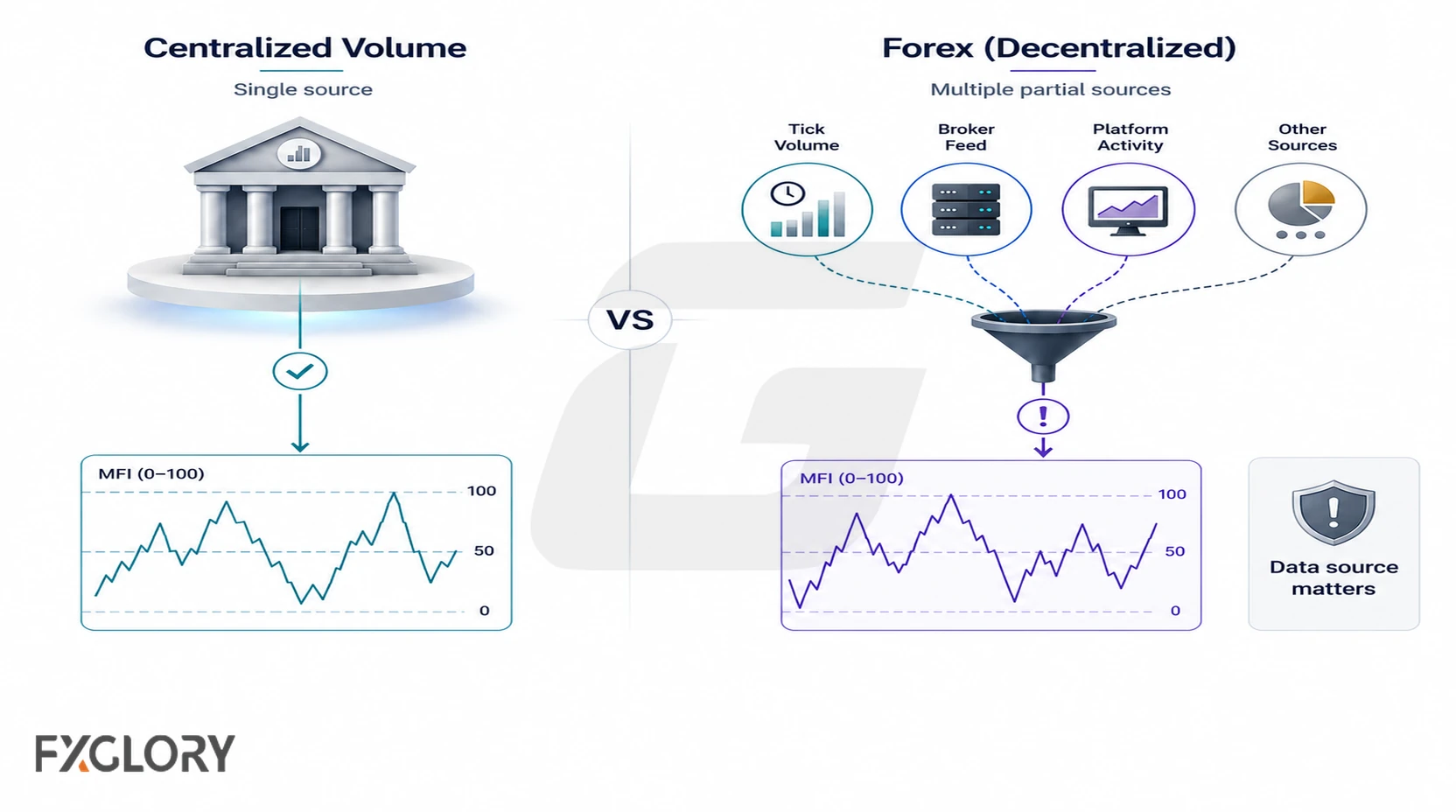
This does not make MFI useless, but it changes how it should be read. A clean MFI reading on one platform may not mean the same thing across every broker, data feed, pair, or timeframe.
- Tick-volume dependency: MFI may be calculated from price-update activity rather than actual market-wide transaction size.
- Platform dependency: MFI can vary when the available volume source changes.
- Pair dependency: Quiet pairs and active pairs can produce different pressure behavior.
- Timeframe dependency: Lower-timeframe MFI readings can whipsaw more often.
- News dependency: Event-driven movement can distort both volume and price-pressure readings.
MFI Formula in Plain English
The Money Flow Index formula can look technical, but the chart-reading question is simple: is price movement supported by stronger positive or negative money flow over the selected lookback?
For each period, compare typical price with the previous period, classify its raw money flow, and sum positive and negative amounts over the chosen lookback.
| Step | Calculation |
|---|---|
| Typical price (TP) | (High + Low + Close) / 3 |
| Raw money flow | TP × available volume |
| Positive / negative flow | Assign raw flow to positive when TP rises versus the previous period, or negative when TP falls; an unchanged TP contributes to neither. |
| Money flow ratio | Sum of positive money flow / sum of negative money flow over the lookback (commonly 14 periods) |
| MFI | 100 − [100 / (1 + money flow ratio)] |
If negative money flow sums to zero but positive money flow is nonzero, MFI is normally set to 100; if positive flow is zero but negative flow is nonzero, MFI is 0. When both sums are zero, implementations may handle the undefined ratio differently. Check your platform rather than assuming a universal value.
MFI 80/20 and 90/10 Levels in Forex
MFI is commonly read with 80 and 20 reference zones. The more extreme 90 and 10 thresholds select fewer, stronger oscillator extremes, but they do not automatically provide more reliable trade signals.
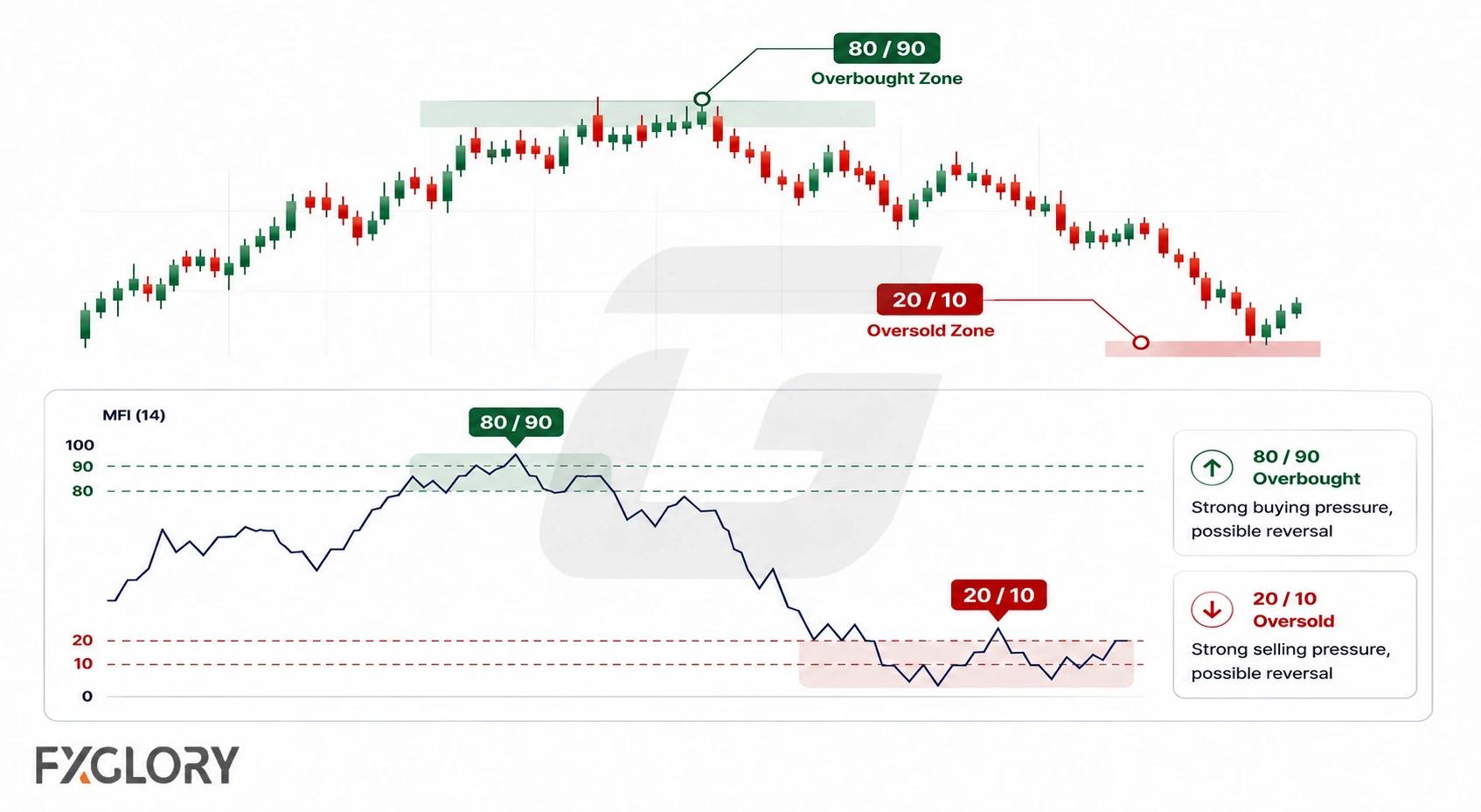
Strong trends can keep MFI high or low for longer than expected. Choppy markets can also make MFI jump between levels without clean follow-through.
| MFI area | Common reading | What it does not confirm |
|---|---|---|
| Above 80 | High or overbought reference zone | Does not confirm a bearish reversal |
| Below 20 | Low or oversold reference zone | Does not confirm a bullish reversal |
| Above 90 | More extreme high-pressure zone | Does not make reversal timing safer by itself |
| Below 10 | More extreme low-pressure zone | Does not make reversal timing safer by itself |
| Repeated extreme reading | Pressure may be persistent | Does not mean price must immediately correct |
| Middle area | Pressure may be less extreme or unclear | Does not mean the market is safe or directionless |
MFI 50 Line and Pressure Shifts
The 50 line is the midpoint: above 50, summed positive money flow exceeds summed negative flow over the lookback; below 50, negative flow exceeds positive flow. These are formula-based categories, not verified market-wide buy and sell volumes.
A 50-line cross can help describe a pressure shift, but it should not be treated as a signal by itself. In range-bound or choppy markets, MFI can cross the centerline repeatedly without clean direction.
- MFI above 50: Positive money-flow pressure may be stronger.
- MFI below 50: Negative money-flow pressure may be stronger.
- Repeated 50-line crosses: The market may be noisy or range-bound.
- Centerline plus structure: The reading is more useful when price also shows a clear structural clue.
MFI vs RSI in Forex
MFI and RSI are both oscillators, but their inputs differ. RSI uses changes in closing prices; MFI combines typical price changes with available volume or tick volume.
This difference matters in forex because MFI depends on the available volume source. MFI should not be called better than RSI. The two tools answer different questions.
| Tool | Uses price? | Uses volume? | Main job | Main caution |
|---|---|---|---|---|
| RSI | Yes | No | Reviews gains-and-losses momentum pressure | Can stay extreme in strong trends |
| MFI | Yes | Yes, or tick-volume context in forex | Reviews price-volume pressure | Forex volume source matters |
For price reaction beyond MFI, review price action in forex.
MFI Divergence in Forex
MFI divergence appears when price movement and MFI pressure stop confirming each other. Price may make a higher high while MFI makes a lower high, or price may make a lower low while MFI makes a higher low.
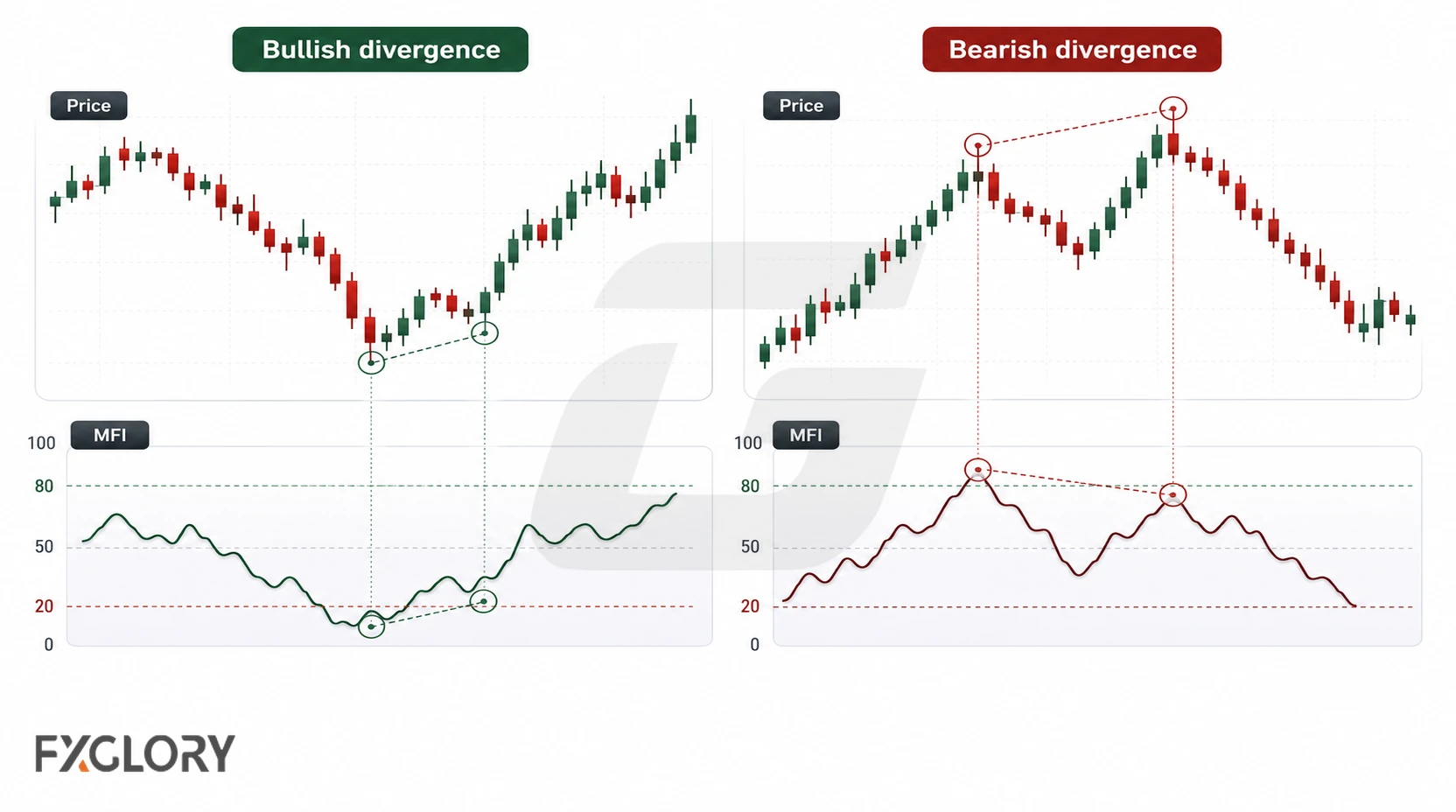
Divergence can warn that pressure is changing, but it is not a reversal signal by itself. It needs price location, structure reaction, volatility context, and invalidation before it becomes useful in a plan.
- Bullish MFI divergence: Price makes a lower low while MFI makes a higher low. This can warn that downside pressure is weakening.
- Bearish MFI divergence: Price makes a higher high while MFI makes a lower high. This can warn that upside pressure is weakening.
- Hidden or continuation divergence: Price and MFI may disagree during a pullback, but broader structure still matters.
- Weak divergence: Divergence away from support, resistance, or structure can be easier to misuse.
For confirmation beyond MFI disagreement, review market structure context and support and resistance zones.
MFI in Trending Markets vs Ranging Markets
MFI can behave differently in trends and ranges. In a range, MFI may rotate between high and low zones. In a trend, MFI can stay elevated or depressed longer than expected.
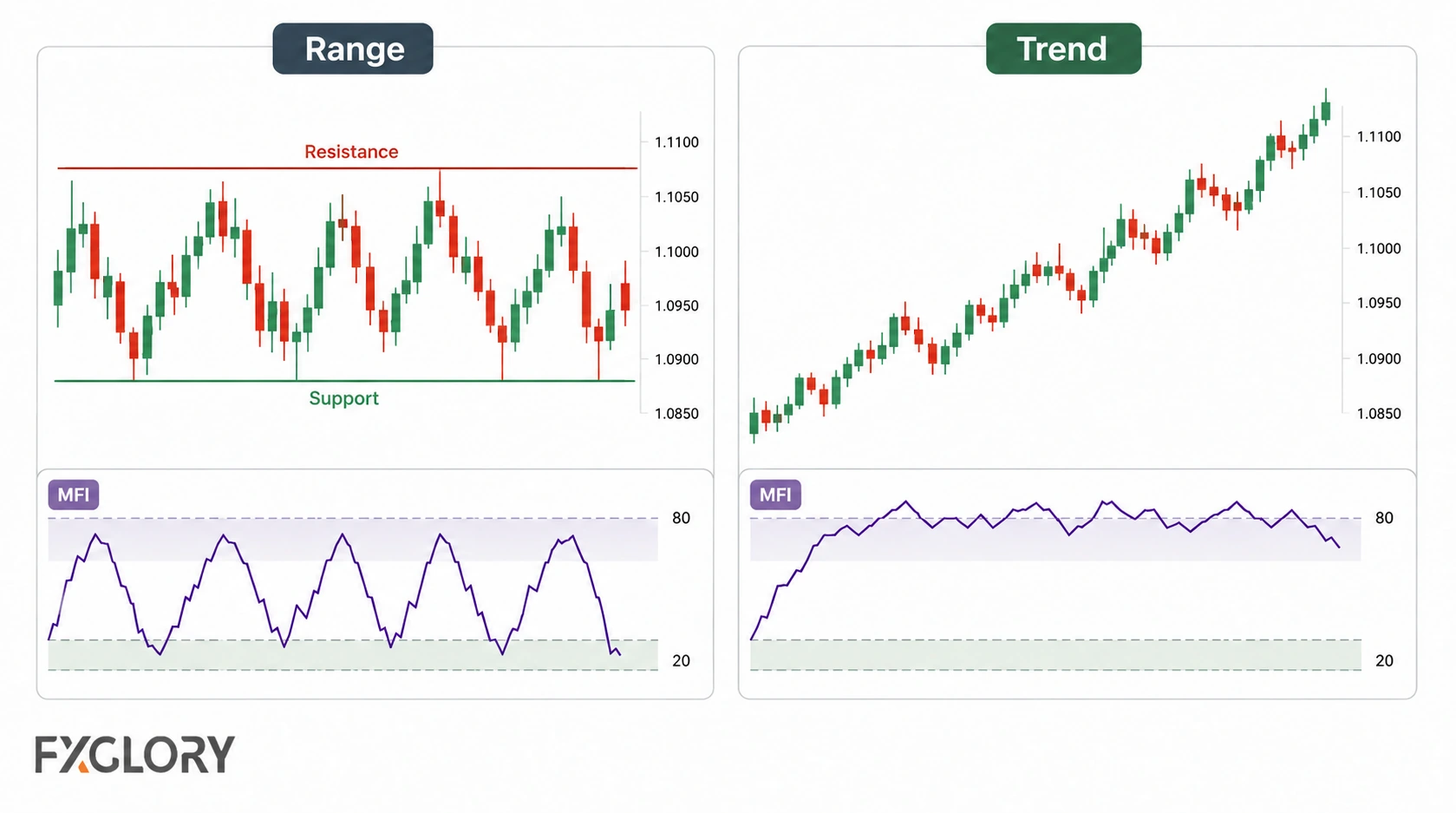
| Market condition | MFI behavior | Main risk |
|---|---|---|
| Quiet range | MFI may whipsaw between mid and extreme zones | Treating every level touch as a reversal |
| Active range | MFI extremes may appear near range edges | Ignoring support/resistance reaction quality |
| Strong uptrend | MFI may stay high or recover quickly from pullbacks | Fading high MFI too early |
| Strong downtrend | MFI may stay low or fail to recover strongly | Buying low MFI too early |
| News volatility | MFI can jump sharply with unstable price-volume behavior | Confusing event-driven movement with clean pressure |
MFI Settings in Forex
The 14-period MFI setting is commonly used. This does not make it the best setting for every pair, timeframe, volume source, or market condition.
Shorter settings may react faster, but they can create more noise. Longer settings may smooth the reading, but they can react later. Changing MFI settings only to make old examples look cleaner can create curve fitting.
- 14-period setting: Common default, not a universal rule.
- Shorter setting: Faster reaction, more false pressure shifts.
- Longer setting: Smoother reading, slower response.
- Lower timeframe: More vulnerable to tick-volume noise and repeated crosses.
- Changing settings too often: Can make past examples look better without improving future review.
MFI vs Volume Indicators, VWAP, OBV, and MACD
MFI is a bounded price-volume oscillator, unlike the cumulative OBV indicator, a price-location measure such as VWAP, or a price-momentum measure such as MACD. Different tools answer different questions.
| Tool | Main job | What MFI adds |
|---|---|---|
| MFI | Price-volume oscillator review | Shows pressure on a 0–100 scale |
| Tick volume | Activity review | Can feed MFI-style pressure context in forex |
| OBV | Cumulative price-volume pressure | Gives a cumulative view rather than a bounded oscillator |
| VWAP | Volume-weighted average price context | Answers a price-location question, not an oscillator question |
| MACD | Moving-average momentum review | Separates price-volume pressure from moving-average momentum |
How to Use MFI in Forex Without Treating It as a Signal
Start with the volume data source, then read MFI level, direction, divergence, price structure, and market condition. The goal is to decide whether MFI clarifies a price-volume pressure question, not to turn an 80/20 reading into a trade command.
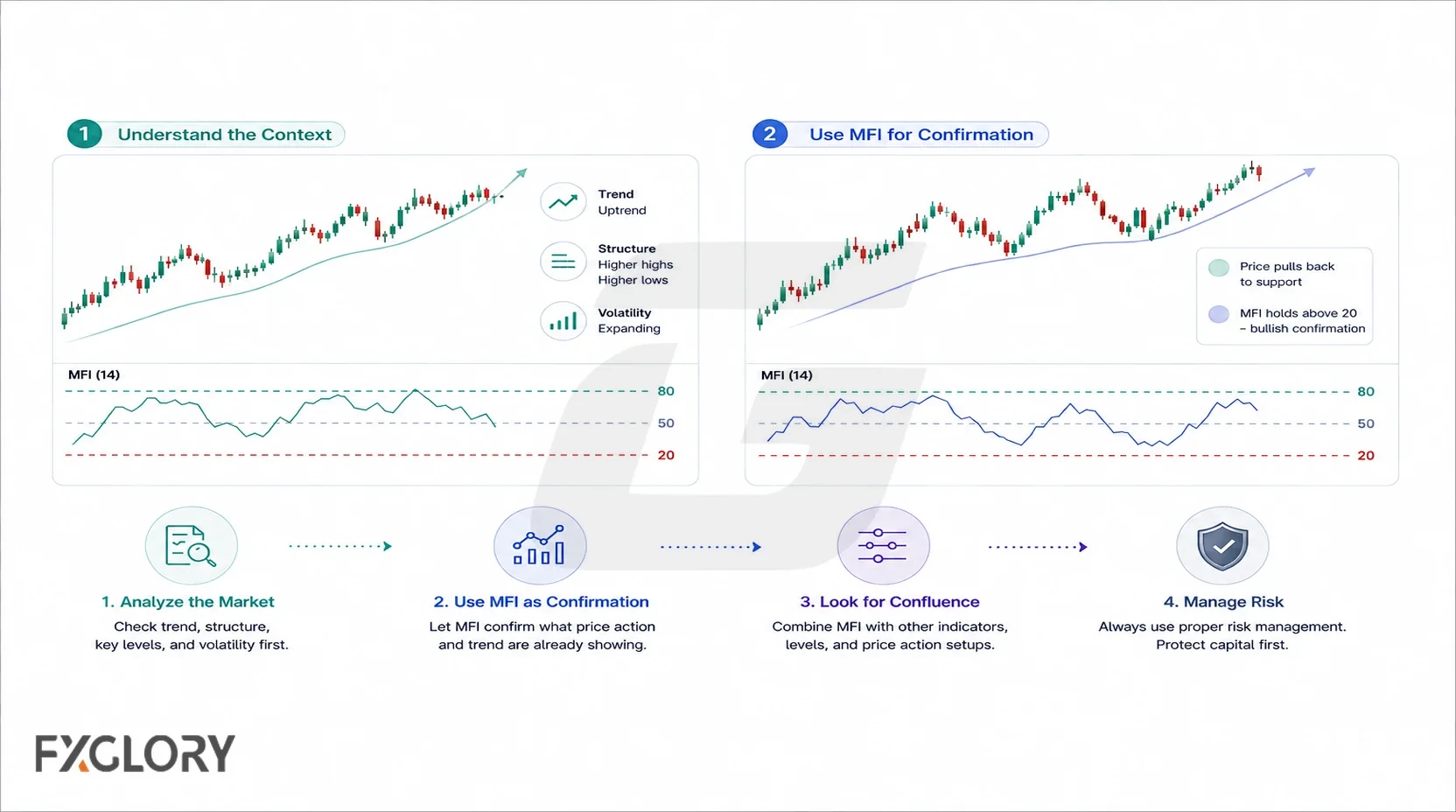
- Identify the data source: Tick volume, broker/platform data, or another available volume input.
- Read the MFI level: Is MFI below 20, above 80, near 50, extreme, or neutral?
- Read MFI direction: Is MFI rising, falling, flattening, crossing 50, or diverging from price?
- Check price structure: Is price trending, ranging, breaking out, rejecting a level, or moving inside chop?
- Check support and resistance: Is the MFI reading appearing near a meaningful price area?
- Check volatility and news: Is the reading affected by spread, session, event risk, or abnormal movement?
- Define invalidation: Know where the MFI-based idea is wrong before using it in a plan.
Illustrative MFI Chart Scenarios
These hypothetical situations show questions to investigate, not measured signals or trading results.
| Situation | MFI observation | What matters next |
|---|---|---|
| Strong uptrend | MFI stays above 80 while price makes higher highs | An overbought reading alone is not a reason to sell; check whether price structure actually changes |
| Range support | Price makes a lower low while MFI makes a higher low | Look for a price reaction at the range boundary; divergence is not confirmation |
| Sideways market | MFI crosses 50 several times | Repeated crosses may reflect chop rather than a directional shift |
Custom MFI Indicator Caution
Some traders use custom MFI dashboards, combined oscillator panels, divergence labels, 50-line modes, moving-average overlays, or alert-based MFI tools. These can make scanning easier, but the logic should be understandable before it is used.
A custom MFI tool can look clean in old examples and still fail when volume source, market condition, session, spread, or volatility changes.
- Calculation check: Does the tool use standard MFI or a modified formula?
- Data-source check: Does it use tick volume, broker data, platform volume, or another source?
- Alert-timing check: Does the alert appear after candle close, or does it change while the candle is forming?
- Repaint check: Does the indicator change past signals after new data appears?
- Threshold check: Are 80/20, 90/10, or 50-line labels being treated as hard rules?
- Divergence check: Does the tool explain how it detects divergence, or does it hide the logic?
MFI False-Signal Filters
Use these filters when the MFI indicator looks active but the chart condition does not support the reading.
| Filter | Problem it catches | What to check |
|---|---|---|
| Tick-volume-source filter | MFI treated as if it uses full centralized forex volume | Data source, platform context, and recent activity history |
| 80/20-overread filter | High or low MFI treated as automatic reversal | Trend context, structure, and price reaction |
| 90/10-overfit filter | Extreme levels treated as safer signals | Testing across ranges, trends, news, and volatility |
| Trend-extreme filter | MFI stays high or low during a strong trend | Trend pressure, pullback quality, and structure |
| Centerline-whipsaw filter | MFI crosses 50 repeatedly inside chop | Range condition, timeframe, and volume quality |
| Divergence-overread filter | MFI divergence treated as reversal confirmation | Price reaction, structure change, and follow-through |
| No-level filter | MFI warning appears away from a meaningful price area | Support, resistance, retracement, or structure point |
| News-volatility filter | MFI jumps because of event-driven movement | News risk, spread behavior, and liquidity conditions |
| Low-timeframe-noise filter | MFI changes repeat on a noisy lower timeframe | Broader structure and timeframe alignment |
| No-invalidation filter | No clear place where the idea is wrong | Risk distance and invalidation rule |
How to Test MFI in Forex
A repeatable test needs a specific hypothesis, consistent data, written rules, and outcomes recorded for both successful and unsuccessful cases. The following is a testing framework, not an existing backtest or a claim of profitability.
- Define the question: For example, test whether MFI divergence at a predefined range edge adds information beyond price action alone.
- Document the dataset: Record broker/platform, volume type, currency pair, timeframe, time zone, start and end dates, missing-data handling, and MFI lookback and threshold settings.
- Write objective rules: Define swing points or threshold crossings, the eligible market regime, price confirmation, entry timing (if any), invalidation, exit and holding period before reviewing outcomes.
- Account for execution: If simulating trades, include plausible spreads, commissions, slippage, session restrictions, and position-sizing assumptions.
- Separate conditions: Compare trends, ranges, and event periods rather than blending incompatible observations without labels.
- Record every qualifying observation: Include time, screenshot or OHLC/volume data, MFI reading, price outcome, costs where relevant, and reasons for excluded observations.
- Check robustness: Review another time period and, where possible, another feed. Avoid changing thresholds only to improve historical results.
Without a defined sample and results, MFI observations remain illustrative; they do not establish predictive accuracy or a trading edge.