
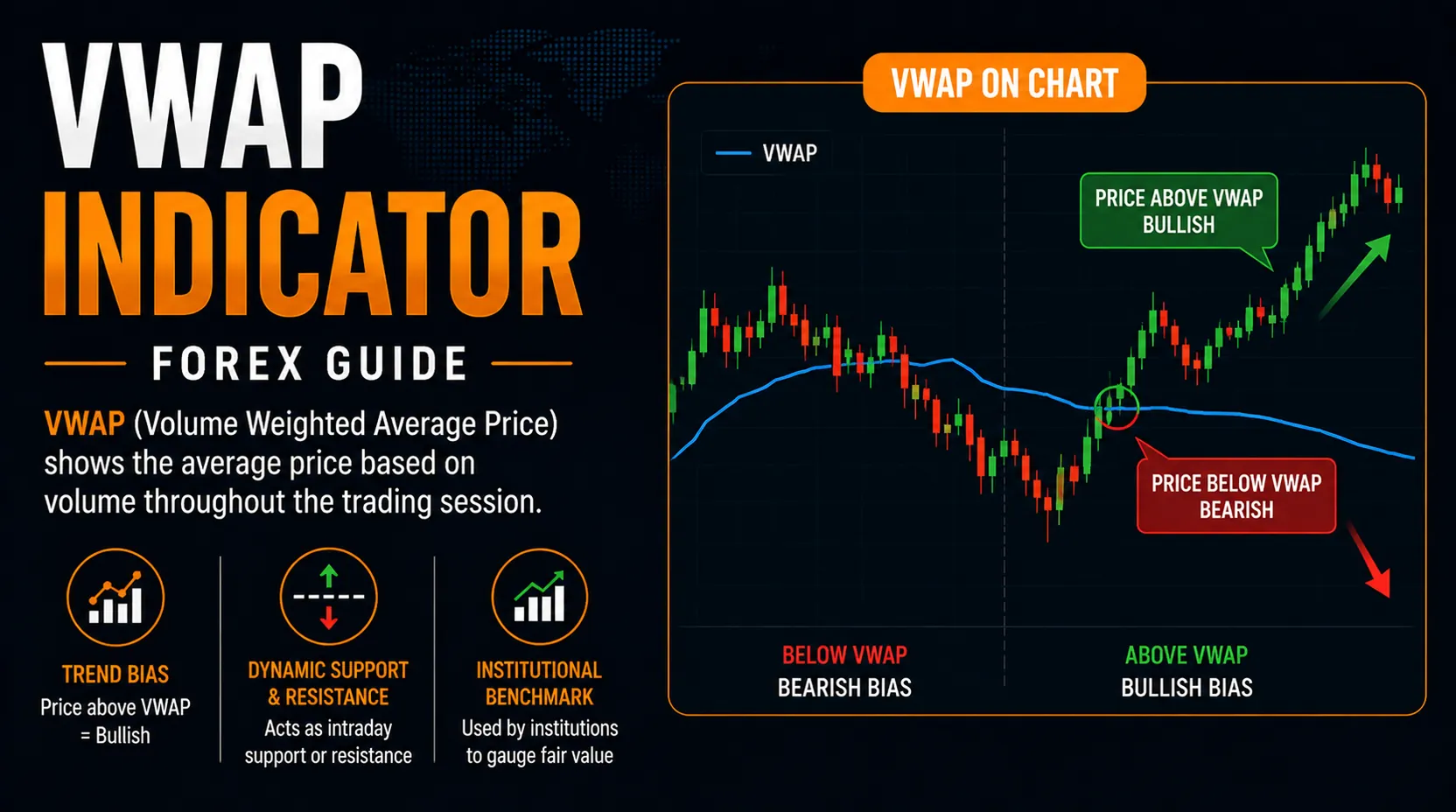
What Is VWAP in Forex?
VWAP stands for Volume Weighted Average Price. In forex trading, VWAP is used as a price-location reference that averages price by available volume over a selected session or anchor.
VWAP is not the same as a simple moving average. A moving average uses price only. VWAP uses price and available volume data, which means the quality of the volume source matters.
In spot forex, that point is important. Most retail forex platforms do not show complete centralized global forex volume. VWAP readings are usually based on tick volume, platform-specific activity, or another available proxy.
For chart context around VWAP reactions, review market structure context.
How VWAP Works
VWAP compares price with an available volume-weighted average. It gives more weight to price areas where more available volume or tick activity appears in the selected calculation window.
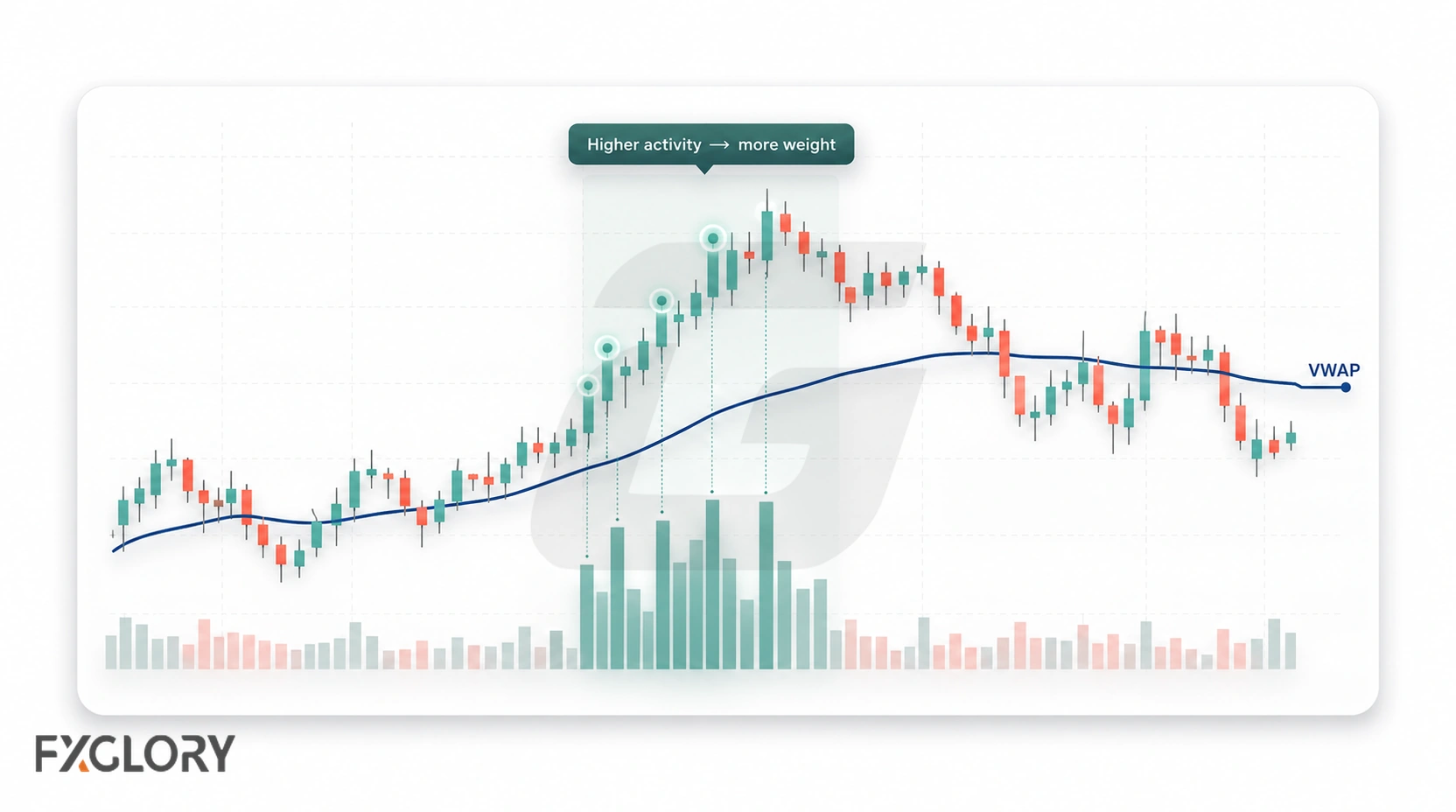
The selected window matters. Standard VWAP often resets by session. Anchored VWAP starts from a chosen point. VWAP bands plot distance around the VWAP line. A different reset, anchor, or volume source can create a different reading.
- Price near VWAP: Price is near the selected volume-weighted reference.
- Price above VWAP: Price is above the selected reference, but direction still needs confirmation.
- Price below VWAP: Price is below the selected reference, but continuation is not confirmed.
- VWAP sloping: The selected reference is moving, but it can still lag price.
- Price far from VWAP: Price may be extended from the selected reference, but reversal is not confirmed.
Why VWAP Needs Extra Caution in Forex
VWAP uses volume in its calculation. In spot forex, available volume is usually not total global forex volume. It may be tick volume, broker-specific volume, platform activity, or another proxy.
This does not make VWAP useless, but it changes how it should be read. VWAP in forex is only as clear as the available volume source, reset time, anchor point, and platform calculation.
- Tick-volume dependency: VWAP may use price-update activity rather than full market-wide transaction size.
- Platform dependency: VWAP can vary when platform data, liquidity source, or calculation method changes.
- Reset dependency: Session VWAP can change when the reset time changes.
- Anchor dependency: Anchored VWAP changes when the starting point changes.
- News dependency: Event-driven movement can distort price, volume, spread, and VWAP behavior.
VWAP Formula in Plain English
The VWAP formula can look technical, but the chart-reading question is simple: where is price compared with a selected average price weighted by available volume?
| Formula part | Plain-English meaning | Forex caution |
|---|---|---|
| Typical price | Average of high, low, and close | Still needs price-structure context |
| Volume or tick volume | Available activity input for the selected period | Spot forex volume is usually not centralized total market volume |
| Typical price multiplied by volume | Price weighted by available activity | Only as clear as the input data |
| Cumulative price-volume value | Running total of weighted price values | Depends on session reset or anchor point |
| Cumulative volume | Running total of available volume input | Can vary between platforms |
| VWAP line | Cumulative price-volume value divided by cumulative volume | Reference line, not a prediction line |
In plain English, VWAP asks where the current price is compared with the selected volume-weighted average price.
Session VWAP and Reset Time in Forex
Standard VWAP often resets at the start of a session. In stocks, the market open and close are usually clearer. In spot forex, trading runs around the clock during the trading week, so the platform reset time can affect the VWAP reading.
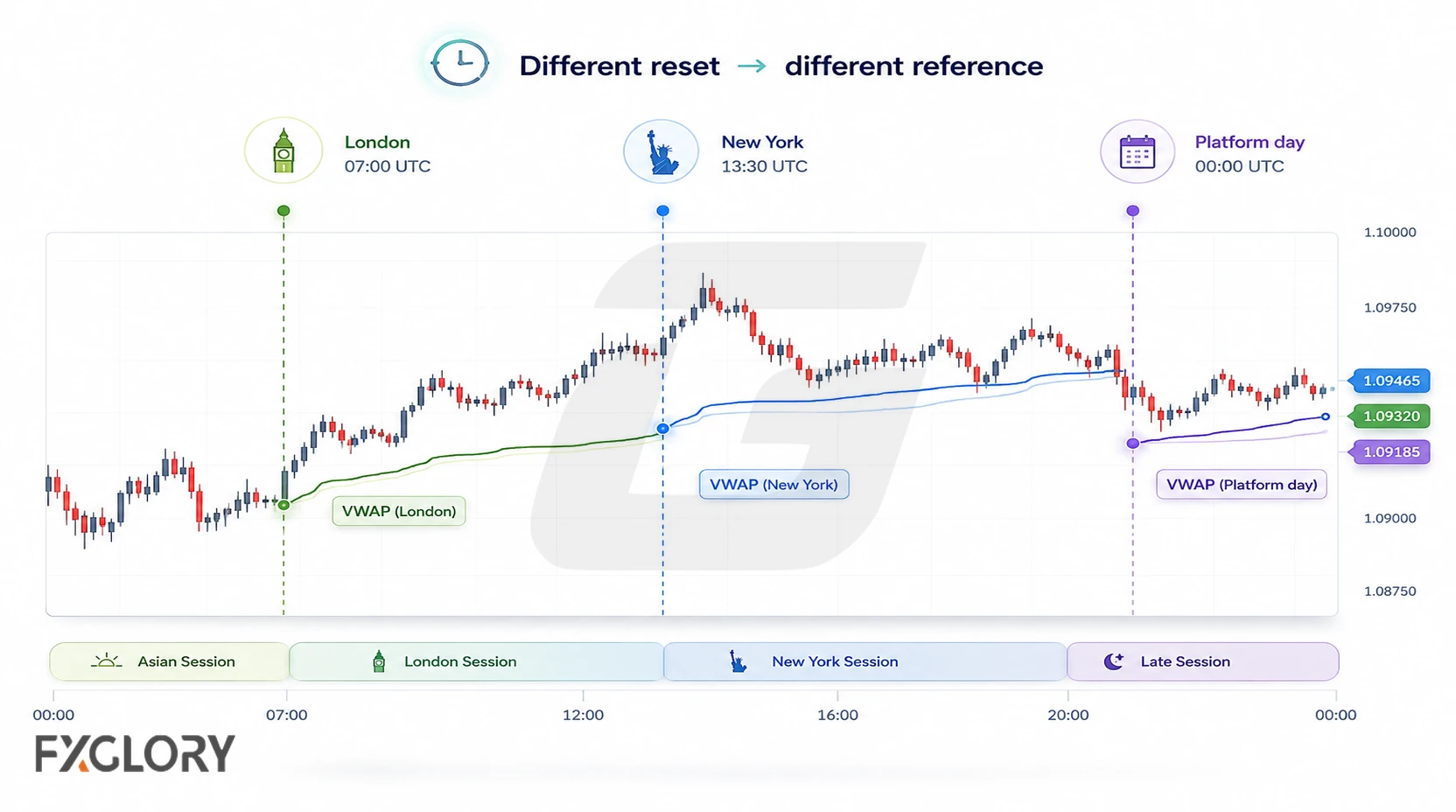
This means two VWAP readings can differ if they use different session resets. A London-session VWAP, New York-session VWAP, platform-day VWAP, and custom reset VWAP are not automatically the same reference.
| VWAP reset style | What it reviews | Main caution |
|---|---|---|
| Platform-day VWAP | VWAP from the platform's selected daily reset | May differ between brokers or server times |
| London-session VWAP | VWAP from a London-session start point | Does not represent the whole forex day |
| New York-session VWAP | VWAP from a New York-session start point | Can differ from London or platform-day VWAP |
| Custom reset VWAP | VWAP from a trader-selected reset time | Can be overfit if the reset is chosen only to make old examples look clean |
Price Above or Below VWAP
Price above VWAP means price is trading above the selected volume-weighted reference. Price below VWAP means price is trading below that reference. Neither condition confirms continuation, reversal, entry, or exit by itself.
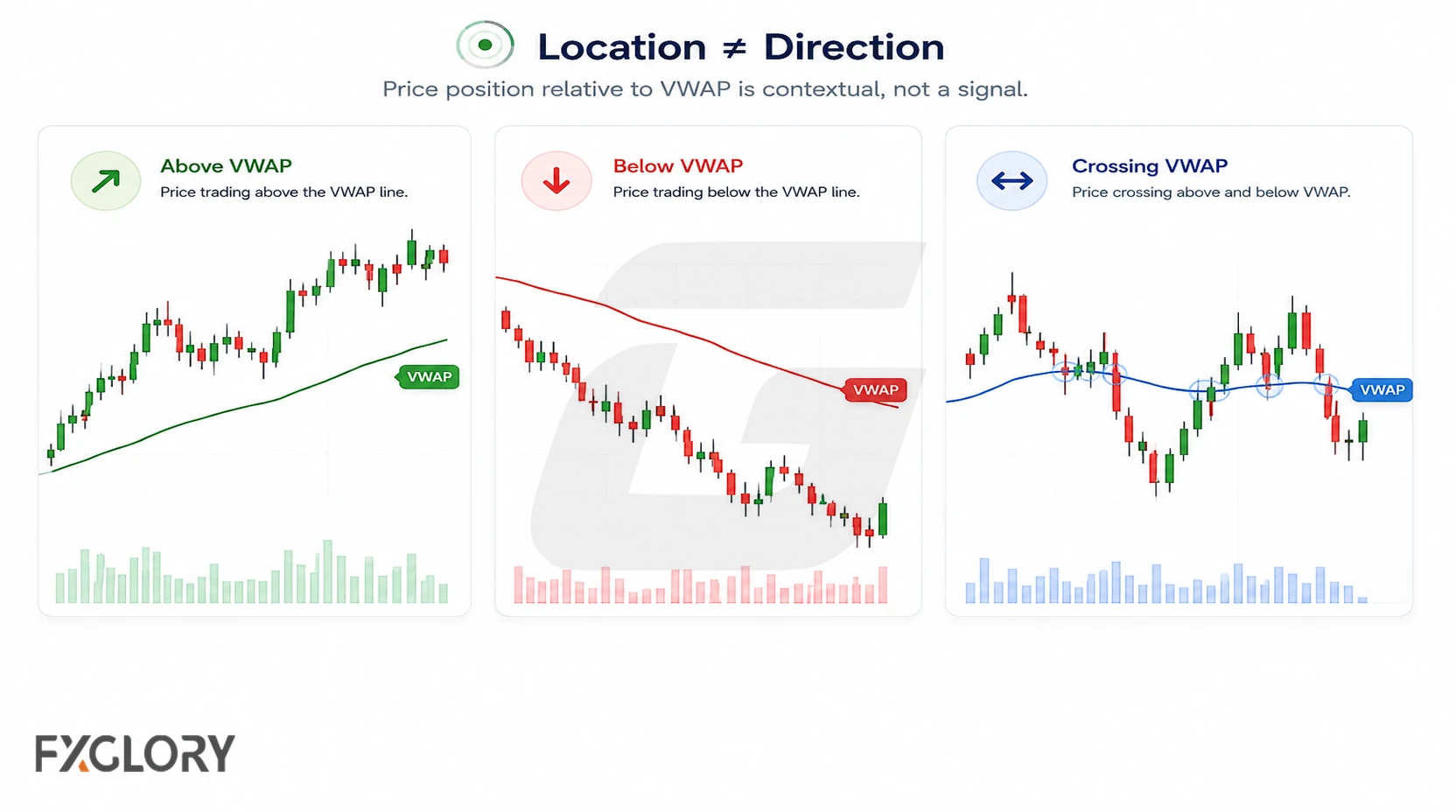
A VWAP cross can show that price moved from one side of the selected reference to the other. It does not prove that market structure has changed.
| VWAP behavior | What it may suggest | What it does not confirm |
|---|---|---|
| Price above VWAP | Price is above the selected volume-weighted reference | Does not confirm price must continue higher |
| Price below VWAP | Price is below the selected volume-weighted reference | Does not confirm price must continue lower |
| Price crossing VWAP | Price changed sides relative to the selected reference | Does not confirm a breakout or reversal |
| VWAP flat | The reference may be less directional or range-sensitive | Does not mean the market is safe or predictable |
| VWAP sloping upward | The selected reference is rising | Does not confirm clean trend continuation |
| VWAP sloping downward | The selected reference is falling | Does not confirm clean trend continuation lower |
| Price far from VWAP | Price may be extended from the selected reference | Does not confirm a snapback or reversal |
VWAP vs Moving Average in Forex
VWAP can look similar to a moving average because both can appear as lines near price. The inputs are different. A simple moving average uses price only. VWAP uses price and available volume-style data.
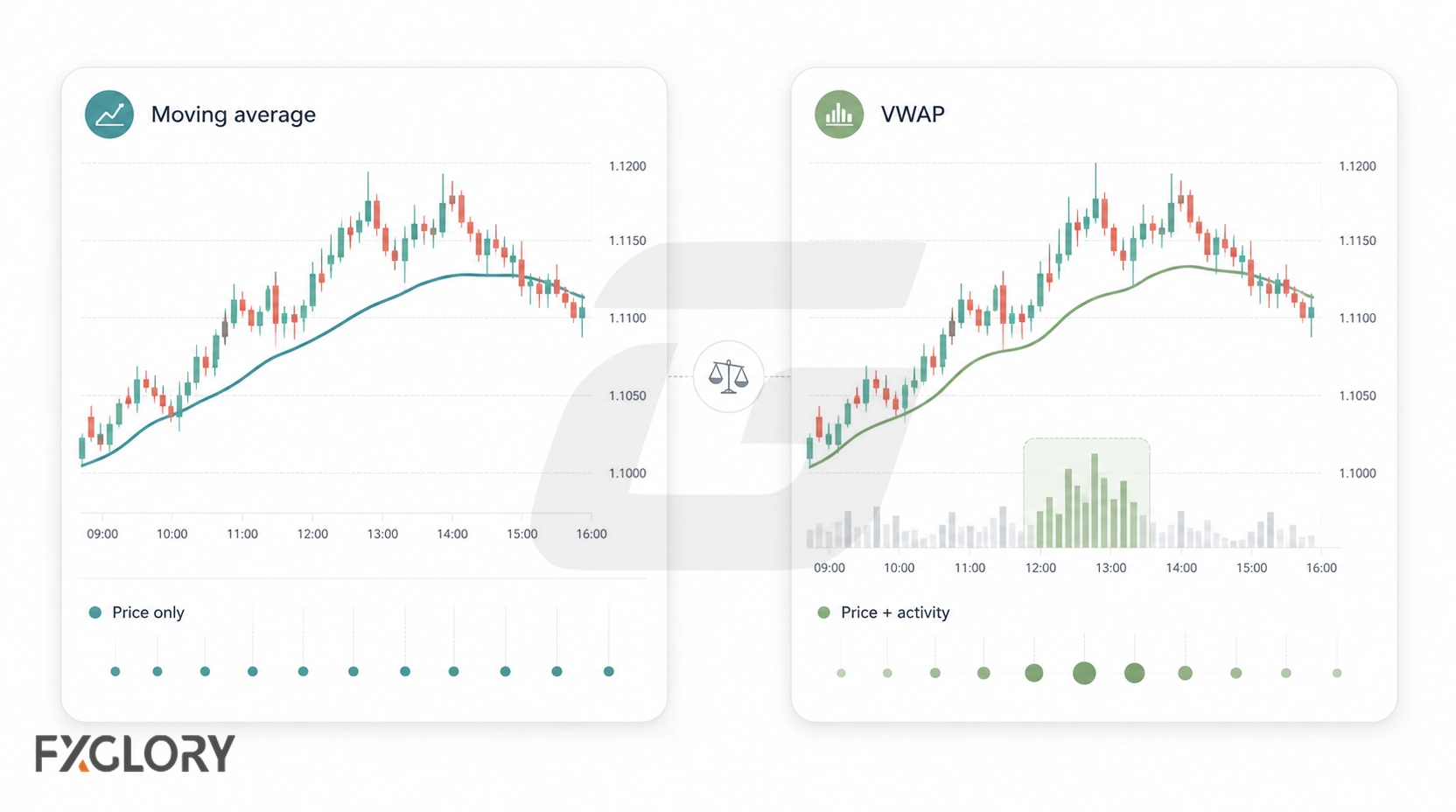
| Tool | Uses price? | Uses volume? | Reset or anchor behavior | Main caution |
|---|---|---|---|---|
| Simple moving average | Yes | No | Rolling lookback period | Lagging smoother, not a prediction tool |
| VWAP | Yes | Yes, or tick-volume context in forex | Session reset or selected anchor | Data-source and reset-time dependent |
For broader price reaction context around any line on a chart, review price action in forex.
Anchored VWAP in Forex
Anchored VWAP starts the VWAP calculation from a selected point. The anchor may be a session open, weekly open, major swing high, major swing low, breakout attempt, or important event.
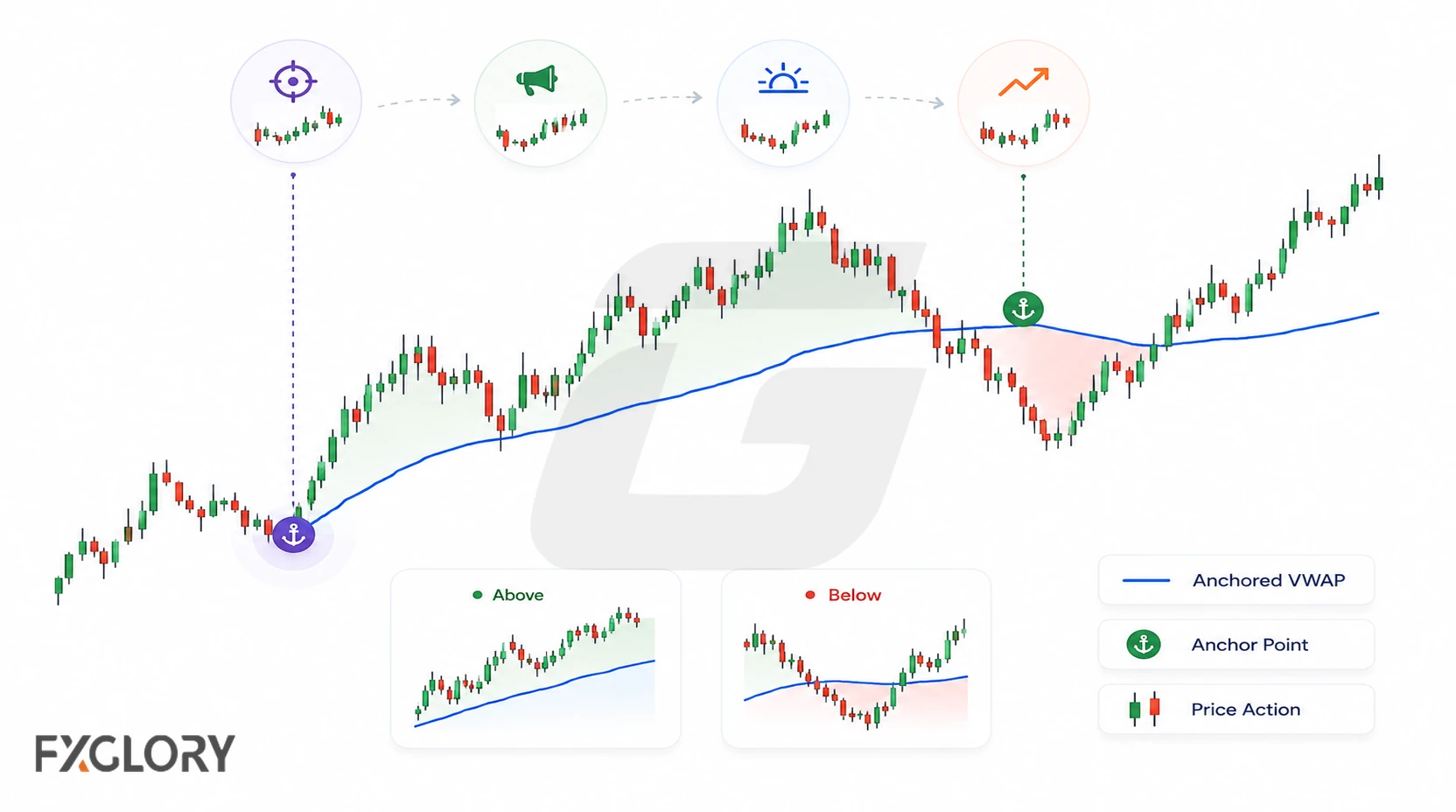
Anchor choice changes the reading. That makes anchored VWAP useful for reviewing a specific market episode, but it also creates overfitting risk when anchors are chosen only because they make old examples look clean.
| Anchor point | What it can review | Main caution |
|---|---|---|
| Session open | Price location from a session start | Session choice affects the line |
| Weekly open | Price location from the start of the trading week | Not the same as intraday VWAP |
| Swing high | Price behavior after a major high | Can be cherry-picked after the fact |
| Swing low | Price behavior after a major low | Can be cherry-picked after the fact |
| Breakout attempt | Price behavior after a break or failed break | Still needs structure and follow-through |
| Major event | Price behavior after a data release or central-bank event | Event volatility can distort spread and execution context |
VWAP Bands in Forex
VWAP bands plot zones around the VWAP line. Some bands use standard deviation or similar distance logic. They can help review how far price is from the selected VWAP reference.
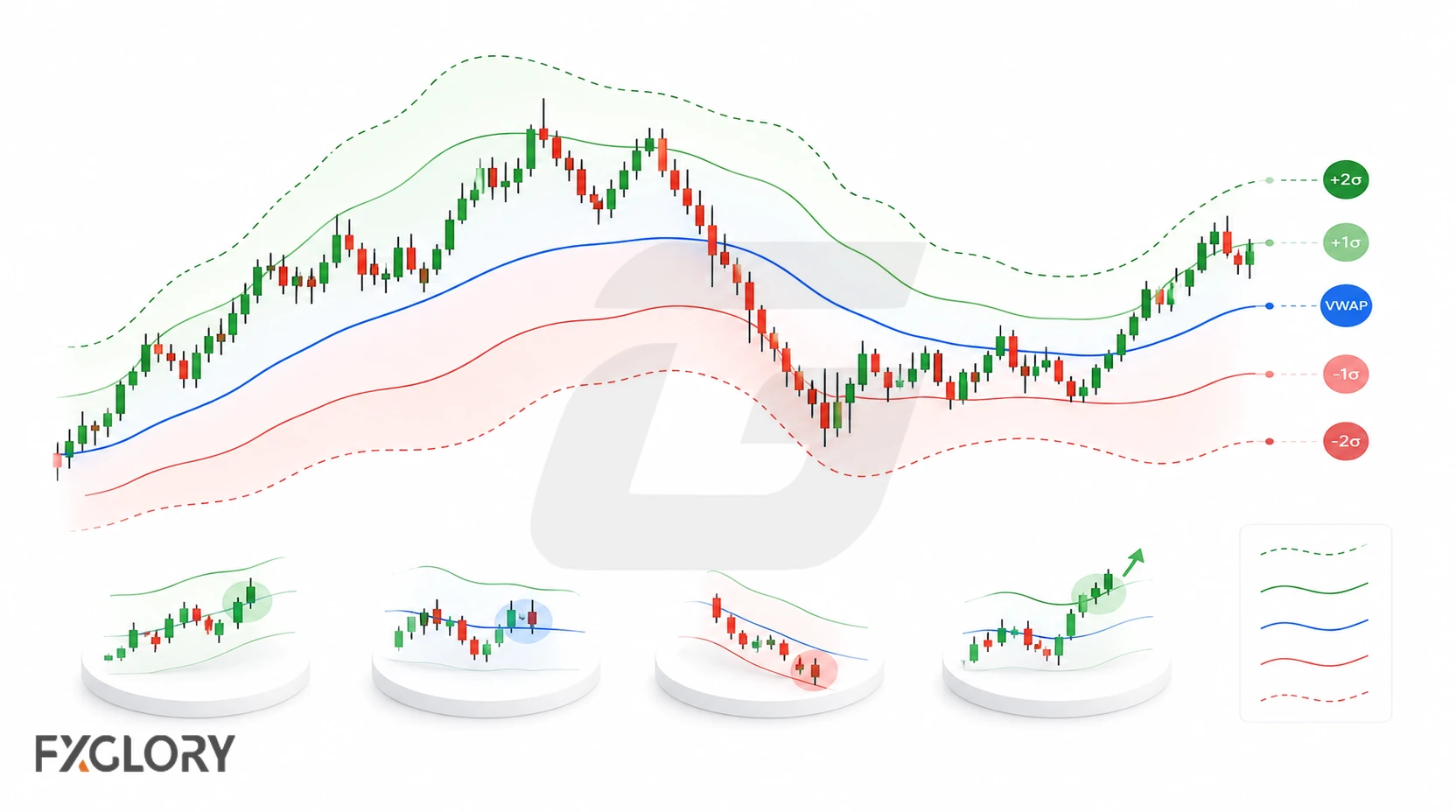
VWAP bands are not the same as Bollinger Bands. VWAP bands are built around a volume-weighted reference. Bollinger Bands are built around a moving average and standard deviation. Both can show distance or extension context, but neither gives automatic reversal or continuation by itself.
- Upper VWAP band: Price may be extended above the selected reference, but reversal is not confirmed.
- Lower VWAP band: Price may be extended below the selected reference, but reversal is not confirmed.
- Repeated band touch: Price may be trending, stretched, or reacting to volatility.
- Band compression: Distance may be narrowing, but breakout timing is not confirmed.
- Band expansion: Distance may be widening, but direction still needs price structure.
VWAP as a Reference Area, Not Guaranteed Support or Resistance
VWAP can become a watched reference area. Price may react near VWAP, reject it, cross it, hold around it, or ignore it completely.
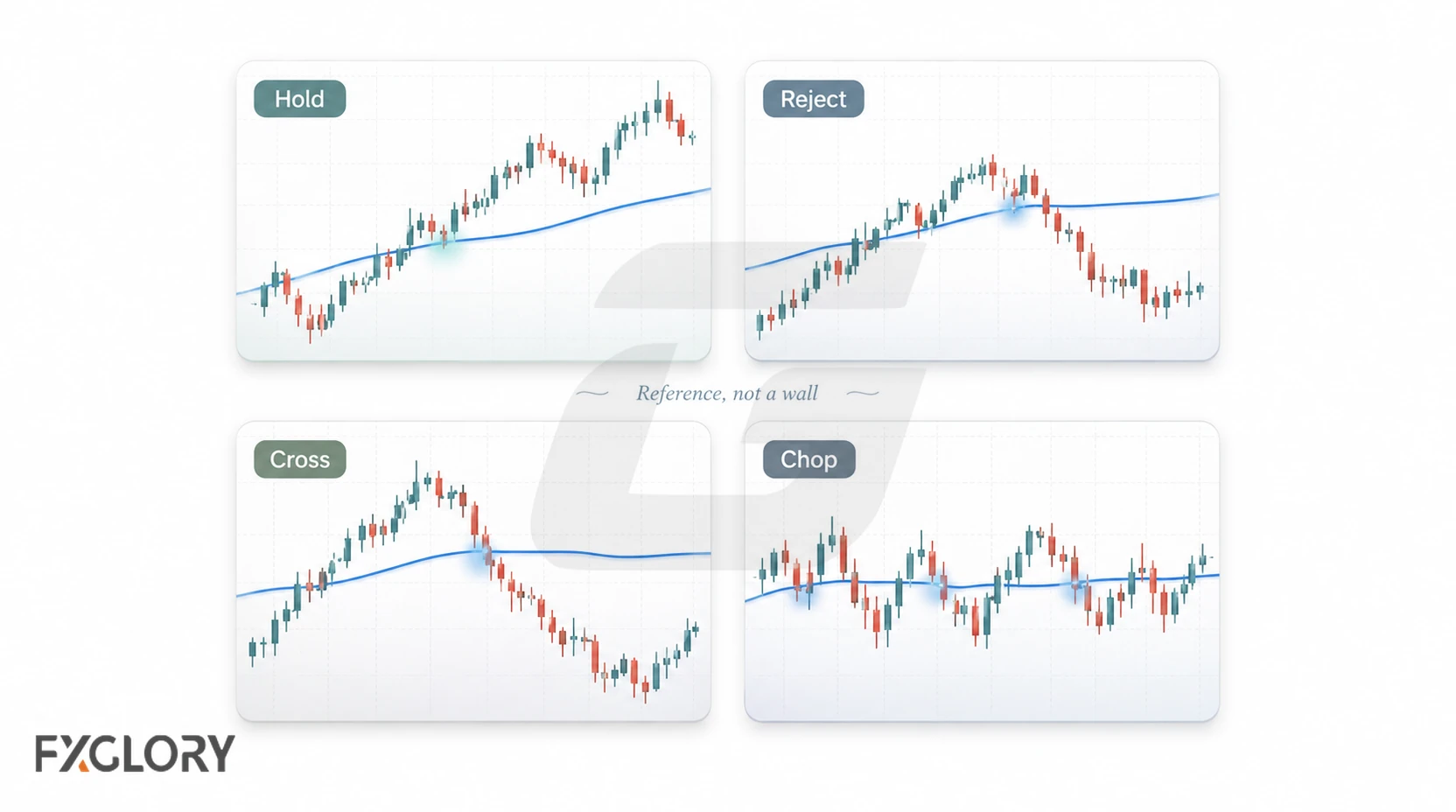
The reaction matters more than the line itself. VWAP is not guaranteed support or resistance. A VWAP touch needs price structure, repeated reaction, session context, spread, volatility, and invalidation before it becomes useful.
- VWAP hold: Price may respect the reference temporarily, but continuation is not guaranteed.
- VWAP rejection: Price may react near the reference, but reversal is not confirmed.
- VWAP cross: Price moved through the reference, but a structure break still matters.
- VWAP chop: Price may cross repeatedly during range-bound movement.
- VWAP failure: A reaction around VWAP can fail quickly when volatility, news, or liquidity changes.
For level-based confirmation beyond VWAP, review support and resistance zones.
VWAP vs OBV, MFI, Volume Profile, and Bollinger Bands
VWAP belongs to the volume-tool family, but it has a specific job. It is a volume-weighted price-location benchmark. It should not be confused with cumulative pressure tools, bounded oscillators, profile tools, or volatility bands.
| Tool | Main job | Difference from VWAP |
|---|---|---|
| VWAP | Volume-weighted average price reference | Shows price location versus selected volume-weighted benchmark |
| OBV | Cumulative volume-pressure review | Rising/falling pressure line, not an average price benchmark |
| MFI | 0–100 price-volume oscillator | Bounded pressure oscillator, not a price reference line |
| Volume Profile | Available activity by price area | Distribution-style view, not a session average line |
| Moving average | Price-only smoothing | No volume input |
| Bollinger Bands | Volatility bands around a moving average | Not built around volume-weighted average price |
For related chart context, use market structure context, support and resistance zones, and price action in forex.
How to Use VWAP in Forex Without Treating It as a Signal
Start with the volume data source, VWAP type, reset time, and anchor logic. Then compare price location with market structure and session context. The goal is to decide whether VWAP clarifies a price-location question, not to turn a cross, band touch, or anchor reaction into a trade command.
- Identify the data source: Tick volume, broker/platform data, or another available volume input.
- Identify VWAP type: Session VWAP, anchored VWAP, VWAP bands, or a custom VWAP tool.
- Check reset or anchor: Know where the calculation begins before reading the line.
- Read price location: Is price above, below, near, far from, crossing, or reacting around VWAP?
- Check market structure: Is price trending, ranging, breaking out, rejecting a level, or moving inside chop?
- Check session and spread: Is the reading affected by session open, overlap, thin liquidity, or spread changes?
- Define invalidation: Know where the VWAP-based idea is wrong before using it in a plan.
VWAP with Confirmation Checks
A VWAP reading becomes more useful when it is connected to price context. Confirmation does not remove risk, but it can reduce the chance of treating every VWAP touch, cross, band reaction, or anchor reaction as a trade idea.
- Price location: Is the VWAP reaction near support, resistance, a range edge, or a retracement zone?
- Market structure: Has price shown breakout, failed breakout, continuation, rejection, higher low, lower high, or unclear chop?
- Session context: Is the VWAP reading tied to a clear reset or session period?
- Volume context: Is VWAP based on tick volume, platform activity, or another data source?
- Volatility context: Is the reaction connected to normal movement or event-driven volatility?
- Risk rule: Can the trader explain where the idea is wrong before using it in a plan?
For confirmation beyond VWAP, review support and resistance zones, market structure context, and price action in forex.
Live Market Examples: Matching VWAP to Chart Questions
The first step is to identify the VWAP question, not to treat every VWAP touch, cross, or band reaction as a signal.
| Market page | VWAP question | Context to check |
|---|---|---|
| EUR/CHF live chart | Is VWAP flat or chopped through inside a quiet range? | Range boundaries, tick-volume quality, and support/resistance |
| EUR/GBP live chart | Is price crossing VWAP repeatedly inside a range? | Price location, structure reaction, and range whipsaw risk |
| GBP/USD live chart | Is session VWAP useful during directional movement? | Reset time, trend context, structure reaction, and follow-through |
| Gold live chart | Is anchored VWAP reacting around an event-sensitive move? | Anchor logic, news risk, volatility, and support/resistance distance |
| BTC/USD live chart | Is platform-volume sensitivity distorting the VWAP reference? | Data source, spread, execution conditions, and structure clarity |
Custom VWAP Indicator Caution
Some traders use custom VWAP dashboards, anchored VWAP scripts, dynamic anchors, sigma bands, filled VWAP zones, alerts, or session templates. These can make scanning easier, but the logic should be understandable before it is used.
A custom VWAP tool can look clean in old examples and still fail when volume source, reset time, anchor choice, session, spread, or volatility changes.
- Calculation check: Does the tool use standard session VWAP, anchored VWAP, bands, or a modified formula?
- Data-source check: Does it use tick volume, broker data, platform volume, or another source?
- Reset check: When does the VWAP calculation restart?
- Anchor check: Is the anchor fixed, manual, automatic, or dynamically changing?
- Band check: Are bands standard-deviation based or custom thresholds?
- Alert-timing check: Does the alert appear after candle close, or does it change while the candle is forming?
- Overfitting check: Are reset times, anchors, and bands being chosen only to make old examples look clean?
VWAP False-Signal Filters
Use these filters when VWAP looks important but the chart condition does not support the reading.
| Filter | Problem it catches | What to check |
|---|---|---|
| Tick-volume-source filter | VWAP treated as if it uses full centralized forex volume | Data source, platform context, and recent activity history |
| Reset-time filter | Different VWAP resets compared as if they are identical | Session start, server time, and calculation window |
| Anchor-overfit filter | Anchored VWAP chosen only because it fits old examples | Anchor logic, event relevance, and structure |
| Above-below-overread filter | Price above or below VWAP treated as direction confirmation | Trend context, price reaction, and structure |
| Cross-overread filter | VWAP cross treated as entry or breakout confirmation | Follow-through, retest behavior, and invalidation |
| Support-resistance-overread filter | VWAP treated as guaranteed support or resistance | Repeated reaction, structure, and price action |
| Band-touch filter | VWAP band touch treated as automatic reversal or continuation | Distance, volatility, trend condition, and reaction quality |
| Range-whipsaw filter | Price crosses VWAP repeatedly inside sideways movement | Range condition, timeframe, and session context |
| News-volatility filter | VWAP is distorted by event-driven movement | News risk, spread behavior, and liquidity conditions |
| No-invalidation filter | No clear place where the idea is wrong | Risk distance and invalidation rule |
How to Test VWAP in Forex
VWAP should be tested inside one market condition, one volume source, and one reset or anchor rule at a time. Testing random VWAP touches without separating sessions, anchors, ranges, trends, news, and platform data can create misleading results.
- Choose the VWAP job: Price-location review, session reference, anchored reference, band-distance review, cross review, or support/resistance reaction check.
- Identify the data source: Tick volume, broker/platform data, or another available volume input.
- Choose the VWAP type: Session VWAP, anchored VWAP, VWAP bands, or custom VWAP.
- Record the reset or anchor: Note exactly where the calculation begins.
- Choose the market condition: Quiet range, active range, trend, breakout attempt, high volatility, news movement, or unclear structure.
- Compare VWAP with price: Mark whether price is above, below, near, far from, crossing, or reacting around VWAP.
- Name the confirmation layer: Support/resistance, structure, trend context, volume source, volatility regime, spread, news risk, or invalidation.
- Define the trigger: Write the exact price behavior that would confirm the VWAP reading.
- Define invalidation: Write the price behavior that would make the idea wrong.
- Record the failure type: Tick-volume issue, reset mismatch, anchor overfit, above/below overread, cross overread, support/resistance overread, band-touch misuse, range whipsaw, news volatility, or no invalidation.
VWAP is useful only if it makes the volume-weighted price-location question clearer. If it encourages prediction, hides price structure, or ignores data source and reset choice, it should not stay in the plan.
A Practical Way to Use VWAP in Forex
Start with the volume data source. Identify the VWAP type, reset time, or anchor. Read price location around the line or bands. Compare the reading with price structure, support and resistance, session context, volatility, confirmation, and invalidation. If the VWAP reading does not make the price-location question clearer, ignore it.
VWAP does not need to predict the next move. It only needs to support one part of a clear process: volume-weighted price-location review, session reference, anchor reference, band-distance context, VWAP cross review, or false-signal filter.
For price-location confirmation, use the support and resistance guide. For structure confirmation, use market structure context. For candle-level reaction context, use price action in forex.