
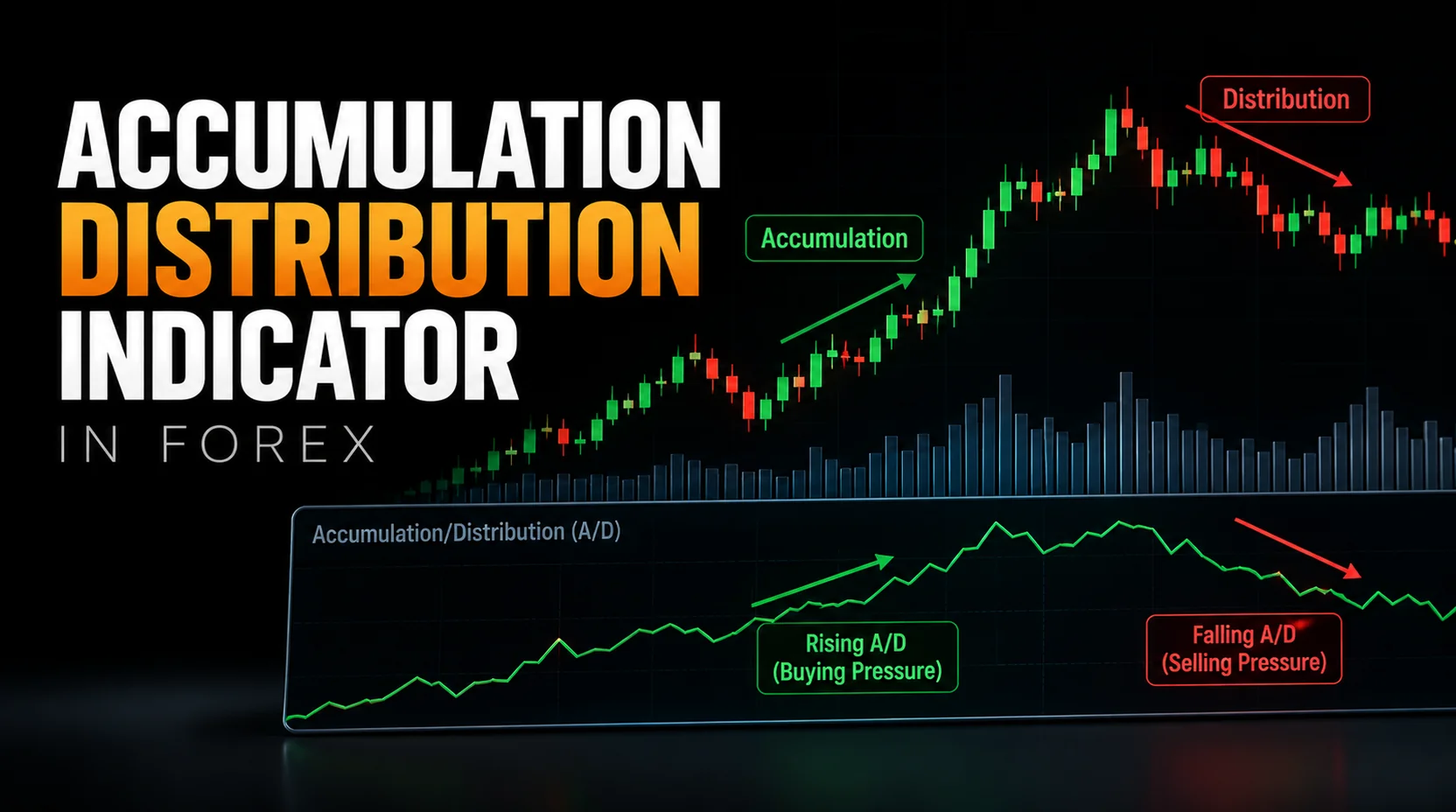
What Is Accumulation/Distribution in Forex?
The Accumulation/Distribution Line (A/D Line), developed by Marc Chaikin, accumulates a volume-weighted measure of where each candle closes within its high-low range. It is a calculation-based indicator, not a record of which traders bought or sold.
In spot forex, the input often comes from broker-provided tick volume, so readings should be interpreted within the available feed. Market structure provides the price context for interpreting changes in the line.
A/D Line vs Accumulation-Manipulation-Distribution
The A/D Line should not be confused with Accumulation-Manipulation-Distribution (AMD) or Wyckoff accumulation/distribution phases. Those are interpretations of broader market behaviour; an A/D reading does not establish manipulation, institutional positioning or hidden order flow.
| Topic | What it means | This page covers? |
|---|---|---|
| A/D Line indicator | Cumulative close-location and volume-flow indicator | Yes |
| Accumulation-Manipulation-Distribution | Market-cycle model around consolidation, false movement, and expansion | Only briefly |
| Wyckoff accumulation/distribution | Broader market-structure and phase framework | Only briefly |
| Order flow and liquidity | Execution-flow, bid/ask, depth, and liquidity concepts | No |
How the A/D Line Works
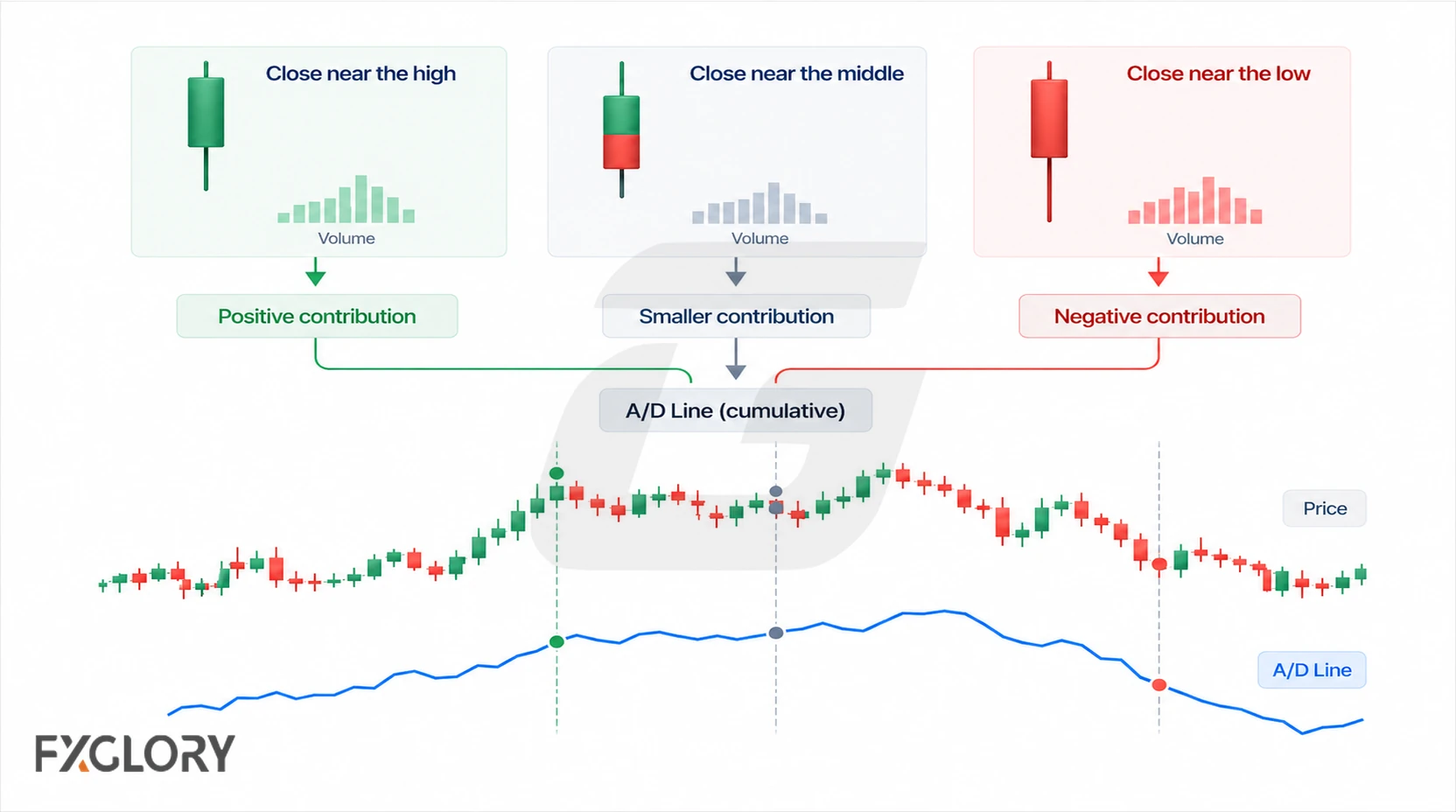
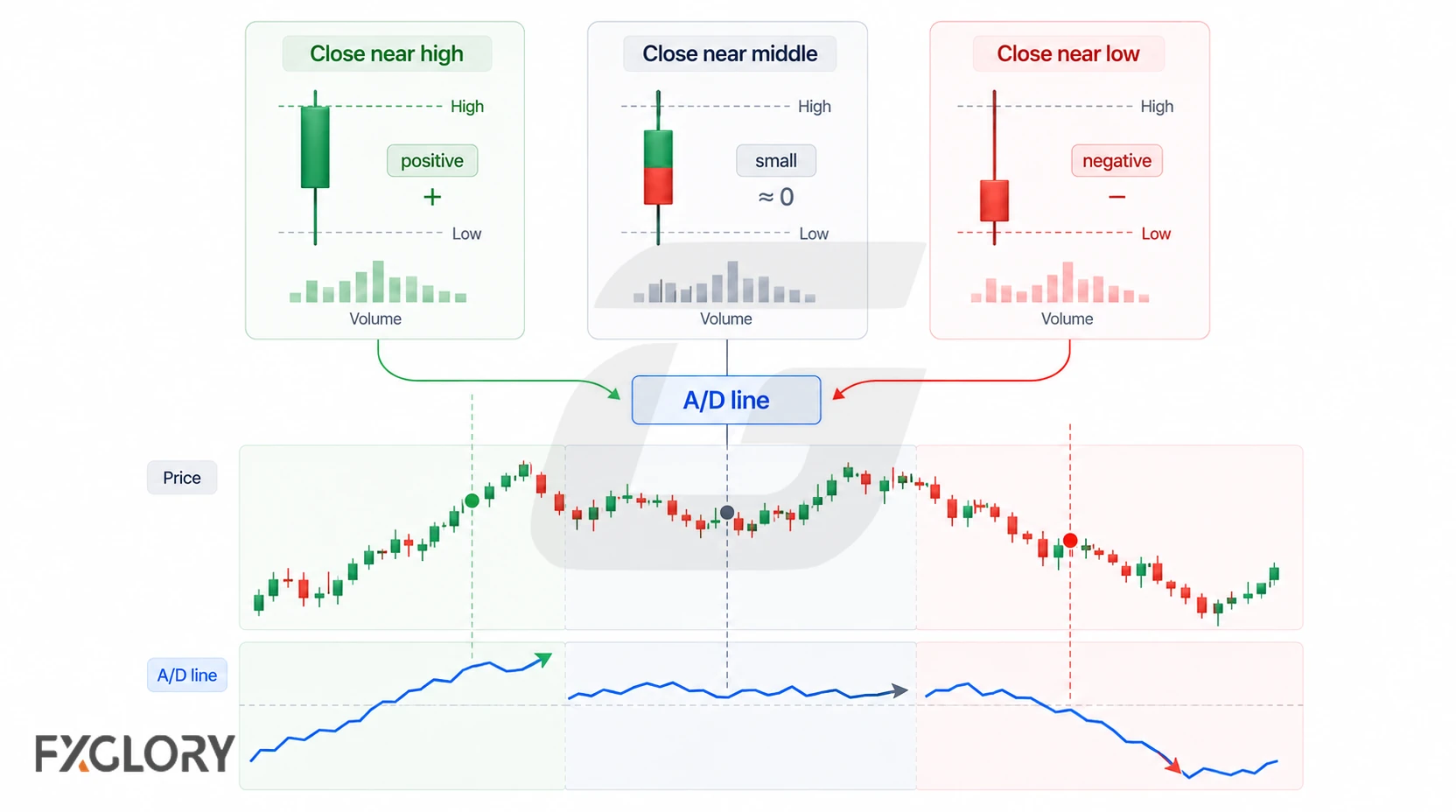
A close near the candle high gives a positive contribution, a close near the low gives a negative contribution, and a midpoint close gives zero. Volume scales that contribution. This describes closing location within the current candle, which can differ from whether the close rose or fell versus the preceding candle.
Why the A/D Line Needs Extra Caution in Forex
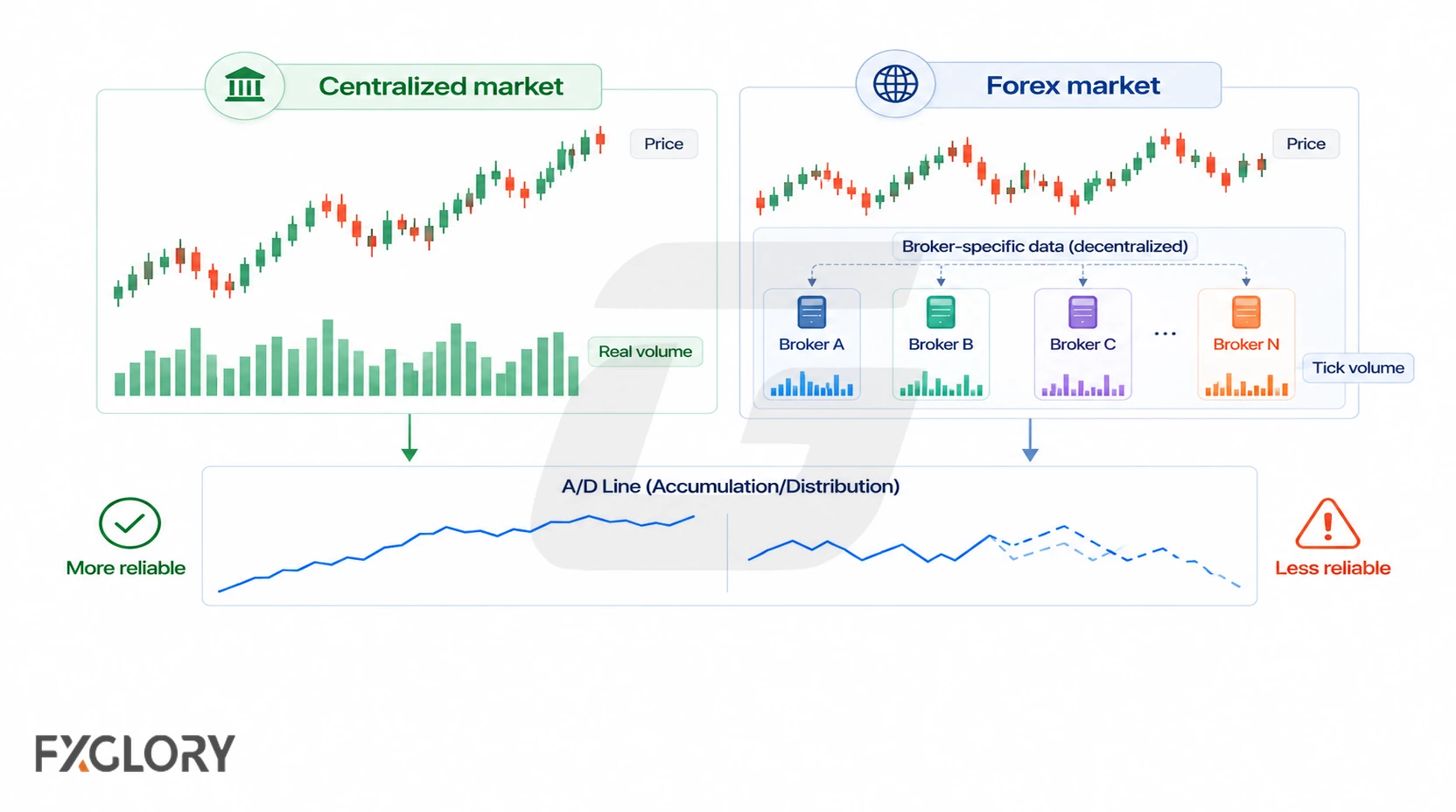
Spot forex has no single consolidated tape of global transaction volume. Many platform implementations calculate A/D using tick volume—often a count of price updates from the broker feed—not the number of units traded across the market. Two feeds can therefore produce different A/D paths even for the same pair and timeframe.
Keep the data source and calculation settings consistent when comparing periods or testing a method. News, thin liquidity, unusual candle ranges and differences in price feeds can materially affect a reading. For a deeper explanation, see forex tick volume.
A/D Line Formula in Plain English
For a bar with high H, low L, close C and available volume V:
Money Flow Multiplier = [(C − L) − (H − C)] / (H − L)
Money Flow Volume = Money Flow Multiplier × V
A/D(current) = A/D(previous) + Money Flow Volume
For a nonzero candle range, the multiplier lies between −1 and +1. A zero-range candle (H = L) would cause division by zero; platforms must handle it by an implementation-specific convention, so check the implementation rather than applying the fraction literally.
Hypothetical example: If H = 1.1050, L = 1.1000, C = 1.1040 and tick volume = 200, the multiplier is 0.6 and the bar adds 120 tick-volume units to the preceding A/D value. This is not observed market data.
Close Location: The A/D Line’s Core Input
A candle can close higher than the preceding candle yet finish near the bottom of its own range. In that case its A/D contribution is negative even though close-to-close price change is positive. This is why A/D can disagree with OBV without a calculation error.
Review long wicks, unusually narrow ranges and event-driven candles before interpreting a single contribution: closing location is not direct evidence of net buying or selling by a particular group.
A/D Is Cumulative, Not Bounded
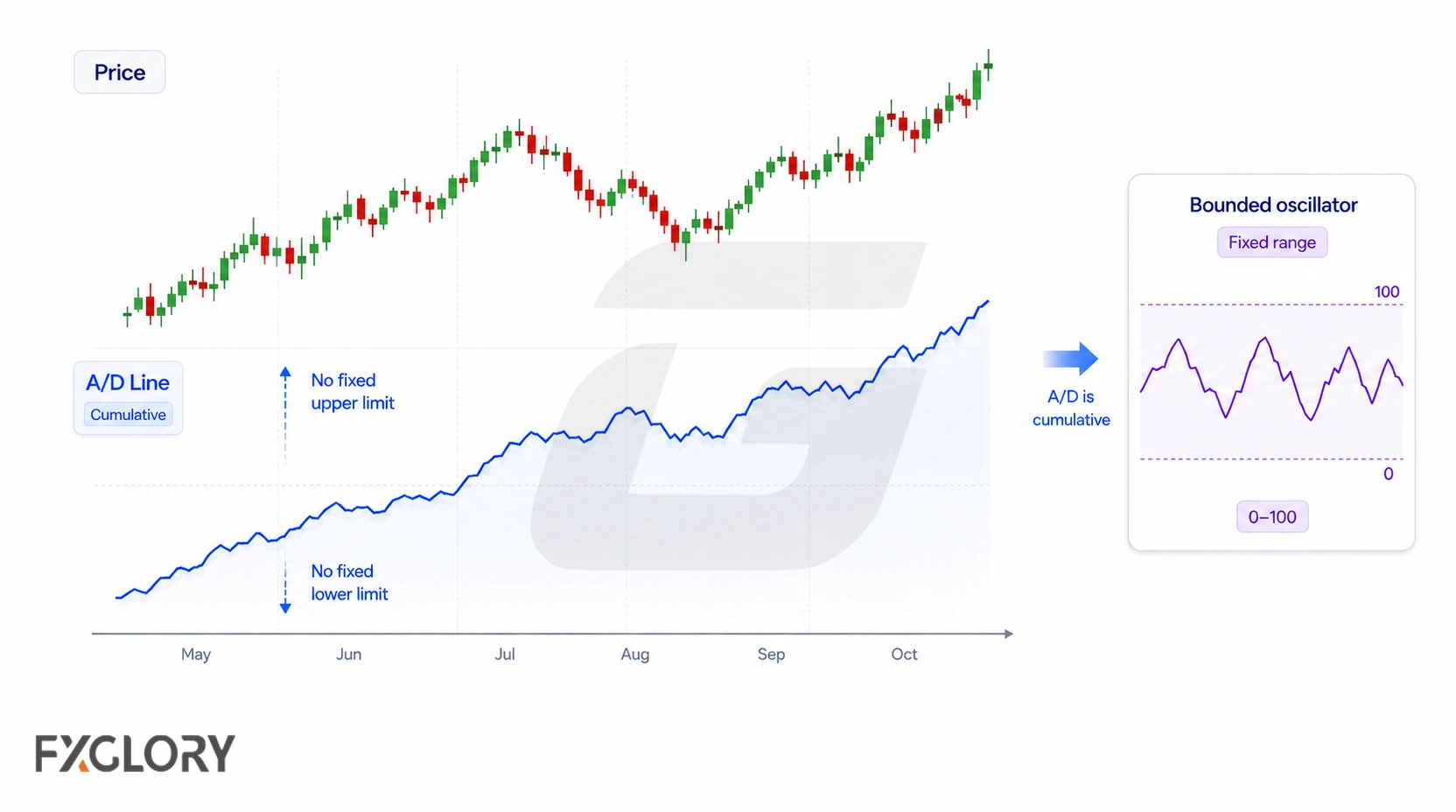
A/D adds each bar’s contribution to the prior value, so its raw level depends on the selected starting history and input feed. It is not constrained to a 0–100 scale and has no universal overbought or oversold threshold. Compare changes over a consistent observation window rather than comparing absolute A/D numbers across brokers.
Common A/D Line Readings in Forex
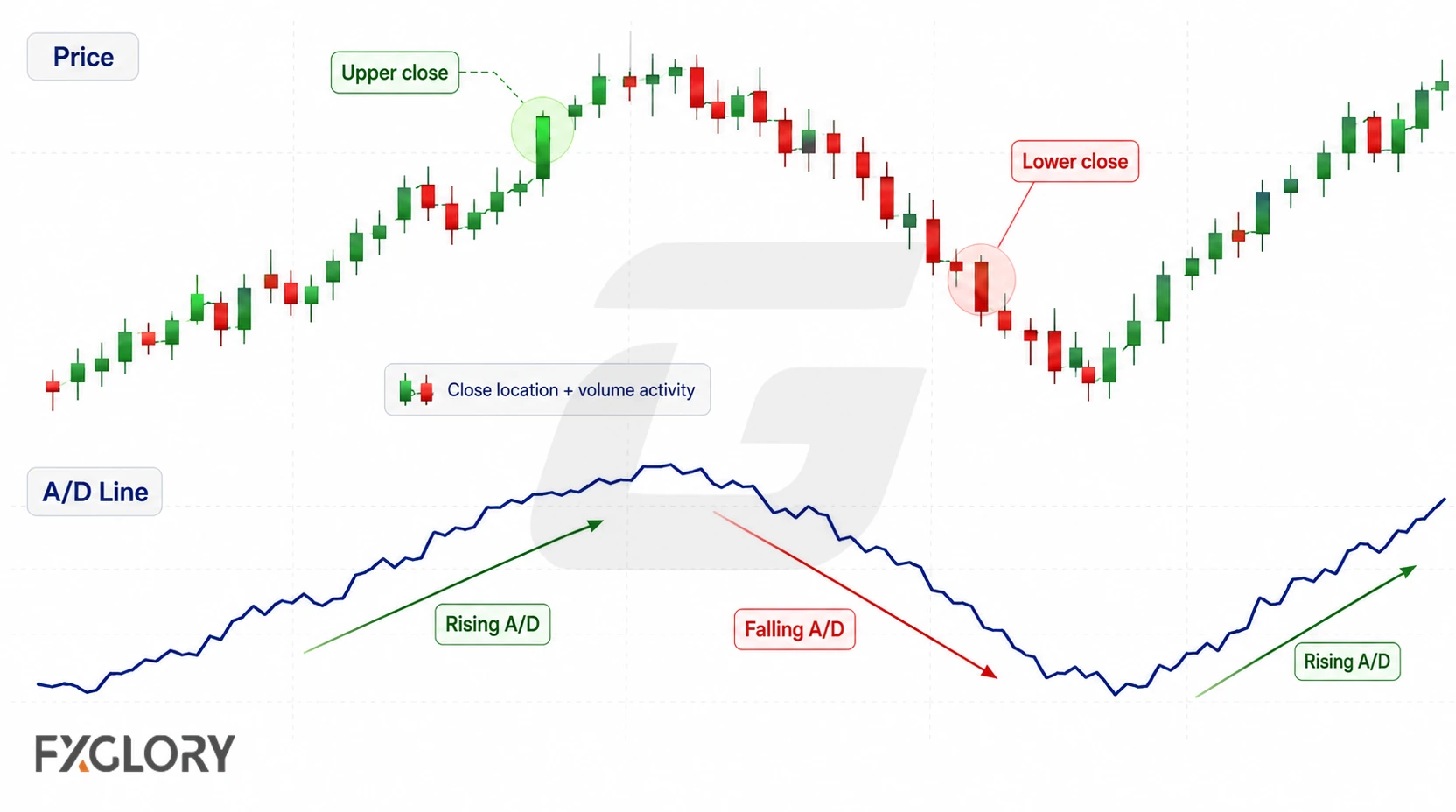
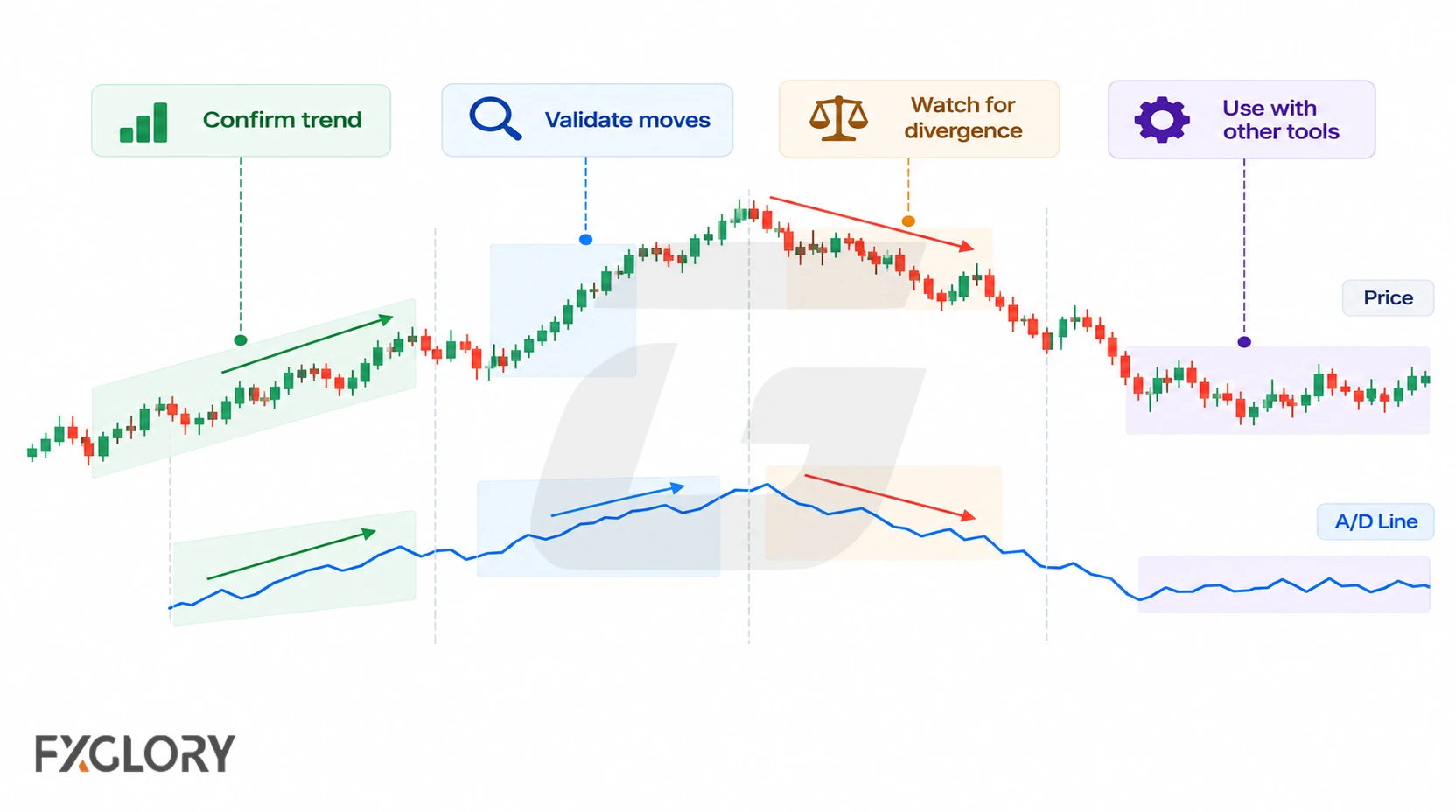
Compare the line with price over matching swing periods. Agreement can describe consistent close-location weighting; disagreement can identify a question for closer chart review. The table distinguishes each observation from what it cannot establish.
| A/D behavior | What it may suggest | What it does not confirm |
|---|---|---|
| A/D rising with price | Available close-location pressure may support upward movement | Does not confirm price must continue higher |
| A/D falling with price | Available close-location pressure may support downward movement | Does not confirm price must continue lower |
| Price rising while A/D falls | Upside movement may lack available flow confirmation | Does not confirm bearish reversal |
| Price falling while A/D rises | Downside movement may lack available flow confirmation | Does not confirm bullish reversal |
| A/D flat | Pressure may be unclear, quiet, or range-bound | Does not mean the market is safe or predictable |
| A/D spike | One period may be distorting the line | Does not confirm clean participation or direction |
A/D Divergence in Forex
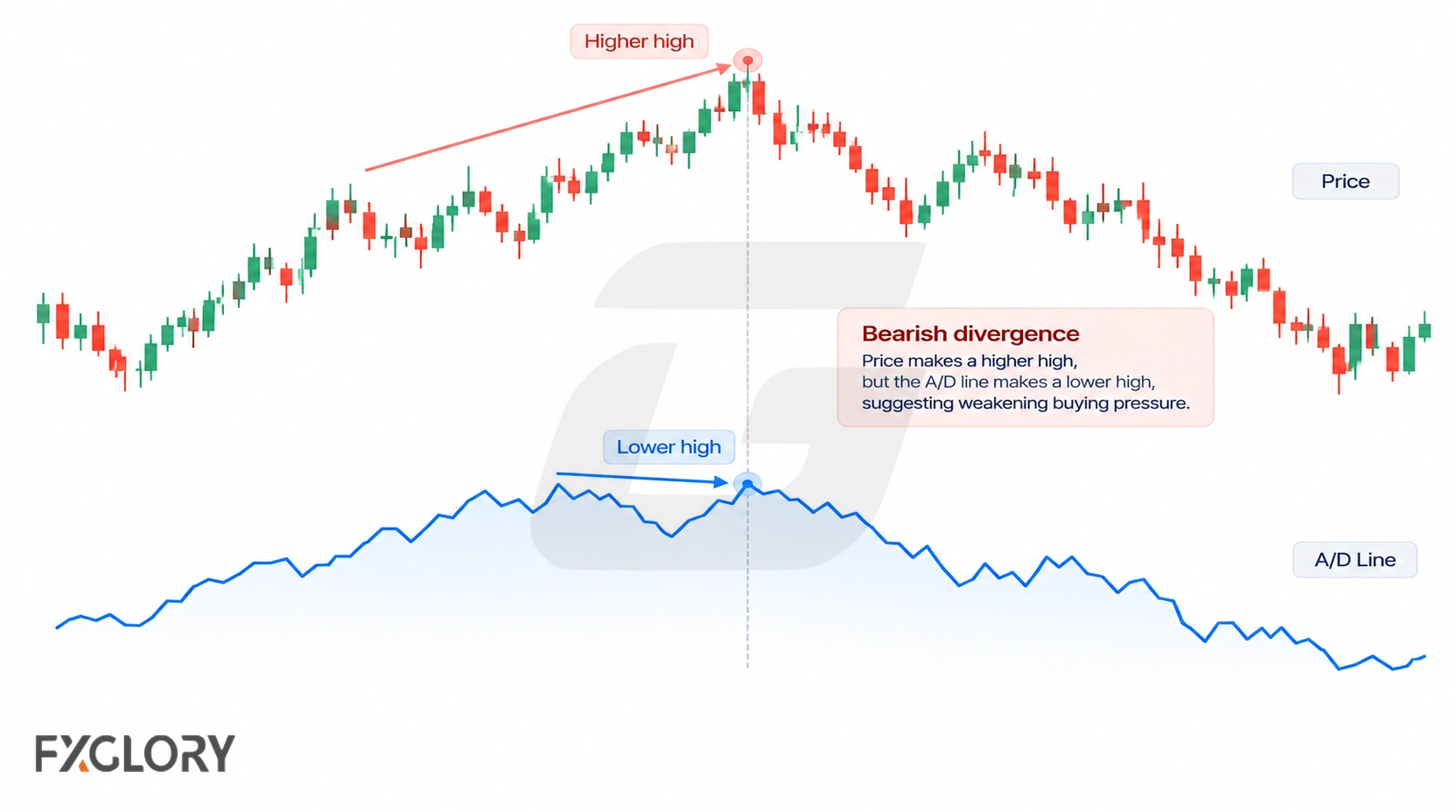
Bearish divergence occurs when price makes a higher swing high while A/D makes a lower high. Bullish divergence occurs when price makes a lower swing low while A/D makes a higher low. Compare identifiable swing points rather than unrelated bars.
Divergence is an observation, not reversal confirmation. In a strong trend it can persist or disappear as the cumulative series changes. Check whether price actually reacts at a meaningful level before applying a strategy’s entry and invalidation rules. For additional context, see support and resistance zones.
A/D in Trending Markets vs Ranging Markets
The same A/D movement has different implications depending on whether price is ranging or trending. A disagreement near a well-defined range boundary presents a different chart question from a disagreement during a persistent trend. Use the table to separate these settings rather than treating every divergence alike.
| Market condition | A/D behavior | Main risk |
|---|---|---|
| Quiet range | A/D may flatten or move noisily | Treating small A/D shifts as meaningful pressure |
| Active range | A/D may diverge near range edges | Assuming divergence means immediate reversal |
| Strong uptrend | A/D may rise with price or pause during pullbacks | Calling reversal too early from one A/D disagreement |
| Strong downtrend | A/D may fall with price or pause during pullbacks | Buying too early from one A/D disagreement |
| News volatility | A/D can spike or distort sharply | Confusing event-driven candle behavior with clean pressure |
A/D vs OBV, MFI, VWAP, and Chaikin Tools
Indicators called “volume tools” do not necessarily measure the same thing. On-Balance Volume (OBV) signs a bar’s volume by the change from the previous close, whereas A/D uses the position of the current close inside its high-low range. Money Flow Index (MFI) is a bounded oscillator. The table summarises other distinct functions.
| Tool | Main job | Difference from A/D |
|---|---|---|
| A/D Line | Cumulative close-location and volume-flow review | Uses where price closes inside the candle range |
| OBV | Cumulative volume-pressure review from close direction | Adds/subtracts volume based on higher or lower close versus previous close |
| MFI | 0–100 price-volume oscillator | Bounded oscillator, not a cumulative close-location line |
| VWAP | Volume-weighted average price reference | Price-location benchmark, not cumulative pressure line |
| Chaikin Oscillator | Momentum-style reading based on A/D behavior | Separate tool; do not treat it as the same as the A/D Line |
| Volume Profile | Available activity by price area | Distribution-style view, not a rising/falling cumulative line |
How to Use the A/D Line in Forex Without Treating It as a Signal
A practical workflow should identify the specific question A/D is meant to answer, then define what would change the interpretation.
- Fix the input: Record the broker, instrument, timeframe and type of volume.
- Choose the observation: Compare A/D with matching price swings or examine an unusual bar contribution.
- Locate price: Mark the relevant range boundary, swing, breakout or other structural level.
- Define the decision rule: Specify the price event required for action and the level that invalidates the setup.
- Plan trade risk separately: Set the stop by the method’s invalidation logic, then size the position using stop distance, instrument value and account-risk limit.
Market Chart-Review Examples
Illustrative chart-review prompts, not verified live A/D signals: These links lead to market pages where a reader may examine price context. The questions do not assert that any listed divergence, range or volume distortion is occurring now. Some pages may not display an A/D indicator or comparable volume feed.
| Market page | A/D question | Context to check |
|---|---|---|
| EUR/CHF live chart | Is A/D flat or noisy inside a quiet range? | Range boundaries, tick-volume quality, and support/resistance |
| EUR/GBP live chart | Is A/D divergence appearing near a range boundary? | Price location, candle closes, structure reaction, and false reversal risk |
| GBP/USD live chart | Is A/D moving with directional price pressure? | Trend context, candle closes, structure reaction, and follow-through |
| Gold live chart | Is A/D distorted during event-sensitive volatility? | News risk, candle range, volatility, and support/resistance distance |
| BTC/USD live chart | Is platform-volume sensitivity distorting the A/D Line? | Data source, spread, execution conditions, and structure clarity |
Custom A/D Indicator Caution
Custom A/D dashboards and divergence alerts may use modified formulas or different feeds. Before relying on labels, verify the underlying calculation, the volume input, whether alerts are issued at candle close, and whether historical markers change when new bars arrive. A backfilled divergence marker is not necessarily a signal that was available in real time.
A/D Line False-Signal Filters
Use the diagnostic table to investigate apparently persuasive signals. Prioritise feed inconsistencies, unusual candle ranges, one-off spikes and price behaviour that fails to follow through; avoid treating the table as ten separate requirements for every trade.
| Filter | Problem it catches | What to check |
|---|---|---|
| Tick-volume-source filter | A/D treated as if it uses full centralized forex volume | Data source, platform context, and recent activity history |
| Close-location-overread filter | Close near high or low treated as proof of buying or selling control | Candle range, wick behavior, spread, and follow-through |
| Spike-distortion filter | One abnormal candle or volume period shifts the cumulative line | News, session, spread, and platform feed behavior |
| Range-whipsaw filter | A/D shifts repeatedly inside sideways movement | Range condition, timeframe, and volume quality |
| News-volatility filter | A/D jumps because of event-driven movement | News risk, spread behavior, and liquidity conditions |
How to Test the A/D Line in Forex
Testing should determine whether A/D adds information to a specified price-based setup, not whether it happens to look persuasive on selected charts. Fix the rules before examining results and keep comparisons on a consistent feed.
- Specify the hypothesis: For example, define exactly what constitutes bullish divergence at a range boundary.
- Fix the sample: Document instrument, broker/feed, timeframe, dates, sessions and market regime.
- Write executable rules: Define swing identification, signal timing, price entry, stop, exit and sizing without hindsight.
- Account for implementation: Include spreads, slippage and holding costs where relevant; distinguish completed-bar signals from intrabar alerts.
- Record outcomes: Log signal count, results, drawdown, failures and conditions where the indicator added or failed to add information.
- Validate separately: Compare with a price-only baseline and assess out-of-sample periods or a second feed where possible.
No performance results are asserted here; these are procedural testing recommendations.