

What Are Forex Entry And Exit Indicators?
Forex entry and exit indicators are technical tools used to review trade timing and trade management. Before entry, they may help assess trend, momentum, volatility, price location, or confirmation. After entry, they may help assess exhaustion, trend failure, trailing conditions, target realism, or changed market behavior.
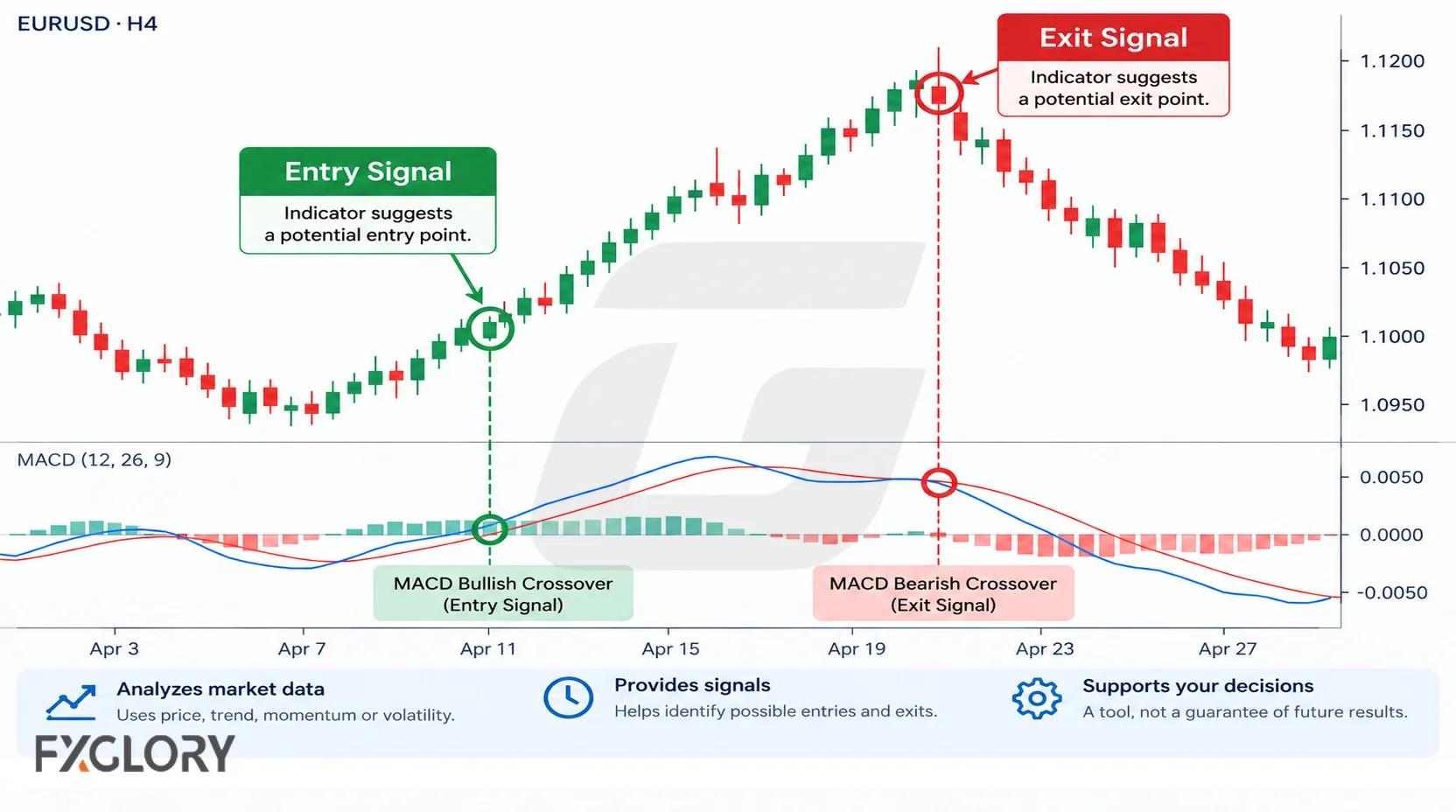
An indicator should not replace the trade plan. The trade still needs setup context, an entry trigger, invalidation, stop-loss logic, target or exit rules, spread checks, and risk planning. If those are missing, the indicator reading does not make the trade complete.
This page is about indicator-assisted timing and exit review. For the full setup-to-close workflow, use the entry-to-exit rule chain. For dedicated exit methods, use the stop, target, trailing, partial, and time-exit guide. For broader indicator mechanics, use the forex technical indicators guide.
Entry Indicator vs Exit Indicator
The same tool can inform both stages of a trade, but its entry and exit functions should be specified in the plan. Its role may change or remain a continuing context check. For example, a moving average may define trend context before entry and later warn that structure is weakening; RSI may help assess momentum before entry and later warn of exhaustion.
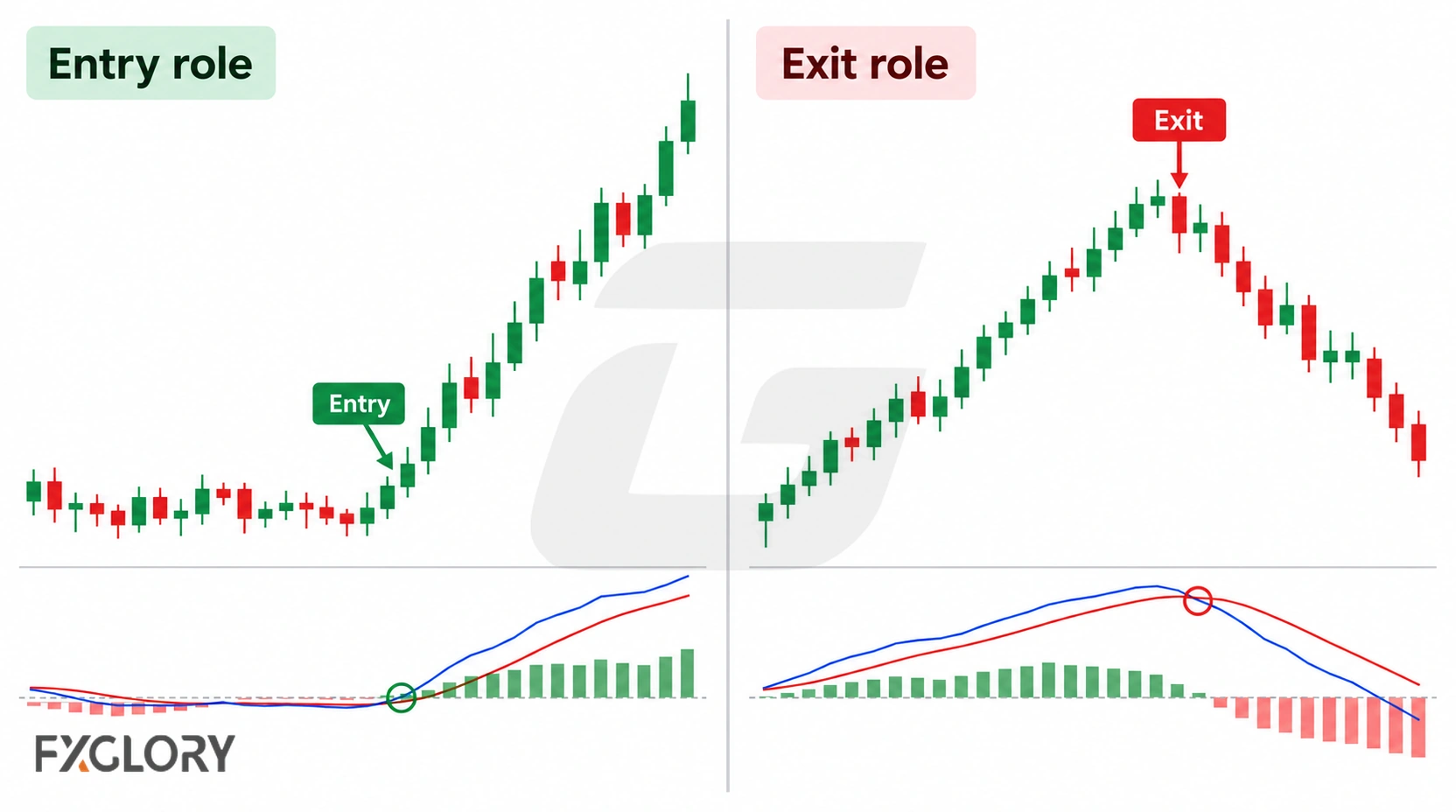
| Indicator | Entry Role | Exit Role | Weak Use |
|---|---|---|---|
| Moving average | Trend direction, slope, pullback area, price position | Trend failure, close beyond average, trailing context | Entering or exiting every crossover without context |
| RSI | Momentum, divergence, overextension, reversal context | Momentum exhaustion, failed continuation, divergence review | Buying or selling every RSI level touch |
| ATR | Volatility and stop-distance review before entry | Trailing distance, target realism, abnormal movement review | Using ATR as a buy or sell signal |
| ADX | Trend-strength review before trend entries | Strength fade, weak-trend warning, continuation review | Using ADX as direction by itself |
| Bollinger Bands | Price location, range reaction, volatility compression | Band-walk failure, squeeze release, range reaction review | Closing or entering every band touch automatically |
Indicator vs Strategy
An indicator gives information. A strategy defines action. That difference prevents every signal from becoming a trade instruction.
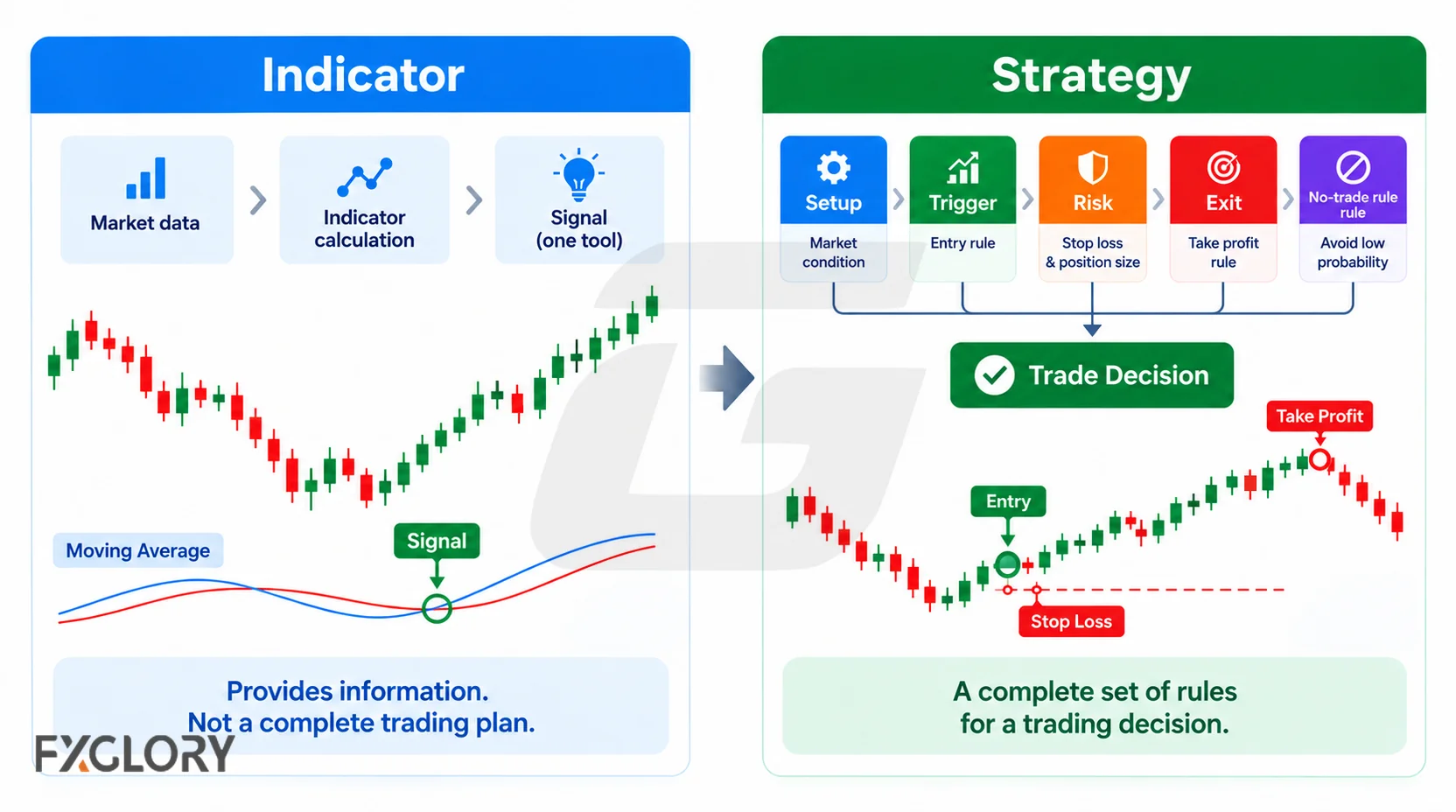
| Item | What It Does | Example | Main Risk |
|---|---|---|---|
| Indicator | Shows a condition that may require review | RSI divergence, ATR expansion, ADX weakening, moving-average break | The trader treats the reading as a full strategy |
| Entry rule | Defines what must happen before opening a trade | Enter only after price reacts at the planned level with the planned confirmation | Entry is taken from an isolated signal |
| Exit rule | Defines what happens after the indicator condition appears | Close, trail, reduce, wait for confirmation, or do nothing | The rule is invented after the trade is open |
| Review rule | Records whether the indicator helped or conflicted | Note whether the indicator supported price context or contradicted it | The trade is judged only by profit or loss |
For role planning before using any tool, review the indicator-strategy framework.
Signal vs Invalidation
A signal is a condition that may require action or review. Invalidation is the point where the trade idea is no longer valid. They can overlap, but they are not the same.
For example, RSI may show fading momentum while price still holds structure. ADX may weaken while the target is still not reached. ATR may expand while the setup remains valid but needs a volatility review. The trade plan should define which condition has priority.
| Situation | Indicator Reading | Price Context | Better Response |
|---|---|---|---|
| Momentum slows | RSI divergence or MACD histogram weakness | Price still holds structure | Review, trail, or wait for the planned confirmation |
| Trend weakens | ADX declines or moving-average slope flattens | Price approaches target or loses structure | Use the written trend-exit or trailing rule |
| Volatility expands | ATR rises or Bollinger Bands widen | Spread and stop distance may change | Review stop distance, target realism, and event risk |
| Price hits a level | Indicator confirms exhaustion | Support, resistance, Fibonacci, or pivot area is reached | Use the planned target or partial-exit rule |
| Signals conflict | RSI suggests exhaustion, ADX still shows strength | Trend structure remains intact | Follow the prewritten priority rule |
Forex Entry And Exit Indicators By Role
The useful question is not which indicator is best. The useful question is what timing or review problem the indicator is supposed to solve.
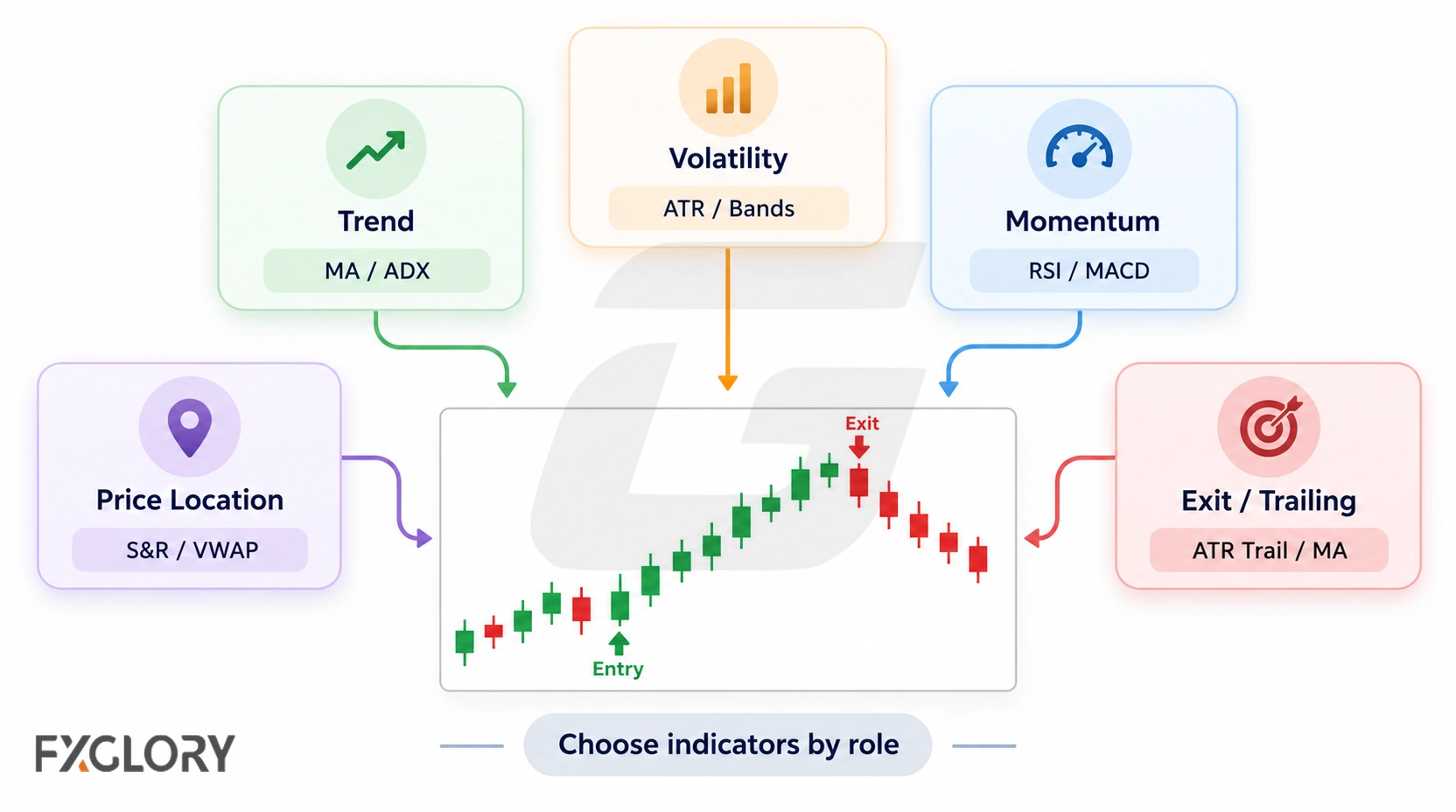
| Problem | Indicators And Price-Context Tools | What They Can Help Review | What They Cannot Replace |
|---|---|---|---|
| Trend direction and strength before entry | Moving average and MACD for directional context; ADX for strength | Direction or momentum from the selected tools, with ADX measuring strength rather than direction | Entry trigger and invalidation |
| Momentum may be stretched | RSI, Stochastic, MACD | Overextension, divergence, failed continuation | Price structure and planned target |
| Volatility changed | ATR, Bollinger Band width | Stop distance, target realism, abnormal movement | Direction and trade validity |
| Trade needs a trailing reference | ATR, Parabolic SAR, moving average | Where a trailing reference may sit | Position size and risk plan |
| Price reaches a reaction zone | Support, resistance, Fibonacci, pivot area | Entry zone, target, partial exit, or reversal review | Execution and spread checks |
| Signals conflict | Higher-timeframe context and role priority | Which signal matters more for this setup | A written trade plan |
Moving Average Entry And Exit Support
Moving averages can help before entry when the trade needs trend direction, slope, price-position context, or a pullback reference. They can help after entry when price closes beyond a selected average, the slope flattens, the trend structure weakens, or a trailing reference is needed.
A moving-average signal is weaker in choppy conditions. Price may cross the average repeatedly without creating a clean timing or exit decision. The rule should define which average matters, what type of close counts, and whether confirmation is required.
| Moving Average Condition | Entry Use | Exit Use | Main Risk |
|---|---|---|---|
| Price holds above or below the average | Trend-location context | Review whether trend context still holds | Treating location as a signal by itself |
| Average slope supports direction | Trend-quality review before entry | Review trend fatigue if slope flattens | Late reaction after price has moved |
| Pullback reacts near the average | Possible pullback timing reference | Exit if the pullback structure fails | Entering every touch of the average |
| Fast average crosses slow average | Possible trend-shift confirmation | Review possible trend failure | Too many signals on lower timeframes |
For mechanics, use moving-average behavior and settings context. For strategy use, review moving averages as strategy tools.
RSI Entry And Exit Support
RSI can help when the question is about momentum. Before entry, it may help review overextension, divergence, reversal context, or failed continuation. After entry, it may warn of exhaustion, divergence near a target area, or weakening continuation.
RSI should not force an entry or exit every time it reaches an overbought or oversold zone. In a strong trend, RSI can stay elevated or depressed while price continues moving.
| RSI Condition | Entry Use | Exit Use | Main Risk |
|---|---|---|---|
| RSI divergence | Review possible reversal or momentum shift | Review profit protection or exhaustion | Calling reversal too early |
| RSI reaches extreme zone | Review overextension before entry | Review target area or partial exit condition | Trading every level touch |
| RSI fails to confirm price high or low | Review momentum quality | Review failed continuation | Ignoring price structure |
| RSI resets during a trend | Review pullback quality | Review whether momentum still fits the trade | Using one RSI level for every market |
For mechanics, use RSI reading and calculation context. For strategy use, review RSI as a momentum strategy tool.
ATR Entry And Exit Support
ATR helps with volatility review. Before entry, it can check whether the stop distance and target are realistic for recent movement. After entry, it can provide context for trailing distance, target realism, abnormal movement, and volatility-adjusted management.
ATR does not show trade direction. It should inform the plan; it should not become the reason to enter, stay in, or close a trade without price context.
| ATR Use | Entry Question | Exit Question | Main Risk |
|---|---|---|---|
| ATR stop review | Does the planned stop fit current movement? | Does changed volatility trigger the predefined trailing, reduction, or exit review without increasing the original account-risk limit? | Widening an existing stop automatically when ATR rises |
| ATR target review | Is the target realistic after recent movement? | Does the target still fit current movement? | Using oversized targets in low movement |
| ATR trailing review | Is this setup suitable for trailing after entry? | How much room does the trade need? | Changing trailing distance emotionally |
| ATR abnormal-move review | Is volatility too low, too high, or event-driven? | Should spread, stop distance, or event risk be reviewed? | Ignoring changing trade conditions |
For mechanics, use ATR volatility-measurement context. For dedicated trailing rules, use ATR trailing-stop logic.
ADX Entry And Exit Support
ADX can help when the trade depends on trend strength. Before entry, it can review whether a trend strategy has enough strength context. After entry, it can review whether strength is fading, still developing, or unclear.
ADX does not show direction by itself. Direction still needs price context, +DI and −DI behavior where relevant, or another defined rule.
| ADX Condition | Entry Use | Exit Use | Main Risk |
|---|---|---|---|
| ADX rises | Review whether trend strength is developing | Review whether trailing may fit better than fixed exit | Assuming ADX gives direction |
| ADX declines | Review whether a new trend entry is weak | Review trend-strength fade or profit protection | Exiting before price confirms weakness |
| ADX is low or flat | Review whether range logic is more suitable | Review whether trend trade still fits | Forcing trend logic into a range |
| +DI and −DI shift | Review directional pressure | Review change in pressure after entry | Treating DI shifts as automatic trades |
For mechanics, use ADX trend-strength context.
Bollinger Band Entry And Exit Support
Bollinger Bands can help review price location, range reaction, volatility compression, expansion, and band-walk behavior. Before entry, they may show whether price is near a range boundary, inside compression, or expanding from a squeeze. After entry, they may help review continuation, failure, or exhaustion.
A band touch alone should not become an automatic entry or exit. In a strong move, price can walk the band. In a range, outer-band reactions may matter more. The plan should define the market condition before assigning meaning to the band.
| Bollinger Condition | Entry Use | Exit Use | Main Risk |
|---|---|---|---|
| Price rejects outer band in a range | Review range reaction setup | Review target, partial exit, or reversal pressure | Assuming every band touch reverses |
| Bands contract | Review compression before breakout | Prepare for changed movement conditions | Entering before a trigger exists |
| Bands expand | Review breakout movement | Review target realism and trailing distance | Chasing after expansion is already extended |
| Band walk continues or fails | Review trend continuation quality | Support hold, trail, or exit review | Closing too early on the first touch |
For mechanics, use Bollinger Bands mechanics and settings context.
MACD And Stochastic Entry And Exit Support
MACD and Stochastic can help when the question is about momentum, reversal pressure, or trend-quality change. They should be used with the original trade idea, not added after entry to avoid a planned exit.
| Tool | Entry Use | Exit Use | Main Risk |
|---|---|---|---|
| MACD | Momentum shift, trend-quality review, crossover context | Histogram fade, momentum loss, possible trend change | Late signal after price has moved |
| Stochastic | Overextension, reversal context, range timing | Momentum exhaustion or reversal review | Too many signals in trends |
| Divergence | Possible weakening of current move | Profit-protection or target review | Calling reversal before structure changes |
| Momentum loss | Review whether entry timing is late | Review whether open profit needs protection | Closing or entering without invalidation logic |
For broader indicator categories, including momentum, volatility, trend, and trailing-style tools, use the forex technical indicators guide.
Parabolic SAR And Trailing Exit Support
Parabolic SAR is mostly useful as a trailing-style reference. It can help review possible trend shift, stop movement, or management conditions after price has moved.
Parabolic SAR can flip quickly in choppy markets. The plan should define whether the dot flip closes the trade, moves a stop, triggers review, or is ignored unless price structure confirms it.
| Trailing Tool | Exit Role | Useful When | Weak When |
|---|---|---|---|
| Parabolic SAR | Trailing-style reference or trend-shift review | Price trends clearly and the plan accepts trailing exits | Market is choppy or range-bound |
| ATR trail | Volatility-adjusted trailing distance | Movement size changes during the trade | Multiplier is untested |
| Moving average trail | Trend-location reference | Trade depends on price holding trend structure | Average is repeatedly crossed |
| Structure trail | Swing-high or swing-low reference | Price forms clean structure | Structure is too wide for account risk |
Support, Resistance, Fibonacci, And Price-Structure Support
Some traders group structure tools with indicator-based timing, but support, resistance, Fibonacci, and swing levels are better treated as price-context tools rather than formula-based indicators.
These tools can help define entry zones, invalidation areas, target locations, and review points. They work best when marked before entry. Drawing a new level after the trade is open can make the exit harder to review.
| Structure Tool | Entry Use | Exit Use | Main Risk |
|---|---|---|---|
| Support and resistance | Entry zone, breakout area, retest area | Target, invalidation, range exit, retest failure | Levels are moved after entry |
| Fibonacci area | Pullback or reaction-zone review | Target or reaction-zone review | Treating the level as guaranteed |
| Previous swing high or low | Breakout or pullback reference | Target or structure trail | Using minor swings without a plan |
| Pivot area | Intraday reaction-zone review | Short-term target or exit review | Ignoring spread and session conditions |
For structure planning, use support and resistance context.
How To Combine Entry And Exit Indicators Without Stacking Noise
Combining indicators can help only when each tool has a different job. If three indicators all measure similar momentum, the trader may get repeated versions of the same signal instead of clearer timing.
The plan should define role and priority before entry. For example, ATR may review movement size, RSI may review momentum, and support or resistance may define the target area. If they conflict, the plan should say which rule controls the decision.
| Combination | Role Split | Useful When | Weak Version |
|---|---|---|---|
| MA + ADX | MA reviews trend location; ADX reviews trend strength | Trend entry or trend-exit needs both location and strength context | Signals conflict with no priority rule |
| RSI + resistance | RSI reviews momentum; resistance defines reaction area | A long trade approaches a planned target zone | RSI alone closes the trade |
| ATR + structure | ATR reviews movement size; structure defines invalidation or target | Stop and target distance need volatility context | ATR replaces price structure |
| Bollinger + ATR | Bands review price location; ATR reviews movement size | Volatility expansion affects entry or exit distance | Both tools are used as standalone signals |
For role-based pairing, use the indicator-combination framework.
Indicators By Setup Type
The same indicator should not be used the same way in every setup. A breakout, range trade, trend pullback, and day trade each need different indicator roles.
| Setup Type | Entry Role | Exit Role | Skip Or Reduce Use If |
|---|---|---|---|
| Trend pullback | Moving average, ADX, RSI, structure | Moving average, ADX, ATR, RSI | Price breaks trend structure |
| Breakout | ATR, Bollinger Bands, ADX, structure | ATR, Bollinger Bands, ADX, retest structure | Price returns inside the old range |
| Range trade | RSI, Stochastic, Bollinger Bands, support/resistance | RSI, Stochastic, Bollinger Bands, opposite boundary | Range is breaking instead of reacting |
| Trailing trend trade | Moving average, ADX, structure | ATR trail, moving average, Parabolic SAR | Market becomes choppy |
| Day-trading setup | ATR, moving average, RSI, session levels | ATR, moving average, RSI, no-progress rule | Exit would require holding beyond the planned session |
For full setup construction, use context, trigger, invalidation, exit, and review rules.
Indicators By Trading Style
Trading style changes how much indicator delay the trade can tolerate. A lower-timeframe trade may not have room for a late signal. A higher-timeframe trade may need more confirmation before closing.
| Trading Style | Entry Indicator Need | Exit Indicator Need | Main Check |
|---|---|---|---|
| Scalping | Fast context near a planned level | Fast review with cost awareness | Spread compared with expected move |
| Day trading | Session-aware setup and trigger support | Session-aware exit support | Whether the trade fits the planned session |
| Swing trading | Structure and trend-quality review | Structure, trend, and volatility review | Stop distance and margin exposure |
| Position trading | Broad trend and location review | Broad trend and periodic review | Whether the indicator is too sensitive for the timeframe |
Before using short-target indicator signals, review FXGlory spreads. When stop distance affects exposure, use the FXGlory margin calculator.
Common Forex Entry And Exit Indicator Mistakes
- Using an indicator as the whole strategy: The indicator gives information, but the strategy decides the action.
- Adding indicators after entry: A new tool is added only because the original exit feels uncomfortable.
- Stacking similar signals: Multiple momentum tools repeat the same information without making the decision clearer.
- No priority rule: RSI, ADX, and price structure conflict, but the trader has no rule for which matters most.
- Ignoring invalidation: The indicator changes before the original trade idea is actually wrong.
- Ignoring spread: A small-target entry or exit becomes weak after trading cost.
- Using slow signals for fast trades: The indicator reacts too late for the trade style.
- Using fast signals for slow trades: The indicator exits too often before the higher-timeframe setup develops.
- Expecting one best indicator: The useful tool depends on setup type, timeframe, volatility, and risk plan.
- No review notes: The trader cannot tell whether the indicator helped, conflicted, or caused a poor decision.
Forex Entry And Exit Indicator Checklist
Before using a forex entry or exit indicator, answer these questions.
- What problem is the indicator supposed to help solve?
- Is the indicator reviewing trend, momentum, volatility, price location, or trailing distance?
- Is the indicator being used before entry, after entry, or both?
- What is the original setup context?
- What is the entry trigger?
- What is the invalidation point?
- What is the planned stop-loss rule?
- What target, trailing, partial, or time-based exit rule already exists?
- Will the indicator trigger action, trigger review, or only provide context?
- What happens if the indicator conflicts with price structure?
- What happens if two indicators conflict with each other?
- Does the indicator react fast enough for the trading style?
- Does the expected move still make sense after spread?
- Does stop distance fit position size, leverage exposure, and margin?
- Can the indicator rule be reviewed later from written notes?